K-MY BILLIONAIRE HUSBAND WAS ASHAMED OF MY SIMPLE GREEN DRESS—UNTIL THE WOMAN HE CALLED ORDINARY HELD HIS ENTIRE FUTURE IN HER HANDS
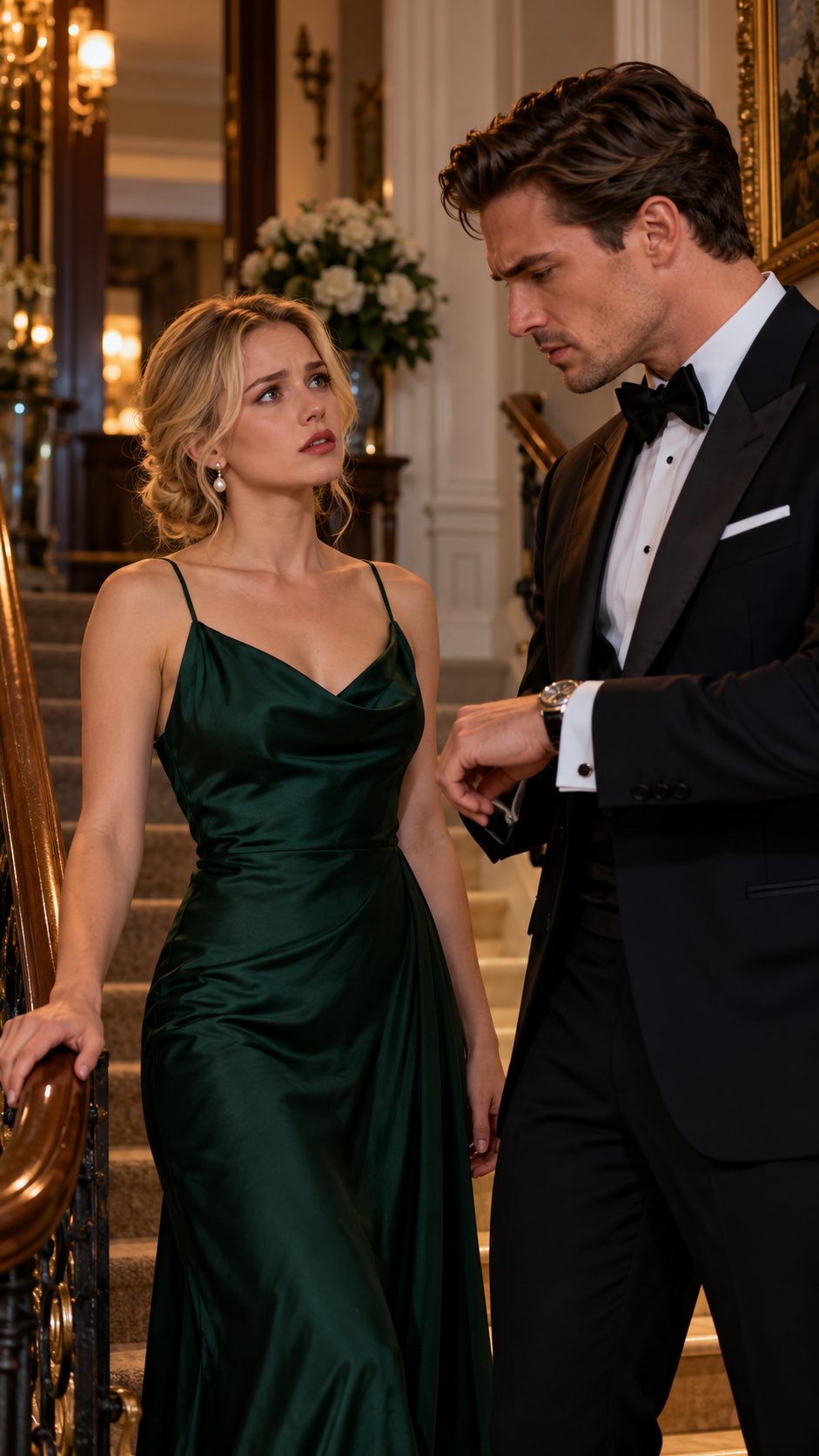
*He wanted a wife who belonged among Chicago’s most powerful people.
He never realized that the woman he had spent years overlooking was the one person who could change everything.*
**CHAPTER 1:THE WOMAN BEHIND THE CURTAIN**
Grant Whitmore knew his wife had chosen the wrong dress before she finished walking down the stairs.
He didn’t say it immediately.
That was worse.
Anna Whitmore descended the staircase of their renovated Chicago brownstone wearing a dark-green silk dress, simple heels, and pearl earrings that had belonged to her mother.
Her blonde hair was pinned loosely behind her head.
Nothing glittered.
Nothing announced wealth.
She looked beautiful in the quiet, unforced way Grant had once loved.
Now he looked disappointed.
“You’re wearing that?”
Anna stopped on the final stair.
“I was planning to.”
“The Alder Row dinner is tonight.”
“Everyone important will be there.”
“I know that too.”
Grant adjusted the cuff of his black tuxedo.
“It’s just a little simple.”
Anna glanced down.
“That isn’t funny tonight.”
Her smile disappeared.
Grant approached and straightened one of the thin straps of her dress.
Graham Pierce will be there.
The investment committee will be there.
These people decide whether I become senior partner next spring.”
“I understand.”
“Then stay close to me.
And please don’t get pulled into conversations about the neighborhood center.”
Anna looked up.
“You mean my work?”
“The volunteer thing.”
“It isn’t volunteer work, Grant.
I run Harbor House five days a week.”
“Nobody needs a lecture about underfunded schools and children painting murals.”
Anna stared at him.
She had spent twelve years supporting his ambitions.
When he was broke, she paid rent.
When he needed a suit, she helped buy one.
When he was terrified before his first interview, she stayed awake until two in the morning helping him rehearse.
Now he seemed embarrassed by everything that reminded him of where they had begun.
Grant kissed her forehead.
We’re late.”
The kiss felt less like affection than the end of an argument.
By the time they arrived at the hotel, Grant had become someone else.
Perfectly polished.
The ballroom shimmered beneath enormous chandeliers.
Champagne traveled through the room on silver trays.
Chicago’s most influential investors mingled beneath towering arrangements of white roses.
Grant spotted Graham Pierce immediately.
Beside him stood Celeste Harrow.
Thirty-three.
Recently appointed director of corporate affairs at Alder Row Capital.
Celeste wore a champagne-colored designer gown that caught the light whenever she moved.
She noticed Grant.
Her expression brightened.
His did too.
“I need five minutes,” Grant murmured.
“You just told me to stay close.”
“Socially close, Anna.”
He was already walking away.
“Find our table.”
Anna stood alone.
For the next ninety minutes, Grant barely acknowledged her.
She ate beside strangers.
Answered questions about her marriage.
Explained her work at Harbor House.
One woman smiled politely.
“How sweet.”
Anna knew what that meant.
Unimportant.
Not worth asking another question.
Across the ballroom, Celeste touched Grant’s arm.
He leaned closer.
They laughed together.
Anna looked away.
It wasn’t jealousy that hurt most.
It was the realization that Grant had never looked at her with that kind of admiration in years.
Eventually, she slipped toward the terrace.
Before reaching the doors, she heard Graham Pierce speaking behind a heavy velvet curtain.
“You’re close, Grant.
Very close.”
“To senior partner?”
“If the redevelopment portfolio closes before January.”
“There’s one concern.”
A silence followed.
Then Grant said quietly:
Her fingers tightened around her champagne glass.
Graham gave a dry laugh.
“You said it, not me.”
“She isn’t involved in the firm.”
“At this level, everything is involved in the firm.”
Anna stopped breathing.
Graham continued.
“People notice spouses.
They read a man’s home life as part of the prospectus.”
“Celeste understands these rooms.”
A longer silence followed.
Then Grant whispered:
“That’s part of the problem.”
Graham asked:
Anna waited.
She should have walked away.
Instead, she remained perfectly still.
And when her husband finally answered, every year she had spent believing in their marriage began to feel like a cruel misunderstanding.
“Anna reminds people of the man I used to be.”
Graham said nothing.
Grant continued.
“And I don’t think that man belongs in this room anymore.”
Behind the curtain, Anna closed her eyes.
For the first time in twelve years, she wondered whether the marriage she had protected so fiercely was already over.
**CHAPTER 2:THE HUSBAND WHO FORGOT HIS BEGINNING**
Anna remained behind the curtain until the conversation ended.
She heard Graham tell Grant that senior partners needed spouses who understood the expectations of the institution.
She heard Celeste laugh softly when she joined them.
Then she heard Grant say something that hurt more than everything else.
“Anna is a good woman.
She’s just never wanted anything bigger.”
Anna gripped the curtain.
She wanted to step forward.
Wanted to tell him that running Harbor House required ambition.
That helping children whose families could not afford private lessons was not a small dream.
That she had once wanted to teach art in Florence.
That she had turned down a graduate fellowship because Grant received his first serious opportunity in Chicago.
But she stayed silent.
Not because she agreed.
Because suddenly she wanted to hear who her husband became when he believed she wasn’t listening.
Celeste spoke.
“Grant, don’t be too hard on yourself.”
Anna recognized her voice immediately.
Celeste continued.
“You’ve worked incredibly hard to belong here.”
“Sometimes people grow in different directions.”
Grant said nothing.
Graham cleared his throat.
“Let’s focus on closing the redevelopment portfolio.”
Footsteps moved away.
Anna waited another minute before emerging.
She found an empty corridor and leaned against the wall.
For years, Grant had described her as someone who preferred small things.
He forgot that she had once dreamed of studying abroad.
Forgot the exhibitions she wanted to organize.
Forgot that Harbor House had begun as a temporary project and grown into an organization serving hundreds of young people.
He had mistaken her decision to support his ambitions for an absence of ambition in herself.
Anna returned to the ballroom.
Grant was standing with Celeste.
He looked surprised to see her.
“Where have you been?”
“Getting some air.”
“You disappeared.”
Anna almost laughed.
For ninety minutes he had left her alone.
Now he sounded annoyed that she had briefly become unavailable.
“Are you ready to go?” she asked.
Grant glanced toward Graham.
His expression tightened.
“Anna, don’t start.”
She looked directly at him.
“I’m going home.”
Celeste stepped closer.
“Is everything okay?”
Anna smiled politely.
“Perfectly.”
The word sounded strange in her mouth.
She left before either could respond.
Outside, cold November air settled against her skin.
She ordered a car.
Then stood beneath the hotel’s covered entrance as traffic passed.
Her phone vibrated.
Where are you?
She answered.
Going home.
His reply appeared immediately.
You’re embarrassing me.
Anna looked at the message for a long time.
Then locked her phone.
At home, she changed into pajamas and sat on the edge of the bed.
She opened an old wooden box beneath her nightstand.
Inside were photographs from their first apartment.
Grant smiling in a borrowed suit.
Anna laughing over a plate of cheap pasta.
Their wedding beneath a tree covered in white flowers.
A handwritten note from their first anniversary.
I couldn’t have become anything without you.
Love, Grant.
Anna read the words twice.
Then placed the note back inside the box.
At nearly two in the morning, Grant returned.
He entered their bedroom without turning on the light.
She remained awake.
“I heard you left early.”
“That wasn’t a good look.”
Anna stared into the darkness.
“Neither was leaving your wife alone for ninety minutes.”
“Don’t exaggerate.”
“I checked the time.”
Grant removed his watch.
“Celeste was introducing me to people.”
“I noticed.”
“What’s that supposed to mean?”
Anna sat up.
“You’re jealous.”
She almost laughed.
“Grant, do you still love me?”
The question caught him off guard.
“Of course.”
“Then why do you seem ashamed of me?”
“Where is this coming from?”
“Answer me.”
Grant rubbed his forehead.
“Anna, I’ve had a long night.”
“So have I.”
He looked frustrated.
“Can we not make everything about feelings?”
Anna lowered her eyes.
Once, he had stayed awake listening to her talk about anything.
Now he treated her emotions like interruptions.
“Fine,” she whispered.
Grant switched off the lamp.
Within minutes, his breathing became steady.
Anna remained awake.
At four in the morning, she quietly opened her laptop.
She searched the redevelopment portfolio Grant had mentioned.
Several results appeared.
One project caught her attention.
A proposed commercial redevelopment near the neighborhood where Harbor House operated.
Anna read the address.
Then looked again.
The property boundaries included the old warehouse beside the community center.
The same warehouse Harbor House had been negotiating to purchase for its youth arts expansion.
Anna’s stomach tightened.
She opened another document.
Alder Row Capital was seeking approval for a major redevelopment plan.
And Harbor House appeared in the planning materials as a community facility that could be relocated.
Anna stared at the screen.
Grant had never mentioned it.
Suddenly, his embarrassment about her work looked less like ordinary snobbery.
It looked like something much worse.
**CHAPTER 3:THE COMMUNITY CENTER HE CALLED SMALL**
Harbor House occupied an old brick building on Chicago’s west side.
The roof needed repairs.
The heating system complained every winter.
The classrooms were decorated with mismatched furniture and brightly colored murals.
To wealthy donors, it looked modest.
To Anna, it was one of the most important places in the city.
Every weekday, children arrived after school to paint, read, learn music, and spend time with adults who believed their futures mattered.
Some came from families struggling financially.
Others simply needed somewhere safe to belong.
Anna knew most of them by name.
She knew which children loved charcoal pencils.
Which ones feared public speaking.
Which ones wanted to become teachers, architects, or musicians.
That morning, she arrived early.
Her program coordinator, Sofia Bennett, noticed something was wrong immediately.
“I’m fine.”
Sofia raised an eyebrow.
“That sounds suspicious.”
Anna attempted a smile.
Then placed a printed redevelopment map on the desk.
“Have you seen this?”
Sofia leaned closer.
Her expression changed.
“Where did you get it?”
“Public planning records.”
Sofia studied the map.
“The warehouse?”
Anna nodded.
“And possibly the center.”
Sofia sat down.
“But our expansion agreement—”
“Hasn’t been finalized.”
They had spent eighteen months developing plans to acquire the vacant warehouse next door.
It would provide studio space.
A small theater.
A computer lab.
Rooms where students could prepare portfolios for arts scholarships.
Several foundations had expressed interest in supporting the project.
But the final funding commitment had not yet arrived.
Now a much larger commercial development threatened everything.
Sofia looked worried.
“What do we do?”
Anna considered the question.
“We find out exactly what they’re planning.”
She contacted the city planning office.
Requested the relevant public documents.
Reviewed meeting agendas.
And arranged to speak with the legal clinic that advised Harbor House.
By afternoon, a more complicated picture emerged.
Alder Row’s proposed redevelopment would replace several aging commercial buildings with luxury apartments, office space, and retail.
The project could bring jobs and investment.
But the current plan had not adequately addressed the potential displacement of community programs.
Harbor House was one of them.
Anna felt sick.
Grant had repeatedly told her that her work was too small to discuss with his colleagues.
Meanwhile, his firm was developing a project that might force that work out of its neighborhood.
That evening, she confronted him.
Grant stood in his home office reviewing financial projections.
“Can we talk?”
He didn’t look up.
“About what?”
“The redevelopment portfolio.”
His typing stopped.
Anna placed the printed map on his desk.
“Why didn’t you tell me?”
Grant examined the document.
His face tightened.
“Where did you get this?”
“It’s public information.”
He leaned back.
“Anna, this is complicated.”
She almost smiled.
Those words again.
Always complicated when he didn’t want to answer.
“Does your project require Harbor House to relocate?”
“We’re reviewing several options.”
“Did you know?”
Grant hesitated.
That was enough.
Anna stared.
“You knew.”
“Nothing has been decided.”
“You knew this could affect the center.”
“Anna, developments involve tradeoffs.”
She looked at him.
“Children aren’t tradeoffs.”
His expression hardened.
“Don’t be dramatic.”
Anna closed her eyes.
When she opened them, her voice was steady.
“I’m not asking you to abandon the project.”
“Then what?”
“I’m asking you to recognize that the people living there deserve a real voice.”
Grant shook his head.
“Investment committees don’t operate on feelings.”
“Neither do responsible community agreements.”
He stared at her.
She continued.
“If the project is sound, it should withstand questions about displacement and public benefit.”
His jaw tightened.
“Are you threatening me?”
“Because you’re speaking like someone who wants to interfere with my career.”
Anna looked at the map.
“Your career isn’t the only thing that matters.”
Grant stepped back.
For a moment, she saw the young man who had once admired her conviction.
Then his expression closed.
“You have no idea what’s at stake.”
Anna picked up the document.
“Maybe that’s because you keep treating me like someone who shouldn’t know.”
She left his office.
The following morning, Harbor House received a letter from an investment group.
The organization was considering substantial funding for the warehouse expansion.
Anna opened the envelope with trembling hands.
The letter did not promise anything.
It requested financial statements, program outcomes, and a formal presentation.
But at the bottom was a familiar name.
A woman Anna hadn’t spoken to in almost ten years.
Margaret Vale.
Chairwoman of the Vale Family Foundation.
And one of the most influential private investors in Chicago.
Anna stared at the signature.
She had known Margaret long before Grant entered the world of elite finance.
But Margaret was more than a potential donor.
She was someone who knew exactly why Anna had once walked away from a promising career.
And her unexpected return was about to change everything.
**CHAPTER 4:THE WOMAN WHO REMEMBERED ANNA**
Margaret Vale was seventy-one and possessed the quiet confidence of someone who never needed to announce her importance.
Her family foundation supported education, historic preservation, and neighborhood development across several American cities.
The Vale family’s investment office also maintained relationships with prominent financial firms, including Alder Row Capital.
But Anna had not known Margaret through finance.
They met years earlier at an education conference in Milwaukee.
Anna was twenty-five and presenting a project about using public art to strengthen neighborhood communities.
Margaret attended the session.
Afterward, she approached Anna and asked dozens of questions.
They remained in contact for several years.
Margaret encouraged Anna to pursue graduate study.
She even offered to introduce her to a fellowship program in Florence.
Anna had been accepted.
Then Grant received a major opportunity in Chicago.
She chose to remain with him.
At the time, Margaret had been disappointed.
But she never criticized Anna.
She simply said:
“Promise me you won’t forget what you wanted.”
Now, almost ten years later, Anna sat across from Margaret in a quiet restaurant.
The older woman looked at her carefully.
“You’ve changed.”
Anna smiled.
Anna looked down.
Margaret reached for her hand.
“Tell me about Harbor House.”
For the next hour, Anna explained the programs, the students, the expansion plans, and the threatened redevelopment.
Margaret listened closely.
She asked precise questions about operating costs, governance, community demand, and long-term sustainability.
Anna answered each one.
When she finished, Margaret smiled.
“You’ve built something remarkable.”
Anna felt warmth spread through her chest.
“Thank you.”
Margaret leaned back.
“Why didn’t you tell me sooner?”
Anna hesitated.
“I didn’t want you to think I was using our friendship.”
Margaret laughed softly.
“Anna, asking someone to consider funding worthwhile work isn’t using them.”
She became serious.
“Good projects deserve scrutiny.
They also deserve a fair opportunity.”
Anna nodded.
Margaret opened a folder.
“The foundation can evaluate the warehouse expansion.
But there may be another option.”
Anna looked up.
“What option?”
Margaret pointed toward the redevelopment map.
“The Alder Row project.”
Anna went still.
Margaret continued.
“Large developments often require community partnerships.
Sometimes those partnerships are meaningful.
Sometimes they’re decorative.”
Anna nodded slowly.
Margaret studied her.
“Would you be willing to present the community’s needs directly to the investors?”
Anna hesitated.
“Grant works there.”
“He won’t like it.”
Margaret remained calm.
“That isn’t what I asked.”
Anna looked toward the window.
For years, she had arranged her choices around what Grant might dislike.
She chose her clothes carefully.
Avoided difficult conversations.
Declined invitations that made him uncomfortable.
And repeatedly apologized for wanting things of her own.
Now Margaret was offering her something she had almost forgotten.
A chance to be heard.
“Yes,” Anna said.
Margaret smiled.
Over the following week, Anna prepared a detailed presentation.
She included program outcomes.
Financial records.
Community feedback.
Potential relocation costs.
And alternative designs that might preserve Harbor House while allowing responsible redevelopment.
She did not frame the proposal as a battle between rich and poor.
She framed it as a planning problem that deserved a thoughtful solution.
Sofia helped gather data.
Parents submitted letters.
Students contributed drawings showing what the expanded center could become.
Anna worked late into the evenings.
For the first time in years, she felt energized instead of diminished.
Meanwhile, Grant became increasingly distant.
Celeste called more frequently.
Business dinners multiplied.
He often returned home after midnight.
One evening, Anna found him examining a new suit in the bedroom.
“Another event?”
“Investor presentation.”
She paused.
“For the redevelopment portfolio?”
Anna nodded.
Grant looked at her.
He frowned.
“You’re being strange.”
Anna almost laughed.
For years, he had been allowed private meetings and confidential conversations.
Now her silence bothered him.
“I’m working on something,” she said.
“A presentation.”
He smiled faintly.
“For the center?”
“That’s nice.”
The old dismissal.
That’s nice.
Anna said nothing.
Three days later, she received the formal invitation.
Alder Row’s investment committee would hear presentations from stakeholders connected to the proposed redevelopment.
Harbor House had been granted a place on the agenda.
Anna read the email.
Then checked the list of attendees.
Graham Pierce.
Celeste Harrow.
Grant Whitmore.
And several major institutional investors.
She exhaled.
For the first time in twelve years, she would enter one of Grant’s important meetings not as his wife.
But as someone whose work mattered independently of him.
What she didn’t know was that Graham Pierce had already been asking questions about her.
And the answers he was finding were beginning to concern him.
**CHAPTER 5:THE PRESENTATION HE NEVER EXPECTED**
The investment committee meeting took place on the seventeenth floor of Alder Row Capital’s headquarters.
Floor-to-ceiling windows overlooked the Chicago River.
A long polished table dominated the room.
Senior executives sat beside institutional investors and independent advisers.
Grant entered early.
He wore a dark navy suit.
Celeste approached carrying a leather portfolio.
“More than ready.”
The redevelopment project was his strongest opportunity to become senior partner.
He had spent months negotiating financing arrangements.
Coordinating external advisers.
Preparing detailed financial projections.
If the committee approved the next stage, his promotion would become significantly more likely.
Graham Pierce entered.
The room quieted.
Grant straightened.
Then the doors opened again.
And Anna walked inside.
She wore a tailored cream jacket over a dark-green dress.
Her blonde hair was neatly pinned.
Her mother’s pearl earrings rested against her neck.
Grant stared.
“What are you doing here?”
Anna met his eyes.
“Good morning, Grant.”
Celeste looked confused.
Graham stood.
Anna smiled politely.
“Thank you for inviting Harbor House.”
Grant turned toward Graham.
“Inviting?”
Graham looked at him.
“Your wife’s organization submitted a stakeholder presentation.”
Grant’s expression tightened.
“She’s not part of this transaction.”
Margaret Vale, seated near the far end of the table, raised an eyebrow.
“She’s part of the community the project affects.”
Grant went silent.
He had not realized Margaret would attend.
He certainly had not realized she knew Anna personally.
The meeting began.
Grant presented the financial case for redevelopment.
His projections were impressive.
The project promised new commercial space, residential development, and substantial investment.
Several investors asked questions.
Grant answered confidently.
Then Graham introduced Anna.
Whitmore, the floor is yours.”
Anna stood.
For a moment, she felt nervous.
Not because she doubted her work.
Because her husband was watching her from the other side of the table.
Twelve years of habit urged her to make herself smaller.
Then she remembered Margaret’s question.
Would you be willing to present the community’s needs?
Anna took a breath.
“Thank you.”
She began by describing Harbor House.
Its programs.
Its students.
Its partnerships with local schools.
She explained the proposed expansion and the potential impact of the redevelopment plan.
Then she presented an alternative.
Rather than forcing Harbor House to relocate, the development could incorporate the existing center and adjacent warehouse into a mixed-use community space.
The proposal would require design changes.
But it could preserve valuable local infrastructure while supporting the larger commercial project.
Anna did not pretend the alternative was free.
She showed estimated costs.
Potential benefits.
Operational risks.
And areas requiring independent verification.
One investor leaned forward.
“Who prepared your financial model?”
Anna answered.
“I did, with assistance from our advisers.”
Grant looked up sharply.
The investor nodded.
“Your assumptions are conservative.”
“I prefer plans that survive difficult years.”
Several people smiled.
Grant didn’t.
Another committee member asked about community engagement.
Anna explained the outreach process.
She showed survey responses.
Letters from families.
Examples of student work.
Then she concluded.
“Development is not inherently harmful.
But development without meaningful community consideration can destroy things whose value doesn’t appear in a conventional spreadsheet.”
The room became quiet.
Anna continued.
“I am not asking you to choose between economic growth and children.”
She paused.
“I’m asking you to consider whether responsible planning can protect both.”
When she finished, several committee members applauded.
Margaret smiled.
Graham leaned forward.
Whitmore, that was an excellent presentation.”
Anna nodded.
“Thank you.”
He continued.
“I’d like our development team to evaluate your alternative.”
Grant’s expression changed.
“That could delay the project.”
Graham looked at him.
“Then we should understand the delay.”
Grant said nothing.
Celeste glanced toward Anna.
For the first time, her polished expression faltered.
After the meeting, Anna gathered her documents.
Grant approached.
“What was that?”
She looked at him.
“A presentation.”
“You could have warned me.”
“I could have.”
His jaw tightened.
“Why didn’t you?”
Anna considered the question.
Then answered quietly.
“Because you’ve spent two years telling me my work doesn’t belong in your world.”
Grant stared at her.
She continued.
“Today, the committee disagreed.”
Before he could respond, Margaret approached.
“Anna, you were wonderful.”
Anna smiled.
“Thank you.”
Margaret looked toward Grant.
Then back at Anna.
“The foundation would like to move forward with a formal review of your expansion proposal.”
Anna’s eyes filled.
For a moment, she forgot Grant was standing there.
She embraced Margaret.
Then laughed through tears.
Across the corridor, Celeste watched.
And Graham Pierce, who had joined them quietly, turned toward Grant.
“Your wife is impressive.”
Grant swallowed.
Graham studied him.
Then said something Grant had never expected to hear.
“I think we’ve been overlooking the wrong person.”
**CHAPTER 6:THE PRICE OF BECOMING SOMEONE ELSE**
Grant spent the following week replaying the investment committee meeting in his mind.
Anna standing before the investors.
Her confidence.
Her precise answers.
The way Graham listened.
The respect in Margaret Vale’s expression.
Grant had watched strangers recognize qualities he once admired in his wife.
And instead of feeling proud, he had felt threatened.
That realization unsettled him.
At home, Anna became less available.
She worked late at Harbor House.
Attended meetings.
Spoke with architects and advisers.
She no longer waited for Grant to return before eating dinner.
She no longer asked whether he needed her to attend every social event.
And she stopped apologizing for having priorities of her own.
Grant noticed everything.
One evening, he found her packing documents into a leather bag.
“Going somewhere?”
“Meeting with the architects.”
He leaned against the doorway.
“You’ve been busy.”
Anna smiled faintly.
For a moment, Grant wanted to complain.
Then he remembered the committee meeting.
He swallowed the words.
“How’s the proposal going?”
Anna looked surprised.
The conversation ended awkwardly.
But it was the first time in months he had asked about her work without dismissing it.
A few days later, Celeste entered Grant’s office.
She looked irritated.
“Graham wants another review of the redevelopment plans.”
Grant nodded.
“This could delay the portfolio.”
“Possibly.”
Celeste crossed her arms.
“Anna’s making things difficult.”
Grant looked up.
For the first time, the statement bothered him.
“She’s presenting legitimate concerns.”
Celeste stared.
“You’re defending her?”
“She’s my wife.”
Celeste gave a short laugh.
“That’s convenient.”
Grant’s expression hardened.
“What does that mean?”
She stepped closer.
“At the dinner, you practically admitted she was holding you back.”
Grant remembered the curtain.
The conversation with Graham.
His own words.
Anna reminds people of the man I used to be.
He closed his eyes.
Celeste continued.
“You can’t suddenly become sentimental because she impressed a few investors.”
Grant looked at her.
“Maybe you should stop talking about my wife.”
The room fell silent.
Celeste’s expression cooled.
Then she picked up her portfolio.
She left without another word.
Grant sat alone.
He had spent years admiring Celeste because she understood the polished world he wanted to inhabit.
But now he wondered whether he had confused sophistication with superiority.
He remembered Anna sewing a button onto his only good shirt.
Anna bringing him dinner during late nights at the office.
Anna celebrating his first promotion with cheap champagne in their tiny apartment.
She had believed in him before there was anything impressive to believe in.
And he had become ashamed of those memories because they reminded him of being ordinary.
That evening, Grant returned home early.
Anna was sitting in the kitchen reviewing plans.
He placed his keys on the counter.
“Can we talk?”
She looked up.
“About what?”
He took a breath.
“The dinner.”
Her expression changed.
Grant continued.
“I was wrong about your dress.”
Anna said nothing.
“And your work.”
He swallowed.
“I was wrong to leave you alone.”
For a moment, she looked as though she might cry.
Then she asked quietly:
Grant hesitated.
He could have said he finally understood.
That he had been busy.
That he had been under pressure.
But none of those explanations felt honest enough.
Finally, he said:
“Because I saw other people respect you, and I realized how little respect I’ve been showing you.”
Anna looked down.
Grant stepped closer.
“I’m sorry.”
She nodded slowly.
“Thank you.”
But she did not embrace him.
Did not tell him everything was fine.
Did not pretend the apology erased years of small humiliations.
Grant looked toward her documents.
“Can I help with anything?”
Anna considered the question.
Then shook her head.
“Not tonight.”
“All right.”
But he accepted the answer.
Later, when Anna went upstairs, she found Grant’s old interview shirt inside a storage box.
The one she had repaired twelve years earlier.
She held it for a long time.
Then returned it to the box.
She had spent years trying to protect the man he used to be.
Now she needed to decide whether the man he had become deserved another chance.
And for the first time, she wasn’t sure love would be enough.
**CHAPTER 7:THE CHOICE SHE MADE FOR HERSELF**
Anna moved into a small apartment near Harbor House in February.
She did not leave after a dramatic confrontation.
There was no shouting.
No slammed door.
No accusation that could reduce twelve years of marriage to one argument.
She simply told Grant that she needed space.
He stood in their kitchen when she said it.
For a long moment, he looked stunned.
“Are you leaving me?”
Anna took a breath.
“I’m leaving the house.”
“Isn’t that the same thing?”
“Not necessarily.”
Grant looked down.
“Do you still love me?”
Anna’s eyes filled.
He seemed relieved.
Then she continued.
“But I don’t know who I am in this marriage anymore.”
The relief disappeared.
Grant approached slowly.
“We can work on that.”
He swallowed.
“Anna, please.”
She looked at him.
For twelve years, she had responded to that tone.
The frightened young man beneath the polished exterior.
The man she once believed she could save from every disappointment.
But she was tired of making his comfort more important than her own.
“I need time,” she whispered.
Grant closed his eyes.
Then nodded.
“All right.”
He helped carry her bags downstairs.
Neither spoke much.
At the front door, Anna turned.
“Thank you.”
Grant looked devastated.
“For what?”
“For not making this harder.”
His eyes filled.
“I’ve made enough things hard for you.”
Anna touched his hand briefly.
Her new apartment was modest.
One bedroom.
A small balcony.
A kitchen with barely enough space for two people.
But it was bright.
And entirely hers.
She filled it with plants.
Paintings created by Harbor House students.
She began taking long walks before work.
Started sketching again.
And enrolled in an online art-history course she had wanted to take for years.
The first time she opened her old sketchbook, she cried.
Not because she had forgotten how to draw.
Because she had forgotten how much she missed it.
Meanwhile, Grant began making changes.
He stopped attending every social function.
Declined invitations designed solely to impress senior executives.
And asked Graham for a meeting.
They sat in Graham’s office overlooking the river.
Grant looked nervous.
“I want to discuss the partnership track.”
Graham raised an eyebrow.
“You’re close.”
“Then what’s the concern?”
Grant took a breath.
“I’ve spent years trying to become someone I thought this firm wanted.”
Graham studied him.
“I don’t like the person I’ve become.”
Graham leaned back.
“That’s a difficult thing to admit.”
Grant nodded.
He continued.
“I’m not withdrawing from the partnership process.
But I won’t let my marriage become another performance measure.”
Graham’s expression tightened slightly.
Grant looked directly at him.
“And I won’t participate in discussions about whether my wife looks appropriate beside me.”
Graham considered the statement.
Then nodded slowly.
“Fair enough.”
Grant left the meeting uncertain whether he had damaged his career.
Strangely, he felt relieved.
For the first time in years, he had defended Anna without expecting anything in return.
But he understood that one good decision could not erase hundreds of bad ones.
Over the following months, he began counseling.
He learned how deeply his fear of being ordinary had shaped his choices.
He had grown up in a family that measured success through titles and salaries.
His father believed financial achievement was the only reliable form of respect.
Grant spent his youth terrified of becoming someone people overlooked.
Then he married Anna.
A woman who valued him before he became important.
Instead of trusting that love, he began resenting the parts of himself she remembered.
The realization was painful.
But necessary.
One spring afternoon, Anna received an invitation from Margaret Vale.
The Harbor House expansion had passed its preliminary funding review.
The foundation was prepared to support the project, subject to final agreements and planning approvals.
Anna stared at the message.
Then called Sofia.
They screamed.
They laughed.
They cried.
For months, they had worked toward this moment.
Now it was becoming real.
That evening, Anna walked along the lake.
She considered calling Grant.
For years, he had been the first person she told whenever something wonderful happened.
Her hand hovered over his name.
Then she called Sofia again instead.
It wasn’t punishment.
It was simply a reminder that her happiness no longer needed to pass through her husband’s approval.
Later that night, Grant sent her a message.
I heard about the funding review.
Congratulations.
You worked incredibly hard for this.
Anna smiled.
Then replied:
Nothing more.
Nothing less.
For once, that was enough.
But as she placed the phone on the table, she realized something unexpected.
She missed him.
Not the polished executive who dismissed her work.
Not the man who abandoned her at parties.
She missed the young man who once believed they could build a life together without pretending to be anyone else.
And she wondered whether that man could still exist.
**CHAPTER 8:THE GREEN DRESS SHE WORE AGAIN**
The following autumn, Harbor House celebrated the opening of its expanded arts center.
The old warehouse had been transformed.
Bright classrooms replaced empty storage rooms.
A small theater occupied the eastern wing.
A new computer lab offered digital design courses.
Sunlight poured through restored industrial windows.
Murals covered the walls.
Children ran through the corridors laughing.
Parents embraced teachers.
Community leaders gathered beneath banners painted by the students.
Anna stood near the entrance.
She wore the same dark-green dress Grant had criticized almost a year earlier.
Her mother’s pearl earrings rested against her neck.
Her blonde hair was pinned loosely behind her head.
Nothing glittered.
Nothing announced wealth.
She looked beautiful.
And this time, she knew it.
Sofia approached.
“Are you ready?”
Anna smiled.
“As I’ll ever be.”
The opening ceremony began.
Margaret Vale spoke about community investment.
Architects described the restoration.
Parents shared stories about the importance of Harbor House.
Then Anna approached the microphone.
She looked across the room.
Volunteers.
People who had supported the project long before anyone powerful noticed it.
“Thank you for being here,” she began.
Her voice trembled slightly.
“When Harbor House started, we had three classrooms, a broken heater, and more enthusiasm than money.”
The audience laughed.
Anna smiled.
“We didn’t know whether we’d last a year.”
She looked toward Sofia.
“But people kept showing up.”
Her eyes filled.
“Teachers volunteered.
Families helped repair furniture.
Artists donated supplies.
Children arrived with ideas bigger than the walls around them.”
She paused.
“And gradually, this place became something none of us could have built alone.”
Applause filled the room.
Anna continued.
“Sometimes people look at community work and assume it must be small.”
Her voice strengthened.
“But small doesn’t mean unimportant.”
She looked toward the new classrooms.
“A child finding confidence is important.”
“A neighborhood keeping its history is important.”
“A young person discovering that their voice matters is important.”
She smiled.
“And today, we celebrate all of those things.”
The audience rose.
Anna stepped away from the microphone.
Sofia embraced her.
Margaret kissed her cheek.
Parents thanked her.
Children surrounded her with drawings.
For the first time in years, Anna felt completely seen.
Not because she wore expensive jewelry.
Not because she stood beside a powerful husband.
Because her work mattered.
Later that afternoon, she noticed Grant standing near the back of the room.
He wore a simple dark suit.
No entourage.
No expensive watch displayed prominently.
Just Grant.
He had attended quietly.
He waited until most guests had moved into the new classrooms before approaching.
She turned.
“You look beautiful.”
She glanced down at the green dress.
“Still too simple?”
He looked ashamed.
“I was wrong about that.”
Anna studied him.
Grant continued.
“I was wrong about a lot of things.”
She nodded.
He looked around the center.
“This place is incredible.”
“Thank you.”
He smiled faintly.
“You built something important.”
Anna looked toward the children painting inside the classroom.
“We all did.”
Grant followed her gaze.
For a moment, neither spoke.
Then he said:
“I remember when you first told me about Harbor House.”
Anna looked at him.
“You were still working out of the old building.”
She smiled.
“With the terrible heater.”
He laughed softly.
His expression became serious.
“I remember thinking how proud I was of you.”
Anna’s eyes filled.
“What happened?”
Grant looked toward the floor.
“I got afraid.”
“Being ordinary.”
She studied him.
He continued.
“I thought if I became rich enough, respected enough, important enough, nobody could ever look down on me.”
His voice tightened.
“And then I started looking down on the people who reminded me where I came from.”
Anna swallowed.
Grant looked at her.
“Especially you.”
For the first time, she didn’t need to explain her pain.
He finally understood.
Grant continued.
“I’m not asking you to forget what happened.”
He took a breath.
“And I’m not asking you to come home.”
Anna looked surprised.
He smiled sadly.
“I just wanted you to know I’m proud of you.”
Tears gathered in her eyes.
“Thank you, Grant.”
Then stepped aside as a group of students hurried past.
One little girl stopped in front of Anna.
“Yes, sweetheart?”
“Are you coming to see our paintings?”
Anna smiled.
“Of course.”
The girl grabbed her hand.
Anna looked back at Grant.
“Excuse me.”
She followed the child into the classroom.
Grant watched her disappear.
For a moment, he remembered the young woman who used to sit cross-legged on their apartment floor sewing buttons onto his shirts.
He had spent years believing that becoming important meant leaving that life behind.
Now he understood that the best parts of himself had existed long before he earned a prestigious title.
And he had nearly destroyed his marriage trying to prove otherwise.
Several weeks later, Anna and Grant began meeting for coffee.
Not as a reunited couple.
Not immediately.
As two people trying to understand whether a different relationship might be possible.
They talked about things they had avoided for years.
Sometimes the conversations were uncomfortable.
Sometimes they ended in silence.
But Grant listened.
Anna spoke honestly.
Neither pretended the past had disappeared.
One evening, as they walked beside the Chicago River, Grant stopped near a bridge.
He looked nervous.
“Would you ever consider going on a date with me?”
She stared.
Then laughed softly.
“We’ve been married twelve years.”
“And you’re asking me on a date?”
Grant smiled.
“I don’t think I ever learned how to properly date the woman I married.”
Anna considered the question.
Then looked toward the river.
The city glittered beneath the autumn sky.
She thought about the years they had shared.
The sacrifices.
The mistakes.
And the slow, uncertain work of becoming honest with each other.
Finally, she smiled.
“One date.”
Grant let out a breath.
“One date.”
She raised a finger.
“And no expensive restaurant where you spend the entire evening networking.”
He laughed.
“I know a diner.”
Anna’s eyes widened.
“The one near our old apartment?”
“The very same.”
She smiled.
“Then it’s a date.”
Grant reached for her hand.
Then waited.
Anna noticed.
For years, he had treated her presence as something guaranteed.
Now he was learning that affection had to be offered, not assumed.
She took his hand.
And together, they walked toward the lights.
Their marriage was not magically repaired.
There were still conversations ahead.
Trust to rebuild.
Choices to make.
A future neither of them could guarantee.
But for the first time in years, Anna no longer felt she had to become someone else to remain loved.
She could wear her mother’s pearls.
Run Harbor House.
Speak passionately about community art.
Dream about Florence.
And still deserve respect.
Grant had once been ashamed of her simple green dress because it reminded him of the ordinary life he desperately wanted to escape.
Now he understood something he had almost lost forever.
The woman in that dress had never been too small for his world.
His world had become too small for her.
And if he wanted to stand beside her again, he would have to learn how to make room.
Not for a more polished version of Anna.
Not for someone who impressed Graham Pierce or matched Celeste Harrow.
For the woman who had loved him before he became important.
For the woman who finally remembered that she was important too.
As they crossed the bridge, Anna looked toward the city lights.
Grant squeezed her hand gently.
“A little.”
He offered his coat.
She smiled.
“Thank you.”
Then, after a moment, she added:
“Next time we go somewhere important, I’m choosing my own dress.”
He laughed softly.
“I wouldn’t dream of stopping you.”
Anna smiled.
And this time, she believed he was beginning to mean it.
**THE END**
✓ Lynn R. Adams
*He wanted a wife who belonged among Chicago’s most powerful people. He never realized that the woman he had spent years overlooking was the one person who could change everything.* **CHAPTER 1:THE …