K-I Couldn’t Afford $38 Christmas Shoes for My Six-Year-Old Daughter—Then New York’s Most Feared Mafia Billionaire Saw What She Drew on an Old Bus Ticket, Canceled Every Meeting, and Uncovered a Secret That Changed Our Lives Forever
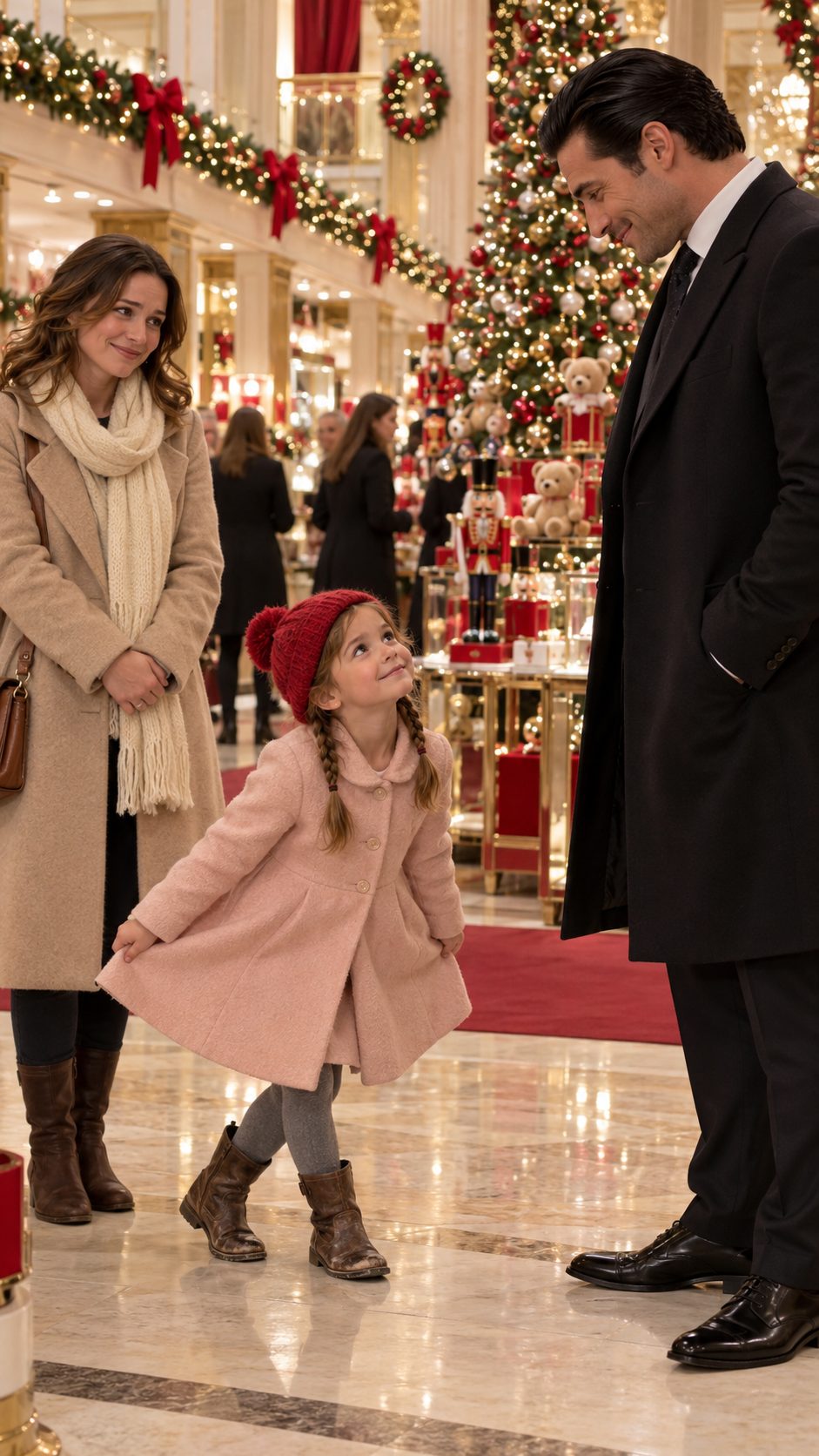
Chapter 1 — The Day My Little Girl Chose to Draw the Christmas Shoes I Couldn’t Afford, a Dangerous Stranger Heard Every Word
I told my six-year-old daughter we couldn’t afford the thirty-eight-dollar Christmas shoes she’d fallen in love with.
What I didn’t know was that one of New York’s most powerful and feared men was standing three feet behind us.
And what Rosie did next would change our lives forever.
“Mommy, could I wear those for Christmas?”
My daughter pressed her small fingers against the glass display.
The shoes were beautiful.
Bright red velvet, tiny silver buckles, and delicate bows that sparkled beneath the department store’s golden lights.
I looked at the price.
Thirty-eight dollars might have meant a casual lunch to someone else.
To me, it meant deciding whether to buy groceries or keep the heating on for another week.
My name is Emily Carter.
I’m twenty-nine years old, and I work at Novak’s Bakery in Queens.
I earn about $148 a week before taxes.
Every morning, I wake at four thirty, leave Rosie with our neighbor Mrs.
Alvarez, and take the first bus to work.
By the time I return home, my feet ache, my fingers are cracked from washing trays, and I’m usually too tired to do anything except make dinner and listen to Rosie describe her school day.
But I always listen.
Because she’s the best thing that’s ever happened to me.
Four years earlier, my husband, Michael, left for Chicago, claiming he’d found work.
He promised to send money.
He promised to call.
He promised he’d be back before Christmas.
That Christmas came and went.
Then another.
And another.
Eventually, I stopped waiting.
Rosie was too young to understand abandonment.
She believed her father had simply gone somewhere far away.
I never had the heart to explain that sometimes people leave because they choose to.
Every December, I brought her to Bergman’s magnificent department store on Fifth Avenue.
We never bought anything.
But for thirty magical minutes, she could walk beneath enormous chandeliers, admire the towering Christmas tree, and pretend she lived inside a fairy tale.
That afternoon, we’d reached the shoe department when Rosie found the red shoes.
“Please, Mommy?”
I knelt beside her.
“Not today, sweetheart.
Maybe someday.”
She looked at me for a moment.
I expected disappointment.
Maybe tears.
Instead, she smiled.
“That’s okay, Mommy.
I can draw them instead.”
She pulled a worn pencil from her coat pocket and flipped over an old bus ticket.
Then she began sketching the shoes.
As though drawing something beautiful meant she could carry a small piece of it home.
I turned my face away before she could see my tears.
Behind us, a deep voice spoke.
“Cancel my afternoon meetings.”
I glanced over my shoulder.
A tall stranger dressed entirely in black stood beside two men who looked like professional security.
One of them frowned.
“Boss, those meetings are important.”
The stranger’s expression turned cold.
“Did I ask for your opinion?”
The man immediately fell silent.
The stranger looked back toward Rosie.
Then he said something that made my stomach tighten.
“Find out why that little girl thinks she doesn’t deserve those shoes.”
I didn’t know his name.
I didn’t know what kind of man he was.
And I certainly didn’t know why someone who looked capable of buying the entire building had suddenly become interested in my daughter.
But when heavy footsteps approached behind us, I instinctively pulled Rosie closer.
“Excuse me, ma’am,” the stranger said.
“We need to talk.”
Chapter 2 — The Man in the Black Coat Was Dominic Moretti, and Everyone in the Store Seemed Afraid of Him Except My Daughter
I turned slowly.
The stranger stood a respectful distance away.
He was tall, broad-shouldered, and dressed in an expensive black overcoat.
His dark hair was swept neatly back, and his expression was difficult to read.
“Can I help you?”
He glanced at Rosie.
“Your daughter has quite a talent.”
Rosie held up her drawing.
They’re Christmas shoes.”
He studied the little sketch.
“They’re beautiful.”
“Thank you, sir.”
She gave him a tiny curtsy.
To my surprise, he laughed.
Not a polite smile.
An actual laugh.
The two men behind him looked startled.
I tightened my grip on Rosie’s hand.
“That’s very kind, but we should be going.”
“Of course,” he replied.
Then his gaze returned to me.
“My name is Dominic Moretti.”
The name meant nothing to Rosie.
But I recognized it immediately.
I’d seen it in newspaper headlines.
A billionaire investor with shipping companies, hotels, real estate holdings, and connections people discussed in whispers.
Some called him one of New York’s most influential businessmen.
Others used a different word.
I took an involuntary step backward.
Dominic noticed.
His expression changed.
“I’m not here to frighten you, Mrs…?”
“Miss,” I corrected.
“Miss Carter.”
He nodded once.
“Miss Carter.”
Rosie tugged my sleeve.
“Mommy, is he famous?”
“Something like that.”
Dominic crouched slightly so he could speak to her without towering over her.
“What’s your name?”
“That’s a lovely name.”
“My mommy picked it.”
“She has good taste.”
Rosie beamed.
I wanted to leave.
Every instinct told me that a man like Dominic Moretti didn’t approach strangers without a reason.
But he wasn’t looking at me the way wealthy customers at the bakery sometimes did.
He wasn’t impatient.
He wasn’t condescending.
He simply seemed curious.
“Do you come here often?” he asked.
“Every Christmas,” Rosie answered before I could speak.
“We look at everything.
Mommy says looking is free.”
Dominic’s smile faded almost imperceptibly.
He glanced toward the shoe display.
Then toward me.
I recognized pity beginning to form in his eyes.
And I hated it.
“We’re perfectly fine,” I said quickly.
“I didn’t suggest otherwise.”
“We don’t need anything.”
He regarded me for a moment.
Then nodded.
“I understand.”
For some reason, that answer surprised me.
He didn’t insist.
Didn’t offer a wad of cash.
Didn’t embarrass me in front of Rosie.
Instead, he stepped aside.
“Enjoy your afternoon, ladies.”
Rosie curtsied again.
“Thank you, Mr.
He laughed softly.
We walked away.
Only when we reached the escalator did I realize my hands were trembling.
“Yes, sweetheart?”
“That man looked sad.”
I glanced back.
Dominic was still standing beside the shoe display.
“Why do you think that?”
Rosie considered the question.
“Because he smiled with his mouth, but not his eyes.”
I looked at my little girl.
Sometimes children see what adults spend years learning to hide.
What neither of us knew was that Dominic had come to Bergman’s to buy his mother a birthday present.
And by the time we reached the ground floor, he’d forgotten all about it.
Instead, he’d asked his assistant to find the name of the bakery where I worked.
That decision would bring him back into our lives.
And it would uncover a connection to my missing husband that none of us expected.
Chapter 3 — When the Most Feared Man in New York Walked Into My Tiny Bakery, I Thought I Was About to Lose Everything
Two mornings later, Dominic Moretti walked into Novak’s Bakery.
I was dusting powdered sugar over a tray of pastries when the doorbell rang.
“Good morning,” I called without looking up.
Then the room went quiet.
Our regular customers stopped talking.
Novak emerged from the kitchen, took one look at the visitor, and nearly dropped his coffee.
Dominic stood near the entrance wearing a charcoal overcoat.
One bodyguard waited outside.
Moretti,” my employer said nervously.
Dominic inclined his head.
“Good morning.”
I froze behind the counter.
What was he doing here?
His eyes found mine.
“Miss Carter.”
I forced a polite smile.
“Can I get you something?”
“Of course.”
“And whatever you recommend.”
I reached for a fresh almond croissant.
“It’s our most popular pastry.”
“Then I’ll take two.”
I prepared his order with shaking hands.
When I gave him the total, he paid normally and left a generous tip in the jar.
Then he sat at a small table near the window.
For twenty minutes, he drank coffee and read a newspaper.
He didn’t ask personal questions.
He didn’t mention Rosie.
He didn’t even look at me particularly often.
But I couldn’t relax.
When he finally stood, I approached.
“Why are you here?”
He considered me carefully.
“Because I was nearby.”
I raised an eyebrow.
He almost smiled.
“And because your daughter recommended that I try something sweet.”
“She told me that people are nicer after cookies.”
Despite myself, I laughed.
“That sounds like Rosie.”
He glanced at the bakery’s old refrigerator and the worn shelves behind the counter.
“How long have you worked here?”
“Four years.”
“Do you enjoy it?”
I hesitated.
“I enjoy feeding people.”
“That’s not quite the same thing.”
“No,” I admitted.
He didn’t push further.
Before leaving, he placed his empty cup on the counter.
“Excellent croissant, Miss Carter.”
“Thank you.”
“I’ll be back.”
And he was.
The next morning.
And the one after that.
He never arrived with an entourage inside.
Never demanded special treatment.
He simply ordered coffee, purchased pastries, and sometimes asked whether Rosie was doing well.
By Friday, Mr.
Novak was losing his mind.
“Emily, do you understand who’s coming into my bakery?”
“Then why?”
“I honestly don’t know.”
That evening, as I was closing up, Dominic appeared again.
This time, he carried a small paper bag.
“Is Rosie here?”
“She’s with our neighbor.”
“I brought something for her.”
My shoulders stiffened.
“I told you, Mr.
Moretti, we don’t need charity.”
His expression remained calm.
“Then don’t think of it as charity.”
He placed the bag on the counter.
Inside was a beautiful set of colored pencils and a sketchbook.
Not jewelry.
Not expensive clothes.
Not the red shoes.
Art supplies.
I looked up.
“Because she likes drawing.”
I stared at the pencils.
Rosie had been using the same worn pencil for months.
I hesitated.
“Dominic, I can’t accept expensive gifts.”
“They aren’t expensive.”
“That’s not the point.”
He nodded thoughtfully.
“Then perhaps she can draw something for me in exchange.”
I looked at him.
“A commission?”
For the first time, I didn’t know how to refuse.
And that evening, when Rosie opened the sketchbook, she smiled so brightly that I nearly cried.
But what she drew on the first page wasn’t a pair of shoes.
It was a picture of three people.
And a tall man wearing a black coat.
Underneath, she wrote:
THE NICE MAN WHO SMILES SADLY.
Chapter 4 — My Daughter Asked the Mafia Billionaire Why He Was Always Alone, and His Answer Revealed a Pain Money Could Never Fix
Dominic came to the bakery the following Saturday.
This time, Rosie was with me.
She sat near the counter drawing while I prepared orders.
When the bell rang and Dominic entered, she jumped from her chair.
His expression softened immediately.
“Hello, Rosie.”
She ran to retrieve her sketchbook.
“I made you something!”
He accepted the drawing carefully.
Three stick figures stood beneath an enormous Christmas tree.
He studied it for several seconds.
“Which one is me?”
“The tall one.”
“And why am I smiling?”
“Because you’re with us.”
Dominic went quiet.
I watched his expression change.
For the first time, I wondered what his life looked like when the expensive suits came off and the bodyguards went home.
Rosie tilted her head.
Dominic, do you have kids?”
“Do you have a wife?”
“Do you have a mommy?”
He laughed softly.
“Then why do you always look lonely?”
My face burned.
But Dominic raised one hand.
“It’s all right.”
He crouched beside her chair.
“Sometimes adults forget how to be happy.”
Rosie thought about that.
“Then you should get a dog.”
I nearly choked.
Dominic stared at her.
Then he laughed harder than I’d ever heard him laugh.
Dogs make everybody happy.”
He nodded solemnly.
“I’ll consider that.”
Later, while Rosie colored, Dominic told me something about himself.
His father had been a ruthless man who viewed affection as weakness.
His mother had been kind, but she’d spent most of her life surviving a marriage she hadn’t chosen.
Dominic inherited the family business at twenty-six.
Since then, he’d built an empire worth billions.
But success had come at a cost.
“People are always asking me for something,” he said.
Protection.
“And Rosie?”
He glanced toward her.
“She asked me why I was sad.”
I looked down.
“Children can be painfully honest.”
“They can.”
He hesitated.
“My mother used to say the same thing about me.”
There was something unexpectedly human about him that afternoon.
Not the billionaire.
Not the feared businessman.
Just a lonely man drinking coffee in a small bakery.
But as he prepared to leave, his phone rang.
His expression changed when he saw the number.
“Excuse me.”
He stepped outside.
Through the window, I watched him listen.
Then he turned sharply toward the street.
His jaw tightened.
One of his men approached.
Dominic said something I couldn’t hear.
The bodyguard nodded and hurried away.
When Dominic returned, his manner was different.
Controlled.
“Everything okay?”
He looked at me.
For a second, I thought he might tell me.
Instead, he said, “I need to take care of something.”
Then he left.
That night, while Rosie slept, I received a message from an unfamiliar number.
Miss Carter, I need to ask you something important.
It was Dominic.
I stared at the screen.
A second message appeared.
Was your former husband’s name Michael Carter?
My heart stopped.
I hadn’t told Dominic my husband’s name.
And I had certainly never told him what Michael had been doing before he disappeared.
I typed back with trembling fingers.
His response arrived almost immediately.
Because I think I know what happened to him.
Chapter 5 — The Man Who Abandoned Us Four Years Ago Had Been Connected to Dominic’s Empire, and the Truth Was Nothing Like I Imagined
I didn’t sleep that night.
At eight the next morning, Dominic called.
“Emily, I owe you an explanation.”
My hands shook around the phone.
“Then start talking.”
He took a breath.
“Four years ago, a man named Michael Carter worked for a transportation contractor connected to one of my companies.”
I closed my eyes.
“Michael told me he was going to Chicago.”
“Then what happened?”
“Records show he left that job several months later.”
“Where did he go?”
“That’s what I’m trying to establish.”
I sat down.
For four years, I’d imagined dozens of explanations.
An accident.
A new family.
A deliberate disappearance.
But I’d never imagined my missing husband might have been connected to Dominic Moretti.
“Why are you investigating him?”
Dominic hesitated.
“One of my employees recognized your surname.”
“That’s it?”
His voice grew serious.
“Michael’s name appeared in an old internal report involving missing company funds.”
I stared at the wall.
“What kind of funds?”
“Money that disappeared during a contracting dispute.”
“Are you saying he stole it?”
“I’m saying his name was connected to the inquiry.
That doesn’t establish what happened.”
I appreciated the caution.
But my mind was racing.
Michael had never been particularly ambitious.
He struggled to keep jobs.
He made promises he rarely fulfilled.
Still, I couldn’t imagine him becoming involved in something that attracted the attention of Dominic Moretti.
“Was he in danger?”
“I don’t know.”
“Did someone hurt him?”
“Emily, I won’t pretend to know more than I do.”
I pressed my fingers against my forehead.
“What happens now?”
“Nothing unless you want me to continue.”
That surprised me.
“You aren’t going to investigate anyway?”
“Not your personal life.”
For several seconds, I didn’t speak.
Then I asked the question I’d avoided for years.
“Can you find out whether he’s alive?”
Dominic answered quietly.
“I can ask my legal team to help check public records.
If you agree.”
I looked toward Rosie’s bedroom.
She was still asleep.
Her sketchbook lay open on the kitchen table.
On the page, she’d drawn a Christmas tree with three presents beneath it.
One for me.
One for herself.
One labeled for the lonely man.
“All right,” I whispered.
“Thank you.”
Over the next week, Dominic’s attorney helped me review information from Michael’s previous employment.
The results were painful.
Michael had left the transportation company voluntarily.
He had opened a bank account in another state.
He’d used an address in Pennsylvania.
And according to recently available public records, he’d remarried.
I stared at the document.
While our own marriage had never been legally dissolved.
My throat tightened.
There were legal questions that needed to be addressed.
But emotionally, the answer was brutally simple.
Michael hadn’t disappeared because he couldn’t come home.
He’d disappeared because he didn’t want to.
I sat in Dominic’s office, unable to speak.
Finally, I whispered, “Rosie still thinks her daddy might come back.”
Dominic looked at me with an expression I couldn’t read.
“I’m sorry, Emily.”
I shook my head.
“I’ve spent four years wondering whether he needed help.”
My voice broke.
“He knew where we lived.
He knew I was working.
He knew his daughter was growing up.”
Dominic said nothing.
“He could have called.”
A tear fell onto the document.
“He could have sent her a birthday card.”
Dominic moved a box of tissues within reach.
He didn’t touch me.
Didn’t offer meaningless promises.
He simply let me cry.
And somehow, that kindness mattered more than anything expensive he could have bought.
When I finally looked up, he said something I would remember for years.
“His decision to leave says nothing about your daughter’s worth.”
But I wasn’t sure I believed it yet.
Then he added quietly,
“Or yours.”
Chapter 6 — Dominic Offered Me a Future I Had Never Dared Imagine, but I Refused to Become Another Woman Dependent on a Powerful Man
Dominic’s first offer was a new job.
Not a suitcase of money.
Not a luxury apartment.
Not an invitation to move into his mansion.
One afternoon, he visited the bakery after closing.
“I’ve been reviewing the catering operation in one of my hotels,” he said.
“Because they need someone who understands pastry production.”
“And you’ve spent four years keeping this bakery running.”
I crossed my arms.
Novak keeps it running.”
Dominic raised an eyebrow.
I opened my mouth.
Then closed it.
The truth was, Mr.
Novak owned the bakery, but I handled most of the daily scheduling, inventory, customer orders, and baking whenever his arthritis became too painful.
I had never considered those responsibilities valuable.
They were simply things that needed doing.
Dominic continued.
“My hotel is hiring an assistant pastry manager.
Better hours.
A salary that would allow you to support Rosie comfortably.”
I stared at him.
“You’re offering me a job?”
“I’m telling you about an opening.”
“Because you feel sorry for me?”
“Then why?”
“Because I’ve tasted your croissants.”
Despite myself, I smiled.
He continued.
“You’d have to apply.
Meet the hiring manager.
Complete a practical assessment.”
I considered him carefully.
“And if I fail?”
“Then you don’t get the job.”
That answer made me trust him more.
For the first time, he wasn’t trying to rescue me.
He was offering me a chance to prove myself.
The interview terrified me.
I borrowed a blazer from Mrs.
Alvarez and spent three evenings practicing answers after Rosie went to sleep.
On the morning of the practical assessment, Rosie kissed my cheek.
“You’re going to win, Mommy.”
“It’s not a contest, sweetheart.”
“Then you’re going to be the best.”
“That’s a lot of pressure.”
She hugged me.
“I believe in you.”
I carried those words into the hotel kitchen.
Three days later, I received the call.
I’d been hired.
The salary was more than four times what I earned at Novak’s Bakery.
I sat at my kitchen table and cried.
Not because Dominic had given me something.
Because I’d finally earned something that could change our lives.
That evening, he called to congratulate me.
“How does it feel?”
“Terrifying.”
He laughed.
“That’s normal.”
“Thank you for telling me about the job.”
“You’re welcome.”
“But I need you to understand something.”
“I’m listening.”
“I can’t be someone you take care of because you feel guilty or lonely.”
He remained quiet.
“I have a daughter.
I can’t build our lives around the possibility that one powerful man might decide we’re no longer interesting.”
His response came without hesitation.
“Then don’t.”
“Build your life around yourself and Rosie.
You don’t owe me anything.”
For several seconds, I couldn’t speak.
Then I whispered, “Okay.”
A month later, I started work at the hotel.
Rosie entered an after-school art program.
We could afford better groceries.
I paid the electricity bill before the deadline.
And for the first time in years, I bought a winter coat without calculating which meals we’d need to skip.
But Dominic didn’t disappear from our lives.
He called occasionally.
Stopped by the bakery when visiting the neighborhood.
Asked Rosie about her drawings.
And slowly, very slowly, something began changing between us.
Not because he was rich.
Because every time he made a promise, he kept it.
That was something I hadn’t experienced in a very long time.
Chapter 7 — My Daughter Invited the Mafia Boss to Christmas Dinner, and for the First Time, He Entered a Home Where Nobody Wanted His Money
Two weeks before Christmas, Rosie decided Dominic needed an invitation.
She announced this while we were decorating our tiny apartment.
“Mommy, Mr.
Dominic should come for Christmas.”
I nearly dropped a glass ornament.
“Because he doesn’t have any kids.”
“He has a family, sweetheart.”
“But he looks lonely.”
“Rosie, you can’t invite people just because they look lonely.”
I had no answer.
That evening, she drew an invitation.
At the top, in enormous uneven letters, she wrote:
CHRISTMAS DINNER AT OUR HOUSE.
Underneath, she drew three plates.
Then she added a fourth.
When he visited the hotel the following day, Rosie handed it to him.
Dominic studied the drawing.
“Is this for me?”
He looked at me.
I shrugged helplessly.
“Apparently, you’ve been invited.”
“I’d be honored.”
On Christmas Eve, Dominic arrived at our apartment wearing a dark sweater and a simple black coat.
No expensive watch.
No visible security detail.
He carried a small bouquet for me and a box of cookies from a bakery I’d mentioned liking.
I opened the door.
He glanced around.
Our apartment was small.
The Christmas tree leaned slightly to one side.
The kitchen table had mismatched chairs.
A strand of lights blinked unevenly around the window.
But everything was warm.
Everything was ours.
Rosie ran toward him.
He crouched as she offered a paper crown she’d made.
“You’re the Christmas king!”
Dominic examined it.
“That sounds like an important responsibility.”
She placed it on his head.
I burst out laughing.
He looked at me.
“Does this suit me?”
“Perfectly.”
During dinner, Rosie told him about school.
She described her teacher, the class hamster, and the girl who always borrowed her crayons.
Dominic listened to every word.
Afterward, he helped clear the table.
I watched one of New York’s most feared men carefully stack ordinary dinner plates beside our sink.
“You don’t have to do that,” I said.
“Then why?”
“Because you cooked.”
Later, Rosie fell asleep on the couch beneath a blanket.
Dominic stood near the window, watching the Christmas lights across the street.
“Thank you,” he said.
“For dinner?”
“For letting me come.”
I studied him.
“You really don’t do this often, do you?”
“Spend time with people who don’t want something from you.”
He looked toward Rosie.
I stepped beside him.
For a moment, neither of us spoke.
Then he said, “My mother used to make Christmas feel like this.”
“Before the money?”
He smiled faintly.
“Before everything became complicated.”
I turned toward him.
“Dominic, you don’t have to be complicated here.”
He looked into my eyes.
Something shifted between us.
Neither of us moved closer.
But for the first time, the silence felt different.
Not awkward.
Not frightening.
Just full of something neither of us was ready to name.
Then Rosie murmured in her sleep.
“Don’t forget the cookies.”
Dominic and I laughed.
And for one beautiful evening, the most powerful man in New York looked like someone who had finally found a place to belong.
Chapter 8 — When My Missing Husband Suddenly Returned, He Thought Dominic’s Money Had Made Me Forget Our Marriage
Michael appeared three days after Christmas.
I was leaving work when I saw him standing near the hotel entrance.
For a second, I didn’t recognize him.
He’d gained weight.
His hair was shorter.
He wore an expensive leather jacket I couldn’t imagine him affording four years earlier.
My stomach tightened.
He smiled as though we’d seen each other yesterday.
“You look good.”
I stared at him.
Four years.
Four years of unanswered questions.
Four years of birthdays he’d missed.
Four years of explaining to Rosie why other children had fathers waiting outside school.
And he opened with a compliment.
“What do you want?”
His smile faded.
“Can we talk?”
“We have nothing to discuss.”
“Come on, Em.”
I flinched.
He used to call me that when we were young.
Now it sounded like a stranger borrowing someone else’s memory.
“I heard you’ve been spending time with Dominic Moretti.”
My blood turned cold.
“How do you know that?”
“People talk.”
“Then let them.”
Michael stepped closer.
“So that’s it?
You replace me with a billionaire?”
I laughed in disbelief.
“You left us.”
“I had reasons.”
“You didn’t call your daughter for four years.”
His jaw tightened.
“Things got complicated.”
“Complicated?”
I stepped back.
“Rosie had pneumonia when she was three.
I worked while I was sick because we couldn’t afford groceries.
I sold my wedding ring to keep the lights on.”
His expression shifted.
“You sold it?”
“That’s what you heard?”
He looked away.
I continued.
“Not the pneumonia.
Not the bills.
“Emily, lower your voice.”
For years, I’d imagined this conversation.
I’d rehearsed questions.
Prepared accusations.
Imagined crying.
But now, standing before him, I felt something unexpected.
Just exhaustion.
“Do you want to see Rosie?”
He hesitated.
“Eventually.”
I stared at him.
“Eventually?”
“I’m trying to get things sorted out.”
I nodded slowly.
There it was.
The same man.
The same vague promises.
The same expectation that everyone else would wait.
“No,” I said.
His eyes narrowed.
“You don’t get to disappear and then walk back into her life whenever it’s convenient.”
He glanced toward the hotel entrance.
“You think Moretti can protect you from everything?”
I held his gaze.
“This isn’t about Dominic.”
“Sure it isn’t.”
“This is about your daughter.”
Michael looked away.
At that moment, I understood something important.
He hadn’t come because he missed Rosie.
He’d come because he’d heard I was connected to a wealthy man.
That night, I contacted an attorney recommended by a colleague.
I began the process of resolving the legal questions surrounding our marriage and establishing appropriate arrangements for Rosie.
Dominic learned what had happened when I told him the following day.
His expression darkened.
“What did he say?”
I explained.
Dominic remained silent for a long moment.
Then he asked, “What do you want to do?”
I looked at him.
Not what should he do.
Not whom should he call.
What did I want?
“I want Rosie protected.
And I want to handle this legally.”
“Then that’s what we’ll do.”
For the first time, I understood the difference between a man who wanted control and a man who respected my choices.
One had abandoned us.
The other was standing beside me without demanding that I belong to him.
Chapter 9 — The Little Girl Who Once Drew Her Christmas Shoes Finally Received Them, but What She Gave Dominic Was Worth Far More
By the following December, our lives looked very different.
I was managing a pastry team at the hotel.
Rosie was thriving in school.
We’d moved into a slightly larger apartment with windows that let in morning sunlight.
I had savings.
Not a fortune.
Just enough to feel safe when unexpected expenses appeared.
That mattered more to me than any luxury.
Dominic remained part of our lives.
He came to Rosie’s school art exhibition.
He attended her birthday party.
He even adopted a dog after she insisted he needed one.
The dog was a clumsy golden retriever named Biscuit.
Rosie claimed she’d chosen the name because Dominic was always eating pastries.
He didn’t argue.
Over the year, Dominic and I had grown close.
There were dinners.
Walks through Central Park.
Conversations that lasted long after Rosie fell asleep.
He told me about the parts of his past that frightened him.
I told him about the years when I’d stopped believing I deserved kindness.
We didn’t pretend either life was simple.
But we were honest.
And honesty made everything feel possible.
A week before Christmas, I took Rosie back to Bergman’s department store.
The decorations were just as magnificent as she remembered.
The enormous tree.
The chandeliers.
The red velvet displays.
We reached the children’s shoe department.
And there they were.
A new version of the same red shoes.
Rosie stared.
“Would you like to try them on?”
Her eyes widened.
The shoes cost a little more than the pair we’d seen the previous year.
But this time, I didn’t need to count the money in my wallet.
I could afford them.
Rosie slipped them on.
She stood before the mirror.
Then she began turning in tiny circles.
“Look, Mommy!”
“You look beautiful.”
She stopped and looked at me.
“Are we rich now?”
I knelt beside her.
“No, sweetheart.”
“Then how can we buy them?”
I took her hands.
“Because Mommy worked very hard.
And now we have enough.”
She considered that.
Then nodded.
We paid for the shoes.
As we left, Rosie noticed Dominic waiting near the entrance.
He’d agreed to meet us for lunch.
She ran toward him.
“Hello, princess.”
She lifted her shopping bag.
“Guess what?”
“Mommy bought the shoes!”
Dominic looked at me.
His expression softened.
Rosie reached into her coat pocket.
Then handed him something.
An old, creased bus ticket.
The same one she’d used the previous year.
On the back was the faded sketch of the red shoes.
Dominic stared at it.
“I kept it,” Rosie explained.
“Because that was the day I met you.”
His expression changed.
Rosie smiled brightly.
“And now I don’t need to draw the shoes anymore.”
Dominic looked at her.
Then at me.
His eyes filled with tears.
He slipped the little drawing carefully into his wallet.
“I think I’ll keep this forever,” he whispered.
Rosie beamed.
And I realized that a man who could buy almost anything had just received something money could never replace.
A memory of the day someone had trusted him simply because he’d been kind.
Chapter 10 — One Year After My Daughter Couldn’t Afford Christmas Shoes, the Mafia King Knelt Before Us With a Question That Changed Our Family Forever
Christmas Eve arrived beneath a gentle snowfall.
Rosie stood by our apartment window wearing her new red shoes.
She’d insisted on wearing them even though we weren’t going anywhere.
“Mommy, do you think Santa likes red?”
“I’m sure he does.”
Then he’ll notice my shoes.”
The doorbell rang.
“Biscuit!” she shouted.
She raced toward the door.
I opened it.
Dominic stood outside wearing a dark wool coat.
Beside him sat Biscuit, wagging his tail.
Rosie squealed.
She dropped to her knees and wrapped her arms around the dog.
Dominic laughed.
“Nice to see you too, Rosie.”
We spent the evening together.
I made roast chicken, garlic potatoes, and apple pie.
Dominic helped set the table.
Rosie insisted on lighting the battery-operated candles herself.
After dinner, she gave Dominic a Christmas card.
Inside she’d drawn four figures.
And Biscuit.
Above them, she had written:
MY FAVORITE PEOPLE.
Dominic stared at the card for a long time.
Then he looked at me.
“Emily, can we talk for a minute?”
My heart began beating faster.
“Of course.”
We stepped into the kitchen.
Snow drifted past the window.
From the living room came Rosie’s laughter as Biscuit chased a toy.
Dominic took my hand.
For all his wealth and confidence, he looked nervous.
“There’s something I need to tell you.”
I smiled faintly.
“That sounds serious.”
He took a breath.
“A year ago, I walked into a department store to buy my mother a birthday present.”
“I remember.”
“I thought I knew what mattered in life.”
He smiled sadly.
“I had everything people told me I should want.
But I didn’t have anywhere I could go and simply be myself.”
I squeezed his hand.
“Then I saw a little girl drawing shoes on an old bus ticket because she didn’t want to make her mother feel bad.”
My eyes filled.
“And I met a woman who had every reason to be bitter, but still worked every day to make her daughter feel loved.”
I looked down.
“You make us sound extraordinary.”
“Emily, I know my life is complicated.”
“And I know my name carries things neither of you asked for.”
“But I don’t want to become someone who decides your future for you.”
He reached into his coat pocket.
For one impossible second, I thought he might produce a diamond ring.
Instead, he took out the old bus ticket.
Rosie’s drawing.
He held it between us.
“This was the day my life changed.”
I started crying.
Dominic continued.
“I don’t know exactly what our future looks like.
But if you’ll let me, I’d like to keep building it with you.”
I looked into his eyes.
A year earlier, I had been terrified of accepting help from him.
I’d feared that kindness always came with conditions.
That powerful people eventually demanded obedience.
That love meant waiting for someone to disappoint you.
But Dominic had spent twelve months proving something different.
He hadn’t tried to purchase our affection.
He hadn’t asked me to abandon my work.
He hadn’t made Rosie feel indebted to him.
He had simply shown up.
Again and again.
And perhaps that was the most extraordinary thing of all.
I stepped closer.
“I’d like that too.”
Then he kissed me gently.
From the living room came a delighted gasp.
Rosie stood in the doorway.
Biscuit sat beside her.
Her little red shoes sparkled beneath the Christmas lights.
“Does this mean Mr.
Dominic is staying?”
I laughed through my tears.
Dominic crouched beside her.
“Would that be okay with you?”
Rosie thought seriously.
Then she pointed at Biscuit.
“But he has to stay too.”
Dominic laughed.
She threw her arms around him.
And I watched the man people feared across New York hold my daughter as though she were the most precious thing in the world.
Months later, Dominic and I continued building our relationship carefully.
I kept my job.
Rosie kept drawing.
Biscuit kept stealing socks.
There were difficult conversations about Dominic’s past and the kind of future we wanted.
We didn’t pretend love could erase every complication.
But we were learning to face them honestly.
One afternoon, I found the old bus ticket framed on Dominic’s office desk.
Beside it were photographs of Rosie, Biscuit, and me.
He noticed me looking.
“That’s my favorite piece of art,” he said.
“A drawing of thirty-eight-dollar shoes?”
He shook his head.
Then he looked toward the picture.
“That’s the day I learned what it means to have enough.”
I thought about the Christmas before we’d met.
The cold apartment.
The overdue heating bill.
The shoes I couldn’t afford.
The little girl who smiled instead of crying because she didn’t want to make her mother sad.
For so long, I’d believed that Christmas was about giving Rosie everything I couldn’t afford.
But now I understood.
She hadn’t needed a perfect life.
She’d needed to know she was loved.
And somehow, through all our struggles, she’d never doubted that.
That evening, Rosie came running into the kitchen holding a new drawing.
It showed a large Christmas tree.
Four figures stood beneath it.
And Biscuit.
Everyone was smiling.
Even the dog.
“What do you call this one?”
She grinned.
“Our family.”
I looked at Dominic.
He smiled back.
And for the first time in years, the word family no longer reminded me of what we’d lost.
It reminded me of everything we’d found.
Because sometimes a miracle doesn’t arrive in a golden carriage.
Sometimes it begins with a tired mother, a little girl, a thirty-eight-dollar pair of shoes…
And a stranger who finally learns that the greatest fortune in the world isn’t something you own.
**It’s having someone who is genuinely happy when you come home.**
✓ Lynn R. Adams
Chapter 1 — The Day My Little Girl Chose to Draw the Christmas Shoes I Couldn’t Afford, a Dangerous Stranger Heard Every Word I told my six-year-old daughter we couldn’t afford the thirty-eight-dolla…