Just before our wedding, I overheard my fiancé’s father explaining that I’d be moving to Hyderabad, quitting my job, and living with his parents after the ceremony. Nobody had asked me. When I confronted Vihan, he admitted he’d planned to explain everything after we were married. I’d spent years building my career as an architect, and suddenly the man I loved expected me to accept a future his family had arranged without me. With our guests waiting and the ceremony about to begin, I needed to know whether I was marrying a partner or someone who would always decide my life for me.
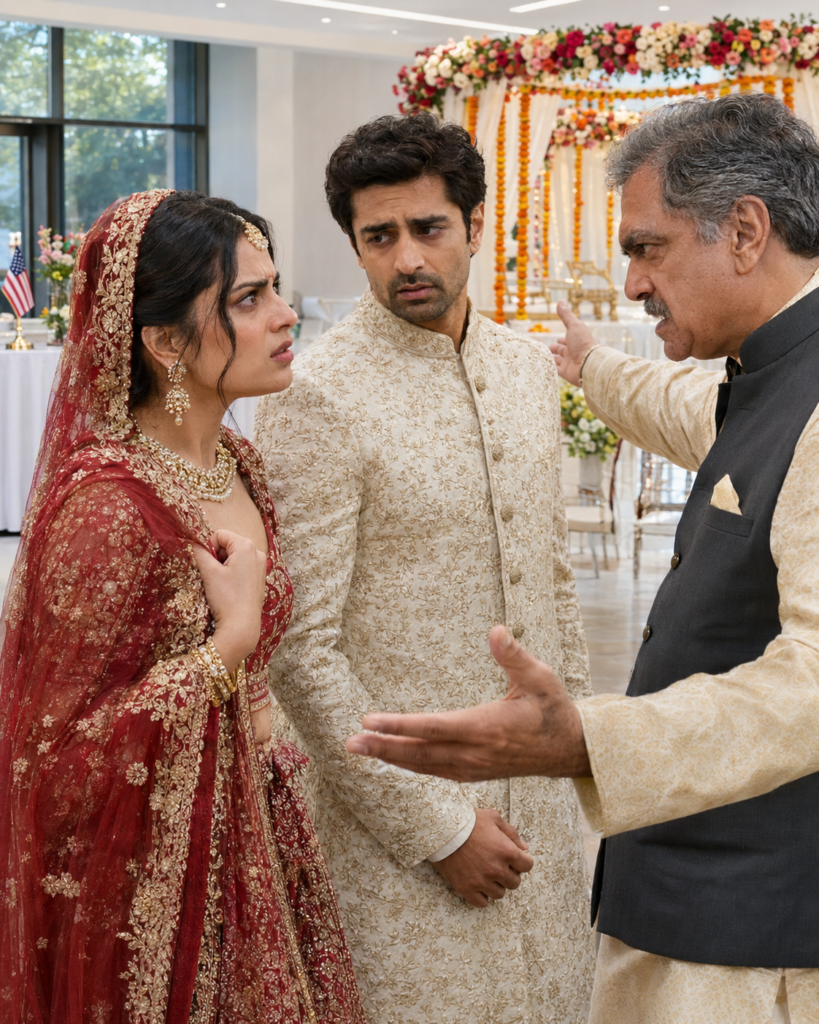
My Fiancé Planned Our Move to Hyderabad Without Telling Me. I Found Out Minutes Before Our Wedding.
“Enough. Let’s begin the ceremony.”
Vihan’s father spoke directly to the officiant, as though I hadn’t been standing there asking a question about my own future.
The officiant looked from him to me.
My hands were trembling beneath the embroidered fabric of my wedding outfit. Beyond the decorated wedding platform, our relatives sat waiting beneath strings of flowers and warm lights. A photographer stood near the aisle with his camera ready.
Everyone expected me to smile.
Everyone expected Vihan to take my hand.
And apparently, everyone expected us to move to Hyderabad after the wedding, live with his parents, and leave my career behind.
Everyone except me.
“Please wait,” I said.
The officiant lowered his hands.
Vihan’s father turned toward me.
“Dia, this has gone far enough.”
I looked at Vihan.
“Tell him I need a minute.”
Vihan’s expression was strained. He had been smiling when I walked toward him only moments earlier, but the smile was gone now.
“Dad,” he said quietly, “let us talk.”
“We’ve already talked. The guests are waiting.”
“Then stop embarrassing everyone.”
I looked at the man I was supposed to marry.
“Vihan, I’m asking you something very simple. If I don’t agree to quit my job and move into your parents’ house, will you still marry me?”
He swallowed.
“Dia, can we please not do this right now?”
“That’s what you’ve been saying since I found out.”
“We can discuss the details later.”
“But you already agreed to the transfer.”
“It was an excellent opportunity.”
“And you told your parents I would leave my job.”
He looked toward his father.
That small movement told me more than another explanation would have.
I had spent years believing that Vihan and I would make our important decisions together. We’d talked about careers, savings, travel, and eventually having a home of our own.
Yet he had arranged an entirely different future without asking me.
Now, with our families watching, he wanted me to promise myself to him first and ask questions afterward.
I turned toward the officiant.
“I’m sorry,” I said. “I can’t continue the ceremony right now.”
The room became very quiet.
Vihan reached for my hand.
I stepped back.
“I need to know what I’m agreeing to before I make a promise.”
His father rose from his chair.
“You cannot stop a wedding over a misunderstanding.”
I looked at him.
“This isn’t a misunderstanding. Nobody asked me.”
For a moment, I thought he might finally hear me.
Instead, he said, “Once you’re married, you’ll live with your husband. That’s how families work.”
I felt something settle inside me.
I wasn’t angry enough to shout.
I was simply no longer willing to walk forward without an answer.
“I am not getting married today,” I said.
Then I turned away from the wedding platform.
My older sister, Meera, was the first person to reach me.
She’d been standing near the front of the gathering, watching the exchange.
When I stepped into the side corridor, she followed and gently guided me into a quiet room.
“Sit down,” she said.
I lowered myself onto a sofa.
The heavy fabric of my wedding outfit gathered around my feet.
Meera brought me water and sat beside me.
“Are you all right?”
She nodded.
“That makes sense.”
I looked at her.
“I’ve ruined everything.”
“No,” she said. “You’ve stopped something you weren’t ready to agree to.”
I stared at my hands.
For months, I’d imagined this wedding.
I’d helped choose the flowers, discussed the menu, and spent evenings laughing with Vihan about which relatives would insist on staying until the very end.
We’d planned a short trip after the ceremony.
I’d pictured the photographs we’d frame and the ordinary life we’d begin afterward.
Now those plans seemed to belong to someone else.
Meera put an arm around my shoulders.
“Do you want to tell me exactly what happened?”
I explained what I’d overheard.
Vihan’s father had been speaking to another relative shortly before the ceremony. He’d mentioned Vihan’s transfer to Hyderabad as though it were settled.
Then he’d explained that after the wedding, Vihan and I would live with his parents.
My job, apparently, would no longer be necessary.
I’d been an architect for years. I was working on projects that mattered to me and had responsibilities I couldn’t simply abandon.
Yet Vihan’s father spoke as though my career was a temporary arrangement that marriage would naturally bring to an end.
When I confronted Vihan, he’d admitted that he knew about the transfer.
He’d planned to explain everything after the wedding.
Meera listened without interrupting.
When I finished, she asked, “Did he say you had to resign?”
“He said I could leave work and take some time for myself.”
“That isn’t the same as asking what you want.”
She squeezed my hand.
“Then don’t let anybody rush you back into that room.”
There was a knock at the door.
My mother came in.
She looked pale and worried.
“Dia,” she said softly.
I stood, expecting a lecture about the guests and the money already spent.
Instead, she came across the room and hugged me.
I began crying.
For several minutes, she simply held me.
Then she asked, “Have you made your decision?”
“I can’t marry him today.”
She nodded.
“Then we’ll tell the family.”
I pulled back.
“What about everyone waiting outside?”
“They’ll have lunch. They’ll go home.”
“Mom, the arrangements—”
“Can be dealt with.”
I looked at her.
She was frightened, too. I could see it.
But she was standing beside me.
That mattered.
I had met Vihan several years earlier through friends.
He was thoughtful, funny, and easy to talk to.
He remembered small things about people and had a way of making an ordinary evening feel special.
When I worked late on a project, he’d bring dinner to my office. When he had a difficult week, I’d sit with him and listen.
We weren’t alike in every way.
He was more comfortable with routines and family expectations. I liked plans, too, but I needed room to make my own choices.
Those differences had never seemed impossible to manage.
In fact, I thought we balanced one another.
We’d spent long evenings imagining our future.
A small apartment at first.
Two incomes.
Savings for a home.
Maybe children someday, when we were ready.
I loved the idea of coming back from work and finding him in the kitchen, asking how my day had gone.
I didn’t need an enormous house or a life that impressed anybody else.
I wanted a partner.
And I believed Vihan wanted the same thing.
My career had never been a secret.
I’d worked hard to become an architect.
During school, I spent evenings working on drawings while my friends went out. I completed internships, learned from demanding supervisors, and slowly built the experience needed to take on serious projects.
I loved the work.
I loved standing inside a building that had existed only on paper and seeing people begin to use it.
There was something deeply satisfying about solving a problem that affected how someone lived.
A hallway that finally admitted enough light.
A staircase that was easier to navigate.
A public room that made people want to sit and stay awhile.
Architecture wasn’t merely a way to earn money.
It was part of how I understood the world.
Vihan knew that.
He’d visited project sites with me. He’d seen me arrive home exhausted after long design reviews and celebrate when a difficult proposal was approved.
He knew how proud I was of the small team I worked with.
That was why his wedding-day revelation felt so strange.
It wasn’t as though he’d discovered my career that morning.
He’d known what it meant to me for years.
A little while after I left the ceremony, Vihan came to the room where I was sitting.
Meera opened the door.
He looked as shaken as I felt.
“Can I speak to Dia?”
Meera glanced at me.
“I’ll be right outside,” she said.
Vihan entered and closed the door gently.
For a moment, we stood looking at each other.
He was still dressed for our wedding.
I had imagined that outfit beside mine in photographs for years.
Now I could barely look at him.
“Dia,” he said, “please don’t do this.”
I sat down.
“Don’t do what?”
“Call off the wedding.”
“I’ve already said I’m not continuing today.”
“Our families are devastated.”
He looked away.
“I know I should have told you about Hyderabad.”
“When did you accept the transfer?”
He hesitated.
“Several weeks ago.”
“How many?”
I looked at him.
He’d known for six weeks that his employer wanted him to relocate.
During those weeks, we’d discussed our wedding menu, the guest list, and whether we’d need a larger refrigerator after moving into our own place.
He’d listened to me talk about a project deadline scheduled for shortly after the wedding.
All the while, he knew he was planning to leave the city.
“Why didn’t you tell me?” I asked.
“I wanted to find the right time.”
“Six weeks wasn’t enough?”
“I knew you’d be upset.”
“Then you knew it mattered.”
He sat across from me.
“My father thought it would be easier if we discussed it after the ceremony.”
I stared at him.
“Your father knew?”
“And I didn’t?”
He looked miserable.
“I wasn’t trying to hurt you.”
I believed that.
And somehow, believing it made the situation worse.
If he’d been deliberately cruel, perhaps the choice would have been easier.
Instead, the man I loved had convinced himself that keeping me uninformed was a reasonable way to manage a difficult conversation.
“Vihan,” I said, “did you think I would agree to quit my job once we were married?”
He rubbed his forehead.
“I thought we’d have more flexibility. My new salary would cover our expenses. You wouldn’t have to work if you didn’t want to.”
“But I do want to work.”
“I know you love your job.”
“Then why did you tell your parents I was leaving it?”
He didn’t answer.
Finally, he said, “I thought once we were settled, you’d see the advantages.”
I looked down at the wedding fabric gathered in my lap.
He had pictured my agreement as something that would come eventually.
Not because he’d persuaded me.
Because marriage would make refusing more difficult.
“Do you understand why I can’t go back out there?” I asked.
He leaned forward.
“Because you’re angry.”
He stopped.
“I’m hurt. And I’m frightened.”
His face changed.
“Frightened of me?”
“Of the life you’re asking me to enter.”
I took a breath.
“If you make a decision this important without telling me, what happens the next time your father wants something? What happens when we disagree about money or where to live? Am I supposed to learn about those decisions after they’re made, too?”
He shook his head.
“Of course not.”
“But that’s what happened.”
He reached for my hand.
I let him take it for a moment.
“I love you,” he said.
“I love you, too.”
Relief crossed his face.
Then I withdrew my hand.
“But I still can’t marry you today.”
The ceremony did not continue.
My mother and Vihan’s family spoke with the people organizing the event.
The guests were informed that the wedding had been postponed.
Some were confused.
Others were upset.
Relatives who had traveled a long distance wanted explanations. A few tried to speak to me directly.
Meera handled most of those conversations.
I stayed in the quiet room until the gathering had begun to disperse.
The food had already been prepared.
The venue had been decorated.
Money had been spent that neither family could fully recover.
I knew that.
I had helped plan the wedding and understood the work and expense involved.
But the cost of a canceled ceremony couldn’t be the reason I agreed to a marriage I no longer understood.
Later that afternoon, my mother helped me change into a simple outfit.
As I removed the jewelry I’d worn for the ceremony, I felt the full weight of what had happened.
There would be no wedding photographs.
No first evening as husband and wife.
No beginning to the married life we’d imagined.
My mother folded the embroidered fabric carefully.
“Do you want me to put this away?” she asked.
She closed the garment bag.
Then she sat beside me.
“People will talk,” I said.
“Probably.”
“Some of them will blame me.”
“Probably.”
I looked at her.
She gave me a tired smile.
“I can’t promise that everyone will understand, Dia. But I would rather answer difficult questions about a wedding that didn’t happen than watch you enter a marriage because you were afraid to disappoint people.”
I leaned against her shoulder.
For the first time all day, I could breathe.
The days after the wedding were harder than I expected.
There was no dramatic relief.
I woke up the following morning and remembered what I’d done.
My phone was full of messages.
Some relatives asked whether Vihan and I had reconciled.
Others wanted to know whether the ceremony would be rescheduled.
A few suggested that I’d overreacted.
One aunt wrote that every marriage required adjustment and that refusing to move cities was hardly a reason to embarrass two families.
I didn’t respond.
Moving cities wasn’t the issue.
Neither was living with parents.
I knew couples who had made both choices happily.
The issue was that nobody had asked me whether I wanted either one.
My career, my home, and my daily life had been included in a plan I hadn’t been allowed to discuss.
Vihan sent several messages.
At first, they were mostly apologies mixed with requests to talk.
He said he’d never intended to put me in an impossible position.
He said he wanted to make things right.
I read each message carefully.
Then I asked him to send me the transfer details.
Not an explanation from his father.
Not a summary of the benefits.
The actual terms he’d accepted.
He sent the relevant correspondence from his employer.
The transfer was real.
It involved a more senior position in Hyderabad, a salary increase, and a start date shortly after our planned wedding trip.
Vihan had accepted the offer six weeks earlier.
The company had not required me to resign.
It had not required us to live with his parents.
Those arrangements had come from Vihan and his family.
I sat at my kitchen table with the messages open on my laptop.
The transfer itself wasn’t outrageous.
It was the kind of opportunity many people would seriously consider.
Had Vihan discussed it with me when it was offered, we might have talked about living in different cities temporarily or exploring work opportunities in Hyderabad.
I might even have considered relocating eventually.
But instead of giving me those choices, he’d allowed his father to decide what my role would be.
I closed the laptop.
Then I wrote Vihan one message.
I can discuss our future with you. I will not discuss a future you have already decided for me.
He replied a few minutes later.
I understand.
I wanted to believe him.
But I wasn’t ready to trust the words.
I returned to work the following week.
The first morning was uncomfortable.
People knew I’d been supposed to get married.
My colleagues had seen photographs of the preparations and asked about the ceremony.
Now I had to explain that it hadn’t happened.
I kept the explanation simple.
“We postponed it because we had some important things to work through.”
A few people looked surprised.
Most were kind enough not to ask more.
My supervisor, Mrs. Rao, invited me into her office.
She’d been a practicing architect for decades and had little patience for unnecessary drama.
“Do you need time off?” she asked.
I shook my head.
“I’d rather work.”
She nodded.
“Then let’s talk about the library project.”
We were helping redesign an older municipal building into a public library and community space.
The project was complicated.
The building had narrow corridors, aging electrical systems, and a layout that didn’t make good use of the available light.
I’d spent months working with the team to preserve the structure while making it more accessible and useful.
Our next design review was approaching.
Mrs. Rao opened the drawings.
“We’ve received comments on the entrance layout,” she said.
For the next hour, we discussed circulation, seating, and how visitors would move through the building.
Nobody asked about my wedding.
Nobody told me what a married woman should do.
We looked at a problem, considered the options, and made decisions together.
It was an ordinary meeting.
Afterward, I sat at my desk for a long time.
I loved my work.
That hadn’t changed because I was supposed to get married.
And I wasn’t willing to treat that love as something childish I needed to outgrow.
Vihan and I met for coffee two weeks after the canceled wedding.
I chose a quiet place near my office.
He arrived early.
When I walked in, he stood.
“Thank you for coming,” he said.
I sat down.
He looked tired.
I suspected he’d been receiving as many calls from relatives as I had.
We ordered coffee.
Then I asked him what he’d told his parents.
“The wedding is postponed,” he said. “And they need to stop contacting your family about rescheduling.”
“Did they agree?”
“My mother did.”
“And your father?”
He looked down.
“He’s upset.”
“He thinks you humiliated him.”
I held my cup between my hands.
“Does he understand why I stopped the ceremony?”
“He says these things should have been discussed privately.”
“I tried to discuss them privately.”
Vihan nodded.
“He was the one who told the officiant to begin.”
“I know that, too.”
The old Vihan might have added an explanation for his father’s behavior.
This time, he didn’t.
Finally, he said, “I should have stopped him.”
“I thought if we could just get through the ceremony, everything would calm down.”
I looked at him.
“That was exactly what frightened me.”
He nodded again.
“I understand that now.”
I wasn’t sure he did.
Understanding a mistake after it cost you something was easier than recognizing it while you still had the power to prevent it.
“Tell me what you want,” I said.
He looked surprised.
“About what?”
“About Hyderabad. Your career. Your parents. Our future.”
He thought for a moment.
“I want the promotion. I’ve worked toward that kind of position for years.”
“Then say that.”
He gave a small, sad smile.
“All right. I want it.”
“I want to be near my parents. They’re getting older. My father has been talking about wanting the family together for a long time.”
Those were real desires.
I didn’t have to dismiss them simply because I wanted different things.
“And what do you want from me?” I asked.
He looked directly at me.
“I want to marry you.”
“What kind of marriage?”
He started to answer, then stopped.
For once, I wasn’t going to help him find the words.
Finally, he said, “I don’t think I’ve really thought about that question the way you’re asking it.”
That was the most honest thing he’d said since our wedding day.
We talked for nearly two hours.
Vihan admitted that he’d begun thinking about marriage as a series of practical arrangements.
A better job.
A larger household.
Parents nearby.
One reliable income.
Someone available to manage the home.
He’d convinced himself that those things would make life easier for both of us.
He’d also assumed that because I loved him, I would eventually accept the arrangement.
“Did you think I might say no?” I asked.
“Then why didn’t you ask?”
He looked at the table.
“Because I was afraid you’d say no before I could explain.”
I let the words sit between us.
“You didn’t want a conversation,” I said. “You wanted time to make your decision difficult to challenge.”
He didn’t deny it.
I appreciated that more than another apology.
After a while, he said, “My father has always been the person who makes decisions in our family. I grew up thinking that was normal.”
“Did you like it?”
“Not always.”
“Then why would you want the same thing in your marriage?”
He looked at me.
“I don’t think I understood that I was doing it.”
I believed that, too.
But understanding where a habit came from didn’t make its consequences disappear.
I told him I couldn’t agree to another wedding date.
I needed to see whether we could make important decisions differently when there wasn’t an entire room full of people waiting for us to smile.
Vihan asked what that would involve.
“Start by making your own decision about Hyderabad,” I said.
He frowned.
“You mean decline the transfer?”
“I mean decide what you want to do. Then tell me honestly. Don’t tell your father one thing and me another.”
“What if I still want to go?”
“Then we discuss what that means for us.”
“And if we can’t agree?”
I looked at him.
“Then we have to be honest about that, too.”
He was quiet for a long time.
When we left the café, he walked beside me to the door.
He didn’t ask when we’d get married.
I was grateful.
Vihan’s father called me several days later.
I nearly let the phone ring.
Then I answered.
“Hello, Uncle.”
He greeted me formally.
I could hear voices in the background.
“I understand you’ve been speaking with Vihan.”
“He tells me you’re still refusing to set a wedding date.”
“I’m not ready to set one.”
“Dia, you and Vihan have known each other for years. Surely you understand that marriage involves compromise.”
“Then why are you unwilling to compromise?”
I took a breath.
“I’m willing to discuss where we live. I’m willing to discuss careers and family responsibilities. I wasn’t given that opportunity before the wedding.”
“You know how important it is for us to have Vihan nearby.”
“I understand that.”
“And the house in Hyderabad is large enough for everyone. You’d have your own space.”
“Maybe. But I would want to see it and discuss how we’d live before agreeing.”
“You make everything sound like a business arrangement.”
I looked at the drawings spread across my desk.
“I’m trying to understand the arrangement that was made for my life.”
He became impatient.
“In our family, we don’t question every decision.”
I spoke carefully.
“Then you may not have understood what kind of marriage Vihan and I were planning.”
There was silence.
I continued.
“I respect you. I know you care about your son. But you can’t decide whether I leave my profession.”
His voice hardened.
“Are you saying you won’t listen to your husband’s family?”
“I’m saying I need to be part of decisions about my own life.”
He ended the call shortly afterward.
I sat quietly for a few minutes.
Then I messaged Vihan and told him what had happened.
He called immediately.
“I’m sorry,” he said.
“I don’t need another apology. I need you to speak with him.”
I didn’t ask him to report every word of the conversation.
That was his responsibility.
I had enough responsibility of my own.
Vihan’s mother invited me for tea the following weekend.
I hesitated before agreeing.
She had always treated me kindly, but I knew she loved her husband and son and might hope to persuade me to restore the wedding plans.
We met at a quiet café.
She looked older than I remembered from the wedding preparations.
“Dia,” she said, “I’m sorry about what happened.”
I thanked her.
She stirred her tea for a while.
“Vihan told me you didn’t know about the move.”
“I knew about his transfer. I thought he’d discussed it with you.”
I looked up.
“He hadn’t.”
She nodded sadly.
“I understand that now.”
We sat in silence for a moment.
Then she said, “When I married, I stopped working.”
“I was teaching at the time. Your uncle wanted us to live near his family, and there were many responsibilities at home. I told myself I could return to teaching later.”
Her answer was quiet.
“I had a good life in many ways. I love my family. But sometimes I still think about the classroom.”
I didn’t know what to say.
She looked at me.
“I’m not telling you this because I think every woman should make the choices I wish I’d made. Some people are happy leaving work. Some are not. I’m telling you because nobody asked what you wanted, and that wasn’t right.”
I felt tears gathering.
“Thank you.”
She reached across the table and touched my hand.
“I don’t know what will happen between you and Vihan. But I hope you don’t let the wedding decide for you.”
That was a different kind of support.
She wasn’t promising to change her husband.
She wasn’t asking me to forgive her son.
She was simply acknowledging what had happened.
Before we left, she told me that Vihan had spoken to his father.
There had been an argument.
His father was still upset.
But for the first time, Vihan had told him that living together after marriage was not a decision the family could make without me.
I didn’t know whether that conversation would change anything.
Still, I was glad he’d had it.
The decision about Hyderabad came sooner than I expected.
Vihan’s employer needed an answer about the transfer.
The position couldn’t remain open indefinitely.
He called me one evening and asked whether we could meet.
We went for a walk near the park where we’d spent so many evenings before our engagement.
The weather was warm.
Children were playing near a small fountain, and a few older couples sat on benches watching them.
Vihan looked nervous.
“I spoke with my manager,” he said.
“The transfer is still available. But if I don’t accept the start date, they’ll offer the position to someone else.”
“That makes sense.”
“There isn’t a way to keep the promotion and stay here.”
He took a breath.
“I decided not to take it.”
I stopped walking.
“I know what you’re going to say.”
“That you didn’t ask me to give up my career.”
“That’s right.”
“I know. And I don’t want you to feel responsible for the decision.”
I looked at him.
“Why did you decline?”
“Because I accepted it without thinking about what it would mean for our relationship. And because I realized I was making the same choice again if I tried to convince you to follow me after everything that happened.”
“That doesn’t mean Hyderabad was a bad opportunity.”
“No. It was a good one.”
“Then you might regret losing it.”
His honesty surprised me.
He continued.
“I’ve been thinking about what you said. About wanting a partner. I told myself I was providing for our future, but I wasn’t letting you help decide what that future looked like.”
We began walking again.
“I don’t know whether we’ll get married,” he said. “I hope we do. But I can’t ask you to trust me if I keep making decisions for both of us.”
I looked ahead.
He had lost a promotion he genuinely wanted.
I didn’t celebrate that.
I knew what professional disappointment felt like.
But he’d made a decision himself and accepted its cost without asking me to pretend it hadn’t been difficult.
That was new.
After a while, I said, “How did your father take it?”
Vihan smiled without much humor.
“He thinks I’m throwing away a wonderful opportunity because of you.”
“And what did you tell him?”
“That it was my decision.”
I looked at him.
He met my eyes.
“I didn’t ask you to make it.”
For the first time since our wedding day, I felt a small part of my trust return.
Not all of it.
But enough to keep walking beside him.
We didn’t become engaged again immediately.
In fact, we spent the next several months learning how to have the conversations we’d once avoided.
Some were ordinary.
What did we want to do on weekends?
How much time did we want to spend with our families?
How would we handle different work schedules?
Others were difficult.
Where would we live if another opportunity arose in another city?
How would we share household responsibilities?
What would we do if one of us wanted children before the other felt ready?
We didn’t always agree.
Sometimes Vihan became defensive.
Sometimes I assumed he was trying to control a decision when he was only expressing a preference.
We learned to stop and clarify.
We also spent time apart.
I continued living near my office.
Vihan stayed in his own apartment.
Neither of us wanted to move in together simply to prove that everything was fixed.
I focused on the library project, which was approaching an important design review.
Vihan worked on rebuilding his professional plans after declining the transfer.
He applied for opportunities within his current city and spoke honestly about his goals.
There were disappointing weeks.
He’d expected the Hyderabad position to move his career forward quickly.
Now he had to find another route.
I didn’t try to solve that for him.
And he didn’t ask me to.
One evening, after a particularly difficult day at work, he called.
“My father says I should ask whether you would reconsider Hyderabad.”
I felt my shoulders tighten.
“Are you asking me?”
“Then why are you telling me?”
“Because I want you to know he’s still bringing it up. And I want to be honest rather than pretend the conversation never happened.”
I sat down.
“What did you say?”
“I told him we aren’t planning a move. If we ever consider one, it’ll be because we both want to.”
I was quiet for a moment.
Then I said, “Thank you for telling me.”
It wasn’t a romantic conversation.
But it mattered more than some of the romantic conversations we’d had before.
The library project gave me something steady to hold on to during those months.
Our team was redesigning an older municipal building that had once housed several government offices.
The structure had good bones but poor circulation.
Visitors entered through a narrow doorway, climbed an awkward set of steps, and passed through rooms that didn’t connect naturally.
The new plan would create a more welcoming entrance, accessible pathways, reading areas, and a flexible community room.
I was responsible for coordinating parts of the interior layout and helping resolve conflicts between the old structure and the new requirements.
Some days, the work was frustrating.
We couldn’t change everything we wanted.
The budget had limits.
The existing columns couldn’t simply disappear because we’d drawn a prettier plan.
We had to work with what was there.
One afternoon, Mrs. Rao stood beside me looking at a difficult section.
“What’s your recommendation?” she asked.
I explained the options.
She listened, asked questions, and eventually agreed with my preferred approach.
Later, while reviewing the updated drawings, I thought about how much I valued that process.
Nobody expected one person to be right simply because they were older or more senior.
We discussed the practical consequences.
We adjusted.
We decided.
I wanted my marriage to work that way.
Not because a family should operate like an architecture office.
Because people could respect one another without always agreeing.
Vihan began joining me for dinner occasionally after work.
Not every evening.
We both had responsibilities and separate routines.
But slowly, being together stopped feeling like a test.
We talked about books and friends and the strange things that happened during our workdays.
We laughed again.
I had missed that.
One evening, he came over with groceries and asked whether I’d like to cook together.
I said yes.
We were preparing vegetables when he noticed a stack of drawings on my dining table.
“Is that the new library entrance?”
He walked over.
“May I look?”
“Of course.”
He studied the drawing.
“Why did you move the seating area?”
I explained how visitors would enter the space and how the natural light changed during the day.
He listened carefully.
Then he asked another question.
Not because he thought he knew better.
Because he was interested.
I found myself explaining the design for nearly half an hour.
When I finished, he smiled.
“I can see why you love this work.”
I looked at him.
“You always knew I loved it.”
“I did. But I think I treated it like something you enjoyed rather than something that mattered to who you are.”
I didn’t answer immediately.
Then I said, “That’s exactly what it is.”
He returned to the kitchen.
“The vegetables are probably overcooked.”
“They definitely are.”
We laughed.
It was a small evening.
But afterward, I felt hopeful.
Not every conversation went smoothly.
There were still moments when Vihan slipped into old habits.
Once, he told me his parents had invited us to stay with them for a long weekend.
He’d already said we’d probably come.
I looked at him.
“Did you check whether I was free?”
He stopped.
“I should have asked.”
He picked up his phone.
“I’ll tell them I spoke too soon.”
I watched him make the call.
His father was disappointed.
Vihan explained that he needed to check our schedules before committing to a visit.
He didn’t blame me.
He didn’t say I was busy or difficult.
He simply said he shouldn’t have answered for both of us.
When he hung up, he looked embarrassed.
“I’m still learning.”
We discussed the weekend.
It turned out I had a project presentation on Friday and needed part of Saturday to prepare.
We could visit his parents the following month.
Vihan called them back with the plan we’d agreed on.
Nothing dramatic happened.
Nobody stopped speaking to us.
The world continued.
That ordinary result was one of the most useful things we learned.
Eventually, Vihan asked whether we could see a counselor together.
I was surprised.
He said he’d been thinking about how easily he’d hidden the transfer from me and how difficult he found it to disappoint his father.
He wanted to understand those habits before we considered marriage again.
The sessions weren’t magical.
We still had disagreements.
But having someone ask us to slow down and explain what we meant helped.
Vihan learned to recognize when he was seeking approval by agreeing too quickly.
I learned that I could raise a concern without waiting until I was frightened or furious.
We talked about the canceled wedding.
For a long time, neither of us could discuss it without feeling ashamed or hurt.
Eventually, Vihan said something I’d needed to hear.
“I made you choose between trusting me and protecting the life you’d built.”
I looked at him.
He continued.
“I kept telling myself I would explain the plan when you were already my wife. I didn’t understand that doing it that way took away your ability to choose freely.”
I felt tears in my eyes.
“I wanted to marry you.”
“I still might.”
“But not because you were pressured.”
We sat quietly.
Then I reached for his hand.
It wasn’t forgiveness of everything that had happened.
But it was a beginning.
Nearly eight months after the canceled wedding, the library project reached a milestone.
Our team completed the main design review, and the updated plans were approved for the next stage.
We had more work ahead, but it was a significant step.
My colleagues celebrated with tea and a small cake in the office.
Mrs. Rao stood beside me looking at the drawings pinned to the wall.
“You’ve done good work,” she said.
“Thank you.”
“You should be proud.”
That evening, Vihan took me to dinner.
He’d brought a small gift.
Inside the box was a beautiful mechanical pencil.
“Of all the things you could have bought me.”
“I thought you might actually use it.”
Then he became serious.
“Dia, can I ask you something?”
I looked at him.
“Of course.”
“I’ve been thinking about our future again.”
My heart began beating faster.
He noticed.
“Not making plans,” he said quickly. “Just thinking.”
I laughed nervously.
“All right.”
“I still want to marry you. But I don’t want to ask unless you’re ready to consider it.”
I looked down at the pencil in its box.
I’d spent months rebuilding my trust in him.
We’d learned how to disagree, how to make plans, and how to admit when we didn’t know the answer.
I couldn’t guarantee we’d never hurt one another.
No marriage could promise that.
But I knew we were no longer pretending that love made difficult conversations unnecessary.
“I want that, too,” I said.
He looked relieved.
Then I lifted a finger.
“But I don’t want another enormous wedding.”
He laughed.
“Neither do I.”
“And I don’t want either family planning our home.”
“And we need to talk about where we’ll live before anyone sends invitations.”
He reached across the table.
“Then let’s start there.”
We looked at apartments together.
Not houses chosen by our parents.
Not rooms already prepared in Hyderabad.
Apartments in the city where we both worked.
Some were too expensive.
Others were badly arranged.
One had a wonderful kitchen but almost no space for a desk.
Another had a large second bedroom and a balcony that overlooked a noisy road.
We spent weekends comparing rent, commuting time, and whether we could afford the place comfortably without depending on our families.
Vihan had opinions.
Sometimes we disagreed.
At one apartment, he loved the view.
I hated the narrow entrance and the way the living room received almost no daylight.
He laughed.
“You’re looking at it like an architect.”
“I am an architect.”
We stood in the room for a while.
Then he said, “What if we keep looking?”
Eventually, we found a modest apartment with two bedrooms, good natural light, and enough space for both of us to work comfortably.
We checked the terms.
We discussed the budget.
We decided together.
It was a small thing compared with a wedding.
But when we signed the lease, I felt happier than I had while choosing flowers and decorations months earlier.
Telling our families that we intended to marry again was another test.
My mother was pleased but cautious.
She asked whether I felt ready.
I said yes.
Then she asked whether Vihan had taken responsibility for what happened.
I told her about the transfer, our conversations, and the work we’d done together.
She listened.
Finally, she smiled.
“I hope you’re both happy.”
Meera was more direct.
“Are you sure?”
“Not because you feel bad about what happened?”
She looked at me for a long moment.
Then she hugged me.
“All right. I’ll stand beside you again.”
Vihan’s mother was delighted.
His father was less enthusiastic.
He still believed the first wedding had been unnecessarily stopped.
He thought we should have resolved the disagreement privately.
Vihan told him we’d tried.
His father objected to the smaller ceremony we were planning.
He wanted more relatives invited and a grander celebration.
Vihan listened.
Then he said, “Dad, we’ve chosen what works for us.”
His father looked at me.
“Dia, surely you understand why this matters to the family.”
I was about to answer when Vihan spoke.
“Please don’t ask Dia to change our plans. We’ve made them together.”
His father fell silent.
I looked at Vihan.
He didn’t seem angry.
He wasn’t trying to humiliate his father or prove something in front of me.
He was simply keeping a boundary we’d agreed on.
That quiet firmness meant a great deal.
The second wedding took place on a warm afternoon with a smaller group of family and friends.
We chose a simple venue and planned the ceremony ourselves.
There were flowers, music, and good food.
But there was no elaborate performance of wealth or status.
I wore an outfit I loved.
Vihan looked nervous and happy.
My mother sat beside Meera near the front.
Vihan’s mother smiled through tears.
His father attended, too.
He was quiet, but he came.
Before the ceremony, he approached me near the entrance.
For a moment, I wondered whether he intended to revisit the argument about Hyderabad.
Instead, he said, “Dia, I wanted to speak with you.”
I turned toward him.
“Yes, Uncle?”
He looked uncomfortable.
“I was wrong to speak over you at the first ceremony.”
I hadn’t expected that.
He continued.
“I still believe families should stay close. But I understand that you and Vihan have chosen your own home.”
I looked at him.
“Thank you for saying that.”
It wasn’t a complete transformation.
I didn’t expect one.
But he’d acknowledged something important.
Then he stepped aside so I could join the others.
When the ceremony began, I stood beside Vihan and looked at the people gathered around us.
The room was smaller than the one we’d filled eight months earlier.
The decorations were simpler.
But I wasn’t frightened.
I knew where we would live.
I knew what would happen to my work.
I knew that if either of us received a new job offer, we’d have a conversation before making promises to anyone else.
We still had questions about our future.
We hadn’t decided everything.
But we understood that neither of us had the right to make those decisions alone.
Before we began, Vihan turned toward me.
“Are you ready?” he asked.
I looked at him.
He wasn’t asking because someone had told him to hurry.
He was asking because my answer mattered.
“Yes,” I said. “I’m ready.”
We turned toward the officiant.
This time, when the ceremony continued, it was because we both wanted it to.
Married life wasn’t suddenly perfect.
We still had busy workdays, disagreements about household chores, and occasional difficult conversations with our families.
Vihan sometimes forgot to put things away.
I sometimes worked longer than I’d promised.
We learned to make room for one another’s routines.
His parents visited occasionally.
So did mine.
We enjoyed those visits, but we also kept time for ourselves.
Vihan continued building his career in our city.
He found new responsibilities at work and eventually became interested in a different advancement opportunity.
When it came up, he told me about it before applying.
We sat at the dining table and discussed what it might mean.
The job involved more travel.
That would affect our schedules.
We talked about it.
He applied.
He didn’t get the position.
I was disappointed for him.
He was, too.
But there was no secret plan waiting to be announced after the fact.
We went out for dinner, talked about his next steps, and went home.
I continued working as an architect.
Our library project moved forward, and I took on more responsibility within the firm.
Sometimes I came home tired and frustrated.
Sometimes I came home excited about a problem we’d solved.
Vihan listened to both.
I did the same for him.
One evening, several months after our wedding, we sat on the floor of our apartment surrounded by paint samples and furniture catalogs.
We’d been discussing how to use the second bedroom.
Vihan wanted a comfortable place to work when he brought projects home.
I wanted a drafting table and storage for drawings.
The room wasn’t large enough for every idea we had.
I spread a floor plan on the coffee table.
Vihan leaned over it.
“What if we put your drafting table near the window?”
“Then where would your desk go?”
He studied the room.
“Maybe against this wall.”
“That might work.”
I picked up a pencil and marked the dimensions.
He watched me.
“Do you think there’s enough space?”
“Let’s measure it.”
He stood and went to get the tape measure.
I moved the chairs out of the way.
We worked together for the next hour, shifting furniture and checking distances.
The room slowly began to make sense.
When we finished, Vihan stood in the doorway and looked around.
“I like it.”
He turned toward me.
“Should we order the desks?”
I looked at the measurements one last time.
Then I smiled.
“Yes,” I said. “Let’s do it.”
He reached for his phone.
I handed him the drawing.
And together, we checked the measurements once more before placing the order.
✓ Lynn R. Adams
My Fiancé Planned Our Move to Hyderabad Without Telling Me. I Found Out Minutes Before Our Wedding. “Enough. Let’s begin the ceremony.” Vihan’s father spoke directly to the officiant, as though I ha…