Jack Mercer heard the chainsaws before he saw the damage.
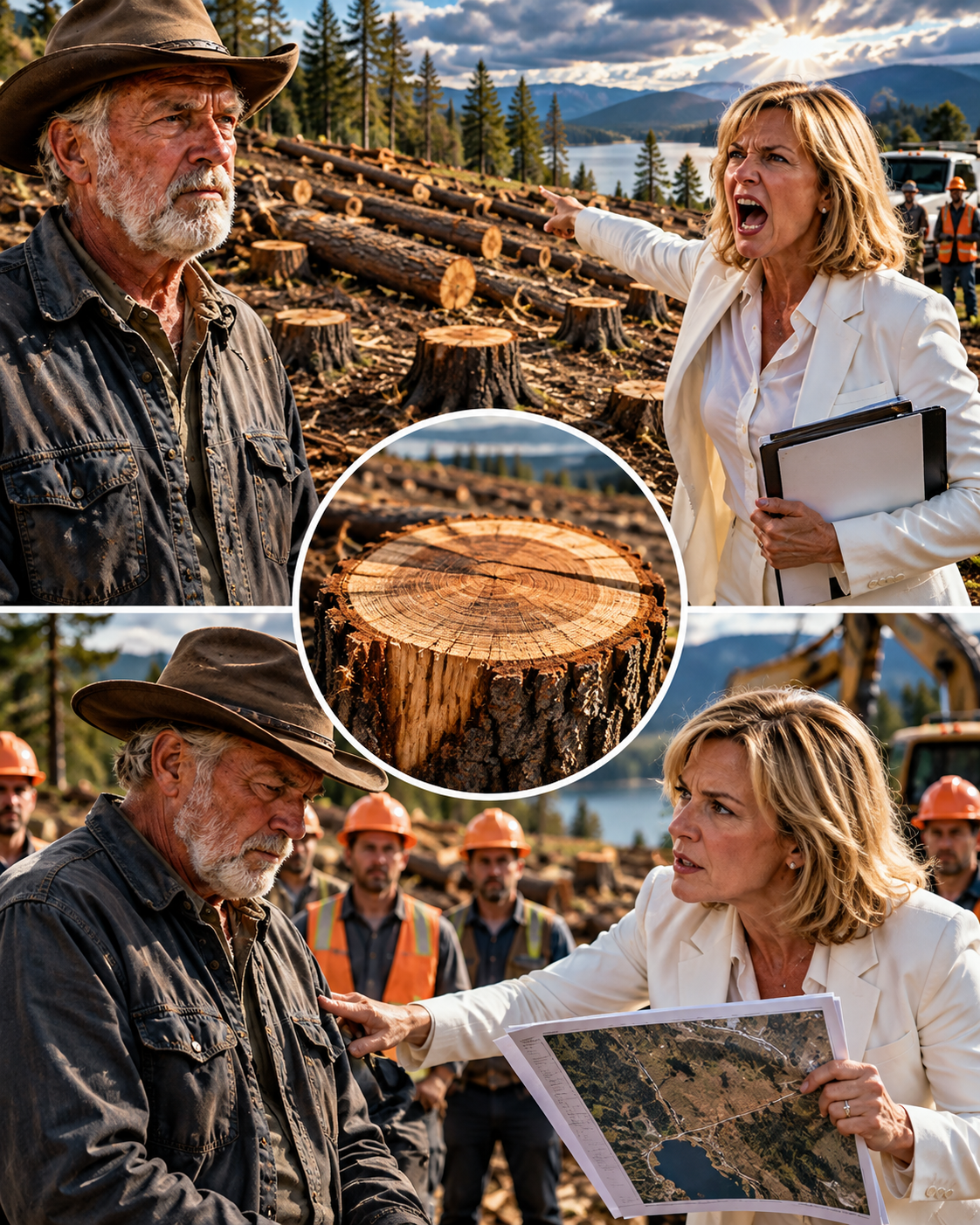
Part 2: Attorney uncovers why eleven trees were never hers to cut
Jack stood at the kitchen window, looking at the gap where the trees had been. The lake was visible now, but he had never wanted that view badly enough to trade for eleven living oaks. He turned from the glass and went to the study closet, where a banker’s box sat behind agricultural reference books and old tax records. The box was marked with one word in black marker: ranch. Inside were his deed, a boundary survey, the original HOA covenants, and a leather card holder. He carried everything to the kitchen table and began with the documents most likely to settle the matter.
Pine Hollow Ranch covered twelve acres. Three acres, including the farmhouse, front pasture, and main driveway approach, were zoned residential and included within the HOA’s jurisdiction. The other nine acres contained the back pasture, creek corridor, barn pad, and the entire eastern tree line. That land was zoned agricultural. Under Redwood County’s development agreement and Silver Creek Shores’ original covenants, agricultural parcels were explicitly excluded from HOA authority. The survey confirmed the small pin’s location: every felled oak and both trees marked for the next phase stood on the agricultural land.
Diane had not merely cut Jack’s trees without permission. She had ordered removal on land outside the association’s jurisdiction, issued Jack a fine for a condition she had created, and marked two more trees for cutting. She had done all of it while standing on his property. Jack had spent thirty-one years working in land-use and property-rights law, though few residents knew his career history. He had learned that the most dangerous institutional actors were often the ones who believed themselves unquestionably right. They moved boldly and rarely thought to check where they were standing.
Diane had led the HOA for nine years. During that time, she had issued more than four hundred fines, filed liens against eleven properties, and threatened several homeowners with foreclosure. She had harassed Sophia Bennett for months over a decorative mailbox later found to comply with the rules. Harold and June Collins had repainted their fence three times and their garden shed twice because Diane kept changing the color standard. Jack had heard these stories from neighbor Walter Briggs, half in frustration and half in resignation. He had quietly paid Sophia’s mailbox fine with an anonymous cashier’s check, never expecting her to learn who had sent it.
He set the deed beside the survey and opened the leather card holder. The top card read “Mercer and Associates, Land Use, Zoning, and Property Rights Law.” Jack had retired two years earlier and moved to the ranch full-time. He had never seen a reason to tell the neighborhood what he had done for a living. Now he wrote a nine-page cease-and-desist letter, citing the parcel boundaries, zoning code, HOA covenants, state statutes, and relevant court decisions. It demanded the HOA stop all activity on the agricultural parcel, void the $400 fine, acknowledge its jurisdictional error in writing, and attend a formal review.
Part 3: Neighbors reveal fines and harassment while Jack assembles evidence quietly
The next morning, Jack printed nine copies of the letter and delivered them to Diane, the HOA treasurer, and the remaining board members. He handed each envelope over without argument and wished them good morning. On his way back, he checked the four trail cameras he had installed along the fence line. They had captured the trucks, the crew, the chainsaws, the orange flags, and the precise moments each oak was cut. Two cameras recorded clear timestamps, and one also captured audio. Jack had installed them before the dispute, as a practical measure on a working ranch. Now they preserved evidence that could not be reconstructed from memory.
At eleven, an email arrived from the HOA. Diane had sent it to all seventy-four households, calling Jack a difficult homeowner who had been fined for an aesthetic violation and was retaliating with baseless legal threats. She described him as a potential danger to the community’s governance and urged residents to stand behind their elected board. Jack read it once, forwarded it to his former associate Elaine Foster, and saved a screenshot. The message had been sent forty-one minutes after he delivered the cease-and-desist letter to Diane. He noted the timestamp and made himself lunch.
Diane called that afternoon and left a voicemail lasting more than two minutes. She insisted the HOA had authority over all land inside Silver Creek Shores and said the board did not recognize his letter as valid. The association planned to return the next week to remove the two remaining oaks. If Jack tried to block access, she warned, he could be charged with trespassing. Her final words were delivered with the confidence of someone who had never been stopped: “Try and stop us.” Jack listened twice, then called Elaine, his former associate, twenty-seven years younger and far more aggressive in court. “Elaine,” he said, “pack a bag. The box is open.”
Walter Briggs met Jack at the fence the next morning with coffee and a folder. He had lived in the neighborhood since it was built and had kept records because he trusted documentation more than memory. His folder contained seven years of fine notices, three unanswered complaints to the board, and a notebook recording every interaction he had witnessed or experienced with Diane. Jack visited Sophia Bennett next. She had bought her small blue house with money saved over six years of working two jobs and had received three fines in her first year. She described each one carefully, then asked whether Jack had ever heard of someone paying her mailbox fine anonymously.
Jack gave a small nod. Sophia looked toward the street and then back at him, her expression changing in a way he did not try to name. Harold and June Collins had kept every fine, lien warning, letter, and voicemail from the HOA. By the end of two days, Jack had statements from eleven households, photographs, emails, recordings, and a detailed history of the association’s enforcement. Elaine arrived Thursday evening and sorted the evidence into three binders: property rights, harassment, and procedural violations. When she asked whether they were suing, Jack looked out at the stumps and said, “No. Something better.”
Part 4: The HOA returns with deputy, then retreats before county records
Diane returned on Monday morning, as promised. Two white trucks came up the gravel road, followed by a flatbed carrying a wood chipper and a Redwood County sheriff’s cruiser. Jack put down his coffee and walked to the gate. Deputy Chen stepped forward with the slightly uncomfortable manner of someone assigned to escort a civil dispute. He explained that the HOA had requested law enforcement to ensure the “peaceful execution” of its vegetation-management project. The briefing, he said, described a valid community improvement order and warned that anyone obstructing the crew might be trespassing.
Jack listened without interrupting. Then he handed the deputy three documents: the recorded deed with parcel boundaries highlighted, the boundary survey showing agricultural zoning, and the cease-and-desist letter. He explained that the trees stood on agricultural land, which was excluded from HOA authority under the county code and the original covenants. The board had been formally notified in writing. Deputy Chen read the papers once, then again, with the focused attention of someone realizing the situation was more complicated than the briefing had suggested.
He walked back to his cruiser and made a phone call. Then he went to Diane’s truck and spoke to her through the window. The conversation lasted about four minutes. From where Jack stood, he watched Diane’s face shift through certainty, confusion, irritation, and finally a stillness that looked like an assumption being removed without warning. The crew stayed in their vehicles. One worker shut off the engine of the flatbed. The deputy returned and said he could not support the HOA’s claim of authority over the parcel, and that no trespassing enforcement would be issued against Jack.
The trucks backed down the road. Diane remained beside her vehicle, staring at Jack. “This isn’t over,” she said. “We will find a way. We will have your house.” One of the trail cameras recorded her words from six feet away. Jack looked at her, then turned and walked back to the porch to pick up his coffee. He called the Redwood County Planning Board and asked to be placed on Wednesday’s public-hearing agenda. Then he made an appointment with the county attorney and called Patrick Greer, a regional reporter who had covered land-use disputes for two decades.
Elaine came to the porch and asked what he was building. “You’ll see Wednesday,” Jack said. The planning board met twice a month in a low brick county building that smelled of paper and industrial cleaner. By Wednesday, every folding chair was occupied and people stood along the back wall. Patrick sat near the front with a notebook. Walter, Sophia, and the Collinses had brought written statements. Elaine sat beside three binders and a laptop. Diane had arrived early, prepared remarks in hand and a seat near the front.
Part 5: County hearing exposes Diane’s overreach in front of neighbors all
Diane asked to speak first and was given the floor. She described the dispute as one difficult homeowner obstructing legitimate community governance. She called the tree removal a reasonable aesthetic improvement and said the HOA had a fiduciary responsibility to maintain property values. She warned that allowing one landowner to override an elected board would create a dangerous precedent. Her remarks were fluent, calm, and organized. Several commissioners nodded as they followed the argument, while residents in the back waited to hear what Jack had brought.
When the board chair called him, Jack placed a rolled zoning map on the projection table and weighted its corners with the binders. He explained the split zoning: three residential acres and nine agricultural. He marked the location of the eleven felled oaks and the two surviving trees, all on the excluded parcel. Then he showed the relevant covenant language, the county statute, and three court decisions involving associations that had exceeded their authority. He noted that he had provided the same information to the HOA two weeks earlier. Instead of asking for clarification, the board had called him dangerous in a communitywide email.
Jack connected his laptop and played two minutes and forty seconds of trail-camera footage. The screen showed the work trucks arriving, the crew cutting each oak, and Diane standing on agricultural land with her clipboard. It also showed her planting orange flags beside the two remaining trees. Then Jack played the voicemail. Diane’s recorded voice filled the room: “Try and stop us.” The second recording captured her threat that the HOA would find a way to take his house. The room fell into a silence so thick that no one moved for several seconds.
Walter submitted his statement. Sophia handed hers to the clerk. Harold stood and read June’s account aloud because her hands were shaking. Three residents who had never spoken to Jack asked to submit written complaints of their own. Then county planner Dr. Sandra Huitt confirmed that the agricultural acreage was unambiguously outside the HOA’s jurisdiction. The tree removal had occurred entirely on excluded land, and the $400 fine had no legal basis. Diane stood up without being called and said the board had already authorized a lien against Jack’s property.
“Ms. Holloway,” the chair said, “please be seated.” The reporter’s camera clicked twice. Diane sat down, and Neil Parker, the HOA treasurer, stared at his shoes. The commissioners exchanged a look that required no explanation. When the hearing adjourned, two flatbeds appeared on the county road near Pine Hollow’s gate. They carried mature oak trees, balled and burlapped, their canopies dark against the evening light. The nursery driver held out a signed work order and asked Jack, “Where do you want the first load?”
Part 6: Jack restores slope with fourteen oaks and permitted barn lawfully
The next morning began in bands of color, from predawn blue to gray and then amber as the sun reached across the pasture. A county permit officer arrived before six, followed by Robbie, the construction foreman who had worked with Jack’s contractor for eight years. The nursery crew had slept in their trucks by the gate. By seven, the construction equipment was in place, and by eight, the first post hole was being dug on the slope where eleven stumps still seeped sap into the spring earth. Jack reviewed the layout with Robbie, approved it, and listened as the sound of tools used for building replaced the sound of chainsaws.
Four days after the trees were cut, Jack had filed for a permit to build an agricultural storage and livestock barn. He had commissioned plans from an agricultural engineer, then submitted them with the parcel survey and zoning documents. The county approved the permit in three days. The barn would stand thirty-five feet high at the ridge and stretch 120 feet along the agricultural acreage. It complied with Redwood County’s agricultural building codes, and it sat well within Jack’s property. Nothing about it depended on an HOA vote.
That afternoon, the nursery crew unloaded fourteen mature oaks, each twenty feet tall or more. Using a tree-spade attachment, they set them into holes along the slope between the barn site and the eastern boundary. The arborist had specified a staggered double row to create a dense canopy as the trees matured. Dave Kellerman walked the line after planting and said that, when grown, the trees would block the lake sightline from the cul-de-sac and nearby homes. Jack had eleven trees cut down; he planted fourteen in their place, each larger than the young oaks he had planted in 1989.
Jack walked the row as the construction crew raised the barn frame. At the last tree, he placed a hand against the bark. It was cool, rough, and alive beneath his palm, nothing like the warmth of fresh sawdust he had felt beside the stumps. Elaine had followed him down the slope and stood two trees back. “They cut down eleven,” Jack said. “I’m putting back fourteen.” She looked at the barn skeleton behind the row and said it would block the view even before the trees matured. “Yes,” he replied. “And the trees will block it after that?” “Yes.” “There’s nothing the HOA can do?” “No.”
Diane’s silver sedan came skidding up the gravel road, scattering stones as she braked near the gate. She got out without turning off the engine and walked toward the construction site. First, she saw the barn frame, already substantial against the sky. Then she saw the fourteen trees between her and the lake. Jack held out the county permit, but she kept staring at the row. “You can’t,” she began. “Agricultural parcel,” he said. “Permitted barn. Permitted planting. All county codes met.” He set the permit on the hood of her car and told her she was welcome to call the building department.
Part 7: County charges and civil claims transform neighborhood’s old patterns
Walter Briggs walked up the gravel road and stopped a few feet from Diane. He looked neither triumphant nor angry, but like someone who had waited a long time for a situation to resolve. “Did you know Jack Mercer spent thirty years taking homeowners associations to court?” he asked the space between them. “Land-use law, mostly. Jurisdictional overreach, covenant violations, improper fine schemes.” He paused and looked at Diane. “He retired two years ago. You probably should have checked.” Her expression went very still as she looked from the permit to the barn and then to the new oaks.
That afternoon, Neil Parker resigned from the board, citing personal reasons. The county attorney filed a complaint against the HOA for unauthorized vegetation removal, improper fines on excluded land, and a bad-faith lien filing. The association’s insurer received notice of a claim and responded that the conduct appeared to fall outside the board’s documented authority. The following week, deputies executed a search warrant at the HOA office. An auditor reviewing the recovered financial records found a pattern of fine revenue that required further scrutiny. The case was no longer limited to Jack’s trees.
Elaine filed a civil suit the next Thursday with eleven households as co-plaintiffs. The forty-seven-page complaint described four years of documented harassment, three improper liens, six fines issued without a valid board quorum, and the illegal tree removal that had started the dispute. The filing fee was four hundred dollars, which Jack paid in cash. Elaine recorded the expense in her ledger with handwriting so neat it looked deliberate. The HOA entered a formal guilty plea to the county charges six weeks later.
The settlement required restitution to affected homeowners, removal of invalid liens from county records, and voiding fines issued without a proper legal basis. The association also accepted three years of county oversight and mandatory governance reforms. Diane was removed from the board and permanently barred from serving as an HOA officer or director in Redwood County. The civil case settled at the same time, with affected households receiving restitution the county auditor considered fair. The insurer called it the minimum acceptable outcome, but the residents cared more about having their records corrected and their money returned.
Sophia received repayment for every fine she had ever paid, with interest, and a written apology from the interim board chair. She stood on her porch and read the letter twice before folding it into her jacket pocket. Harold and June received restitution for their fence and shed repainting, and the lien tied to their birdhouse was removed. June cried when the release document arrived, then asked Harold to drive her to the paint store so she could finally choose the color she had always wanted. Walter declined repayment for his own fines and asked that the money go toward legal expenses for whichever household needed it most.
Part 8: Patricia’s swing returns while fourteen young oaks take root deeply
The new board formed from volunteers who applied rather than accepting appointments. At its first meeting, it limited enforcement to properties within documented residential zones and required legal review for any fine above one hundred dollars. It also approved a neighborhood tree-planting initiative. Walter was elected secretary on the condition that meetings end within an hour. The neighborhood did not change overnight, but gradually the streets began to feel different. Residents walked in the evenings without looking over their shoulders, and the Collinses hosted their first summer cookout in five years.
Sophia hung a larger wind chime on her porch, its deep notes carrying through the spring air. No one complained, because there was no valid reason to do so. Three households that had quietly considered selling decided to stay, and another family withdrew its listing. The barn at Pine Hollow Ranch was complete by the end of spring, with a sealed roof and warm, reddish-brown siding that looked at home in the working landscape. The fourteen oaks stood in their double row, their new leaves small and bright against the pasture.
Dave Kellerman returned in June to check the root systems. He confirmed that all fourteen trees were establishing well, drawing water from the deep clay soil and putting out new wood and leaves. They would need monitoring through another summer, he said, and after that they would manage on their own. Jack thanked him and walked the row, letting his hand trail from one trunk to the next. The new oaks could not replace the years lost with the eleven old trees, but they gave the slope something living to hold onto. That mattered more to Jack than any view the HOA had wanted to uncover.
Patricia had chosen the porch swing years earlier, a two-seat wooden bench that caught the afternoon sun and looked down the slope toward the tree line. Jack had taken it down after she died, not because he had decided to forget her, but because the empty seat beside him felt too large. In late May, he brought the swing back out and measured the chain spacing with his usual care. When it was secure, he sat down and pushed off gently with one boot. The porch boards were warm under his feet, and the ranch settled around him with the sounds of birds, cattle, wind, and the soft creak of the chains.
From the swing, he could see the fourteen young oaks and the roof ridge of the new barn beyond them. Silver Creek Lake still lay farther down the slope, beautiful in the evening light. The trees did not erase the lake; they changed how much of it could be seen from the cul-de-sac. Jack had never objected to his neighbors enjoying the water. He had objected to being told that his land belonged to the association and his trees could be cut because someone preferred a different view.
The survey pin remained where it had always been, small and nearly flush with the ground. Jack crouched beside it one morning and pressed his fingers into the cool spring soil. Two feet away, one of the new oaks had pushed its roots into that same earth. He had commissioned a sign for the ranch gate that read, “Mercer Ranch. Right to Farm. Protected Redwood County Agricultural Preserve.” Elaine laughed when she saw it, the first unguarded laugh Jack had heard from her in weeks. The sign faced the cul-de-sac precisely where the county survey showed the agricultural parcel began.
Part 9: The lake remains, but ownership finally has clear boundaries again
Elaine asked Jack before driving back to the city whether he would be all right alone at the ranch. He told her he was not alone: he had the land, the cattle, Walter down the road, and fourteen new oaks to watch through their first summer. She looked at him with the expression of someone who knew he was telling the truth, but not all of it. “Call me if you need anything,” she said. Jack told her he would, and he meant it. The swing moved gently in the afternoon air as the young leaves caught the gold light at their edges.
The HOA’s reforms did not make every resident friends or erase every difficult memory. They did make it harder for one person to treat a preference as a rule and a vote as permission to cross a property line. The board now kept records, reviewed documents, and asked for legal guidance before issuing a fine or filing a lien. Residents who had once believed there was no point in speaking up began attending meetings. They had watched the county planner confirm what the deed and survey had always said. Their homes and land did not become less complicated, but the rules around them became more visible.
Jack never asked for applause. The eleven trees were gone, and no judgment could give Patricia back the mornings she had spent beneath their shade. But the surviving trees were safe, the new oaks were growing, and the HOA no longer had authority to reach across the agricultural boundary. The barn stood under a valid permit, used for ranch equipment and livestock supplies. The fine had been voided, the lien withdrawn, and the neighbors who had been targeted received restitution. The outcome was not the one Jack would have chosen at the beginning, but it was one he could live with.
On a late afternoon, he walked the property line once more. He checked the fencing and drainage, then followed the boundary to the spot where the metal pin sat under a thin layer of soil. It had been easy to miss, but it had never moved. The survey had not changed when the HOA voted; the covenants had not changed when Diane raised her voice; and the agricultural parcel had never become common property because the board wanted a better view. Jack brushed away the dirt and stood up. Beyond the trees, the lake shone in the distance.
The view was still there, though framed differently. Patricia’s swing creaked behind him, and the new oaks stood in the red clay where the old ones had once spread their roots. The barn roof caught the last light, a quiet sign of the ranch continuing its work. Jack thought of the day he had arrived to find eleven stumps and heard Diane call the destruction an improvement. She had wanted to reveal the lake. Instead, she had revealed the limits of her authority and the people who had been waiting for someone to challenge it.
In the end, the most important part of the story was not that Jack had practiced law for thirty years or that he had built a barn and planted fourteen trees. It was that he knew the land well enough to find the pin and had the patience to prove what it meant. He had answered threats with records, intimidation with witnesses, and the HOA’s claim with the county’s own documents. The neighbors learned that silence could protect a bully longer than any rulebook. And the ranch, scarred but alive, kept growing beyond the reach of a board that had finally learned to check the map.
✓ Lynn R. Adams
Part 2: Attorney uncovers why eleven trees were never hers to cut Jack stood at the kitchen window, looking at the gap where the trees had been. The lake was visible now, but he had never wanted that…