“I’ll Do Anything—Just Give Me a Family,” She Begged the Widowed Rancher, Never Knowing What His Children Were Hiding
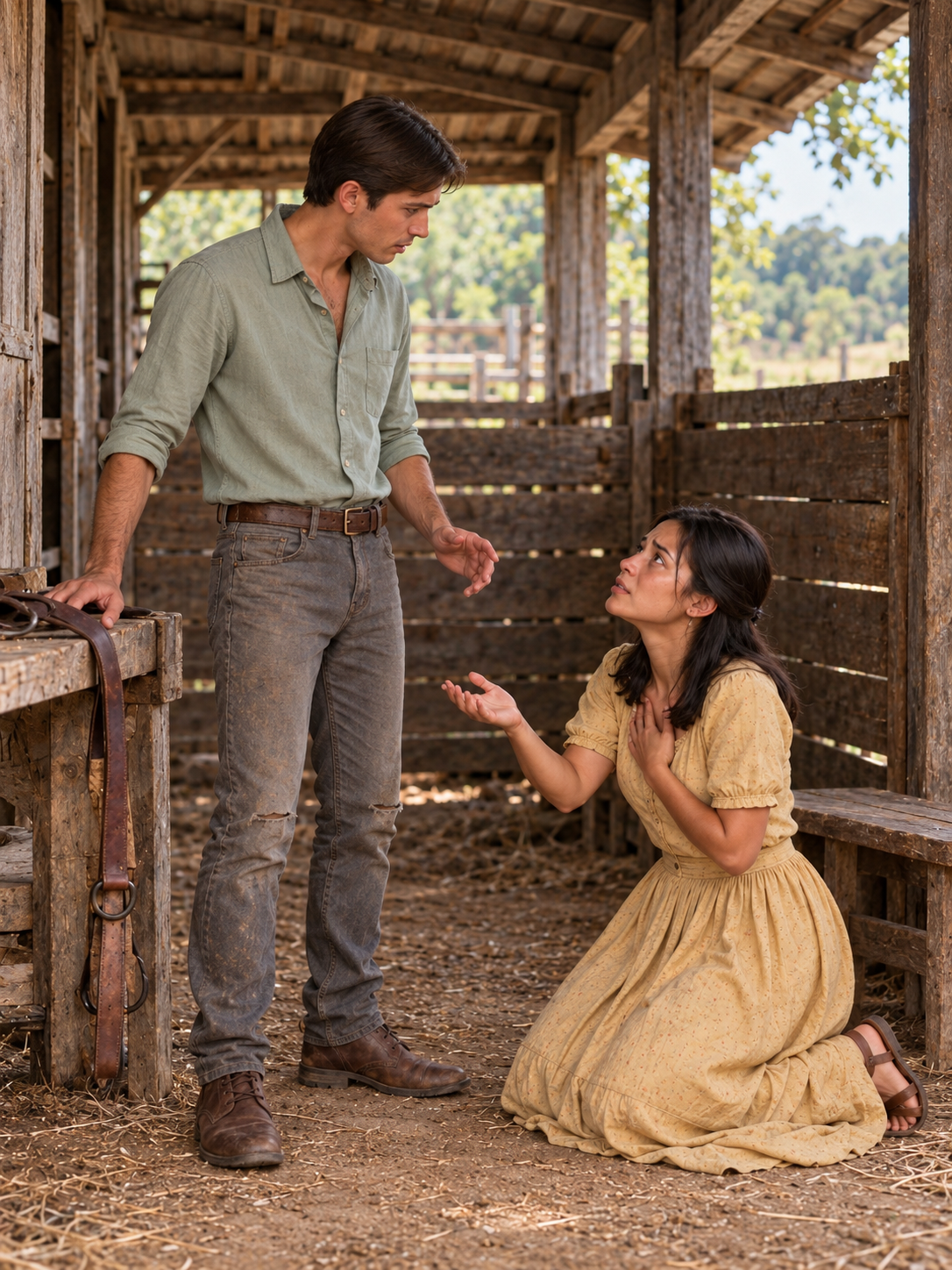
“I’ll Do Anything—Just Give Me a Family,” She Begged the Widowed Rancher, Never Knowing What His Children Were Hiding
“I’ll do anything,” the young woman said, standing barefoot on the ranch porch with rain running from her hair to her borrowed coat. “Just give me a family.”
Caleb Morgan did not answer.
Behind him, his two children had gone completely silent.
His eight-year-old daughter was clutching the kitchen doorway with both hands.
His eleven-year-old son had stopped pretending not to listen.
And the stranger standing in front of them looked one bad night away from disappearing forever.
Her name was Hannah Carter.
She was twenty-six.
She had one canvas bag, twenty-three dollars, no living parents, no husband, and nowhere she could safely call home.
Caleb was thirty-eight.
A cattle rancher.
A man who had buried his wife three winters earlier and spent every day since convincing himself that his children needed routine more than they needed warmth.
Neither of them understood yet that Hannah had not arrived at the Morgan ranch by accident.
And before the next winter ended, the secret hidden inside an old cedar chest upstairs would force Caleb to decide whether the lonely woman asking for a family had come to save his—or unknowingly walked into a promise made before she was even born.
Should Caleb send Hannah away before his children became attached to her—or let a desperate stranger stay long enough to discover why his late wife had written Hannah’s name inside a letter nobody was supposed to find?
The Morgan ranch sat eleven miles outside Red Creek, Wyoming, where the road narrowed from pavement to gravel and the mountains looked close enough to touch even when they were twenty miles away.
Caleb’s property covered almost nine hundred acres.
Good grass.
Cold creek.
One weathered two-story house.
One cemetery plot beneath a cottonwood tree where his wife, Emily, had been buried beside her parents.
People in Red Creek considered Caleb lucky.
That was because people confuse land with happiness.
The ranch was paid for.
The cattle herd was strong.
Caleb’s mortgage was gone.
His children were healthy.
What could possibly be missing?
Everything that used to make the house feel alive.
Emily Morgan had been the kind of woman who sang while cooking even though she could not carry a tune.
She planted sunflowers along the kitchen fence because they annoyed Caleb’s father.
She kept Christmas lights up through February.
She danced with their daughter, Lily, in the living room while their son, Noah, complained that both of them were embarrassing.
Then, at thirty-four, Emily became sick.
At first everyone said it was exhaustion.
Then an infection.
Then something more serious.
Within ten months, she was gone.
Caleb did what men like Caleb often do when grief becomes too large.
He organized it.
Breakfast at .
School bus at .
Feed cattle.
Repair fence.
Pick up groceries.
He never forgot a lunch.
Never missed a school meeting.
Never let the refrigerator become empty.
And still Lily began drawing families without mothers.
Noah stopped inviting friends over.
The house became clean and cold.
Caleb noticed.
He simply did not know what to do with that knowledge.
Then Hannah Carter appeared during a storm in late September.
Caleb first saw her at Red Creek’s general store.
She was standing near the front counter, arguing quietly with the owner, Ruth Dawson.
Embarrassed.
“I can work for it.”
Ruth shook her head.
“Honey, I don’t have anything.”
“I can clean.”
“I already have someone.”
“Stock shelves?”
“My nephew.”
“I can unload deliveries.”
Ruth sighed.
“You’re freezing.”
“I’m fine.”
She clearly was not.
Caleb carried a fifty-pound sack of mineral supplement toward the register and pretended not to listen.
Hannah wore jeans too large for her.
A gray sweater under a thin green coat.
Her hair was long, dark blond, and wet from rain.
Not styled.
Not dramatic.
Just tired.
Ruth looked toward Caleb.
He stopped.
Ruth only used his name like that when she wanted something.
“I haven’t asked.”
“You’re about to.”
Hannah turned.
Her face went red.
“No. Please don’t.”
Ruth ignored both of them.
“Your ranch needs help.”
“I have Eli.”
“Eli is seventy-one.”
“He’s sixty-eight.”
“Same difference.”
Caleb put the feed sack down.
“I don’t need house help.”
“You need a miracle.”
She leaned over counter.
“This girl needs work.”
Hannah stepped back.
“I’m sorry.”
Caleb looked at her.
“For what?”
“For this.”
She gestured vaguely.
Being seen.
He hated that instinct because he recognized it.
Emily used to apologize whenever she was sick enough to need help.
“I’m Hannah,” she said.
“I can work.”
“That’s what Ruth says.”
“I don’t need charity.”
“Good. I don’t give it.”
Ruth rolled her eyes.
Caleb continued.
“What can you do?”
“Everyone says that.”
“Then don’t hire me for cooking.”
“What kind?”
“Horses. Chickens. Goats. Not cattle.”
Hannah hesitated.
That hesitation made him trust her more.
“I like them.”
“Experience?”
“Younger cousins.”
“References?”
She looked at Ruth.
Then floor.
“I’ve moved around.”
Caleb hated vague answers.
“What does that mean?”
Hannah lifted her eyes.
“It means I can tell you everything here in front of half the town, or you can decide you don’t need help.”
Ruth looked offended.
“There are four people here.”
Caleb almost smiled.
He gave her ranch address.
“Tomorrow. Seven.”
“For what?”
“A trial day.”
Hannah blinked.
“Seven means seven.”
“I know what seven means.”
She came at .
Caleb found her at end of driveway.
“You walked from town?”
“That’s eleven miles.”
“Ten point eight.”
“You measured?”
“My phone did until battery died.”
“Why didn’t you call?”
“I don’t have your number.”
He drove her remaining half-mile to house.
Noah was eating cereal.
Lily was drawing at table.
Both stared.
“This is Hannah,” Caleb said. “She’s helping today.”
Lily asked immediately:
“Are you Dad’s girlfriend?”
Caleb nearly choked.
Hannah did not.
Hannah answered calmly.
“Because we met yesterday.”
Lily considered.
“That makes sense.”
Noah smirked into cereal.
Caleb gave Hannah list.
Do not touch Emily’s things in upstairs closet.
Do not reorganize office.
Do not feed dogs table scraps.
Hannah said:
“Anything else?”
“Don’t let Lily negotiate.”
Hannah looked at her.
“I’ve been warned.”
By noon, kitchen smelled like bread.
Caleb came inside suspicious.
“What is that?”
“Because flour was going stale.”
“You bake?”
“You asked if I cook.”
“I thought that meant eggs.”
“You have very low standards.”
She stared back.
Then Noah laughed from hallway.
It was the first full laugh Caleb had heard from him in weeks.
That got Hannah second day.
Then a third.
By Friday, Caleb offered her temporary work.
Five days a week.
Room in old bunkhouse.
Cash wages.
Hannah looked at bunkhouse.
Roof solid.
Wood stove.
Small bathroom.
She touched window frame like it was marble.
“How much rent?”
“None. Part of job.”
“Then reduce wages.”
“That’s offer.”
She looked at him.
“Because bunkhouse is empty.”
“That’s not why.”
He did not answer.
She accepted.
For first month, nothing extraordinary happened.
That was the extraordinary part.
Hannah did not try to replace Emily.
She never moved family photographs.
Never called children pet names too soon.
Never changed routines without asking.
She simply filled spaces nobody realized were empty.
She repaired Lily’s Halloween costume at midnight after a seam tore.
She taught Noah to make biscuits because he complained Caleb’s were “weaponized flour.”
She sat on porch with Eli and learned how to read cattle behavior.
She kept a small notebook of expenses and discovered Caleb had been overpaying one feed supplier by four percent because of a duplicate delivery surcharge.
“That’s impossible,” he said.
She slid invoices across table.
“Apparently not.”
She was right.
“Where did you learn this?”
“My mother kept books for a trucking company.”
Again vague.
Caleb noticed Hannah knew how to stretch food without making meals feel cheap.
She could mend shirts invisibly.
Could identify when a person wanted company but not conversation.
Could disappear inside a room when conflict rose.
That last skill bothered him.
People learn invisibility somewhere.
Usually not in happy houses.
One evening Lily asked Hannah:
“Where’s your family?”
Hannah stopped peeling potatoes.
Caleb looked up.
“It’s okay.”
Hannah set knife down.
“My mom died when I was nineteen.”
Lily’s face softened.
“My mom died too.”
“What about your dad?”
“Then where?”
Hannah smiled sadly.
“If I knew, I’d tell you.”
Noah asked:
“Brothers?”
“Grandparents?”
Hannah’s hands tightened slightly.
“We don’t talk.”
Lily whispered:
“So you’re all alone?”
That question changed room.
Hannah looked down.
“Pretty much.”
Lily slid from chair.
Walked around table.
Hugged her.
No permission.
No warning.
Hannah froze.
Then slowly wrapped one arm around child.
Caleb looked away.
Because something in Hannah’s face hurt too much to watch.
That night he found her sitting outside bunkhouse steps.
“You’ll freeze.”
“I’m fine.”
“No one who says that is fine.”
She smiled faintly.
“Ruth says that too.”
He handed her coat.
She put it on.
For a while neither spoke.
Then Hannah said:
“I should probably leave before winter.”
“Kids are getting attached.”
He looked toward house.
“That’s dangerous.”
“All of us.”
Caleb sat on step beside her.
“You planning to disappear?”
“Then what’s dangerous?”
“I don’t know how long you want me here.”
“That can be discussed.”
“You don’t understand.”
Hannah looked at him.
Eyes bright but no tears falling.
“I’ve spent seven years being temporary.”
That sentence landed harder than he expected.
She continued.
“Couch. Room. Job. Family friend’s place. Church spare room. Motel. Another job.”
Caleb said nothing.
“Everywhere I go, somebody says I can stay until.”
“Until what?”
“Until they need room. Until boyfriend moves in. Until rent goes up. Until cousin comes back. Until I stop being useful.”
She laughed once.
“Turns out until is longest word in English.”
Caleb looked at her.
She shook head.
“I’m not asking for anything.”
Yet three weeks later, she did.
Because things changed.
Not romantic first.
Snow came early.
A pipe burst in bunkhouse.
Water flooded floor.
Caleb shut valve.
Repairs needed.
“Stay in guest room,” he said.
“It’s temporary.”
She flinched at word.
He noticed.
“Until bunkhouse fixed.”
She almost laughed.
“You want to sleep in flooded building?”
“Then guest room.”
She moved in.
Then two because plumber delayed.
Then Lily got fever.
Hannah stayed up beside her while Caleb handled calving emergency.
Noah started asking Hannah for help with school before asking father.
The house softened.
Caleb hated how much he liked it.
Because liking means risking.
Emily had taught him that without intending to.
Then one Sunday after church, town gossip reached him.
Ruth cornered him beside truck.
“You know people are talking.”
“People are always talking.”
“About Hannah.”
“She’s living in your house.”
“Bunkhouse pipe broke.”
“Somebody says she’s after your ranch.”
Caleb laughed.
“Karen Blake.”
“Of course.”
Karen owned boutique and half town’s opinions.
“She says Hannah came into town with nothing, attached herself to widower, now lives under same roof.”
Caleb’s jaw tightened.
“She works.”
“Then why tell me?”
“Because Hannah heard.”
Caleb turned.
“Church bathroom.”
Cruelty often prefers small enclosed spaces.
He found Hannah packing that afternoon.
Canvas bag on guest bed.
“What are you doing?”
She looked at him.
“That isn’t your decision.”
“Fair. Why?”
“Town thinks I’m using you.”
“Town thinks weather is government conspiracy.”
“That doesn’t help.”
“Who cares what Karen Blake says?”
“Because your children live here.”
Caleb stopped.
Hannah continued.
“I don’t want Lily hearing I’m trying to replace her mother.”
“She knows better.”
“She’s eight.”
“He’s eleven.”
“He also knows better.”
He stepped inside room.
“Did I accuse you?”
“Did children?”
“Then don’t let bored people run my house.”
She looked at him.
“That’s not only reason.”
“Then tell me.”
“I’m starting to want this.”
He knew immediately what this meant.
She continued before he could respond.
“And wanting it is stupid.”
“Because none of it is mine.”
That was when sentence came.
The one she would remember forever.
“I’ll do anything.”
Caleb frowned.
Hannah’s voice broke slightly.
“Just give me a family.”
She hated herself as soon as words escaped.
He could see it.
She took breath.
“No. Forget that.”
“I didn’t mean—”
She stared.
He did not mock her.
That made it worse.
“I don’t want your ranch,” she whispered. “I don’t want money. I don’t want to take Emily’s place. I don’t need some fairy-tale wedding.”
Caleb’s chest tightened.
“I want people who notice if I don’t come home.”
“I want somewhere nobody can tell me to leave because cousin is visiting.”
Her eyes finally filled.
“I want Christmas plans made in October because everyone assumes I’ll still be there in December.”
Caleb could not speak.
“I want Lily asking me to fix costumes.”
She wiped one eye angrily.
“I want Noah insulting my pancakes.”
“They are bad.”
She laughed through breath.
“I want somebody to be annoyed when I forget milk.”
“I just want to belong somewhere before I’m thirty and still carrying everything I own in one bag.”
Caleb looked at canvas bag.
Then at Hannah.
He wanted to say stay.
But he had children.
Emily’s memory.
His own fear.
He could not promise family because lonely woman asked.
That would be cruel in another direction.
So he said:
“Don’t leave tonight.”
Hannah looked disappointed.
“Because neither of us should make a lifetime decision while angry at Karen Blake.”
That earned small smile.
“Tomorrow?”
She nodded.
That night Caleb did not sleep.
At a.m., he went downstairs.
Found Emily’s old cedar chest open in hallway.
Lily stood beside it.
“What are you doing?”
“I was looking for Mom’s scarf.”
“Why at two?”
“I couldn’t sleep.”
Caleb moved closer.
Chest held Emily’s letters, baby clothes, photographs, jewelry box, and things Caleb had not touched since funeral.
Lily held one envelope.
“What’s that?”
“It has Hannah’s name.”
Caleb froze.
Cream paper.
Emily’s handwriting.
HANNAH CARTER.
Caleb’s blood went cold.
Impossible.
Emily died three years ago.
Caleb met Hannah two months ago.
He took envelope.
Dated on back:
March 18, four years earlier.
Emily had written Hannah’s name a full year before she died.
Caleb sat on hallway floor.
Lily whispered:
“Who is it for?”
“I don’t know.”
“Same Hannah?”
“How many Hannah Carters do we know?”
“Then maybe.”
He did not open it.
Not his name.
At breakfast, he placed envelope before Hannah.
She looked at handwriting.
Her face changed.
“Where did you get this?”
“Emily’s chest.”
“You knew?”
She did not touch it.
“Did she know me?”
“I was going to ask you.”
“You sure?”
“Full name Hannah Carter?”
“Rebecca Carter.”
Caleb froze.
He knew that name.
Not personally.
Emily had mentioned Rebecca once.
A woman from her college years?
He tried remember.
“Hannah, open it.”
Her hands shook.
She broke seal.
Inside were three pages.
She read first line.
Caleb waited.
Hannah handed it over.
Dear Hannah,
If you are reading this, then either Caleb finally found you, or God has a stranger sense of timing than I do.
Caleb stared.
He kept reading.
You do not know me.
My name is Emily Morgan.
Your mother, Rebecca, saved my life when we were nineteen.
Hannah covered mouth.
Caleb read.
Not metaphorically.
There had been a car accident outside Laramie.
Emily in overturned vehicle.
Rebecca Carter pulled her from car before engine fire.
News report.
Caleb remembered Emily telling story once.
She never knew rescuer’s full family.
Apparently later they stayed in contact.
Then drifted apart.
Emily found Rebecca again through social media years later.
Rebecca was sick.
She told Emily about daughter Hannah.
About unstable family.
About fear Hannah would have nobody.
Emily wrote:
Rebecca made me promise that if anything ever happened and Hannah needed somewhere safe, I would help.
Then I became sick myself.
I never contacted you because I thought I had time.
I was wrong.
If Caleb finds you one day, I hope he gives you work before charity.
He respects people who stand on their own feet, sometimes too much.
Hannah laughed softly through tears.
Emily continued:
Do not let him turn grief into a religion.
Do not let Noah pretend he does not need comfort.
Do not let Lily grow up believing love always disappears.
And do not feel you owe us anything because your mother once saved me.
A debt is not a family.
Family must be chosen.
Caleb could barely see page.
Final paragraph:
Caleb, if you are reading over her shoulder, stop being stubborn.
Hannah laughed louder.
He almost did too.
Emily had written:
If Hannah ever arrives at our door, you do not have to love her.
You do not have to marry her.
You do not owe Rebecca that.
Just do one thing for me.
Do not let her believe she is disposable.
Caleb stopped.
The kitchen went silent.
Noah stood doorway.
Lily beside him.
They had heard enough.
Hannah folded letter.
“Your wife knew my mother.”
“She wrote this before she died.”
“And you really didn’t know?”
Hannah looked almost suspicious.
Then Caleb understood.
Her life had taught her coincidence usually meant manipulation.
He opened chest records.
Found old photo.
Beside another young woman.
Dark blond hair.
Hannah’s eyes.
Rebecca Carter — the bravest person I ever met.
Hannah touched photo.
Then cried.
Not collapsing.
Not dramatic.
She sat at table while tears moved down face.
“My mom never told me.”
“Maybe she didn’t want you to feel indebted.”
“She always said Wyoming was where she made biggest mistake.”
Caleb frowned.
“What mistake?”
Hannah looked at photo.
“She never said.”
That became story’s first major twist.
Hannah had not randomly stumbled into Morgan ranch.
Their mothers’ lives had crossed long before.
But coincidence still needed explanation.
How did Hannah end up in Red Creek specifically?
She answered.
“My bus ticket.”
“When I left Denver, I had enough for cheapest westbound route. Red Creek was last stop I could afford.”
“Why Denver?”
“My aunt lives there.”
“Why leave?”
Hannah looked at children.
Caleb said:
That evening she told him outside.
Aunt Susan took Hannah in after Rebecca died.
At first kind.
Then controlling.
Hannah worked.
Susan’s boyfriend moved in.
He drank too much.
Not violent enough for police story, Hannah said.
But enough that she stopped feeling safe.
One night he entered her room without knocking.
Hannah packed next morning.
Susan blamed her.
Said she was dramatic.
Then withheld last paycheck from family catering business claiming “expenses.”
Hannah left with $117.
Bus to Cheyenne cost most.
Cheapest connection landed Red Creek.
Or strange timing.
No deliberate trail.
That mattered.
No hidden scheme.
No manipulated arrival.
Emily’s letter simply waited.
Like a promise buried in grief.
Caleb did not propose marriage.
That would have been ridiculous.
Instead he offered something more important.
“Stay through winter.”
Hannah looked at him.
“As employee?”
“Let that become true instead of naming it too fast.”
She nodded.
That was smart.
Winter tested everyone.
Snow buried north fence.
One heifer nearly died during difficult birth.
Water line froze.
Noah broke wrist sledding.
Lily developed school problem with classmate who mocked her dead mother.
Hannah never became savior.
She became present.
That difference mattered.
She drove Noah to physical therapy when Caleb could not.
She taught Lily to braid hair from YouTube because Emily had done it differently and Caleb never learned.
She burned Thanksgiving rolls.
Noah celebrated.
“Finally, Dad isn’t worst cook.”
She threw dish towel.
Christmas approached.
Hannah began packing one evening.
Lily panicked.
“You’re leaving?”
“Then why bag?”
“Church coat drive.”
Lily looked relieved so visibly Hannah had to turn away.
That night Hannah realized Emily’s letter had been right.
Lily did not fear rejection.
She feared disappearance.
Hannah began saying things differently.
“See you after school.”
“Tomorrow we’ll finish this.”
“Next Saturday we’ll bake.”
Future language.
Small promises.
That was how trust returned.
Meanwhile Caleb and Hannah changed too.
Not because rancher needed wife.
Not because lonely woman needed rescue.
Because they learned each other under pressure.
Caleb discovered Hannah was stubborn about money.
When he tried giving Christmas bonus twice normal, she returned half.
“Because it’s too much.”
“You worked extra.”
“Not that extra.”
“You kept household running.”
“Part of work.”
He eventually put difference into formal savings account in her name as documented bonus.
She found out.
Then saw payroll records.
Legitimate.
Accepted reluctantly.
Hannah discovered Caleb hated asking for help.
During blizzard he twisted knee.
Still tried feeding cattle.
She blocked mudroom door.
“My ranch.”
“Your knee.”
“Say please.”
Noah filmed that one.
Family laughed.
That laughter began replacing silence Emily left.
Then came Karen Blake again.
Not main villain.
Just town gossip.
At school fundraiser, she cornered Hannah.
“You’ve settled in.”
Hannah knew tone.
“What does that mean?”
“A widower with nine hundred acres.”
There it was.
Hannah stayed calm.
“You seem very interested in his acreage.”
“Everyone knows what Morgan ranch is worth.”
Karen smiled.
“Then maybe you’re better actress than people say.”
Hannah could have left.
“Karen, I work for Caleb. I have my own wages. I have no claim on his land.”
“You’re trying very hard to turn my life into something entertaining.”
Karen looked offended.
Hannah continued.
“I hope yours improves enough that you stop needing mine.”
Then walked away.
Mini-payoff.
No shouting.
No humiliation campaign.
But Karen’s gossip produced unexpected consequence.
Caleb’s late wife’s brother, Daniel Hayes, heard Hannah was living at ranch.
Daniel lived in Montana.
He had barely spoken to Caleb since Emily died.
He arrived unannounced in January.
Protective.
“You moved a woman into Emily’s house?”
Caleb stared.
“She works here.”
“She sleeps here.”
“Guest room.”
“You have children.”
“Yes. I’m aware.”
Daniel looked toward Hannah.
“Convenient.”
Hannah’s face changed.
She stepped back.
Caleb’s voice sharpened.
Daniel ignored.
“My sister dies and three years later you replace her with—”
Caleb grabbed front of Daniel’s coat.
Not struck.
Just stopped sentence.
“Do not finish that.”
Children froze.
Hannah said calmly:
He released.
Daniel straightened coat.
“She knows about trust?”
Hannah frowned.
“What trust?”
Caleb turned.
“What are you talking about?”
Daniel realized mistake.
Second major twist approaching.
“What trust?”
Daniel looked at children.
“Not here.”
They moved office.
Hannah initially stayed out.
Caleb called her in.
“If this concerns you, you hear it.”
Daniel hated that.
Then explained.
Emily’s parents created family trust before death.
Some assets passed Emily.
Upon Emily’s death, certain funds went to Noah and Lily.
Caleb knew.
But Daniel referenced something else.
A 120-acre parcel north of Morgan ranch.
Owned separately by Emily.
Caleb stared.
“She never owned land.”
“Hayes parcel.”
Caleb knew tract.
Timber and water access.
He had leased grazing there from a holding company for years.
Daniel said:
“Emily inherited it from Mom.”
“Why didn’t she tell me?”
“She planned to.”
“Before she got sick.”
Then illness came.
Paperwork stalled.
After death, title remained in Emily Hayes Family Trust.
Beneficiaries:
And one contingent life-use provision.
For a surviving spouse of Caleb?
For “Rebecca Carter or her surviving child, if either requires safe residence or agricultural employment.”
Hannah stopped breathing.
Daniel looked at her.
“Emily changed trust six months before she died.”
Caleb stared.
“She put Hannah in a trust?”
“Not by name initially. Rebecca Carter or descendant.”
Because promise.
Emily did more than write letter.
She created practical safety net.
But Daniel had been trustee.
He never activated.
He claimed he did not know Rebecca’s daughter’s identity.
Maybe true.
Trust said if located and in need.
No obligation to search aggressively? Let’s make.
Daniel said:
“I had first name. No current address.”
“Did you try?”
“How hard?”
Caleb’s eyes hardened.
“What does enough mean?”
“Private investigator found three Hannah Carters matching age.”
“Then Emily died. Mom died. Dad died. Everything became legal mess.”
He looked ashamed.
“I stopped.”
Hannah sat.
Adults stopped.
“What does provision give me?”
Daniel answered carefully.
“Not land ownership.”
“Right to occupy old foreman cottage on Hayes parcel for up to five years and option for paid ranch work through trust operations, if trustee approves need.”
Hannah almost laughed.
Emily had tried to guarantee exactly what Hannah begged for.
A place nobody could throw her out casually.
Not family.
But stability.
“Why tell us now?”
Daniel looked at Caleb.
“Because if Hannah is Rebecca’s daughter, trust applies.”
Hannah’s face changed.
“I don’t want it.”
Daniel blinked.
“I’m not taking Emily’s land.”
“It isn’t Emily’s anymore.”
Caleb said quietly:
“You don’t have to decide.”
Daniel added:
“It could give you independence from Caleb.”
That stopped her.
If relationship soured, she would have somewhere.
Not trapped.
Emily planned that.
Hannah whispered:
“She thought of everything.”
Daniel shook head.
“No. Emily thought of fear.”
He knew sister.
“She was terrified of leaving children and leaving promises unfinished.”
For first time Daniel softened.
“I think she would’ve liked you.”
Hannah looked away.
Daniel stayed two days.
Apologized badly.
But sincerely.
“I shouldn’t have spoken like that.”
“I was protecting Emily.”
Hannah said:
“She isn’t here to be protected from me.”
Daniel nodded.
“I was protecting my memory of her.”
They reached uneasy peace.
Hannah activated cottage right.
Not to move immediately.
To establish legal independence.
Caleb supported.
They repaired cottage in spring.
One bedroom.
Hannah moved there.
Lily cried.
Hannah explained:
“I’m not leaving.”
“You’re moving.”
“Three hundred yards.”
“Tomorrow breakfast?”
“Then future.”
Lily understood.
This move changed romance.
Until then Hannah and Caleb lived under same roof, dependency blurred.
Now she had separate home.
Legal right.
Caleb began courting her properly.
Almost awkwardly.
First date at diner.
Ruth seated them deliberately in front window.
“You’re enjoying this too much,” Caleb said.
“Absolutely.”
Hannah laughed.
Second date:
County fair.
Picnic near creek.
No children.
They learned versions of each other outside survival.
Caleb had terrible taste in music.
Hannah hated fishing.
She loved old mystery novels.
He secretly watched baking competitions.
She discovered that and threatened blackmail.
Then one night in June, he walked her to cottage porch.
“Can I kiss you?”
She smiled.
“You’ve repaired three miles of fence without asking permission.”
“This seems different.”
He kissed her.
She cried afterward.
He panicked.
“I’m sorry.”
“Then why—”
“Because nobody has asked permission before.”
That sentence made him furious at people he never met.
He did not interrogate.
Just held her.
By fall, town accepted them.
Karen Blake redirected gossip to school superintendent.
Noah began calling Hannah “H” around friends.
Lily introduced her as:
“This is Hannah. She’s ours but not officially.”
That phrase became family joke.
Not officially.
Then Caleb proposed.
No grand crowd.
No hidden ring in dessert.
He took her to cottonwood near Emily’s grave.
At first Hannah hesitated.
“Because I need to say something without pretending she didn’t exist.”
He stood before Emily’s headstone.
Then Hannah.
“I loved Emily.”
“I still do in way that doesn’t compete with you.”
Hannah’s eyes filled.
“I don’t want replacing.”
“I don’t want marriage because kids need woman.”
“I don’t want ranch because—”
Then he held ring.
“I want you because when you’re not here, I miss you before room even gets quiet.”
Her face broke into smile.
They married in October.
Small ceremony.
Ruth brought cake.
Eli cried openly.
Daniel attended.
Karen was not invited.
Children stood beside them.
Lily wore sunflowers in hair.
After vows, Lily asked officiant:
“Can I say something?”
Everyone laughed.
He allowed.
Lily looked at Hannah.
“Does this mean you can’t leave now?”
Room went quiet.
Hannah knelt.
Lily’s face fell.
Hannah took her hands.
“Marriage never means someone cannot leave.”
Caleb watched.
“It means I’m choosing to stay.”
Lily considered.
“I’m planning on it.”
That was healthier promise.
Marriage first year was not easy.
Hannah discovered family did not magically cure loneliness.
Sometimes Caleb shut down.
Sometimes Noah resented changes.
Sometimes Lily clung too hard.
Sometimes Hannah overworked because she feared becoming burden.
They fought over money.
Caleb wanted joint account.
Hannah wanted separate savings too.
They compromised.
Joint household.
Separate personal.
Emergency fund in Hannah’s name.
Because security mattered.
They fought over discipline.
Noah lied about grades once.
Caleb wanted consequence.
Hannah defended too quickly.
Later realized she was trying to become favorite.
She apologized.
They adjusted.
Love became less cinematic.
More durable.
Then, eighteen months after wedding, old cedar chest created another question.
Hannah was organizing Emily’s trust papers with Daniel.
A false bottom shifted.
One sealed photograph envelope.
Emily’s handwriting.
FOR HANNAH — ONLY AFTER SHE CHOOSES US WITHOUT NEEDING US.
Hannah sat down.
Caleb stared.
“What does that mean?”
She opened.
Photograph of Rebecca Carter.
Hannah’s mother.
Standing beside a newborn.
At Morgan ranch.
Not current Morgan house maybe older.
Caleb recognized porch.
His parents’ ranch house before renovation.
Date on back:
Hannah was months old.
Her mother had brought her here.
Emily had met Hannah as baby.
But letter said you do not know me.
Another letter.
Dear Hannah,
I wrote the first letter as though we had never met because you were too young to remember and I did not want childhood connection to become obligation.
Your mother brought you to Red Creek once.
She asked me to be your godmother unofficially because your father had disappeared and her family situation was unstable.
I said yes.
Then Rebecca changed her mind.
She wanted distance from everyone connected to Wyoming.
I respected that.
Hannah stared.
Why mother called Wyoming biggest mistake?
Letter continued.
Rebecca’s greatest fear was not loneliness.
It was Daniel Carter.
Hannah frowned.
“My father’s name is Daniel Carter?”
Caleb knew she said father gone but not name.
Emily wrote:
Your father was not dead when Rebecca left.
He was connected to a land dispute involving Hayes parcel and Morgan ranch.
Hannah stopped.
That sounded dangerous but could overcomplicate.
We need 1-2 twists only. This second twist could be father connection, cliffhanger. Since story should complete but end cliffhanger. We can make main story family resolution complete, cliffhanger father/land secret.
Continue letter:
Rebecca believed Daniel wanted access to Hayes parcel because of spring and mineral lease.
Not violent villain necessarily.
He signed fraudulent? Need motive.
Maybe father was land broker who tried to pressure Rebecca to influence Emily? He disappeared after civil fraud investigation.
This connects ranch.
Emily says Daniel tried using Rebecca to get water easement from Hayes family. Rebecca refused and fled relationship. He later vanished after indictment? Could be too criminal. Let’s make he was land agent for Silver Creek Energy seeking pipeline easement. Rebecca discovered forged signature in a contract and reported it, causing him to lose job. He left. Could explain mother fear.
But why now? Perhaps a current company wants the parcel again for data center/water? Might be part 2. Cliffhanger: letter says Daniel Carter may have returned under another name and recently contacted Daniel Hayes? Hmm.
Let’s craft.
Emily’s second letter:
Daniel Carter worked for Prairie West Land Services. They were assembling ranch easements for a private reservoir project. He pushed Rebecca to persuade me to sign Hayes spring rights. She refused. Then she found a transfer document with her signature copied onto it.
Rebecca reported it.
Project died.
Daniel disappeared before civil hearing.
No criminal conviction; company settled.
Rebecca believed he blamed her.
So she left Wyoming entirely.
She told Hannah father abandoned them rather than burden her with dispute.
This reveals father was unsafe manipulative. But user asked Facebook-safe, no graphic. Fine.
Then final:
Three months before my diagnosis, Daniel Carter contacted me.
He said he wanted to meet Hannah someday.
I refused to give him information.
I told him if he had changed, he could prove it without finding her.
He sent one thing.
Hannah looked at Caleb.
✓ Lynn R. Adams
“I’ll Do Anything—Just Give Me a Family,” She Begged the Widowed Rancher, Never Knowing What His Children Were Hiding “I’ll do anything,” the young woman said, standing barefoot on the ranch porch wi…