I’d been waiting tables in a small Prescott bar for nine days when an off-duty
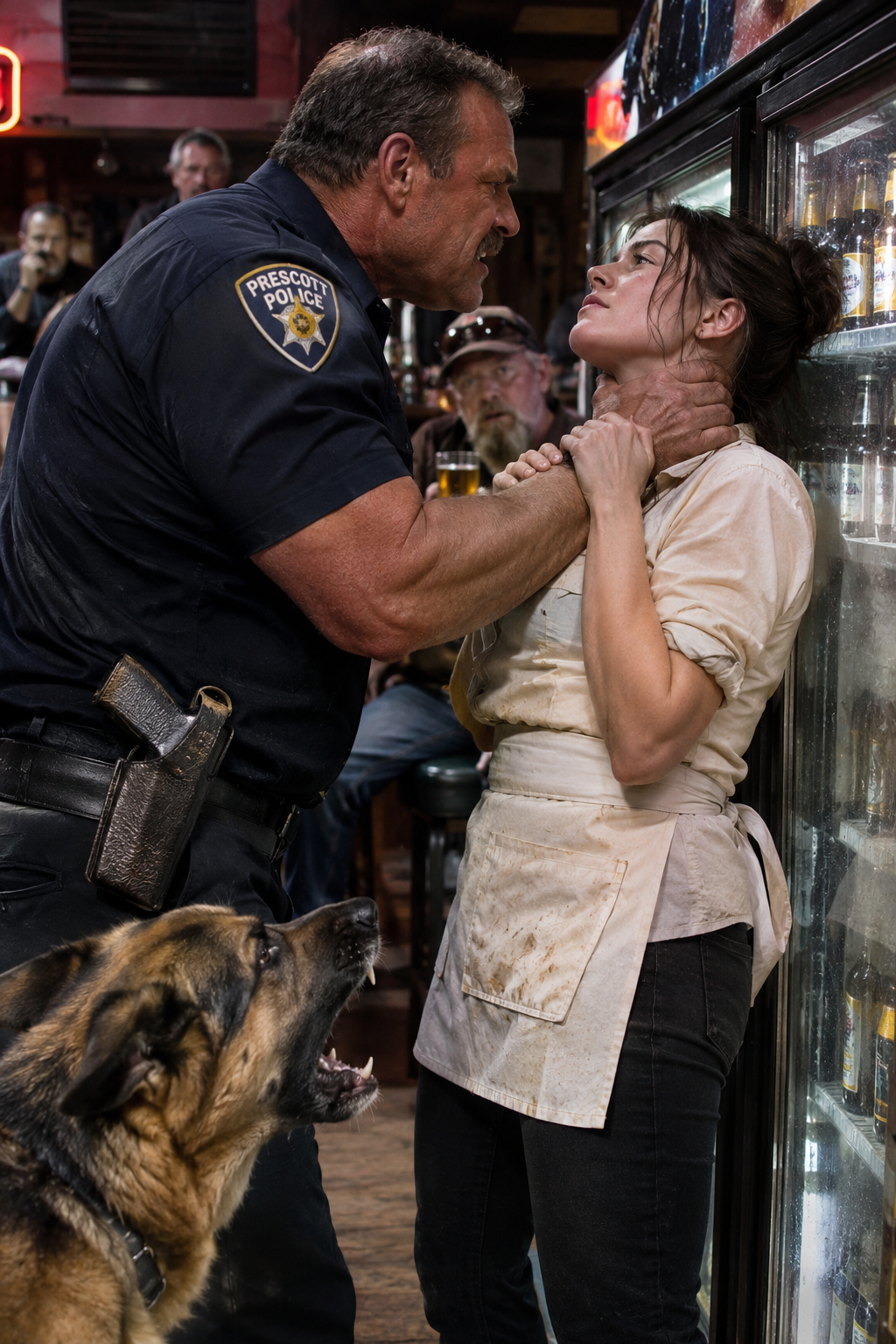
I’d been waiting tables in a small Prescott bar for nine days when an off-duty policeman grabbed me by the throat and the customers looked away, but after an old German Shepherd forced him to release me, I asked our bartender to call a garage on Route 89, and the policeman’s reaction told me he was afraid of something he couldn’t see…
My name is Delia Voss, and I came to Prescott, Arizona, from Phoenix with two duffel bags, a car that burned oil, and a need to be somewhere nobody knew my business. I hadn’t come to impress anybody or make a scene. I wanted a little room to make decisions without somebody else stepping in to make them for me.
The Iron Kettle sat in a low brick building off the highway, with gravel out front and a neon sign missing part of a letter. It wasn’t a pretty place, but the owner paid cash after every shift and didn’t pry. For the time being, that was exactly what I needed.
I’d been there nine days when everything happened. By then I could carry a full tray around the tight booths, remember orders without a pad, and refill cups before anybody asked. Regulars started calling me by name, which was kind, though I was trying not to put down roots too quickly.
Ruth tended bar and had done so for thirty years. She had a way of studying people over the rims of her glasses while she polished the same clean glass for an extra minute. After my first shift, she told me, “You’ve got a backbone, girl.” Coming from Ruth, that sounded more like an observation than praise.
What Ruth didn’t know was that I’d grown up learning how to hold my ground. My father was gone by the time I was six, and my older brother, Cole, helped our mother raise me. He taught me how to defend myself, but he spent more time teaching me when not to use my fists.
“Look a bully in the eye,” he’d tell me. “And watch the ones who have a little power and think they don’t have to answer for it.” Those lessons stayed with me long after I was old enough to take care of myself.
Cole had another name around that part of Arizona: Ramrod. He was the road captain of the local Hells Angels charter, the man riding at the front when their motorcycles came down the highway. I loved my brother, but I’d seen enough of that life to know it wasn’t the one I wanted.
He had offered me money before. I always said no, not because I thought I was better than him, but because I needed to know the paycheck in my pocket came from work I’d done myself. I hadn’t told the people at the Iron Kettle who my brother was, and I wasn’t planning to.
There was one man Ruth wanted me to know about. His name was Roy Bittner, an off-duty patrolman who’d spent twenty-two years on the Prescott police force. He took the same booth most nights, snapped his fingers for service, and ran a tab that was never paid as quickly as it should have been.
“Keep your distance from that one,” Ruth warned me on my second night. “He’s made three girls quit without ever laying a hand on them. He just keeps after them until they can’t stand coming to work.” I glanced at Roy’s booth, then told her I’d be careful.
It wasn’t hard to see what she meant. Roy complained when his glass wasn’t full, made comments about my appearance, and seemed irritated whenever I answered politely instead of looking frightened. I wasn’t trying to embarrass him. I brought his orders, cleared the dishes, and kept moving, hoping he’d eventually get bored.
But he seemed especially bothered by women who wouldn’t flinch. I could see the other waitresses brace themselves when his car appeared outside. I heard the regulars tell stories about complaints going nowhere, traffic stops that felt personal, and people learning that arguing with Roy could make their lives harder.
There was also Diesel, an old gray-muzzled German Shepherd who slept on a blanket near the storeroom. He’d belonged to the motorcycle club for about twelve years and spent his days at the bar now that he was too old to ride along. I’d slipped him bits of bacon from plates coming back to the kitchen, and by my third shift he followed me around like we had an understanding.
That Tuesday, rain ticked against the tin roof and only about fifteen customers were inside. Hank was working the grill, Ruth was behind the bar, and Diesel was curled up in his corner. Roy came in around nine, already smelling of whiskey, and ordered a double, a burger, and fries.
I brought his food and his next drink promptly. He said the burger was cold, although it had just come off Hank’s grill, and then accused us of watering down his whiskey. I said, “I’ll get you another one, no charge,” and started toward the bar.
“Hey. I’m talking to you,” Roy called. When I turned back, he asked if I thought I was too good to look at him. I told him, “No, sir. I was getting your drink.” He pushed himself out of the booth, and the room grew so quiet I could hear the rain again.
He walked toward me, lecturing me about how his food should arrive and how his glass should never be empty. Hank stopped at the kitchen window with a spatula in his hand. Ruth went still behind the bar, and two men near her looked down at the wood in front of them.
I had done nothing to deserve it, and I was tired of pretending that serving somebody meant surrendering every bit of dignity. “I hear you,” I said, keeping my voice even. “But I’m not going to be spoken to like that.” Roy’s expression changed as if he’d been slapped.
He crossed the space between us in two strides. One hand caught the front of my shirt and shoved me back against the beer cooler, rattling the bottles inside. Before I could get my balance, his grip moved to my throat and squeezed hard enough that my heels barely touched the floor.
I tried to pull his wrist away, but the pressure made it difficult to breathe. I remember staring over his shoulder at the men at the counter, waiting for somebody to move. Nobody did. They knew he carried a badge, even when he wasn’t wearing his uniform.
My brother had taught me not to let panic make my decisions, and I fought to keep my thoughts steady. My vision was starting to narrow when a low growl came from the storeroom side of the bar. Diesel was on his feet, ears back, walking toward us with more purpose than I’d ever seen in that old dog.
Roy turned his head toward the sound. Ruth shouted, “Roy, let her go. You’re going to kill her.” Between the dog, her voice, and all the people watching, something finally got through to him. His fingers opened, and I slid down against the cooler, coughing and struggling to draw a full breath.
Diesel stood between us, growling. Roy stepped away, raised his hands, and laughed as though he’d pulled some harmless prank. “Relax,” he told the room. “She’s fine. Just teaching the new girl some manners.” He went back to his booth and asked Ruth for another drink.
Hank returned to his grill. A couple of men began talking again in low voices, and Ruth poured Roy’s whiskey with a shaking hand. I could tell everybody wanted the night to go back to normal. I wanted that too, except I knew what had happened wasn’t normal, and pretending otherwise would give Roy permission to do it again.
I straightened my shirt and went to Ruth at the far end of the bar. My voice came out rough when I said, “Can you do me a favor?” She wanted to call the sheriff, but I asked her to make one phone call first, to the Iron Horse Garage out on Route 89.
“Ask for Cole,” I told her. “Tell him Delia’s at the Iron Kettle and a man put his hands on me. That’s all. He’ll know.” Ruth studied my face for a moment, then reached for the phone beside the register. She got the message out, and when I looked back toward the booths, Roy was standing up again. Part 2…..
Roy came toward us slowly, his expression colder than it had been when he grabbed me. He pulled back his jacket just enough to show the pistol on his hip and his badge beside it. “Hang up the phone,” he told Ruth, and she put the receiver down.
He turned to me and spoke quietly enough that it felt personal, though everyone in the room could hear. He said he’d worn that badge for twenty-two years, and nobody in Prescott would believe a waitress who’d just arrived over him. Then he told me how he could write up the evening if I dared to complain.
According to Roy, I could be accused of attacking a police officer, resisting him, even reaching for his weapon. I hadn’t done any of those things, and he knew it. The frightening part wasn’t that he was lying; it was how comfortably he described turning those lies into an official report.
“Get in your car and leave town tonight,” he said. “Don’t tell anybody what happened. Or I’ll make sure you regret it.” I looked past his jacket and back up at his face, remembering the stories Ruth and the regulars had told me.
I’d come to Prescott because I wanted to stand on my own. Now a man with a badge was telling me that standing on my own meant nobody would believe me. I could feel Diesel leaning against my leg, still keeping watch.
“You should’ve let me hang up that phone,” I told Roy. I didn’t raise my voice, and I didn’t explain what I meant. For a few seconds he just stared, trying to decide whether I was threatening him or bluffing.
Then I heard engines through the rain. At first they sounded distant, but the noise kept building until the bottles behind Ruth’s bar trembled. Headlights swept over the wet gravel outside, and a line of motorcycles stopped so close together that the silence afterward seemed almost unnatural.
I heard boots crossing the parking lot. Everybody turned toward the entrance, including Roy. When the door opened, Cole stepped inside wearing his worn leather cut, rain caught in his beard and gray hair showing at his temples.
More men followed him, until there were about a dozen from the club standing inside and near the doorway. Nobody came in shouting or throwing furniture. The room was tense enough without that, and Cole seemed to understand it as soon as he saw me.
Diesel left my side and walked straight over to him, his tail moving once. Cole put his hand on the old dog’s head without looking away from me. His gaze settled on the front of my shirt and then on the marks forming around my throat.
“Delia,” he said. I told him I was okay, though my voice caught on the words. He came close enough to see my neck clearly and answered, “You’re not. But you will be.”
Roy was still armed, still an officer, and clearly unused to being challenged in that room. He said this was police business and accused me of assaulting him. He threatened to call every unit in the county if the men didn’t leave.
Cole didn’t raise his voice. “Cole Voss,” he said. “Road captain. And that woman is my sister.” I watched Roy look from Cole to me, trying to put together something he’d never bothered to ask.
Roy started to explain that he hadn’t known who I was. Cole stopped him. “That’s the point. You figured nobody would come for her. It would have been just as wrong if she didn’t have a brother at all.”
I was relieved Cole had come, but I didn’t mistake his presence for a magic solution. Roy still had a gun, and twelve angry men in a crowded bar could make a terrible night worse. I stayed near Ruth and watched my brother keep his hands open and his voice low.
Roy’s hand drifted toward his holster. Cole looked at it and told him to stop there. He said there were witnesses who’d seen the assault and that Roy ought to put his weapon down instead of making another decision he’d regret.
Roy hesitated, looking around the room. Hank had come out from the grill, Ruth was beside me, and the regulars who had spent so many evenings avoiding his eyes were now watching him. Even before anything else happened, I could see that the room wasn’t willing to pretend anymore.
Final Roy finally unfastened his holster and placed his pistol on the bar. Ruth slid it away from him, and when Cole told him to set down his badge too, he did. I had never seen Roy look so uncertain about what he was allowed to say next.
Cole told him to apologize to me, not to the men who’d come with him. Roy walked over, lowered his head, and then made himself look me in the eye. “I’m sorry,” he said. “I had no right to put my hands on you. I don’t have an excuse.”
I stood there a moment, my throat aching, and answered, “Okay.” It wasn’t an announcement that everything was forgiven or forgotten. I simply had nothing else I wanted from him in that moment, and I wasn’t going to turn my own pain into another performance for the room.
Cole told Roy he wasn’t welcome back at the Iron Kettle. Then he said Roy needed to go to his captain the next morning and tell the truth, because the people in that bar had seen what happened and weren’t going to let it disappear. He walked Roy to the door, released him, and let him leave.
We listened to Roy’s car pull out of the gravel lot. No one cheered. I think everybody understood how close we’d come to something even worse, and how much damage one man had been permitted to do simply because people were afraid to challenge him.
Cole crossed back to me and wrapped his arms around me carefully. I held on for a few seconds longer than I meant to. Then I stepped back, wiped my face, and tried to breathe without wincing.
“You could’ve called nine days ago,” he said. “You didn’t have to handle everything alone.” I told him, “I wasn’t trying to do everything alone. I was trying to do it myself. There’s a difference. Tonight I needed help, so I called.”
He looked at me, then at Diesel pressed against my leg. “Seems the old man was looking after you too,” he said. It was the first time all night I felt anything like a smile coming on.
The club men stayed a while, drinking coffee Ruth poured without charging them. Hank made food for everyone, saying he hadn’t felt that good about the place in years. The regulars came over one by one to apologize for keeping quiet, and I listened because I knew some of them had been afraid for a long time.
The next morning, Roy walked into his captain’s office and put his badge and gun on the desk. I wasn’t there to see it, and I never pretended to know whether conscience or fear had brought him there. What I did know was that Ruth and Hank had both called the station to report what they’d witnessed.
For once, the account of that night didn’t depend only on the person wearing the badge. People who had stayed silent when I needed them most had decided to speak plainly afterward. That mattered to me as much as anything Cole had said in that bar.
I kept working at the Iron Kettle. Two years later, I’d saved enough money to open a little breakfast place on the north side of town, and Ruth and Hank came to work with me. I named it Delia’s Diner, a simple place with good coffee and a front window that caught the morning sun.
Diesel came too. He spent his last good year stretched out in that warm patch by the window, raising his old head whenever a customer walked through the door. I still think of him whenever I see sunlight reaching across an empty floor.
Cole stopped in most Sundays, parking his motorcycle outside and ordering eggs and coffee at the counter. He never offered to bankroll my business again. He seemed to understand that loving me meant coming when I called, not taking over the life I was trying to build.
I have never forgotten the feeling of Roy’s hand on my throat or the way everyone looked away. But I remember what came after, too: Ruth speaking up, Diesel getting to his feet, Cole walking through the door, and witnesses finally telling the truth when it counted.
For a long time, I thought being strong meant never asking anybody for anything. That night taught me something better. I could make my own living and my own decisions, and still reach for people who loved me when I needed them.
A badge never made Roy stronger than the rest of us. The people who found the courage to stop looking away were the ones who changed that room. And every morning I opened my own diner, I was grateful that I got to keep building a life that was mine.
THE END. I’ve shared the complete story, and I truly hope it touched your heart. If this story moved you, please , like, and share the post. Thank you for reading! ❤️
✓ Lynn R. Adams
I’d been waiting tables in a small Prescott bar for nine days when an off-duty policeman grabbed me by the throat and the customers looked away, but after an old German Shepherd forced him to release …