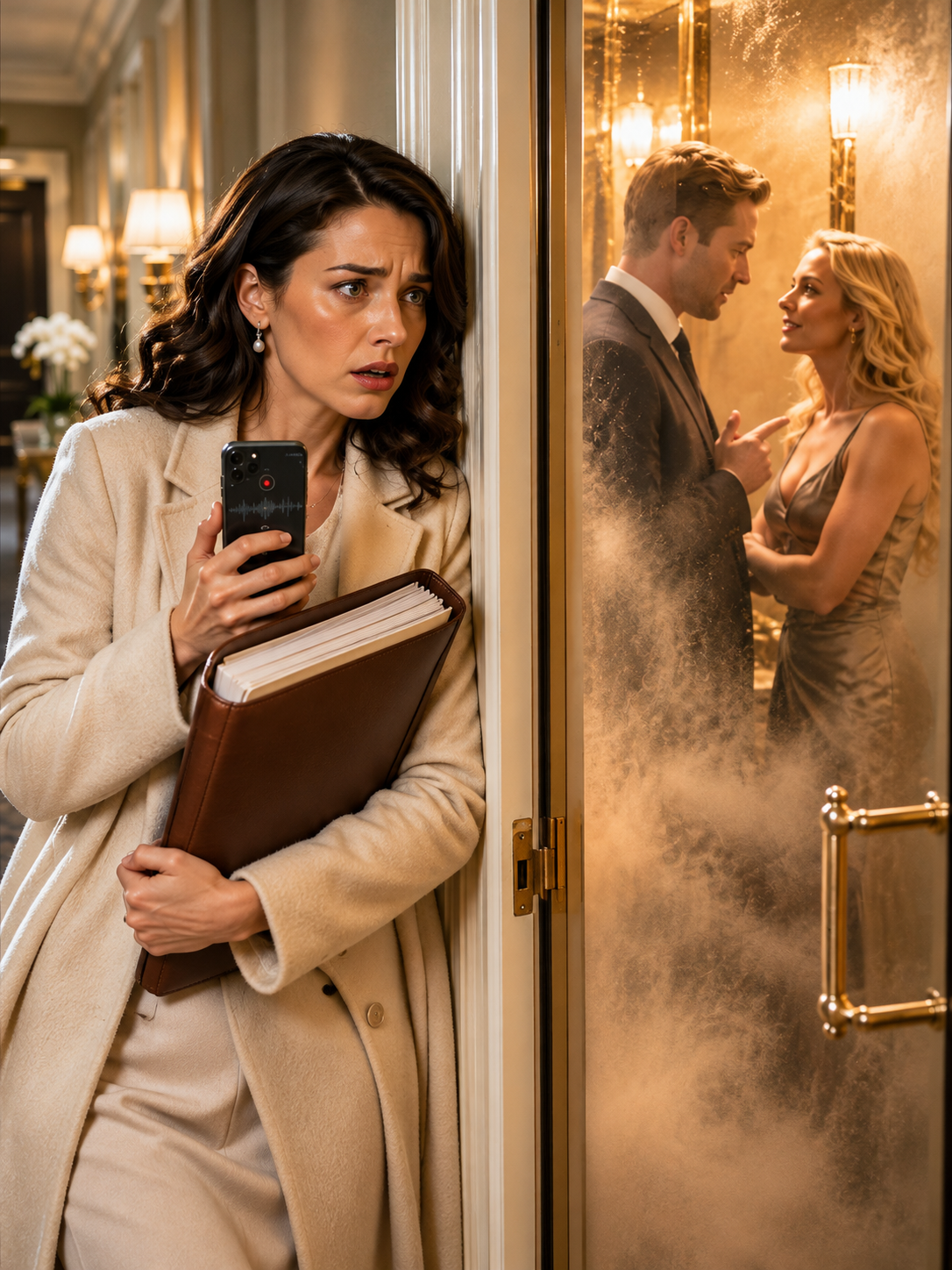
I went to surprise my husband with an anniversary gift and heard him telling my best friend how he planned
IF FACEBOOK BROUGHT YOU HERE, HERE’S THE CONTINUATION YOU’VE BEEN WAITING FOR. ENJOY! 👇 I sat back at Bet’s kitchen table while she poured more coffee. The Quinland family had developed commercial properties in the Hudson Valley for two generations. Seth’s father, Robert Quinland Sr., had worked with contractors in the 1990s, around the same years Mom was repairing the mill window by window.
The letter explained that Mom had learned of an unlicensed solvent dumping site beside the mill’s old access road. Her records linked the disposal activity to a Quinland Group subcontractor. When she threatened to report it to the state, Robert offered to buy Kellum Mill, and she refused.
Six months later Mom was diagnosed with the lung illness that killed her two years after that. Her letter did not claim the illness was caused by the dumping. She simply recorded the chronology, then described where buried waste might be disturbed if anyone excavated for new riverfront construction.
I read the pages twice, careful not to turn a suspicion into a conclusion. Bet knew the box existed but had never opened the drive. The label and the location were enough for us to understand why the records had to go to professionals who could examine them properly.
“He knew about this before he came to that gala,” I said. Bet watched me across the table and asked what I wanted to do. I said we needed to see the mill in daylight and report the possible contamination before anyone began digging around the access road.
My phone showed fourteen missed calls from Seth and four from Britta. I forwarded the recording to Dominique and a divorce attorney, with a request to call me at seven and advise me on its handling. Then I turned the phone off and slept for four hours on Bet’s couch.
The next morning, Bet drove us to Kellum Mill on the bend of Esopus Creek. The building rose between wooded ridges, its brickwork cleaned and repointed and its old factory windows reglazed. Mom had stabilized the wide plank floors and kept the iron loom frames in the main hall, along with a little archive of textile patterns, union records, and workers’ photographs.
Seth’s car was in the gravel lot. He came around the building in a suit that looked freshly pressed, his face arranged into concern. “Paloma, hear me out before you do something you can’t undo,” he said. I told him Dominique had already notified his lenders that the $8 million was never committed.
He called it a timing issue, insisting I’d been going to invest. “Considering a proposal is not a bank transfer,” I said, unlocking the mill door. I walked inside with Bet behind me, and Seth followed into the smell of old wood and mineral oil.
He said I was destroying four years of work over a conversation overheard through a door. I looked at the looms and remembered being small enough to hide behind their frames. “I heard you explain why you married me,” I said. His expression tightened, then softened into the one he used when asking for another chance.
He claimed he loved me and had merely been telling Britta what she wanted to hear. He said their affair was over. “The affair or the plan?” I asked. He couldn’t give me a direct answer.
From the south window I could see the access road Mom had marked. I asked why he needed this mill when other riverfront land was available. He praised the location until I mentioned the old solvent dump and the risk that excavation would uncover what his father’s subcontractor had left behind.
“Who told you that?” he asked. “My mother,” I said. I told him about her letter and the thumb drive. He dismissed her concerns as old contractor rumors, but his tone had changed, and he no longer spoke as though the rezoning application were a certainty.
I had already contacted the state environmental reporting office and asked for an inspection before site work. I told him the records would be evaluated independently, not by either of us. He sat on the edge of the foreman’s platform, looking at the floor for the first time since we’d arrived.
Then he offered a new arrangement: I could oversee both the development and cleanup, with my name on everything. “My name has been connected to this mill since I was nine,” I said. “You aren’t offering me ownership. You’re offering to let me stand in front of your plan.”
He asked what I intended to do instead. “Finish restoring it,” I answered. I took back the mill key he’d been using and set it on the platform beside him when he wouldn’t accept it. Then I walked out into the daylight with Bet.
Part 3 Britta called that afternoon as Bet drove us back from a meeting about the environmental inspection. I answered on speaker. She said Seth had shown her a version of my funding letter that appeared to confirm the money had been transferred, and that she’d believed him when he said our marriage was already mostly over.
I asked whether the document sounded like something I’d written. She was silent before admitting it didn’t quite. “Tell your attorney that,” I said. “Whatever Seth told you, you stood beside me at my wedding. You knew me.” I ended the call without offering her a way to make the conversation easier.
What followed took months, not days. The divorce proceedings lasted five months while lenders reviewed the construction credit they’d advanced based on a capital commitment that never existed. Britta’s attorney produced records showing that Seth had used old Durant Capital letterhead from a prior joint pitch to create a false confirmation, then sent it to two lenders.
Seth first denied responsibility, then said I’d known, then tried to blame Britta. His emails contradicted those shifting accounts, and the lenders’ internal review led to a fraud referral. I gave counsel the documents I possessed and let them determine which claims could actually be supported.
The environmental inspection confirmed failed buried containment along the access road, solvent residues, and contaminated soil sampled six feet below the surface. State officials identified Robert Quinland Sr.’s former subcontracting firm and its successor as responsible parties. The mill building itself had not been contaminated.
Seth faced no criminal environmental charge over dumping that occurred when he was a child. His urgency to advance the riverfront scheme before sampling, however, became part of the documented dispute. I wanted the actual cleanup handled by qualified people, not turned into another argument about what he had meant.
On the afternoon the settlement was finalized, I sat in attorney Franklin Moore’s Kingston office and signed the remaining documents. They formally settled interests and claims over a mill that had always belonged to my family. Moore had a tired-looking houseplant on his desk and the restraint not to fill the silence with congratulations.
“The building is clean,” I said. “Mom chose its location carefully.” He nodded, then observed that most people he saw discussed what they’d lost, while I kept talking about what my mother had built. I told him both things could be true.
That evening I went alone to the loading dock and sat with my feet above the creek. April was warmer than March, and the water was running fast over the stones. When Bet called to ask how I felt, I looked toward the windows and said I knew what my next project was.
Six weeks earlier, at a materials-conservation conference in Albany, I’d met Reed Tanner. We’d argued over mortar for nineteenth-century industrial brick, and he’d examined my evidence, admitted where it was stronger, and amended his position without making it personal. We exchanged cards and had since emailed about technical restoration questions.
The day after the settlement, I wrote to him that Kellum Mill was mine to restore and environmental review was underway. I needed a conservator who understood old industrial materials and wouldn’t spend the first three months telling me my standards were unreasonable. I wasn’t looking for a rescuer or a business partner in disguise.
He answered within two hours that his standards might be even higher, and he could visit Thursday. He arrived in work clothes with a reference binder worn at the tabs, inspected the looms and old loading structures, and didn’t once call the building charming or quaint.
Reed found two structural issues I’d missed. I found one he had overlooked. We spent forty minutes arguing amicably about the east glazing and reached a solution neither of us had begun with. When he asked about the building’s future, I described artist residencies, craft workshops, and a public textile-history archive, perhaps six rooms upstairs once the work allowed it.
“No restaurant?” he asked. “Absolutely not,” I said. He wrote that down and promised a condition report at his usual professional rate. I knew what good work cost, and I wanted ours to begin with clear agreements.
Part 4 Reed returned the next Thursday, then the one after. He brought coffee from the local bakery and complained about parking, and we disagreed over archive lighting with the enthusiasm of people who trusted that disagreement wouldn’t end a relationship. I was not ready to call what grew between us romance, but I noticed how often I wanted to tell him what I was thinking.
When the preliminary cleanup estimate came in higher than expected, I sat on the dock for twenty minutes without talking. Reed sat beside me, asked what I needed, and went back inside when I said I needed time to think. He didn’t try to turn every hard fact into an optimistic slogan.
At dinner in June, Bet said he looked at me the way the mill looked at the light. I told her it was an absurd sentence. She grinned and said I knew what she meant. I did, but interest wasn’t the same as readiness, and I needed to cross that distance myself.
In August, Reed and I were reviewing restoration costs in the archive room when I reached across the table. I told him I wasn’t going to pretend our friendship hadn’t changed, but I wasn’t fully put back together. “I’m not looking for someone who’s finished,” he said. “I’m looking for someone who’s honest about the work.” I put my hand over his, and he turned his palm upward to hold it.
We moved slowly. He didn’t crowd me or confuse patience with a strategy for winning my trust. At Thanksgiving he met Bet, and the two of them spent ninety minutes disagreeing about historic windows while I listened from the kitchen and enjoyed being in a room where nobody expected me to manage their feelings.
Seth emailed in November, saying he’d heard the restoration was progressing and that this was the version of the project he’d always believed in. I read it in the mill archive while Reed took a call in the hall. I thought of the green dress, the signed book left in the hotel corridor, and the man who expected me to turn hurt into a list of tasks. I didn’t reply.
The fraud case concluded the following spring. Seth entered pleas to two counts connected with the fabricated capital commitment and false statements to lenders. Britta settled a civil case brought by one lender and gave up her interest in the communications firm she’d formed to promote Quinland Development.
One lender recovered its exposure through Seth’s personal assets, but the failed projects still disrupted contractors’ livelihoods. Two regional firms took over viable work and kept crews employed. I sent three preservation clients to one of those firms, a small decision that helped keep thirty-eight people in the trades they knew.
Kellum Mill finally opened the following October. The finished project held eight residency rooms, a public textile archive, and a craft apprenticeship program with seventeen applicants in its first season. The cleanup beside the access road was still underway, and orange markers remained visible from the creekside walking path.
I chose not to disguise those markers. My mother had taught me that preserving history meant showing the damage as well as the repairs. Near the entrance we hung a photograph of Analise in muddy boots, laughing with a measuring tape in one hand, and a caption I wrote about why she had restored the mill rather than pretending it had never been damaged.
Bet gave a speech that included two stories I’d specifically asked her to leave out. The crowd loved them both. Reed stood in the second row, letting the occasion belong to my mother, my family, and everyone who had helped bring the building back into use.
Final After the last guest left, Bet, Reed, and I sat on the old loading dock with takeout and paper cups of wine. A lantern hung above the door, and the creek ran black below the boards. Bet raised her cup toward the illuminated mill windows and said, “To Analise.” Reed and I echoed her.
I looked up at the windows and felt grief arrive beside gratitude. Mom would have complained about seven things in the archive lighting, I told Bet, and then she’d have loved it. Bet laughed because she knew I was right.
Reed’s hand found mine on the dock. I leaned my shoulder against his and listened to the water. The mill was not a trophy I’d won from Seth, and my new relationship wasn’t a reward for surviving him. They were parts of a life I had chosen to build with clearer eyes and firmer boundaries.
I had stopped financing a lie, but that was only the decision that made the rest possible. The work continued inside, the creek kept moving, and for once I could let the evening be exactly what it was without needing to fix anything.
THE END. I’ve shared the complete story, and I truly hope it touched your heart. If this story moved you, please , like, and share the post. Thank you for reading! ❤️
✓ Lynn R. Adams
IF FACEBOOK BROUGHT YOU HERE, HERE’S THE CONTINUATION YOU’VE BEEN WAITING FOR. ENJOY! 👇 I sat back at Bet’s kitchen table while she poured more coffee. The Quinland family had developed commercial pr…