I went to a county auction in Barstow to help my motorcycle club
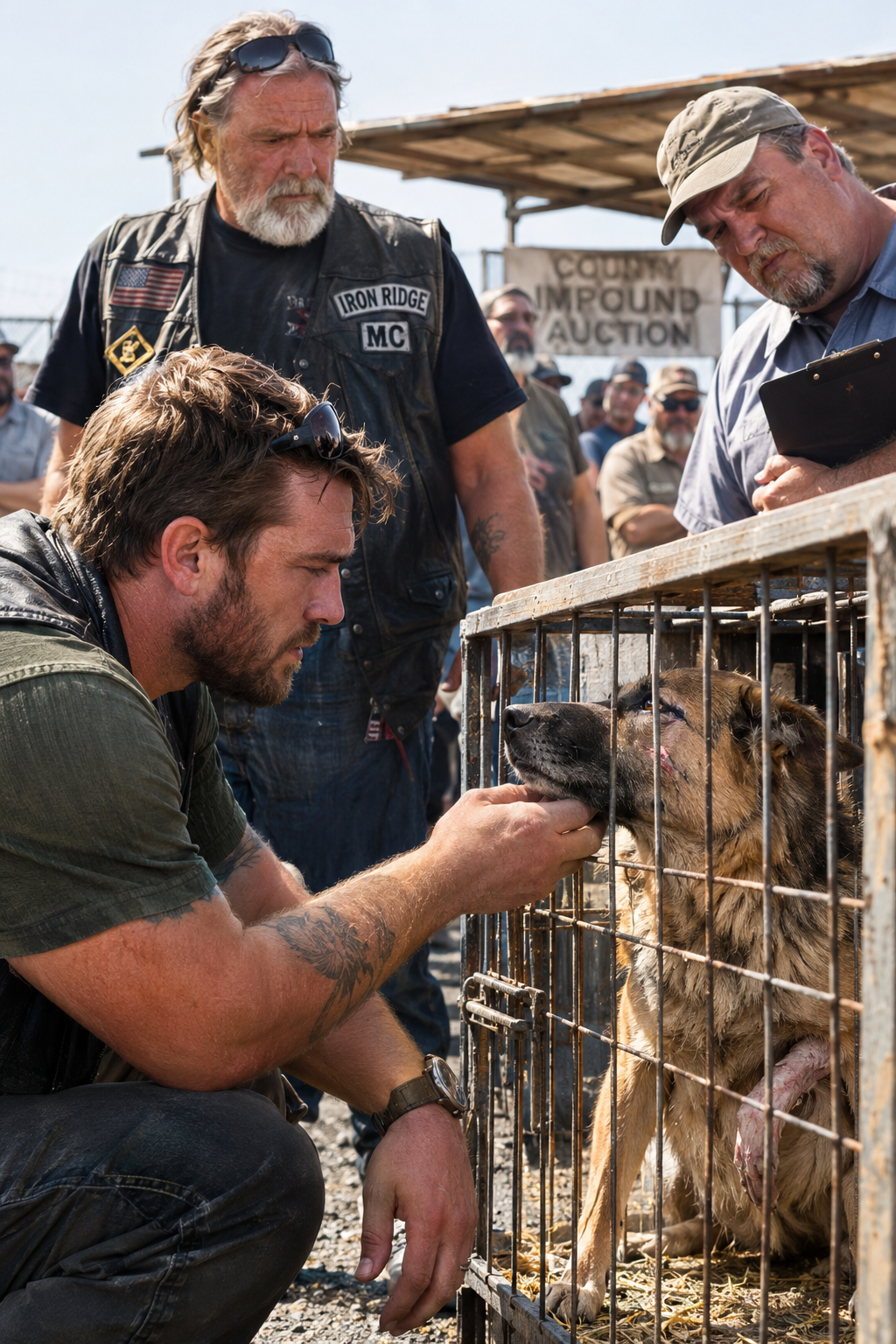
I went to a county auction in Barstow to help my motorcycle club buy a used flatbed trailer, but when a supervisor kicked a starving German Shepherd’s cage and offered him to anyone for one dollar, I heard a sound that stopped me cold—and the name on a battered old collar brought back the partner I had spent four years trying not to mourn…
The plan that morning was simple: buy a trailer and get out of the heat. It was August in Barstow, California, hot enough that the gravel seemed to throw the sunlight back at us, and the county impound yard didn’t have much shade. We needed a flatbed to haul motorcycles to our fall run, and one seized from a contractor was supposed to go cheap.
My name is Cole Travers. I was thirty-four then, a member of the Iron Ridge Motorcycle Club, and I had come along to help load whatever we bought. Our president, Walt Mercer, whom everybody called Deacon, was sixty-one, gray in the beard, and still had the thick hands of a man who’d spent his life working metal.
Deacon had led Iron Ridge for nineteen years. He rarely raised his voice, and he had a way of waiting out a loudmouth until the man ran out of things to say. Four of us brothers stood with him that morning, including Tiny, a big bearded man whose nickname had never fit him.
Before I wore an Iron Ridge patch, I was a Marine. I’d served two tours as a military working-dog handler, searching for explosives with a German Shepherd named Ranger. We had made more than fifty missions together, moving ahead of men who trusted us to find what they couldn’t see.
Ranger wasn’t just a piece of equipment to me. When supplies ran short, I shared my food with him, and at night he slept near the foot of my cot. He knew my movements so well that sometimes I thought he was preparing to follow a command before I’d even decided to give it.
Four years before that auction, our unit was ambushed. There was an explosion, smoke everywhere, men shouting, and Ranger was thrown clear in the confusion. I went back looking for him twice, calling until my throat burned, before other Marines pulled me away while we were still taking fire.
We never found him. The official report listed him as lost and presumed dead, and three weeks later I came home with his leash in my gear and no dog at the other end. I knew the difference between what the report said and what we’d actually seen, but after enough months even hope can start to feel cruel.
I rode with Iron Ridge, worked, and kept my troubles to myself. I slept badly and stood near exits without thinking about it. The brothers noticed that I watched the dogs that sometimes wandered through the clubhouse yard, but they were decent enough not to ask why I never reached down to pet one.
So when Deacon took us to the auction, I was thinking about tie-downs and the long drive home, not the past. Roughly forty people had gathered around the lot: scrap dealers, tow operators, and others looking for something they could fix or resell. Nobody looked particularly happy to be standing in that heat.
After the vehicles, a supervisor named Dale Pruitt led everyone toward a row of animal cages. He carried a clipboard and talked like the whole place belonged to him. Most cages were empty, but the last one held a German Shepherd who was so thin I could count his ribs beneath a dull, dusty coat.
The dog had scars across his muzzle, a notch missing from one ear, and a back leg twisted badly enough that he wouldn’t put weight on it. He stayed quiet in the corner, head lifted and eyes following the people outside. Something about the way he watched the crowd made me stop looking at the ground.
Pruitt said the dog had arrived as a stray eight months earlier. He claimed there was no readable microchip, no useful tag, and no adoption placement because the animal had failed temperament testing. He called him half wild, broken, and too much trouble for anyone to take home.
Then Pruitt struck the cage with his boot. The dog hit the bars, caught himself, and rose again on his three usable legs without making a sound. A couple of men laughed, and I felt my hands tighten at my sides, but for a moment I was stuck watching the shepherd’s face.
Pruitt said the county wanted the dog moved that day. He slapped a one-dollar tag on the cage and announced that anyone willing to pay a dollar could have him; otherwise, the dog would go onto a truck bound for what sounded like euthanasia. He didn’t have to explain it twice.
No one bid. A dealer near the front muttered that the vet bills alone would be worth more than the dog, and another man nodded. I looked around at those forty people staring at their shoes, and then I saw Deacon’s arm go up.
“I’ll give you the dollar,” Deacon said. Pruitt looked irritated that his performance had ended so quickly, but he declared the dog sold and went for the gate. Deacon hadn’t even asked what we’d do with a frightened shepherd or how we’d get him to a veterinarian, and that was exactly like him.
I turned toward the trailer because I thought the brothers would need room to move the dog. Then a faint, low whimper came from the cage behind me, and my feet stopped in the gravel. There was something painfully familiar about that small sound, though I couldn’t have told you why without saying a name I hadn’t spoken aloud in years.
Deacon crouched a few feet from the cage instead of reaching straight inside. Pruitt warned him that the animal had bitten before, and Deacon waited, letting the dog decide whether to move. The shepherd didn’t come to him; his eyes went past Deacon, searching the men standing behind.
A cracked leather collar lay half buried in the old straw. Deacon picked it up carefully and turned a tarnished brass plate toward the sun, trying to make out letters worn almost smooth. He sounded them out once, uncertainly, until the name finally came together: “Ranger.”
The shepherd sprang up as sharply as his injured leg allowed. His ears rose, his body went still, and he stared straight at me, not at the man holding the collar. My mouth went dry because I knew those ears, that look, and the way he waited for the next sound.
“Ranger,” I whispered. I went past Deacon, dropped to my knees in the dust, and held out my hand. The dog pressed his scarred muzzle into my palm and stayed there trembling while I tried to speak, and all I could think was how in God’s name my lost partner had reached a cage six thousand miles from where we’d been separated. Part 2…..
Deacon told Pruitt to open the gate the rest of the way. I stayed low while Ranger came forward, then slipped my belt through his old collar to make a temporary lead. He limped toward me, put his weight against my leg, and kept glancing up as though he needed to be sure I wasn’t going to disappear again.
Tiny stood nearby repeating, “I’ll be damned,” so softly I could barely hear him. The other brothers gathered around without crowding Ranger, and Deacon paid his dollar and folded the receipt into his vest. “Let’s get him home,” he said. “Water, shade, food. Then we figure out that leg.”
I carried Ranger to the trailer and eased him onto an old moving blanket in the shade. He laid his nose against my knee and closed his eyes. I stayed beside him, running a hand over the fur behind his ears, too afraid to move and break a moment I had spent four years imagining.
Then a truck horn sounded across the yard. A lifted black pickup had come through the gate, and three men climbed out. The lean man in front had a shaved head and walked directly toward our trailer while the other two hung back on either side of him.
“That’s my dog you’re loading,” he said. “I want him back.” I stepped down and stood between him and Ranger before I even thought about doing it. The man introduced himself as Royce and claimed the shepherd had run from his property eight or nine months earlier, just before the county picked him up.
He said the dog belonged to him and that an impound auction couldn’t change it. I looked back at Ranger’s twisted leg, scarred muzzle, and torn ear, and felt a sick suspicion forming. Those injuries hadn’t all come from one blast overseas, and the way Ranger flinched when a hand moved too quickly made my stomach turn.
“He’s not going with you,” I told Royce. He answered that our dollar payment didn’t settle ownership, that Pruitt would confirm the paperwork was unfinished, and that he had a friend in the sheriff’s office. He threatened to call a deputy and accuse us of stealing his property.
Pruitt began shuffling his clipboard pages. Deacon came to stand beside me, with Tiny and the other brothers behind us, and explained that Ranger had been a Marine Corps explosives dog and I had handled him overseas. Royce looked at us and demanded proof: a readable chip, a government document, anything more than my word and a collar.
He wasn’t entirely wrong about what we lacked in that moment. Ranger had been missing for four years, and I hadn’t brought my service records to a county auction. The old collar wasn’t enough by itself to establish ownership, no matter what the dog meant to me.
Royce raised his phone and said a deputy would be there in ten minutes. I could feel Deacon watching me, hoping I had an answer, while Royce waited for us to argue. Instead, I turned away from the pickup and went back to the trailer, where Ranger lifted his head the moment I approached.
I knelt close and rested a hand against his neck. “I need you one more time, buddy,” I murmured. “Just one more time.” Then I stood and walked into the open gravel, putting some distance between us while he watched me with the same steady attention I’d known on patrol.
Part 3 I gave him a command in Dutch, the language we’d used in training. “Zit.” Ranger settled into a sit despite that damaged leg, his gaze fixed on me. I asked him to lie down, then stay, and he obeyed with a precision that made the voices around us fade away.
I walked a slow circle at a distance. Royce shifted sideways, trying to draw the dog’s attention, but Ranger didn’t look at him. He watched only me, holding his position as if we were still working together and the years between us had somehow been folded shut.
“Any dog can learn tricks,” Royce muttered, though his voice had changed. I wasn’t doing it to impress him. I was doing the only thing I knew that might make someone stop treating Ranger like an unwanted stray and start asking where he’d really come from.
The county cruiser arrived while Ranger was still lying quietly in the gravel. A younger deputy got out and asked who’d called about the ownership dispute. Royce started telling his side immediately, but I waited until the deputy looked toward us before calling, “Ranger, hier.”
Ranger rose and crossed the lot on three working legs, coming straight to my left side and sitting tight against me in the heel position he’d held through more patrols than I could count. The deputy stopped walking. He looked at the dog, then at me, and asked whether I’d trained him.
I told him my name, my service, and the unit we’d served with, and explained that Ranger had been recorded as missing after an ambush four years earlier. Then I knelt, gently turned back Ranger’s left ear, and showed him the faded identification tattoo inside. I remembered the number even before I read it again.
“That number can be checked against his military records,” I said. “Please don’t send him away with anyone until you do.” The deputy leaned in to look, took down the identification, and said he’d need to verify the information through the proper channels before making a decision about ownership.
Royce suddenly stepped toward Ranger and reached for his collar. Ranger stiffened and warned him off with a low growl, and Deacon caught Royce by the wrist before his hand reached the dog. “Don’t,” Deacon said. He released him as the deputy ordered Royce to step away from the animal.
Deacon pointed out that Royce himself had claimed to possess a dog with multiple old injuries, some of them consistent with mistreatment. He asked the deputy to find out how Ranger had acquired those scars. Royce pulled back toward his truck, muttered that the matter wasn’t finished, and left with the other two men while the deputy continued taking information.
I wanted to believe that walking away meant he’d given up, but his claim was still there, and the tattoo had not yet been confirmed. I sat beside Ranger under the trailer’s shade while the deputy made calls. Ranger rested his head on my thigh, and I kept one hand on him until somebody could tell us what would happen next.
Final The confirmation came that afternoon. The identification matched a Marine Corps military working dog named Ranger, listed as lost in action four years earlier during my deployment. The deputy now had documentation supporting what I had said, rather than just my memories and a dog that still answered to my voice.
That didn’t explain how Ranger had crossed an ocean and ended up in California. Nobody ever established every step of that journey. What the deputy could examine were the injuries in front of him and Royce’s own claim that he’d kept Ranger on his property before the dog reached the impound yard.
A week later, sheriff’s deputies and animal control went to property out in the desert and shut down a dogfighting operation. They found a fighting ring, chains, and about a dozen other dogs in poor condition. Royce Dillard faced criminal charges connected to what investigators found; I didn’t need to invent a verdict in my head to know those dogs had finally been seen.
Iron Ridge collected money for Ranger’s treatment, and a veterinarian two towns over examined the leg that had healed badly. Surgery was needed to correct the old damage. I stayed close during his recovery, giving him time to rest and watching him learn to trust that hands reaching toward him were there to help.
He never got a perfectly smooth walk back. There’s still a hitch in his stride, but he moves around the yard behind my place and sometimes breaks into a short run for no other reason than he feels like it. I think that’s one of the finest things I’ve ever watched.
As for me, I started sleeping longer than four hours at a time. The brothers noticed I talked a little more, though I’ll never be the loud one at the clubhouse. Some evenings I sit outside with Ranger beside me and tell him things I couldn’t bring myself to say to anybody while he was gone.
Deacon framed that county receipt and hung it on the clubhouse wall. When a younger rider asks why a one-dollar piece of paper deserves a frame, Deacon tells him about an August afternoon in Barstow, a shepherd everyone else had written off, and a Marine who knew his name.
“Best dollar this club ever spent,” Deacon always says. “Didn’t buy a dog. Bought a brother back his partner.” I can’t improve on that, and I don’t try. Most nights Ranger sleeps at the foot of my bed, just as he once did across the ocean, and sometimes I reach down in the dark to make sure he’s there. He always is.
THE END. I’ve shared the complete story, and I truly hope it touched your heart. If this story moved you, please , like, and share the post. Thank you for reading! ❤️
✓ Lynn R. Adams
I went to a county auction in Barstow to help my motorcycle club buy a used flatbed trailer, but when a supervisor kicked a starving German Shepherd’s cage and offered him to anyone for one dollar, I …