I was visiting my grandfather’s grave with my seven-year-old daughter when she walked
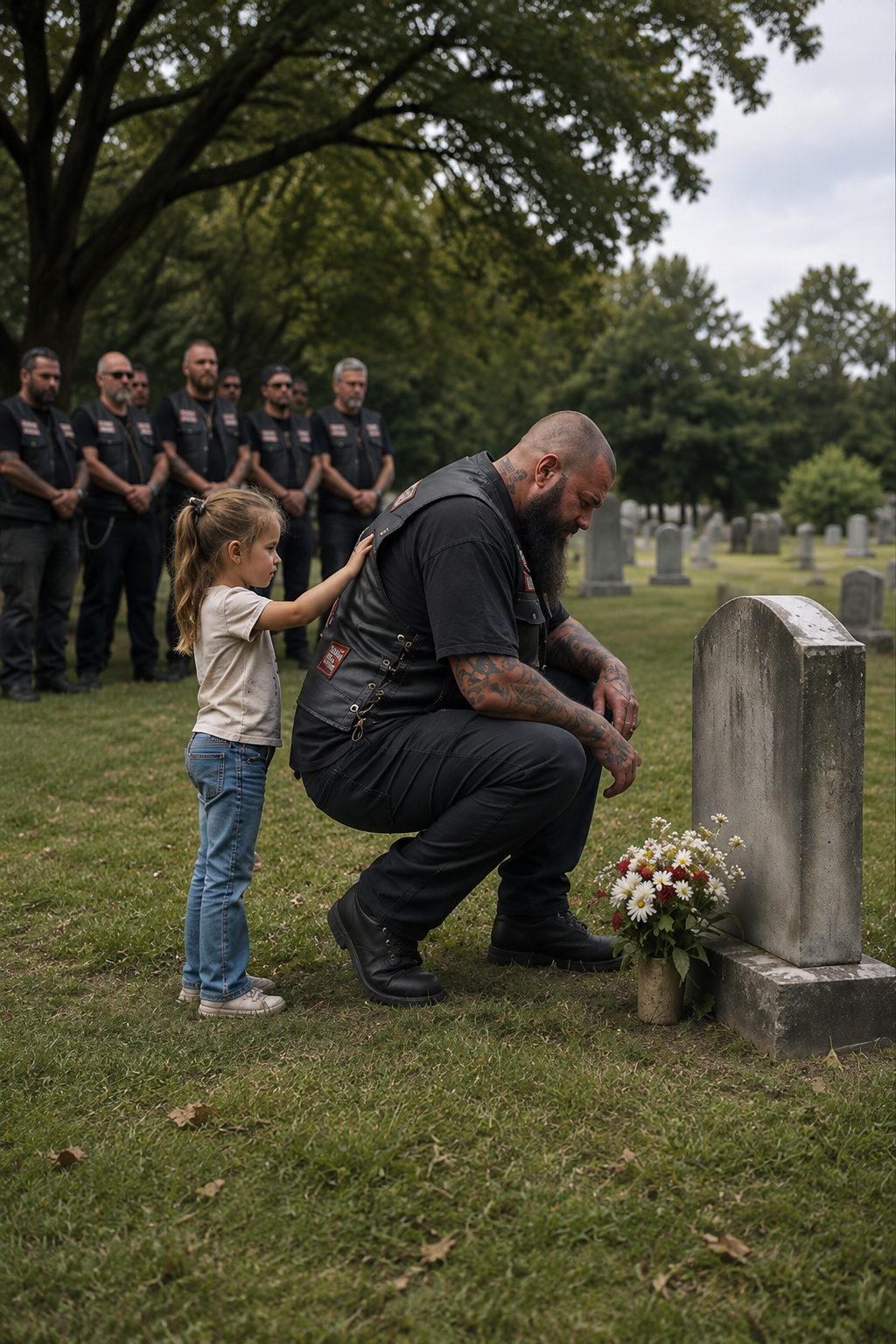
IF FACEBOOK BROUGHT YOU HERE, HERE’S THE CONTINUATION YOU’VE BEEN WAITING FOR. ENJOY! 👇 On Sunday morning, the Patriot News published a short article identifying Gerald as Gerald Whitmore, president of the Harrisburg Hells Angels chapter. The article described Vivian’s flower and noted a 2018 state police investigation into alleged activity involving the local chapter, while also stating that no Harrisburg members had been charged in that inquiry.
I understood why a reporter would examine the club’s history. Membership in an organization with a serious public reputation isn’t irrelevant, and I wasn’t going to pretend it was. But the article didn’t change what I had witnessed at the cemetery: a grieving man responding respectfully to a child who approached him.
My inbox filled with messages. Some parents thanked me; others warned me that I had put Vivian at risk, and one message was hostile enough that I reported it. I stopped letting her use my phone because I didn’t want her reading strangers’ opinions about her.
A mutual acquaintance told me Gerald had seen the video and was worried about our family being drawn into the argument. That mattered to me more than the online praise. I hadn’t known him before that Saturday, and he had no obligation to protect our privacy, yet he was thinking about it.
During the following week, I learned that Gerald owned a six-bay automotive repair shop on the eastern side of Harrisburg. He employed three full-time mechanics and had built the business from a two-bay garage years earlier. The same acquaintance said two customers had backed out of appointments after the news coverage.
I couldn’t tell how much of that was caused by the video and how much came from opinions people already held. I only knew that a quiet visit to his brother’s grave had become a public examination of his character. Vivian noticed that I was distracted and asked whether Gerald had gotten into trouble for crying.
“No,” I told her. “Some grown-ups are arguing about what his vest means.” She looked puzzled. “But I talked to him, not his vest.” I wrote that sentence down because I didn’t want to forget it.
By Thursday, a neighborhood association had announced a town hall about motorcycle clubs and community standards. The meeting would be held the following Tuesday at Harrisburg Area Community College, with city council members and a newspaper reporter attending. I considered going, but I didn’t want Vivian’s name to become the center of another argument.
Gerald attended alone. I read about the meeting afterward and later watched a recording of his brief remarks. He spoke about owning a repair shop, employing local people, and losing his younger brother Thomas two years earlier.
Thomas had died unexpectedly of an undiagnosed heart condition at forty-one, just three weeks before the birth of his first child. Gerald told the room that his brother had coached Little League and donated to the food bank, and that those facts belonged in any honest account of the man. He didn’t claim the club’s reputation was imaginary or ask anyone to forget its history.
Then he said he would be visiting Thomas’s grave again on Saturday with friends. Anyone who wanted to come and observe was welcome. I remember thinking it was an unusual invitation, but a dignified one.
A city council member named Leonard Briggs approached him after the meeting, according to the report. The newspaper’s reporter, Cassandra Holt, also asked about Saturday. Gerald gave neither of them a number, only the assurance that people would be coming to pay their respects.
On Friday evening, Vivian asked if we could visit Grandpa the next morning. I told her we could, although I had heard there might be a gathering at Rolling Hills. She wanted to bring another flower for Gerald’s brother, so we bought a marigold at a grocery store on the way home.
I didn’t know that Gerald had spent the week calling riding clubs and chapters across Pennsylvania and neighboring states. His friend Denny Marsh had helped coordinate the invitations, and a rider named Carl Ingram had been organizing routes and parking arrangements. By then the expected number was twelve hundred.
Saturday morning was colder than the week before. When Vivian and I reached the road near Rolling Hills, I saw motorcycles parked in orderly rows farther down the street and people in leather vests walking toward the entrance. Traffic moved slowly, but the cemetery access road remained open.
I found a place to park and asked Vivian to stay beside me. She clutched the marigold with both hands, staring at the riders passing us. “Are they all Gerald’s friends?” she whispered.
“Some of them,” I said. “I think they came for his brother.”
We walked through the gates and saw Gerald standing near row G, plot 14. He looked much as he had the previous Saturday, except he was surrounded by people who had traveled a long way to stand with him. When he spotted Vivian’s yellow coat, he lifted one hand in recognition.
She waved back, then looked up at me for permission to go closer. I nodded, and together we approached the edge of the gathering. Nobody rushed us or asked us to pose for a photograph; a few riders simply stepped aside to make room.
Part 3 The motorcycles were silent now. People stood among the headstones in coats and leather vests, their breath visible in the cold air. Some had brought wildflowers, and the flowers were being passed carefully toward Thomas’s grave.
Gerald stood at the front with his hands clasped. He didn’t give a long speech. He said, “This is my brother Thomas. He was a good man. Thank you for coming to meet him.”
Then twelve hundred people stood quietly. There was no cheering and no engine revving, only the wind moving through the trees and the soft shuffle of boots on gravel. I had expected the size of the gathering to feel overwhelming, but what struck me was how much care everyone took not to disturb the place.
Vivian waited until the people nearest the grave had finished placing their flowers. Then she asked me to walk with her to the headstone. Gerald recognized the orange marigold in her hand, and his face changed in a way I couldn’t quite describe.
“You came back,” he said. “I wanted your brother to have another flower,” she answered. She set it beside the others and stood quietly for a moment, as though that was all the ceremony required.
I shook Gerald’s hand. “I’m sorry the video caused so much trouble,” I told him. He looked toward Vivian and shook his head. “She didn’t cause any trouble. She gave me a good moment on a hard day. Other people decided what to do with it.”
I could see Cassandra Holt and a photographer standing on a rise beyond the older graves. Leonard Briggs had come, and so had Margaret Flowers, the neighborhood association chair who had led the town hall. They watched the gathering without interrupting it.
I stayed with Vivian for about forty minutes. She grew cold and asked to go home, so we said goodbye and walked back through the rows of parked motorcycles. Several riders nodded to us, but nobody made a spectacle of her.
The next morning, a photograph of the gathering appeared on the front page of the Patriot News. It showed Gerald near Thomas’s headstone, with flowers at his feet and people stretching back among the graves. The article included voices from the riders, the neighborhood association, and the people who had known Thomas.
Cassandra quoted Leonard Briggs saying that what he had seen challenged some of his assumptions. She also reported Denny’s account of the chapter raising more than forty thousand dollars for veterans’ organizations over five years. The article didn’t erase the club’s complicated history; it simply gave readers more than one fact to consider.
When Cassandra called to ask whether I wanted to comment, I agreed on the condition that Vivian’s school and other personal details remain out of the story. I told her my daughter had seen a man grieving and offered him a flower. I was grateful something good had come from that, but I wished strangers had shown more care with a child’s privacy.
Margaret Flowers later signed a neighborhood association statement welcoming continued dialogue. Leonard Briggs requested a meeting with Gerald and other chapter representatives about coexistence and community concerns. None of it meant everyone suddenly agreed, and I didn’t expect them to.
A few days later, Vivian made Gerald a card. She drew a motorcycle with enormous wheels and flames she insisted were orange, though the crayon barely showed on the paper. Inside she wrote, slowly and carefully, that she liked his brother’s flowers and was glad he had come back.
I added a note explaining that she had insisted on sending it. We mailed it to his repair shop, and I wondered whether he would think it was too much. I needn’t have worried.
Final A week later, a short note arrived from Gerald. He thanked Vivian for the card and said he had pinned it to the corkboard above his shop counter, beside his business license and a photograph of Thomas laughing at a motorcycle rally. He told her he could see the flames just fine.
I read the note aloud at dinner. Vivian smiled, then asked whether we could send him another drawing at Christmas. I said we could, provided we remembered that Gerald had a life beyond being the man we met at the cemetery.
The newspaper coverage faded as other stories took its place. I heard that Gerald’s shop received several new appointment requests, including from a customer who had canceled earlier. The neighborhood association continued talking with the chapter about practical concerns, but I never mistook one peaceful gathering for proof that every concern had vanished.
What stayed with me was smaller and more lasting. Vivian had seen somebody crying and offered comfort without asking who he was first. Gerald had accepted it without turning her into a symbol, even when other people tried to make her one.
That winter, when we visited my father’s grave again, Vivian carried two flowers. She left one for Grandpa and asked if we could walk past Thomas Whitmore’s headstone with the other. I told her we could, as long as we remembered the cemetery belonged to every family grieving there.
The old flowers were gone, cleared away as the seasons changed. Vivian placed her marigold at the base of the stone and stood beside me for a quiet minute. Then she took my hand and asked whether Thomas had ever met his baby.
I told her he had died before the child was born. She squeezed my fingers and looked back at the headstone. “That’s really sad,” she said, and I agreed because there was nothing useful to add.
We walked toward the gate under bare branches, her frog-print boots crunching over the gravel. I thought of the twelve hundred people who had stood in that same place, and of the one man who had been there alone a week earlier. For all the noise the story made, its beginning had been almost silent: a grieving brother, a little girl, and one orange flower.
THE END. I’ve shared the complete story, and I truly hope it touched your heart. If this story moved you, please , like, and share the post. Thank you for reading! ❤️
✓ Lynn R. Adams
IF FACEBOOK BROUGHT YOU HERE, HERE’S THE CONTINUATION YOU’VE BEEN WAITING FOR. ENJOY! 👇 On Sunday morning, the Patriot News published a short article identifying Gerald as Gerald Whitmore, president …