I was twenty-two years into my police career when I pulled a Hell’s Angel off a rain-soaked highway and put him in handcuffs,
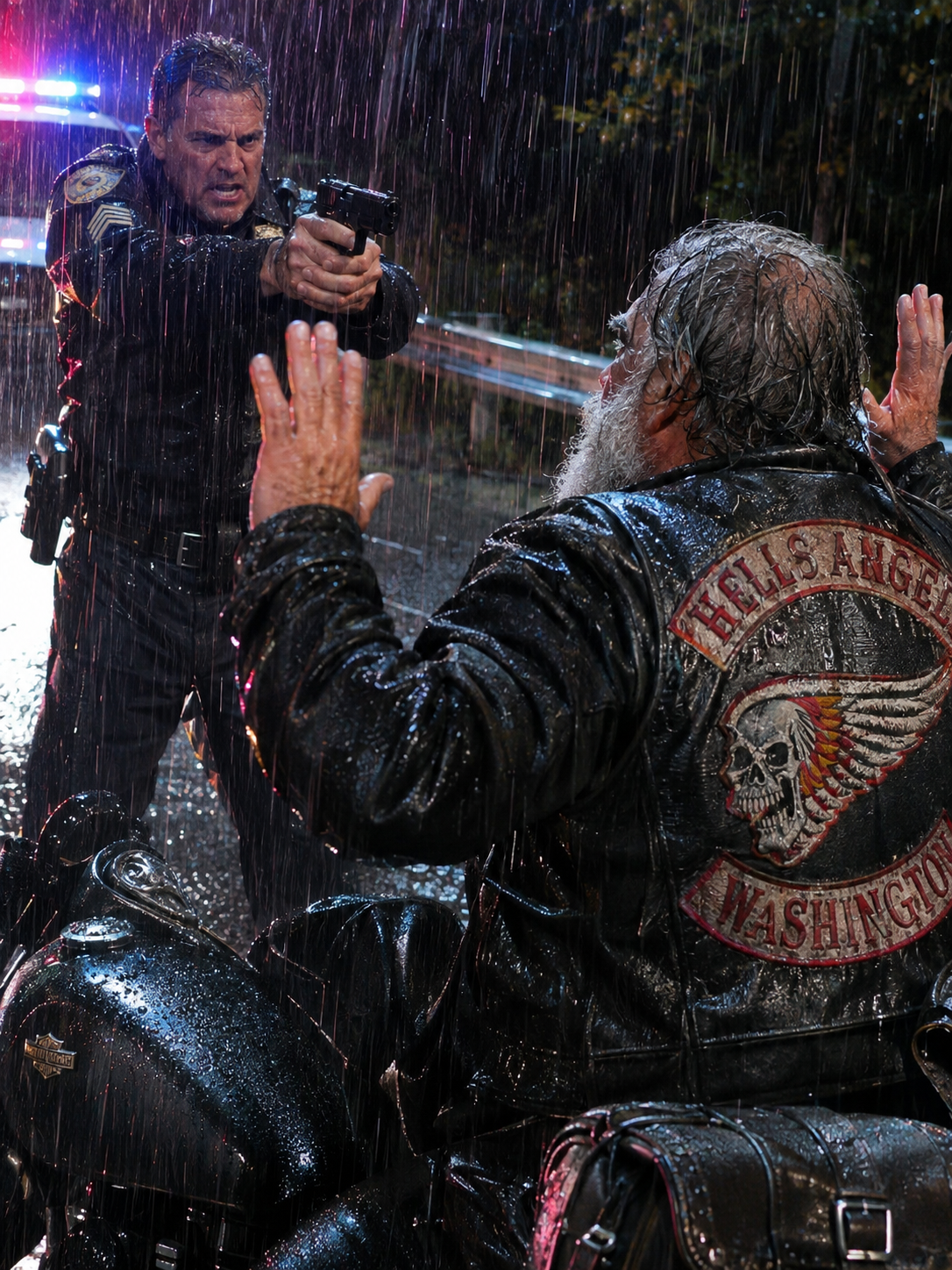
I was twenty-two years into my police career when I pulled a Hell’s Angel off a rain-soaked highway and put him in handcuffs, certain I had stopped a dangerous rider. He kept begging me to open the saddlebag on his Harley, saying a little girl would die if I waited. I didn’t believe him until I finally unbuckled it…
The first thing I remember is the sound of that motorcycle in the rain. It wasn’t like the low rumble of the trucks that hauled timber through Ashwood. It was a hard, urgent roar that cut across the highway, and when my radar flashed 98 miles an hour, I reached for my radio before I even saw the rider clearly.
My name is Thomas Mitchell. I’d spent twenty-two years with the Ashwood Police Department, long enough to know which stretches of Highway 9 iced first and which local drivers needed somebody to take their keys on Friday nights. I was getting close to retirement, and most of my overnight shifts had become a routine of coffee, traffic checks, and watching for deer.
That Friday was nothing like routine. A Pacific storm had moved into our part of the Northwest, pouring freezing rain over the logging town and sending mud down the slopes above the road. It was 11:42 p.m., and I’d parked my Ford Explorer near the northern bend people called Dead Man’s Curve because I didn’t trust anybody to take it fast in weather like that.
Then a black Harley-Davidson came past me like the rider had somewhere more important to be than staying alive. I hit my lights and pulled out after him, the wipers struggling to clear the windshield. Water sprayed from his back tire, and his taillight kept disappearing behind the sheets of rain.
“Dispatch, Unit Four. Southbound Highway Nine,” I told Brenda, our night dispatcher. “One motorcycle. Clocked at ninety-eight, and he’s still moving.” She warned me about possible mudslides near the gorge, then told me the state troopers were busy with a pileup on Interstate 5.
I wasn’t expecting much help. I also wasn’t willing to let a rider keep going at that speed on a road where one wrong move could send him into another car or over a guardrail. I pushed the cruiser forward, keeping enough distance that I could still stop on the slick pavement.
The strange thing was how well he handled the Harley. He wasn’t weaving across the centerline or losing control in the curves. He leaned into each turn with a precision that frightened me almost as much as his speed, because it meant he knew exactly what he was doing and still wasn’t slowing down.
When my headlights finally caught his back, I saw a rain-darkened leather vest under his gear. Across it was the winged death’s head of the Hell’s Angels, with Washington stitched below. I’d dealt with enough trouble on the highway to know a patch didn’t tell me everything about a man, but it made me pay closer attention.
“He’s a patched club member,” I told Brenda. “Requesting backup at the county line.” She repeated that nobody was available and told me not to engage unless I had to.
Near Miller’s Ridge, the decision was taken out of my hands. The Harley made a sharp metallic cracking sound, followed by a cloud of black smoke. Its rear tire swung sideways, and for one awful second I thought I was about to watch the rider go underneath the guardrail.
He fought the bike onto the muddy shoulder and stopped just short of the metal barrier. I angled my cruiser behind him, got out into the cold rain, and drew my service weapon. My uniform was soaked before I took three steps, and I could hear the damaged engine ticking over the wind.
“Hands where I can see them,” I called. “Keep them on the handlebars.” The rider turned toward me instead, a broad-shouldered older man with a thick gray beard plastered to his face and water running from his forehead into his eyes.
He looked to be in his late fifties, and he was breathing as though he’d been running, not riding. “Officer, I don’t have time,” he said. His voice was rough, but what caught me was the fear in it.
He reached back toward a large leather saddlebag secured behind him. I raised my voice and ordered him to stop. I didn’t know what was inside, and on a dark highway, with a man ignoring instructions and reaching into a bag, I wasn’t about to guess.
“I need what’s in there,” he shouted. “You don’t understand. We’re out of time.” I told him to turn around and place his hands behind his head, and after staring at the bag for another long moment, he finally obeyed.
I handcuffed him beside the guardrail. His hands were cold, and his shoulders were trembling, but he wasn’t trying to fight me. When I checked his license, I found the name Arthur Rollins and a California address.
“Arthur, why were you doing nearly a hundred in this weather?” I asked. “Who are you trying to get away from?” He didn’t answer either question.
“They call me Chisel,” he said. “Please, check the bag.” When I started leading him to the cruiser, he twisted around to look at the Harley, his face drawn tight.
“If I don’t get moving in the next twenty minutes, she dies.” I stopped for a second, then opened the rear door and helped him into the back seat. In my years on patrol, people had given me every kind of explanation for why they couldn’t stop, and I couldn’t decide a story was true because a man sounded desperate.
Still, his words bothered me all the way back to the station. He hadn’t asked for a lawyer, tried to bargain over a ticket, or complained about the cuffs. He kept asking me to look in the saddlebag, sometimes quietly and sometimes loud enough that I heard him through the partition.
We brought the disabled motorcycle in for impound and secured the bag for processing. I intended to examine it in the dry evidence room rather than out on a shoulder where the rain had soaked everything. By the time I’d started the paperwork, it was well after midnight.
Ashwood’s station was a little brick building with old windows that rattled in a hard wind. Wet uniforms made the place smell like damp wool, and somebody had left a pot of coffee burning on the warmer. Chisel was put in holding cell two while I sat at my desk, still trying to write with fingers that wouldn’t warm up.
“Call the hospital in Portland!” he shouted down the hall. “Call St. Jude’s!” I heard the bars rattle when he grabbed them, and I tried to concentrate on the report in front of me.
Brenda came to the dispatch window, her headset resting around her neck. “Thomas,” she said, “he’s been saying hospital since you brought him in. Could we at least see what’s in that bag?” I looked at her for a moment, then pushed my chair back.
The saddlebag sat on a stainless-steel table, still dripping onto the floor. I pulled on gloves and opened the heavy buckles, expecting something I would have to photograph and inventory as evidence. Instead I found a rigid, bright yellow medical cooler with a digital temperature gauge and a warning label.
Inside were carefully packed thermal gel packs surrounding a reinforced metal cylinder. Tucked into the cooler lid was a sleeve of hospital transport paperwork bearing the name Seattle Children’s Hospital. I lifted out the papers, trying to understand why an outlaw biker had been riding through our town with something that belonged in a medical courier vehicle.
The patient’s name was Lily Henderson. She was seven years old, and the cylinder held a rare donor match of hematopoietic stem cells for her bone marrow transplant at Portland Regional Medical Center. I read the transport deadline twice, certain I’d misunderstood it.
The material had to reach the hospital by a.m. I looked at the clock over the evidence room door. It was , and I had just spent precious time treating a frightened man like his only concern was escaping the law. Part 2…..
IF FACEBOOK BROUGHT YOU HERE, HERE’S THE CONTINUATION YOU’VE BEEN WAITING FOR. ENJOY! 👇 I carried the papers straight into the dispatch room. “Brenda, get Portland Regional on the phone,” I told her. “Tell them we have Lily Henderson’s transport cooler. We need someone who can confirm exactly what we’re holding.”
She reached for her headset while I went to holding cell two. Chisel was leaning against the bars, his forehead resting on his folded hands, and for the first time since I’d arrested him, he wasn’t yelling. When I said Lily’s name, he looked up so quickly I almost stepped back.
“You found it,” he said. It wasn’t really a question. I unlocked the cell and asked him to tell me how he’d gotten the cooler, because the papers explained what it was but not how it had ended up on a Harley.
He told me a medical courier van had blown a tire outside Seattle and gone into a ditch. The paramedics had been trapped, and the storm had grounded the helicopters. Chisel and other members of his club had been coming back from a ride near Tacoma when they came upon the wreck.
A member of the medical crew had explained that Lily had already undergone the treatment needed to prepare her for the transplant. Her immune system was dangerously weakened, and delays could have devastating consequences. Chisel said the crew had entrusted him with the sealed transport, hoping a motorcycle could make the trip where a damaged van couldn’t.
“I was the fastest rider with them,” he said. “So I took it.” His voice broke as he added, “I told her mother I’d get it there. I made that promise right there beside the road.”
I asked why he hadn’t stopped when I lit him up. He stared at me for a moment before saying, “I thought a small-town cop would see the patch and lock me up. And I was scared you’d make me wait while you checked everything.”
The truth was hard to hear because that was exactly what had happened. I took the cuffs off him, and we moved quickly toward the front desk. “Get the cooler,” I told him. “We’ll use my cruiser. I’ll call ahead so they know we’re coming.”
Brenda was just setting down the phone. The medical team had confirmed the urgency of the transport, but that wasn’t the news she was struggling to get out. Highway 9 was washed out near the gorge, she said, and the bridge over Miller’s Creek was under three feet of moving water.
The storm had cut Ashwood off from the route south. Even the heavy tow trucks couldn’t get through, and the state had no helicopter that could safely fly in the wind. I looked down at my car keys and realized they weren’t going to solve anything.
“What about another road?” Chisel asked. Brenda shook her head; the available routes were blocked by the same flooding and slides. He looked at the cooler’s gauge, then at the wall clock. It was a.m., thirty-eight minutes before the deadline printed on Lily’s paperwork.
I could hear the rain hitting the station windows. Chisel stood beside me with the cooler in his arms, and I tried to think of someone I hadn’t called, a route I might have missed, anything that would get those cells out of town. Then the glass in the dispatch window began to tremble.
At first I thought a big truck was pulling up. A low mechanical rumble grew louder, until Brenda turned to the security screens and saw headlights gathering on the streets outside. There were five, then dozens, and soon the road in front of the station was crowded with motorcycles.
I’d never seen anything like it in Ashwood. Around a hundred Hell’s Angels riders had come through the rain, their headlights stretching along the block and their engines sending a vibration through the old building. My hand went toward my holster before I made myself stop and look at Chisel.
He gave me a tired, almost disbelieving smile. “They’re not here to break me out,” he said, adjusting the strap on the medical cooler. “They’re here to finish the ride.”
We went outside together. A large man with a braided beard and a scar along his jaw stepped away from the lead motorcycle and introduced himself as Jackson Sullivan, the club’s chapter president. He said they’d seen Chisel’s GPS tracker stop in Ashwood and heard reports on the radio about the washed-out road.
I told Sullivan the bridge was flooded, the highway was impassable, and taking a motorcycle onto that crossing could kill somebody. He listened without interrupting. Then he turned and looked down the line of riders who had followed him through the storm.
“Then we’d better go see it ourselves,” he said. I wanted to argue, but the clock was still running, and I knew that standing in the station had no chance of helping Lily.
Part 3 I led the way in my cruiser, with Chisel riding a motorcycle supplied by one of his club brothers because his own Harley was disabled and impounded. The yellow cooler was secured close to his chest. Behind us, headlights followed around the wet corners of town until we reached the flooded bridge.
Miller’s Creek was normally a shallow stream that ran past the trees and under an unremarkable concrete crossing. That night it was a roaring brown torrent, carrying branches and debris across the road. Even from the bank, I could see the current was strong enough to sweep a motorcycle away in seconds.
I told the men to stay back. Sullivan walked to the edge, studied the water, and proposed forming a wedge with their heavy bikes, angled into the current to make a sheltered passage for Chisel. He spoke as though weight and determination might overcome the water, but I knew floodwater didn’t negotiate with anybody.
“That’s not a safe crossing,” I said. “Not for cars. Not for motorcycles. Not for anybody.” Sullivan looked at the cooler strapped to Chisel and answered, “Then none of us ought to pretend we have an easy choice.”
I still can’t call what happened next a sensible plan. What I can say is that those riders understood the danger, and they chose to try it anyway. I radioed the conditions and asked dispatch to arrange help while I stayed at the bank, watching for anyone who needed to be pulled clear.
At a.m., we reached the bridge. A few minutes later, riders began easing their motorcycles toward the flooded approach in a staggered formation. They steadied one another wherever they could, engines laboring while water struck the frames and sprayed against their boots.
Sullivan shouted instructions over the roar of the creek. More bikes edged into position until they formed a rough, angled barrier against part of the current. It was an astonishing sight and an unstable one; I could see every rider fighting to keep his machine upright.
By , Chisel had a narrow opening ahead of him. He looked back once, not toward the town, but toward Sullivan and the men bracing themselves in the water. Then he lowered his visor and accelerated onto the crossing.
For a few seconds his tires held. Muddy water struck his wheels and the bike shuddered beneath him as he passed between the other riders. I couldn’t hear my own voice, but I remember shouting his name as the rear end swung sideways near the middle of the bridge.
Chisel caught himself with a boot against the pavement and kept moving. When he reached the southern side, I saw the red taillight climb away up the road. The cooler was across, and I finally let myself breathe.
The formation didn’t hold much longer. The current knocked three motorcycles out from under their riders, and the machines disappeared over the bridge edge into the ravine. The men caught hold of one another and of the bikes still standing; their brothers hauled them back toward the bank.
Nobody celebrated. Three riders were hurt and shaken, three motorcycles were gone, and everyone left behind was cold enough that their hands barely worked. We checked the men who’d fallen and made sure nobody was still in the water while I relayed what had happened to Brenda.
“Medical transport is clear of the washout,” I said into the radio. “Chisel is southbound on Highway Nine. Notify Portland Regional and get the state police to help him through wherever the roads are open.”
For the next stretch of road, I followed his progress over the scanner rather than with my eyes. Troopers were getting intersections and freeway access points under control so he could keep moving without meeting traffic in his path. Every update felt too far apart.
At a.m., word came that he’d reached Portland. The storm was still beating down on the city, and the surgical team at Portland Regional Medical Center was waiting near the emergency entrance. Dr. Carter Evans, the lead transplant surgeon, had been told the cooler was on its way.
Two minutes later, Chisel pulled up under the hospital overhang, got off the motorcycle, and hurried toward the doors. He was covered in rain and road grime, and he barely stopped to explain himself before putting the yellow cooler into Dr. Evans’s hands.
“Is there still time?” he asked. The doctor looked at the temperature display and the time, then said they had only minutes to spare. The team carried the container inside to prepare Lily’s infusion, while Chisel sank down against the wall and covered his face with his hands.
Back in Ashwood, I sat at the dispatch desk with my wet coat hanging off the chair. Brenda kept the phone within reach. We had gotten the cells to the hospital, but I knew there was still a little girl inside whose future depended on much more than a motorcycle ride.
Final By morning the storm had eased, leaving standing water along Ashwood’s streets and mud where the shoulders used to be. A few of the riders who had stayed behind were at our local diner, drinking coffee beside loggers who usually didn’t see that many motorcycles in a whole month. Three men from the bridge had bandages, and the town’s heavy tow trucks were helping recover the motorcycles that had gone into the ravine.
I went to the diner after Dr. Evans sent an update. Chisel had made it back to town, and he and Sullivan were sitting in a rear booth with coffee growing cold in front of them. I slid into the seat across from them and laid a printed photograph on the table.
It showed Lily Henderson resting in her hospital bed with an IV beside her. The stem-cell infusion had been completed successfully, I told them, and the doctors were encouraged by how she was doing. She still faced recovery and careful monitoring, but they were hopeful she would get the full recovery everybody had been fighting for.
Chisel didn’t reach for the photograph at first. He just stared at the little girl’s face, then put one broad hand over his mouth. Sullivan looked down into his coffee and let him have a moment.
After a while Chisel took an old, creased picture from his leather vest and set it beside Lily’s. It showed him when he was younger, standing shoulder to shoulder with a clean-cut man in a Washington state trooper’s uniform. The resemblance between the man and Lily was in the shape of his eyes.
“That’s David Henderson,” Chisel said quietly. “Lily’s dad. He died on duty five years ago.” I looked up from the photograph, and he added, “Before he was a trooper, we were two kids growing up on the same block. We went different ways, but we never quit being brothers.”
He ran a finger along the worn edge of the picture. When he heard David’s little girl was sick and the storm had grounded the medical flights, he said, the club had agreed to help however it could. What began as one rider taking a cooler from a wreck had become a night of men risking their lives for the daughter of a friend they had never forgotten.
I thought about that rainy shoulder, my service weapon drawn, and the way Chisel had stared at his saddlebag as if it held his whole world. I’d had a duty to stop a motorcycle traveling that dangerously, and the risk to other drivers was real. But I wished I’d listened sooner to the urgency in his voice, and I knew I would carry that lesson into whatever years I had left in uniform.
Before I stood up, I told him his damaged Harley was still at the precinct impound. I also told him that, after everything we’d been through, the arrest paperwork seemed to have gotten lost in the flood. Chisel looked at me for a long moment, then nodded without making a joke of it.
“Ride safe, Thomas,” he said when I reached the door. Outside, the morning light fell on wet leather jackets and tired faces as the motorcycles started up one by one. For the first time in a long while, the sound didn’t make me think of trouble coming down the highway; it made me think of a promise kept to a little girl who needed every bit of help she could get.
THE END. I’ve shared the complete story, and I truly hope it touched your heart. If this story moved you, please , like, and share the post. Thank you for reading! ❤️
✓ Lynn R. Adams
I was twenty-two years into my police career when I pulled a Hell’s Angel off a rain-soaked highway and put him in handcuffs, certain I had stopped a dangerous rider. He kept begging me to open the sa…