I was seventy-one when I crossed a flooded Georgia street to help a stranger thrown from his motorcycle,
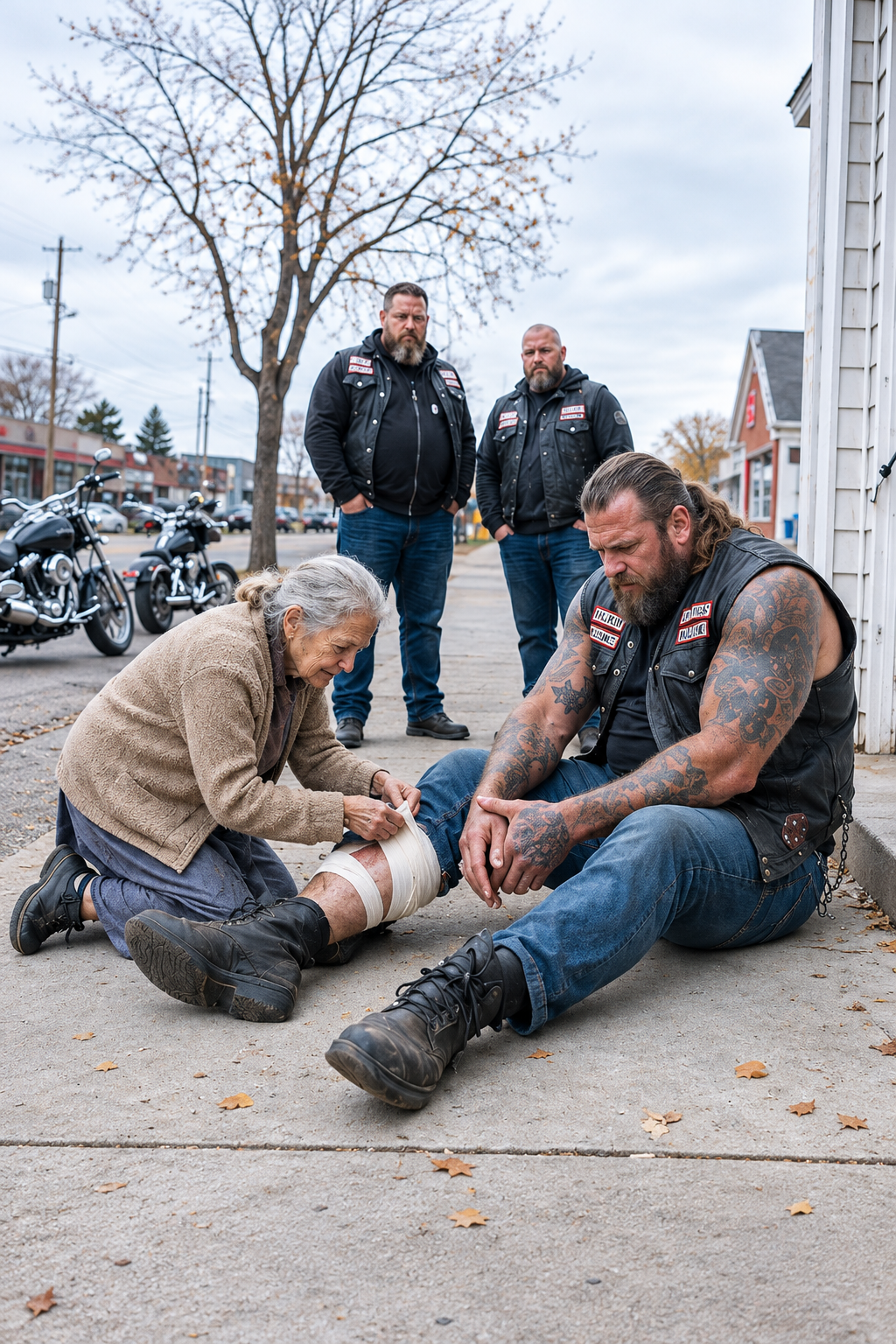
IF FACEBOOK BROUGHT YOU HERE, HERE’S THE CONTINUATION YOU’VE BEEN WAITING FOR. ENJOY! 👇 When Vincent called that Thursday, he sounded stronger and told me his arm was in a cast for four weeks. He’d heard about the gossip and apologized for the trouble, but I told him he hadn’t caused my neighbors’ opinions. We spoke about his hometown of Valdosta, my library work, and what it was like belonging to a club people judged before meeting its members.
A few days later, Patricia’s husband Jim came to my door to warn me about the company I was keeping. I thanked him, closed the door, and made myself lunch, but I was still thinking about his words when Vincent called again on a warm Saturday morning in May. He said the Iron Saints had been talking about what happened and wanted to come thank me properly.
I was sitting on the brick wall beside my tomato plants when I asked how many people he meant. “Around two thousand,” he said, then corrected himself: “Two thousand one hundred and some, as of this morning.” I looked at the narrow street beyond my garden and tried to picture that many motorcycles arriving at my little house.
“Vincent,” I said, “Pickett Street isn’t built for two thousand motorcycles.” He told me the riders would come in an organized procession, not crowd onto my lawn, and that they wanted to show their appreciation without frightening anyone. He also wanted me to understand that the whole town would see.
I thought about Patricia, Reverend Whitmore, and the people who’d watched from their windows the night of the accident. I thought about all the hospital rooms where I’d sat quietly with someone who needed me and how little I’d ever expected in return. “All right,” I told him. “Saturday after next will be fine.”
I didn’t tell my neighbors. Partly that was because I was a private woman, and partly because I couldn’t explain an event I hadn’t seen myself. I went on volunteering, tending the garden, and making dinner for one, while the date sat in the back of my mind.
On the appointed Saturday, I woke at six and made coffee. By half past nine, I had put on the blue dress I wore to church on special occasions and taken my place on the porch swing. The morning was clear, and the oak trees along Pickett Street had filled out with spring leaves.
At first I thought I heard distant thunder. Then the sound became a low, steady rumble, growing until I could feel it through the porch boards. I stood when the first motorcycles turned onto my street at ten o’clock.
They came two by two, moving slowly, their engines kept low. Chrome caught the morning sun, and the line stretched around the corner and farther than I could see. I had imagined a large gathering, but nothing had prepared me for that sight.
At the front rode Vincent Calloway, his injured arm still in its cast. He stopped in front of my house, set down his kickstand, and walked up the path wearing the same leather jacket I’d helped him remove in my living room. He stopped at the bottom of the porch steps and looked up at me.
“Eleanor Marsh,” he said, loud enough for the nearest riders to hear, “this club would like to say thank you.” I looked past him at the faces turned toward my house and saw neighbors appearing in their doorways. Across the street, Patricia stood on her porch with one hand near her mouth.
Three women from the club had left wildflowers at my garden gate. They weren’t expensive flowers, just a bright handful tied together with care. I noticed them because they were the kind of gift someone brings when they’ve thought about the person receiving it.
“You didn’t have to do all this,” I told Vincent. He smiled slightly and answered, “No, we didn’t.” Then the riders began to applaud.
The sound came from the people nearest the house and spread along the street. I stood at the top of my steps, one hand resting on the railing, trying to take in what was happening. For years I’d felt as though I could walk through Harlow without anyone remembering the work I’d done here, and now more people than I could count had come simply to acknowledge it.
I didn’t cry. I’ve never been someone who cries easily, but I could feel something shifting in my chest as I raised a hand to the riders. The applause lasted nearly four minutes; I know because I counted, the way I always counted when I needed to steady myself.
Later I learned there had been 2,117 riders, organized by chapter and region. It took forty minutes for the procession to pass, and I stayed on the porch for every minute. My neighbors remained outside too, watching a street they thought they knew become something none of us had seen before.
About half an hour in, Patricia crossed over and stood beside me. She didn’t try to explain herself, and I didn’t ask her to. After a while she said only my name, and I took her hand briefly while we watched the last riders go by.
When the final motorcycle turned the corner, the silence felt almost as remarkable as the noise. Vincent stayed behind with five or six club members, including Tom Braddock and a woman named Darlene Hutchins. I put on another pot of coffee and found cups for everyone.
We sat on the porch steps and the low garden wall, talking about ordinary things. Tom told me about growing up in a small town not far from Harlow, and Darlene asked about my nursing career with the sort of interest that invites a real answer. Before long, I was telling them about labor and delivery and the families I’d known over four decades.
I hadn’t spoken about my work with that much pleasure in years. Retirement hadn’t taken away what I’d learned or how much I cared about it, but it had taken away the daily opportunity to use those skills. Darlene listened as if that part of my life mattered, which was a kindness all its own.
Vincent was quieter than the others. He sat on the steps holding his coffee, listening until the conversation turned and we had a moment to ourselves. Then he told me he knew helping him had brought me trouble and that he was sorry.
“It was less trouble than leaving you in the rain would have been,” I said. He looked at me and replied that he wasn’t sure everyone in town understood that. I told him some people were reconsidering, and I hoped they would keep doing so.
Final He said he’d belonged to the Iron Saints for twenty-two years. The club had done things he was proud of and things he wasn’t, and he didn’t expect strangers to approve of everything about it. But he wanted to be judged for what he did, not just for the patch on his back.
I told him I’d seen that same guarded look in hospital patients who expected to be treated badly before anyone had spoken to them. He nodded and said, “You treated me like a patient.” I told him that was because he’d been one.
After a while, I asked what he intended to carry away from the day. Vincent turned his coffee cup in his hands and thought before answering. “Try to do for somebody else what you did for me,” he said. “Be the person who stops.”
That answer meant more to me than the procession. A public thank-you was generous, but if Vincent remembered a stranger’s kindness the next time someone needed help, then our rainy night had reached farther than Pickett Street. I sat beside him, content to let the conversation rest.
Darlene asked whether I’d been frightened when I found him. I admitted I had been a little afraid, standing in cold rain beside a badly injured man I didn’t know. But I told her I’d learned on my first night shift, when a patient needed emergency care, that fear could come along without making the decision for me.
“You can be afraid and still do what needs doing,” I said. Darlene asked whether I’d ever speak to the club’s wives group about nursing and the things I’d learned. To my own surprise, I said I’d like that.
They left around half past noon. Vincent was the last to go, and he stopped beside his motorcycle to thank me one more time. I told him he’d already said it, and he answered, “I’m saying it again.”
After the engines faded, I found the wildflowers still tucked into my garden gate. I carried them inside and put them in water. The house was quiet again, but it didn’t feel quite the same.
At two o’clock, Patricia arrived with another casserole. She sat at my kitchen table, looked at me for a moment, and said, “I didn’t understand.” I poured her coffee and answered, “I know.”
We talked for an hour about her daughter, whom I’d helped deliver in the back of an ambulance twenty-eight years earlier. That daughter was now a pediatrician in Atlanta who called her mother every Sunday. Patricia and I had known each other for so long that we didn’t need to settle every disagreement before we could begin being neighbors again.
I didn’t mistake one procession for a change in every heart in Harlow. People would still have their opinions about the Iron Saints, and Vincent hadn’t asked me to pretend the club was perfect. What mattered was that some of my neighbors had stopped long enough to question what they’d assumed.
I had spent my working life holding hands, checking on people in the dark, and sitting beside beds when there was nothing more useful to do. None of those moments had come with applause. They mattered anyway, just as helping Vincent mattered before a single motorcycle arrived.
That afternoon I stood on my porch and watched Patricia cross back to her house. The azaleas had finished blooming, but the oaks were full and green, and the wildflowers were waiting in a glass on my kitchen table. I went inside, made tea, and prepared supper for one.
My placemat was still in its usual place. The room was still quiet, and Ruth’s boxes were still waiting in the second bedroom. But I knew Vincent would remember to stop for someone else, and I knew there were people beyond my street who now knew my name.
I hadn’t crossed that road to be thanked. I’d crossed because a man was hurt, and I’d stayed because I knew how much it matters not to leave someone alone. Sitting at my table that evening, I felt peaceful knowing I would make the same choice again.
THE END. I’ve shared the complete story, and I truly hope it touched your heart. If this story moved you, please , like, and share the post. Thank you for reading! ❤️
✓ Lynn R. Adams
IF FACEBOOK BROUGHT YOU HERE, HERE’S THE CONTINUATION YOU’VE BEEN WAITING FOR. ENJOY! 👇 When Vincent called that Thursday, he sounded stronger and told me his arm was in a cast for four weeks. He’d h…