I was seventeen, homeless, and
I was seventeen, homeless, and searching for somewhere to survive a blizzard when I found fresh tire tracks outside an abandoned cabin. Then I heard someone trapped inside, and the name she whispered changed everything….
At seventeen, I knew how to disappear. Eight months after running from the foster care system, I could walk through Cascade Falls without anybody really seeing me. I knew which diner threw away food after closing, which abandoned sheds kept out the rain, and which hollow trees were big enough for a sleeping bag. I also knew that when people looked through you long enough, you started to believe you weren’t worth noticing.
My name is Luther Sullivan. That late-November night in the Pacific Northwest, I wasn’t thinking about changing anybody’s life. I was trying to keep my own. The temperature had fallen toward ten degrees, and the wind coming through the pine forests was sharp enough to hurt my face. Snow had soaked my worn-out sneakers. My sleeping bag was thin, the kind that might get you through a chilly evening but couldn’t protect you from a blizzard.
I had no home to return to, no parent waiting for me, and no money for a motel. My choices were getting smaller with every step. I could keep walking until I collapsed, or I could try the old Miller logging cabin about a mile off a road nobody used anymore. Everyone in town said to stay away from it. They talked about black mold, rotten foundations, and the possibility that the whole thing would come down around you. That night, four walls sounded better than the open woods.
I held my rusted crowbar as I made my way through snow that reached my calves. The tool had gotten me into abandoned places before, and I kept it close when I slept outside. Ahead of me, the trees opened around the cabin. I should have seen nothing but a sagging porch and blackberry brambles. Instead, I saw a pair of fresh tire tracks cutting right through the snow.
They were too wide to belong to an ordinary car. Something heavy, with off-road tires, had driven straight up to the porch. I stopped behind a Douglas fir and watched the building. Nobody was supposed to be out there. It was too far from town, too deep in the woods, and too late for anyone to be checking an abandoned property. I couldn’t see a vehicle, but the tracks were recent enough to make my stomach tighten.
For ten minutes, I stood there listening. Snow settled on the shoulders of my jacket while the wind moved through the branches. I heard no voices and no engine. The cabin looked empty, and the sensible thing would have been to leave it alone. But I was so cold I could barely feel my fingers, and the thought of going back into the woods frightened me almost as much as those tire tracks.
When I finally stepped onto the porch, I noticed something else. A brand-new steel padlock had been fitted to the old door. The wood around it was swollen and soft from years of rain, but the lock gleamed like somebody had bought it that morning. Whoever had installed it clearly cared about keeping that door shut. I stood there wondering what anyone would need to lock inside a building nobody wanted.
Then something thudded against the floor on the other side. It wasn’t loud. It came again after a pause, a dull, uneven knocking that sounded almost like someone trying to get attention without being heard. I leaned closer, held my breath, and listened for a third sound. When it came, I understood that I wasn’t alone.
I almost walked away anyway. I’m not proud of that, but it’s true. I’d spent months learning that getting involved in someone else’s trouble could leave you hurt, arrested, or worse. I had no phone, no backup, and nowhere safe to run if whoever owned those tire tracks returned. But the knocking stopped, and I couldn’t bear the idea of leaving a person there if they were waiting for help.
I wedged the crowbar between the lock’s metal fitting and the rotten frame. The wood gave faster than I expected. With one hard pull, the fitting tore loose, and the padlock hit the porch. I pushed the door inward. The hinges complained, and a smell of mildew and something metallic reached me from the dark. I stood still long enough to listen, then took my battered flashlight out of my coat.
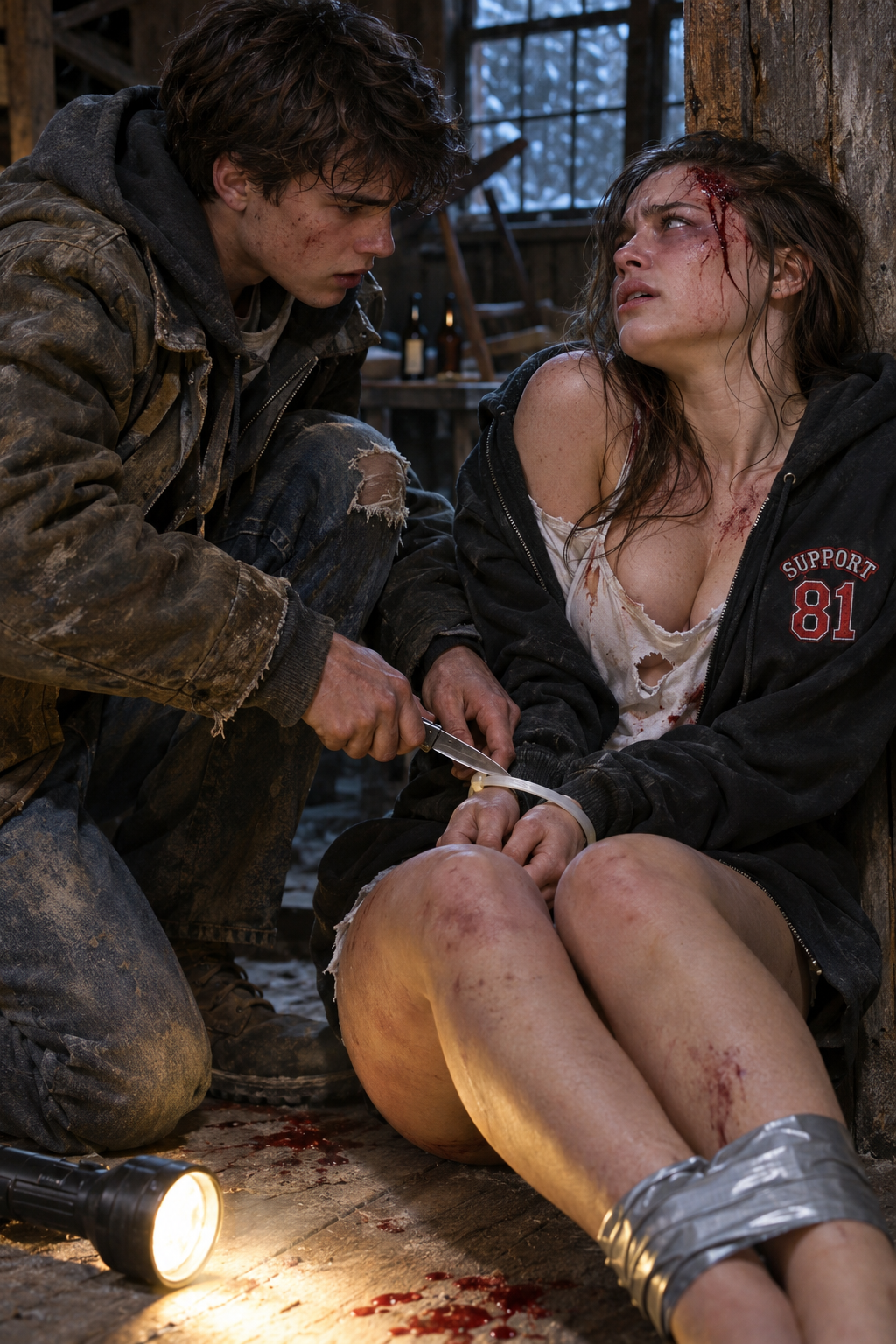
The narrow beam passed over fallen chairs and empty bottles. Dust covered most of the floorboards. Then the light reached a support post in the far corner, and I forgot how cold I was. A young woman was sitting against it with her hands secured behind her back. Silver duct tape bound her ankles. More tape covered her mouth. Her head had fallen forward, and she was trembling hard enough that I could see it from the doorway.
She looked about nineteen, only a couple of years older than me. Her dark hair was tangled near an injury at her temple, and her face was badly bruised. She wore a torn white T-shirt beneath a heavy black hoodie. There was a red-and-white emblem on the hoodie, but I didn’t understand what it meant at first. I understood the restraints, though, and the fact that whoever left her there had not expected anybody to find her.
I went to my knees beside her. When she opened her eyes and saw me, she jerked back against the post with a frightened sound muffled by the tape. I put my flashlight on the floor so she could see my face. My coat was filthy, my hair was wet with snow, and I probably looked as frightened as she did. I kept my hands where she could see them and spoke as quietly as I could.
“I’m not with whoever did this,” I told her. “I came here because I needed shelter. I can take that tape off, but you have to stay quiet. Can you nod if you understand?” She studied me for a moment, breathing fast. Then she nodded. I pulled the tape from her mouth, and she gasped, coughed, and finally managed a few words: “We have to go. They’re coming back.”
I wanted to ask a hundred questions, but she looked as though she might collapse at any moment. I pulled my little pocketknife from my coat and worked carefully at the thick plastic ties around her wrists. She winced every time the blade moved. When the last tie snapped, she brought her hands forward and rubbed at the marks. Her voice was hoarse when she said, “My name is Karina. Karina Davies.”
I didn’t recognize the name. I was a kid who spent most days trying to find food, not keeping track of people with influence in town. But as I bent to cut the tape around her ankles, I noticed the silver rings on her fingers and read the words on her hoodie: Support 81. I knew just enough about motorcycle clubs to understand what the number meant. Eight and one stood for H and A. Hells Angels.
“Your family is with the bikers?” I asked. Karina nodded. “My father is Jim Davies,” she said. “He’s president of the Cascade Falls charter.” I had heard enough about that club to know I had walked into something far bigger than a random break-in. I finished freeing her ankles and tried to help her stand, but her knees buckled. I caught her before she hit the floor and put her arm across my shoulders.
Karina told me she’d been grabbed outside her college dorm, blindfolded, and thrown into a van. I asked whether a rival gang had done it. She looked straight at me, her expression changing from fear to a terrible kind of certainty. “No,” she whispered. “It was Ray Miller. My father’s vice president.” Part 2…..
The name had barely left Karina’s mouth when an engine growled through the forest. Headlights swept between the trees, cutting across the falling snow. She tightened her grip on my jacket. “They’re here,” she said. I turned off my flashlight, took more of her weight on my shoulder, and steered her toward the back door.
We slipped outside just as a black SUV stopped in front of the cabin. Car doors slammed. Men shouted about the broken lock, then someone ordered them to find her before she got out of the woods. I knew the trails around that place better than most people because I’d spent months searching them for food and somewhere to sleep. That was the only advantage we had.
Karina could barely walk. I told her to put her feet where I put mine, but our tracks cut obvious holes through the new snow. Flashlights began moving between the trees behind us. When someone yelled that he’d found fresh tracks, I led her toward a rocky ravine. We slid down the frozen embankment together, scraping against dirt and branches, and crawled beneath the overhang of an uprooted tree.
Boots crunched at the top of the ravine. A flashlight swept past our hiding place, and I held still with one hand gently covering Karina’s mouth so a sudden cough wouldn’t give us away. From above, I heard Ray Miller’s voice. He was furious that his men couldn’t find a badly injured girl. Then he said something that explained the entire kidnapping: if Jim discovered what had happened before Ray arranged the ransom calls, they were all dead.
Once they moved away, we climbed out and headed for Route 9. Betty’s Truck Stop was roughly two miles north, and its diner stayed open all night. Karina’s strength was fading; I had to support almost all her weight. She asked why I hadn’t left her behind when I had the chance. I told her the simplest truth I knew: “Nobody helped me when I got thrown out. I know what it’s like to be left in the cold.”
As we struggled through the trees, she told me Ray had been stealing from the club’s treasury and her father was beginning to suspect him. Ray planned to blame her kidnapping on the Jimenez cartel, demand money from the club, and use the chaos at the ransom exchange to kill Jim. It wasn’t just about taking her. He wanted her father’s position, and she was the bait.
By the time the flickering lights of Betty’s appeared through the snow, I was so tired I could hardly keep my balance. I pushed open the glass door and helped Karina into a booth. Marge, the waitress who sometimes gave me a free cup of coffee, dropped the pot she was holding when she saw us. I asked her to lock the door and tell me where the payphone was. She looked at Karina’s face and did both without asking why.
Karina gave me a ten-digit number and a strange sentence to say when someone answered: “The angel lost her wings in the snow.” I put my last quarter into the payphone and dialed. A man with a low voice answered. I repeated the sentence, then told him his daughter was hurt, we were at Betty’s on Route 9, and Ray Miller was looking for her. He told me to lock the doors and not let anyone in. He said he’d be there in five minutes.
I sat across from Karina while Marge held a damp towel against her injured temple. At first, the sound outside resembled distant thunder. Then it grew into the rumble of motorcycle engines. Headlights streamed over the highway rise and into the lot, more bikes than I could count. The windows shook as over two hundred riders filled the parking area. When the engines finally stopped, the sudden silence felt almost worse.
The front door opened hard enough to tear the deadbolt from the frame. Jim Davies came inside wearing a leather jacket covered with club patches. He was a broad, scarred man with two imposing members behind him, one of them a tattooed sergeant-at-arms named Tommy “Wrench” Gallagher. I thought I might be in trouble until Karina whispered, “Dad.” Jim went straight to her, knelt beside the booth, and gently held her face between his hands.
He looked from her bruises and injured wrists to the blood on my jacket. “You did this?” he asked me. Before I could answer, Karina grabbed his sleeve. “No. He saved me. He broke into the cabin and got me out.” Jim studied my worn shoes and shaking hands. He asked my name, and I told him. “Luther,” he said quietly, “I owe you a debt that blood can’t repay.”
Then the diner door opened again, and Ray Miller stepped inside with four men. He pretended he’d been searching the logging roads for Karina and began blaming the Jimenez cartel. But the moment he saw her alive, he stopped talking. Karina stared at him without a word. Jim stood, lit a cigarette, and asked why a new padlock had been found on a cabin owned by Ray’s family.
Ray tried to say Karina was confused from her injury. Jim reminded him that the restraints came from the logging mill Ray managed and that strangers from a cartel wouldn’t know Karina’s college schedule. Outside, the riders had formed a wall around the building. Ray’s four companions glanced at one another, suddenly aware there was nowhere to go.
Tommy stepped forward with his shotgun held down at his side. Jim gave one order: “Take his cut.” Ray swung at Tommy, but Tommy caught his wrist, forced him down, and removed the club patches from his leather vest with a hunting knife. Whatever authority Ray believed he had was gone. Jim ordered him taken into the woods. His four men were stripped of their club colors and ordered toward the county line, with a warning about what would happen if they stopped walking.
I didn’t follow them. I had been cold and hungry for so long that when the danger finally passed, my legs gave out. Jim caught me before I hit the diner floor. “Easy, son,” he said. “You’re done running tonight. Let’s get you to a doctor.” The last thing I remembered was his arm holding me upright and Marge calling after us from the counter.
Part 3 The next time I opened my eyes, I was warm. I was in a hospital bed under a thick blanket with an IV in my arm. My first instinct was to sit up and leave. I was seventeen, a runaway from foster care, and hospitals meant questions I didn’t want to answer. But a voice from the corner stopped me. “I wouldn’t do that,” Jim said. “You’ve got two cracked ribs and some frostbite.”
He was wearing jeans and a plain black T-shirt instead of his leather vest. He looked tired. I asked about Karina before I asked about myself. Jim said she was two doors down, recovering from a concussion, dehydration, and a head wound that needed stitches. Dr. Arthur Pendleton expected her to be all right. When I heard that, I finally felt able to lie back on the pillow.
I asked whether the police were coming. Jim said Detective Harrison Barnes had already stopped by. According to the story Jim told me, Ray had slipped on the ice, injured his jaw and both hands, and somehow ended up on a freight train heading south. Jim’s dry expression told me there was a lot he wasn’t saying. I didn’t ask him to explain what had happened in the woods.
Instead, he pulled his chair closer and told me he’d looked into my past. He knew about my mother, the group homes, and the eight months I’d spent sleeping in abandoned places and eating whatever I could find. I turned away. I hadn’t wanted anybody, especially a stranger with that kind of power, to see how desperate my life had become. “I’m not looking for a handout,” I said.
“I don’t give handouts,” Jim replied. He said he’d spent twenty years around men who talked about courage and loyalty, yet I had shown both while I had nothing to gain. I had walked into danger to help somebody whose name I didn’t know. He didn’t speak as though he pitied me. He spoke as though my decision mattered to him.
Then he reached into his pocket and placed a heavy ring of keys in my hand. His auto shop in town had a garage with an apartment upstairs. It was heated and furnished, and the refrigerator had food in it. Jim said I could live there as long as I wanted. Once I recovered, I could come to the shop at eight in the morning, learn to rebuild engines, earn a real paycheck, and work toward my GED.
I kept turning the keys over in my palm. I had spent so many nights thinking only about surviving until morning that I didn’t know what to do with the idea of a future. “Why?” I managed to ask. Jim rested a hand on my shoulder. “Because when we say family, we mean family,” he said. Then he told me that some people were waiting outside to meet me.
Final Ten minutes later, I stepped through the doors of Cascade Falls General Hospital wearing clean jeans, new boots, and a warm flannel shirt Jim had brought me. The winter sun was rising above the pines. I expected a few men from the diner, maybe somebody who wanted to shake my hand. Instead, motorcycles lined the street, wheel to wheel, and continued around the corner.
There were 281 patched Hells Angels members standing beside their bikes, gathered from charters across the state. Nobody revved an engine. Nobody shouted. Tommy “Wrench” Gallagher stood at the front of the line, removed his riding glove, and put his right fist over his heart. He lowered his head. One man after another did the same until the entire street had gone silent in front of me.
For eight months, I’d been the boy people stepped around without looking at. That morning, I stood beside Jim Davies and watched 281 men bow their heads in respect. I hadn’t gone into the old cabin looking for a reward. I’d gone in because someone needed help, and I knew what it felt like when no one came. Now I had a roof over my head, work waiting for me, and people who knew my name. The cold still touched my face. For the first time in a long while, I didn’t feel abandoned. I felt home.
THE END. I’ve shared the complete story, and I truly hope it touched your heart. If this story moved you, please , like, and share the post. Thank you for reading! ❤️
✓ Lynn R. Adams
I was seventeen, homeless, and searching for somewhere to survive a blizzard when I found fresh tire tracks outside an abandoned cabin. Then I heard someone trapped inside, and the name she whispered …