I was seven when a man in a blue…
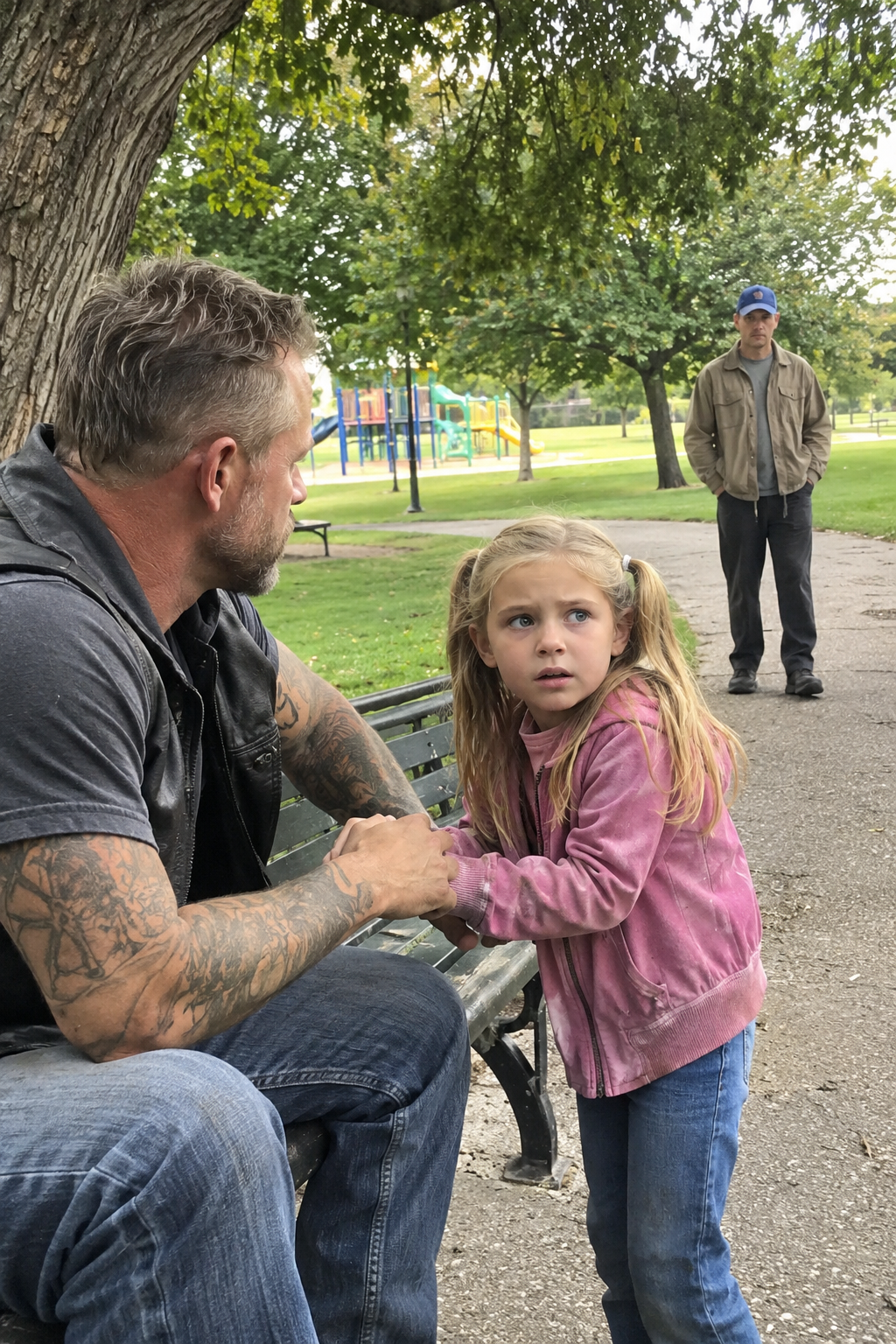
I didn’t know it then, but the man who answered my plea was carrying his own grief.
Vince later told me he’d gone to the park after another disappointing call with his ex-wife, Karen. He hadn’t held his daughter, Lily, in two years, and the visits he’d hoped for had never worked out. He had been watching other fathers play with their children when I ran up to him.
Twenty minutes after I reached his bench, Mom and Dad found me there with an ice cream from a nearby cart. They had been searching the park in a panic. Dad hurried toward Vince and demanded to know why I was sitting with a man neither of them knew.
“Your daughter asked me for help,” Vince said evenly. “There’s a man in a blue hat who’s been following her.” Dad started to say we’d already talked to the police, but Vince stopped him: he’d seen the man approach me and change course when Vince stood up.
Mom went white. “You actually saw him?” she asked. Vince described the thin man, his brown hair, and the blue cap without needing me to supply a detail. I watched my parents understand that the person I’d feared for weeks was real.
Dad reached for his phone to call the police. Vince told him he had people coming who could help look around the park and identify the stranger, though he made clear that the police needed to handle any arrest. Then we heard motorcycles approaching the main entrance.
Riders arrived in groups, their engines rumbling as they pulled in. Vince introduced himself as a member of the Hells Angels, and I felt Mom pull me closer. She was grateful to him and afraid of the men gathering around us at the same time.
Forty-seven bikers spent the next two hours looking for information. They searched the public paths and parking areas, spoke with people who had been nearby, and noted cars that might be connected to the man. One vehicle stood out: a gray Honda Civic in the overflow lot, linked to a mailing address in Indiana.
Vince’s friend Ghost brought the lead to his attention, and a lawyer helped pass the information to investigators rather than pretending it was enough to prove anything on its own. Police checked the registration and their own records. The name connected with the vehicle was Marcus Webb.
Marcus Webb was wanted in several states. Investigators found that he was a registered sex offender who had failed to report an address change and had a documented history of targeting children. That information gave the police reasons to investigate that they hadn’t had when all I could offer was a description of a blue hat.
Officer Martinez looked at the records and asked that officers across the area be alerted to Webb. He also looked at me and apologized for not taking my fear more seriously. I didn’t know what to say. I leaned against Mom and listened to the adults finally talk about keeping me safe.
Two days later, police found Webb in a motel outside the city. He tried to escape through a back window, but officers arrested him. During the investigation, they recovered hundreds of photographs of children taken near playgrounds, schools, and parks in several states.
Seventeen photographs showed me. Some had been taken outside my school, others at the grocery store, and others through a gap in the fence around our backyard. What I had recognized as three weeks of being followed had actually begun months earlier, without any of us realizing it.
When Mom learned about the backyard pictures, she sat at the kitchen table and covered her mouth with both hands. Dad walked outside and stood by the fence for a long time. They had believed they were keeping danger away by being careful, and now they understood how close it had come.
The arrest made national news. Reporters called it the story of a little girl helped by bikers after the authorities failed to see the danger. Mom and Dad tried to protect me from the attention, but my face and the story of the blue hat seemed to be everywhere.
At a police press conference, Officer Martinez said the original report had not provided enough evidence for immediate intervention and thanked the community for helping identify a suspect. Vince and his friends didn’t like how tidy that explanation sounded. Still, Webb was in custody, and at first that mattered more to me than anything anyone said on television.
Part 3 Vince was worried that an arrest did not mean the danger was over. He knew Webb would have a lawyer and a trial, and he wanted my family to feel supported while the case worked its way through court. His friends agreed that helping me didn’t have to end at the park.
At first my parents hesitated. Having members of a motorcycle club near our home was not what they would ever have chosen for us. Then I asked if Vince could come over because he was the first adult who had made me feel safe, and Mom picked up the phone.
He came that afternoon and sat in our living room, looking out of place among the flowered pillows and family photographs. I climbed onto the couch beside him and asked, “What if the bad man gets out?” He said he and his friends would do what they could to make sure I wasn’t alone.
Soon, two of the bikers took turns keeping an unobtrusive watch near our house, with my parents’ permission. They walked with us on the school route, watched the pickup corner, and helped us think through which places made me nervous. They were not police officers, and they didn’t claim to replace them.
One night Dad admitted he worried what the neighbors might say. Mom reminded him about the pictures Webb had taken through our fence, and about how I had finally started sleeping through the night. Dad nodded. None of us liked needing protection, but we cared more about being able to live without constant fear.
Four months later, the criminal case reached trial. Webb faced charges involving more than one state, supported by the photographs, witnesses, and evidence of conduct over the years. My parents struggled with the thought of me testifying in front of the man I had feared.
But I wanted to speak. Investigators had found photographs of other children, and I couldn’t stop wondering if some of them had tried to tell their families what was happening. I told Mom I wanted Webb to know that people finally believed me, even if facing him would be hard.
On the day I testified, the courtroom looked too big for someone my age. Webb sat at the defense table, and I tried not to look at him. In the gallery, Vince sat with eleven of his fellow bikers, quiet and respectful, wearing the neatest clothes I had ever seen them in.
I told the jury about seeing Webb outside school, in stores, and at the park. I explained what it had felt like to keep telling people and hearing that I might be mistaken. When the prosecutor asked why I’d run toward Vince, I answered that he looked like someone Webb would be afraid of.
“He looked scary,” I said, glancing at Vince, “but he was nice to me. He believed me right away.” There was a small stir in the courtroom, and Vince gave me a reassuring nod. I kept speaking until there was nothing more I needed to say.
The jury returned guilty verdicts in less than two hours. Webb received a sentence of twenty-five years to life, with proceedings in other states still pending. When the sentence was announced, I looked at Vince, and he nodded once, just as he had in the courtroom when I needed courage.
The conviction brought relief, but it didn’t erase what had happened. I still needed reassurance at school and at home, and my parents still regretted doubting me. Vince understood that making a child feel safe again was a longer job than helping one afternoon in a park.
Part 4 Three months after the trial, Vince spoke to a gathering of two hundred Hells Angels from chapters across the Midwest. He talked about children who tried to tell adults they were in danger and weren’t heard. He said his friends couldn’t replace investigators or the courts, but they could show up, witness what was happening, and help families reach the right people.
They called their volunteer effort Guardian Angels. The idea was to offer a visible, nonviolent presence when families felt threatened: accompany children where appropriate, be present at difficult custody exchanges, and support families in contact with shelters and child advocates. Vince insisted that the volunteers were not there to act as vigilantes.
Within six months, groups had formed in twelve states. They worked with domestic violence shelters, child advocacy organizations, and some schools that welcomed extra help. A program that began because I had asked one frightening-looking stranger for protection grew into something meant for children Vince and I would never even meet.
That work also changed Vince’s life at home. He had never stopped missing Lily, his own daughter, and for a long time he hadn’t known how to repair the distance between them. While he helped other families, he continued hoping he and Karen could agree on a dependable way for him to see her.
About a year after the day at the park, he came to our house for my eighth birthday party. His phone rang, and Ghost told him someone was at the motorcycle clubhouse who wanted to see him. Vince left without knowing whether he was being called about the volunteer program or some new problem.
When he reached the clubhouse, Karen was waiting outside with Lily. His daughter ran toward him calling, “Daddy!” Vince told me later that he could barely speak as he lifted her into his arms. He had waited two years to hear her say that word to him again.
Karen explained that Lily had seen the news reports about the little girl he had helped. She’d asked whether her father really was a hero, and Karen had begun to see the effort Vince was making to change his life. She admitted she had been angry with him, but said Lily deserved a reliable relationship with her father.
She offered to work toward a consistent custody arrangement. Vince didn’t pretend every past mistake could be undone, but he promised to keep trying. When Lily asked whether he could make her feel safe too, he held her close and told her he would always do his best.
Then Vince invited them both back to my birthday party. He said there was a girl he thought Lily should meet. I remember watching her step into our house beside him, shy at first, and realizing I was meeting someone who meant as much to Vince as he had come to mean to my family.
Over the years, Lily and I became friends, and our families grew closer. Karen and Vince eventually reconciled and remarried. What had begun as a desperate afternoon in Lincoln Park had given him a way back into his daughter’s life, and it had given our family people we could count on.
Final Five years after the park, I was twelve and standing on a stage at a child-safety conference in Chicago. Behind me was the Guardian Angels symbol: wings surrounding the silhouette of a child. The room was filled with parents, social workers, police officers, and people who had devoted their lives to protecting children.
I told them what it had been like to spend three weeks afraid of a man nobody could prove was following me. I told them about Mom and Dad’s doubts, Officer Martinez’s visit, and the way my own fear had started to make me question myself. Then I told them about the biker on the bench.
“I’m not saying bikers are better than police,” I said. “I’m saying that when a child tells us something is wrong, we have to listen carefully and take that fear seriously.” I explained that Vince had not known me, yet he’d believed I needed help and had stood between me and the man I feared.
A photograph of Vince with children at a Guardian Angels event appeared on the screen. I talked about the volunteers who had since helped hundreds of children feel less alone, and about how safety should never depend on whether a frightened seven-year-old happens to find the right stranger in a park.
I finished with the words I’d carried with me for years: “The scariest person in the room might be the one who saves you.” The audience stood and applauded. In the front row were Mom and Dad, and beside them Vince, Lily, and Karen, now his wife again.
After the conference, Vince found me in the hallway and said I’d given a good speech. I admitted I’d been nervous, and he said it hadn’t shown. We talked about Lily getting ready for middle school and how she kept saying she wanted to volunteer with Guardian Angels when she was old enough.
Then I asked Vince whether he ever thought about what might have happened if I hadn’t run to him that day. He said he did. We didn’t need to say more about the pictures from my backyard or how much bolder Webb had been getting.
“I was terrified,” I told him. Vince smiled and said, “That’s what courage is sometimes. Being terrified and doing the right thing anyway.” I laughed and told him he sounded like my therapist, and he said she must be a smart woman.
Before we went back inside, I thanked him for believing me and for everything he’d done after the park. He thanked me for trusting him when I had no reason to. He said I’d helped him want to become the person I’d believed he could be.
I sometimes think about that first moment, my small hand holding his tattooed one while the man in the blue hat approached. I didn’t know what kind of man Vince was, and he didn’t know me. But he heard a frightened child ask for help, and he answered.
The case taught my family that fear deserves attention even before every piece of evidence is in place. It taught me that asking for help can be an act of courage, and it taught Vince that protecting someone else could change his own future. I grew up knowing that the people who look intimidating are not always the ones we should fear.
THE END. I’ve shared the complete story, and I truly hope it touched your heart. If this story moved you, please , like, and share the post. Thank you for reading! ❤️
✓ Lynn R. Adams
I didn’t know it then, but the man who answered my plea was carrying his own grief. Vince later told me he’d gone to the park after another disappointing call with his ex-wife, Karen. He hadn’t held …