I was seven months pregnant when my husband’s mistress came to our family harvest dinner wearing my mother-in-law’s treasured pearls, and when she attacked me in the kitchen, my husband finally moved—but she left us with one terrible question…
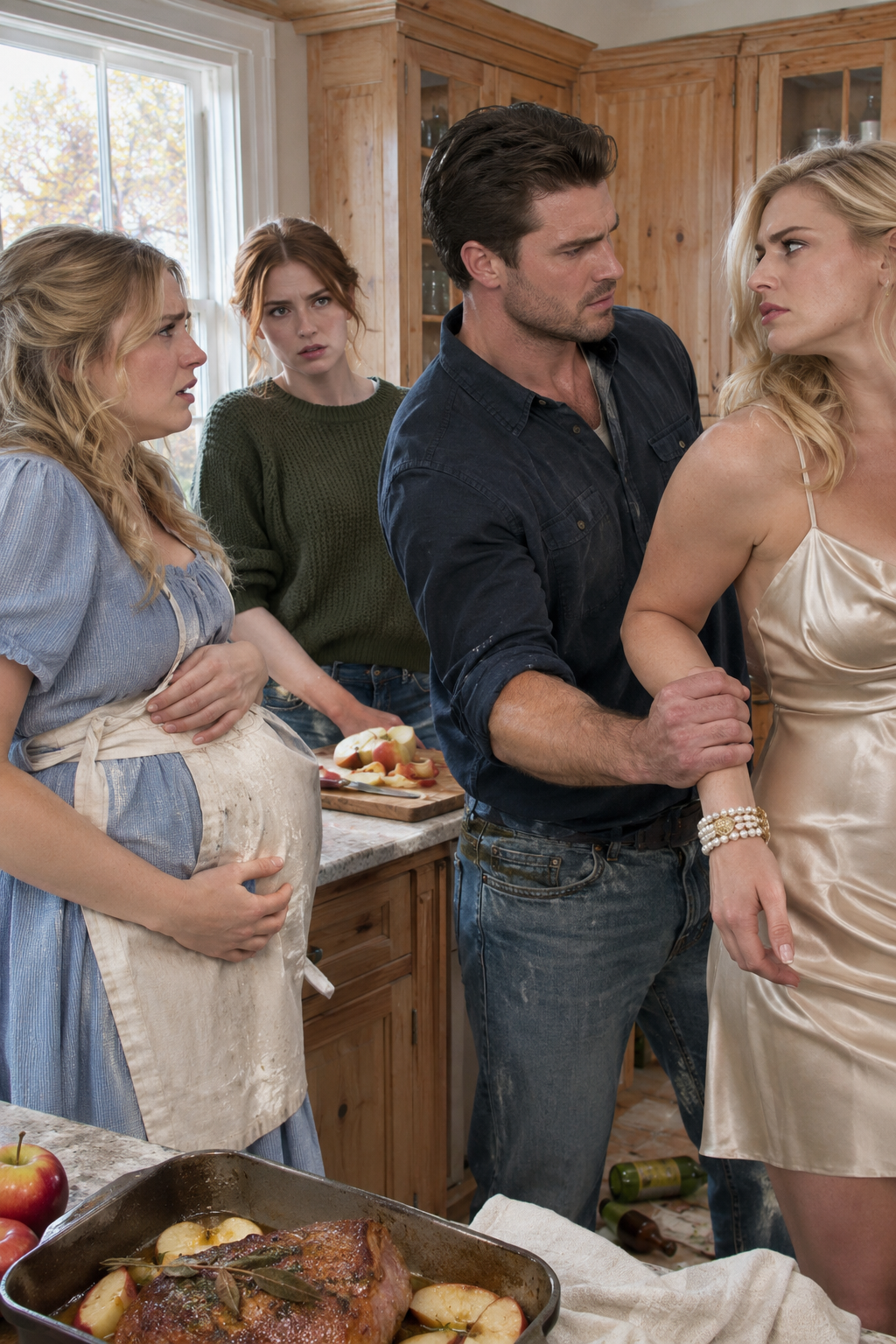
I was seven months pregnant when my husband’s mistress came to our family harvest dinner wearing my mother-in-law’s treasured pearls, and when she attacked me in the kitchen, my husband finally moved—but she left us with one terrible question…
My name is Marin Osley. I was 29, seven months pregnant with our daughter, and standing in my in-laws’ kitchen with a roasting pan in my hands when the woman my husband had been seeing walked through the back door. I had imagined meeting her a hundred times, but never with my mother-in-law’s permission.
Every October, the Osleys gathered at their farmhouse for harvest weekend. Osley Orchards and Cider had been in the family for four generations, and my mother-in-law, Lenor, treated the gathering like a formal inspection. Fourteen people, handwritten place cards, and not one crooked napkin were allowed at her table.
I had been cooking since seven that morning. My feet were swollen, my lower back throbbed, and the apple-and-sage pork had to be just right because Lenor still talked about last year’s dinner as though I were an inexperienced hired cook. I’d been married to her son Cade for three years.
Here is what I owe you before I tell you the rest: I wasn’t blameless in what happened to our marriage. Five months earlier, I’d found a hotel receipt in Cade’s work jacket, then seen a message from a woman named Sabrina, signed with a heart, light up his phone while he showered. I knew enough to understand what it meant.
I put the receipt back. I never asked him a question, never demanded an explanation, and never told him how much I’d been hurt. Instead, I became a perfectly polite wife who answered every question and offered nothing of herself.
Part of me called it dignity. A less flattering part of me enjoyed watching him come home looking guilty and not knowing whether I knew. Behind his back, I opened a separate savings account and looked at apartments where I could live with the baby.
My plan was to disappear before she was born and let Cade find the empty house. I told myself I was protecting our daughter, and some of that was true. But I was also punishing him in a way that spared me the frightening work of saying out loud what he’d done.
That Saturday, Cade was in the barn helping his father, Royal, move cider crates. Lenor was arranging place cards in the dining room, and Cade’s 27-year-old sister, Joanie, stood beside me peeling apples. Joanie had barely tolerated me since the wedding, so our silence felt ordinary.
Then the back door swung open. A tall blonde woman in a cream-colored sundress stepped inside, smiling as though she had been expected. Around her wrist sat three strands of pearls joined by a small gold clasp.
I recognized that bracelet immediately. It had belonged to Lenor’s mother, and when I’d asked to borrow it on my wedding day, Lenor had told me it was reserved for a woman who earned it. Somehow, this stranger had earned it in her eyes.
“Hi, Marin,” she said. “I’m Sabrina. Lenor invited me to help with dinner.” Joanie’s peeling knife stopped halfway down an apple.
“I know who you are,” I answered. My voice came out so evenly that it surprised me. Sabrina walked around the kitchen island with a little smile, tracing the counter with one finger.
“Do you?” she asked. “Cade hardly talks about you. I had to ask what you looked like.” Her gaze dropped to my stomach, and my daughter kicked hard enough to make me catch my breath.
Sabrina told me Lenor was thrilled about the baby, especially because she suspected it would be a boy. Then she added that Lenor had never liked me, that she’d wanted Sabrina for Cade, and that everyone had simply been waiting for me to get out of the way. I could hear Joanie breathing behind me, but she said nothing.
“Please leave,” I said. I didn’t shout, and I didn’t move toward her. I was thinking about the hot oven behind me and the narrow stretch of floor between the island and the door.
Sabrina stepped into that space instead. She caught a handful of my hair and pulled my head back, telling me I was only useful to the family because I was carrying Cade’s child. When I tried to free myself, she struck my face.
My hip hit the kitchen island. I twisted to shield my belly, lost my footing, and felt the sharp edge of the counter against my ribs. The taste of blood filled my mouth.
“Cade!” I screamed, though I didn’t know whether he could hear me from the barn. Sabrina stood over me, furious that I was still trying to rise. Then she brought her heel down on my hand, and I heard a crack I will never forget.
For a few seconds I couldn’t make sense of the pain. I was holding my stomach with one arm and trying to pull my injured hand away with the other. Joanie stood frozen near the apples, still holding her knife pointed toward the cutting board.
The back door opened again. Cade came in carrying a crate of cider bottles and stopped at the sight of us. His eyes moved from Sabrina to the blood on my lip, then to the way I was curled around our daughter.
He stood still for perhaps three seconds. I remember thinking that this was the moment he would tell me to calm down, the way he did whenever his mother was unkind. Instead, the crate slipped from his shoulder and bottles shattered across the tile.
He crossed the kitchen, caught Sabrina by the wrist, and pulled her away from me. “Enough,” he said. His voice was low, but I had never heard him sound so certain.
“She attacked me first,” Sabrina protested, grabbing for his sleeve. Cade shook his head. “I watched you step on her hand. She’s seven months pregnant.” He kept himself between us as he moved her toward the back door.
“Get out of my house,” he told her. Sabrina stared at him as though he’d broken a promise. She said she’d given up everything for him, and Cade answered that she’d spent months demanding money for rent, car repairs, and even a supposed surgery for her mother.
He said he should have questioned why she’d never allowed him to pay the hospital directly. Sabrina’s expression changed when she realized he wasn’t backing down. “Everybody in this family knew about me,” she snapped. “Everybody.”
Cade opened the door and told her to leave. She stumbled onto the porch, caught the railing, and turned to look straight past him into the kitchen. Her next words were quieter than anything she’d said all afternoon.
“Ask your mother who told me exactly what time you’d be home today.” Cade shut the door, and neither of us spoke. Until that moment, I’d thought I understood who had betrayed me; now I couldn’t stop looking at the pearls Sabrina had worn into our kitchen. Part 2…..
IF FACEBOOK BROUGHT YOU HERE, HERE’S THE CONTINUATION YOU’VE BEEN WAITING FOR. ENJOY! 👇 Cade stood with his back to the door, breathing hard. When he turned, he looked at my swelling hand, the broken bottles, and the blood at the corner of my mouth. He knelt in front of me and started apologizing, but my attention was on the baby, who had gone frighteningly quiet.
“Take me to the hospital,” I said. “Now.” He helped me up without another word, and Joanie followed us in her own car.
Lenor stayed at the farmhouse. She told the other guests there had been a small accident and insisted that harvest dinner could still proceed. Later, I would remember that choice more clearly than anything she’d said to me in three years.
At the hospital, the nurses attached a monitor, and at last I heard my daughter’s heartbeat, fast and steady. I cried with relief while the doctor examined my hand and the bruising around my ribs. The baby appeared unharmed, but I’d broken my hand in two places, needed a cast for six weeks, and had a cut on my lip.
Cade sat beside my bed while I stared at the ceiling. Every time he reached for my uninjured hand, I moved it away. After two hours of silence, he finally told me that he’d tried to end things with Sabrina weeks earlier.
“She kept threatening to tell you,” he said. “I gave her money because I thought I could keep her quiet.” He didn’t ask me to believe him; he just sat there looking ashamed.
“You were more afraid of getting caught than of being a husband,” I said. Cade lowered his eyes and agreed. When he told me seeing Sabrina hurt me had finally made him understand what he’d become, I said, “Waking up in the last ten seconds doesn’t erase five months.”
Then Lenor came into the room carrying white lilies. At 58, she was a tall, silver-haired woman who could make a compliment sound like a warning. She took a seat by the window and surveyed my cast as though she were assessing damaged equipment.
“Well,” she said, “that was unfortunate.” Cade stood up so quickly his chair scraped the floor. “Mom, Sabrina attacked Marin.”
Lenor called it an emotional situation that had gotten out of hand. Then she reminded us that investors from Seattle were supposed to tour the orchard on Monday and that the expansion agreement was two weeks from signing. A police report, she said, would complicate everything.
“Your son’s mistress broke my hand,” I told her. “And you’re worried about a tour?” Lenor replied that I was an Osley now, carrying an Osley baby, and should remember my responsibilities to the family.
She called our daughter an “Osley asset” before hastily changing it to “a child with a future.” Cade went pale. I watched him struggle to understand that his mother was talking about her unborn granddaughter as though she were another piece of the business.
“Mom,” he said, “Sabrina told me to ask who let her know when I’d be home.” Lenor’s face tightened for an instant, then relaxed. She dismissed Sabrina as a gold digger who would say anything to protect herself.
I believed Sabrina wanted Cade’s money. I also knew a woman didn’t appear at a private family dinner wearing an heirloom bracelet without help from someone inside the house. Lenor left the lilies on a table and said she expected us at breakfast on Sunday.
Late that night, Joanie slipped into my hospital room while Cade was out getting coffee. Her mascara was smudged, and she gripped her car keys in both hands. “I watched her hit you,” she whispered. “I had a knife in my hand, and I did nothing.”
For three years, Joanie had made it clear she thought I’d married above my station. Now she was crying over the way she’d treated me, not asking for forgiveness but admitting she’d been cruel. I was too exhausted to decide what to say to her.
She took a black flash drive from her purse and laid it beside my good hand. She’d found it in Lenor’s desk the previous spring while looking for a stapler, listened to one recording, then put it back and tried to forget it. “There are messages, voicemails, a spreadsheet,” she said. “Please listen with Cade.”
Joanie promised to stand beside me and tell the family what she knew. After she left, I held the drive in my palm, wondering why a woman who’d disliked me for years would suddenly risk standing against her own mother. The baby moved again, and I held it against my chest.
After I was discharged, Cade drove me to the old barn behind the orchard rather than the farmhouse. He’d proposed to me there under string lights three years earlier. Now we sat beside a space heater, with my cast resting on my knee and his old inventory laptop between us.
The drive contained 41 voicemails. The earliest was eight months old, and the first voice we heard belonged to Lenor. “Sabrina, it’s Lenor Osley. You came highly recommended. Let’s meet for lunch. I have an arrangement in mind.”
Cade put his hand over his mouth. We listened as his mother told Sabrina where he’d be, which restaurants he liked, how to dress, and how to make him feel understood. It wasn’t a mother reluctantly accepting her son’s affair; she had arranged its beginning.
In one recording, Lenor said she was paying Sabrina well and expected results. In another, she worried that if I didn’t leave before our baby was born, removing me would become a custody problem instead of a divorce. My stomach turned at the casual way she spoke about separating me from my child.
The spreadsheet listed eight months of payments from an Osley Orchards account, labeled “consulting,” to Sabrina Teal. Cade scrolled past one entry after another. The woman who’d taught him to count orchard profits had used the business to pay someone to dismantle his marriage.
“I thought she was protecting us,” he said. He told me she’d chosen his college, his first job, and which women were acceptable to date. He’d spent his life mistaking obedience for love.
“And you let her,” I said, without raising my voice. Cade looked at the screen a long time. “I did,” he answered. “Then I did it to you.”
Near the end of the folder was a voicemail from Sabrina, three weeks earlier, demanding twice her agreed payment and threatening to expose who funded her apartment. Lenor’s reply was icy: Sabrina would receive no more than the agreed amount. Listening to them, I understood that Sabrina’s attack wasn’t something Lenor had ordered in those recordings; it was an escalation by a woman whose demands were no longer being met.
Cade asked what I wanted to do. I told him the truth about the hotel receipt, the savings account, and the apartment I’d planned to rent without telling him. “I knew almost from the beginning,” I said. “I let you worry because I wanted you to feel some of what I felt.”
He said he’d suspected I knew and had lacked the courage to confess. We sat in that barn with no one left to blame for the silence between us. I told him I didn’t want revenge anymore; I wanted our daughter safe, Lenor unable to control our lives, and Cade to decide before morning what kind of man he intended to be.
“I’ll decide now,” he said. Just then Joanie knocked on the barn door and told us she’d asked Royal to be ready to hear something important at breakfast. We made three copies of the files, Cade printed the payment spreadsheet, and Joanie wrote down what she’d witnessed and known. That night, on a creaking cot in the barn, I listened to my daughter hiccup inside me while my husband lay beside me without touching me.
Final At eleven on Sunday morning, the farmhouse dining table was laid with white linen, cinnamon rolls, and pitchers of apple cider. Lenor sat at the head wearing a pearl necklace, with her 62-year-old husband Royal at the other end and Joanie across from me.
Beside Lenor was Mr. Hargreave, the lead representative of the Seattle investment group. His tour wasn’t supposed to be until Monday, but he’d arrived early, and Lenor had apparently decided that a picture of domestic harmony would help the expansion deal. She praised my baking as though nothing had happened to my hand.
I set down my fork. “Lenor, I’d like to say something before we eat.” She smiled tightly and suggested we wait until afterward. “No,” I said. “Now.”
I laid my phone on the table and played the first voicemail. Lenor’s own voice filled the room, inviting Sabrina to discuss a mutually beneficial arrangement. Before anyone could speak, I played the recording about getting me out before the baby was born.
“Turn that off,” Lenor ordered. Mr. Hargreave set down his coffee, and Royal slowly raised his head. I left the recording playing until it finished.
Cade rose beside me. He said he’d heard all 41 messages and read the spreadsheet showing payments from the orchard’s account. “You hired her to break up my marriage,” he said. “You wanted Marin gone so you could have our daughter.”
Lenor said she’d been protecting Cade, the family, and the orchard from a woman who didn’t belong among them. Cade reminded her that Sabrina had injured his pregnant wife. “I didn’t tell her to do that,” Lenor answered. “She lost control.”
Joanie stood, her written account trembling in her hand. “You put her in our lives,” she said. “I knew something was wrong for six months, and I stayed quiet. That was my choice, and I’ll tell the truth about it to anyone who asks.”
Royal, who rarely spoke above a murmur at family dinners, put down his napkin and asked Lenor whether the recordings and payments were real. She tried to wave the question away. He asked again, looking her directly in the face.
“Of course they’re real,” she said at last. “Someone in this family has to make the hard decisions.” She looked at me and said Cade would never truly be mine because he was an Osley.
I had spent years trying to earn a place at that table, but sitting there with a broken hand, I no longer wanted her approval. “I’m not trying to own Cade,” I said. “I’m trying to keep our child safe from you.”
Cade took a folded packet from his jacket and handed it to Royal. It contained his resignation from the orchard board and documents setting out his decision to transfer his shares into a trust for our daughter, with me as sole trustee. The lawyers would still have to complete the transfer, but he was giving up his control of the family business.
“I won’t run a company built on this,” he told his father. Lenor asked whether he’d really walk away from four generations of work. “I’d rather lose the job than keep being the man you trained me to be,” he said.
Royal read the papers and apologized to Mr. Hargreave. He said the proposed expansion would have to wait for an independent audit of the company’s books. As the head of the family business, he would seek Lenor’s removal from management and the board through the necessary process.
Then Royal looked at his wife and admitted that he’d spent forty years ignoring decisions he knew were wrong because silence had seemed easier than conflict. “I called it peace,” he said. “It wasn’t.” For once, Lenor had no answer.
She stood, took her purse, and left the dining room without another word. I didn’t feel victorious watching her go. I was exhausted, and my hand hurt, but for the first time I believed the people at that table had heard me.
On Monday I filed a police report about Sabrina’s attack, supported by my hospital records. Detective Aaphor listened carefully and followed up. Within two weeks, Sabrina had been charged with assault; a charge, of course, was not the same as a conviction.
With Lenor shut out of the orchard accounts, Sabrina’s regular payments stopped. She threatened to tell the press what she’d been paid to do, but she also faced questions about her part in it. The expensive life she’d maintained began to unravel: the lease ended, the car was repossessed, and she eventually returned to her mother’s town to work at a pharmacy while awaiting court.
I could see that Lenor had used Sabrina, and I could also see that Sabrina had chosen to hurt me. Both things were true. I didn’t need to pretend either of them was a monster from a storybook to understand how much damage they’d done.
I didn’t move back in with Cade after breakfast. The following week, I packed two suitcases and went to stay in my sister’s spare room across the valley. Cade carried my bags to the car and asked only that I tell him when the baby came.
Our daughter arrived on a snowy December morning, weighing exactly eight pounds, with a head of dark hair and a furious little cry. I named her Willa. Cade drove two hours through the snow after I called and stood outside the delivery-room door before finding the courage to come inside.
He didn’t ask me to take him back. He looked at Willa, asked if he could touch her tiny hand, and sat quietly beside us. Watching him, I felt tenderness and anger together, neither one canceling the other out.
In the months that followed, Cade took an hourly job on a neighboring orchard’s pruning crew. He declined Royal’s offers to return to the family board, saw a counselor every Thursday, and wrote me short letters that never demanded an answer. In one, he said he was learning that love sometimes meant being willing to disappoint the person who expected your obedience.
I kept the letters. Joanie came to my sister’s place most Sundays with groceries and a stuffed giraffe that seemed almost as big as Willa. The woman who’d stood still in that kitchen became one of the people I trusted most, not because she’d never failed me, but because she stopped pretending she hadn’t.
Joanie still visited Lenor, who was living alone in the farmhouse she’d once controlled. According to Joanie, her mother hadn’t apologized to anyone. I couldn’t make her sorry, and I finally stopped treating an apology as something I needed in order to move forward.
I also had to reckon with my own silence. Cade was responsible for his affair, and Sabrina was responsible for attacking me; I hadn’t caused either of those choices. Still, the five months I spent quietly planning to punish Cade were months when I could have spoken honestly about what was happening to our marriage.
One spring afternoon, Cade came to my sister’s kitchen, and for the first time I let him hold Willa without anyone else in the room. She fell asleep against his chest, and he studied her small face as if he couldn’t quite believe she was real. He looked up only when I spoke.
“I’m not forgiving you today,” I told him. “I’m watching what you do tomorrow, and the day after that.” Cade nodded and said he understood.
I still don’t know whether we’ll live together again or remain two people raising the same little girl from separate homes. He has a chance to earn my trust, not a promise that he will get it. What I know now is that love without the courage to protect someone isn’t enough, and one brave moment doesn’t erase a long history—but the ordinary choices that follow it can tell you who a person is becoming.
THE END. I’ve shared the complete story, and I truly hope it touched your heart. If this story moved you, please , like, and share the post. Thank you for reading! ❤️
✓ Lynn R. Adams
I was seven months pregnant when my husband’s mistress came to our family harvest dinner wearing my mother-in-law’s treasured pearls, and when she attacked me in the kitchen, my husband finally moved—…