I was serving overseas…
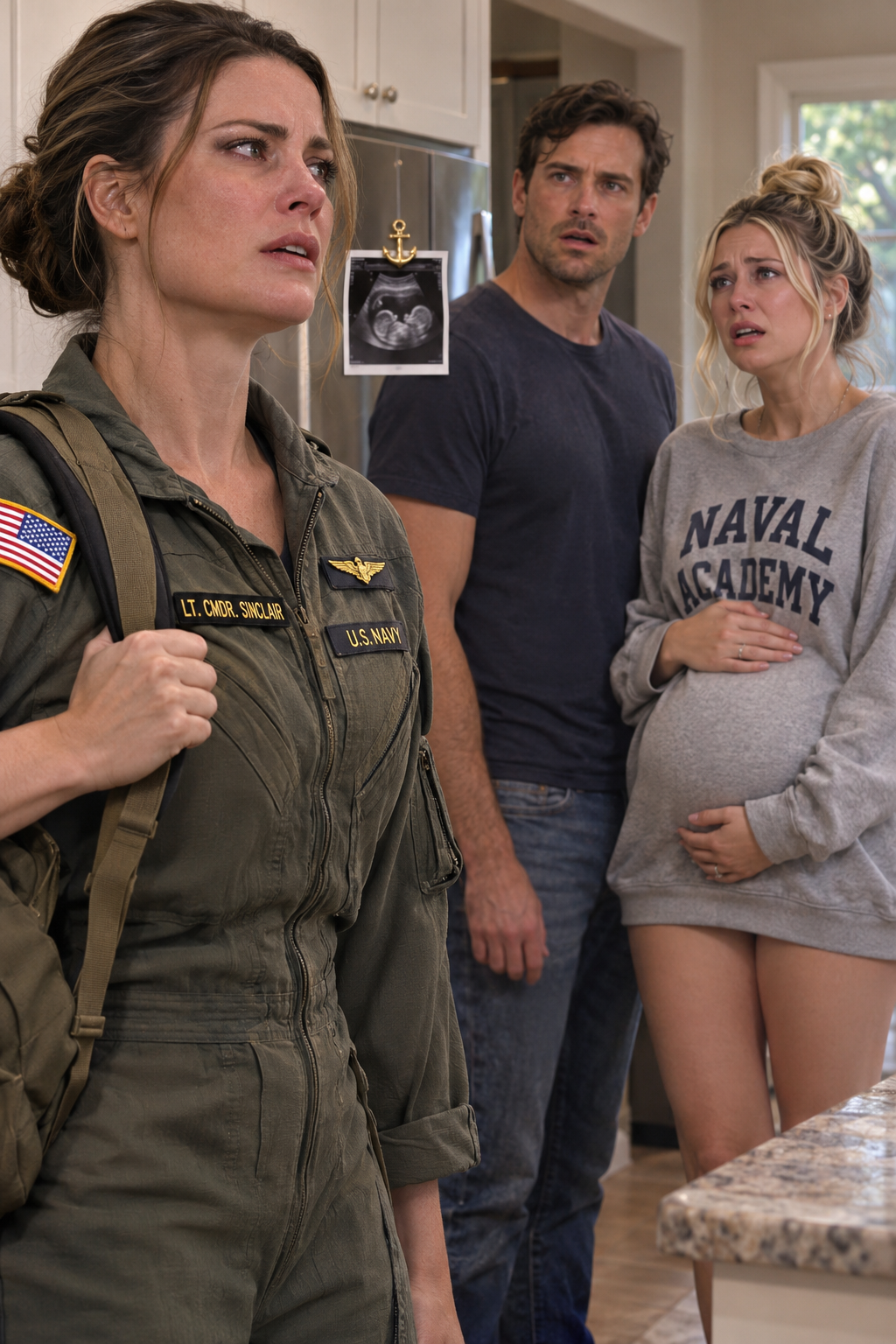
I was serving overseas when a video call showed my sister kissing my husband in our kitchen. Then my mother held up an ultrasound from my own couch and demanded I make room for their baby….
My name is Cara Sinclair. At thirty-five, I was a lieutenant commander in the United States Navy, serving as a naval flight officer with an electronic attack squadron. My job was to fly in the backseat of a jet, help identify enemy radar, and protect the people flying beside me. I understood how to recognize deception in the air, but I hadn’t recognized it at home.
My husband, Nick, and I had been married seven years. We lived in Navy family housing at Naval Air Station Whidbey Island, Washington, where I was the service member sponsoring the home. Nick worked at a marina, repairing boat engines. He had always seemed comfortable with the strange schedules and long separations my career required.
In June, I was aboard an aircraft carrier in the Western Pacific. Our internet connection was unreliable, but I tried to video-call Nick every Sunday. Those calls were my little piece of ordinary life: his news from the marina, my sanitized stories about work, and the kitchen table where we’d once planned our future.
One Sunday evening, the connection finally came through. Nick was sitting in our kitchen, sunburned and smiling, telling me about an engine he’d rebuilt. Then a woman walked behind his chair in my gray Naval Academy sweatshirt. She leaned down, kissed his neck, and told him dinner was ready.
The woman turned toward the screen. It was my younger sister, Brittany. She froze, and so did Nick. Behind them, on my refrigerator, was an ultrasound photograph held up by the little Navy anchor magnet my father had given me when I received my commission.
Even through the poor connection, I could make out Brittany’s name on the photograph. Nick’s face drained of color. He said, “Cara, I can explain,” and the picture froze before he could say another word. Eight thousand miles of ocean separated me from my own kitchen.
I sat staring at the dead screen while other aviators nearby laughed at a movie. I managed to get back to my cramped sleeping quarters before I cried. Then I washed my face, zipped up my flight suit, and reported for a 3 a.m. mission. My pilot still needed me to do my job.
When I returned, I had four emails from Nick and one from my mother, Gail. Hers had the subject line “Please don’t overreact.” I opened Nick’s first, although I knew the central truth already. Reading the details somehow made it worse.
Nick said the relationship had started in March, a few weeks after I deployed. Brittany had moved to Oak Harbor after a breakup, and he’d helped her look for an apartment. They’d “gotten close,” as though closeness were something that happened without anyone choosing it. She was pregnant, and the baby was due in November.
He said he loved me and had wanted to tell me, but he couldn’t find the right moment while I was flying missions. I wondered which moment he had considered right: while I was briefing a flight, sitting alone with poor internet, or walking back toward the aircraft after a long night. He had apparently decided none of them was convenient.
My mother’s email was shorter. Brittany had told her in April. Brittany had lost her apartment in May, so my parents had moved her belongings into the guest room of my house. Gail ended with “It just makes sense” and promised we’d talk on Sunday.
I read that message several times. My mother had known for eleven weeks by the time we spoke openly about it. She had sent me a care package in May with my favorite beef jerky and a card saying she was proud of me. She’d known what was happening while writing those words.
I grew up with Brittany in Yakima, Washington. Our father, Steve Barlow, repaired irrigation pumps and called me “Admiral” because I’d been organizing neighborhood kids into pretend formations since I was six. Gail managed the household and treated Brittany as someone who needed sheltering, while expecting me to be the person who could carry everyone else’s burdens.
“You’re never home anyway,” she liked to say. When I left for the Naval Academy at eighteen, my bedroom became Brittany’s art studio. During flight school, when I missed Christmas, my gifts went to Brittany’s boyfriend. My military service was somehow always presented as a reason I should need less.
But my sister had not always been someone I distrusted. During my first lonely summer at the Academy, twelve-year-old Brittany wrote me seventy-two letters. They contained crooked drawings of airplanes, silly jokes, and even a pressed dandelion from our yard. I kept every letter in a shoebox in the closet of our house on Whidbey Island.
I thought about that box as I pictured Brittany living there. She was using my kitchen and wearing my clothes, and apparently expecting a child with my husband. My parents had driven her belongings onto the military installation using the access arrangements connected with my household. No one had asked whether I wanted her there.
When Sunday, June 22, arrived, Gail called me on video. She was seated on the leather couch Nick and I had bought when we moved in. My throw pillows sat behind her, and a framed photograph from my first carrier landing hung on the wall. She lifted an ultrasound toward the camera as if announcing wonderful family news.
“It’s a little boy,” she told me. I asked why she had moved my sister into my home without permission. Gail said Brittany was pregnant and had been evicted, while she and Dad lived in a one-bedroom condo. Nick had plenty of space, she argued, and I was away.
“Cara, you’re gone three more months anyway. Brittany needs somewhere safe. Let her stay until the baby comes. It’s what family does.” As she spoke, I could see Brittany through the kitchen doorway, wearing my navy sweatshirt and stirring something on my stove. She kept her eyes away from the camera.
I told Gail that Brittany was having a baby with my husband. She assured me, in a tone she might have used to resolve an argument about sleeping arrangements, that Brittany had the guest room and Nick had our bedroom. “It’s all very respectful,” she said. I could hardly believe those words had come from my mother.
Then she delivered the sentence I’d heard all my life: “You’re never home anyway.” She added that I’d chosen this life and that somebody had to be there for Nick. The house I worked to keep, and the marriage I had trusted, were being discussed as though I’d abandoned them.
Dad appeared at the edge of the screen. I asked whether he had known, and he admitted Gail had told him in April. He’d driven the U-Haul himself. “I’m sorry, kiddo,” he said, “but it’s done. There’s a baby coming. Just let it be for now.”
I looked at my mother on my couch, my father beside her, and my sister moving around my kitchen. They all seemed to expect shouting, tears, or another plea for them to recognize what they had done. Instead I heard myself speak with the same measured voice I used at work.
“Okay,” I said. My mother blinked, and I added, “Brittany can stay until I get home.” Gail thanked me for understanding, as though she had just settled a harmless misunderstanding. None of them knew what that simple condition was going to mean. Part 2…..
That same night, I knocked on the door of Lieutenant Commander Ellen Hargrove, a Navy legal officer aboard our carrier. I told her about Nick, Brittany, the pregnancy, and my parents moving someone into military housing without my consent. She listened closely, then asked a question I hadn’t expected: “Did you sign a power of attorney before you deployed?”
I had. Nick needed to manage household matters, car registration, and unexpected paperwork while I was at sea. Ellen suggested we review my accounts before doing anything else. What we found changed the situation from a betrayal of trust to a financial mess that would follow me home.
In May, Nick had used the power of attorney to obtain a $14,500 personal loan in my name from the credit union on base. He’d also transferred another $3,000 out of my savings. The records showed overdue rent for Brittany’s Oak Harbor apartment, payments to an obstetrician’s office in Mount Vernon, and baby furniture bought in Burlington: a crib, a glider, and a stroller.
Ellen explained that being appointed my agent did not give Nick permission to act for his own benefit. She helped me prepare and notarize a revocation and get notice of it to the financial institutions involved. We also took steps to protect my credit. I kept copies of the transactions and arranged for the credit union to review what had happened.
Then Ellen pointed out something my mother had ignored. The house was Navy family housing. I was the sponsor; Brittany was neither on the lease nor listed as my dependent. Ellen recommended that I contact the housing office and confirm the rules and the records before returning. She made no promises about the outcome, but she gave me a practical place to begin.
I signed the revocation in Ellen’s stateroom at 11:47 p.m., under a fluorescent light, with the ship humming around us. She placed her notary seal on it. For the first time since the video call, I felt as though I had taken one useful action on my own behalf.
Over the next few months, I kept flying and kept my conversations with home brief. Gail sent cheerful pictures of Brittany painting my home office sage green, Nick putting together a crib, and tiny baby clothes arranged in a dresser near the closet where I kept my letters. Brittany even sent a picture of her pregnant belly with a thank-you for being so “cool” about everything.
I answered, “Take care of yourself,” and forwarded the message to Ellen. I was angry, but the unborn child wasn’t responsible for any of it. I would not turn my anger toward a baby who had no voice in how these adults had behaved.
In July, Nick went back to the credit union and tried to increase the loan. A teller told him the power of attorney on file had been revoked and that she could not discuss my accounts with him. That night he emailed me, calling it a paperwork glitch and asking me to fix it. I wrote, “I’ll handle it when I’m home.” He apparently read that as reassurance.
In August, Gail asked whether Brittany could drive my Jeep because her own car was making a noise. I said the vehicle was registered in my name and that access to the installation was controlled. After the call, I contacted base security about my concern and made clear that I had not authorized Brittany to use it. The requests never seemed to stop.
Later that month, Nick told me Gail wanted the entire family at the squadron’s homecoming in September. She was ordering a banner and thought that if everyone stood together in the hangar, nobody would ask questions about Brittany’s pregnancy. He even said Brittany felt terrible and that the gesture would mean a lot to her.
The main squadron homecoming was scheduled for Friday, September 19, at 2 p.m. in Hangar Five. I confirmed that schedule when my mother asked. I did not mention that I was assigned to an advance group expected to return two days before the main celebration. She had never asked how our homecomings worked.
In early September, a routine housing occupancy review notice arrived at our door. Nick sent me a worried picture of the letter and asked whether Brittany could get us into trouble. I told him the housing office conducted these reviews and that I would address the lease when I returned. Both statements were true.
The housing manager, Rosalind Pike, had been reviewing the information I’d supplied, including my lease and the records concerning the household. I knew the unauthorized living arrangement would have to be dealt with through the proper office. Nick and Gail still seemed convinced it was simply a matter I would smooth over for them.
My closest friend aboard ship, Lieutenant Danny Okafor, was a pilot who had flown many missions with me. One night on the flight deck, I told her the whole story. She asked if I was truly okay, and I said no: I was hurt, angry, and grieving the sister who had once sent me seventy-two letters. But I knew what I intended to do when I returned.
Danny asked whether I needed a wingman. I told her I always did. On Wednesday, September 17, our advance party landed at Naval Air Station Whidbey Island at 11:30 a.m. The air smelled like rain and pine, and the people waiting for Friday still believed I was thousands of miles away.
Part 3 At 1 p.m., I walked into the base housing office in my flight suit. Rosalind Pike had reviewed my records and confirmed that Brittany had lived in my house since May without being listed as an authorized occupant. My mother had also been visiting frequently on passes arranged by Nick. Rosalind explained the housing procedures and coordinated with base security to assist with removing unauthorized guests.
At 2 p.m., I arrived at my house in a government sedan, with Rosalind beside me. A base security vehicle followed, and Danny came in her own car. Our street looked ordinary: kids’ bikes in driveways, tidy porches, and flags hanging in the mild afternoon light. Except my porch had a huge welcome-home banner and blue balloons.
The banner said, “Welcome home, Cara. We love you.” Beneath it, someone had added the names of Nick, Brittany, Mom, Dad, and “baby boy.” Two neighbors were outside, including my commanding officer’s wife. I could feel their eyes on the banner as I climbed my own front steps.
I opened the door with my key. Gail was standing on a stepladder, hanging a framed ultrasound in the hallway. Dad was watching a Mariners game on the couch, and Brittany, now about thirty-two weeks pregnant, was in my kitchen in my bathrobe, eating ice cream. Nick was coming down the stairs with a basket of laundry.
He saw me and dropped the basket. Little baby socks scattered over the hardwood floor. My mother gripped the ladder and said, “It’s Wednesday. You said Friday.” I told her the squadron was coming Friday, but I had returned that day. Brittany began talking about how they had planned to finish the sign.
Rosalind entered behind me, with two security officers at the doorway. Dad switched off the television. I introduced Rosalind and explained that I was the service member sponsoring this Navy family home. Brittany was not an authorized resident, and I was withdrawing any permission for her to remain there.
Rosalind informed Brittany that she needed to gather her belongings, that security would assist with her departure, and that future installation access would require proper authorization. My parents were told they would have to leave as well. Nick stood silent, holding onto the laundry basket he’d finally picked up.
Gail climbed down and demanded to know how I could send away a pregnant woman. “Where is she supposed to go?” she asked. I reminded her that back in May, she’d decided my home was the answer without speaking to me. Brittany protested that I had said she could stay.
“I said until I got home,” I replied. “I’m home.” I had not raised my voice, although I could feel my pulse pounding. The house had been rearranged around a family story in which I apparently did not get to choose my own role.
Gail appealed to Rosalind, saying I had agreed and could not change my mind. Rosalind stayed focused on the lease and occupancy records. I pulled up the email in which Gail had admitted that she and Dad moved Brittany in after the eviction and read those words aloud. “You didn’t ask me,” I told her. “You told me after it was done.”
Nick finally said we should discuss things privately. I turned toward him and brought up the power of attorney. He’d borrowed $14,500 in my name and transferred $3,000 of my savings while I was deployed. That money had helped pay Brittany’s rent, medical expenses, and the baby furniture upstairs.
Dad stared at Nick. He’d been told Nick received a bonus from the marina and used his own money. Nick did not answer. I handed him a copy of the notarized revocation and explained why the credit union had refused his request in July. I also told him the loan records were with the credit union’s fraud department and my lawyer.
I had begun arranging the end of our marriage, too. I was not going to pretend we were a happy family for a homecoming photograph. I told Nick that our financial responsibilities and his status as a military dependent would have to be addressed through the divorce process and the appropriate offices, not through whatever story he had told everyone else.
Gail said I was humiliating our family in front of the neighborhood. Through the window I could see several neighbors watching. I told her I had not put up that banner, with my husband’s name and my sister’s baby displayed on my porch. I had simply come home to find it there.
Danny appeared with a cardboard box and asked where we wanted to put Brittany’s things. I suggested the front lawn while they were loaded for departure. For the next hour and forty minutes, Brittany packed clothes and baby supplies, Gail kept protesting, and Dad quietly carried boxes to his truck.
One of the security officers warned my mother that refusing to comply with directions on the installation could lead to further restrictions on access. Dad barely spoke. At the door, he stopped with the last box, called me “Admiral,” and said he was sorry. I looked at him and said, “You drove the U-Haul, Dad. Drive this one, too.”
Nick packed a duffel bag and left voluntarily, although his situation as my spouse was not the same as Brittany’s. He departed with Brittany, following my parents’ truck toward the gate. When an officer removed the welcome-home banner and asked what I wanted done with it, I said to throw it away, but let the neighborhood children have the balloons.
Part 4 That night, the house was silent. I went upstairs to my office, now painted sage green. The crib Nick had assembled stood in the corner, bought with money taken from my accounts. I opened the closet and found my shoebox pushed behind maternity clothes on the highest shelf.
All seventy-two letters were still there. I sat on the floor and opened the first one. Twelve-year-old Brittany had written that she hoped the Navy wasn’t too scary, drawn me a plane, and told me she loved me to the moon. I cried over that letter more than I had cried over any of Nick’s emails.
I wasn’t crying because I wanted the people who had betrayed me back in the house. I was mourning the sister I remembered. I put the letters safely away, went to my own bedroom, and slept better than I had in months.
On Friday, September 19, the squadron’s aircraft flew home to Whidbey Island. I stood in Hangar Five with the advance party as families embraced sailors, children ran toward their parents, and homecoming signs filled the room. The staged reunion my mother had planned never happened.
Danny’s husband swept her into a hug. Our commanding officer, Commander Hollings, found me in the crowd and said his wife had heard about Wednesday. He told me she believed I’d handled the situation with composure. Later, at the homecoming gathering, several spouses came up to hug me without asking for an explanation.
On Saturday morning, Gail called from the main gate. Security would not let her onto the installation. She had continued resisting directions during the removal, and the base commander had barred her access. She said she only wanted to talk to me, but I told her the decision was not mine to override over the phone.
She said Brittany and the baby had been forced into her and Dad’s living room. Nick was sleeping in his truck near the marina, and Dad was hardly speaking to her. The arrangements were cramped and miserable, she said. She wanted me to understand that she had been acting for the baby.
I reminded her that she’d had the choice to help Brittany in her own home. Instead, she’d selected mine because I was overseas and unlikely to interrupt her plans. She began to cry. I said goodbye, ended the call, and did not open the door to another negotiation.
The divorce was not quick. My attorney in Oak Harbor, a retired Navy JAG named Thomas Albrecht, assembled the records of the credit-union loan, the savings transfer, and the expenses charged while I was deployed. Nick’s attorney argued that the borrowing had covered family expenses. Mine challenged whose expenses those had actually been.
Brittany gave birth in November at a civilian hospital in Mount Vernon. The baby was a healthy boy. Dad sent me one photograph without a note, and although I didn’t reply, I saved it. The child had done nothing to deserve the bitterness surrounding his arrival.
In December, the retired Navy captain who owned the marina fired Nick after learning what he’d done. Nick no longer had the job he’d counted on, and my parents were still trying to make space for Brittany and her son in their condo. I heard pieces of it, but I had no desire to return to the center of their problems.
In January, Brittany sent me a handwritten letter. Nick had gone to live with a friend in Bellingham, she said, and she and the baby were still living in our parents’ living room. Gail was difficult to be around. Brittany apologized and said she knew she had no right to ask me for anything.
At the end, she explained that she’d named the baby Steven after our father, not after Nick. I thought about the shoebox in my closet and the little girl who once wrote me every day when I was lonely. I could still love the memory of her without pretending that nothing had happened.
I wrote back on Navy stationery: “I hope Steven grows up in a house where nobody waits for someone to leave before they move in. Please don’t write again.” I mailed the letter on my way to the flight line. It was a boundary, not an invitation to keep arguing.
The divorce took five months. Ultimately, the judge ordered Nick to repay the $14,500 loan and the $3,000 taken from my savings, with the loan transferred into his name through the credit union’s process. He sold his boat to help cover the payments. The consequences of using my authority as if it were his own had finally reached him.
Nick later called me from a number I didn’t know. He said he’d lost his job, his boat, and the access to military life he’d enjoyed through our marriage. “I made a mistake,” he said, and asked what he was supposed to do. I told him a mistake was not the same as signing loan paperwork in my name and spending my savings while I was flying over the Pacific.
When the divorce became final, Nick was no longer my military dependent. His dependent identification and associated privileges ended under the applicable process. He could no longer simply drive onto the base or treat my house as his home. I ended our last call without making another promise.
Final The following June, a year after the video call that had changed everything, I was promoted to commander. The ceremony took place in Hangar Five. Danny pinned the silver oak leaf on one shoulder, and Commander Hollings pinned the other. I looked around the hangar and saw people who knew what it meant to show up when it mattered.
Dad was there in his only suit. He’d asked whether he could attend, and I’d said yes because he came alone and because I wanted him to see that part of my life. He sat quietly in the back row. It didn’t erase the U-Haul or his silence that spring, but it was a small step he had chosen to take himself.
Gail was still barred from the installation. Dad later said she’d watched the ceremony by livestream and cried. I didn’t ask what kind of tears they were. I had spent too much of my life trying to interpret her feelings while my own were treated as an inconvenience.
After the ceremony, I returned to my house on Whidbey Island. My office walls were gray again. I’d given the crib to a Navy family down the street who had recently welcomed twins. The seventy-two letters were back on the top shelf, where I wanted them.
On the refrigerator, beneath Dad’s anchor magnet, I put a new photograph of Danny and me on the flight deck, smiling in our flight suits. There was no staged family scene in it. Just two people who had relied on each other and come home.
Mom had spent my whole life saying, “You’re never home anyway.” In one sense, she’d been right. I had been in Annapolis, Pensacola, and the backseat of a Navy jet above the Pacific. But being away was never the same as being gone. Home was still mine to return to, and when I returned, I defended it.
THE END. I’ve shared the complete story, and I truly hope it touched your heart. If this story moved you, please , like, and share the post. Thank you for reading! ❤️
✓ Lynn R. Adams
I was serving overseas when a video call showed my sister kissing my husband in our kitchen. Then my mother held up an ultrasound from my own couch and demanded I make room for their baby…. My name i…