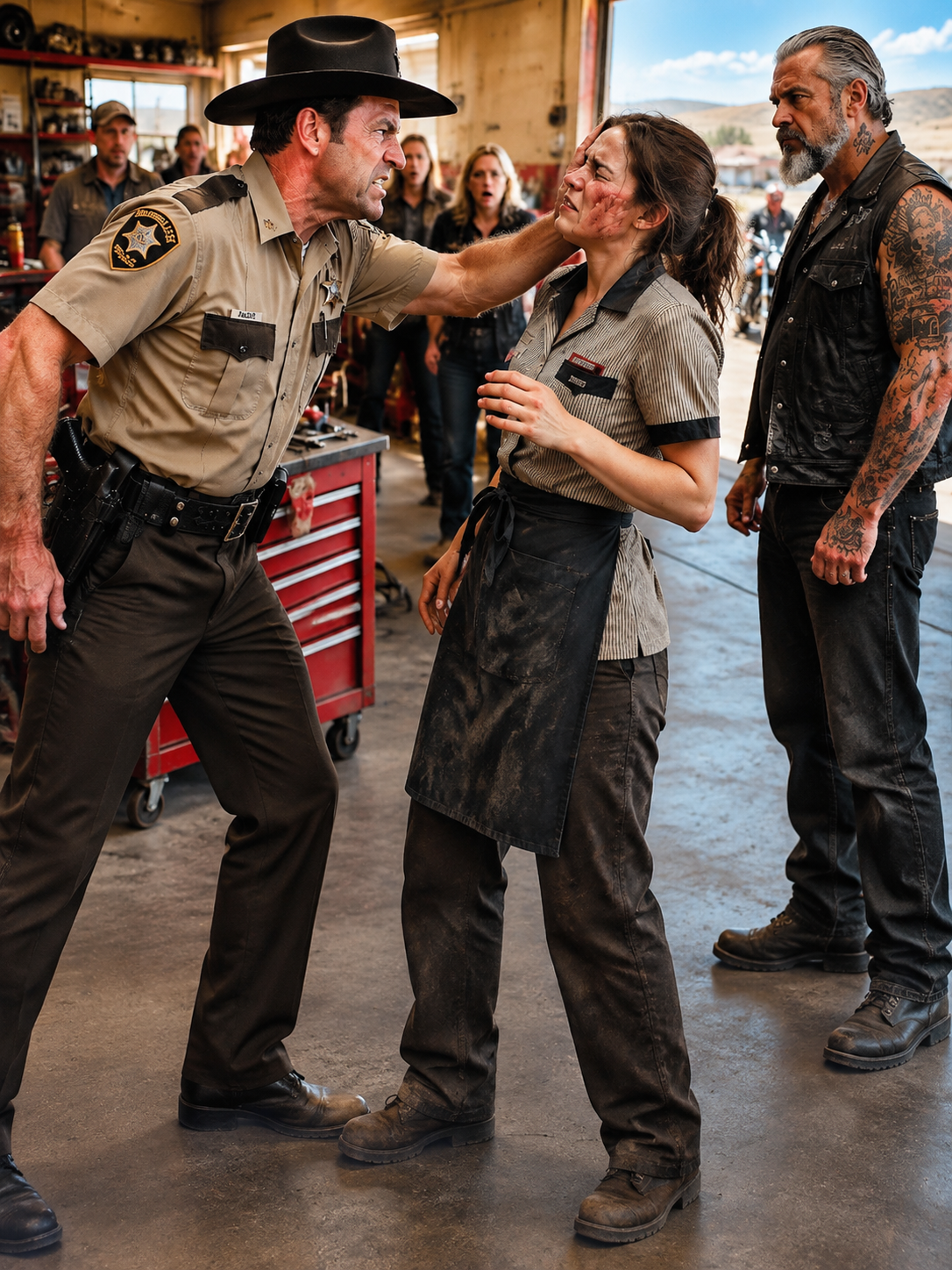
I was running my late father’s auto shop in Drumheller when the town’s police chief struck my seventeen-year-old
IF FACEBOOK BROUGHT YOU HERE, HERE’S THE CONTINUATION YOU’VE BEEN WAITING FOR. ENJOY! 👇 The inspection happened Tuesday. A county employee arrived with a clipboard and city identification, then spent two hours examining every corner of Sinclair’s Auto: lift certifications, fire-extinguisher dates, oil-disposal records, and the ventilation specifications for the paint area I had added two years earlier with a permit still in my files. He found a floor-drain cover of the wrong gauge and gave me thirty days to replace it. The cover cost forty-two dollars, and I installed it myself that evening.
The second inspection came Thursday, this time from WorkSafe. The inspector checked floor markings, tool storage, and the space between the bench grinder and the nearest flammable material. I had everything documented and answered every question evenly. After he left, I sat in my truck for ten minutes and let myself feel how exhausting it was to be impeccable in a fight I had not started.
Josie came back Wednesday, as promised. Her cheek had gone from flushed to bruised and then toward normal, but she was quieter and checked the front window more often than she needed to. I told her this might get worse before it got better, and made sure she understood I was not suggesting she find another job. She said her father had lost his feedlot job after a supervisor took a dislike to him, and their family had spent eleven months eating donated bread. “I’m not scared of men like that,” she said. “I’m just tired of them.”
On Friday night, a journalist named Deanna Marchetti called from the Calgary Herald. She was writing about Chief Beaumont and said she had spoken with other people who described similar pressure from him. When she asked if I would talk, I thought of Josie’s face, the drain cover, and the possibility that this was bigger than one confrontation. I agreed to meet her the following Tuesday in Hanna, where neither of us would be seen together in Drumheller.
Marchetti told me six people had spoken to her so far: two business owners, a former civilian employee of the department, a retired officer who had moved to British Columbia, and two women who were not yet ready to be named. The pattern, she said, was that Beaumont chose someone he thought he could control, used his position to pressure them, and pushed harder when they resisted. I told her he had struck my seventeen-year-old employee, and that I had security footage.
That changed the conversation. We spent two hours going through the events in order. I explained what I had observed, what I knew, and what I could prove, the same way I would explain a repair diagnosis. Marchetti asked careful questions and took notes. Before we parted, she warned that the situation could get worse before it got better. I told her I could hold.
Three weeks later, Gord called and asked me to meet him at the Tim Hortons on Second Street. He was already at a corner table when I arrived. Across from him sat a man in his fifties, wearing a gray fleece and wire-rimmed glasses. Gord introduced him as Warren, a Crown attorney from Edmonton whom he had known for years.
Warren said he had been following what was happening at the shop and looking into matters that went further back than a service counter and a parts delay. He described financial irregularities in the police department’s equipment procurement, a civil settlement buried under a strict nondisclosure agreement, and a retired officer in Kelowna who had recently signed an affidavit about what he had witnessed over nearly a decade. The footage from my security system, he said, was not the end of the story. It was the beginning.
He needed the footage formally, with my consent documented, along with a statement. He also said I might eventually have to agree to be identified publicly. I asked Gord why he was involving himself when he barely knew me. He said he had known my father, who had repaired his 1984 Softail when nobody else in the county would touch it. Dad had charged him what was fair and done the job properly, without charging more because of who Gord was or less out of pity. “That kind of person is not as common as it should be,” he said.
I agreed to sign what was needed. Six weeks later, the Calgary Herald published Marchetti’s investigation on a Saturday morning. It laid out dates, amounts, documented patterns, and names where they could be responsibly published. It described the security footage, included the retired officer’s account, and quoted a statement from Warren’s office confirming that an investigation was underway.
I read the article at my kitchen table over coffee I barely tasted. By noon, I had forty-seven messages, most from people I knew and three from people I did not. Other business owners in the county had apparently been waiting for someone to put the pattern into public view. By Monday, Beaumont had been placed on administrative leave.
Josie read the town’s notice on her phone while standing at the parts counter. After a long silence, she asked if it was over. I told her the leave was not the end; Warren expected a longer process, but the process had started. She nodded. “Yeah,” she said. “It started.”
The investigation took four months. I gave my statement twice and turned over the footage with dates, backups, and documentation. I answered questions from a provincial oversight body as carefully as I had answered Marchetti. After the article ran, the inspections stopped. Nobody explained why; they simply stopped.
In March, Josie passed the admission evaluation for SAIT’s automotive program. She told me on a Thursday while holding a torque wrench at the workbench, as if it were incidental news. She would start in September. When I asked if she was going, she put the wrench back in its proper place and said that if I needed someone for the summer, she needed someone for the summer. I told her immediately that I did.
Aldric Beaumont was formally charged in April with misconduct in public office, breach of trust, and one count related to the procurement irregularities. The charges were read in a Drumheller courtroom on a Tuesday morning. I did not attend; I had a transmission job booked for three weeks, and the customer needed the vehicle by Thursday. Work did not stop just because justice had finally begun moving.
I read about the charges on my phone in the parking lot after closing. I thought about Gord sitting on a stool in my shop and asking me to tell him. I thought about Marchetti’s notebook, Warren’s precise explanation, and my father’s habit of charging people fairly and doing the job right. Then I put my phone away and went back inside to finish the work order.
Two weeks after the charges, Gord returned on a Tuesday afternoon on a Road King that had seen better winters. I heard the valve train before he shut off the engine. He came through the side door like someone who had been there before. I told him the bike sounded rough; he said it was getting old, then asked how I was doing.
I said I thought I was actually okay. He nodded as if he believed me but would check again. I asked whether the bike needed a valve adjustment and looked at my schedule. Wednesday afternoon was open, and he agreed to bring it then.
He turned to leave, and I went back to cleaning the caliper. Outside, the coulees sat as they always had, old and indifferent and permanent. I had built the shop with my father’s tools and my own hands, and I had not let it be taken—not by the ice, the loans, or a man with a badge who thought a quiet threat was enough. For now, that was exactly enough.
Final I had not set out to expose a police chief. I had only stepped between a frightened teenager and a man who believed his badge made him untouchable. But Josie deserved better, my father’s shop deserved better, and the people Beaumont had pressured deserved to be heard. The truth took months to surface, and it did not arrive with a dramatic victory. It arrived through preserved footage, careful records, people willing to speak, and a young mechanic who kept showing up for work.
THE END. I’ve shared the complete story, and I truly hope it touched your heart. If this story moved you, please , like, and share the post. Thank you for reading! ❤️
✓ Lynn R. Adams
IF FACEBOOK BROUGHT YOU HERE, HERE’S THE CONTINUATION YOU’VE BEEN WAITING FOR. ENJOY! 👇 The inspection happened Tuesday. A county employee arrived with a clipboard and city identification, then spent…