I was halfway through
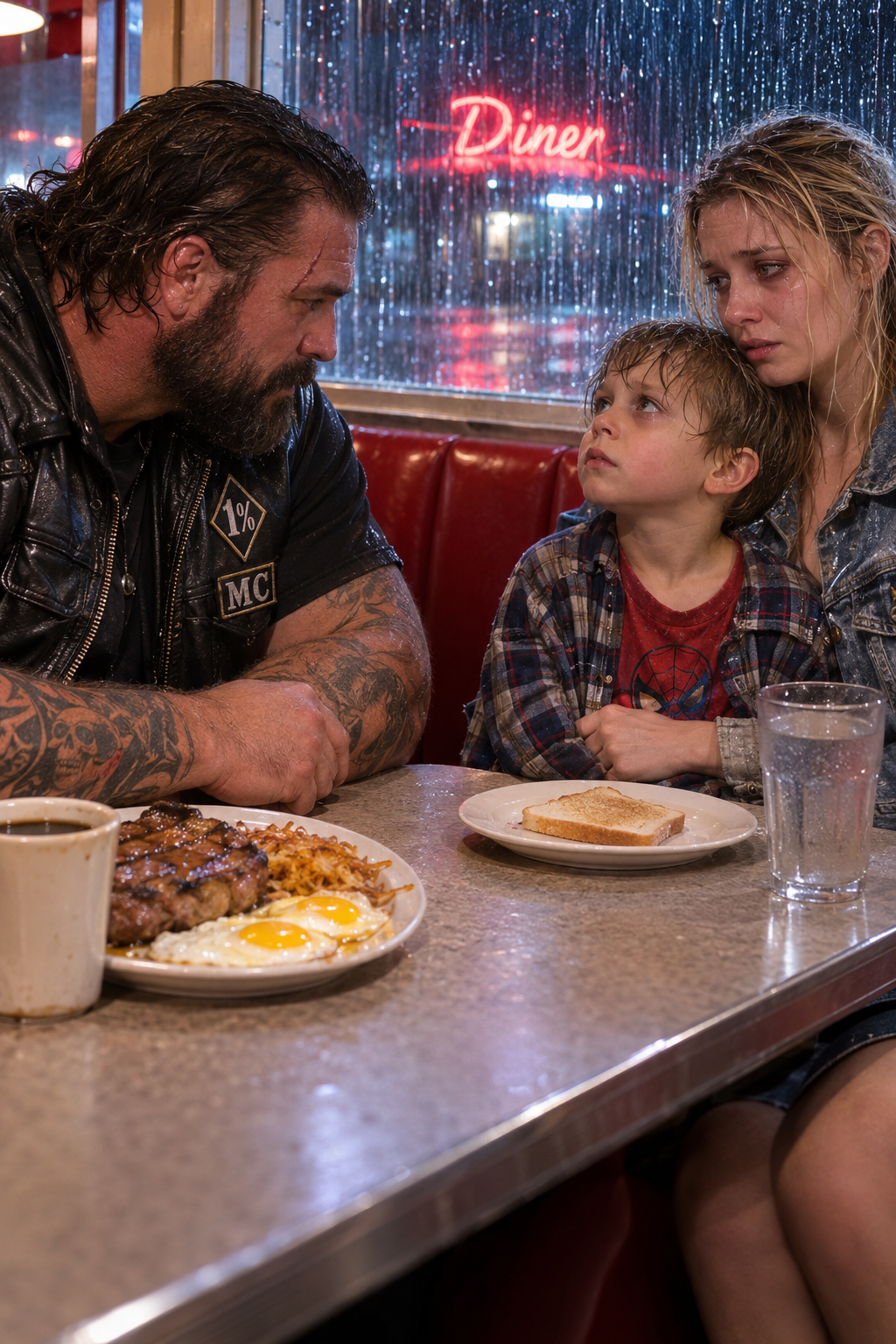
I was halfway through a thirty-dollar steak when a five-year-old boy asked whether eating tonight meant going hungry tomorrow. I bought him and his mother breakfast, but then a police captain came through the diner door….
Rain hammered the roof of Patterson’s Diner at 11:45 on a Tuesday night. I was sitting alone in the back booth, my back against the wall, watching trucks pass along Route 66 outside Gallup, New Mexico. My name is Thomas Reynolds, though most people knew me as Breaker. At forty-two, I weighed 250 pounds, wore the patches of a one-percent motorcycle club, and had spent years making people afraid of me.
I’d ridden for three days on club business, and all I wanted was a meal I could eat without having to watch anybody else’s hands. My black leather jacket was still wet. A scar ran through my left eyebrow, my beard hid a jaw that had been broken more than once, and my knuckles were sore. In front of me sat a rare bone-in ribeye, two eggs, hash browns, and black coffee. The steak alone had cost about thirty dollars.
Then the bell above the door rang. A young woman stepped inside with a little boy, and the cold rain followed them across the checkered floor. Her faded denim jacket was soaked, her long blond hair hung in tangles, and there were dark circles beneath her eyes. The child looked about five. He wore an oversized Spider-Man shirt under an adult flannel, and his sneakers made wet sounds with every step.
The two of them took the booth farthest from the windows. I noticed that before I noticed anything else. The woman kept looking toward the road whenever headlights passed, then pulling the boy closer. She wasn’t simply tired. She looked like someone who expected trouble to arrive through the front door, and I knew that look better than I wanted to.
Brena, the night waitress, walked over carrying a menu and a coffee pot. She’d worked at Patterson’s for as long as anyone could remember and had never been impressed by my club vest. “Rough night to be traveling, honey,” she told the woman. “What can I bring you?” The woman flinched at the sound of her voice, then opened a little plastic coin purse instead of the menu.
I was two booths away, close enough to see the coins spread across the tabletop. Two quarters. Three dimes. A nickel. A couple of pennies. Eighty-seven cents in all. She counted it twice with fingers that wouldn’t quite hold still. Then she glanced down at her son, gathered herself, and asked for a single slice of plain white toast, no butter, and a glass of tap water.
Brena looked from the money to the boy. “Toast is a dollar fifty, sweetheart. But I can bring you both some chili, on me.” The woman shook her head so fast that her wet hair brushed her cheeks. “No charity, please. We have eighty-seven cents. If that’s not enough, we’ll leave.” She was already reaching for her son’s hand when Brena told her to sit and keep the change.
The woman sank back against the cracked red vinyl, and the boy leaned into her side. I looked at my overflowing plate. I’d spent more on one piece of meat than she had in her purse, and I hadn’t even thought about it when I ordered. That shouldn’t have surprised a man who’d done the things I’d done. But it did.
A few minutes later Brena brought one dry slice of toast on a white plate and two glasses of ice water. The woman slid the plate entirely in front of the boy. “Eat, Nolan,” she said. “It’s all yours.” That was when I learned his name. His stomach growled loud enough for me to hear across the aisle, but he didn’t pick up the bread.
Instead, Nolan pressed his fingers into the middle of the slice, tore it into two pieces, and pushed one toward his mother. “You eat, Mommy.” She pushed it back. “I already had a big lunch, baby.” Nolan watched her face, then looked down at the table. “Your tummy’s making the angry noise, too,” he said, without accusing her of anything.
She tried once more to give him the entire piece. He stared at the two halves as though he were working out a problem no kindergartner should ever have to solve. Finally he looked up and asked, in a small, matter-of-fact voice, “Mom, if we eat now, will we be hungry tomorrow?”
I had my coffee halfway to my mouth. I stopped moving. Suddenly I wasn’t forty-two and sitting in a diner with a full plate. I was a little boy in a Texas trailer park in 1991, holding my younger sister’s hand in front of an empty pantry. Our mother hadn’t come home. All we had was the last spoonful of peanut butter, and I remembered trying to decide whether to feed my sister then or save it until morning.
My mug hit the table harder than I meant it to. The woman jerked toward the sound and pulled Nolan against her. I stood up, and I could see her measuring my size, the scar, the boots, and the patches on my vest. To her, I probably looked like one more man who might hurt them. I hated how reasonable that fear was.
I didn’t walk straight to their booth. I went to the counter and laid a hundred-dollar bill in front of Brena. I ordered two stacks of buttermilk pancakes, three servings of bacon, two of sausage, hash browns, four scrambled eggs with cheese, orange juice, whole milk, and a slice of whatever pie was waiting in the case. Brena raised an eyebrow. “You already have enough food, Thomas.”
“It isn’t for me,” I told her. “Take it to the mother and the boy. If she says no, tell her it’s paid for.” Brena glanced across the room, her expression softening. “You’d better not scare them while I cook it,” she muttered. I waited until she went into the kitchen, then approached the booth slowly, stopping several feet away with my hands open.
“Ma’am, I heard what your boy said. I’ve ordered him some hot food. You don’t owe me anything.” She immediately shook her head. “We can’t pay you back.” “I’m not asking you to.” I looked at Nolan, trying to keep my voice gentle. “You like pancakes, little man?” From behind his mother’s arm, he gave me one careful nod. It was the first time I had seen him look interested in something besides surviving the night.
I was about to return to my booth when white headlights washed across the windows. A dark gray SUV had stopped directly in front of the diner, blocking the entrance rather than pulling into a parking space. The woman’s expression changed before I even turned around. When she reached for Nolan, her sleeve slipped back and I saw dark purple bruises around her wrist. She knocked over a glass of water and shoved him beneath the table. “Hide,” she whispered urgently. “Nolan, get down.”
A man climbed out of the SUV in a state police captain’s uniform, pulled his broad-brimmed hat lower against the rain, and came toward the door. I recognized him: Captain Richard Miller, a name I’d heard too often in the ugly corners of New Mexico. The bell rang again. He stepped inside, searched the booths, and fixed his eyes on the woman. “Well, well,” he said. “Found you, Sarah.” Part 2…..
I moved into the aisle before Miller could reach their table. He was still dripping rainwater onto the floor, and one hand rested near his holstered pistol. He eyed my leather vest with open contempt. “Step aside, biker trash,” he said, touching the captain’s star on his chest. “Official business. That woman’s wanted for grand larceny.”
Behind me, Nolan made a small frightened sound from beneath the booth. Sarah, whose surname I later learned was Jenkins, stood halfway from her seat. “He’s lying,” she said. “I worked the dispatch desk. I heard his radio call before he shot Deputy Chief Evans. I saved the recording on a flash drive.” She seemed frightened even to say it aloud, but she didn’t take the words back.
I’d heard enough whispers about Miller’s control of drug routes to know a police badge didn’t make him safe. Now I understood why Sarah had been watching the road. She knew something that could put a powerful man in prison. He knew she had proof. And her son was there to see him find her.
Miller told her to shut up and drew his Glock 22. The muzzle came up toward my chest. “You’re obstructing a peace officer,” he said. “I can say you reached for a weapon.” I kept myself between the gun and that booth. “You don’t sound much like a peace officer to me,” I answered. He gave me one last order to move.
I lunged before he finished. My left hand drove the gun upward as it fired, and the shot shattered a piece of the diner’s neon-lit front window. With my other hand, I hit Miller in the jaw. He went down hard, and the pistol slid across the floor. I kicked it out of reach, rolled him onto his stomach, and fastened his own handcuffs around his wrists. My heart was pounding so hard I could feel it in my throat.
“Brena!” I called. “Already on it,” she answered. She was behind the counter with an old pump-action Remington shotgun, pointed toward the empty entrance in case anyone else came in. “Never liked Dicky Miller,” she said. “Terrible tipper. What now, Thomas?” She had called me by my real name, not Breaker, and somehow that mattered.
“We call the feds.” I took out my burner phone and dialed the number of Special Agent William Carter of the FBI gang task force. Carter had been pursuing my motorcycle club for three years and had an arrest warrant for me. He answered with suspicion as soon as he heard my voice. “Reynolds? You have some nerve calling me.”
“I’ve got Captain Richard Miller handcuffed on the floor of Patterson’s Diner off Route 66,” I said. “He just fired at me while threatening a woman who says she has evidence he murdered Deputy Chief Evans. Bring an ambulance and an evidence team.” Carter demanded to know whether it was a trap. “No,” I told him. “But I’ve got one condition.”
He waited. I looked at Sarah, still holding the edge of the booth while she kept Nolan behind her. “The woman and her boy get federal protection. Somewhere Miller’s friends can’t reach them. Make that your priority.” Carter asked what I wanted in return. I looked at the club patches across my chest. “Nothing for me,” I said. “I’m done running.”
Final The FBI arrived about twenty minutes later, filling the parking lot with flashing lights. Agents secured Miller and had him taken for medical attention while others checked the diner and spoke to witnesses. I stayed near Sarah and Nolan as Carter came inside in a rain-soaked trench coat. He looked at me first, then crouched a little so he wouldn’t loom over the boy.
“I’m Special Agent Carter,” he told Sarah. “Do you have the drive?” She reached into her right boot and brought out a small blue USB stick. Her hand trembled when she put it in his palm. “The recording’s on there,” she said. “And the offshore account information.” Carter promised secure transport to a safe house that night and said he would start the process of getting them witness protection, with new identities and a life far from Miller’s reach. Sarah held Nolan closer, looking as though she barely dared believe him.
She turned to me. “You saved us. Why?” I didn’t have a neat answer. I could still picture that empty pantry in Texas, and I kept hearing Nolan ask about tomorrow. Before I could explain, Brena came through the agents carrying a tray so large she had to balance it on her hip. “Move along, gentlemen,” she said. “Food’s getting cold.”
She set pancakes with syrup, bacon, sausage, cheesy eggs, hash browns, milk, juice, and apple pie on the table. The room had smelled of wet leather and gunpowder a moment earlier; now it smelled of breakfast. Nolan came out from behind his mother and stared at the plates. Even then, he hesitated. He looked from the food to me and began, “If I eat now…”
I knelt beside him, my knees cracking, until our eyes were level. I put my big, scarred hand gently over his small one. “Eat now, Nolan,” I said. “You’re going somewhere safe, and I’m going to do everything I can to make sure you have food tomorrow, too.” For a few seconds he studied me. Then he smiled, picked up a strip of bacon, and took a bite. Sarah sat beside him with her hands over her mouth, trying to hold herself together.
I stood and undid the heavy pins of my leather vest. The club patches that had defined my life fell to the floor with it, leaving me in a plain black T-shirt. I faced Carter and held out my wrists. “You’ve got a warrant,” I reminded him. “I’m right here.” He looked at the vest, then at Nolan eating, then pulled the paper from his pocket.
Carter tore his copy of the warrant in half. “My report will say an anonymous citizen helped stop an armed officer,” he told me quietly. “I suggest that citizen leave New Mexico tonight.” I knew tearing a piece of paper couldn’t erase everything I’d done or make the legal trouble disappear. But I understood what he was offering me at that moment, and I wasn’t going to make Sarah and Nolan stand there while we argued about my past.
Sarah formed a silent thank-you with her lips. Nolan looked up from the pancakes and gave me a sticky thumbs-up. I nodded to Brena and stepped back through the diner’s glass door into the rain. My heavy cruiser was still under the awning. I started the engine and rode away, leaving my cold steak, my club vest, and a piece of dry toast behind. I had no way to know what the law would make of my own past, but for the first time in years I felt free. And for one night, at least, a hungry child could eat without having to count the hours until morning.
THE END. I’ve shared the complete story, and I truly hope it touched your heart. If this story moved you, please , like, and share the post. Thank you for reading! ❤️
✓ Lynn R. Adams
I was halfway through a thirty-dollar steak when a five-year-old boy asked whether eating tonight meant going hungry tomorrow. I bought him and his mother breakfast, but then a police captain came thr…