I was eleven years old and had spent six years learning not to expect anyone to come back,
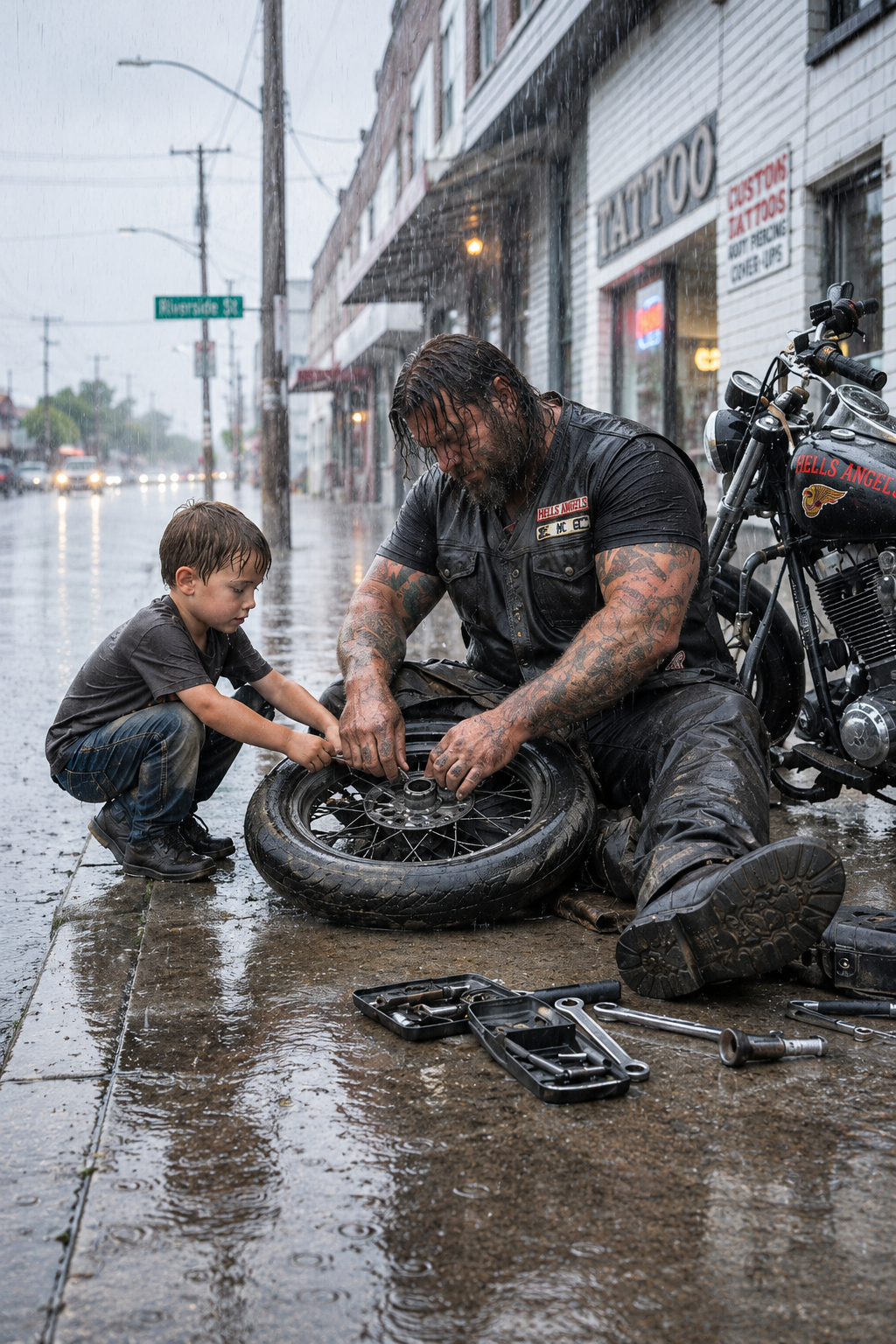
IF FACEBOOK BROUGHT YOU HERE, HERE’S THE CONTINUATION YOU’VE BEEN WAITING FOR. ENJOY! 👇 Garrett told me he’d described what happened to other riders and that they wanted to thank me. I looked at the road, where motorcycles stretched beyond both bends, and tried to understand why anyone would travel that far for a repair that had taken twenty minutes. I hadn’t asked him for anything, and I still didn’t want payment.
Mrs. Pruitt walked over and asked Garrett to explain the gathering. She was calm but firm, the way she was when something unexpected happened at the home. Garrett assured her the riders wouldn’t enter the building or approach the children without permission.
He said the Iron Brothers and riders from other groups had organized supplies for the home. He handed her a folded list showing six months of groceries, winter coats and boots, books, art materials, and new tools for Mr. Alderman’s maintenance room. A replacement boiler had been donated, with professional installation arranged for the following week.
Mrs. Pruitt read the list twice. There were also contributions from sixty-eight riders totaling forty-seven thousand dollars toward education savings, and a Nashville law firm had offered pro bono assistance with adoption cases delayed in the county system. She thanked him, then said every gift and service would need to be reviewed and handled properly.
Garrett agreed. He admitted he’d filmed me fixing the chain and posted the video without asking permission. Mrs. Pruitt told him plainly that sharing footage of a child in care was not acceptable, and he apologized and agreed to remove it.
I was glad she spoke up, even though I didn’t quite know how to feel about people seeing me work. I hadn’t done anything special for a camera. I’d just seen a chain on the ground and known where to find a tool.
Garrett said a man named Raymond Park, who ran a youth trades program in Nashville, had offered me a scholarship for future mechanical and carpentry training. He made it clear I wouldn’t owe anybody anything in return. Mrs. Pruitt said I would have time to consider it with Carol, and that nobody would decide for me.
“Why?” I finally asked Garrett. He crouched so we were eye to eye and said people often crossed the street when they saw his vest. I’d looked at his broken motorcycle instead of deciding what kind of man he must be, and that had meant something to him.
I thought about the way Mrs. Pruitt had questioned him and how patiently he’d answered. I didn’t think she was wrong to protect us, but I was glad she’d allowed me to finish the repair. I told Garrett I hadn’t been afraid of him, only worried about the chain.
He smiled. Behind him, a rider named Doug Mercer was helping organize the deliveries and directing motorcycles away from the entrance. Other riders set up folding tables with food and hot chocolate, while staff supervised the children who came outside to look.
June was already asking questions about engines and patches. She talked to a woman wearing a road captain patch, who explained how the riders had traveled together. I stayed beside Garrett because he didn’t mind when I was quiet.
Then Doug brought us to a white pickup parked at the edge of the lot. He folded back a canvas tarp to reveal a small, well-maintained Honda Trail learner bike and a padded case of mechanics tools. There was also an envelope attached to the handlebars.
I stared at the bike, then at Mrs. Pruitt. Garrett said it was a gift, not something I had to accept that morning, and that any future riding would depend on adult supervision and appropriate training. I told him I couldn’t ride, and he answered, “Not yet.”
I asked whether I could open the envelope. Inside was a note from Raymond Park, who wrote that he hadn’t had anyone either, but had built something of his life and believed I could too. I folded the card carefully and put it in my jacket pocket.
For a while I couldn’t speak. I kept touching the edge of the tool case, imagining having something I could learn to use for years instead of something I’d outgrow. Garrett waited without asking me to smile or say thank you again.
Mrs. Pruitt came over and told me there was something else she wanted to discuss privately. Carol had learned of a couple in Nashville who’d been approved through the adoption system and specifically hoped to welcome an older child. They’d heard about me that morning and asked whether they might begin getting to know me.
My stomach tightened because I remembered the Hendersons. Mrs. Pruitt said I could take my time, that meeting a family was not a promise, and that I wouldn’t have to act louder or happier than I felt. I asked what they were like, and she said Carol knew them and they had two dogs and a house near a park.
I looked over at June, who was telling a rider something with both hands waving in the air. The first thing I wanted to know was whether I’d still be able to see her. Mrs. Pruitt said any visits would need planning and approval, but that the adults would work to keep our friendship in our lives.
June heard enough to march over and announce that nobody was getting rid of her that easily. I laughed before I could stop myself. Garrett looked away politely, but I could tell he was smiling too.
Part 3 The riders stayed through the afternoon. Food came from coolers and trucks, and the children were allowed to look at parked motorcycles with staff nearby. June collected more facts about engines than I could remember, while I listened to Garrett and Doug talk about the Iron Brothers’ food banks, toy drives, and members who had grown up in foster care.
I learned that many of the riders were veterans or people who’d needed help at some point themselves. Some had come from hundreds of miles away. They didn’t all know one another, but someone had told them about a boy fixing a chain in the rain, and they’d decided it was worth making the trip.
Mrs. Pruitt and Carol spent much of the day talking with donors and checking the arrangements. The money wasn’t simply handed over to anyone; the home needed records and approvals, and the legal help would have to follow the rules protecting children in care. I liked that they took their time, because it made the promises sound more real.
Around four, the riders began leaving in groups. The road filled with engines again, but this time I knew why they were there. Garrett was one of the last to go, and he gave Mrs. Pruitt his contact information so she and Carol could arrange any future visits or questions.
He shook my hand and told me I could ask him about repairs whenever the staff said it was all right. Then he said something I kept thinking about: “You were never invisible, Eli. Some people just weren’t looking.” I didn’t know how to answer, so I nodded and watched him ride away.
The supply trucks remained while volunteers finished unloading. Mr. Alderman came out to inspect the new tools, looking almost as excited as June had looked at the motorcycles. Mrs. Pruitt reminded him that the boiler replacement needed proper installation and inspection before anyone could use it.
That evening, June and I sat on the low wall after supper. She asked whether the Nashville family had a yard big enough for two dogs. I told her I didn’t know, and she said dogs were good because once they decided you belonged to them, they didn’t keep changing their minds.
I took Raymond Park’s note out of my pocket and read it again. I still didn’t know whether the couple in Nashville would want me after meeting me, and I was scared of hoping. But there was a difference between a promise someone made in a hurry and a chance I could consider slowly, with Carol and Mrs. Pruitt helping me.
The next week, the donated boiler was installed by professionals after the home’s arrangements were approved. The groceries, coats, books, and art supplies were sorted and distributed, and Mr. Alderman showed me the new chain tools. I was allowed to help him organize the workshop, which made an ordinary Wednesday feel surprisingly good.
Carol explained the scholarship paperwork to me in language I could understand. It was for learning when I was ready, not a demand that I become a mechanic or leave school. I asked whether I could still study other things, and she said of course I could.
She also told me the Nashville couple would begin with a supervised introduction, followed by more visits if everyone felt comfortable. Their interest didn’t mean an adoption was certain. I appreciated that she didn’t make it sound like a happy ending had already been signed and filed.
When the couple came, I sat across from them with my hands under my knees. They asked about the books I liked and what I enjoyed fixing, then waited while I found my answers. They didn’t fill every silence, and when I told them about June, they asked what made her such a good friend.
I told them she noticed when I was missing. The woman nodded and said that sounded important. For once, I didn’t feel as though I had failed a test because I hadn’t talked enough.
Final There were more visits after that first one. Some were awkward, and I was still afraid the couple would change their minds. But they kept showing up when they said they would, and the adults handling my case kept asking what I thought rather than assuming they knew.
The scholarship arrangements moved forward separately from the adoption process. Raymond Park’s program gave me something to look toward, whether I eventually lived in Nashville or somewhere else. I began to understand that being good at fixing things could be part of my future without becoming the only reason somebody valued me.
Garrett visited again after getting permission from Mrs. Pruitt and Carol. He brought no crowd and made no announcement, just stopped by to see how the workshop was doing. I showed him the new tools and told him Mr. Alderman had let me help sort the old ones.
He asked about June and listened while I told him she was still collecting motorcycle facts. When he asked about the Nashville family, I said I liked them but wasn’t ready to be sure. Garrett said I didn’t have to rush, and I believed him.
Months later, the family and I were still getting to know one another through the process arranged by the county. I hadn’t moved in or been adopted yet, and nobody pretended the paperwork or the feelings were simple. But I had stopped thinking that every quiet moment meant someone was preparing to leave.
June and I still sat on the wall when the weather was good. She made plans for imaginary trips, and I told her which tools I’d need to repair a motorcycle if we ever took one. Sometimes we didn’t talk at all, and she never seemed to mind.
One afternoon a crow landed on the wall near us. I watched it lift into the air and disappear over Cedar Hill Road, the same road where Garrett’s motorcycle had broken down. I remembered how cold the rain had felt inside my shoes and how certain I’d been that helping him was just a small thing.
The next morning had brought 3,500 riders, but the number wasn’t what stayed with me most. It was Garrett crouching beside me and listening, Mrs. Pruitt making sure the gifts were safe, and the people who returned afterward when there were no cameras or motorcycles to watch. They made room for me without asking me to become somebody else.
I was still the quiet boy with the worn paperback and the blue jay feather in his box. I still didn’t know exactly what home would look like in a year. But when I thought about the future, I no longer saw only a door closing; I could picture someone arriving, staying for a while, and asking what I wanted to build.
THE END. I’ve shared the complete story, and I truly hope it touched your heart. If this story moved you, please , like, and share the post. Thank you for reading! ❤️
✓ Lynn R. Adams
IF FACEBOOK BROUGHT YOU HERE, HERE’S THE CONTINUATION YOU’VE BEEN WAITING FOR. ENJOY! 👇 Garrett told me he’d described what happened to other riders and that they wanted to thank me. I looked at the …