I was eating alone in a Montana
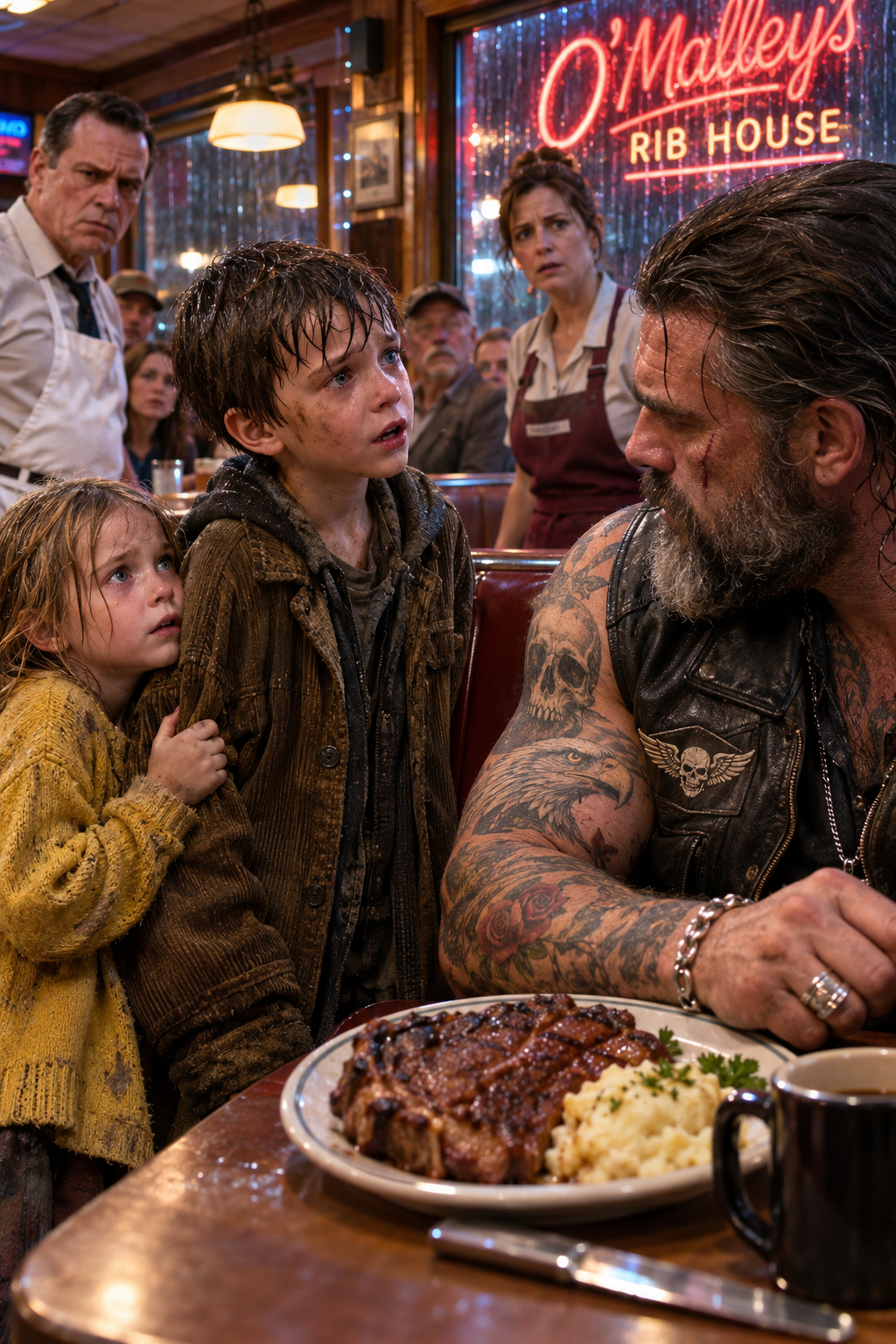
I was eating alone in a Montana diner when two shivering children asked for my leftovers, and the manager tried to throw them into the storm. Then the little boy looked me straight in the eye….
The rain was beating against the windows of O’Malley’s Rib House so hard that Tuesday night, I could barely hear the jukebox. I was sitting in my usual corner booth outside Billings, Montana, with a twenty-four-ounce ribeye, mashed potatoes, and a cup of black coffee. I’d ridden in on my matte-black Harley, wanting nothing more complicated than a hot dinner and a little quiet.
My name is Wyatt Henderson. I’m six feet five, broad enough to make two people reconsider squeezing past me, and covered in old tattoos. A scar runs from my left ear toward my collarbone. People see the leather vest, the gray in my beard, and that scar, and usually decide they don’t need to know anything else.
That’s fine with me. For years, keeping people at a distance had been easier than explaining where I’d been or what I’d done. O’Malley’s was usually full of truckers passing through Highway 87 and ranchers who wanted supper after a long shift. They knew how to give a man space, and I appreciated it. Brianna Carmichael, who’d worked at O’Malley’s for fifteen years, was one of the few people who didn’t treat me like I might bite. She set my plate down, refilled my coffee, and let me eat.
I noticed the children first as shapes outside the front window. They stood beneath the flickering red neon sign, close enough to see the food but not close enough to feel the warmth. The boy looked about eight, wearing a corduroy jacket much too big for him. The little girl, maybe six, had a thin yellow sweater plastered to her arms by the rain.
They watched a waitress carry fries past the window, then a slice of cherry pie. More than once, the boy looked at my steak. The little girl held his hand with both of hers, and he kept moving his body between her and the wind. Every now and then, he’d bend close to say something I couldn’t hear, and she’d nod as if she was trying to be brave for him. After twenty minutes, I was starting to wonder why nobody had come looking for them.
Then the boy pulled open the heavy glass door. The bell overhead gave its bright little ring, and both children stepped onto the checkered floor in worn sneakers. Water pooled around their feet. The girl was trembling so hard I could see it from my booth; her lips had a bluish cast that worried me more than the mud. Those were not children who’d simply been caught outside without their raincoats. They looked exhausted, and neither of them was watching the other customers with the curiosity you’d expect from kids their age.
Gregory Wallace, the shift manager, came out from behind the register almost immediately. Gregory liked polished floors and orderly tables. He took one look at the puddle and frowned like someone had dumped a bucket of garbage in his dining room. “Hey. You two can’t be in here,” he said. “This is a business, not a shelter.”
The boy held his sister’s hand tighter. “We just wanted to ask something,” he said, barely loud enough to reach me. Gregory didn’t bother lowering his voice. He said they were bothering paying customers and threatened to call the police if they didn’t get out.
Brianna stopped with a coffee pot in her hand. “Gregory, they’re children,” she told him. He snapped that she should mind her tables. I could see the boy looking from the rain beyond the door to his sister’s face, trying to decide which was worse. Then Gregory reached for his shoulder.
The boy ducked away. He hurried past a couple eating salads and came straight toward my corner booth, pulling his sister after him. I heard a fork stop against a plate somewhere in the room. People at O’Malley’s had an understanding about my table: leave the big biker alone, especially while he’s cutting into a steak.
Nobody had explained that rule to an eight-year-old whose sister was hungry. He stopped by my elbow, his shoes squeaking on the floor. The girl slipped behind him, peeking out around his jacket. Both were soaked, dirty, and shivering, but the boy stood there waiting for me to look up.
I put down my knife and fork. He stared at the steak, then at the scars on my hands, then finally at my face. He was frightened; there was no point pretending otherwise. But whatever had brought him through that door mattered more to him than being frightened of me.
Gregory came puffing up behind them. “Sir, I’m sorry. I’ll get these brats out of your way.” I raised one hand without taking my eyes off the boy. Gregory stopped talking, and the room went quiet enough that I could hear rainwater dripping from the child’s sleeve onto the floor.
“Go on,” I said. The boy swallowed. His sister’s hand had found the back of his jacket, bunching the wet fabric into a fist. He opened his mouth, closed it again, and looked at my half-finished dinner as though he hated himself for needing to ask.
“Excuse me, sir,” he whispered. “Can we have some leftovers?” He didn’t ask for money. He didn’t ask me to take them anywhere. He wanted the food I was going to leave on my plate, and he was willing to face a room full of strangers to get it for his sister.
I looked at his hollow cheeks, then at the girl barely holding herself upright behind him. She was watching the mashed potatoes like they belonged to another world. Gregory was still standing too close, ready to usher them back into the cold. Something about that sight pulled me straight out of the quiet evening I’d planned.
“You got a problem with your hearing, Gregory?” I asked. His face twitched. “The boy asked a question.” Gregory mistook my meaning and reached out again. “I’ll remove them right now,” he promised, as though that might earn my approval. I told him plainly not to touch the boy.
He froze. I’m not proud of how easily people read danger in my voice, but that night it got his hand away from a child who needed help. I slid out of the booth and stood. The boy looked up at me, eyes wide, already stepping backward as if he’d made a terrible mistake.
“You don’t want leftovers, kid,” I told him. His face fell so fast I wished I’d chosen better words. “I’m sorry,” he said, tugging his sister toward the door. It was the kind of apology a child learns when he’s spent too long being afraid of making adults angry.
I put my hand lightly on his shoulder and waited until he looked back. “You don’t want leftovers,” I repeated, “because you’re going to eat fresh.” The girl lifted her head. The boy stared at me, not quite believing that the answer he’d risked asking for had just become something much bigger. Part 2…..
“Brianna,” I called, “two lumberjack platters. Extra bacon, extra fries, and hot chocolate made properly, not that powdered stuff.” She nodded and headed for the kitchen before Gregory could object. I pointed the children toward the seat across from me. “Sit down.”
The boy climbed into the booth first and helped his sister up beside him. Their clothes left dark wet patches on the red vinyl. I went back to my steak, partly because I was hungry and partly because I knew they didn’t need an entire restaurant staring at them. “I’m Wyatt,” I said. “Lucas,” the boy answered. “And this is Charlotte.”
When Brianna brought the food, the platters nearly filled the table: eggs, bacon, sausage, hash browns, and pancakes piled high. Lucas cut Charlotte’s pancakes into manageable pieces before he touched his own. Then they ate with the hurried concentration of children who didn’t know when they’d get another meal. Brianna left a couple of dry towels nearby and went back to work with shining eyes.
I noticed yellowing marks around Lucas’s wrists, shaped more like fingers than playground scrapes. I didn’t ask about them while he was eating. But when he reached across the table for the ketchup, something slipped out of his collar and struck the edge of his plate. It was a tarnished silver medallion: a howling wolf surrounded by barbed wire.
My appetite vanished. Only fifty of those pieces had been made at a South Dakota chop shop, and every one had belonged to someone connected to the Iron Wolves motorcycle club. I’d once ridden among those men. Years earlier, after seeing what the club was doing to people, I’d helped federal investigators bring down its leadership and disappeared from the club’s world.
“Where did you get that?” I asked. Lucas shoved the pendant back under his shirt so quickly his elbow struck his mug. “It’s my mom’s,” he said. “What’s her name?” I asked, keeping my voice low. “Valerie. Valerie Brandon.” I didn’t recognize her name, but the look on his face told me he thought the necklace had put them in danger.
“Where’s Valerie now?” I asked. Lucas looked at Charlotte, who was still holding half a pancake. “Mom told us to run,” he said. “She gave me the necklace and said if anyone saw it, they’d know he was coming. She told us to hide until she came for us.” I felt the old, familiar warning settle in my stomach. “Who was coming?”
Before he could answer, red-and-blue lights swept across the rain-streaked windows. A sheriff’s cruiser pulled into the lot and stopped in front of my Harley. Charlotte slid off the booth and ducked beneath the table. Lucas grabbed my vest so hard his fingers hurt my arm. “That’s Matthews Dawson,” he whispered. “He’s our stepdad. If he takes us back, he’ll kill our mom.”
The deputy came through the door hard enough to bang it into the brick wall, shattering an old beer mirror. Gregory hurried to greet him, but Dawson shoved him aside and scanned the room. He was tall and lean, with a dark raincoat over his uniform. When he spotted Lucas’s oversized jacket and Charlotte’s yellow sweater, he headed straight for us, one hand resting near his holstered pistol.
“There you are,” he said. “Your mother is worried sick.” Lucas wrapped an arm around his sister. “She’s not worried. You hurt her. You locked her in the basement.” Dawson leaned toward the child and warned him, in a voice low enough to sound almost casual, to keep quiet or his mother would pay for it. Then he reached for Lucas’s hair.
I caught Dawson’s wrist before he touched the boy. “He’s eating,” I said. Dawson pulled against my hand and announced that I was assaulting an officer. He threatened to shoot me if I didn’t let go. I kept my voice steady and told him a badge didn’t make him a protector of children. Then I said the words that changed his face: “Iron Wolves.”
For the first time, Dawson looked scared. His gaze flicked to the wolf pendant. I let go of his wrist and took out the secure phone I still carried for emergencies. “I know that club,” I said. “I helped put Big Bill Carver away for three consecutive life sentences after the 2019 federal investigation. They used to call me the Reaper.” Dawson stared at the scar on my neck as recognition caught up with him.
I called Special Agent Kenneth Brody, my federal contact, and reported Dawson’s location, the children’s account, and Valerie Brandon’s name. Brody confirmed he’d received the distress alert and was coordinating with state officers. I asked him to send people to Dawson’s property immediately. I didn’t know whether Valerie was alive, and I wasn’t going to pretend I did.
Dawson turned and ran toward the door. I intercepted him before he reached it and shoved him into an empty wooden booth. It cracked under his weight, and his handgun came loose on the floor. I kept him pinned long enough for help to arrive. I didn’t enjoy the damage or the frightened faces around me, but I wasn’t letting him get back to those children.
Within minutes, state troopers filled the parking lot and entered the diner. One moved the dropped weapon safely out of reach while another handcuffed Dawson. Brody arrived soon after and spoke to the responding officers. He treated the children with a gentleness that didn’t surprise me. I stayed out of the way once people with legal authority were in control.
Brianna had found a warm blanket and wrapped it around Lucas and Charlotte. They sat shoulder to shoulder at the booth, their uneaten pancakes cooling in front of them. I watched Lucas keep glancing toward the door, as though an arrest couldn’t possibly be enough to make the danger stop. I understood that feeling better than I wanted to.
Brody pulled me aside near the register. Officers had located Valerie in a storm cellar at Dawson’s ranch, he said. She was badly shaken and injured, but alive; paramedics were examining her. Investigators would have to sort through the evidence and any charges tied to Dawson’s conduct and his connections to the old club. For the children, only one part of that report mattered: their mother was coming back.
Final When the ambulance arrived, Lucas heard it before I did. He and Charlotte turned toward the front window as two paramedics helped a pale woman through the door. Valerie Brandon held one arm close to her ribs, and there was a dark bruise across her cheek. But the instant she saw her children, her face changed. “Lucas! Charlotte!”
They ran to her so quickly the blanket fell behind them. Valerie sank to her knees and gathered them into her arms on the checkered floor. Lucas, who had been careful and brave all evening, finally let himself hold on like the eight-year-old he was. Charlotte pressed her face against her mother’s shoulder and wouldn’t let go. I turned away to give them a moment that belonged to them.
Nothing about that reunion erased what they’d lived through. Valerie still needed medical care, the children needed safety, and Dawson would have to answer to investigators and the courts. But they were together, and for that night, the door was no longer something the children had to fear. It was the door their mother had walked through.
I took a folded stack of hundred-dollar bills from my vest and put it on the counter. It would cover the broken booth, the mirror, the children’s dinner, and whatever else we’d disrupted. “Keep the change,” I told Brianna. “And get those two some dessert when they’re ready.”
She looked from the money to the family on the floor. “You’re a good man, Wyatt Henderson,” she said. I didn’t have an answer worth saying out loud. I pulled up my collar, walked into the cold rain, and started my Harley before anyone could come looking for me with thanks I wasn’t prepared to accept.
As I rode out of the parking lot, I caught one last glimpse through the glass. Lucas was standing beside Valerie, one hand in hers and the other closed around the silver wolf pendant. That little piece of metal had frightened him when he came in. I hoped it would remind him of something different now: he’d asked a stranger for help, and someone had listened.
THE END. I’ve shared the complete story, and I truly hope it touched your heart. If this story moved you, please , like, and share the post. Thank you for reading! ❤️
✓ Lynn R. Adams
I was eating alone in a Montana diner when two shivering children asked for my leftovers, and the manager tried to throw them into the storm. Then the little boy looked me straight in the eye…. The r…