I was a 45-year-old biker riding alone when a diner owner threw two freezing children into the night, so I gave the little girl
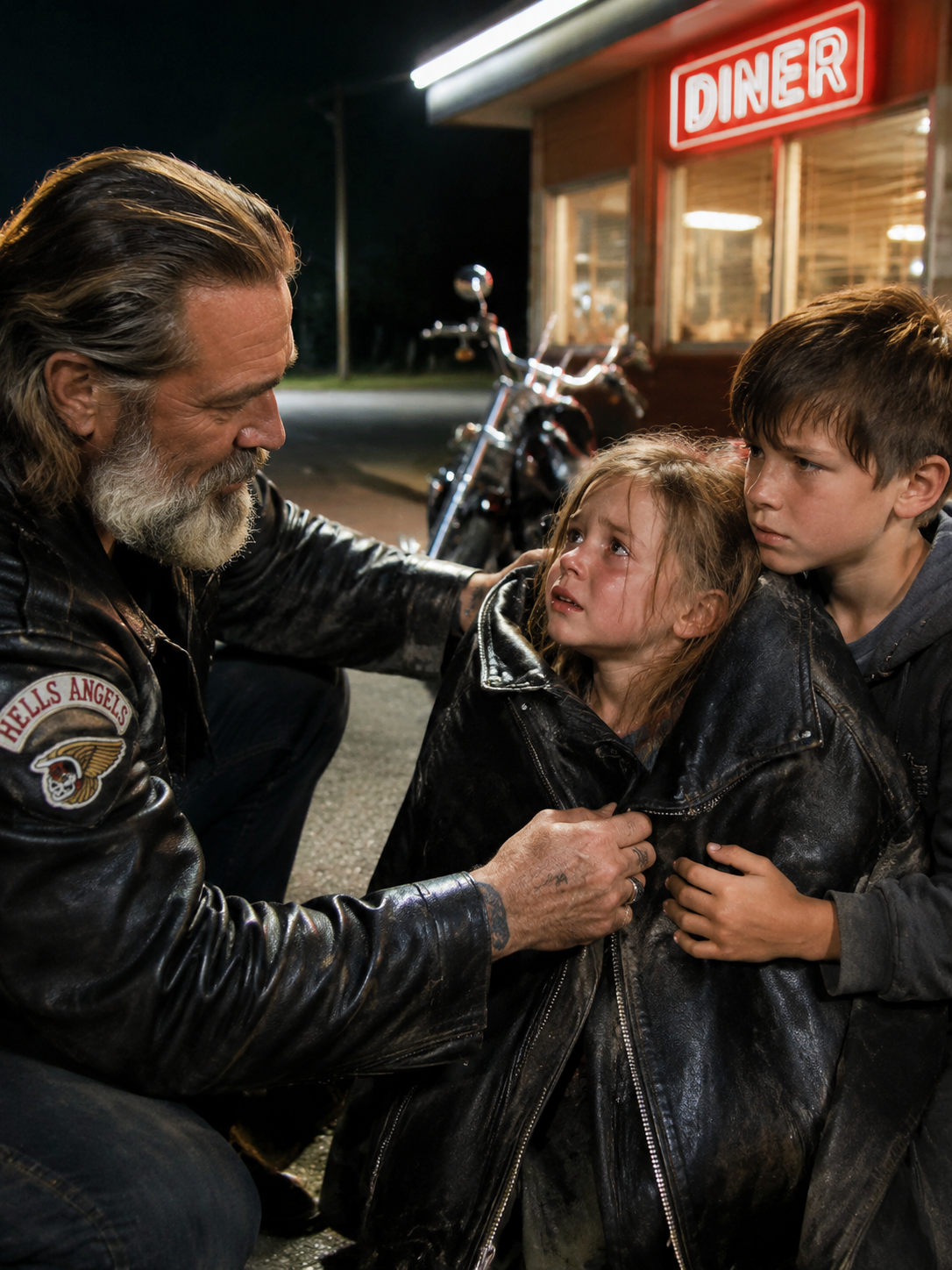
I was a 45-year-old biker riding alone when a diner owner threw two freezing children into the night, so I gave the little girl my leather jacket and her brother my last $20; then I turned my motorcycle around, and the gravel where I had left them was empty—and twenty years later, two adults walked into my garage carrying that jacket…
I was forty-five that winter, a Hell’s Angel with a gray beard, stiff fingers, and a motorcycle that had become my closest companion. I had spent most of the evening riding Route 9, and when a little diner’s neon sign appeared through the dark, I pulled into its gravel lot just to get warm and drink a cup of coffee.
Inside, the place had cracked red booths, a worn counter, and a man named Frank wiping a mug behind it. I had barely wrapped both hands around my coffee when I noticed two children huddled in a booth by the window: a boy who looked about ten and a little girl who couldn’t have been more than four.
The boy had dark hair and a jacket too small for him. His little sister was curled against his side with her eyes closed, and the only thing on their table was a glass of water. Their cheeks were red from the cold, and the boy watched every adult in the room as if he were waiting to be told to leave.
I knew that look. I had been a hungry kid once, and I remembered how carefully you learned not to ask for too much. I called to Frank and asked him to bring the boy hot cocoa and the little girl milk, putting both on my bill.
Frank glanced at the children and lowered his voice. They were street kids, he said; they came in sometimes, and he couldn’t have them hanging around when they weren’t buying anything. Before I could answer, he walked over and told them loudly that they had to go.
The boy stood at once. He said they had only been warming up and would leave, then lifted his sister onto his back when she began to cry. She wrapped her arms around his neck and buried her face against his shoulder. He didn’t argue or plead; he just carried her toward the door.
I paid for my coffee and left extra money on the counter. Frank didn’t apologize. Outside, I found the boy standing in the gravel with his sister still clinging to him, her hands trembling in the cold. I took off my leather jacket and wrapped it around her; it nearly swallowed her whole.
She stopped crying and looked up at me. The boy watched me with guarded eyes, as if kindness were another thing he needed to be careful about. I reached into my pocket and held out my last twenty-dollar bill. I told him there was a store down the road and he should get his sister something warm to eat.
He asked why I was helping them. I didn’t have a grand answer. I told him it was cold, she needed food, and I could help. Then I pointed to my motorcycle and said I would get it turned around, and we could figure out whether there was a shelter or somewhere safe for them to go.
The boy nodded. His sister peeked out from the oversized jacket and gave me a tiny smile. I walked to my bike, put on my helmet, and started the engine. It took less than a minute to turn around and ride back to the spot where I had left them.
They were gone. I stopped and looked across the empty lot, then down both sides of the road. I waited five minutes, then ten, telling myself they had gone to the store and would come back. The store was closed, and when I rode through the nearby streets, I couldn’t find them.
I went back the next morning and asked Frank if he had seen the children. He said he didn’t know where they went, but he thought they sometimes slept behind the grocery store. I found a thin blanket and a paper cup tucked among some crates in the alley, but no children.
For weeks, I searched. I checked shelters, churches, bus stations, train platforms, diners, and stores. I asked other riders to watch for a boy around ten with dark hair and a little girl around four. I put up signs with their descriptions and my phone number, though I didn’t even know their names.
Winter came on hard. The pastor at a small church promised to keep an eye out, and the other bikers did what they could. No one called. After a month or so, the snow got deep, my money ran low, and the signs faded in the wet. I went back to fixing trucks and tractors, but I never stopped wondering whether those two children were safe.
I kept the jacket in the end. It was cracked and worn, with a broken zipper and a grease mark near the collar, but I couldn’t bring myself to throw it away. It sat on my workbench for twenty years, a reminder of two small faces I had never been able to find.
By the time I was sixty-five, my garage had grown into a proper little repair shop on the edge of town. I had never married or had children. I had a lift and a tire machine, but I still lived alone, and the jacket still lay folded at the end of my workbench.
One morning, I was working beneath a pickup when I heard the shop door open. A young man’s voice called my name. I rolled out on my creeper, wiped my hands on my jeans, and saw a broad-shouldered man with dark hair standing beside a young woman in a blue scarf.
The man said I probably wouldn’t remember them because it had been a long time. I looked from his face to hers, and the years seemed to fall away. I remembered the boy’s guarded eyes and the little girl tucked inside my jacket. I told them I remembered.
He introduced himself as Danny and said the woman beside him was his sister, Lily. Then he reached into a paper bag and pulled out a piece of old, dark leather. My hands began to shake before he even held it out. It was my jacket, the same cracked leather, the same broken zipper, the same grease mark near the collar.
Danny said they had kept it all those years and should have brought it back sooner. Lily told me she didn’t remember the cold as clearly as she remembered being warm, and being picked up by a big man who had made her feel safe. I could hardly answer.
Danny apologized for running away that night. I asked why they had run, and he glanced at Lily before he answered. Then he told me something I had never imagined: they had not been orphans at all. They had been in foster care, and the plan was to send him one way and his four-year-old sister another. Part 2…..
IF FACEBOOK BROUGHT YOU HERE, HERE’S THE CONTINUATION YOU’VE BEEN WAITING FOR. ENJOY! 👇
“I was ten,” Danny said. He had heard that the foster home planned to separate us, and I couldn’t make myself hand Lily over to strangers. I took her hand and left. I told people we had no one because I thought that was the only way to keep us together.
He said they had used my twenty dollars for two bus tickets to reach their grandmother. She took them in, raised them, and gave them a home. She had died a few years earlier, but she had known about me; Danny and Lily had told her about the biker who gave them his coat and his last twenty dollars.
“She used to say a man who would give away his coat in freezing weather was worth praying for,” Lily told me. “She prayed for you every night.” I sat on an overturned bucket because my legs had gone weak. For twenty years I had believed I had failed them, and all that time they had been safe.
I asked why they had come now. Danny said Frank had found them about a year after that night. Frank had searched until he located them, apologized to their grandmother, and helped her get a lawyer so she could keep the children. He became their foster father, paid for Danny’s schooling, and taught him how to run a business.
Frank never told me. Lily said he had been ashamed of how he treated them and of how he had looked at me that night. He later bought the old diner again, repaired it, and turned it into a place where children without homes could come for food and shelter. He named it Ray’s Place.
Frank had died recently. The building belonged to Danny and Lily now, but his will included one last request: they were to find the man with the leather jacket and ask him to run the place with them. I looked down at the old jacket in my hands and told them I was only an old biker with a bad back.
“You gave a little girl your coat,” Lily said. “That’s who you are.” I couldn’t think of an answer, so I finally said yes. Lily hugged me, then Danny joined us, and for a moment the three of us stood in my garage holding on to one another.
Then Danny remembered the envelope he had brought. He opened it, read the letter inside, and his face changed. It was from the bank. Frank had borrowed against the diner, fallen behind on the loan, and the bank wanted $35,000 within thirty days or it would take the building.
We went to the diner and sat in a booth by the window. The place was clean and plain, with children’s drawings on the walls, books and board games on a shelf, and twelve children sleeping there every night. Lily told me Frank had stopped taking a salary, put the diner’s income into food, beds, and clothes for the kids, and even sold his truck.
She and Danny had found a dented metal box in Frank’s desk. Inside was a copy of the deed and a handwritten note. Frank admitted he had bought the diner partly to save himself from the guilt of sending two children into the cold, then explained how he had found them and helped their grandmother keep them together.
He had wanted the diner to become a place where no child would be turned away. He had never asked me to forgive him, and he had never told me what he had done. Lily said he couldn’t face me because he believed I had been the better man that night.
I told them I had only been a man with a coat. But the bank letter was still on the table, and twelve children needed the place to stay open. I said we weren’t going to give it up without a fight, though I had no idea yet how we would raise thirty-five thousand dollars.
The next morning we made a list. Danny would look at expenses, Lily would organize people in town, and I would repair the motorcycles I had stored in my garage. We could sell the ones that ran, hold a bake sale, and ask the riders I knew to support a charity ride.
We took the bank letter to the branch and asked the manager for more time. A man named Mr. Hall listened, but he said the loan had already been extended twice. He also told me the board was concerned about my old record and my thin credit history.
I told him I understood the numbers mattered, but I asked what the bank could do. He gave us thirty days and said the property would go into foreclosure if we did not pay. Outside, Lily looked at her notebook and said thirty-five thousand dollars in a month was more than a thousand dollars a day.
I told her we would start with what we had. The next morning, we set up a folding table outside Ray’s Place, put out pies, cookies, cakes, and cider donated by people from town, and hung Danny’s hand-painted sign asking people to help keep the shelter open.
The children wanted to help, too. They stood near the sidewalk telling passersby that the apple pie was the best in town. By the time we packed up, the first donations had come in—not enough to solve the problem, but enough to prove that people were willing to stand beside us.
At the garage, I pulled the covers off three old motorcycles: a Honda, a dirt bike, and a tired Triumph. I cleaned the Honda’s carburetor, changed the oil, put in a battery, and got it running. An older man bought it for five hundred dollars, and I went straight back to work on the others.
By the end of the week, all three bikes had been sold. The coffee can at the diner grew heavier, and the town kept finding small ways to help. Then a restaurant owner named Mr. Grimes came in, looked around at the children, and offered to buy the property so he could tear it down and build a chain restaurant.
I refused without reading his offer. Grimes reminded us that the bank deadline was close and said he expected to be the highest bidder if we lost the building. I told him the answer would still be no. After he left, the children watched me from their table, and I knew we had to find a way to keep our promise.
Part 3 Danny came to the garage that Friday with a notebook full of arrows, numbers, and a rough map of the county roads. He wanted to hold a charity motorcycle rally in eight days. We would charge an entry fee, sell food, and ask riders to bring sponsors and donations.
I looked at the map and then at Danny. He was tired, his shirt was wrinkled, and he looked like he had been running on coffee for days. I told him if he was serious, I was in. We had no time to waste.
Lily called every business she knew. The bakery donated bread, the grocery store promised water and soda, the hardware store offered folding tables and a banner, and the pastor let us use the church lot for overflow parking. I called riders I hadn’t spoken to in years and told them a shelter needed saving.
Most of them said yes before I finished asking. By Tuesday, riders from three counties were calling about the route, and Danny’s online post was being shared around the area. We repaired and sold more bikes, but the money still wasn’t enough.
On Friday night, Lily and I stood in the empty diner and looked at the tally on the wall. We had raised twenty-one thousand dollars. The bank wanted thirty-five thousand, and the rally was the next morning. Lily said we were close, but neither of us pretended the remaining amount was small.
Saturday arrived gray and cold. The first motorcycles came in singles, then pairs, then long lines that filled the road and overflowed into the church lot. By nine-thirty, bikes stretched as far as I could see, and the kids stood by the entrance holding signs they had painted themselves.
Danny handed me the lead. I put on my helmet, looked back at the riders gathered behind me, and raised my hand. The engines rose together, and we led the ride down the road. People had come from all over the county for a diner and twelve children who needed a home.
The last rider returned at four. We were exhausted, the parking lot was a mess, and the children were still smiling as they helped put away tables. Danny carried the cash box inside, Lily opened her notebook, and we counted everything twice.
The entry fees came to $6,400. The donation jars held $12,210. Danny opened his laptop and added the online gifts from forty-two donors, including one person who had sent five hundred dollars with a note that simply said, “Keep going.” The online total was $11,390.
I added the figures on the counter, checked them, and added them again. Thirty thousand dollars. We had raised thirty thousand in one day, but we were still five thousand short of the amount the bank wanted.
Danny laughed and grabbed my shoulders. Lily hugged us both, and I let myself laugh, too. For the first time in weeks, the number on the wall looked like proof that we might make it. We still had twenty-six days, and we decided to keep asking.
We took the thirty thousand dollars, our records, and a petition to the bank. By then, 311 people had signed in support of Ray’s Place. We asked for one more week to raise the last five thousand and showed the manager how the town had come together.
The bank manager, Walter Barrett, studied the papers. He said the community response was impressive, but the bank had to review the borrower as well as the numbers. He had checked my record, my lack of credit history, and the fact that I had been late paying rent on my garage.
Danny told him the money was real and the children were real. I said I knew what my past looked like, but the man sitting there now was trying to keep a safe place open. Walter said the board would not approve an extension with my record on the file, and he could not change that decision.
I stood, thanked him for his time, and walked out. Rain began falling a couple of blocks later. I didn’t put on my helmet or turn back; I just kept walking until I reached my garage, soaked through and ashamed that I had let myself believe we could save the place.
I sat on the old couch with the bank notice under a wrench on the workbench. I thought about the children, especially the little girl with braids who had once asked whether I would stay. I had promised her I would, and now I feared I would be the one who let her down.
I didn’t hear the car arrive. I only heard the garage door roll up, and then Danny and Lily stood in the gray light, wet from the rain. Danny had kept their folder dry under his jacket. Lily came over and sat on the damp concrete in front of me.
Danny said I had walked out on them. I told him the bank had made up its mind and that a man with my record would always look like trouble to people who read files. Lily reminded me that she remembered a man who had given away his coat and his last twenty dollars without asking for anything back.
Danny said that twenty dollars had bought two bus tickets to their grandmother and changed their lives. Lily said they didn’t need the bank to say yes that day; they needed me not to give up that day. They had four days before the board meeting, and they were not leaving without me.
I looked at the two of them, soaked and tired and still standing beside me. I folded the bank notice and put it under the wrench. Then I told them to bring me the notebook. We had work to do.
Part 4 I had not slept much by dawn. I sat at the workbench with a pencil and a pad, writing down every possible way to reach people before Monday. Most ideas were no good, but a few gave us somewhere to start.
Danny arrived with coffee, and Lily came in with donuts. We made lists of every business, family, and rider we knew. Lily took the bakery and the shops on Main Street; Danny went to the school neighborhood and the parents who knew the shelter; I called the riders and mechanics who had stood with me before.
Lily also wanted the story told publicly. She knew a reporter named Dana at Channel 7, who had done a story on the shelter the year before. I didn’t like the idea of talking about my past on television, but I agreed because the children needed people to understand what was at stake.
By noon, the garage was full. Riders leaned against their bikes, the mechanic brought his toolbox, and Mrs. Alvarez from the bakery arrived with trays of bread. The pastor came, too. Lily set up a table with a petition asking people to keep Ray’s Place open.
The first names went on the page in careful handwriting. Marcus, one of the children, asked if he could sign in crayon. I told him crayon was fine. When Dana arrived with a cameraman, she found neighbors signing, children eating bread, and people looking for ways to help.
She asked me why the shelter mattered. At first I answered slowly, because I had never been comfortable talking about myself. Then I looked at the children and told her about the freezing night twenty years earlier, the jacket, the twenty dollars, and the two children who had disappeared.
I told her about Frank, too: how he had carried his guilt until he did something useful with it, and how the bank was now judging me by an old record instead of looking at the place we were trying to save. Dana listened and took notes. She said the story was about a whole town choosing to care.
That evening we watched her report on the little television in my garage. The camera showed the diner, the children doing homework, and Lily explaining that they were asking for a chance, not a handout. When Dana asked what would happen if the bank took the building, I said the children would have nowhere safe to go.
The phone started ringing before the report was over. A woman who owned a diner in Bakersfield wanted to send a check. The mechanic called, then Mrs. Alvarez, then a man I had never met who said he had once lived in a shelter and wanted to help.
By the next morning, people were coming to the garage with checks, cash, paint, envelopes, and folding tables. A retired teacher offered to write letters. Mr. Ellis, who had declined to sign our petition, came back after his wife watched the report and put his name on the page along with forty dollars.
At two that afternoon, Lily answered a call from the bank. The manager had watched the story and received more calls than he expected. He said policy still mattered, but he wanted to bring our case to the board with a fuller picture. He did not promise approval; he agreed to hear us on Monday.
We kept working. The petition grew, and by Monday morning we had 311 names gathered from neighbors, business owners, parents, and people who used the shelter. I put on the clean shirt Lily had ironed, Danny wore a tie that looked borrowed, and Lily carried the folders.
The meeting room had a long table and eight chairs. Walter Barrett sat at the head with the loan file in front of him. He said he would listen, but he would not promise anything. I told him my record was old, and that what I had now was a place where children could do homework instead of standing on a corner.
Lily laid out photographs of the children eating, reading, and laughing at the diner. A social worker who had handled Danny and Lily’s case years earlier explained what the shelter meant to children who needed stability. Mrs. Alvarez spoke about her son, who had once been angry and withdrawn but now read books to the younger children and wanted to become a teacher.
I stood and told the board what I knew. A ten-year-old boy had once lied because he was afraid his little sister would be taken away from him. A man who had treated them cruelly had spent years trying to make it right. A stranger had given away twenty dollars, and that small act had helped change two lives.
Barrett listened, looked through the photographs and signatures, and then said the bank’s policy told him to deny the extension. He paused. Then he said he was going to recommend approval anyway. He signed a one-week extension, giving us time to raise the last amount, and said he would file paperwork for a community grant we might qualify for.
I shook his hand. He told me he was giving us a chance, the same chance I had given two children on a cold night. We walked outside into the bright morning, and Danny put his arms around me while Lily laughed through her tears. We had a week, and for the first time it felt possible.
Two days later, Mr. Grimes drove his clean black car to the garage. I expected another offer for the property, but he had no folder and no practiced smile. He said he had watched the rally and the news report, and that seeing the town gather around the shelter had made him feel small.
He said he had spent years looking at profit and loss and had mistaken the value of Ray’s Place for the value of its land. He had heard we were still five thousand dollars short. Then he held out a plain white envelope and told me it contained a $5,000 gift, not a loan or an investment, with no conditions and no drive-through window.
I asked why he was doing it after wanting the property so badly. Grimes said he had been wrong about the place and wrong about me. He had looked at my long hair and leather vest and seen a risk, not the man who had given a little girl his coat. He asked me to let him do one thing right.
I took the envelope. Lily and Danny came out and heard what he had done. They thanked him, and I shook his hand. I told him he hadn’t owed us the money; he had chosen to help, and that was different. When he drove away, we knew we finally had the five thousand dollars between us and the deadline.
Final We paid what was due and kept the doors open. A few days later, neighbors filled the parking lot with covered dishes and folding chairs. Mrs. Alvarez set yellow flowers beside the register because, she said, yellow meant welcome.
Danny carried chairs while Lily moved between the kitchen and the children. The waitress who had been there the night Frank sent the children out came, too. She remembered me giving Danny the twenty dollars and wanted to witness the good night after the bad one.
Later, Danny and I stood by the fence with coffee. He said he still thought about the bus tickets. I told him the money mattered less than how he watched his sister and never let go of her hand. Maybe, I said, he had helped me as much as I had helped him.
Lily joined us as the party wound down. The diner windows glowed behind us, and children slept in a corner on a pile of coats. I realized I had spent years telling myself I didn’t need anybody, but I had finally found a place where I belonged.
People asked me to say a few words. I thanked the neighbors, pastor, riders, businesses, and everyone who had brought food, chairs, flowers, money, or prayers. Then I thanked the children, because they were the reason we had fought so hard.
I told them that twenty years earlier I thought I was giving something away when I handed a boy my last twenty dollars. I had been wrong. Danny had shown me how to care about someone more than yourself, and Lily had reminded me that a small kindness can stay with a person for a lifetime.
I spoke about Frank, too. He had made a terrible mistake, then spent the rest of his life trying to make it right. We could not undo every wrong thing we had done, I said, but we could choose what to do next. Ray’s Place belonged to everyone who had helped keep its doors open, and to every child who needed safety.
The crowd applauded, and Lily cried while Danny whistled from the fence. I stood there and let them. For the first time in twenty years, I did not feel like a man standing outside everyone else’s life.
The reopening came on a crisp morning. I wore my cleanest black shirt, Danny held the scissors, and Lily carried hot cocoa. The pastor, Mrs. Alvarez, the waitress, the mechanic, bikers, parents, and children gathered in the lot.
I told Danny and Lily to hold the ribbon with me. I didn’t want to cut it alone. I said the place had once been a diner and then a shelter, and now it would be both: hot food, warm beds, and a door that would not be closed on a child who needed help.
We counted down, and I cut the ribbon. The bell jingled when Danny opened the door, and warm air smelling of bread, soap, and fresh paint rolled out. People came in with flowers, cookies, toolboxes, and stories; the children played checkers while the adults ate and talked.
The work did not end with the ribbon. There were dishes to wash, tables to fix, meals to prepare, and children who needed steady adults. I liked having a reason to get up and people expecting me.
Just before supper one evening, a woman named Denise knocked at the door with her six-year-old son, Marcus. Her coat was thin, and the boy carried a plastic bag with a few clothes inside. She asked quietly whether this was the place that took people in.
I stepped aside and told her to come in out of the cold. Denise explained that her car had broken down, she had lost her job, and she could no longer stay with her cousin. Lily brought soup for both of them, and Marcus ate as if he wasn’t sure the food would last.
We found Denise and Marcus a room with a blue blanket on the bed. Denise offered to cook and clean because she had worked in a kitchen before. I told her she could help the next day, but that night she and her boy could rest.
After supper, Danny read to the children while Lily helped them get ready for bed. I stopped at each room to say good night. Marcus, tucked beneath the blue blanket, asked if I would be there tomorrow. I promised I would be there tomorrow and the day after, too.
He nodded and said he liked it there. I told him I did, too. In the hallway, Lily was waiting with two cups of tea. She said she had heard his question and asked what I had told him. I said I had told him the truth.
The next morning, Danny and Lily helped me hang Frank’s small black-and-white photograph behind the counter. He stood in front of the old diner with his arms crossed and a half-smile. Lily said he would have complained about the paint; I told her he would have found something to complain about either way.
I told them Frank had never called, though my garage had been in the same place for years. Danny said Frank was ashamed and afraid I would never look at him the same way. I told him I wouldn’t have held it against him. Then Marcus stopped beneath the photograph to ask who the man was.
I crouched beside him and said it was Frank, who had once owned the diner. He had been grumpy, I told him, but he had become family. Marcus nodded as if that made perfect sense, then followed the smell of pancakes into the kitchen.
Later, I took a folded photograph from my wallet. It showed Danny, Lily, and me at the shelter opening, with Frank’s shadow at the edge. I looked at our smiles and whispered, “Thank you, Frank.” Nobody heard me, and that was all right.
That evening, I stood beneath the hand-painted Ray’s Place sign. Danny asked if I planned to stay outside all night. I told him I used to ride past places like this because I thought everyone inside had somebody and I didn’t. Now Marcus followed me around, Denise asked me to check homework, and somebody always needed a sandwich or a ride.
Danny said it sounded terrible. I told him it was the best thing that had happened to me. He reminded me it began when I stopped for two cold children and gave a frightened boy my last twenty dollars. We went inside, where Lily had made a Tuesday cake, and the room was full of noise and light.
After the children were in bed, I took my motorcycle out for a slow ride. The road ahead was empty, but it no longer felt lonely. I thought about Frank’s picture, Danny and Lily, Denise and Marcus, and every child who would come through our door. I had a family, a home, and a reason to be there in the morning.
THE END. I’ve shared the complete story, and I truly hope it touched your heart. If this story moved you, please , like, and share the post. Thank you for reading! ❤️
✓ Lynn R. Adams
I was a 45-year-old biker riding alone when a diner owner threw two freezing children into the night, so I gave the little girl my leather jacket and her brother my last $20; then I turned my motorcyc…