I was a 36-year-old widowed father who had walked away from medicine after losing my wife
IF FACEBOOK BROUGHT YOU HERE, HERE’S THE CONTINUATION YOU’VE BEEN WAITING FOR. ENJOY! 👇 The next morning, Amelia told me Sarah would have been proud. I burned her pancakes because I was thinking about the ICU, and she gave me the patient look her mother used to wear when I forgot breakfast on the stove. I wanted our lives to go back to normal, but I couldn’t stop wondering what had happened to Ava.
Ava woke asking about the man who had donated blood. Three weeks later, after a gradual return to work, she was still trying to understand her recovery. Her assistant Marcus contacted me on her behalf, and I was startled that a CEO with an entire company to run wanted to meet a construction worker from Queens.
I agreed to one meeting in Central Park, with Amelia beside me. Ava arrived in jeans and a sweater rather than the severe business clothes I’d seen in photographs. She thanked me without making a speech, then knelt to speak to Amelia as though the two of them were old friends.
We walked near the Bethesda Fountain and watched the model boats. Ava asked why I had left medicine, and I told her about Sarah’s illness, the failed treatments, and how angry I’d become at a profession I’d once loved. She didn’t argue with me, even though she ran a pharmaceutical company.
Instead, she admitted that being helpless in the hospital had frightened her more than anything in her career. She offered to support careful research into the unusual blood response, without using my name publicly or proceeding without my consent. I told her I needed time, because I didn’t know whether I could survive another promise of a miracle that turned out to be false.
As we left, Amelia said Ava had sad eyes like mine used to. I kept the personal phone number Ava had given me, folding the card into my wallet beside a photograph of Sarah. I hadn’t decided to call, but I found myself checking it whenever I reached for money at the grocery store.
Unknown to me, Ava’s former fiancé, Richard Blackwood, had hired someone to watch her. Their engagement had ended because of his controlling behavior and her determination to run her own life. When his investigator reported that she’d met an unknown man and his daughter, Richard began looking for a way to use that attachment against her.
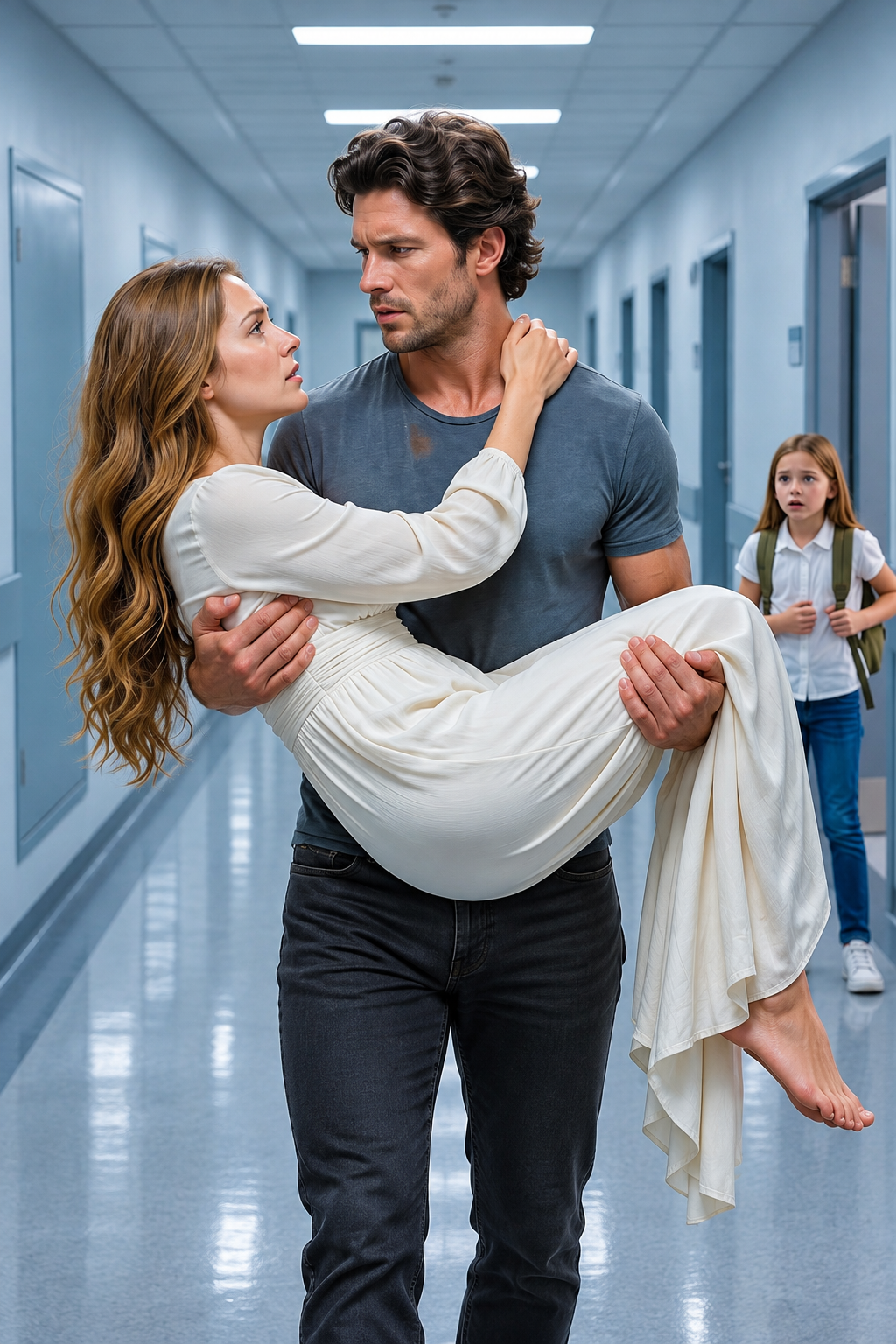
Part 3 A call from Dr. Morgan woke me at two in the morning, three weeks after the park meeting. Ava was back in the ICU with chest pain, breathing trouble, and blood results that resembled her first crisis. Amelia heard me dressing and insisted on coming, so I took her with me rather than leave her alone.
Ava was awake when I reached her bedside. She held out a shaking hand and said she had asked for me because she was frightened the illness had returned. I wanted to tell her she’d be fine, but Sarah had taught me not to promise what I couldn’t know.
Dr. Morgan explained that the team wanted to investigate whether another carefully managed transfusion might help while specialists searched for the cause. I agreed to testing and donation within the medical team’s safety limits. This time the staff collected additional samples and documented the changes, trying to understand the strange proteins they believed they’d detected in my blood.
The early findings suggested damage that did not fit a naturally occurring illness. Dr. Morgan said the possibility of deliberate exposure needed investigation, not guesswork. Ava went very still, and I could see her searching her memory for anyone who might have wanted to hurt her.
Richard appeared at the hospital that night, speaking as if he still had a right to enter Ava’s room. She stiffened at the sight of him. When Dr. Morgan asked him to leave, he began making disturbing remarks about having followed Ava’s health and about consequences for ending their engagement.
He spoke about substances introduced into her daily surroundings, including cosmetics and drinks, in a way that sounded less like concern than a confession. Staff called security and notified the police; no one needed me to act as an investigator. I stayed beside Ava as the team continued treatment and secured the information Richard had volunteered.
Ava’s condition worsened again during the commotion. I offered more blood, desperate to do anything useful, but Dr. Morgan refused to endanger a healthy donor and directed the team to continue treatment within safe limits. I hated hearing no, even though I knew she was right.
I held Ava’s hand while the doctors worked. She told me she had spent the weeks since Central Park thinking about Amelia and me, about how strange it was to feel wanted for herself rather than for what she owned. I told her I had been thinking about her, too, and that the thought of losing her frightened me more than I wanted to admit.
By morning, the treatment had stabilized her again. Richard was taken into custody while investigators examined his statements and the suspected exposures; the case would require evidence and legal proceedings beyond what any of us could settle that night. I sat beside Ava’s bed, exhausted, with Amelia asleep in a chair, and realized that I had stopped thinking of Ava as a stranger long before I was ready to say so.
Part 4 Ava’s recovery took time, and so did the investigation. Doctors continued studying the unusual proteins in my blood, but they could not explain every observation or claim that affection itself was a proven treatment. Ava and I understood the difference between what we hoped was true and what the tests could establish.
Our relationship grew in the ordinary spaces between appointments. She learned Amelia’s favorite stories, listened when I talked about Sarah, and never asked me to pretend my first marriage had not mattered. I began to see how lonely Ava had been inside a company that treated every hour of her life as a business asset.
Three months after the second emergency, we brought a research proposal to an ethics review committee at Columbia Medical Center. Dr. Elizabeth Hartwell chaired the discussion, and a hematology specialist, Dr. Chen, questioned whether the unusual blood findings could be reproduced safely. Ava offered Meridian’s resources, while I insisted that any patients involved be fully informed and independently monitored.
The committee allowed a tightly supervised limited study involving five patients with serious genetic disorders. I felt both hopeful and afraid when I heard the decision. Sarah’s death had taught me how dangerous it was to confuse possibility with certainty, and I didn’t want another family to be misled.
Our first participant, Maria Santos, was thirty-two, a mother of two whose degenerative illness had taken away much of her mobility. Her husband, Carlos, held her hand through the treatment. Over the following weeks, the team recorded improvements that let Maria begin walking again, and I watched her family celebrate every careful step.
Other patients responded differently. The fifth, eight-year-old Rebecca Chen, continued to deteriorate despite repeated treatment attempts. Her parents looked at me with the same desperate hope I had once carried into Sarah’s hospital room, and I told them the truth: we didn’t know why the treatment was failing.
We reassessed Rebecca’s care with her specialists instead of assuming another transfusion would solve everything. Ava and I also spent time reading and talking with her, and Amelia became her friend. When Rebecca’s condition eventually began to improve, the doctors documented it cautiously, without pretending that kindness alone had reversed a genetic disorder.
Seeing Amelia and Rebecca laughing together changed something in me. I had spent years believing my worth depended on whether I could save someone, but my daughter had been helping people simply by showing up. Ava understood that too, and I loved the way she made room for both children to be children.
At Rebecca’s discharge celebration, the little girl asked whether Ava and Amelia would come to her wedding someday. I looked at Ava and said that depended on whether she wanted to be part of our family for good. She smiled, took my hand, and said she couldn’t imagine wanting anything more.
Part 5 We became engaged while the Blood of Hope Foundation expanded its research and patient-support work. The unusual properties of my blood remained difficult to reproduce, and our team kept investigating rather than promising a cure for every disease. Ava used Meridian’s money to build treatment centers and make care more accessible to people who otherwise struggled to afford it.
Richard’s case continued through the justice system. Ava gave her statement, the investigators pursued the evidence, and we tried not to let the proceedings become the center of our lives. There were security worries and pressure from people who wanted control of the research, but our work had oversight and boundaries that neither of us wanted to abandon.
Two years after the first hospital night, we married in Central Park’s Conservatory Garden. Amelia was ten and wore a flower-girl dress; Rebecca joined her, while Maria attended with Carlos and their children. Dr. Morgan stood with Ava, and Dr. Richardson stood with me.
We placed Sarah’s photograph near the ceremony, surrounded by white roses. I wanted Amelia to know that loving Ava didn’t mean putting her mother away. When I made my vows, I promised to build a life that honored both the family I’d lost and the family standing beside me.
Ava took Amelia’s hand along with mine during her vows. She promised to love us both and to use her resources to help families facing frightening diagnoses. Afterward, Amelia asked whether we could finally have cake, and everyone laughed because it was exactly the question a ten-year-old should ask at a wedding.
We spent our honeymoon at a lake house in upstate New York, just the three of us. We fished, read, played board games, and cooked meals without discussing quarterly earnings or test results. It was the first time in years that I could sit quietly without waiting for a phone call to ruin the evening.
Back in New York, the foundation continued growing, and we helped establish a network for people exploring unusual forms of supportive care. We made a point of separating promising research from stories that had not been tested. I wanted families to receive compassion without being asked to give up sound medical treatment.
Final Five years after our wedding, Amelia was fifteen and volunteering as a junior counselor at one of our New York centers. I watched her read to young patients, then help them settle in for an afternoon rest. She had Sarah’s gentle way of noticing who needed someone to sit beside them.
Ava joined me in the hallway and told me Dr. Morgan had heard from the World Health Organization about interest in aspects of our patient-support work. The prospect of reaching more families excited us, but we knew expansion would require careful training and evidence. We had learned not to measure success by the size of a promise.
Then Ava took my hand and told me she was pregnant. Dr. Morgan had confirmed she was eight weeks along, and early testing had raised questions about whether the baby might share some of my unusual blood characteristics. We agreed that those questions could wait; what mattered was that Ava and the baby were doing well.
Amelia already knew and had been waiting impatiently for me to find out. We talked about names that evening, settling on Hope if the baby was a girl and Chance if it was a boy. I kept thinking of Sarah and wishing she could see the remarkable person our daughter had become.
Ten months later, Hope Ava Roar was born. Amelia, now sixteen, held her baby sister with the solemn concentration she’d once given her coloring books. Ava lay back against the pillows, tired and smiling, while I looked from one daughter to the other and tried to take in how much our lives had changed.
Over the years, the foundation grew, and Amelia eventually pursued research of her own. Hope grew up surrounded by people who believed that good science and human kindness belonged together. We continued learning what my blood could and couldn’t do, never forgetting the patients who trusted us with their hopes.
I still remember the night I walked past that ICU with Amelia’s scraped knee freshly bandaged. I went there because I was afraid of losing my daughter, and I left knowing that helping someone else didn’t betray the wife I’d lost. Sarah’s love had never stopped being part of our family; it had simply taught us how to make room for more.
THE END. I’ve shared the complete story, and I truly hope it touched your heart. If this story moved you, please , like, and share the post. Thank you for reading! ❤️
✓ Lynn R. Adams
IF FACEBOOK BROUGHT YOU HERE, HERE’S THE CONTINUATION YOU’VE BEEN WAITING FOR. ENJOY! 👇 The next morning, Amelia told me Sarah would have been proud. I burned her pancakes because I was thinking abou…