I was a 22-year-old courier on a lonely Bakersfield
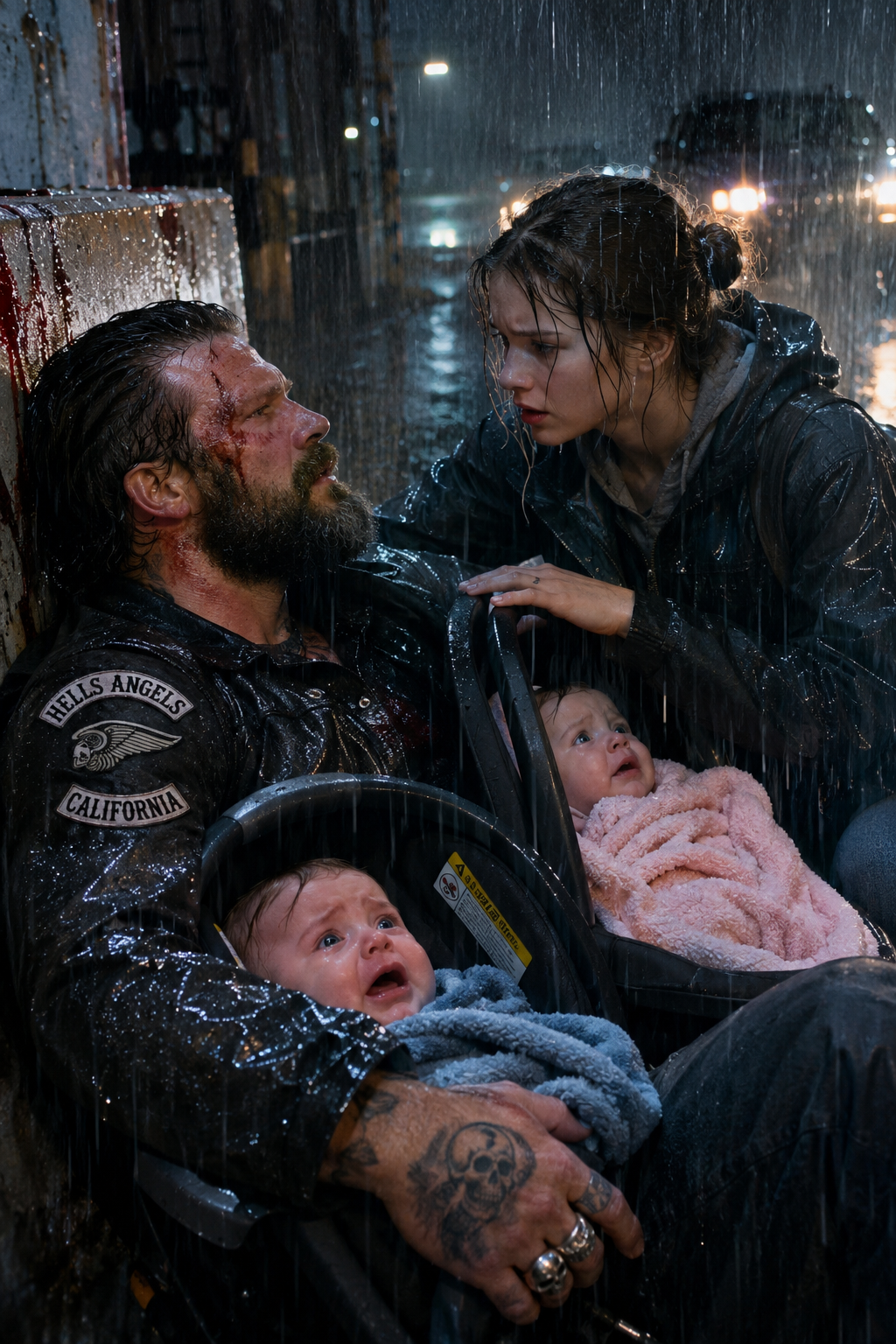
I was a 22-year-old courier on a lonely Bakersfield road when my headlights found a wounded biker shielding two babies from the rain, and although every instinct told me to drive away, I loaded all three into my battered Honda, never imagining that getting them to safety would leave me face-to-face with a stranger who wouldn’t let me walk out…
My name is Emma Jenkins, and until that Tuesday night, my biggest concern was getting through another overnight shift without my car breaking down. I drove a rusty 2012 Honda Civic for a premium courier service, carrying sealed legal documents to offices that needed them before morning. The heater was dead, my navigation app kept losing its mind, and a freak California downpour had turned the roads outside Bakersfield into shiny black ribbons.
At a.m., a wrong turn took me onto an unmarked access road between deserted warehouses. My high beams caught a Harley-Davidson lying on its side, its front wheel twisted and smoke curling from the wreckage. I hit the brakes so hard my Civic slid, and for a second I sat gripping the wheel, trying to decide whether to reverse and call 911 from somewhere safe.
Then I heard a baby cry. I grabbed my flashlight and stepped into the rain, following that thin sound toward a concrete barricade about twenty feet from the motorcycle. A huge man in denim and a leather vest was slumped against it, barely moving, with a Hells Angels patch visible on his back.
There was dark blood on the left side of his vest, and his breathing sounded wrong. Under his arms were two infant carriers, tucked close enough that his leather jacket shielded their blankets from the rain. Inside were a boy and a girl, no older than six months, looking up at me while the little boy cried.
The man lifted a revolver with a shaking hand. “Step back,” he rasped, and I stopped so fast my shoes skidded on the wet pavement. I lowered the flashlight and told him I was only a courier, that I hadn’t come to hurt him, and that he needed help before he lost any more blood.
His eyes kept slipping shut, but he forced out a few words. “They took her. They shot Sarah. They came for the kids.” I asked who he meant, and he tried to answer, but the sound of engines coming down the road swallowed his voice.
Three sets of SUV headlights appeared through the rain, moving much too fast for that empty stretch of road. The biker looked past me and suddenly seemed more frightened for the babies than for himself. “Leave me,” he whispered. “Take Leo and Lily. Please.”
I had spent my childhood going from one foster home to another, learning what it felt like when adults decided you were someone else’s problem. Those two babies had done nothing to deserve what was happening around them. I looked from the oncoming headlights to their father, whose name I still didn’t know, and told him, “Put the gun away. We’re all leaving.”
He gave a weak, disbelieving laugh because he must have weighed at least 250 pounds. Somehow I got one of his arms over my shoulders and hauled him upright while he fought to put weight on his boots. We stumbled to my Honda, and he collapsed across the back seat, breathing through clenched teeth.
I ran back for the two carriers, one in each hand, and lifted them into the back beside him. The SUVs were close enough now that I could see the rain flashing in their beams. I ordered him to keep the babies close, slipped behind the wheel, turned off my headlights, and steered into a muddy gap between two metal warehouses instead of racing down the open road.
I shut off the engine. The car went quiet except for the rain hitting the roof and his painful breaths, and even the twins fell still when he leaned toward them. Through my side mirror, I watched three black SUVs rush past our hiding place and brake beside the wrecked Harley.
Four men in tactical gear got out, followed by a tall man in a dark coat with a badge hanging from his neck. The biker spoke so softly I almost missed it: “Detective Ray Garrison.” He told me Garrison led a regional anti-gang task force and had been pressuring his motorcycle club for money from its legitimate businesses.
When the club president refused, Garrison apparently stopped being satisfied with threats. The biker said officers had stormed his home about an hour earlier claiming a no-knock warrant; his wife, Sarah, held them off with a shotgun so he could get the twins out. He had escaped on his motorcycle, only to be shot and run off the road.
In the mirror, I watched Garrison inspect the blood near the wreckage and send his men farther down the road. I waited until their taillights disappeared before starting the Civic again. I told the biker we needed an emergency room, but he insisted Garrison had people watching hospitals in the county and would find the children there.
He pulled a small USB drive from inside his vest and told me it held recordings and wire-transfer records documenting the task force’s extortion. He was supposed to deliver it to a federal prosecutor the following morning. “My name’s Mike Donovan,” he added, his voice fading. “Get us to Oildale. Chester Avenue, behind the junkyard. Ask for Silas.”
Silas, Mike said, was a club mechanic who had served as a medic in Fallujah. That was not the kind of medical plan I wanted for a man who could barely stay conscious, but I had seen Garrison with my own eyes. I took Highway 99 north, watched every pair of headlights behind us, and kept talking to Mike so he wouldn’t drift away.
He told me Leo had his mother’s temper, while Lily liked the sound of his motorcycle. When I glanced back, her tiny hand was wrapped around one of his thick fingers. “You’re going to stay awake for both of them,” I told him, and he promised he would, though his lips had gone frighteningly pale.
About thirty minutes later, I followed his directions through a junkyard to a big steel garage and sounded the horn in the pattern he gave me: three short blasts, then two long. The door rolled up on a room full of motorcycles and men wearing the same club colors. Several reached toward their waistbands before I jumped out shouting that Mike had been shot.
A gray-bearded mechanic named Silas hurried to the car and ordered the others to carry Mike to a workbench. Another biker carefully took the twins’ carriers after I hesitated to let go. Standing beside my bloodstained Honda in soaked jeans, I watched them work and thought that, at last, the babies and their father had people who knew how to help.
I started toward the open garage door, hoping to slip away before anyone involved me in more trouble. A heavy hand closed around my shoulder, and I turned to find an older biker wearing a president patch. He looked at me, then at Mike on the table, and asked why I thought I could simply leave when I was the only outsider who had seen what happened… Part 2…..
His name was Thomas “Brick” Henderson, and he was the president of Mike’s charter. He didn’t raise his voice, but there was no mistaking how seriously he took a stranger arriving with his wounded sergeant at arms and two infant children. I told him about the wreck, the SUVs, and the man with the badge.
“Ray Garrison?” Brick repeated, as if he needed to make sure he’d heard me right. I nodded and said Mike had told me Garrison’s men had shot Sarah before pursuing him. Anger rippled through the garage, but Brick silenced the others with one lifted hand.
He said Garrison had been hounding their club for a year, demanding money from businesses the members legally owned. Then Brick asked a question that made the whole room pay attention: “Why go after Mike’s family tonight?” I remembered what Mike had put in his vest, reached into my jacket pocket, and held out the little blood-smeared USB drive.
Mike had passed it to me while we drove, afraid he might lose consciousness before reaching help. I explained that he meant to bring its recordings and financial records to a federal prosecutor the next morning. Brick took the drive carefully, his expression changing as he understood why a corrupt detective might be desperate to recover it.
From the workbench, Silas called that Mike’s bullet wound had passed through the shoulder area without hitting a major artery, but the blood loss was severe. He had stopped the bleeding for the moment, yet Mike needed a hospital, blood, and proper surgery. Brick ordered his men to prepare to move him to a safe house in Fresno while they figured out how to get trustworthy medical care.
Then Brick turned back to me and said I should go home. He thanked me for saving Mike and the twins but warned that staying would pull me deeper into whatever came next. I was still deciding whether I could bear to leave those babies when tires screamed outside the garage.
Someone watching the security monitors shouted that three black SUVs had blocked the front gate and two more were pulling into the alley behind us. Every head swung toward me. One of the men accused me of leading Garrison straight to them, and I tried to explain that I’d driven without lights and used back roads.
Brick stared at my Honda and then at the infant carriers, which had been placed safely near the work area. He walked to Leo’s seat, reached beneath its plastic base, and pulled off a tiny magnetic GPS tracker. For a moment nobody said anything; then he crushed it beneath his boot.
Garrison hadn’t followed my car. Someone had planted a tracker on a baby’s carrier before Mike fled his home. I felt sick thinking about how carefully I’d hidden us in that warehouse alley, believing the danger was behind us, while the danger had been traveling with us the whole time.
Outside, a voice boomed through a megaphone, telling Brick to send Mike, the children, and me outside. Mike was still on the table, and Silas was leaning over him. Brick ordered the men to keep the doors closed and told a broad-shouldered biker named Dutch to take me and the twins into the garage’s recessed grease pit.
Dutch carried the carriers down while I hurried after him. I crouched beside the babies, one hand resting on each seat, and heard the front of the building shudder under a violent impact. Then gunfire erupted overhead, so loud that the twins’ cries nearly disappeared inside it.
Dust sifted into the trench. Dutch stayed between us and the opening, watching the steps and listening to the fight above. My first impulse was to curl around the children and pray, but I couldn’t stop thinking about the drive in Brick’s pocket and the reason these men had come for it.
“If Garrison takes that evidence, he gets away with everything,” I shouted to Dutch. He told me to stay down. I looked at Leo and Lily, both bundled in their carriers, and realized that hiding them for another few minutes wouldn’t protect them if Garrison could erase every trace of what he’d done.
Part 3 I climbed the steps before Dutch could stop me, keeping as low as I could as I crossed the workshop floor. Men crouched behind machinery while the tactical team pushed through the damaged entrance. I spotted Brick sheltering behind a heavy lathe and crawled to his side.
“Give me the drive,” I said. He stared at me as though the gunfire had knocked all sense out of my head, and ordered me back into the pit. I told him my company scanner had a satellite-connected hotspot and that I might be able to send the evidence before anyone got hold of it.
Brick said Silas had shut down the wired connections and pointed out that we could barely move across the garage. I told him I only needed a working computer and a few minutes. After a hard look, he handed me the USB drive and directed me toward Silas’s diagnostic laptop on a cart behind a blue Mustang.
I made it to the car on my hands and knees and pulled the laptop toward me. I plugged in the drive, switched on my courier scanner’s hotspot, and waited through several agonizing seconds for a connection. When the files appeared, there were folders of recordings and financial records, exactly as Mike had described.
I’d spent years delivering sensitive packages to media offices and federal buildings, and I knew contacts I could use without asking anyone at the garage for help. I attached the files to an outgoing message addressed to federal investigators and news organizations, including the FBI, CNN, and the Los Angeles Times. Then I hit send and watched the progress indicator begin to climb.
I could hear movement on the other side of the Mustang, but I kept my eyes on the screen. The transfer crept toward completion. Just before it finished, the car door crashed into my shoulder and knocked me away from the laptop.
Ray Garrison stood above me with a rifle. His coat was gone, and his face was streaked with sweat and grime, but I recognized him at once from the road. “You should’ve kept driving,” he said, then glanced at the fallen laptop and lifted his boot to destroy it.
The progress indicator reached its end. The message was sent, and I told him so before I had time to think about whether speaking would get me killed. He turned back toward me, furious, with the rifle still in his hands.
Then sirens began to sound outside, one after another until they overwhelmed the noise in the garage. Red and blue lights flashed through the broken entrance. Garrison hesitated, saw that the building was being surrounded by other officers, and finally lowered his rifle and raised his hands.
I couldn’t tell from the floor who had received the files first or how the arriving officers had been alerted so quickly. I knew only that the evidence was no longer locked inside one tiny drive, and Garrison was no longer the only man with a badge at the scene. Dutch found me near the Mustang and helped me back to the twins.
Final By the time the fighting ended, the garage looked like a storm had passed through it. Silas was still focused on Mike, and the first thing I asked was whether he was breathing. He was, but he needed the emergency care we’d been trying to reach from the moment I found him.
The files Mike had collected brought outside scrutiny to Garrison and the task force he controlled. Federal investigators had recordings, transfer records, and witnesses to what happened to Mike’s family and at the garage. The case did not end that night, and the people accused still had to face trial, but Garrison no longer had the power to make every witness disappear.
I learned that Sarah had died during the attack on their home. There was nothing fair about that, and no amount of evidence could give Leo and Lily their mother back. Mike survived his injuries, though recovery was slow, and his children’s future became the reason he kept pushing through it.
Six months later, I was sitting on the porch swing of a quiet suburban home in Fresno with coffee in my hand and a criminal justice textbook open on my lap. Garrison and members of his task force were in federal custody awaiting trial, facing charges serious enough to carry the possibility of life sentences. The records on Mike’s USB drive had helped dismantle the corruption he’d risked his life to expose.
I wasn’t driving overnight courier routes anymore. When Brick learned that I’d grown up in foster care and had no family waiting for me, the club helped me settle into a secure apartment in Fresno and paid my college tuition. I still found their rough edges intimidating sometimes, but they followed through on their promises and made room for me in their lives.
The screen door opened, and Mike stepped onto the porch, walking with a slight limp and carrying a baby in each arm. The twins were laughing, completely unconcerned with the terrible night that had changed the people around them. Mike sat beside me, shifted Lily carefully into my arms, and joked that both children were getting too heavy.
He watched me settle her against my sweater before speaking again. “We owe you everything, Emma,” he said. “You delivered my kids a future.” I looked at Leo resting against his father’s chest, then at Lily holding my finger just as she had held Mike’s in the car.
For most of my life, I had believed family was something other people were born into. That night on the road, I’d only known that two babies needed someone to stop. I smiled at Mike and said, “I think we all delivered each other.”
THE END. I’ve shared the complete story, and I truly hope it touched your heart. If this story moved you, please , like, and share the post. Thank you for reading! ❤️
✓ Lynn R. Adams
I was a 22-year-old courier on a lonely Bakersfield road when my headlights found a wounded biker shielding two babies from the rain, and although every instinct told me to drive away, I loaded all th…