I was 71 and had spent 42 years caring for strangers, but when I helped an injured biker off a rain-soaked Georgia street and into my house, I never expected the first neighbor at my door the next morning to come carrying a casserole, looking past my shoulder, and warning me about the man whose life I had tried to protect…
I was 71 and had spent 42 years caring for strangers, but when I helped an injured biker off a rain-soaked Georgia street and into my house, I never expected the first neighbor at my door the next morning to come carrying a casserole, looking past my shoulder, and warning me about the man whose life I had tried to protect…
By seventy-one, I had gotten used to my house being quiet. My name is Eleanor Marsh, and I live in a white clapboard place at the end of Pickett Street in Harlow, Georgia, where the azaleas bloom before spring has quite made up its mind to stay. I used to think I’d miss the noise when I retired, but some days I missed being needed more.
I’d worked at Harlow Regional Medical Center for forty-two years, most of them in labor and delivery, before retiring three years earlier. I knew how to steady a frightened mother, how to recognize when something was wrong, and how to keep my hands working even when my heart was pounding. What I hadn’t learned was how to make a life feel full after the work ended.
My sister Ruth had died four years before, and the boxes from her things still occupied my second bedroom. I kept one placemat at the kitchen table and sometimes let my chamomile tea go cold while I read beside the front window. On Tuesdays I helped adults learn to read at the public library, and on Sundays I went to First Methodist because I liked the singing and the familiar faces.
I wasn’t miserable, and I wouldn’t have appreciated somebody saying I was. I brought food when neighbors were sick, tended my little garden, and walked out to the mailbox to admire the flowers. Still, people who had once stopped me in grocery aisles to tell me about babies I’d helped deliver now often walked right by without knowing me.
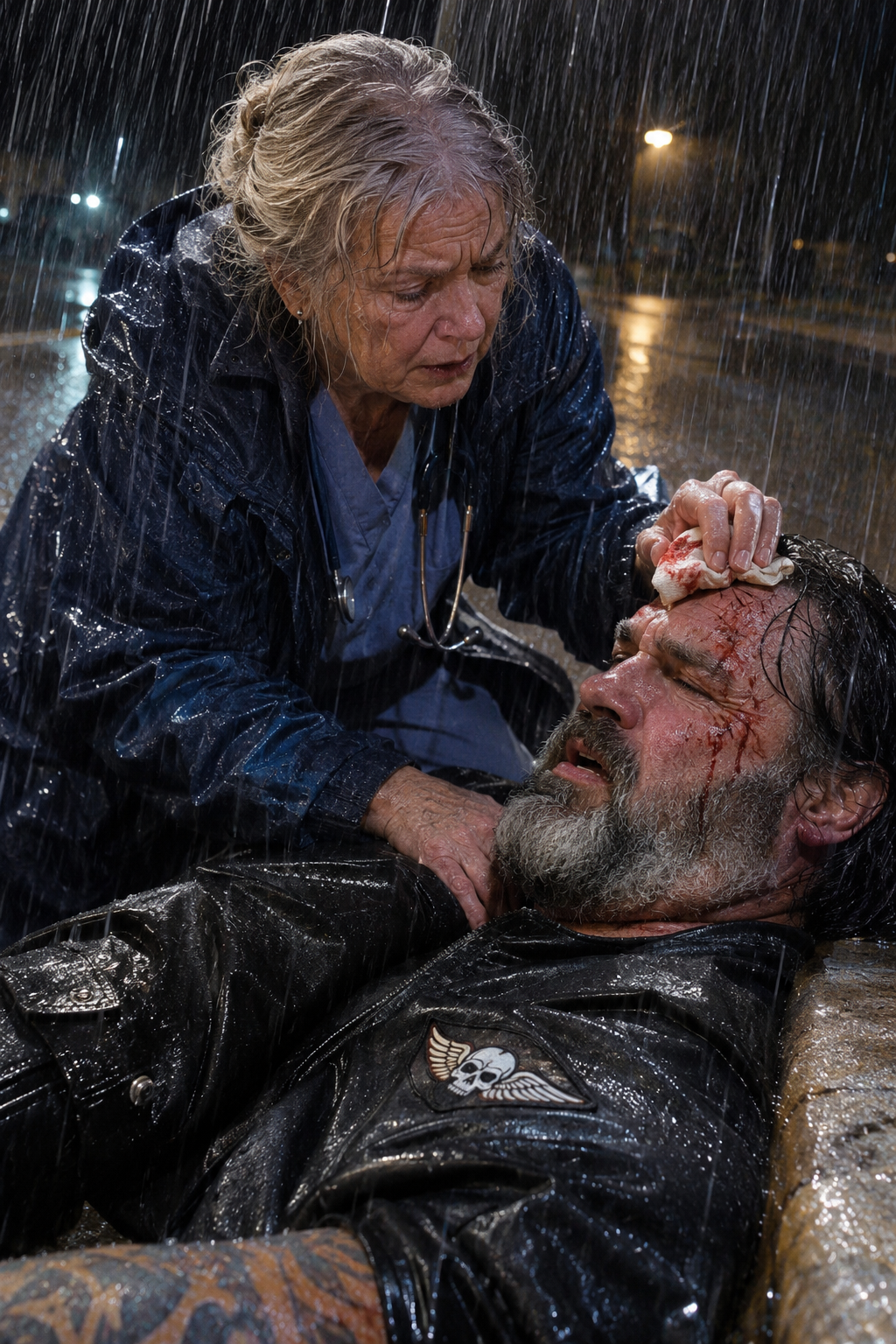
On April 9, rain started falling around nine that evening, hard enough to blur the houses across the road. I was in my armchair with a book when I heard a motorcycle engine sputter and strain. Through the glass I saw a headlight swinging across the wet street, followed by a crash and a silence I recognized from too many hospital nights.
I left my book open and hurried outside without an umbrella. A motorcycle lay on its side under a streetlight, its rear wheel still turning, and a man was crumpled against the curb farther down the road. Two cars slowed near him, and I thought one of them would stop, but both continued on.
I was frightened when I stepped into that street. The rain was cold, the pavement was slick, and at my age I knew better than to pretend a fall couldn’t hurt me. But a person was lying there, and I’d spent my adult life answering that particular kind of need.
He was a broad-shouldered man with a thick dark beard streaked with gray, tattoos on his arms, jeans, boots, and a torn leather jacket. A patch on the back identified the Iron Saints motorcycle club. I noticed it, just as I noticed that he wasn’t wearing a helmet, but neither fact told me whether he was breathing.
He was breathing, though shallowly, and I found a fast pulse at his neck. There was a cut above his left ear, and his left arm was swollen and bent at an angle I didn’t like. When he opened his eyes, I told him, “I’m Eleanor. I’m a nurse. Don’t try to move. Can you feel your feet?”
He stared through the rain for a second, then whispered, “Yeah. I can feel them.” I told him that was good, though I was worried about his head as much as his arm. I had rushed out without my phone, so I said I needed to go inside and call an ambulance.
“Don’t call,” he said, gripping my wrist with his good hand just long enough to make me listen. “Please. No hospitals.” I couldn’t know why he was afraid of going, and I wasn’t about to guess his reasons from the jacket he wore. I told him plainly that a head injury and a possible fracture needed urgent medical care.
He begged me to let him get through the night and said he had someone he could call in the morning. I did not think that was a good plan, and I said so, but he remained conscious and insisted. The rain was soaking both of us, and I couldn’t safely leave him lying at the curb while we argued.
With his uninjured arm across my shoulders, we managed to get him upright. It took several difficult minutes to cross the yard and make it up my porch steps, and by the time he lowered himself onto my couch, my knees were aching. Water dripped from his jacket onto cushions Ruth had once helped me choose.
“What’s your name?” I asked. “Vincent Calloway,” he answered, looking around my living room as if he couldn’t quite understand how he’d gotten there. I brought towels from the hall closet, gave him one to press against his head, and fetched the medical supplies I still kept after retirement.
I checked what I could, used gauze and temporary strips on the cut, and helped him remove his jacket without moving his injured arm more than necessary. His forearm appeared fractured, so I supported and immobilized it as carefully as I could. I told him again that what I was doing was no substitute for a hospital examination, stitches, or an X-ray.
“I know,” he said quietly. His ribs hurt too, and I was concerned about what I couldn’t see, especially with the head injury. We agreed I would watch him closely and seek emergency help if he worsened; I still urged him to be examined that night, though he refused.
After midnight, I asked when he’d last eaten. “Early this morning,” he said, sounding surprised by the question. I warmed up chicken soup, made toast, and set a glass of water beside him, then sat in my armchair while he ate with his good hand.
“You don’t know who I am,” he said after a while. I answered, “You’re Vincent Calloway, and you’ve had a motorcycle accident on my street.” He looked toward the jacket draped over my chair and said that in Harlow, some people would have driven on after seeing that patch.
I thought of those two cars and couldn’t tell him he was wrong. I’d lived in this town long enough to know the stories people told about motorcycle clubs, and I knew I had absorbed some of those fears myself. But no one had ever taught me to decide whether a patient deserved care by reading the back of his coat.
I stayed awake with a blanket over my knees and checked on him through the night. I watched his breathing and his alertness, worried that the injury might change before help came. When morning arrived, Vincent called a fellow rider named Tom Braddock, who came in a truck with a trailer hitch to collect him and arrange the medical attention he needed.
By ten-fifteen that Tuesday morning, my neighbor Patricia Holden stood on my porch holding a covered King Ranch casserole. Patricia had been my neighbor for twenty-three years, and I’d once helped deliver her daughter in the back of an ambulance. She said she’d seen the commotion and wanted to make sure I was all right, but her eyes kept slipping past me toward the couch.
“Eleanor, I saw his jacket,” she finally said. “There are things people in this town know about that club.” For a moment I couldn’t believe that the first thing she wanted to discuss was his patch instead of whether he’d survived. “Patricia,” I said, “he was bleeding on my street.”
She lowered her eyes, but then added, “I just hope you’re being careful.” I thanked her for the casserole and closed the door gently, even though I wanted very badly to slam it. I’d spent the night worrying about a stranger’s injuries; now I understood that some people in Harlow considered helping him a mistake. Part 2…..
I put Patricia’s casserole in the refrigerator and stood for a moment with my hand on the door. The couch was still damp where Vincent had sat, and a towel waited beside the laundry basket. Those things told me exactly what had happened in my house, whatever the neighbors chose to make of it.
Over the next few days I heard versions of the same warning everywhere. Someone at the library made a careful remark about women living alone, and a man at the hardware store who usually chatted with me suddenly had nothing to say. I hadn’t invited a motorcycle club into town; I’d helped one injured man, but people seemed unwilling to see the difference.
Then Reverend Dale Whitmore came by and sat in my armchair, folding his hands as though he was preparing for an uncomfortable hospital visit. “Nobody is judging you,” he began, and I knew immediately that he wouldn’t have come if nobody were judging me. He spoke about the club’s reputation and what people might think of my safety.
“Reverend, what would you have had me do?” I asked. “Leave him in the rain because of some words on his jacket?” He hesitated, so I told him about the two cars that had slowed and gone on while Vincent lay hurt at the curb.
I wasn’t trying to humiliate a decent man who had come out of concern. I wanted him to picture the street as I’d seen it, with the motorcycle on its side and a human being who might have stopped breathing before anyone came back. He grew quiet, and when he left, he seemed to be thinking rather than preparing another warning.
That evening, I sat at my kitchen table and remembered people from my nursing years who had entered the hospital already braced to be dismissed. I hadn’t been able to change every unfair judgment I saw, but I could take an extra minute, speak respectfully, and refuse to treat someone as less worthy of attention. It was never grand work; most of it happened in rooms nobody outside the hospital would remember.
Vincent phoned on Thursday. His voice was stronger, and I was relieved to hear that he’d received medical treatment: he had a cast for about four weeks, his head had been checked, and his ribs were still painful. He asked whether I was having trouble because of him, and when I told him it was nothing I couldn’t manage, he went quiet.
“I heard some things,” he said. “I’m sorry.” I asked whether he meant the accident or the way my neighbors were behaving, and that earned a small laugh. “Both,” he admitted.
“You didn’t create my neighbors,” I told him. “And you didn’t ask to crash.” He thanked me again, but I changed the subject to his recovery because he still sounded like a man who needed reminding to take care of himself.
We talked a little longer than either of us expected. He’d grown up in Valdosta, and I told him I’d lived in Harlow for forty-six years; he asked about my library work, and I asked about the Iron Saints. He didn’t pretend the club was perfect, and I didn’t ask him to defend every person who’d ever worn its patch.
After the call, I found myself looking at the telephone while I washed my cup. It had been a long time since someone had checked on me simply because they wanted to know how I was. His concern didn’t erase the gossip, but it reminded me that the man I’d met in the rain was more than the stories circulating about him.
Four days later, Patricia’s husband, Jim Holden, came over with advice I hadn’t requested. He said the church deacons had discussed my situation and offered to find somebody who could help me if the company I was keeping became a problem. I thanked him, said I was fine, and closed my door.
For a minute I stood alone in the hallway, feeling the old frustration of being spoken about instead of spoken to. Then I went into the kitchen and made lunch. I knew what I’d seen on April 9, and no committee, rumor, or nervous neighbor was going to convince me that I should have left Vincent in the road.
Part 3 Vincent called again on a Saturday morning in early May while I was pulling weeds behind the house. I peeled off my gardening gloves and sat on the low brick wall I’d built years earlier, pleased to hear him sounding more like himself. He said the Iron Saints had been talking about what I’d done and wanted to come by to thank me properly.
“That’s kind of them,” I said. “How many people are we talking about?” He paused long enough for me to look at the tomato plants, and I began to suspect that his idea of a visit was different from mine.
“Around two thousand,” he said. Then he corrected himself: there were already more than twenty-one hundred riders planning to come. I asked him to repeat it, and he did, carefully, as though the number might sound smaller the second time.
I looked toward my back gate and tried to imagine that many motorcycles on little Pickett Street. Vincent said they were coming from different chapters and regions, and that he wanted me to understand what it would look and sound like. The whole town would notice, he warned.
For once, I didn’t mind the thought of being noticed. I thought about Patricia peering into my living room, Reverend Whitmore choosing his words, and Jim offering to rescue me from my own decisions. “All right,” I told Vincent. “Come Saturday after next.”
He asked if I was certain. I was, although I had no idea where more than two thousand people would fit, and I told him not to expect anything grand from my end of the visit. When we hung up, I went back to the weeds and pulled them until lunchtime.
I didn’t tell the neighborhood what was coming. Partly I value my privacy, and partly I couldn’t imagine how to bring it up at church or in the grocery store without sounding as though I’d made up the whole thing. Instead I went to the library on Tuesday, watered my tomatoes, and let the days go by as they usually did.
On the appointed Saturday in May, I woke at six, made coffee, and listened to the birds through the kitchen window. The weather was clear and warm, with an easy morning light falling across the porch. At nine-thirty I put on the blue dress I wore for special Sundays at church and sat on my porch swing for the first time in months.
A little before ten I heard a low rumble in the distance. It grew steadily until I could feel it through the porch boards, and then the first motorcycles turned onto Pickett Street in pairs. They weren’t racing or revving to frighten anyone; they were moving slowly enough for a neighbor to watch from a front step.
I had tried to picture Vincent’s number, but it was one thing to hear “two thousand” on the phone and another to see the line reach the corner and keep coming. Chrome caught the sun, and riders continued around the bends beyond my view. Doors opened up and down the street as my neighbors came out to see what was happening.
Vincent was near the front, sitting straight on his motorcycle with the cast still visible on his arm. He parked outside my house, got off carefully, and walked up the front path in his boots and leather jacket. When he stopped below the porch steps, I stood and waited for him to speak.
“Eleanor Marsh,” he called, his voice carrying above the engines, “this club would like to say thank you.” I looked past him at more riders than I could count and then across the street, where Patricia stood with her hand near her mouth. I could hardly get the words out when I answered, “You didn’t have to do this.”
“No,” Vincent said. “We didn’t.” And then the applause began, rising from the riders closest to us and spreading down the street until I could hear nothing else. I raised my hand because I didn’t know what else to do with it, and stood in my blue dress while the people I’d been warned about thanked me for treating one of them like a human being.
Final The applause continued for nearly four minutes. I know because I counted, a habit left over from nursing whenever something made me feel unsteady. In all, 2,117 riders had come, and it took about forty minutes for their procession to pass our house.
I stayed on the porch throughout, watching faces beneath helmets and neighbors emerging onto lawns where nobody had wanted to talk about what happened in April. Some looked startled, some curious, and a few were smiling by the time the last motorcycles came through. I spotted wildflowers that three women from the club had quietly placed at my garden gate.
About half an hour into the procession, Patricia crossed the street and stood beside me. Neither of us spoke for a while. Then she said, “Eleanor,” softly, and I took her hand for a moment as we watched the riders go by.
After the last motorcycle turned the corner, the quiet felt almost strange. Vincent stayed behind with a handful of riders, including Tom Braddock, who’d collected him after the crash, and a woman named Darlene Hutchins. I made coffee, and we sat on the porch steps and by the little brick garden wall, balancing cups on our knees.
Tom talked about growing up in another small Georgia town, and I recognized every kind of neighbor he described. Darlene asked how I’d managed forty-two years in nursing, and before I knew it I was telling her about delivery rooms, frightened new mothers, and the moments when the most useful thing you could do was keep your voice steady. It felt good to speak about my work with someone who truly wanted to listen.
Vincent mostly listened, turning his coffee cup between his hands. After a while he told me he knew the attention from Harlow had cost me something, and he was sorry. “Less than leaving you out there would’ve cost you,” I answered.
He said he’d belonged to the Iron Saints for twenty-two years. The club had done things he was proud of and things he wasn’t, he admitted, but the hardest part was walking into places where people had already decided what sort of man he was. “You treated me like a patient,” he said. “You didn’t treat me like a threat.”
“That’s what I knew how to do,” I told him. He considered that and said he wanted to remember this day by stopping for somebody else when they needed help. It was the kind of promise you can’t check up on, but I believed he meant it.
As Darlene gathered the empty cups, she asked whether I’d been scared on the night of the crash. I told her I had been, and that my knees had protested every step back to the porch. “Fear doesn’t get to make every decision,” I said, remembering my first night shift at twenty-three, when a patient had needed CPR and my hands had worked despite how terrified I felt.
Darlene invited me to come talk to the club’s wives group sometime. I surprised myself by saying I’d like that. It wasn’t that I suddenly wanted a different life; I was simply glad someone had offered to make room for me in theirs.
The visitors left around half past noon, and Vincent was the last to walk toward his motorcycle. He turned back and thanked me once more, quietly this time, without a crowd to hear him. “You’ve already said that,” I told him, and he nodded before riding away.
At two, Patricia came over with another casserole and sat at my kitchen table. “I didn’t understand,” she said, looking down into her coffee, and I answered, “I know.” She began telling me about her daughter, the same little girl I’d helped deliver in an ambulance twenty-eight years earlier, now a pediatrician in Atlanta who called home every Sunday.
We talked until late afternoon. Patricia couldn’t undo every unkind word that had passed around Harlow, and I didn’t need her to pretend she could, but she’d crossed the street and stayed to listen. That was a beginning I could accept.
After I walked her to the door, I gathered the wildflowers from my gate and put them in water. The azaleas were finished for the season, and the oak trees along Pickett Street had filled out with leaves. Inside, I made a cup of tea and sat at my kitchen table, where there was still only one placemat.
Nothing about my house had changed, and I still had all the ordinary work of being seventy-one and living alone ahead of me. But I thought of Vincent’s steady eyes, Patricia taking my hand, and more than two thousand strangers showing up simply to say that one quiet act mattered. For the first time in a long while, that kitchen didn’t feel empty.
THE END. I’ve shared the complete story, and I truly hope it touched your heart. If this story moved you, please , like, and share the post. Thank you for reading! ❤️
✓ Lynn R. Adams
I was 71 and had spent 42 years caring for strangers, but when I helped an injured biker off a rain-soaked Georgia street and into my house, I never expected the first neighbor at my door the next mor…