I was 68 when a fire took the diner where my husband had built the counter by hand, and the sheriff blamed old wiring before the smoke had cleared.
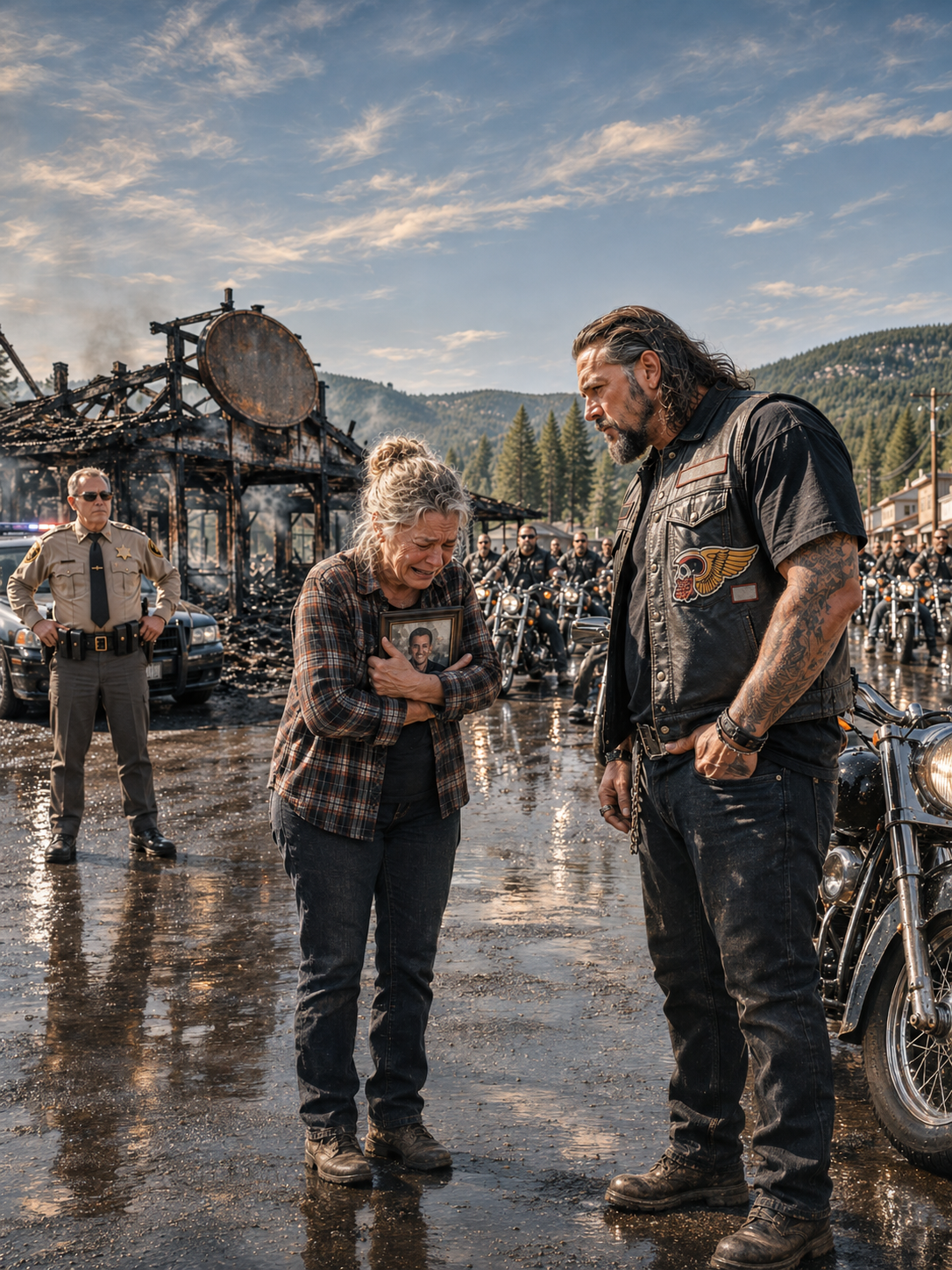
I was 68 when a fire took the diner where my husband had built the counter by hand, and the sheriff blamed old wiring before the smoke had cleared. The mayor offered me $25,000 for the ashes and warned that he would take my land anyway. Then I found a black card in my husband’s old lockbox and remembered a promise made during a mountain storm…
By daylight, the Copper Skillet was a black heap of wet timber, twisted metal, and broken glass. I sat on the tailgate of my rusted 1994 Ford F-150 with a thermal blanket around my shoulders, watching the place where I had worked for 35 years still smoke in the rain.
My husband, Arthur, had built the counter from reclaimed oak with his own hands. Loggers stopped in before their shifts, truckers came through for coffee, and people who had driven too long knew they could count on a slice of cherry pie. It was more than a diner to me; it was the life Arthur and I had made together.
Pine Ridge had struggled since the local lumber mill closed. Mayor Clayton Briggs said a big development would bring jobs back: a corporate truck stop and casino planned near the new highway bypass. The developer needed the access point where my diner stood, and I owned the land they wanted.
Their first offer was $80,000. I turned it down because it was nowhere near the property’s worth. They came back with $100,000, and I still refused. I had no interest in selling the place Arthur built, especially to people who spoke about it as if it were already theirs.
After that, the pressure started. The health inspector, a nervous man who seemed to do whatever the mayor wanted, suddenly found violations in my spotless kitchen and handed me expensive fines. A week later, somebody threw a heavy rock through the diner’s front window in the middle of the night.
I called Sheriff Harlon Dodd. He barely listened and said it was probably teenagers fooling around. He did not take a proper report. I boarded up the window, paid what fines I could, and kept serving breakfast because stopping would have meant letting them push me out.
Then, at two in the morning on a Tuesday, my golden retriever, Buster, woke me with frantic barking. I lived in a small trailer about a hundred yards behind the diner. When I looked outside, the sky over the building was an unnatural orange, and I knew before I reached the lot that something terrible had happened.
The volunteer fire department arrived, but the roof had already begun to cave in. I stood in the freezing rain and watched the neon sign—THE COPPER SKILLET, OPEN 24 HOURS—melt and fall into the flames. By dawn, the fire was out, but the place that held 35 years of my life was gone.
Dodd’s cruiser crunched into the gravel, but he offered no comfort; he kicked a piece of scorched siding and called the fire tragic, probably old wiring. I told him I had smelled gasoline from my porch, and his eyes narrowed as he warned me not to make accusations.
He said his fire investigator, who happened to be the mayor’s brother-in-law, had traced the fire to the deep fryer. Then Dodd suggested the insurance company might wonder whether I had set it myself for the payout. He advised me to accept the mayor’s offer and move somewhere with better luck.
Two days later, the insurance company denied my claim, relying on Dodd’s report of negligence involving the fryer. The developer, speaking through Briggs, lowered the offer to $25,000 for the burned lot. If I refused, they said, the town would use eminent domain for public utility and take the property anyway.
I had no money for a lawyer, no close family left to call, and no reason to believe anyone in town hall would help me. On Thursday afternoon, I picked through the wet ash and broken pieces of my office, looking for anything that had survived. Under a collapsed beam, I found Arthur’s old fireproof steel lockbox.
I pried it open with a crowbar. Inside were our marriage certificate, Arthur’s silver pocket watch, and a small leather address book. Tucked inside its front cover was a soot-stained black business card bearing a red-and-white winged death’s-head insignia. On the back, in thick marker, was one name and a phone number: Dutch.
The sight of that card took me back to 1994. A hard rain had turned the mountain roads slick when a huge man stumbled into the Copper Skillet, soaked through and bleeding from a deep cut in his thigh. His name was William “Dutch” Vanderhorn, president of the Oakland chapter of the Hell’s Angels. He had crashed his Harley on loose gravel and torn his leg on a rusted guard rail.
Most people would have locked the door and called the police. Arthur and I brought him inside. For three days, while the storm kept him from traveling, I cleaned and stitched his wound and changed the dressings every four hours. I fed him stew and kept him hydrated, while Arthur drove out at night, winched Dutch’s damaged motorcycle from the ditch, and hid it under a tarp in our barn.
When the weather cleared, a dozen riders came to collect their president. Before leaving, Dutch handed me the same black card. He said he did not do favors and did not take charity, but that his life and his brothers’ lives were tied to respect. If I ever needed help, he told me, I should call that number—day or night.
Nearly fifteen years had passed. Arthur had been gone for three years, and I had never used the card. Now I sat among the ashes with my hands shaking, not from the cold but from what making that call might mean. Still, I dialed.
The phone rang four times. When a rough voice answered, I said, “I’m looking for Dutch. This is Maryanne Cobb from the Copper Skillet in Pine Ridge.” There was a long silence.
Then he said softly, “The pie lady.” The noise behind him stopped, as if everyone nearby had gone quiet.
He asked about Arthur. I told him Arthur had passed three years earlier, and Dutch said he was sorry. Then he asked why I was calling.
I told him about the offers, the fines, the broken window, the fire, and Dodd’s refusal to investigate. When I said the insurance company had denied my claim and the mayor was offering me $25,000 for the ashes, my voice gave way.
“I don’t have anywhere else to go,” I whispered. Dutch’s answer came without hesitation: “Where are you right now?” I told him I was in my trailer behind the lot.
“Lock the door. Make a pot of coffee. Don’t talk to the police, and don’t sign a damn thing.” Then the line went dead.
That Friday night, Briggs was celebrating at the Rusty Anchor with Sheriff Dodd and Carter Dunn, a local contractor. I later learned Dunn was the man who had thrown the rock through my window and poured gasoline inside my diner while Dodd waited down the road. At the bar, Briggs bragged that the paperwork would be finished Monday and a bulldozer would arrive Tuesday.
At about , the bartender stopped wiping the counter. A low vibration had begun to rattle the bottles on the shelves. Dodd stepped outside, and the mayor followed. A long column of motorcycles was rolling down Pine Ridge’s main street, their engines echoing between the storefronts.
At its head rode Dutch. Five hundred riders from California, Nevada, Washington, and Idaho had answered his call. The motorcycles separated at the intersections and parked in orderly rows around the town square. The streets were blocked, but the men did not shout or start fights.
Dutch entered the Rusty Anchor with six men behind him. Dodd put a hand on his holstered weapon and threatened arrests for disturbing the peace. Dutch did not reach for a weapon; he drew folded papers from his jacket and tossed them onto the pool table. He told Dodd the papers were a lease from me to the club for a private event, and that the motorcycles were legally parked with the meters paid through Monday.
Then Dutch looked past the sheriff toward Briggs and Dunn. “I smell gasoline,” he said, loud enough for the whole bar to hear. “And I don’t think it came from a deep fryer.” For the first time since the fire, I was not the only person in Pine Ridge who knew the official story did not add up. Part 2…..
IF FACEBOOK BROUGHT YOU HERE, HERE’S THE CONTINUATION YOU’VE BEEN WAITING FOR. ENJOY! 👇 By sunrise, the ruins of the Copper Skillet had become the center of an encampment. RVs and supply trucks arrived, and the riders set up generators, floodlights, and chain-link fencing around my trailer. The club members kept to themselves; there was no public drinking, fighting, or noise trouble.
When Briggs sent the health inspector to cite the camp, the man found himself facing thirty bikers holding clipboards and Jonathan Pierce, a civil-rights attorney from San Francisco. Pierce handed him a typed list of federal statutes and warned that harassment could bring a multi-million-dollar lawsuit. The inspector returned to his car without writing a citation.
The mayor and his friends were used to people stepping aside for them. Now, whenever Briggs left his house, riders followed his Cadillac at the speed limit. When Dunn went to his construction yard, a hundred bikers parked across the street and watched in silence. The club did not threaten the town’s ordinary residents.
In fact, Pine Ridge’s businesses began to see money again. The riders bought meals, groceries, and supplies from local shops, tipped generously, and treated the workers politely. People who had first been frightened by the sight of so many motorcycles began to understand that the pressure was aimed at the men who had tried to drive me out.
On Sunday, Harrison Cole, the Seattle developer behind the proposed truck stop and casino, arrived to complete the land transfer. He had expected a quiet widow and a clean title. Instead, he found the streets lined with riders and the mayor’s office under a kind of public watch.
Cole confronted Briggs inside city hall. He said he built truck stops, not in what he called a war zone, and that Briggs had never told him the Hell’s Angels would be there. Briggs tried to reassure him, but Cole was finished. He canceled the deal, ordered his driver to take him back to Seattle, and left the mayor with no development and no easy way to explain what had happened.
Dutch had no intention of letting the failed deal be the end of it. He wanted the people responsible for the fire held accountable, and he knew the local sheriff would not do that. Dunn, meanwhile, was finding it harder to live with the knowledge that the club knew he was involved.
After four days of finding winged death’s-head stickers on his truck and receiving silent calls at three in the morning, Dunn’s nerve finally broke. Late one Tuesday night, he packed a suitcase into his Chevy Silverado and took the old logging roads, hoping to get out of Pine Ridge without passing the motorcycles at the highway exits.
Part 3 About ten miles outside town, a logging truck pulled across the narrow dirt road and blocked Dunn’s way. Before he could back up, headlights came on in the woods behind him, and motorcycles closed the remaining space. Dutch walked to the driver’s window. He carried no weapon and did not raise his voice.
“Where are you going in such a hurry, Carter?” he asked. Dunn gripped the steering wheel and said he knew nothing, then blamed Briggs. Dutch took a small silver digital recorder from his pocket, switched it on, and told him to start at the beginning.
For the next twenty minutes, Dunn confessed. He admitted throwing the rock through my diner’s window, paying off the health inspector, and pouring three gallons of unleaded gasoline across my kitchen floor. He also said Dodd had waited in his cruiser down the road as a lookout. Dunn told Dutch where he had buried the melted gas can behind his tool shed.
The riders did not hit him or damage his truck. They kept the recording, moved the logging truck, and told Dunn to drive on and never return. Dutch then took the recording and a map of Dunn’s property directly to State Attorney General Richard Hammond, bypassing the local department that had ignored my calls.
By Thursday afternoon, state police had arrived in Pine Ridge. Officers went to the mayor’s office and the sheriff’s department at the same time. Briggs was led out of city hall in handcuffs, while Dodd was stripped of his badge and weapon and escorted from his own precinct.
Hundreds of riders stood along the sidewalk as Dodd was put into a state cruiser. They did not cheer or move toward him. Bones Miller gave him a slow salute, and the cruiser pulled away. The town’s officials were finally facing outside scrutiny, but I was still living in my trailer beside a pile of burned rubble.
Final I thought the club would leave once the arrests had been made. Instead, the members put away their leather cuts and changed into heavy canvas work jackets. They brought in excavators, dump trucks, and pallets of lumber, then turned the lot into an organized construction site.
For three weeks, they worked long days. Welders from the Oakland chapter built a new steel frame, electricians from Seattle ran the wiring, and carpenters from Nevada made a broad mahogany counter to replace the oak one Arthur had built. I watched from my porch, hardly believing that the same men who had arrived on motorcycles were now measuring, lifting, and building beside my home.
When I tried to cook for them, they gently sent me back to my chair and had their own prospects handle the outdoor grills. One afternoon, Dutch wiped the sweat from his forehead and told me, “You did your time cooking, Maryanne. You just sit back and watch the show.” I had spent weeks feeling that everything had been taken from me; now I was being asked to let people help.
Exactly one month after the fire, the barricades came down. The debris was gone, and a new diner stood in its place, twice the size of the old one, with stainless-steel appliances, wide windows, and a fresh gravel parking lot. Above the door, the neon sign lit up again: THE COPPER SKILLET.
A solid iron plaque had been bolted into the brick beneath it. It read, “Protected by the Hell’s Angels Motorcycle Club by order of Dutch.” The grand reopening brought the whole town out. Neighbors arrived with pies, casseroles, and kind words, and I stood behind the new counter pouring coffee for the people who had helped me get my life back.
Dutch finished a slice of cherry pie and left a crisp hundred-dollar bill on the counter. When I reached for his change, he refused it, leaned across the counter, and kissed my cheek. “Dad paid, Maryanne,” he said softly. I squeezed his big, calloused hand and told him, “You gave me a miracle.”
Dutch smiled and lowered his sunglasses. “No,” he said. “We just brought a little hell to the people who deserved it.”
Soon the engines of five hundred motorcycles started up, shaking the new windows. I walked onto the porch and watched the riders head back toward the mountains, leaving the diner standing and Pine Ridge changed.
I had called because I was out of options. What came back to me was not a replacement for Arthur, or for the years that had burned away, but a reminder that kindness can leave a mark long after the person who received it has ridden out of sight. The Copper Skillet was open again, and no one would ever make me feel that I had to surrender it just to be left alone.
THE END. I’ve shared the complete story, and I truly hope it touched your heart. If this story moved you, please , like, and share the post. Thank you for reading! ❤️
✓ Lynn R. Adams
I was 68 when a fire took the diner where my husband had built the counter by hand, and the sheriff blamed old wiring before the smoke had cleared. The mayor offered me $25,000 for the ashes and warne…