I was 24, unemployed………
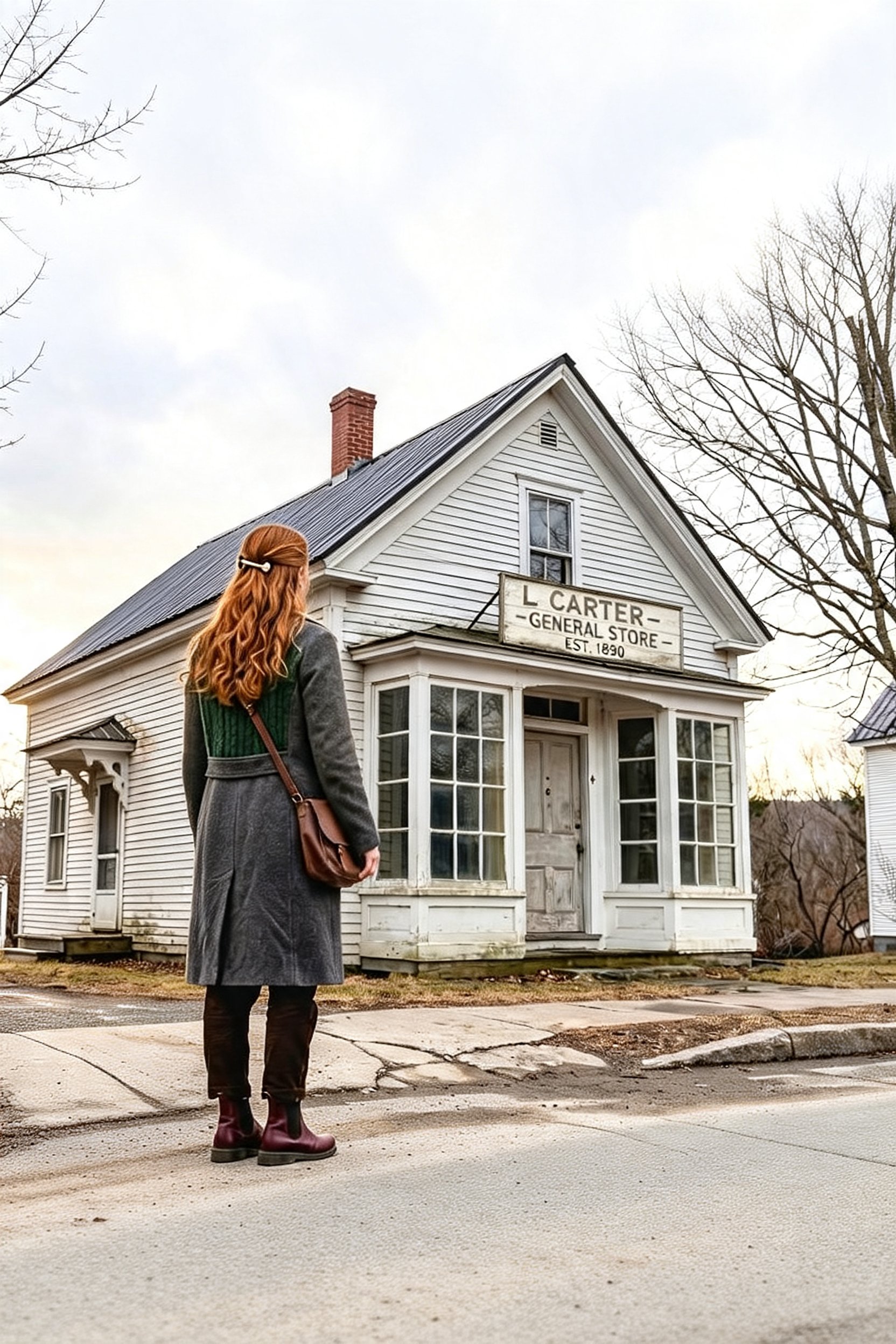
I was 24, unemployed, and nearly out of money when I found an old Vermont apothecary listed for one dollar, but the county clerk’s reaction when I asked to buy it made me wonder what I was walking into….
The hospice where I worked closed on a Friday afternoon in March 2024. Eight of us had spent years caring for people in the remote villages of Vermont’s Northeast Kingdom, and we left with two weeks of severance and a printed list of grief counseling resources. I sat in my car afterward, looking at the building as if somebody might come back and say it had all been a mistake.
My name is Mave Donnelly. I was 24, a registered nurse, and more worried about our patients than my own paycheck. Fourteen people were still receiving care when the regional nonprofit that ran our program decided it couldn’t afford to keep the Lynenville office open.
Those patients were transferred on paper to a hospice in Burlington. Anyone who knew the Kingdom understood the problem: some of those homes were two hours away, each direction. I could picture the wives waiting by kitchen windows and the elderly farmers pretending they didn’t need help because they knew how far someone would have to drive.
I went home to my studio apartment above the hardware store on Lynenville’s Main Street and put my severance check on the bed. My rent was $610 a month. I had $1,840 in checking and another $1,180 coming after taxes. It wasn’t nothing, but it wasn’t much of a future, either.
Across my knees lay a small brown leather satchel with a brass clasp. It had belonged to my grandmother, Bridget, and I had carried it to every hospice visit since she died seven months earlier. I never used it for nursing supplies. I just liked knowing it was with me.
Grandma Bridget had spent decades as a midwife in Berkshire and Hampshire counties in western Massachusetts, beginning in 1948. She was also the woman neighbors called when they wanted to talk about the plants growing around their own doorsteps. By the time her hands grew too stiff for that work in the early 1990s, she knew the hills better than most people knew their backyards.
She started taking me into the woods when I was four. She taught me yarrow by its flat clusters of little white flowers, calendula by its orange-gold petals, and comfrey by the rough leaves that felt almost like sandpaper. When I was twelve, she showed me how to prepare a simple tincture with a clean jar, vodka, and cheesecloth.
By fifteen, I’d filled three school notebooks with her instructions, written down as carefully as I could. Sometimes she looked over my shoulder and corrected a plant name. Sometimes she told me to put the pencil away and pay attention to what was actually growing in front of us.
My mother, Catherine, saw things differently. She’d been a hospital nurse for 31 years at the regional medical center in Pittsfield. She respected hard work and good records, but she wanted me trained in modern medicine, not depending on the remedies her own mother had learned from older women in the hills.
Mom had raised me alone in the small white house my father bought shortly before he died. Dad, Liam Donnelly, was a paper-mill machinist. He was 38 when he had a heart attack; I was only three. Mom knew what it meant to keep a household going on one income, and I understood why she wanted me to have a credential that would always be useful.
So I earned my nursing degree at the University of Vermont and became an RN. I spent a year in acute care in Burlington, where I always seemed to be hurrying away from somebody who still wanted to talk. At 22, I transferred to the rural hospice in Lynenville.
That work made sense to me. If a farmer needed me to sit beside his bed for three hours while his wife rested in the next room, those three hours mattered. My mother’s nursing had taught me what to do clinically. Grandma had taught me how to be quiet long enough to notice what someone needed.
Three days before Grandma died at 89, she put her old midwife’s satchel in my hands. She was already fading in and out of awareness, but she held the bag firmly until I took it. Mom and I were both at her bedside when she died in October, a cup of yarrow and elderflower tea cooling nearby.
Now the hospice was gone, too. I could have moved back to Massachusetts, and Mom would have made room for me without a second thought. But the people and dirt roads of the Kingdom had become my life. I didn’t want to leave just because a regional office had decided our work cost too much.
The next morning, I opened my laptop and started browsing the county’s surplus-property listings. During two years of home visits, I’d passed old creameries, vacant schools, boarded-up stores, and buildings that seemed to be waiting for somebody to care about them. I wasn’t looking because I could afford much. I was looking because I couldn’t think of anything else to try.
Then I saw a listing in Calonia County: a two-story building of about 1,400 square feet in Walden Center, fourteen miles northwest of Lynenville. Asking price: $1. I checked the number twice, thinking I’d missed several zeros.
It was an old village apothecary, built in 1882 by a Swiss German immigrant named Johan Abisher. Three generations of his family had operated it until 1968. It had served as a Boy Scout troop hall from 1971 to 1989, then stood empty; the county took possession in 2002 after unpaid property taxes. Even the historical society had stopped pursuing the building years earlier.
In the listing photograph, the clapboard siding had faded nearly white. A steep metal roof rose above a small porch, and a tall bay window looked out onto the street. The sign over the door had bleached so badly that I could barely make out the words beneath the grime: J. Abisher, Apothecary, Est. 1882.
I drove to Walden Center on Sunday. It took 38 minutes along roads lined with farms and bare trees. The village had a Universalist church, a tiny post office, a closed general store, a working dairy farm, and a handful of houses gathered around a green.
The apothecary sat two blocks away on Mill Lane. I stood on its porch, looking at the old brackets above my head and the eighteen wavy-glass panes in the bay window. They were dusty, but not one was broken. I remember thinking that somebody had built this place to last, even if nobody had known what to do with it for decades.
The building needed work. I knew that much without going inside. But it was small enough that I could imagine keeping it warm, repairing one wall at a time, and maybe finding a way to make it useful to people again. I drove home without deciding anything and hardly slept that night.
On Monday, I went to the county clerk’s office in St. Johnsbury, about twenty-two miles southeast of the village. Behind the counter was Artis Bosma, a woman in her early sixties who had worked there for 26 years. When I mentioned the apothecary, she pulled out the property file and studied my face.
“You’re a hospice nurse, aren’t you?” she asked. When I told her our program had just closed, her expression changed. “My sister-in-law was Edith Bosma. You visited her on Cabot Plains Road.” I remembered Edith: eighty-six, white-haired, and determined to remain in her own bed, drinking black coffee as long as she could.
I’d sat with Edith four times that February. She died three weeks before the hospice shut down. Artis told me that Edith had spoken kindly of me and said I reminded her of her own grandmother, a midwife from the Eastern Townships. Hearing that in a government office, with a stack of forms between us, made it hard to find my voice.
Artis glanced down at the file again. “Three people have asked about that building in all my years here,” she said. “Two wanted to tear it down. One wanted a vacation rental.” She paused, then looked back at me. “The county will sell it to you for one dollar, Miss Donnelly.”
I took a dollar from Grandma’s old satchel. Artis stamped the deed and brought out a small brass key hanging from a faded green ribbon. She said it had belonged to Hugo Abisher, the last family apothecarist, who gave it to the county clerk when he shut the shop in 1968. That clerk had been Artis’s father.
“Hugo told my father that whoever used this key next should understand the apothecary was more than a building,” she said. She’d kept the key in her desk for 26 years. Then she placed it in my hand, and just like that, the abandoned shop on Mill Lane was mine. I had no idea what I would find when I finally opened its door. Part 2…..
The next afternoon, I drove back to Walden Center with the brass key in my pocket. The sun was getting low when I stepped onto the little porch. I slid the key into the old lock, turned it, and heard a clean click, as though somebody had opened that door the day before.
The room beyond stopped me in my tracks. It was long and narrow, with wide pine floorboards worn silver-gray, pale sage-green walls, and an ivory pressed-tin ceiling that sagged slightly near the back. An oak counter ran along one side. Along the other stood a cabinet so beautiful I forgot, for a moment, that the building had been empty for decades.
It was fifteen feet long and eight feet tall, made of quarter-sawn white oak darkened to the color of molasses. Across its front were 108 little drawers in twelve columns and nine rows, each with a brass pull and an ivory label bearing a Latin plant name. Above them sat twenty-eight corked glass bottles, their contents dark with age.
I walked slowly along the cabinet, sounding out names Grandma had taught me: Achillea millefolium, yarrow; Matricaria chamomilla, chamomile; Valeriana officinalis, valerian. There were other labels for plants I knew needed special caution. Whatever this place had once been, I couldn’t treat its contents as medicine simply because they had survived.
I opened the yarrow drawer first. Inside lay a brittle handful of flowers, faded almost beige but still shaped like the little flat-topped blossoms Grandma had pointed out to me when I was four. I brought the drawer closer and caught the faintest dry herbal scent. For a moment I could almost hear her telling me to look closely before naming anything.
Drawer after drawer held remnants of dried plants: calendula, comfrey, white willow bark, chamomile, and others. I wasn’t planning to use anything that had been sitting there since 1968. I was simply astonished that somebody had arranged and labeled it all so carefully, then shut the door and left it untouched.
At the bottom right corner, a drawer labeled Withania somnifera felt different. It stopped after about three inches, while the others were closer to six inches deep. I pulled it out and looked behind the cabinet. A section of backing seemed to have been fitted separately from the rest.
Kneeling on the floor, I reached along the edge until I found a small wooden peg. When I nudged it sideways, a narrow panel swung out on a tiny iron hinge. There was a space behind it, no bigger than a bread box, and on folded yellowed cotton lay three things: a worn leather book, a soft suede pouch, and a folded letter sealed with brown wax.
I carried them to the counter and sat on an old stool. The leather book came first. Its pages were covered in careful, slanting handwriting that mixed English, Latin, and Swiss German dialect. On the first page, dated April 14, 1883, Johan Abisher had written that it was his book of plant medicines for the hill country of the upper Connecticut.
I turned pages slowly, afraid of damaging them. Johan’s entries were followed by those of his son Heinrich, and later by his grandson Hugo, ending in 1968. For eighty-five years, three men had recorded their observations of local plants, Vermont weather, and the ailments of the farmers and families who came through that door.
I recognized something in the way they described their work. It wasn’t just a list of ingredients. They wrote down where a plant grew, when it was gathered, what they noticed, and what happened afterward. Grandma had made me keep notebooks for much the same reason. These observations weren’t a substitute for medical evidence, but they were a record of years of close attention that deserved to be handled with care.
Then I loosened the drawstring on the suede pouch. Gold coins slid into my palm, heavy and unexpectedly bright against the worn wood. I counted forty-two American coins, including Liberty quarter eagles, half eagles, and a few eagles, dated between 1881 and 1932. I had no idea what they were worth, and I put them back before I could drop one.
I saved the letter for last. Its brown wax seal cracked into two pieces, and I unfolded the thick cream paper. The handwriting matched Hugo’s final entries. He had written it on October 19, 1968, the evening before he shut the apothecary for the last time.
Hugo said he was sixty-one and hadn’t wanted to close. Antibiotics and newer medicines had changed what people expected from a country apothecary; a chain pharmacy in St. Johnsbury had taken much of the prescription business. His son had chosen engineering at the University of Vermont, and Hugo didn’t blame him. There was no one left to continue the family trade.
He explained why he’d hidden the book instead of donating it to a medical-school library. In an archive, he feared, it would be treated only as history. He wanted somebody, someday, to read the family’s eighty-five years of notes as the work of people who had paid close attention to a particular place. The book mattered to him because they had written down what they actually saw.
The coins, he wrote, were savings put aside by three generations. His grandfather distrusted banks after 1893; his father did after 1933; Hugo had inherited that habit. He told whoever found the pouch to use the gold as they chose. I held that letter longer than I held the coins.
At the bottom, Hugo wrote that a village apothecary was, above all, a person who watched: the plants, the weather, the neighbors, and the changes too small to notice if you were always rushing. He couldn’t know who would read his words, but he’d trusted that somebody who understood careful observation might someday open that hidden panel. Then he welcomed the stranger to the apothecary.
I read the letter twice. Sitting at the oak counter, with the last light coming through the wavy window glass, I thought about Grandma walking slowly beside me on the riverbank. She had never called herself important. She just noticed things, remembered them, and taught me to do the same.
I folded Hugo’s letter along the old creases and placed it with the book and the pouch. Then I looked up at all 108 drawers and said into the empty room, “Thank you, Mr. Abisher. I’ll pay attention.” I had bought a building for a dollar. What I’d found inside was a responsibility I didn’t yet know how to carry.
Final I didn’t suddenly have a thriving business or a safe financial plan. I still had an apartment in Lynenville, bills coming due, and a deteriorating building that needed patient work. Later, a Burlington coin dealer examined the forty-two coins and estimated that their gold alone was worth about $34,000; with their dates and condition, the collection was valued at just over $52,000. The figure stunned me, but it didn’t restore a wall or tell me how to run an apothecary.
The building’s steep metal roof was still watertight. Its foundation had remained straight and sound for 142 years. The trouble was inside: old horsehair plaster was crumbling along the south and back walls, and the pressed-tin ceiling needed watching. I knew how to care for patients, not how to repair nineteenth-century plaster.
So I borrowed books about Vermont building restoration and found a local plasterer named Emil Boucher. He was sixty-eight, knew exactly what I was doing wrong, and agreed to teach me over six weekend sessions in May and June. He charged $400 and refused to take more, even when I argued that his time was worth it.
By August, after a great deal of scraping, mixing, and starting over, I had replastered the back and south walls with traditional lime materials. Emil sat in a folding chair on the porch and called out corrections while I worked. Those walls made it through the first winter, and then the second.
For six months I drove back and forth from my studio in Lynenville. In late summer, I converted the upstairs storeroom into a small one-bedroom apartment and moved in. I left the great oak cabinet where it had stood for generations. Little by little, I cleaned the drawers and began replacing the old, unusable dried herbs with fresh plants I gathered and identified carefully.
Yarrow came from dairy pastures along the Lynenville Road. Calendula grew in my kitchen garden. Comfrey grew by the river behind the shop, although knowing where a plant grows is not the same as knowing whether it is safe to use. I kept Grandma’s notebooks nearby and spent long winter evenings studying Hugo’s family’s manuscript, treating it as a remarkable historical record rather than a substitute for clinical guidance.
I put the old materia medica in a climate-controlled case made from reclaimed Vermont oak, opening it to a different page each week. Over three years, I replaced the twenty-eight ancient display bottles with fresh preparations I made myself. I didn’t promise cures, and I didn’t pretend every old remedy belonged in modern care. When visitors came with questions beyond what I knew, I referred them to qualified medical help.
In my second year, the Universalist congregation in St. Johnsbury hired me part-time to visit elderly members who could no longer attend services. I went to twelve homes a week, at $24 an hour. Sometimes I brought chamomile tea or small jars of herbs from my own garden, but mostly I brought my time, my nursing experience, and Grandma’s leather satchel.
It wasn’t glamorous work. It was enough to help me stay. Slowly, the apothecary became a place where people stopped in, asked questions, shared a memory, and were heard. The old cabinet no longer looked abandoned. The room sounded different when its door opened regularly.
In the spring of my third year, Mom drove up from Massachusetts. She’d retired from the hospital the previous fall. She stood outside for a while, studying the faint sign above the porch, then came in and walked the length of the cabinet without saying much.
She stopped at the yarrow drawer and rubbed a pinch of fresh dried flowers between her fingers. “Your grandmother would have known where to find every one of these in the Berkshires,” she said. “Yes, she would have, Mom,” I answered. I didn’t ask her to say anything more.
Mom stayed three nights on the daybed upstairs. During the day, she read the family’s handwritten materia medica, sometimes looking up from a page to ask where a particular plant grew. I answered what I knew. It felt different from the kitchen-table conversations we’d had when I was young, when she worried I might choose Grandma’s ways instead of nursing school.
On the morning she left, Mom paused beside her car. “I was wrong about your grandmother,” she said. “I’ve been thinking about it since she died. I’m sorry it took me so long to tell you.” I hugged her there in the driveway. Neither of us needed a speech.
By late September of my twenty-seventh year, more than half the 108 drawers held fresh, carefully gathered herbs. All twenty-eight bottles on the shelf had been replaced. I sat on the porch one evening watching the light fade over Mill Lane while the dairy cows moved toward their pasture and the village church caught the last bit of sun.
I thought about Johan, who had opened this shop in 1882; Heinrich, who carried on his father’s notes; and Hugo, who closed the door in 1968 but left a book and a letter for someone he would never meet. I thought about Grandma, who’d taught a little girl to recognize yarrow along a Massachusetts riverbank, and Mom, who had finally seen why that mattered to me.
Grandma hadn’t really been trying to make me an herbalist when she took me into the woods. She was teaching me to notice people and places, to write things down, and to care enough to keep looking. That was what I took from her into nursing, into hospice rooms, and eventually into the old shop on Mill Lane.
When the hospice closed, I thought I was losing the one kind of work that fit me. Instead, I found another way to practice the same patience, without forgetting what my training could and couldn’t do. I still think about the dollar I pulled from Grandma’s satchel at the county counter. Of all the money I’ve spent, none has changed my life more.
THE END. I’ve shared the complete story, and I truly hope it touched your heart. If this story moved you, please , like, and share the post. Thank you for reading! ❤️
✓ Lynn R. Adams
I was 24, unemployed, and nearly out of money when I found an old Vermont apothecary listed for one dollar, but the county clerk’s reaction when I asked to buy it made me wonder what I was walking int…