I was 19 when a shelter sent…
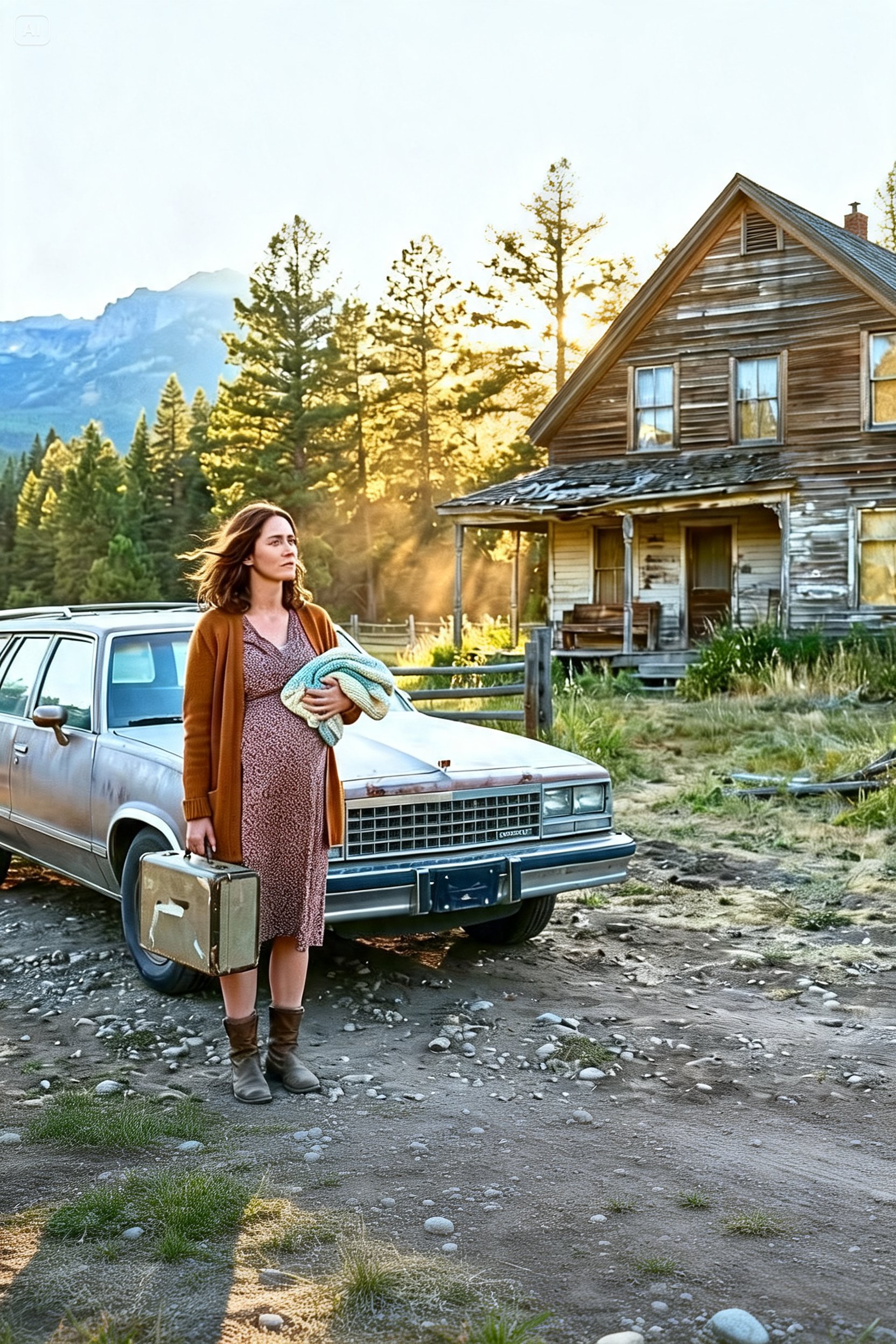
I was 19 when a shelter sent me away with $23 and a backpack. Then I discovered 100 abandoned acres at a $10 auction, and every man in the room turned to stare when I raised my hand….
The morning I turned nineteen, a caseworker at a youth shelter outside Idaho Falls slid a thin envelope across her desk. She looked exhausted, and I could tell she hated what she had to say. “You’ve aged out, Evelyn.” There was no fight, no dramatic goodbye, just paperwork telling me I could no longer stay.
I stepped onto the concrete stairs with a backpack holding two shirts, a toothbrush, and an old pair of boots. I had $23 in my pocket. The March wind blew straight through my jacket, and dirty snow sat along the curb where the plows had pushed it. I remember watching people pass as though I were invisible.
I’d grown up moving between foster homes, group houses, and beds that were always temporary. I knew how to pack quickly, how to stay quiet when adults were upset, and how not to get attached to a room. What I didn’t know was where I was supposed to go now. There wasn’t a relative waiting to pick me up or a spare bedroom with my name on it.
For the next few weeks, I slept wherever I could. Some nights it was a bus station. Other nights it was a corner near the library or an all-night laundromat where the machines hummed until morning. I kept my backpack close and made every dollar last, buying only what I couldn’t do without. During the day, I walked because walking was free.
One afternoon, I went into the county library to get warm. I wasn’t looking for land or even thinking about a house; I was looking for somewhere I could sit without being asked to leave. An old computer near the back was open to county property records. I started clicking through listings mostly to pass the time.
Then one listing made me stop. It said: Parker Ridge Farm. One hundred acres. Abandoned farmhouse. Minimum bid: $10. I read it three times, certain I had misunderstood. I didn’t have enough money for a decent motel room, much less a hundred acres of land.
I went back the next morning and pulled up the full record. Property taxes had gone unpaid for six years. The farmhouse roof was partly collapsed, its plumbing had been ruined by freezing winters, and the estimated repairs were worth more than the property itself. The record made the place sound like a burden that came with a piece of paper saying you owned it.
At the bottom was the auction date: Friday, 10:00 a.m., at the County Administration Office. The minimum bid really was ten dollars. I sat with my hands on the keyboard for a long time, thinking about what ten dollars meant to me. It wasn’t spare change. It was almost half the money I had left when I walked out of that shelter.
I didn’t know a thing about farming. I had never repaired a roof or fixed a broken pipe. I didn’t own a car, a hammer, or even a warm coat that fit properly. But I kept thinking about those words, “abandoned farmhouse,” and wondering if abandoned meant something different to a person who’d spent her life being passed from place to place.
I understood, at least in a rough way, why nobody wanted it. A house could be dangerous if the roof was failing, and winter in Idaho was no joke. I could end up with land I couldn’t reach, a building I couldn’t live in, and responsibilities I had no idea how to handle. Still, that listing stayed in my head while I tried to sleep under the fluorescent lights at the laundromat.
Friday morning, a truck driver who had noticed me around the bus station offered me a ride to the county building. I told him where I needed to go, but not why. He didn’t ask for an explanation. When he let me out, I stood on the sidewalk for a minute, gripping the straps of my backpack and wondering whether I should turn around.
Inside, the auction room smelled like old paper and dust. Six folding chairs were arranged in the middle. Five were occupied by older men who looked as though they’d spent their lives working cattle or fields. Their boots were worn in a different way than mine, and they seemed to know one another. I took the last chair, trying not to draw attention.
The auctioneer was a thin man with glasses and a clipboard. He worked through the properties in a flat, practiced voice. A burned gas station sold first. Then a dry lot outside town. Then a strip of scrubland went for seventy dollars. The men nodded or shook their heads as if they were discussing the weather.
I kept touching the folded money in my pocket. I had imagined somebody wealthy would arrive at the last minute, offer hundreds of dollars, and make the whole trip pointless. Maybe it would have been a relief. If someone else bought the farm, I could go back to worrying about the things I understood: food, shelter, and where to sleep that night.
Finally, the auctioneer glanced down at his clipboard. “Next item. Parker Ridge Farm. One hundred acres, with an abandoned farmhouse. Minimum bid, ten dollars.” One of the men gave a short laugh. Another shifted in his chair but didn’t raise his hand. Their silence told me more than the listing ever had.
I had heard enough of their low conversation to know the farm had a reputation. Snow could cover the road for days. The barn was failing, and the house had stood empty for years. Nobody wanted to spend money trying to bring it back. From their point of view, passing on it was the sensible decision.
“Do I hear ten dollars?” the auctioneer asked. Nobody answered. I could hear a clock ticking on the wall. I looked at the men, then at my hands, and tried to picture waking up somewhere that was mine. Even if it was cold and broken, I would not have to wait for somebody to tell me my time was up.
My heart was beating so hard I thought the others could hear it. I raised my hand before I could talk myself out of it. “Ten,” I said. Five heads turned toward me. The auctioneer blinked behind his glasses, looked at me again, and repeated the bid like he needed to make sure he’d heard correctly.
“Ten dollars. Do I hear eleven?” The room stayed quiet. One of the older men leaned back and gave me a small, almost sympathetic smile. It was the sort of look adults give a young person about to learn an expensive lesson. I wanted to lower my hand and disappear, but I’d already spoken.
“Going once,” the auctioneer said. I stared at the front of the room. “Going twice.” For one awful second, I couldn’t tell whether I wanted another bidder to rescue me or whether I was terrified someone would. The gavel struck the table. “Sold.”
Just like that, I had spent ten of my twenty-three dollars on a hundred acres I had never seen. I walked out holding the paperwork, not keys, not a plan, and certainly not enough money to fix a farmhouse. The men had looked at me as if I had bought myself a disaster. Three days later, when I finally reached Parker Ridge, I would begin to understand what they meant. Part 2…..
The first time I saw Parker Ridge Farm, I understood why no one else had bid.
A retired rancher named Walter Briggs had heard about the auction and offered me a ride in his pickup. The place was nearly twenty miles beyond the nearest town, where the good road gave way to cracked pavement and then dirt. Walter asked if I was the girl who’d bought Parker Ridge, and when I nodded, he whistled softly. “Haven’t seen anyone up there in years,” he said.
Leaning fence posts appeared first, with rusted wire hanging between them. Then we passed what was left of a barn, one wall folded inward and the roof drooping badly. The farmhouse stood alone beyond it. Windows were broken, half the porch had collapsed, and the east side of the roof sagged under damage left by years of snow.
Walter stopped the truck. “You sure you want this place?” I didn’t have a sensible answer. I looked out at the winter grass, the distant trees along the creek, and the hills beyond them. For the first time, the word mine meant an actual place on the ground. “I think I do,” I told him.
The front door was locked, but its frame was so rotten Walter pushed it open with his shoulder. Inside, there was a broken chair, a rusted wood stove, water stains, and plaster fallen near the staircase. I was looking at all the work I couldn’t afford when I noticed photographs hanging on the living-room wall. Someone had left an entire family history behind.
There were children in a field, a man beside a tractor, and a woman holding a baby on the porch. In the largest picture, a younger woman stood in front of the very farmhouse we were in. Walter stepped beside me and looked closely. “That’s Margaret Parker,” he said. “She owned this place a long time ago.”
“Parker?” I asked. It was my last name too. I studied the woman’s dark hair and the shape of her eyes, seeing features that looked painfully familiar. Walter glanced at my face, then back at the photograph. Neither of us could prove anything in that moment, but I began to suspect the place I’d bought had once belonged to my family.
Walter drove home before sunset, promising to return with spare boards and tools. I got a small fire going in the wood stove and settled on the floor under an old blanket I’d found upstairs. Cold air came through the windows, and I was afraid to stand too close to the damaged ceiling. Yet I kept looking at those photographs as if they might explain something about me.
When I lifted Margaret’s portrait off its hook, a folded envelope slipped from behind the frame. The edges were yellow and the handwriting was careful. On the front were two words: “For family.” I sat near the stove, opened it, and found letters Margaret had written over the years.
She described planting fields, repairing fences, and enduring Idaho winters. Then she wrote about a daughter who had left after a bitter argument and never answered the letters sent after her. Margaret had kept hoping someone from her family would come back. One letter began, “If you are reading this, then someone from my family has finally come home.”
I couldn’t fill in every missing piece of my own history that night. But between the name, Walter’s recognition, and Margaret’s words, I felt a connection to that house unlike anything I’d ever known. The broken roof was still broken. I still had almost no money. The difference was that I no longer wanted to run away.
By late October I was patching roof holes with scrap metal that Walter helped haul from an old shed. I boarded windows, split wood until my palms blistered, and learned most repairs by getting them wrong the first time. A little less rain came through the roof, and the stove slowly became dependable. On cold evenings, I read Margaret’s letters again to remind myself why I was doing it.
Then December brought a storm so thick the fields disappeared. Snow buried the fence line and swallowed the road for three days. On the fourth night, close to midnight, I saw headlights struggling through the wind near the creek. Someone was out there, and the car wasn’t moving.
Part 3 I pulled on my coat, wrapped a scarf around my face, and carried a lantern into the snow. A small sedan had slid into the ditch. A woman opened the door when I knocked on the window. “Please,” she said, pointing behind her. “My kids.”
Two children were huddled beneath a blanket in the back seat. The boy was about nine, awake but frightened. His little sister barely responded when I spoke to her. I wrapped the girl in my coat and carried her toward the farmhouse while the mother and boy followed, struggling against the wind.
Inside, I moved them toward the stove, away from the worst drafts. I remembered warnings in Margaret’s old journals about travelers caught in the cold, so we used blankets and body warmth rather than putting the little girl directly against the heat. I heated water, found what food I could, and asked her mother to hold her close. The boy watched every move I made.
For hours, the girl was frighteningly quiet. Then, before dawn, she made a weak little sound and stirred in her mother’s arms. Her mother held her tighter and looked up at me with exhausted, grateful eyes. “I’m Maria Alvarez,” she said. “You saved her.” I was too shaken to feel heroic. I was just glad they were inside.
Maria and her children, Mateo and Sophia, stayed while the roads were blocked. When the snow finally eased, we learned the car had been badly damaged in the ditch. Maria had been driving north to start a bookkeeping job at a small warehouse outside Idaho Falls. By the time she could get there, the job had been given to somebody else.
I recognized the look on her face when she told me. It was the look of someone trying to decide which bad option came next. I had been there myself, standing outside a shelter with a bag and nowhere to go. She didn’t want to impose, but she had two children and no easy way forward. I told her she could stay while we figured things out.
About a week later, Maria watched Mateo stacking scraps of wood in the yard while Sophia followed him through the snow. Then she turned to me and asked how much help I needed around the farm. I laughed because the honest answer was more than I could possibly pay for. She said she wasn’t asking about wages.
Maria was good at the things that overwhelmed me. She turned our kitchen table into a place for ledgers, receipts, and careful budgets. She looked into small government grants available to a first-time landowner, worked on a plan for overdue taxes, and negotiated more time with the county. She also found seasonal work in town around the children’s school schedule.
I spent my days outdoors repairing fence posts and trying to make the barn safe. When spring finally came, the fields began to turn green again. We got a few chickens from a neighbor who was moving away. Mateo fed them before school, and Sophia followed me around asking why the wind sounded different at night and whether chickens really slept standing up.
We shared meals at a crooked wooden table and learned how to live around each other’s habits. Maria worried about numbers; I worried about weather and rotting boards. Mateo was quiet and observant, while Sophia could ask twenty questions before breakfast. None of us had expected to end up together. Somehow, the farm had room for all of us.
One evening, I stood on the porch and watched the children running across the grass as the sun dropped behind the hills. I remembered arriving with nothing but a backpack and an auction receipt. The house still needed work, and there was plenty we couldn’t afford. But when I looked through the window and saw Maria preparing dinner, I realized I no longer thought of Parker Ridge as a place where I was hiding from the world.
It was becoming a home. And gradually, people beyond our little household began to notice that the light was on.
Final Three years after I bought Parker Ridge for ten dollars, the farmhouse was no longer the ruin Walter had shown me. We had repaired the roof, rebuilt the barn with rough timber from fallen trees near the creek, and made a vegetable garden in the southern field. The fences stood straighter. Every evening, warm light filled the windows.
People in town began talking about the place. A truck driver whose engine failed on the highway got a bed for the night. A single mother who lost her apartment stayed for two weeks. A traveling mechanic helped repair the barn roof in exchange for food and somewhere warm to sleep. Nobody arrived with a grand plan to build a refuge. We just kept opening the door when someone needed one.
One evening, Maria sat beside me on the porch while Mateo and Sophia chased chickens across the yard. “You know what people are calling this place?” she asked. I shook my head. “The lighthouse,” she said. I laughed and told her we were nowhere near the ocean. Maria pointed toward the dirt road. “That’s not the kind of lighthouse they mean. When people get lost, they look for the light.”
That fall, I stood beneath the big oak tree behind the farmhouse. Walter told me Margaret Parker had planted it nearly seventy years earlier. Golden leaves drifted around my boots, and I could hear the children laughing while someone inside cooked dinner. I thought about Margaret writing to a daughter who had left, never knowing if her family would return.
I still couldn’t undo the years I’d spent moving from one temporary bed to another. Nor could I claim I’d restored that farm on my own. Walter had helped when he didn’t have to. Maria had brought skills, patience, and two children who filled the quiet rooms with noise. Strangers had given what they could, and sometimes they’d needed something in return.
I had arrived thinking ownership meant nobody could make me leave. What I came to understand was that a home could mean something bigger: a place where people helped one another stay. That was what Parker Ridge had become. The farm nobody wanted was now a place where people could start again.
If somebody asks how it happened, I tell them it began with a girl who had thirteen dollars left after an auction and a house with a broken roof. I didn’t know how to fix the place, and I certainly didn’t know how to fix my own life. I only knew I wanted to try. Three years later, people in our valley knew the way to Parker Ridge: follow the road up the hill until you see the light. We would open the door.
THE END. I’ve shared the complete story, and I truly hope it touched your heart. If this story moved you, please , like, and share the post. Thank you for reading! ❤️
✓ Lynn R. Adams
I was 19 when a shelter sent me away with $23 and a backpack. Then I discovered 100 abandoned acres at a $10 auction, and every man in the room turned to stare when I raised my hand…. The morning I t…