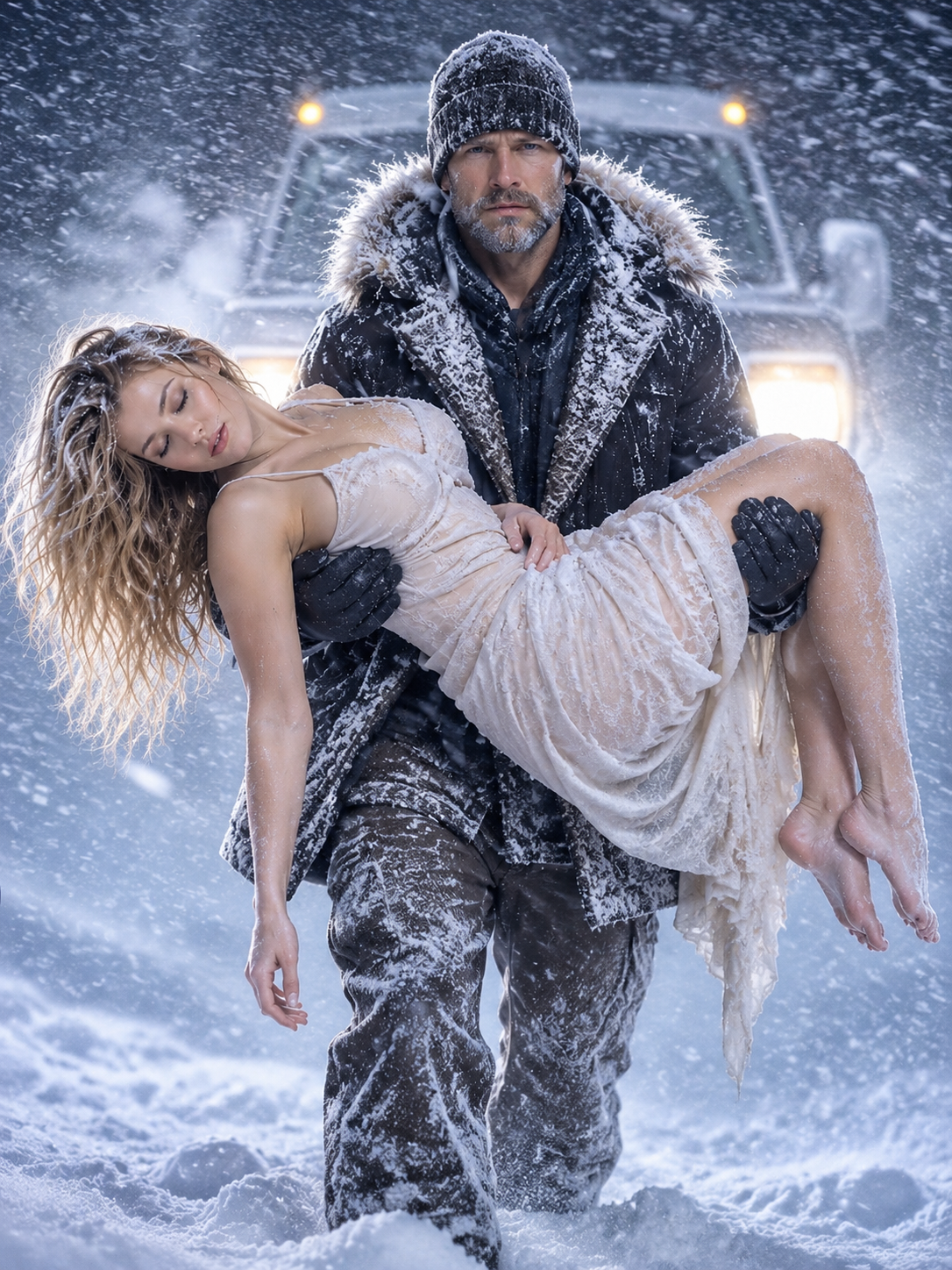
I thought stopping for a woman half-buried in a Montana snowstorm was simply the right thing to do,
IF FACEBOOK BROUGHT YOU HERE, HERE’S THE CONTINUATION YOU’VE BEEN WAITING FOR. ENJOY! 👇 The sun was setting as Rachel and I drove north. For the first hour I checked the mirrors, but nothing followed us. Then headlights appeared behind us, bright and fast. A black SUV closed in and pulled alongside; a passenger raised a gun, and the first shot shattered Rachel’s window.
I swerved onto a smaller county road. The SUV rammed us from behind, but I kept the truck straight and took an unmarked turn into the woods that I’d known since childhood. I killed the headlights and followed the rough track by moonlight. The SUV overshot the turn, giving us a few minutes, but we both knew they would find us again.
Near Billings, the headlights appeared once more. The SUV struck us hard, the truck spun on the ice, and we slid down an embankment before rolling. When I opened my eyes, the truck was upside down, Rachel was unconscious, and men were approaching to check whether we were dead. I defended us when they reached the wreck; by the time federal marshals arrived, three attackers were dead and Rachel was alive.
I collapsed before I could do anything else. A marshal told me Rachel was safe and that we’d made it to Billings. When I woke in the hospital, my ribs hurt with every breath and my head was bandaged. Rachel sat beside my bed, her own head wrapped and one arm in a sling.
She told me the men were contractors hired by Maxwell and that the marshals considered the shooting self-defense. The company was still facing trial, but she was frightened that I’d nearly died and Ella had nearly lost her father. I told her some fights were worth having and some people were worth saving. I meant it, though the memory of the shooting had already begun to trouble me.
Marshal Tom Briggs came to question me. He said the weapons, the attackers’ records, and the evidence from the pursuit supported self-defense, but warned that Maxwell would retaliate. I told him I was done hiding after they came after my daughter. Briggs said I was now a witness, and he was assigning protective custody to Ella and me until the trial ended.
Two hours later, Marie brought Ella to the hospital. She ran into my arms, crying that she’d thought I was dead. Then she turned to Rachel and said the men had come to her school because of her. “Mom’s gone, and now I almost lost you, too,” she said. Rachel quietly apologized, but I told Ella that helping Rachel had been my choice, not something Rachel had forced me to do.
Marie pulled me into the hallway. She said Ella needed a father, not a dead hero, and that I couldn’t keep putting myself in danger because I hadn’t been able to save Sarah. I had no answer. When I returned, Ella told me she didn’t want me to be brave anymore; she wanted me to be safe. I promised to do my best, though I couldn’t promise to abandon Rachel.
Briggs moved us to a guarded cabin outside Billings. The night before the trial, a lawyer representing Maxwell called and offered me one hundred thousand dollars to stay home. He said the press would call me a killer, that the company would destroy my reputation, and that my daughter would see it all. I hung up and told Ella I would testify because Rachel had stood up for thirty thousand people and I would not let the company silence her.
Part 3 On Monday I put on the only suit I owned, the one I’d worn to Sarah’s funeral. The courthouse was packed with reporters, cameras, and people who wanted to know whether I had killed three men. Briggs kept me moving and told me not to answer questions. Inside, the prosecution team reminded me to answer only what was asked and stay calm.
The defense lawyer, Richard Blackwell, tried to turn my grief into a motive. He asked about Sarah’s cancer, our medical bills, my finances, and whether I had saved Rachel because a wealthy judge might reward me. He called me a trained soldier familiar with killing and suggested I wanted to feel important after failing to save my wife. I told him the attackers were trying to execute us. “If that makes me a killer, then fine, but I’d do it again.”
After I stepped down, the prosecutor said I had held my ground. I wanted to see Rachel, but Briggs took me back to the safe house because she had not yet testified and the defense could claim we had coordinated our stories. That night I couldn’t sleep. A young marshal named Peters told me he’d also killed in self-defense during his service in Iraq, and that learning to live with it took time. His words didn’t erase the images, but I felt less alone.
The next morning Rachel took the stand. She described the five-hundred-thousand-dollar bribe, the threats, the cut brake lines, and the evidence that Maxwell had poisoned fourteen communities. More than thirty thousand people had been affected, she said, and the contamination was linked to seventeen deaths. She told the jury she had refused to sell her office because the families deserved justice.
Then Blackwell produced bank records showing a fifty-thousand-dollar payment to the medical center where Sarah had been treated. The payment had been made days after I agreed to testify. I had never known about it and had not taken a cent, but the timing made it look as though Maxwell had bought my testimony. Rachel could not explain the payment, and the defense used it to suggest that we had staged the whole story.
The prosecution feared the jury would doubt both of us. I insisted the payment had to be traced, and asked Briggs whether anyone had followed the money paid to the contractors who attacked us. The FBI found transfers from a Maxwell-owned shell company to an offshore account connected to the security firm that employed the three men. The judge allowed the evidence, while warning the jury that a connection did not by itself prove Maxwell had ordered the attack.
In closing, the prosecution laid out the poisoned water, hidden reports, bribes, threats, and attack. Blackwell argued that contamination and corporate mistakes were one thing, but attempted murder and conspiracy were another; he urged the jury not to be swayed by a dramatic rescue story. Then the jury left to deliberate, and all we could do was wait.
Hours later, Briggs received a call. The verdict was in. We hurried back to the courthouse, where Rachel sat with the prosecution team, her hands folded and her face unreadable. The jury found Maxwell Industries guilty on every charge presented, including criminal negligence resulting in death and bribery and corruption of public officials. Rachel closed her eyes as tears ran down her face.
Outside, reporters crowded the courthouse steps. I slipped away with Briggs and returned to the safe house. Ella ran to me and asked if we’d won. I told her we had, but sentencing and appeals still lay ahead. Rachel would remain in protective custody, and I wouldn’t see her for a while. That night, she called to say she was frightened and lonely. I told her that when it was safe, she should come back to Milfield and finish teaching Ella the piano song they’d started.
Part 4 The victory did not end the danger. Maxwell executives posted bail, and Briggs said protective custody would continue through the appeals process. Ella was tired of living behind guarded doors, and I was desperate to return to work and give her a normal school week. Then the company tried to negotiate a plea deal that would let its executives avoid prison in exchange for greater restitution.
Rachel was furious. She contacted the Attorney General’s office and said she would go public if the deal went forward. The plea was rejected, and she held a press conference in Denver, surrounded by lawyers and federal agents. She described the threats, the attempt on her life, and the people harmed by Maxwell. “Justice cannot be bought,” she said. “It cannot be intimidated, and it will not be denied.”
Ella watched beside me at the safe house. She asked whether I loved Rachel. I admitted I didn’t know, but Ella reminded me that Sarah had wanted us to keep living and loving if she died. She said she had seen me become less sad when Rachel was with us. Hearing that from my daughter loosened something I had carried for two years.
Two weeks later, Maxwell’s executives were sentenced to twenty-five and thirty years, with no parole. The judge condemned their belief that money placed them above the law. Briggs finally told us we were free to return to Milfield, though Rachel would remain under protection during the appeals process. She had also been offered a position on the federal appeals court in Denver.
I met her in a secure conference room before we left. She said she wanted to return to Milfield, finish Ella’s piano lessons, and have dinner at our table, but she couldn’t turn down the appeals court position. I told her we could drive to Denver on weekends and asked her not to shut us out. We admitted we were falling in love and kissed, though it felt like goodbye.
Back home, our rooms seemed full of memories of her. A few days later, an invitation arrived from Congress asking me to testify at a hearing on corporate accountability. Rachel had received one too. Three weeks later, Ella and Briggs accompanied me to Washington, D.C. Rachel was waiting at the Capitol, looking composed but tense.
At the hearing I told the senators about finding Rachel in the blizzard, the threats, the pursuit, and the shooting. When asked why I had helped, I said someone had to stand up for the people Maxwell had poisoned. I wanted Ella to grow up believing justice mattered and that ordinary people could make a difference. Rachel spoke about the families who had lost loved ones and said I had reminded her why she became a judge.
The hearing lasted three hours. Reporters crowded us afterward, and the news networks soon called me a hero. I disliked the attention, but I understood that the story had become bigger than me. A week after we returned to Montana, the Department of Transportation offered me a job as regional infrastructure coordinator, paying eighty-five thousand dollars a year with benefits. I accepted, grateful for steady work and a chance to help keep roads and bridges safe.
Then a letter arrived for Ella: she’d been awarded a full scholarship to the Denver Music Conservatory’s Youth Program. She hadn’t applied, but Rachel had recommended her after hearing how gifted she was. The program meant weekend lessons in Denver, and Rachel gently suggested that our visits could give us time to figure out what we were becoming. I agreed, and Ella was overjoyed.
Part 5 Every Friday, Ella and I drove four hours through the mountains to Denver. Rachel waited at her little house, and the weekends became our new routine. Ella’s first lessons went well until Professor Chen told her she had real talent but was behind where she might have been if she’d started earlier. Ella came out crying, convinced she’d wasted years after Sarah died and it was too late to catch up.
I knelt and told her she hadn’t wasted time; she had been grieving and surviving. Rachel reminded her that fear didn’t mean she couldn’t do something, and that the only way through it was to practice. Two weeks before the winter recital, Ella threw her sheet music across the room, convinced the difficult passage was impossible. Rachel sat beside her and helped break it into small sections. By the end of the evening, Ella could play the hardest measures cleanly.
Rachel told me she wanted to move back to Milfield after the recital. She could do much of her appeals court work remotely and travel to Denver for important hearings. She didn’t want to live four hours away anymore. I was glad, but we agreed to take things slowly and give Ella room to adjust.
At the recital, Ella wore a black concert dress and walked onto the stage looking very small beneath the lights. She played beautifully, then stumbled on a note near the end. For a moment her hands faltered, but she took a breath, found her place, and finished. The audience rose in a standing ovation. Professor Chen told her she had talent and, more importantly, the determination to go far.
Two weeks later Rachel moved into a small house three blocks from ours. Ella asked why she didn’t simply move in with us, but Rachel explained that having her own space would let all of us adjust at our own pace. Most evenings she came for dinner, helped Ella with homework, and shared the ordinary work of building a family. I loved her, and Ella loved having her near.
A television producer asked to follow us for a documentary about ordinary people who made a difference. I agreed only after Ella and Rachel approved. The crew filmed me inspecting bridges, Ella practicing piano, Rachel working on appeals, and our family sharing dinner. Rachel said on camera that I had saved her life and reminded her that justice was about real people. She said Ella and I had given her a family and a home.
The documentary aired and brought more attention than I wanted. But six months later, the governor invited me to Helena. She was creating a state Office of Public Accountability to investigate corporate misconduct and protect whistleblowers, and she wanted me to run it. I told her I was a mechanic, not a lawyer. She said she would give me a team of lawyers; what the office needed was someone who couldn’t be bought or intimidated.
I talked it over with Rachel. She reminded me that I’d already exposed corruption, testified before Congress, and helped people see that ordinary citizens deserved protection. I accepted. The office opened six months later, with investigators, lawyers, and a hotline for whistleblowers. In its first year, it shut down two factories illegally dumping waste, fined three corporations for labor violations, and protected seventeen whistleblowers from retaliation.
One woman who worked for a medical supply company came to my office after being fired for reporting defective equipment shipped to hospitals. We investigated, shut the company down, and helped her get her job back with back pay. That evening I came home exhausted but satisfied. Rachel was cooking with Ella, who was practicing for another piano competition. We sat down to dinner, talking about our days like any other family.
Final After dinner one night, Rachel and I sat on the porch. She said she’d been thinking about the life we’d built and wanted to make it official. Then she took a small box from her pocket and asked me to marry her. I said yes. We married three months later in a small ceremony with family and close friends. Ella was maid of honor, Briggs was best man, and Marie cried through the vows.
I told Rachel she had saved me, not only the night I pulled her from the snow but every day since. She said I had shown her what courage looked like: choosing to do good even when it was frightening, and choosing love after loss. Ella read a poem about second chances and family. Later, beneath the stars, Rachel told me Sarah would be proud that I had let myself be happy again. I still missed Sarah, and Rachel said that was all right; a heart could make room for more than one kind of love.
Five years later, I stood beside Rachel at the Kennedy Center in Washington while Ella, now twenty-one, performed with a professional orchestra. She played flawlessly, and the audience rose to applaud. Afterward she told us she was preparing for an international tour. She was nervous, but excited, and said she had learned to keep going even when she was scared.
Rachel and I had built a life in Montana. I still ran the Office of Public Accountability, which had helped more than three thousand people, shut down dozens of corrupt operations, and changed state laws. Rachel served on the appeals court and led a federal task force on corporate accountability. We came home each evening, made dinner, and shared the ordinary details of our days.
One winter night, I stood on the porch watching the first snow of the season. It reminded me of the night I found Rachel beside Highway 89. She asked what I was thinking, and I told her how one decision had changed my life. I could have driven past, gone home to my warm bed, and never known what I’d left behind.
Rachel wondered how many people drive past someone in trouble because they believe it’s someone else’s responsibility. I told her I didn’t know what happened every time a person stopped to help, but I still believed we had to try. The alternative was a world where everyone drove past everyone else’s pain. We stood together in the falling snow, grateful for the life we’d made and for the simple choice that had started it.
THE END. I’ve shared the complete story, and I truly hope it touched your heart. If this story moved you, please , like, and share the post. Thank you for reading! ❤️
✓ Lynn R. Adams
IF FACEBOOK BROUGHT YOU HERE, HERE’S THE CONTINUATION YOU’VE BEEN WAITING FOR. ENJOY! 👇 The sun was setting as Rachel and I drove north. For the first hour I checked the mirrors, but nothing followed…