I spent my last $13 on a mountain ranger station nobody wanted, hoping to find the place where my mother had once felt safe, but when I opened the door and saw what lined the walls, I could hardly breathe…
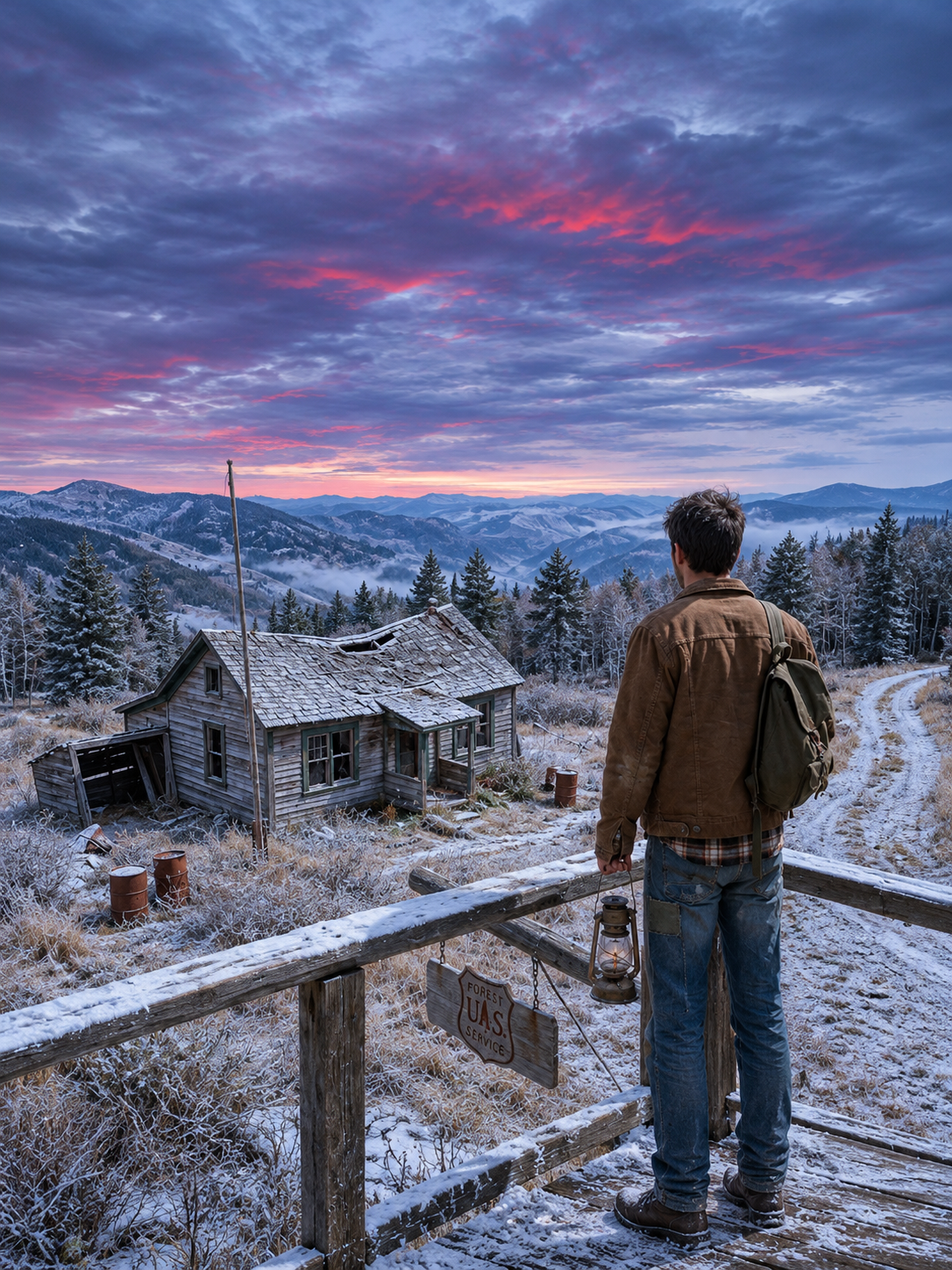
I spent my last $13 on a mountain ranger station nobody wanted, hoping to find the place where my mother had once felt safe, but when I opened the door and saw what lined the walls, I could hardly breathe…
At twenty, everything I owned fit in a canvas army bag. There was a change of clothes, a photograph wrapped in a freezer bag, and a wooden chickadee my mother had carried from one rented room to the next. For over two years, I’d slept wherever I could.
My mother, Della Doyle, died of cancer two years and four months before I found the station. I was still trying to arrange her burial when our landlord changed the locks, and there wasn’t another relative I could call. She’d never told me much about my father or her hometown.
What she did leave me was the photograph. In it, she was nineteen, pregnant with me, standing in deep snow outside a low log building with a steep roof and a stovepipe. A white-haired man stood near the edge of the picture, and a shepherd dog sat at their feet.
On the back, written in pencil, were the words, “Quill Creek, the winter you decided to live.” Beneath them was one letter: E. I knew every detail but never understood the message.
Mom had taught me to fix things because we could rarely afford replacements. By twelve I could patch a window screen, rewire a lamp, and coax an old furnace into working again. After she died, those skills bought me meals and occasional beds when day labor crews needed somebody to hang doors, haul shingles, or repair rotten floors.
Other nights I slept on benches or in shelters, checking the photograph every morning. I learned which churches offered coffee and which streets were safest after dark. I still felt forgotten.
The public library was the one building where I could sit for hours without paying for the privilege. I went there to warm up, read, and sometimes search old maps for Quill Creek. I found only a creek on old forest maps, far from any road.
Then one gray afternoon in late February, a notice taped inside the library window caught my eye. It advertised county surplus and tax-delinquent parcels available by sealed bid. Halfway down the sheet was a line that made me press my finger against the glass.
“Parcel 14. Quill Creek Guard Station and surrounding acreage. Improved. No vehicle access. Minimum bid: $10.”
I read it four times. I had $13 from hauling shingles two days earlier, and no reason to believe I could buy property for that little. Still, the county clerk’s office was only three blocks away, and I walked there before I could talk myself out of it.
The clerk looked at my taped boots and thin coat, then at the parcel number I’d written on the form. She told me the building had belonged to an old man who died the previous fall, leaving unpaid taxes and no will anyone could locate. There was no road, she warned, and the Forest Service had once wanted the neglected station torn down.
“You understand you’re bidding on a long hike and a pile of old logs?” she asked. I told her I understood, though the truth was I was thinking about my mother standing in the snow. The minimum was ten dollars; I wrote thirteen because those were all the dollars I had.
On Friday, the clerk left a message at the shelter where I sometimes stayed. Mine had been the only bid, and the county had recorded me as the new owner of parcel 14. She asked me to come sign the deed and collect the keys, though she doubted there were any.
I went back to the library, took out Mom’s picture, and sat with it between both hands. She was smiling outside a building I now owned without ever having seen it. For the first time since her funeral, I had somewhere specific to go.
A five-hour bus ride took me into the mountains and left me in Hollis, a little place with a gas station, a feed store, a chapel, and a general store. I stepped into the store for directions, carrying my bag because I had nowhere else to leave it.
A silver-haired woman named Inez was working a crossword behind the counter. When I asked how to reach Quill Creek Station, her pen stopped moving. “You bought the Sorenson place?” she asked, and I said I’d bought parcel 14 for thirteen dollars.
She studied my face. Then she gave me coffee and told me about Emmett Sorenson, an old ranger who had spent roughly forty years living up there. The ground was private, part of an old patented mining claim surrounded by national forest, and he had built up the log station himself.
Most people called him a hermit because he rarely came down for more than supplies. Inez said that didn’t tell the whole story. Over the years, frightened runaways, former soldiers, and other people with nowhere to go had climbed his trail, stayed through the worst of their troubles, and eventually returned to town looking stronger.
“He didn’t have much,” she told me, “but people who went up there hungry didn’t come down that way.” I thought of the white-haired man in Mom’s photograph and asked whether Emmett had kept a dog. Inez’s face changed immediately.
He’d always had one, she said, and the last dog was still somewhere around the station. A hunter had been leaving feed near the trailhead since Emmett died, but the old shepherd wouldn’t let anyone close enough to bring him home. He seemed to be waiting for a man who was never coming back.
I bought what food I could carry. Inez slipped matches and a candle stub into my bag without charging me, then showed me where the trail began. She warned me that late winter in those mountains could turn deadly in minutes, and said I should come back if I couldn’t manage the climb.
I thanked her, though I had already made up my mind to reach that station. The trail followed loud, icy water through dark timber before climbing into switchbacks. My bag dug into my shoulder, and snow kept giving way beneath my boots, soaking the socks I had hoped would last another winter.
I kept thinking of Mom climbing those same slopes while she was carrying me. Every time my legs started shaking, I pictured her in those wrong-for-the-weather shoes and took another step. By late afternoon, the trees opened onto a high meadow surrounded by gray peaks.
There it was: the steep roof, the stovepipe, the low log walls. I had memorized that shape from a creased photograph, and suddenly it was standing across the snow in front of me. I stopped so abruptly that the bag slid down my arm.
A gray, grizzled shepherd stood beside the building, ribs showing beneath his coat and one ear notched. He watched me without barking. I crouched and held out the back of my hand the way Mom had taught me, but after a long moment he simply disappeared around the corner.
I crossed the meadow and found the door held shut by a worn wooden latch, not a lock. For a strange second I wanted to knock. Then I lifted it and stepped into a room that smelled of cedar, cold ash, and old paper.
There was an iron stove in the center, a neatly made bunk, a heavy table, and shelves holding leather-bound books. The place was dusty and cold, but it wasn’t a ruin. It looked as if somebody had stopped in the middle of an ordinary day and never returned.
Then I saw the walls. Hundreds of names and dates had been carved into the logs, climbing around the door and up toward the loft. On a shelf near the stove stood more than thirty small wooden chickadees, all facing the doorway as though they were waiting for someone.
I reached into my bag for the bird Mom had kept on every windowsill we ever had. I held it beside the little figures on the shelf and saw the same curved wing, the same knife marks, the same patient tilt of the head. Whoever had carved those birds had also carved hers, and I was standing in the one place she’d never told me how to find. Part 2…..
IF FACEBOOK BROUGHT YOU HERE, HERE’S THE CONTINUATION YOU’VE BEEN WAITING FOR. ENJOY! 👇 I put Mom’s bird on the table, then picked it up again because leaving it anywhere felt wrong. The books beside the oil lamp were journals, their leather spines softened by years of use. I opened the oldest-looking volume and found neat, square handwriting beneath a date from almost forty years earlier.
At first it was all weather and maintenance: frost on the meadow, a broken spring box, a fallen tree across the east trail. Then a stranger appeared in the entries, a young man who had wandered off a high route and arrived shivering after dark. Emmett wrote that he’d fed him and offered him a place to sleep until he stopped shaking.
The next day’s entry said the young man had admitted his name wasn’t the one he’d first given. Emmett hadn’t seemed bothered. He wrote that nobody at Quill Creek had to keep being the person they’d been down below.
I turned pages until the last daylight disappeared from the window. The journals followed one another through years of storms, repairs, and people: a runaway child, a woman so lonely she hadn’t expected to come back down the trail, men who had brought their memories of war up the mountain. Emmett never turned their pain into a spectacle; he recorded a meal, a dry bed, and the work they helped him do afterward.
When I couldn’t see the page, I lit the lamp. Kindling was stacked beside the iron stove, with a whole wall of seasoned firewood beyond it. I cleaned the firebox, coaxed a flame to catch, and watched heat begin to spread through a room a dead man had left ready for winter.
I slept on the floor beside the stove that first night. The neatly made bunk still felt like it belonged to Emmett, and I wasn’t ready to lie in it. For a long time I listened to the fire settling and tried to understand why somebody I’d never met had prepared a place that felt so much like an invitation.
In the morning, the old dog was sitting at the far end of the porch. I told him quietly that I wasn’t Emmett, found some feed in a bin by the door, and put a dish out before going back inside. He ate only after I shut the door and left him alone.
I did the same thing every morning. On the third day he stayed when I came out; by the fifth he lay against the sunny wall while I split wood. He never asked for affection, and I didn’t try to take any he wasn’t ready to give.
I fixed what I could around the station: a loose windowpane, a clogged stovepipe, the woodshed roof. I found the spring box uphill, where clear water ran even in the cold. My hands were busy, my boots dried beside a fire, and I woke up in the same place each morning knowing I was permitted to be there.
On the ninth day I found an entry from two winters earlier. Emmett had written about sewing up the pad of a dog named Pike after he’d cut it on the ice, calling him the best dog he’d ever owned. I glanced toward the porch and said, “Pike?”
His head came up instantly. When I said it again, he crossed the boards and pressed his graying face against my leg so hard I had to brace myself. I knelt and held him while he leaned against me, and that was how we became company for each other.
In a margin of the same book, Emmett had written down his call for the dog: two short whistles and one long. I practiced it until Pike’s ears turned every time. After that, he slept on the porch when the weather was mild and curled up beside the stove when it wasn’t.
When my supplies ran low, I walked back to Hollis. Pike accompanied me to the first switchback, then sat and refused to go farther, and I decided he knew his own mind. At the store, Inez looked up from her crossword and said, “So you’re still up there.”
I offered to work for groceries because I didn’t have any money left. She pointed me toward a cooler door that hadn’t sealed properly in a year, and twenty minutes later I’d fixed it. She traded me flour, beans, and lamp oil for the work, then asked whether I’d found Emmett’s books.
I told her I had. “Then you know him better than his son ever did,” she said, and the way she looked away made me stop packing my bag. Emmett had a son named Garrett, she explained, who grew up at the station and left as soon as he was old enough.
Garrett had never returned, not even after his father died the previous fall. Inez said he had spent his childhood watching his father offer food and warmth to strangers, while feeling that there was never enough left for him. She didn’t ask me to decide who’d been right, and I couldn’t have if she had.
I brought the groceries home and returned to the books. I began finding entries about the carved chickadees, the gifts Emmett made for guests before they left. He called each bird a reason to remember that a warm door waited up the mountain, whether its owner came back in a week or twenty years.
That explained the birds on the shelf. They were ones nobody had returned to claim, over thirty small invitations still pointing toward the door. But Mom’s bird had traveled down that trail and stayed with her through every apartment, every setback, and every move of my childhood.
I needed to find the winter she’d spent there. The books weren’t labeled, so I spread them across the table and arranged them by their first dated pages. I worked backward past my birth until I reached the year before it, when Mom was nineteen and expecting me.
One night, with Pike asleep against my foot, I opened the right journal. The first entry that mattered began with a girl arriving in the wrong shoes, pregnant and frightened, saying she could only stay one night. Near the bottom Emmett had written four words that made my hands go still: “Her name is Della.”
Part 3 I read the entry again, slower, as if doing that could let me hear Mom’s voice in the room. Emmett wrote that she had nowhere left to go, and somebody in town had told her about his trail. She was proud enough to argue about accepting a bed and scared enough that he’d noticed the moment she came through the door.
Over the following weeks she repaired a hinge he’d been ignoring, organized his woodshed, and told him not to fuss over her. Sometimes he heard her crying after dark and let her have her privacy. His entries about the weather grew shorter while the ones about Della grew longer.
During the worst storm of that winter, she became frightened that the baby would come early. Emmett kept the stove blazing, stayed awake with her, and listened as she described the safe, warm places she hoped to take me. He wrote that he wished he could make the world as easy as she imagined it might become.
Then I found the night he carved her chickadee. He gave her his familiar explanation about a warm door to return to, but Mom turned the bird over and told him a bird that stayed through winter wasn’t brave; it trusted the mountain to feed it. Emmett wrote that it had taken a frightened nineteen-year-old to teach him what his own carvings meant.
She’d said those words to me as long as I could remember. In drafty rooms and cars that wouldn’t start, she set the bird on a windowsill and repeated them when she thought I was scared. I’d always believed the saying belonged to only the two of us; now I knew where she’d first spoken it.
I sat at Emmett’s table with my face in my hands. Mom had made this place her shelter while I was still inside her, and the man in the corner of the photograph had helped keep us both alive. He’d never met me, yet I’d grown up carrying a small piece of his work.
The last entry about her said spring came early, and she insisted on leaving before he was ready to let her go. He walked her to the top of the switchbacks and saw her holding the wooden bird through her coat pocket. He didn’t expect she’d return, and he wrote that helping people wasn’t a bargain made in the hope they’d repay him.
What mattered, he said, was that they went back into the world able to open a door for someone else. I turned over the photograph and finally understood the message and the letter E. “The winter you decided to live” was about my mother, and Emmett had been the one who wrote it.
The next morning, while putting the journals back in order, I lifted the oldest one and an envelope slid from behind its back cover. On the front, in Emmett’s square handwriting, were the words “To whoever finds this.” Its wax seal was cracked but still holding.
I opened it at the table. Emmett wrote that his heart was failing and that, instead of selling the timber or leaving the station to his estranged son, he had let the property taxes go unpaid. He hoped a county sale might place the station with somebody who needed it badly enough to make that climb.
He hadn’t known who would buy it, and the clerk hadn’t known his plan. He wrote that a person drawn there for money wouldn’t understand the place, but somebody who arrived cold and desperate might. Reading it, I remembered my thirteen-dollar bid and the way I had felt when I first saw the meadow.
His instructions were simple: keep the stove burning, clear the spring, and leave the door unlocked. When somebody came up the trail cold, hungry, or ashamed, I was to feed them and allow them to rest without forcing them to explain themselves. That, he wrote, was the work he’d spent forty years doing.
There was also money set aside. He told me to lift the third floorboard beneath the bunk and ask the woman at the Hollis store for the rest. Under the board I found a tin holding cash and old savings bonds, worth a little under two thousand dollars altogether.
But the last part of his letter mattered more to me than any money. Emmett admitted he had given tenderness easily to strangers while his own boy stood by feeling unwanted. Garrett had been right to leave, he wrote, because his father had never learned how to make that boy feel first in his heart.
Emmett said he’d written Garrett a letter each year but never mailed one. The bundle was in a box kept in town, and he begged whoever found his message to give those letters to his son if the chance arose. He also asked for something small and painfully overdue: to carve Garrett’s name among the hundreds on the walls.
“Tell him I’m sorry,” he wrote. I looked from the letter to all those names and thought how lonely a child could feel in a room full of people his father had saved. Then I took the old carving knife from the shelf and made Garrett’s name beside the door, slowly enough to keep each letter straight.
A few days later I returned to Hollis. Inez reached under her counter and produced a flat metal box Emmett had left for the station’s next keeper. It contained more money, deed papers, and a county map marked with the private property’s boundaries; she also gave me the bundle of unsent letters for Garrett.
Inez watched me secure the box in my bag. “He picked the right one,” she said, and turned back to her crossword before I could reply. I carried everything up the mountain, put the letters aside unopened, and kept making repairs because there was work in front of me that I knew how to do.
Four days later, Pike rose from beside the stove and growled at the door. Through the window I saw a broad man in his mid-fifties struggling up the last switchbacks, wearing a good wool coat and town boots, his face tight with anger. I recognized the resemblance from the old picture before he ever introduced himself.
He stopped below my porch, out of breath, and ordered me to leave his father’s property. I said, “You’re Garrett,” and his expression sharpened. For the first time since I bought Quill Creek, someone had come up that trail wanting to close its door.
Part 4 I stood on the porch with my hand resting on Pike’s neck and told Garrett my name was Wyatt Doyle. I explained that I’d bought parcel 14 at the county tax sale and had a recorded deed inside. He already knew about the thirteen dollars; he’d called the clerk after hearing what had happened to the place.
“My father’s whole life, sold to some drifter kid for thirteen bucks,” he said. His words hurt, partly because I’d called myself worse things on the street. He told me a timber company had wanted the property for years, and he planned to challenge the sale unless I accepted a couple hundred dollars and walked away.
I wasn’t about to pretend I knew how a lawyer would look at it, but the county had issued me the deed. I told him I wasn’t leaving and asked him to come in before the weather turned. He said there was nothing in his childhood home he needed to see, yet he followed me through the doorway.
The stove was warm and the books were stacked on the table. I showed him entries about fishing trips, a boy sick with fever, and a son slowly growing distant from his father. Then I gave him Emmett’s last letter and pointed to the name I’d carved beside the door.
Garrett read the part about his father’s regret without saying a word. He pushed the letter back at me and rubbed his eyes with two fingers. “Forty years,” he said. “Forty years, and he says sorry in a note he leaves for a stranger.”
He told me he had been eight when he lay sick with fever in that very room. One night a lost logger arrived drunk and freezing, and Emmett gave the stranger Garrett’s bunk. Garrett was moved to a pallet by the stove, where he watched his father tend the other man and learned a lesson he’d never forgotten.
“I was his own boy,” he said, keeping his voice flat. “And I knew I came after anybody who happened to walk up that trail.” I had read plenty about Emmett’s kindness, but sitting across from the person who had paid for some of it made the picture harder and more honest.
I didn’t try to explain away what had happened. Instead, I set the tied bundle of letters on the table and told Garrett his father had written to him every year. The letters were his; I hadn’t opened them, and I asked only that he read them before speaking to a lawyer or the timber company.
He stared at the twine around the bundle. Then he gestured toward the shelf of birds and asked whether I knew how many his father had carved for strangers. He’d counted them often as a boy, he said, and never once received a single bird himself.
There wasn’t an answer I could give that would make an eight-year-old’s hurt disappear. I told Garrett that much. He shoved the letters into his coat, said he’d read them, and promised to return with a lawyer and surveyor before spring.
I watched him march across the meadow, his good coat flapping in the rising wind. The sky had lowered while we talked, and hard pellets of snow were striking the porch. Garrett had no pack, no lantern, and boots that were poor choices for the iced switchbacks; the trail would be difficult even before darkness fell.
Pike stood staring after him, whining and glancing back at me. I thought about the old man’s rule that nobody should be left on the mountain if there was still a way to reach them. Garrett had threatened to take my home, but I couldn’t watch him walk into that weather without doing something.
I pulled on Emmett’s heavy outdoor coat, filled a pack with a lantern, matches, food, and the wool blanket from the bunk, then went outside. I whistled two short notes and one long. Pike came running, and we started down the trail after Garrett.
The storm swallowed the daylight almost immediately. New snow hid slick ice, and the trees creaked as wind swept through them. Pike ran ahead, came back to check on me, and kept his nose low along the trail while I called Garrett’s name into the white.
About half a mile below the station, Pike stopped where the trail passed a steep rocky drop. He barked sharply toward the slope, and I crawled to the edge to look. Twenty feet below, wedged among snow-covered boulders, lay a dark shape that moved when I shouted.
Garrett answered with a string of curses, and I was grateful to hear every one. I climbed down by grabbing roots and rock, scraping my hands until they went numb. His leg was twisted awkwardly beneath him, his ankle wouldn’t take weight, and his wet coat was beginning to freeze.
He said he’d been calling for help and nobody had answered. I told him Pike had heard him, and we were going to get him out of the wind. I couldn’t carry him all the way up the icy mountain, and dragging him over the rocks would have made a bad injury worse.
Between two fallen trunks I found a shelf of ground sheltered from the worst gusts. With Garrett helping as much as he could, I got him into it, traded his wet coat for Emmett’s dry heavy one, and wrapped the blanket around him. I scraped snow away from old needles and gathered the driest wood I could find beneath the fallen trees.
It took lantern oil and three matches, but I managed to start a small fire where it was protected from the wind. Pike pressed himself against Garrett’s uninjured side while I warmed water and helped him drink. The color slowly returned to his face, and the shaking in his hands began to ease.
For a long time we listened to the storm and fed the fire. Finally Garrett looked over and said, “If I’d been a stranger, Dad would have come down for me.” I glanced at the bundle visible inside his coat and told him his father had spent years trying to find words he hadn’t known how to say aloud.
I asked him to take out the letters. There were no lawyers, surveyors, or timber buyers under those fallen trees, and the storm wasn’t going to let us move until morning. Garrett stared at the twine, then began working the knot loose with fingers that were still stiff from cold.
Part 5 There were nearly forty letters, one for each year Garrett had been gone. Some were written on good stationery, others on the backs of weather forms and scraps Emmett had saved. Garrett opened them in order by the firelight, holding each sheet close enough to read while I tended the flames.
At first he made no sound. Then his breathing changed, and he started pausing between pages as if there were things he needed to put down before he could go on. I tried not to watch, because whatever his father had written belonged to him.
Eventually he read a passage aloud. Emmett had written that he could save strangers but had never learned how to save his own son from feeling unwanted. All those years of helping other people, he said, had sometimes felt like practice for a conversation with Garrett he couldn’t bring himself to begin.
Garrett held the letter over his mouth. His shoulders shook, and he bent forward while Pike pressed against his leg. I put a hand on his back and stayed beside him until he could breathe steadily again.
When he finally lifted his head, the birds were still troubling him. He asked again why his father had carved so many for people who barely knew him but none for his own child. I could only tell him what I believed after reading the journals: that the empty shelf places were invitations to return, not proof that the people who left had stopped mattering.
“Maybe he thought you’d come back and choose one yourself,” I said. “Maybe all those birds were his way of keeping a place ready.” I couldn’t know whether I was right, and I didn’t pretend I did, but Garrett looked into the fire for a long time after that.
We kept the little fire alive through the night. When the wind eased toward dawn, the sky cleared above the new snow, and the trail back to the meadow became visible again. Garrett’s ankle was badly swollen; we didn’t know whether it was broken, only that he couldn’t walk on it normally.
I cut a sturdy branch for a crutch and let him put most of his weight across my shoulders. Pike went ahead along the track, and we followed slowly through the drifts. What had taken Garrett seconds to fall took the better part of three hours to climb.
When the station finally came into view, Garrett stopped to look at it. Smoke rose faintly from the stovepipe where I’d banked the fire before we left. He was staring at the building as if he’d been angry with the wrong thing for most of his life.
Inside, I helped him onto the bunk, removed his boot carefully, and cooled the swelling while the stove heated the room. I made coffee and beans, and he ate without speaking much. Our next problem would be getting him down to a doctor once he could travel safely.
After breakfast he said there was a timber-company man’s number in his phone. Once he reached a place with reception, Garrett intended to call and tell him the property wasn’t for sale. He glanced at his name in the fresh-cut wood and asked why I’d put it there before meeting him.
“Your father asked me to,” I answered. Garrett ran a finger near the letters, not quite touching them. Then he looked at me and asked why anyone would spend his last thirteen dollars on a place with no road.
I took out the photograph I’d kept all my life. I showed him the young woman in the snow, the white-haired man standing beside her, the dog, and the pencil writing on the back. I told him about my mother, her cancer, the years on the street, and the bird that had traveled with us from room to room.
“Your father took her in when she was nineteen and pregnant with me,” I said. “He kept her alive one winter when nobody else knew what to do. I came here because it was the only place she ever told me she’d felt safe.”
Garrett held the picture for a long time. “You’re one of the people he helped,” he said, but he sounded surprised by what that meant now. I told him Mom had never been able to return, yet she’d passed his father’s gift to me without explaining where it came from.
“He’d be glad you found this place,” Garrett said quietly. He set the photograph beside my mother’s bird and watched Pike settle by the stove. For the first time since I’d met him, he seemed willing to be in that room without measuring how much of his father belonged to somebody else.
He stayed three days while the weather cleared and his ankle settled enough for the descent. We read the journals together; he could explain details Emmett had written down but never described, and I could show him stories he had never been told. Sometimes Garrett laughed at a memory, and sometimes he had to turn away from the table.
In one old entry, Emmett had written how proud he was the day young Garrett caught his first trout and refused help baiting the hook. Garrett read it twice and went to stand by the window. I left him there, because I was beginning to understand that loving a person badly and loving them deeply could both be true.
On his last evening, Garrett crossed to the shelf with his crutch and lifted one of the little chickadees. He turned it in his palm, studying the knife marks, then slid it into his shirt pocket over his heart. “All those years,” he said, “and there was one here I could take.”
The next morning he started down the switchbacks, headed for a doctor and the rest of his life in the flatlands. Before disappearing into the trees, he called that he’d return before winter with proper tools and a roof that could withstand fifty more years. I stood beside Pike and called back that I’d be there when he came.
Final The last hard storm gave way to spring. Snow melted into Quill Creek, the meadow turned green, and I spent the longer days repairing the woodshed, resetting the spring box, splitting next winter’s firewood, and starting a garden in an old fenced patch. Pike followed me from one job to the next, lifting his head whenever anything moved on the trail.
By early summer, I had put a great deal of strength back into my body. One afternoon I was working on the woodshed roof when Pike stood in the grass and fixed his eyes on the trees. A small figure was coming up the path, stopping every few steps beneath a pack far too big for him.
I climbed down and went to meet him at the edge of the meadow. He looked about sixteen, with a yellowing bruise below one eye and shoes that belonged nowhere near a mountain trail. He stared at the station and its smoking stovepipe as if he wanted to come closer and was afraid of what might happen if he did.
“I’m not here to cause trouble,” he said. A woman in Hollis had told him somebody up here might let him work for a meal. I told him I had beans on the stove and asked him to come inside, but he stood where he was and said he didn’t have any money.
“Neither did I when I got here,” I said. “Come have something to eat.” Pike walked over and leaned his gray head against the boy’s hand, and the boy’s shoulders lowered a little before he followed us across the meadow.
I put him in the warm seat nearest the stove and filled a bowl for him, then another when the first was empty. He ate quickly, keeping both arms close to his food, and I didn’t ask about his bruise or where he’d come from. I’d read enough of Emmett’s journals to know a story could wait until its owner felt safe enough to tell it.
After a while he said his name was Tate. He admitted there were other things he might tell me that weren’t entirely true, and I told him we could start with the name he’d offered. He looked at me, then down at his bowl, and Pike rested his chin on the boy’s knee.
Tate intended to leave the next morning, but there was a fence to mend and wood to split, and he stayed until evening. Then he stayed another day. At first he kept his pack by the door and worked too hard, watching me each morning as though he expected to be sent away.
I knew that feeling too well to lecture him out of it. I kept putting out a place for him at the table, and I let him discover there was no bill coming for the bed or the food. After a couple of weeks his pack had found its way under the bunk, and one evening I heard him laughing at Pike in a way that didn’t sound frightened at all.
When we needed supplies, I took Tate down to Hollis so he would learn the way back. Pike stopped at his usual switchback and watched us go. Inez took one look at the boy’s face and borrowed coat, then placed a sweet roll in his hand before he’d finished introducing himself.
“Of course he’s staying up there,” she said when I told her. She’d watched Emmett send people back down from that mountain stronger for thirty years, and she seemed relieved to see the old routine begin again. On our way home, Tate said it felt as if she already knew him.
“She’s met people who needed the same things,” I told him. He walked quietly after that, holding the paper from his sweet roll as carefully as if he hadn’t yet decided whether to throw it away. At the station I showed him how to keep the spring clear, build a steady fire, and take firewood without damaging healthy trees.
Some nights Tate still sat staring into the stove. One evening he asked how I’d ended up owning such a place when I wasn’t much older than he was. I told him about Mom, the changed locks, the library notice, and the thirteen dollars that had brought me back to the winter before I was born.
I explained that Emmett had kept my mother safe without asking what he would get in return. Everything around us—the roof, the stove, the dog, the stack of journals—was part of what he had left for the next person who needed it. “Now there are two of us,” I said.
Tate touched the fading bruise under his eye and started to say something about his stepfather. He stopped before he could finish, and I didn’t push. I told him he could share his story when he chose, and that he didn’t have to earn a place to sleep by telling it.
When autumn air began to creep under the door, I took Emmett’s carving knife and a piece of pine. Tate watched me work for several evenings while I shaped a small chickadee, rougher than the ones on the shelf but close enough to recognize. When it was finished, I set it in front of him.
He asked why I was giving it to him. I told him it was a reminder that wherever he went later, a warm door would be waiting here if he needed one. Going out into the world someday wasn’t a betrayal; it was the reason to get strong enough to leave in the first place.
He held the bird in his palm without speaking. I told him he didn’t owe me repayment, because I had never been able to repay the man who helped my mother. The only thing I could do was keep his door open for someone else, and someday Tate could do that in whatever life he made.
Garrett returned before the snow, just as he’d promised. He carried tools and roofing supplies, with two men he’d hired to help bring materials up the trail. For a week the meadow echoed with hammers while they replaced the failing old roof with standing-seam metal built to shed heavy mountain snow.
Garrett covered the work himself. In the evenings he sat with Tate and me by the stove, telling stories about growing up there that he had once been too angry to remember. He spoke about his father’s stubbornness, his kindness, and how a child could feel abandoned even while sitting close enough to a good fire to be warm.
He told Tate not to spend decades refusing kindness just because it hadn’t arrived in the shape he expected. I saw the small wooden bird tucked into Garrett’s shirt pocket while he spoke. He still carried it close to his heart, and I left him the privacy of not pointing that out.
Inez sent flour, coffee, lemon cookies, and a note with the men who carried the last roofing supplies. She wrote that my mother would be proud of both Garrett and me. I went out onto the porch with the note in my hand and stood looking at the stars until I could trust my voice again.
After the roof was finished, I took down Emmett’s knife and carved his name high above the doorway. He had marked hundreds of other lives on those logs without ever adding his own, and I wanted every person who came in to know who had kept that door open first. Then I carved Della Doyle lower down, beside Garrett’s name.
Mom had walked up here at nineteen, scared and pregnant, and left carrying a bird she’d keep for the rest of her life. Seeing her name in the wood made that winter feel less like a secret I’d failed to solve and more like a part of my own life I could finally hold. Beneath it I carved Tate, the next person who had found his way up the trail.
Winter returned with deep snow and hard wind, but the new roof held. Tate slept in the loft, Pike lay near the stove, and Garrett came up twice on snowshoes with a sled of supplies. Some of the wooden birds had left the shelf in people’s pockets now, and the spaces they left behind seemed exactly right.
Near the turn of the year, I stood in the open doorway holding a cup of coffee. On the windowsill beside me were Mom’s little chickadee and her photograph of the same building, with her younger face smiling out of an old winter. The words on its back no longer confused me: “The winter you decided to live.”
She had chosen to keep going here, with me still inside her, because somebody had made room for her until she could believe in tomorrow. Years later I’d made that choice too, and Tate was upstairs learning what it meant for himself. The walls, the sill, and the door belonged to a home I knew how to care for, and nobody was going to change the locks on me again.
A real chickadee called from the bare aspens beyond the meadow. I listened with my coffee cooling in my hands and thought of all the people who had passed through this place, leaving stronger because they had been allowed to stay. I didn’t need to go looking for somewhere to belong anymore; I was already home.
THE END. I’ve shared the complete story, and I truly hope it touched your heart. If this story moved you, please , like, and share the post. Thank you for reading! ❤️
✓ Lynn R. Adams
I spent my last $13 on a mountain ranger station nobody wanted, hoping to find the place where my mother had once felt safe, but when I opened the door and saw what lined the walls, I could hardly bre…