I spent an entire Saturday rebuilding my 82-year-old neighbor’s fence in the Georgia heat, and when we finished, he told me to show up for
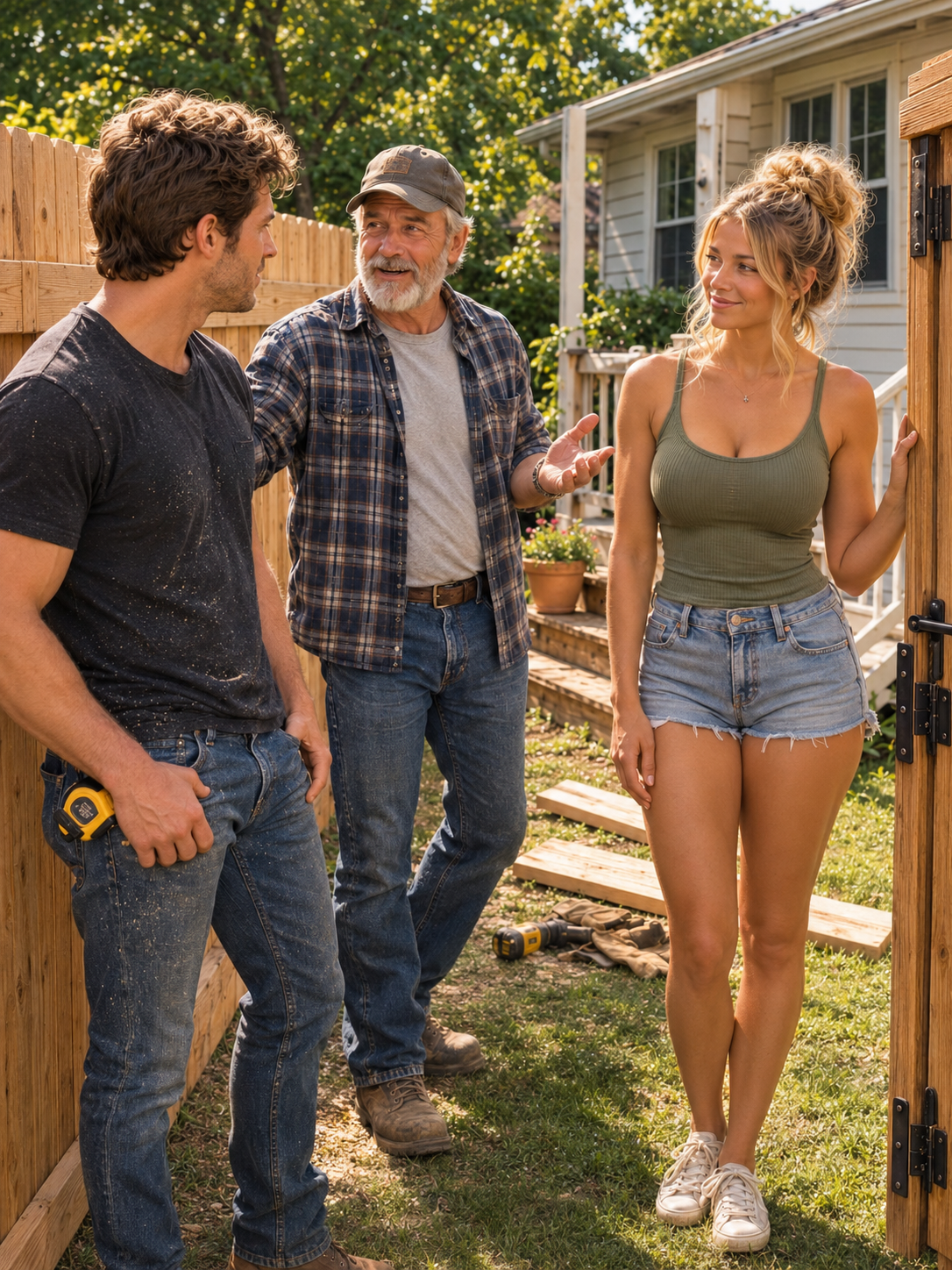
I spent an entire Saturday rebuilding my 82-year-old neighbor’s fence in the Georgia heat, and when we finished, he told me to show up for Sunday supper because he had “someone” he wanted me to meet. I nearly refused, certain it was another awkward setup—until the woman who stepped onto his porch made me forget every excuse I had prepared…
My name is Sam Parker. I’m 30, I direct the band at a public high school in Savannah, Georgia, and I live alone in a little yellow house with a front porch and a piano I can’t afford to have tuned. My neighbor, Hank Dawson, is 82, a Vietnam veteran and a widower of five years. He still raises an American flag on his porch every morning and takes it down every evening, folding it carefully even when it rains.
For the first year I lived next door, Hank and I barely spoke. He’d nod from his porch or grunt when I passed. Once, when I was practicing trumpet on my back steps, he called over the fence, “You’re flat on the high G, son.” He was right, which made it harder to be annoyed.
Eventually, I started bringing him small things: pecan pie from the bakery, his newspaper when it landed in my bushes. He paid me back with tomatoes from his garden and advice I hadn’t asked for. His stories about the Marines usually began, “Now, this one’s not for children.” Somewhere along the way, we became friends, the kind who could sit quietly together without needing to fill every minute.
On Friday afternoon, a delivery truck backed into Hank’s fence and knocked down a long stretch of it. By seven Saturday morning, I was next door with a toolbox and a pot of coffee. Hank was already trying to lift a fence post by himself.
“Hank, put that down.” “I’ve carried heavier things through a rice paddy, son.” “That was sixty years ago.” He glared at me, then set the post down. “Fine. I’m supervising.” He settled into a lawn chair with sweet tea and Sarge, his one-eyed orange cat, in his lap, while I dug holes, poured concrete and hammered boards.
Hank supplied a running commentary, but between instructions he told me how he met his wife, June, at a USO dance in San Diego in 1966. She stepped on his foot during “Moon River” and blamed him for it. When he went to Vietnam, he wrote her a letter every day for thirteen months.
“Every day?” I asked. “Three hundred and ninety-six letters,” he said. “She kept every one. They’re in a shoebox in my closet.” I asked what he wrote about. “Mostly how much I missed her laugh.” He scratched Sarge behind the ear, and for a moment he looked at the roses June had planted along the fence.
Then he studied me over his tea. “Can I ask you something, son? Why does a nice young man like you spend every Saturday alone fixing an old man’s fence?” “I like fences.” “Nobody likes fences.” His eyes narrowed. “Is there a girl?”
I nearly hit my thumb with the hammer. There was a girl, in a way. For four months, I’d stopped every morning at a little coffee shop on Abercorn Street called the Foresight Grind. The same barista made my coffee: large, black, one sugar. Her name tag said Jenna, and by then I knew the sound of her laugh almost as well as I knew the coffee machine.
She had dark, curly hair she usually wore in a high ponytail, a tiny silver hoop in her nose and brown eyes that crinkled whenever she laughed. She laughed at me often. On my first morning there, I’d been humming a John Philip Sousa march while I waited. She handed me my coffee with a tiny trumpet and musical notes drawn on the cup, along with the words, “Have a fantastic day, trumpet guy.”
The next morning, she drew a tuba wearing sunglasses. Then a smiling drum. Then a cartoon of me, glasses and messy hair, conducting a band of squirrels. Every morning brought a new drawing, and I kept all the cups lined up on the windowsill in my classroom. My students thought I needed help, but I couldn’t bring myself to throw a single one away.
In four months, I had never asked Jenna out. I barely managed more than “thank you” and “have a great day.” Once, when she told me to enjoy my coffee, I answered, “You too.” I was still embarrassed about it, which tells you how well I handled talking to her.
Hank watched my face turn red. “So there is a girl.” “There’s a barista. She draws on my coffee cups.” “And you haven’t asked her out?” “I’m probably out of her league.” Hank snorted so loudly Sarge jumped off his lap. “June was out of my league, too. I asked her anyway. Worst thing she can say is no.”
“And then I’d have to find a new coffee shop.” “Coward,” he said cheerfully. I tried to change the subject, but Hank had already made up his mind that he knew more about my love life than I did.
We set the last board in place. Hank wiped his forehead, gave me a slow, sneaky smile I hadn’t seen before and said, “Son, there’s someone I want you to meet.” I groaned. Every older person in Savannah seemed to have a niece, granddaughter or nice church girl they wanted to introduce.
In the previous two years, I’d been set up with a dental hygienist who cried about her ex for three hours, a yoga teacher who told me my aura was beige, and a woman who brought her mother to our first date. “Hank, with all due respect, no.” “Sunday supper. Six o’clock. Wear a clean shirt.” He went inside and shut the door before I could argue.
At Sunday evening, I stood on Hank’s porch in a clean blue button-down, holding a peach cobbler from the bakery and feeling like I was walking into an ambush. Hank opened the door wearing a pressed white shirt and his Marine Corps pin. “You clean up nice, son. She’ll be here any minute.”
“Who exactly is she?” “My granddaughter. She just moved back to Savannah. Six years in the Air Force, aircraft mechanic. Could rebuild a jet engine with her eyes closed. Now she’s finishing her nursing degree at night and working mornings at some coffee place downtown.” “Which coffee place?” I asked.
Before Hank could answer, I heard footsteps behind me and a familiar voice coming up the porch steps. “Sorry I’m late, Grandpa. Traffic on Abercorn—” I turned. Jenna stood there with her dark curls loose around her shoulders, wearing a yellow sundress and white sneakers. She held a bouquet of sunflowers, and when she saw me, she stopped short.
“Trumpet guy,” she said. “Doodle girl,” I managed. Part 2…..
IF FACEBOOK BROUGHT YOU HERE, HERE’S THE CONTINUATION YOU’VE BEEN WAITING FOR. ENJOY! 👇 Hank looked from Jenna to me, his white eyebrows slowly climbing. “You two know each other?” “Very innocently,” I said. “Way too innocently,” Jenna added.
She turned to her grandfather, narrowing her eyes. “Grandpa, did you know? Did you know your neighbor was trumpet guy?” Hank shrugged. “I might have put two and two together. You did say he was a band teacher with glasses who hums Sousa marches and looks like a confused golden retriever.”
Jenna’s face went bright red. “Grandpa!” I stared at her. “You told him I look like a confused golden retriever?” “In a cute way,” she said, hiding behind the sunflowers. “Oh my God. I’m going to die on this porch.”
Hank chuckled and disappeared inside. “Supper’s on the table. Y’all figure it out.” The screen door banged shut, leaving Jenna and me on the porch as the sun went down behind the oak trees and Spanish moss moved in the warm breeze. “So,” she said, peeking at me over the flowers.
“You talk about me to your grandpa?” “Only a little.” “How little?” She lowered the sunflowers, cheeks still pink, wearing the crinkly-eyed smile I’d been watching across a coffee counter for four months.
“Every single Sunday for four months,” she admitted. “He kept asking if Trumpet Guy had asked me out yet. Every week I had to say no.” “I was going to. Eventually. Maybe in five to ten years.”
She laughed, bright and loud, and it sounded even better without a cappuccino machine screaming in the background. “I drew you a tuba wearing sunglasses, Sam. I drew you conducting a band of squirrels. How much more obvious did I have to be?”
My heart seemed to stop. “You know my name?” “It’s on your credit card every single morning. Samuel Jefferson Parker.” She smiled. “What does the J stand for?” “Jefferson.” “That’s a very patriotic name. No wonder Hank likes you.” “I kept them,” I blurted. “Kept what?”
“The cups. All of them. They’re on the windowsill in my classroom. My students think I need help.” Jenna stared at me, her lips parting. For a second, she looked completely stunned. “All of them?”
“Eighty-seven cups.” “You counted?” “I’m a musician. I count everything.” She looked at me for a long moment, then reached up and gently straightened the collar of my shirt. Her fingers brushed my neck.
“Well, Samuel Jefferson Parker, I guess you’d better come inside and eat my grandpa’s pot roast before he comes out here with a shotgun.” “Does he have a shotgun?” “He’s a Marine from Georgia, Sam. He has four.”
Dinner was the best two hours of my life. Hank’s pot roast was incredible, and Jenna had a crush on me that she was no longer bothering to hide; she kept nudging my foot under the table. Hank told embarrassing stories about her as a little girl, including the time she took apart his lawn mower at nine and put it back together with three pieces left over.
“It still ran,” Jenna protested. “It ran backwards, sweetheart.” Jenna told stories about fixing F-16s in the middle of the night at a base in Germany. She explained that she’d joined the Air Force at eighteen because her father left when she was a kid, and Hank was the one who taught her to be tough.
She’d wanted to make him proud. “You did,” Hank said quietly, looking at her. “Every single day.” Jenna’s eyes softened and grew shiny, and she looked down at her plate.
After dinner, Hank announced he was very tired and went to bed with the subtlety of a marching band. Jenna and I sat on his porch swing in the dark. Crickets sang, June’s roses and honeysuckle scented the air, and fireflies blinked over the new fence I’d built.
“He planned this,” Jenna said. “The whole thing, I think.” “I bet he paid that delivery truck to hit his fence.” I laughed, and she leaned back, her shoulder pressing against mine.
Then she told me that when she left the Air Force the year before, she’d felt lost. Six years of fixing jets and taking orders had given her a purpose, and suddenly she was a civilian who didn’t know who she was. She took the coffee shop job because she needed something normal.
“And then one day this guy came in humming a Sousa march badly,” she said. “I drew him a trumpet, and he looked at it like I’d handed him a Christmas present. Every morning after that, I’d wake up and think, ‘What am I going to draw for Trumpet Guy today?’ You were the best part of my day, Sam, for four months, and you didn’t even know it.”
I turned toward her in the porch light. Her eyes were shining. “You were the best part of mine, too. Every single morning.” She looked at my mouth, then back at me.
“Sam, if you don’t kiss me on this porch swing right now, I’m going to start drawing you as a turtle every day forever.” So I kissed her, soft at first. Her lips were warm and tasted like peach cobbler. She slid a hand to the back of my neck, and I pulled her closer.
The swing rocked gently beneath us; fireflies blinked in the yard. When we finally pulled apart, she rested her forehead against mine. “Four months,” she whispered. “I know.”
“Eighty-eight cups.” “Eighty-eight.” “You’re drawing me one tomorrow.” She laughed against my lips. From somewhere inside the house, we heard Hank call, “About time.” Jenna buried her face in my shoulder, laughing so hard she shook.
The next two months were magic. I still went to the Foresight Grind every morning, but now Jenna drew hearts on my cup and sometimes leaned across the counter to kiss me when nobody was looking. Her manager, a big bearded guy named Leon, would call, “Jenna, customers!” On Saturdays, we explored Savannah together, walking beneath the oak trees in Foresight Park and taking a ghost tour downtown. She grabbed my arm whenever the guide said “boo,” even though she’d fixed fighter jets in a war zone.
She taught me how to change the oil in my car; I taught her three notes on the trumpet. She was so terrible that Hank yelled over the fence, “Somebody strangling a goose!” Every Sunday, the three of us had supper at Hank’s house. He’d sit at the head of the table with his arms crossed and pretend to be grumpy, then tell us, “You two make me sick,” while smiling.
Part 3 But then came Veterans Day. Every November, my marching band performed in Savannah’s parade, our biggest show of the year. The city had added a cannon salute near the start of our finale. Jenna and Hank stood near the front: Hank in his Marine Corps cap, saluting each flag, and Jenna waving a little American flag at me. I raised my baton as the cannons fired.
I looked toward the crowd, still smiling, and my smile disappeared. Jenna was gone. I found her twenty minutes later on a bench in a quiet corner of Foresight Park, with Hank beside her and one arm around her shoulders. Her hands were shaking, and her face had gone pale.
When she saw me, she stood and wiped her eyes. “Sam. Sorry. I just needed some air.” She said the kids had been amazing, but when I pointed out that she was shaking, she said she was cold. It was seventy-four degrees.
She looked at Hank. He stood and said, “I’ll be in the truck,” then walked away. Jenna sat staring at the ground before she spoke.
“In Germany, our base had an explosion in the hangar. A fuel-line accident. Two of my friends were inside.” Her voice was flat. “It’s called PTSD. I’ve been seeing a counselor at the VA for a year. Mostly I’m okay, but sometimes…”
I sat beside her. “I’m so sorry. I didn’t know.” Her eyes filled. “I didn’t want you to know. You’re so sweet and normal, Sam. You teach kids music and hum in coffee shops. You haven’t been through anything like this.”
“You deserve someone who doesn’t run away from parades.” Her voice cracked. “I’m sorry. I think we should take a break.” Then she walked away before I could answer.
For a week, Jenna wasn’t at the Foresight Grind. Leon said she’d switched to afternoons. He made my coffee in a plain cup, without drawings. It was the worst coffee I’d ever had.
On Saturday, I knocked on Hank’s door. He answered in his robe with Sarge on his shoulder. “She won’t talk to me, Hank. I don’t know what to do.” He studied me for a moment, stepped aside and said, “Come inside, son.”
He went to his bedroom and returned with an old, worn shoebox. Inside were hundreds of yellowed envelopes with faded stamps, tied together with ribbons. “Three hundred and ninety-six letters,” he said. “Remember?” I did.
“There’s something I didn’t tell you,” Hank said. When he came home from Vietnam, he wasn’t the same man June had written to. He had nightmares every night; Fourth of July fireworks made him hide in the bathtub, and a car backfiring could send him under the kitchen table.
He looked down at the letters. “I tried to break up with June three times that first year. Told her she deserved someone whole.” I asked what she did. Hank smiled, sad and beautiful. “She said, ‘Harold Dawson, I didn’t write you 396 letters to let you quit on me now.’”
They married anyway. For fifty-three years, every Fourth of July, June sat in the bathtub with him, holding his hand until the fireworks stopped. My throat tightened. Hank pushed the shoebox toward me. “Jenna’s not broken, son. She’s the toughest person I know. She’s just scared you’ll see her at her worst and leave.”
“So, don’t leave.” I looked at the letters for a long time. Then I went home and started writing.
Monday at six, before the Foresight Grind opened, Leon let me in. I left a plain white cup with a bad drawing of Jenna in a flight suit, holding a wrench beneath a big heart. I wrote, “Have a bravetastic day. Doodle girl,” and went to school.
Tuesday’s cup showed Jenna fixing an airplane: “You’re the toughest person I know.” Wednesday’s showed me, Hank and Jenna on the porch swing: “Still the best part of my day.” Thursday’s showed me holding her hand beneath a thunderstorm: “I’m not scared of storms.”
On Friday, Leon called. “She cried at every one,” he said. “Then she put them on the shelf behind the espresso machine like a little museum.” I asked if she’d said anything. “She asked what time your band concert is tonight.”
That Friday’s Veterans Day concert was quieter: no marching, no cannons, just our band playing for local veterans. I’d made one change to the program. The auditorium filled, and Hank sat among the front-row veterans in his Marine Corps jacket.
Jenna sat beside him in a blue dress, her hair down, holding his hand. When she saw me glance over from the stage, she gave me a small, nervous smile. At the end, I stepped to the microphone. “We have one more piece. This one isn’t on the program.”
I dedicated it to Hank, who had written 396 letters to the love of his life, and to Jenna, who had served six years and was braver than anyone I knew. The room went quiet. I set down my baton, picked up my trumpet and played “Moon River,” alone and softly.
It was the song Hank and June danced to at a USO dance in 1966. I hit the high G without going flat. The auditorium fell silent, then the veterans in front stood and clapped. Hank cried openly. Jenna was crying, too.
She walked down the aisle, climbed the stage steps and wrapped her arms around my neck in front of three hundred people. “You played Grandma’s song,” she whispered. “I wanted you to know I’m not going anywhere. Not after parades, not after storms, not ever.”
She pulled back, eyes red and shining. “I’m not uncomplicated, Sam. I don’t want uncomplicated. I want you—all the complicated, brave, terrible-at-trumpet parts.” She laughed through her tears. “I’m really terrible at trumpet. Hank says I sound like a strangled goose.”
“I love you, Sam Parker,” she said. “I think I’ve loved you since the squirrel band.” “I love you, too, doodle girl.” She kissed me onstage, in front of my band, three hundred veterans and Hank. My students went wild; the drummer rolled, the tuba player yelled, “Mr. Parker!” and Hank wiped his eyes and saluted.
Final A year later, I walked into the Foresight Grind at on a Tuesday morning. Hank was with me, wearing his Marine Corps cap and a very suspicious smile. Jenna stood behind the counter. She’d finished nursing school and would start at the VA hospital in a month, but she still worked Tuesday mornings because she said Leon would fall apart if she stopped.
She grinned when she saw us. “Well, look who it is. Trumpet guy and Grandpa. Large black coffee, one sugar?” “Actually,” I said, “this time I made you one.” I set a cup on the counter with the best drawing I’d ever managed, which was still pretty bad: Jenna and me on Hank’s porch swing, fireflies around us, and Hank and Sarge peeking through the window.
Underneath, I’d written, “Will you marry me, doodle girl?” Jenna read it, then read it again. Her hand flew to her mouth. I got down on one knee between the pastry case and the sugar station and opened a little velvet box. Inside was a small, simple diamond ring that had belonged to June.
Hank had given it to me a month earlier, pressing it into my palm on his porch. “June would have wanted it to go to somebody who doesn’t quit,” he’d said. I looked up at Jenna. “Four months of coffee cups, a year of the best days of my life. I want every single morning with you—the good ones and the hard ones. Will you marry me, doodle girl?”
Jenna came around the counter so fast she knocked over the tip jar. She dropped to her knees in front of me, tears pouring down her face. “Yes,” she said. “Yes, yes, trumpet guy.” I slid her grandmother’s ring onto her finger, and she threw her arms around my neck and kissed me.
The whole coffee shop started clapping. Leon rang the little bell above the register, and Hank stood by the door wiping his eyes with a napkin. “About time,” he said. We got married the next spring in Hank’s backyard, right beside the fence I’d built. June’s roses were in full bloom.
Jenna wore a white dress with her Air Force dog tags. My marching band played her down the aisle, and Hank walked her slowly and proudly, his Marine Corps pin on his lapel. At the reception, after a few glasses of champagne, Hank pulled me aside by the fence and patted one of the posts.
“Son,” he said, “I need to confess something.” I asked what. He leaned closer and lowered his voice. “That delivery truck barely tapped this fence. Knocked over one board, maybe two.” I stared at him. “There were forty feet of fence down, Hank.”
He gave me that same slow, sneaky smile. “I’m a Marine, son. We know how to make a situation look worse than it is.” Then he admitted he’d knocked the fence down himself with a crowbar. It had taken him two hours, the hardest he’d worked in a decade. “Worth every minute,” he said, clapping my shoulder.
Then he walked off to dance with his granddaughter, humming “Moon River” off-key. I watched them beneath June’s roses and thought about how close I’d come to saying no to that Sunday supper. So tell me, has anyone ever played matchmaker for you in the sneakiest way possible, or have you ever had a crush you were too scared to talk to?
THE END. I’ve shared the complete story, and I truly hope it touched your heart. If this story moved you, please , like, and share the post. Thank you for reading! ❤️
✓ Lynn R. Adams
I spent an entire Saturday rebuilding my 82-year-old neighbor’s fence in the Georgia heat, and when we finished, he told me to show up for Sunday supper because he had “someone” he wanted me to meet. …