I spent 35 years earning a Navy admiral’s star, but when I arrived early at a destroyer in my own strike group, a chief looked at my plain raincoat and told me I didn’t belong on his ship…
I spent 35 years earning a Navy admiral’s star, but when I arrived early at a destroyer in my own strike group, a chief looked at my plain raincoat and told me I didn’t belong on his ship…
My name is Roslyn Vance. In June 2026, I was 57 years old, a rear admiral in the United States Navy, and responsible for a carrier strike group. Yet one damp morning at a destroyer’s gangway brought back a sentence my father had spoken when I was ten.
My father, Conrad Vance, was a boatswain’s mate who rose to master chief. When I was seven, he taught me to blow a boatswain’s pipe on our back porch, guiding my fingers around the little brass instrument until I could make the note rise and fall. I loved that sound before I understood what it meant.
Dad had a saying: “Officers sign the papers. Chiefs run the ship.” He believed it with the certainty other people reserved for church, and our home was full of his stories about sailors who kept vessels running with their hands and backs.
On a family visit to his ship, I watched a captain come aboard between rows of sailors as the pipe sounded. I asked whether a girl could ever receive honors like that. Dad rested his hand on my head and said, “That’s not really our side of the Navy, sweetheart.”
My brother Garrett, two years older than me, picked up the same attitude. He joked that real Vances wore chevrons instead of officers’ stripes, and I laughed along even when it hurt. Our mother, Lorraine, kept Dad’s certificates and medals in a shoebox, and I wondered whether there would ever be room for mine.
I didn’t choose a commission to spite my father. I wanted to understand the ships I loved, lead the people aboard them, and perhaps someday stand where that visiting captain had stood. The pipe had sounded like possibility to me, even when Dad called it someone else’s world.
In the spring of 1987, I laid my Naval Academy appointment letter on our kitchen table. I was 18, and my mother cried and wrapped both arms around me. Dad nodded once and told me the chiefs would teach me anything worth knowing.
That became the pattern of my life with him. There was always praise, followed by a reminder that the real Navy belonged to someone else. I kept listening for the day he would say he was proud without adding anything afterward.
I received my commission as an ensign in May 1991. Dad had retired that spring after 30 years, and I asked him to give me my first salute, a Navy tradition between a new officer and an enlisted sailor. I wanted that moment more than I could tell him.
He saluted with perfect precision, then closed my fingers around a silver dollar. “The easy part’s over,” he said. “Now earn what the crew already has.” My mother took photographs while I tried to convince myself his stiff formality was simply his way of showing love.
In 1993, after months of study and demanding boards, I earned my surface warfare officer pin aboard a cruiser. I called home almost immediately, still shaking with relief. Dad said, “Good. Now you can stand watch like the rest of them,” and Garrett laughed on the extension.
Through the rest of the 1990s, I stood watches in the Gulf, qualified as a tactical action officer, and advanced through the ranks. At family gatherings, Dad told his sea stories while I sat quietly nearby. He never seemed to notice that his daughter was serving in the very Navy he described so proudly.
In 2007, I made commander and was given command of a destroyer. The first morning underway, I stood on the bridge wing and cried where no one could see me, overwhelmed by responsibility and by how far that little girl on the pier had come. Every life aboard depended on decisions I would make.
Mom was delighted when I called from our first port. Dad said it was a fine achievement, then asked whether I had a strong chief running the deck force and reminded me to listen to him. He attended my change of command, but in our photograph afterward he stood a careful half step away.
I became a captain in 2013 and led a destroyer squadron. I had loyal crews, good friends, and Delphine Stroud, my former executive officer, who understood me better than almost anyone. I told myself I no longer needed an approving word from home.
In 2021, I was promoted to rear admiral, lower half. Dad shook my hand and said, “A star. Imagine that.” Then came his familiar qualification: my grandfather would still have said the chiefs ran the ship.
By the spring of 2026, I commanded a carrier strike group with thousands of sailors and a dozen ships under my responsibility. I had a habit my staff knew well: when visiting a ship, I sometimes arrived before the formal welcome to see an ordinary working morning. It helped me understand the crew beyond a polished inspection.
That June morning was cold and gray, with drizzle hanging over the harbor. My scheduled visit to a destroyer was at ten, but I reached the pier around twenty minutes before nine. My aide was parking the car, and I walked ahead alone in slacks and a civilian raincoat.
My identification card was in my pocket, and I wore nothing that announced my rank. I could hear the familiar harbor noises as I approached the brow, the gangway connecting the pier to the ship. I expected to identify myself to the watch and go aboard.
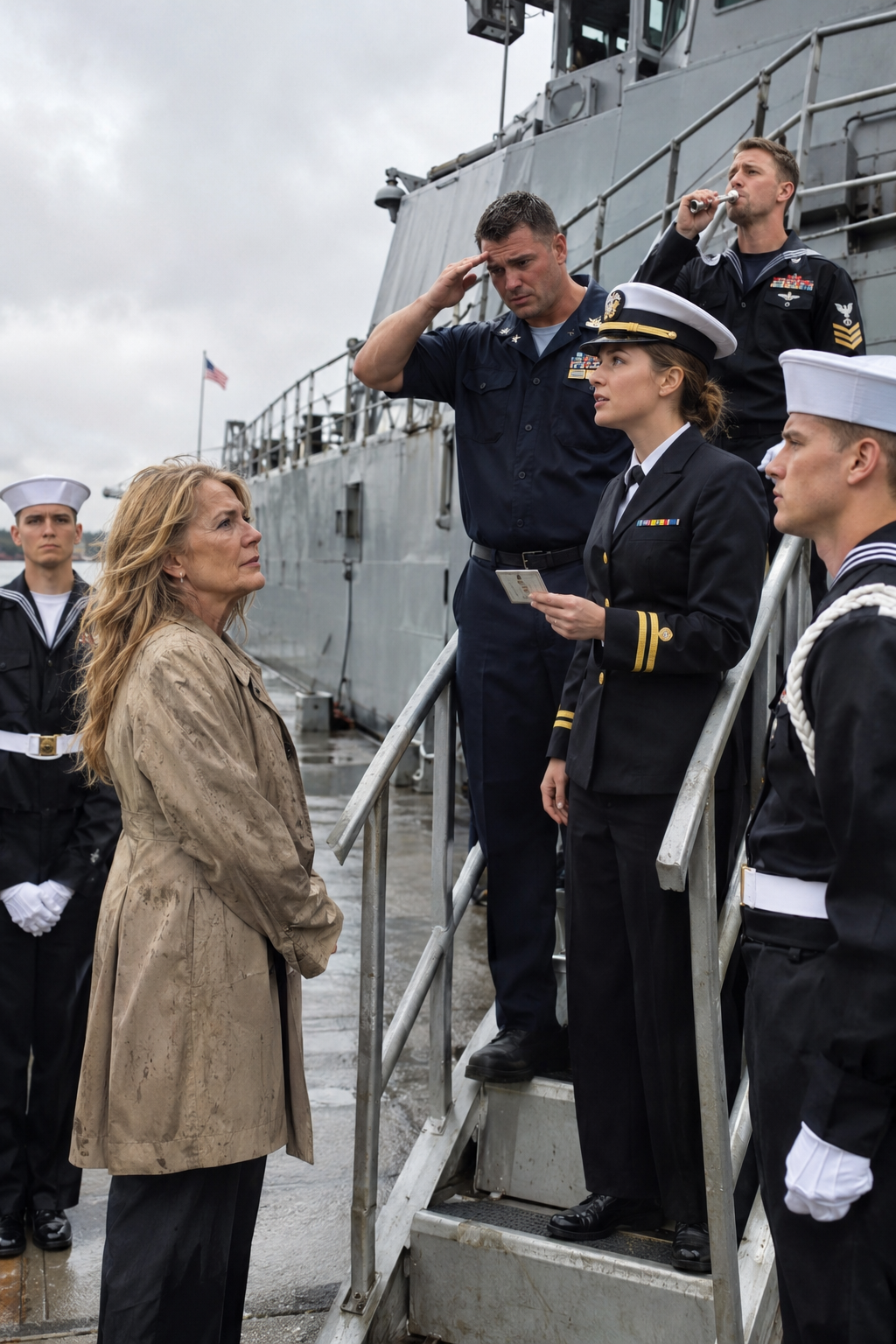
Chief Petty Officer Travis Hale, 38, was on the quarterdeck watch. He saw an unescorted woman in a raincoat, stepped into my path, and raised his hand. “Ma’am, crew only. This is a Navy warship, not a tour,” he said, directing me toward the visitor center.
He was right to protect his ship. Nobody should be allowed aboard a warship just because they look confident, and I respected that responsibility. What caught me was that he had decided I didn’t belong before asking who I was.
“Chief, would you check today’s visit bill before turning anyone away?” I asked. My name had been on the schedule for a week. He moved down a step, glanced at the junior sailors behind him, and tightened his jaw.
“Lady, I run this quarterdeck,” he said. “I know who’s coming aboard this ship today, and I promise you it isn’t you.” I stayed where I was, not wanting to make the watch’s job harder, but the words hit a place I thought I had outgrown.
A young officer, Ensign Nora Albright, was watching. She was 23, only nine months out of the Academy, and unlike the chief, she looked uncertain rather than annoyed. “Chief, let me log it,” she said, then asked me politely for identification.
I handed her my common access card. She glanced at the picture, read my name, then looked again at my rank. Her eyes lifted to mine as she recognized Roslyn Vance from the ship’s plan of the day: the strike group commander expected more than an hour later.
“Admiral,” she said, coming sharply to attention. “Ma’am, I’m so sorry.” I was about to tell her she had done exactly what she should when she turned toward the quarterdeck and called for the boatswain’s mate of the watch.
First-Class Petty Officer Silas Ward raised his pipe. The long note climbed, held, and fell across the damp harbor, the same call my father had taught my seven-year-old hands. Sailors moved into position, the ship’s bell sounded, and the announcement of the strike group commander’s arrival carried across the pier.
Eight sideboys formed the honors I had once watched from beside Dad. Chief Hale stood motionless where he had blocked me, his salute arrested halfway, while the ship honored the woman he’d mistaken for a visitor. I stood in my wet raincoat and finally heard that childhood call being blown for me—and wondered why, after everything I’d accomplished, it hurt as much as it healed. Part 2…..
IF FACEBOOK BROUGHT YOU HERE, HERE’S THE CONTINUATION YOU’VE BEEN WAITING FOR. ENJOY! 👇 Commander Soren Whitfield, the destroyer’s 46-year-old captain, came down from the deck above as the honors were ending. He saluted and welcomed me aboard with a smile that was familiar even before he spoke. “I served under you on the Callaway, ma’am. I was a lieutenant. You probably don’t remember me.”
But I did remember him: a serious young officer who stayed late to make sure a job was finished properly. When I told him so, his expression changed in the smallest, most telling way. He seemed relieved to learn that someone he had respected had remembered him all these years.
I returned the salutes and stepped aboard while Chief Hale finally completed the salute he’d started. My coat was damp, my shoes were wet, and I felt strangely close to tears. There was no pleasure in watching a good chief realize he’d made a mistake in front of his shipmates.
The chief had been protecting his quarterdeck. His mistake was deciding what sort of person I was before checking my identification, and that was a mistake worth correcting. But the sharpness of his words had come from a belief I knew by heart, spoken for decades by a man who loved me.
Commander Whitfield quietly asked whether I wanted Hale put on report. I told him no, and asked to proceed with the visit as planned. A ship’s watch needed firm standards, not fear of being publicly crushed when an error was caught and corrected.
I walked through the destroyer, listened to the officers and sailors, and asked the questions I had come to ask. The work went on around us, as it should have. But I kept hearing the boatswain’s pipe underneath ordinary conversation, and seeing Dad’s big fingers guiding mine around the brass.
When I was ten, I’d asked if a girl could be honored like that captain we watched board his ship. Dad’s answer had stayed with me through boards, deployments, command tours, and promotions. Now eight sailors had lined a gangway for me, and the ship had announced my arrival over the whole waterfront.
The strangest part was that this was hardly the first time I’d been piped aboard as an officer. I’d received the honors before, and I knew exactly what they meant. Yet I had somehow carried my father’s old dismissal into every ceremony, as though the Navy’s recognition couldn’t count unless he recognized it, too.
That evening, alone in a hotel room, I called Delphine Stroud. She’d retired as a captain two years earlier and had been my executive officer before she became the closest friend I had. I told her about Hale, the identification card, and the quarterdeck springing into motion.
“Roz, you’ve received those honors before,” she said. “Why did this time hurt so much?” I stared at the lights trembling on the harbor and finally answered without dressing it up as a lesson in leadership.
“My father taught me that call when I was seven,” I told her. “He taught me how to make it sound, then spent the rest of my life acting as though it would never truly belong to me. Today a stranger told me I wasn’t welcome, and the pipe answered him. I couldn’t keep pretending I hadn’t heard it.”
Delphine let me finish. “So the chief didn’t create that hurt,” she said. “He made you see something that was already there.” I sat quietly with the phone against my ear, knowing she had understood what I couldn’t quite explain to myself.
For years I’d talked about Dad as though I had made peace with his limitations. He had come to ceremonies, shaken my hand, inspected my ships, and shown affection in the only manner he seemed to trust. But I’d still been waiting for one sentence that didn’t begin warmly and end with a reminder about who really ran the ship.
The next morning I went back early and asked Chief Hale to walk with me along the brow. He stood stiffly at attention and said he deserved a report for turning an admiral away. The words came so quickly that I could tell he’d rehearsed them.
“Chief, you stopped a person you couldn’t identify from boarding a Navy warship,” I said as we walked. “That’s the right instinct, and I don’t want you to lose it. But you decided who I was before you asked for my card. Keep your standards and change that part.”
He glanced at me, waiting for the reprimand to grow teeth. I told him the watch should verify a stranger’s credentials before deciding that person had no business being there. It wasn’t a special privilege for admirals; it was a sound way to guard a ship and treat people fairly.
Then I told him something personal. “My father was a master chief boatswain’s mate. Thirty years in the Navy. He’d have stopped me in that raincoat, too, but he’d have asked for identification first.”
Hale looked up sharply at the words “master chief boatswain’s mate.” I could see him realizing that the admiral in front of him had grown up with deck-plate stories, tools, watches, and the same old creed that had shaped his own career. “Ma’am,” he began, then stopped.
“I know, Chief,” I said. “Carry on.” I watched him return to his quarterdeck, where sailors were already reporting for duty, and I felt sure the lesson would stay with him longer than any public humiliation.
There was one more conversation I had avoided all my adult life. This time I wasn’t going to arrive at my parents’ house bearing another accomplishment and hoping Dad would finally approve of it. I was going to tell him what happened and allow him to make of it what he would.
Part 3 Dad was 84 when I pulled into my parents’ driveway. The garage door was up, and he sat inside with a mug of cold coffee in his hands. Garrett, now 59, was there with him, while Mom was in the house.
I turned over a bucket and sat across from Dad, where I used to sit while he repaired things when I was little. He studied my face, perhaps expecting news about a promotion or a schedule he could question. I had nothing to show him except a story.
“Yesterday I went to a destroyer early in civilian clothes,” I said. “The chief at the gangway didn’t recognize me, and he told me the ship was for crew only.” Dad shifted forward, ready with what I knew would be a defense of the watch.
“The young officer checked my identification,” I continued. “She called away honors, and they piped me aboard. Eight sideboys, Dad. The same call you taught me on the porch when I was seven. They blew it for me.”
Dad lowered his eyes to his coffee. His thumb traveled around the edge of the mug, slowly and then slowly again, while Garrett kept still beside the workbench. I could hear a car passing outside, and somewhere inside the house a cupboard closed.
I waited without explaining why the story mattered. For most of my life, I would have filled that silence by talking about my responsibilities, the size of the strike group, or the proper honors for a flag officer. I would have offered him every possible reason to be proud, hoping one would finally reach him.
This time I let the facts stand. I couldn’t make him understand what it had cost me to spend decades receiving approval only with conditions attached. And I didn’t need to turn our garage into another examination I was desperate to pass.
Dad said nothing. I had expected his silence to feel like another rejection, but it didn’t feel quite the same. He wasn’t searching for a clever answer or reaching automatically for a story about chiefs; he was sitting with something he hadn’t expected to hear.
Garrett walked me down the driveway afterward. Near my car he stopped and laid a hand on my arm. “Eight sideboys,” he said quietly, and I realized he’d looked up the honors on his phone while I was talking to Dad.
“I looked up what a strike group commander does,” he told me. “I’ve been making the same joke about officers since you were eighteen, and I never actually bothered to understand your job.” He looked back toward the open garage and swallowed.
“I made you smaller so I wouldn’t have to feel small beside you,” he said. “I’m sorry, Roz.” It wasn’t a neat apology, and after so many years it couldn’t instantly change our history, but for once he had named what he’d done instead of asking me to laugh it off.
I drove away without asking either of them for a promise. Mom told me later what happened after I left, and Garrett filled in pieces over the following weeks. For the first time, the three of them were examining a family rule I had spent decades trying to survive.
Garrett sat at his own kitchen table and considered what my work actually involved. He realized I commanded more ships at once than Dad had served on across his career, with responsibility for more sailors than had crewed those vessels combined. His jokes had kept him comfortable, but they had also kept him from knowing his own sister.
He began telling coworkers and friends about me without turning it into a punch line. “My sister’s an admiral,” he’d say, then explain the ships under my command and what it meant to be piped aboard. I heard about it from Mom before Garrett mentioned it himself.
Dad went into the garage and took his old brass boatswain’s pipe from the pegboard. Mom saw him through the kitchen window, turning it over in his fingers and lifting it toward his mouth. Twice he tried to blow the call and twice he lowered it without making a sound, then sat on the workbench stool with the pipe resting in his palm.
Mom had kept a second shoebox all those years, one I knew nothing about. The first held Dad’s medals and certificates; this larger one held my change-of-command programs, newspaper clippings, and a photograph of me standing on a bridge wing. She had saved evidence of my life while the rest of us argued about whether that life counted.
One evening she carried the box to the kitchen table and opened it in front of him. “I kept these because somebody in this house had to acknowledge what our daughter was doing,” she told him. “I’m tired of being the only one who says it out loud.”
Dad looked at the photographs and programs for a long time. Mom said he eventually put his palm flat on the stack, as though the pages might scatter if he let go. She didn’t force him to speak, and when she told me about it, I didn’t ask her to.
A week after our talk in the garage, Garrett called again. He said he had stopped telling himself the jokes were harmless just because he hadn’t meant them to wound me. “They cost you something,” he said. “I can’t pretend they didn’t.”
I told him I’d always known he loved me. “I just wanted you to see me,” I said, and he answered that he would try to do a better job of it while we still had time. I could hear him struggling, but he didn’t turn it into a joke.
Late that summer, my father called me and asked a question he’d never asked before. “Rosalind, what does a strike group commander actually do all day? I want to understand.” I sat down and told him about the ships, the sailors, and the decisions that could arrive on my desk at three in the morning.
He listened without interrupting to explain the value of a good chief. When I finished, there was a pause, then he said, “That’s a lot of ship, Roz.” It wasn’t a grand declaration, but it belonged entirely to the work I’d described, and he left it there without a qualification.
Not long afterward, Dad said Mom had never seen one of my ships properly and asked whether he could drive her for a visit. He framed it as a favor to her, but I could hear the request underneath it. This time, instead of waiting for him to notice me from a distance, I arranged for my parents to come aboard as my guests.
Final When my parents arrived at the pier, Dad wore an ordinary windbreaker, and Mom stayed close to him as we approached the gangway. There was no crowded family-day ceremony this time. They were visiting a destroyer in my strike group with me, their daughter, who was now the admiral receiving the honors.
The watch called the arrival, the bell sounded, and the boatswain’s pipe rose through the air. Eight sideboys stood in formation as I came aboard, and Dad watched from only a few feet away. He came to attention automatically, but his eyes moved from the young sailors to me and back again.
Commander Whitfield greeted us once the honors were complete. Dad didn’t immediately talk about the brightwork or the condition of the deck, though that would have been the old Conrad Vance. Instead, he approached the young boatswain’s mate who had sounded the pipe and gently adjusted his grip.
“Cup it,” he said, placing his thick fingers around the sailor’s hand for just a moment. “Let the note come from the air, not the lip.” I could almost see our back porch again, the same hands teaching the same lesson half a century earlier.
Then Dad turned toward me. “Your call’s cleaner than mine ever was, Roz,” he said. It was the kind of compliment only he could give, and it came without a lesson about who really ran the ship.
I had to look out over the harbor before I answered. “That’s the only review I ever wanted, Dad.” He nodded, and for once neither of us added anything to the silence.
It didn’t erase all those years. Dad didn’t suddenly become a man who knew how to discuss feelings, and I didn’t suddenly forget the ache of waiting for him to be proud of me. But from that day forward, something essential was different in the way we spoke.
He began asking about my command and telling other people about it. Mom brought the clippings out of their shoebox, and some of the photographs and programs finally found places on the wall. Garrett stopped using the old officer jokes as a way to introduce his little sister.
Back on the destroyer where the misunderstanding began, Chief Travis Hale had been making changes of his own. Commander Whitfield told me that Hale now used the incident to train his watch standers. His rule was simple: ask for the card first, decide second.
It didn’t mean relaxing security. It meant making security more disciplined by checking facts before drawing conclusions, whether the person at the brow looked powerful or ordinary. The sailors started calling it Hale’s rule, and Whitfield said his quarterdeck had become one of the sharpest in the squadron.
Before our strike group sailed, Hale asked for two minutes alone with me. He stood straight and told me he’d looked up my father’s Navy record because he wanted to understand the man who had raised me. He had found Conrad Vance’s thirty years of service and his master chief’s anchors.
“I’ve thought about that morning every day, ma’am,” Hale said. “There were two boatswains on that brow, in a way. You and the man who taught you. I turned away somebody who understood exactly why I was guarding that ship.”
I told him his quarterdeck was the finest in the strike group, and that I would be glad to come aboard again, announced or not. His salute was clean and complete this time. I left knowing he’d made something useful out of the worst mistake of his career, rather than allowing it to define him.
The night before deployment, I stood at the rail of my flagship and watched the harbor go dark. For a long time I had confused being worthy of honor with hearing Dad say I was worthy of it. On the wet pier, the pipe had finally made those two things separate in my mind.
I was grateful he’d begun to see my life clearly, but I no longer had to spend each day trying to persuade him to look. I could love him as the imperfect father he was, and I could honor the sailor who’d taught me so much without agreeing with the limits he’d placed on me. That felt more lasting than winning an argument in the garage.
Our strike group sailed on a clear morning. Families gathered along the pier, waving toward the ships as sailors attended to the work of getting underway. Dad had asked to stand as close to the foot of the brow as the watch would permit, with Mom on one side of him and Garrett on the other.
I boarded my flagship while the boatswain piped the side. The eight sideboys stood along the way, and the announcement of Carrier Strike Group 15’s commander carried across the waterfront. From the deck I looked down and found my father in his windbreaker.
He wasn’t standing stiffly as he had at my commissioning in 1991. He raised his hand slowly to his brow and held a salute while he looked directly at me. It was only the second salute he had given me in my career, and the first that felt less like duty than a father recognizing his daughter.
His eyes were wet, and his hand trembled slightly. I thought about being ten, tugging his sleeve beside another ship’s gangway, asking whether a girl might someday hear that call for herself. Dad had told me the honors weren’t really for our side of the Navy, yet here he was watching them given to me.
I returned his salute and kept my eyes on him until the work of departure called me away. The little girl who had loved a boatswain’s pipe hadn’t needed to change families or become someone else to earn a place on that gangway. She had needed the chance to grow into the life she could already hear.
Before the ship passed the breakwater and we lost cell reception, my phone buzzed. Garrett had written, “Go run your ships. We’re proud of you. I’m proud of you.” I read the message twice, slipped the phone into my pocket, and went back to my duties.
Dad never delivered the perfect speech I’d rehearsed in my imagination for forty years. He gave me a quiet conversation, a compliment about a boatswain’s call, and a salute that said what words had always failed him. And I discovered that I could accept those gifts without pretending the waiting hadn’t hurt.
I still hear that pipe in my mind sometimes. I hear the little brass instrument on our porch, the one on a gray morning’s quarterdeck, and the call that sounded as my ship went to sea. They are the same music, and I finally know I never needed permission to hear it as my own.
THE END. I’ve shared the complete story, and I truly hope it touched your heart. If this story moved you, please , like, and share the post. Thank you for reading! ❤️
✓ Lynn R. Adams
I spent 35 years earning a Navy admiral’s star, but when I arrived early at a destroyer in my own strike group, a chief looked at my plain raincoat and told me I didn’t belong on his ship… My name is…