I paid a used-car dealer twenty dollars to save an old hound he planned
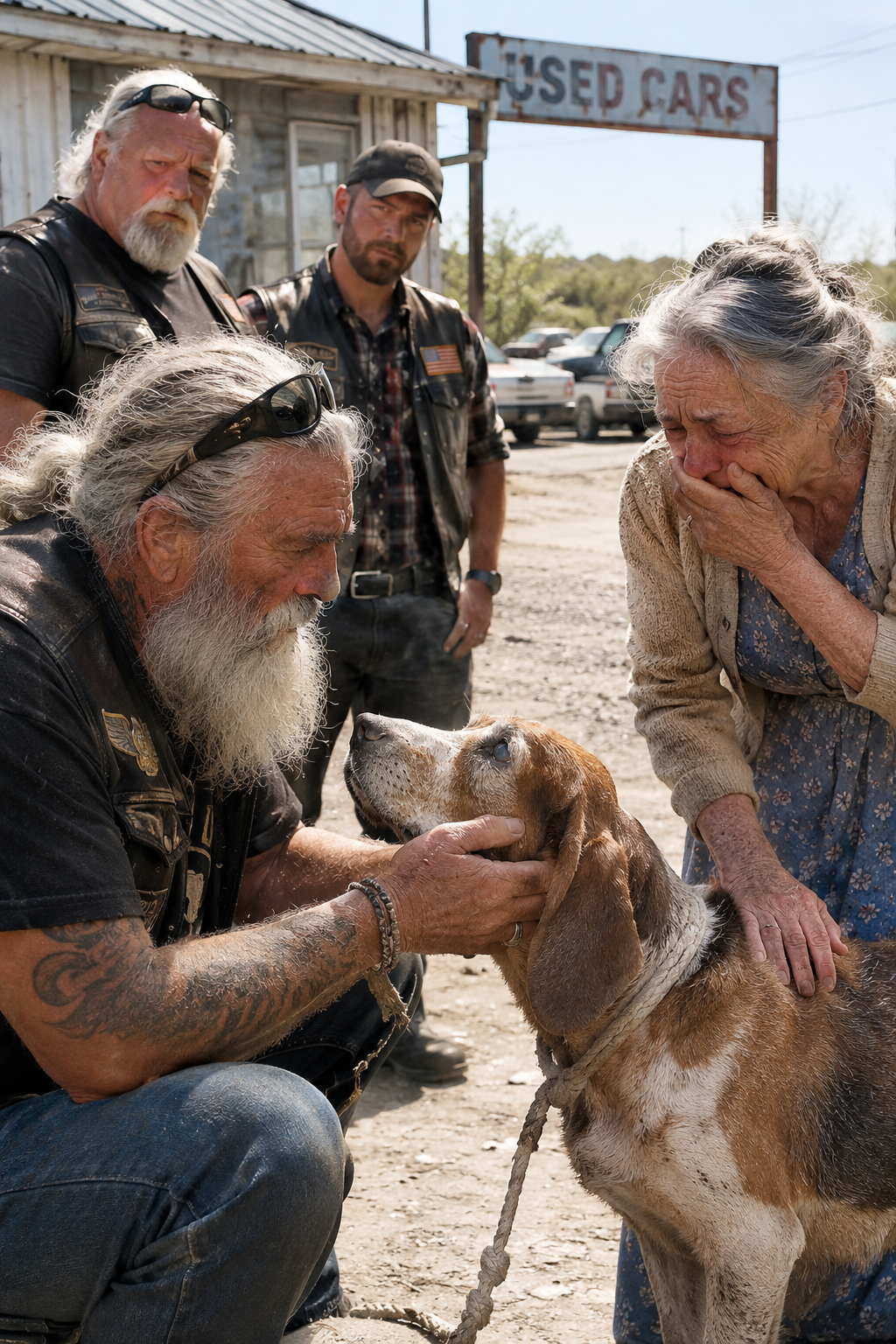
I paid a used-car dealer twenty dollars to save an old hound he planned to abandon, then walked that dog home to a woman who had sold him for five because she couldn’t afford to keep him alive; I thought we’d done one decent thing until the same dealer returned to her porch with a deputy and a folder of papers…
The first thing I heard was a yelp. I looked through the diner window in Flat Rock, Arizona, and saw a man kick a cardboard box across a dusty used-car lot. An old hound scrambled out, only to stumble when the man pulled a rope tight around his neck. The dog was brown and white, gray around the muzzle, and so stiff in the hips that every step seemed to hurt.
I was sixty-six that summer, with a beard nearly to my chest and forty years on a motorcycle behind me. My name’s Dutch Kowalski, and I’d made a habit of staying out of other people’s trouble. Still, I put down my coffee and watched the man in the pressed shirt give the rope another impatient tug.
A small woman in a faded blue dress stood at the edge of the lot, holding five crumpled dollars. She looked about seventy-eight, and she was walking away with her chin up, although she kept turning her head toward the dog. The man laughed as she went, and that was when I knew I wasn’t finishing breakfast.
I left a ten under my plate and headed outside. Roy and Cash came after me without asking questions; Roy was broad through the shoulders with a white ponytail, and Cash was younger, lean, and inclined to save his words. We’d stopped in town while riding to a funeral three states away, and neither of them expected a detour like this.
The man was Rand Coil, though I learned his name a little later. He owned the car lot, wore a gold watch, and had the practiced smile of someone who could make a bad bargain sound like a favor. When I asked about the hound, he said he’d bought him from the old lady for five dollars and figured he’d leave him out in the desert rather than pay a veterinarian.
I felt Roy shift beside me, but I kept my voice even. “I’ll give you twenty for him.” Coil took the bill quickly, handed me the rope, and went back toward his office laughing about how easy the money had been.
I crouched next to the hound and loosened the rope, which had rubbed a red line into the fur of his neck. Instead of backing away, he leaned his trembling body against my knee. He had cloudy eyes, but he looked straight at me long enough that I couldn’t pretend this was simply a purchase.
“We taking him with us?” Roy asked. “We’re taking him home,” I said, glancing down the street where the woman had disappeared. Cash reminded me that sometimes people sell things because they’re broke, and I told him he might be right, but I wanted to hear it from her.
The hound seemed to understand. Once I gave him room to walk, he led us down the cracked sidewalk past a shuttered feed store and an empty bank, then toward the smaller houses at the edge of town. He never pulled away; he kept looking back to make sure all three of us were coming.
He stopped outside a little house that might once have been white but had weathered to gray. The porch sagged, the grass had died, and one rosebush was still trying its best near the steps. The dog sat down, thumped his tail against the dirt, and stared at the front door.
When the woman opened it, she saw the hound before she saw us. “Biscuit,” she whispered, and then she grabbed for him as though three strange men in leather might snatch him away. Her name was Alma Pruitt, and her hands shook so badly she could hardly hold his collar.
“Please don’t take him back,” she said. “I’ll find the money somehow.” I took off my sunglasses, sat on the bottom step, and told her we’d bought Biscuit from Coil and weren’t asking for a cent. It took a moment before the words reached her, and then she sat on the porch with both arms around her dog.
For a while, I didn’t ask a thing. Roy sat down nearby, and Cash stayed in the yard while Alma pressed her face into Biscuit’s fur. When she finally looked up, she asked whether I thought she was a terrible person for selling him.
“No, ma’am,” I said. “I think you were trying to do something hard because you didn’t see another choice.” She studied me for a few seconds, then invited us inside, where the air was hotter than it had been out on the porch.
Alma told us the power company had cut off her electricity three days earlier after four months of unpaid bills. In an Arizona summer, there was no safe way for a woman her age to sit in a sealed-up house without cooling. But she kept glancing at Biscuit while she talked, and I knew the electric bill wasn’t the whole story.
Biscuit had a heart condition and needed a pill every day. Alma had reached the point where she couldn’t afford both the household bills and his medicine, and she’d convinced herself a man who owned a business might be able to care for him. Coil offered five dollars, and she took it because she couldn’t bear to watch Biscuit get sicker on her kitchen floor.
She showed us the empty spot where his medicine usually sat, then apologized for having no cold water to offer. That apology nearly undid me. Roy stepped outside with his phone, and Cash asked what groceries she needed before taking off on his bike.
Within the hour, Cash was back with food and Biscuit’s medicine, which cost eleven dollars a month. Roy had called in a favor and sorted out the overdue power bill so the service could be restored. When the refrigerator finally started humming again, Alma put one hand on the counter and stood very still, looking at the light above her stove.
She insisted on making coffee even though we told her she didn’t owe us anything. We sat in her small living room, and Biscuit lay nearby with his belly full and his medicine in him. Alma told us about her late husband, Harold, and laughed at something Roy said; for the first time that day, her shoulders dropped away from her ears.
I remember thinking we could leave knowing we’d done enough. The dog was safe, the power was on, and Alma had groceries and a little breathing room. I was already considering whether we could still make decent time toward the funeral when somebody knocked hard on the door a little after four.
Alma stopped halfway through a sentence. I watched the color leave her face before she’d even stood up, and she whispered that she knew who it was. I went to the door, with Roy rising behind me and Cash turning from the window.
Rand Coil stood on the porch in his pressed shirt, carrying a folder. A county sheriff’s cruiser was parked at the curb, with a deputy beside it, and Coil looked past me toward Alma as though the rest of us weren’t there. He said she was ninety days behind on a loan, handed over papers he described as a foreclosure notice, and told her she had thirty days to leave.
I opened the folder and saw Alma’s shaky signature beneath a loan agreement with Coil’s name listed as the lender. The dog she’d sold for five dollars was back in her living room, but the man who’d dragged him by a rope was now claiming he could take the house, too. Alma sank into a chair and said, so quietly I almost missed it, “He gave me that loan after Harold died.” Part 2…..
I stepped back from the doorway rather than give Coil an argument he could use. Roy’s jaw was tight, and the deputy watched us closely, but I told everyone we weren’t causing trouble. Coil left with that same little smile, and I kept the papers so we could find out exactly what Alma had signed.
She explained that Harold’s medical bills had piled up after his death two years earlier. The bank had refused to lend to her, but Coil came right into her living room and talked about neighbors helping neighbors. Her eyesight wasn’t good, he was in a hurry, and she trusted him when he called the documents standard.
I read every page at the kitchen table while she sat beside Biscuit. Alma had borrowed eleven thousand dollars at thirty-four percent interest, with charges stacked on top and a balloon payment she hadn’t understood. A clause allowed Coil to demand the whole balance after one missed payment; the amount he now claimed was approaching forty thousand dollars.
Then I reached the description of the collateral. Alongside the house was a military footlocker containing the decorations and personal effects of Daniel R. Pruitt. When I asked who Daniel was, Alma put a hand to her throat and said, “My son. Danny.”
She opened the hallway closet and showed us where the footlocker had once sat. Danny had been a Marine, killed in Afghanistan in the spring of 2015 when he threw himself onto a grenade and saved three men in his unit. He’d been awarded the Navy Cross, and his medals, letters, dog tags, Purple Heart, and folded flag had been kept together in that box.
Coil had taken it as additional security for the loan, assuring Alma it was only a formality. She described watching him carry her son’s things out to his car while telling her not to worry. She could barely finish speaking, and even Roy, who usually had something to say, stayed quiet.
Cash asked what unit Danny had served in. “Second Battalion, First Marines,” Alma told him, and when she repeated the year, Cash stared at the floor for a long moment. Then he went onto the porch and made a phone call while the rest of us listened to Biscuit breathing in his sleep.
He came back with news I hadn’t expected. One of the three men Danny saved was Wade Hendrix, a man about thirty who had been nineteen when Danny died. Wade worked right here in Flat Rock, washing cars and moving vehicles at Coil’s lot.
I’d noticed him that morning: a thin fellow with a grown-out military haircut who seemed to shrink whenever Coil barked an order. Cash knew someone in our motorcycle-club network, which stretched across roughly four hundred riders in regional chapters, who knew Wade’s story. For eleven years, Wade had drifted from place to place, and he had no idea the man paying his wages was holding his rescuer’s medals.
Alma gripped the arm of her chair. After Danny’s funeral, she’d written to all three survivors and received one reply before the correspondence stopped. Now one of those young men was only a few blocks away, and she kept saying she wished she’d known.
Cash’s contact had something else to tell us: Coil had followed a similar pattern with older homeowners in three counties. At least nine houses over six years were connected to his lending deals, with elderly borrowers facing terms they hadn’t fully understood. What looked official on paper was going to take more than the three of us standing on a porch to challenge.
Roy wanted to march back down to the car lot, but I wouldn’t let him. I had a criminal past from my younger years, and I knew exactly how quickly a fight could turn attention away from Alma and onto us. If we were going to help her, we’d have to do it with evidence, a lawyer, and enough patience to let the facts speak.
We found Wade after closing, mopping the office floor at Coil’s lot. He tensed when three men in riding jackets came inside, and I told him we weren’t there for his boss. I said Danny Pruitt’s name, mentioned the spring of 2015, and watched him lower himself onto an overturned bucket.
“I don’t talk about that,” he said. I told him he didn’t have to, but that Danny’s mother lived nearby and Coil was threatening to take her house while holding her son’s belongings as collateral. Wade looked through the office window for a long time before he spoke again.
“I was closest to the grenade,” he said, his voice barely above a whisper. “Danny pushed me out of the way.” He’d spent years asking himself why his life had been worth saving, and when he learned what was happening to Alma, he wiped his face and stood up straighter than I’d seen him stand all day.
Wade told us he opened Coil’s office safe regularly as part of his work and had seen the footlocker there. He also knew the business kept two sets of lending records, with details that didn’t match what customers had been shown. I told him not to take chances or touch anything he wasn’t entitled to handle; we needed a lawyer to help us use what he knew properly.
Cash found one through a club contact, a lawyer who was herself a Marine widow. She listened to Alma’s account, examined the loan papers, and began reviewing the records Wade was authorized to access through his job. The discrepancies, the list of nine properties, and recordings of Coil’s calls gave her reasons to suspect predatory lending, elder abuse, and fraud.
Wade’s cousin was a reporter two counties over, and the lawyer helped us make sure the allegations went to people who could examine them seriously. Over the next three days, Wade documented the records he had legitimate access to while the lawyer organized the evidence and contacted the state attorney general’s office. It mattered to me that we weren’t trying to frighten anyone into doing the right thing; we’d already seen what happened when Coil used fear.
By the fourth morning, the lawyer had sought to stop Alma’s foreclosure and the evidence was in the hands of investigators. She warned me that neither an investigation nor a complaint automatically erased a loan, and I was glad someone was keeping us honest about what could happen next. Still, we finally had a way to challenge Coil on something other than his word against Alma’s.
Part 3 At ten that morning, I walked into Coil’s office with Roy and Cash. Wade came with us, and eleven other riders stood nearby after hearing what had happened to Danny’s mother. Nobody blocked a door or raised a fist; I simply laid a thick folder of copies on Coil’s desk and told him the originals were being reviewed by the lawyer and the proper authorities.
Coil went pale as he turned the pages. When he threatened to call the sheriff, I told him he was free to make the call and that our lawyer was ready to speak with anyone who came. Wade stepped forward and asked him to return Danny Pruitt’s footlocker.
Coil looked from Wade to the folder and finally knelt by the safe. He opened it himself and lifted out the dented olive-green footlocker, its faded lettering still visible on the lid. I set it on the desk and opened it while Wade stood beside me.
The Navy Cross was there, along with Danny’s Purple Heart, dog tags, letters, and folded flag, arranged the way his mother had left them. Wade touched the chain of the dog tags with one finger and sat down, covering his face with both hands. I shut the lid carefully and carried the box out without another word to Coil.
We brought it back to Alma in a pickup truck, Biscuit riding beside it. I placed the footlocker on her porch and stepped away while she opened it. She held Danny’s Navy Cross against her chest and repeated his name softly, as if she’d been saving the sound for the day his belongings came home.
Wade stayed near the bottom step with his hat in his hands. Alma looked at him, then said, “You’re one of Danny’s boys.” When he admitted he was the man Danny had pushed to safety, he struggled to meet her eyes and told her he felt responsible for her son’s death.
Alma came down the steps and took his face gently between her hands. “You’re not the reason he’s gone,” she told him. “You’re the reason I can see what his courage meant. You’re alive, Wade, and you’re worth the life he saved.” She pulled him close, and he held onto her as if he hadn’t allowed himself to lean on anyone in years.
Final There was still the house to save. Over the next month, the lawyer challenged Coil’s claim, and Alma’s foreclosure was voided. The disputed charges were undone, leaving the original eleven thousand dollars she’d borrowed, which our motorcycle chapter paid off by passing a helmet around until the money was there.
Alma had her home free and clear again, though it took an awful lot of paperwork and worry to get there. We made sure the electricity stayed on and Biscuit got his eleven-dollar medicine each month. For the first time since Harold’s death, she could make plans beyond the next overdue bill.
Eleven months later, Coil went to trial. Nine families testified about what had happened to them, and the records gave the court more than angry stories to consider. He was sentenced to nine years, and some of the houses caught up in his schemes were saved.
Roy, Cash, and I were there along with as many riders as could get the day off. I didn’t feel like cheering when the sentence came down. I thought about Alma signing papers she couldn’t read easily, and about how many people had assumed those papers must mean everything was fair.
Wade never went back to Coil’s lot or to drifting. Our club helped him find steady work repairing motorcycles in a shop two towns away, work he was good at because he paid attention and didn’t rush. He told me he was finally sleeping through most nights, something he hadn’t managed in years.
Every Sunday, he went to Alma’s house. He repaired her sagging porch, mowed the yard until grass grew again, and sat at her kitchen table while she told him about Danny as a little boy. Wade told her about the Marine Danny had become, and between them they recovered pieces of him neither one had known alone.
Alma cooked for Wade, and he started out calling her by her first name. One Sunday near Christmas, he called her something else without planning to, a name that made her stop with a dish towel in her hands. Neither of them corrected it, and after that it was what he called her.
As for me, I kept riding back to Flat Rock even after we finished the trip that had brought us through town. There was always a loose porch board, a birthday, or a Sunday when the company mattered more than the miles. I’d spent forty years believing I could keep my life simple by minding my own business, but that house taught me otherwise.
Biscuit lived three more good years. He took his medicine, slept in the sunshine, and greeted us with a slow wag from the same porch where he’d once sat hoping Alma would open the door. He never knew about the loan papers, the footlocker, or the trial; he only knew he was safe at home.
I still think about the five dollars Alma folded into her hand that morning and the twenty I gave Coil to get Biscuit back. None of us knew it would lead us to Danny’s medals, to Wade, or to the families who’d needed somebody to look closely at a stack of papers. I didn’t save everybody in Flat Rock, but I stopped walking past, and three lives that had nearly come apart found a way to hold together.
THE END. I’ve shared the complete story, and I truly hope it touched your heart. If this story moved you, please , like, and share the post. Thank you for reading! ❤️
✓ Lynn R. Adams
I paid a used-car dealer twenty dollars to save an old hound he planned to abandon, then walked that dog home to a woman who had sold him for five because she couldn’t afford to keep him alive; I thou…