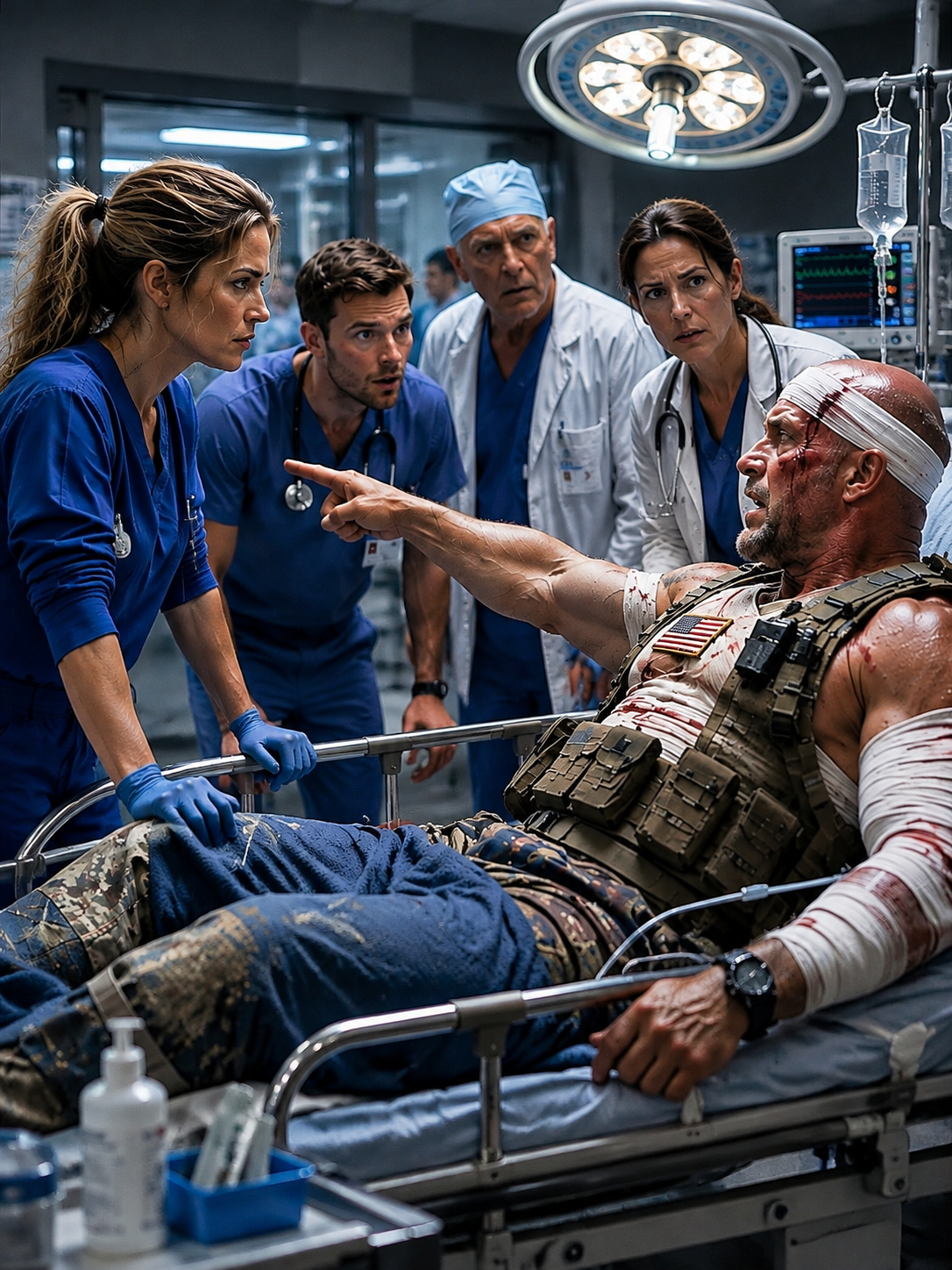
“I only accept Operator Raven,” said the wounded general, pointing at the nurse standing
IF FACEBOOK BROUGHT YOU HERE, HERE’S THE CONTINUATION YOU’VE BEEN WAITING FOR. ENJOY! 👇 The transfer took 22 minutes. I organized the move, directing a small team through corridors I had memorized over a thousand ordinary shifts. Chadwick followed without objecting. It was the first time in three years I had given him instructions without softening my voice.
At a.m., Tariq received word that three people were approaching from the parking structure. They moved with the practiced purpose of people who expected to get through the building before anyone understood what was happening. Tariq and Milo coordinated the response while I used what I knew about Harborview’s layout. I cut lights in a lower corridor, triggered a stairwell alarm away from Duff’s location, and helped redirect movement toward places where the team could contain it.
I did not confront anyone directly. The goal was to buy time and keep the general protected. Milo intercepted one person at a service-corridor junction. Another was drawn toward the false alarm, while the third moved into the darkened lower corridor and found Tariq waiting. By the time federal agents arrived, the building was contained.
An agent named Beaumont asked how I had anticipated the intruders’ movements and known which corridors mattered. I answered honestly, though not completely. “I’m not a civilian,” I said. “I just stopped being a visible one.” Beaumont closed her notebook and assured me that whatever my old file contained would not become public because of what had happened. Some debts, she said, were settled quietly.
Before dawn, O’Shea reversed my suspension and came to tell me himself. He did not quite say he was sorry, but he arranged several careful sentences around the idea. Chadwick’s review came the following week. There was no public showdown. A federal liaison asked precise questions about his initial assessment, and his answers made clear what he had missed. He kept his position, but he no longer had the unchecked confidence that had made him dangerous to patients. I noticed that he stopped talking over me. Once, when a case did not resolve cleanly, he asked what I thought and listened to the answer.
I visited Duff when he was well enough to sit upright. He looked older, but not diminished. He told me I should never have had to do any of it—not the emergency treatment, not the rest of the night. I said I had never meant for my history to find its way into the life I’d built. He replied that it had found me anyway and asked whether that was necessarily the worst thing.
I thought about it before answering. “I thought disappearing was the same as healing,” I told him. “I was wrong about that.”
Duff told me about a program being developed to connect field medicine with civilian emergency care. It would bring people who understood both environments together to teach the gap closed. No deployment, no return to active service—just knowledge transfer. They were looking for someone who knew both sides from the inside. I told him I wasn’t going back into the field. He said that wasn’t what he was asking. I asked him to send me the brief. No commitments, I said. He smiled as if that was exactly the answer he’d expected.
Part 3 In the weeks that followed, Harborview shifted around me in small ways. People who had spent three years looking through me began to pay attention—not with awe, but with the steadier respect of colleagues who were beginning to understand what they had overlooked.
Lena found me one afternoon before shift change. She wanted to know how to recognize the dangerous pressure that had threatened Duff, not how to perform the treatment. She understood that the procedure was beyond her training. I had twenty minutes, so I found a sheet of paper and drew a simple diagram. I explained the warning signs in language she could remember: oxygen dropping faster than the visible injury explained, neck veins becoming unusually prominent, and breathing turning short and labored in a way that didn’t fit what the room could see.
Lena listened carefully and came back the next week with a colleague. Two weeks later, she brought three more. What began as twenty minutes beside the nursing station became an informal teaching practice. I wasn’t trying to impress anyone. I wanted younger nurses to recognize danger early enough to get the right help.
I never used the call sign openly. But I stopped flinching when Tariq used it in an occasional text to check in, or when Milo referred to it without explanation. I had buried Raven, but I hadn’t been able to bury what Raven knew.
The morning Duff was discharged, he walked past the nurses’ station under his own power, two federal escorts behind him. He stopped and shook my hand, holding it a moment longer than a routine goodbye. Staff had gathered nearby, some deliberately and some simply because it was shift change.
“You were never hiding weakness,” he said quietly, but loud enough for them to hear. “You were hiding command. There’s a difference, and I think you’ve always known it.”
When my shift ended, I walked out into the flat gray November air off Halifax Harbor. Three years earlier, I had chosen this city to disappear. I had walked the same streets with my shoulders arranged to take up as little space as possible, always measuring whether I was visible enough to be noticed and not visible enough to be questioned.
That evening, I realized I wasn’t bracing. I wasn’t scanning every angle or calculating how much room I was allowed to occupy. I was simply walking. Behind me, Harborview continued its ordinary rhythm: monitors, call lights, exhausted people doing necessary work in the middle of the night.
I had believed invisibility was the most useful thing I could offer the world around me. What I understood now was that my silence had never been the important part. What mattered was what I knew, what I could teach, and whether I was willing to let people see it.
I kept my nursing job. I considered Duff’s proposal, and I began sharing what I could with the people around me. I didn’t return to the field, and I didn’t need to become the person I had been seven years earlier. I could carry that experience into a different kind of work, one shift and one student at a time.
For the first time in three years, I walked home along the harbor without trying to disappear. The wind came off the North Atlantic, carrying the smell of salt through the streets. I was still Brooke Tillman. I was still a nurse at Harborview. But I no longer believed that being seen meant losing myself.
A wounded general had looked across a crowded trauma bay and spoken the one name that could bring me back to a part of myself I thought I’d left behind. He hadn’t given me a new identity. He had reminded me that I didn’t have to hide the old one to build a life worth living.
Final I never put Raven on my hospital badge, and I never told the whole story to people who had no reason to know it. Some parts of my past remained private, and that was my choice. But I stopped shrinking to make other people comfortable. I kept teaching Lena and the nurses who came after her, and I stayed in the work I had chosen.
Dr. Chadwick learned to listen before deciding. O’Shea learned that a title did not make a decision right. And I learned that healing did not require pretending the hardest parts of my life had never happened.
When I think about that night, I remember the general’s hand lifting from the stretcher, the room falling quiet, and the word that crossed three years of silence. I had spent so long believing that the safest thing I could be was invisible. I finally understood that the most useful thing I could offer was never my silence. It was the knowledge I carried, and the willingness to share it.
THE END. I’ve shared the complete story, and I truly hope it touched your heart. If this story moved you, please , like, and share the post. Thank you for reading! ❤️
✓ Lynn R. Adams
IF FACEBOOK BROUGHT YOU HERE, HERE’S THE CONTINUATION YOU’VE BEEN WAITING FOR. ENJOY! 👇 The transfer took 22 minutes. I organized the move, directing a small team through corridors I had memorized ov…