I moved my children into the sewing shop I had spent my life resenting, with just $900 and a tax deadline hanging over us, and I was almost ready to sell when an elderly stranger walked in asking for a wedding dress my mother had made forty years ago—a dress nobody had ever collected, and one my mother still listed in her old ledger…
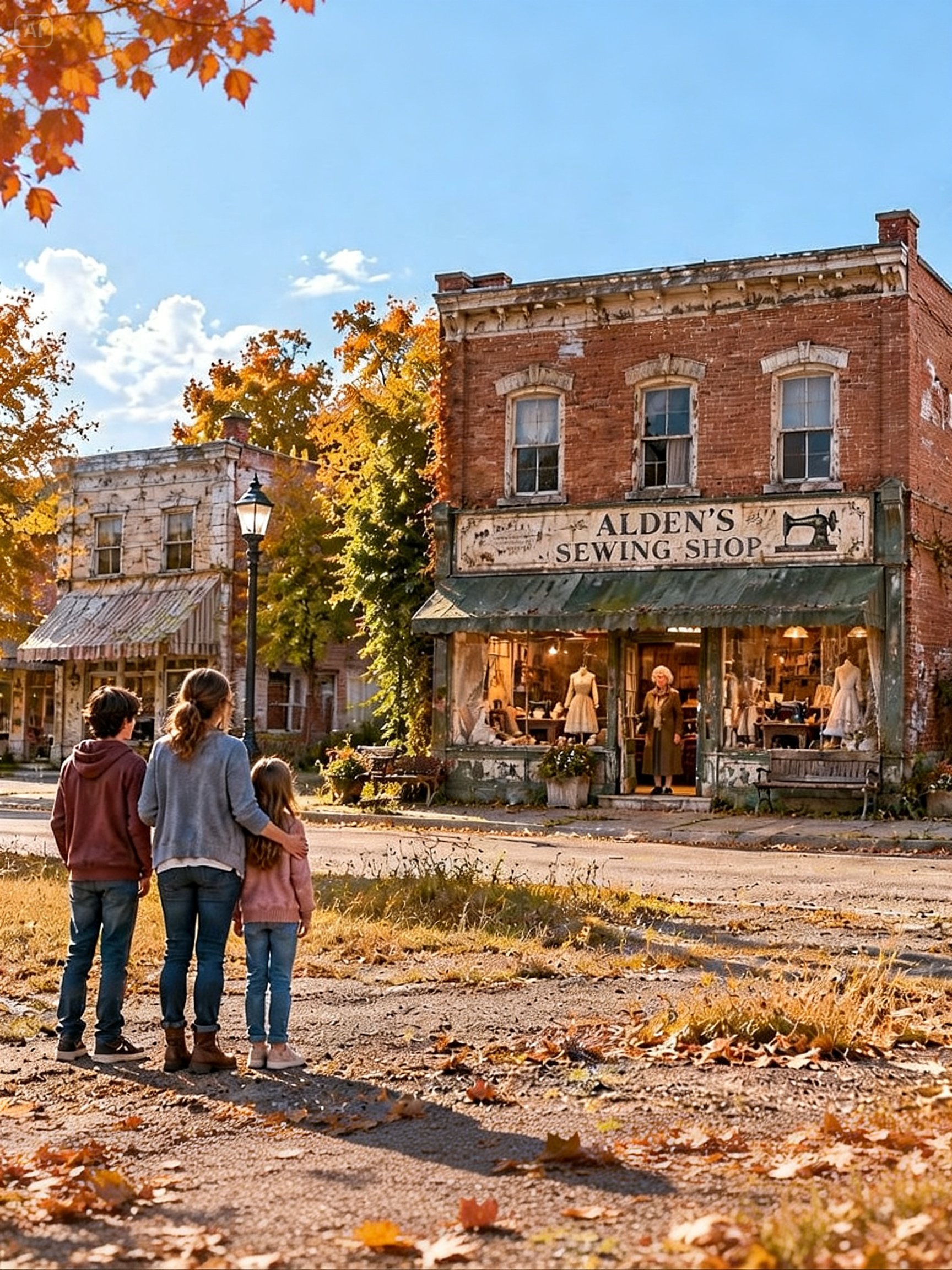
I moved my children into the sewing shop I had spent my life resenting, with just $900 and a tax deadline hanging over us, and I was almost ready to sell when an elderly stranger walked in asking for a wedding dress my mother had made forty years ago—a dress nobody had ever collected, and one my mother still listed in her old ledger…
I was forty-one when I moved my two children into the apartment above my late mother’s sewing shop. I had $900, a car stuffed with garbage bags, and a husband who had disappeared from our lives.
Mark left in July while I was at work. He packed two suitcases and left a note beside the mail: “I can’t do this anymore. I’m sorry. Tell the kids I love them.” Our sixteen-year-old son, Josh, found it first and handed it to me without saying a word. He barely spoke after that.
Four days later, my debit card was declined at the grocery store because Mark had drained most of our joint account. I stood beside a full cart, deciding what to put back while people waited behind me. I called him eleven times that first week, and when he answered, he promised he’d figure out the money soon. By August, he wasn’t answering at all.
A family lawyer who knew my sister filed the first support papers, but Mark ignored those, too. Then in September, while I was at a job interview I didn’t get, our landlord changed the locks. I spent three nights in a motel with Josh and his twelve-year-old sister, Ava. Every night Ava pushed a chair under the door handle before she could fall asleep.
On the third night, my sister Renee called. “Mom’s shop is sitting empty,” she said. I told her I wasn’t going to run a sewing business when I couldn’t sew a straight line. “I didn’t say run it,” she answered. “I said it has a roof.”
Three days later, we stood beneath the shop’s faded green awning, its loose corner moving in the breeze. The dusty bell was still over the door, and the hand-painted sign still hung in the window: “We mend what’s broken.” As a teenager, I’d begged Mom to take it down because I thought it sounded corny. She never did.
“Are we poor now?” Ava asked as we carried our bags inside. “We’re between things,” I told her, hoping she’d believe it. Josh looked up at the apartment windows and said nothing. I wanted to promise them we’d be somewhere else soon, but I didn’t know if that was possible.
My mother, Vivian Alden, had died six years earlier. She’d left the building to Renee and me, and within a year Renee had sold me her half for one dollar because she couldn’t bear to keep it. I’d paid just enough back taxes to hold on to the property, then stayed away. I hadn’t set foot inside since the funeral.
Dad died in a car accident when I was four, and after that, Mom seemed to live at her machines. She missed school plays and rearranged birthdays around brides who needed dresses finished by Saturday. I did homework on a stool in the corner and waited for her to take me home. As a girl, I thought the customers always came first.
“This isn’t just sewing, honey,” she used to tell me. When I asked what else it was, she smiled tiredly and returned to her work. For years I carried the feeling that she’d spent all her patience on strangers. Walking through that shop again, I discovered I hadn’t let go of it at all.
Then a county notice arrived: $4,000 in back taxes, with sixty days to pay before foreclosure proceedings could begin. I had $900, and most of it was already needed for food, gas, and school supplies. After the children were asleep, I sat on the dark stairway turning the notice over in my hands. No matter how I added the numbers, they wouldn’t work.
That was when a voice from the shop said, “Reopen it.” An older woman stood by the doorway with silver hair, a cardigan, and an old set of keys. She introduced herself as Doris, who’d worked for Mom for thirty-six years. Mom had given her a key back when Reagan was president, and she’d never returned it.
Doris knew about the tax bill. She pointed to the paid-off machines, the shelves of fabric, and the family name on the door. “Your mother taught half this town to sew,” she said. “You’ve got more here than you think.” I told her I didn’t know a bobbin from a button, and she said she’d come teach me.
She kept her word, arriving three days a week to show me hems, zippers, and how to take in a waist. I fought the old register and broke threads while Doris quietly helped me start again. One afternoon, when I snapped that Mom had noticed every customer except her daughters, Doris stopped threading her needle. She told me that after Dad died, sewing had been the only thing keeping Mom upright.
“Some people fall apart when they grieve,” she said. “Your mother built something.” I kept stitching, badly, while I considered the years I’d thought Mom was simply choosing work over us. I wasn’t ready to forgive every missed school play, but for the first time I wondered what she’d been carrying through those long nights.
In late September, Victor Lane came in wearing a pressed shirt and a pleasant smile. He owned the hardware building and two nearby storefronts, and a regional pharmacy chain wanted all three properties together for a corner location. He offered $32,000 for mine and said he’d clear the tax debt. “I’d rather pay you fairly now than bid at an auction later,” he told me.
I put his offer in the drawer beneath the register. A few of Mom’s old customers began coming back, some with clothes to mend and others just to see her shop open again. I appreciated every job, but twenty-dollar alterations couldn’t quickly erase a four-thousand-dollar bill. The deadline kept getting closer.
In early October, a county clerk named Mr. Padilla came by to warn me I had fourteen days left on my notice. Mom had once hemmed his wedding suit for free, he said, and he wished he had better news for her daughter. I’d managed to put together $2,300 toward the taxes. I was still $1,700 short.
Victor returned the next afternoon while I swept the step. He raised his offer to $41,500 and reminded me that, if the building reached auction, he might buy it for less. Josh was standing behind me in the doorway, listening. When Victor drove away, my son went upstairs without speaking.
At dinner, I laid the envelope beside our takeout containers and told the kids selling could mean a real apartment. Ava immediately asked if she’d have her own room, with a door that locked. Then she looked down at the old shop and asked whether the new owner would tear it down. “Probably,” I admitted. “Where would the people go when they need something fixed?” she asked.
That night I took the envelope, a pen, and Mom’s old stool downstairs. I sat at her sewing machine for nearly an hour, but I couldn’t sign. The next morning I told Doris the business wasn’t bringing in enough to save us. “Give it till Thursday,” she said, and when I asked why, she pretended she had no reason.
On Thursday afternoon, the bell rang. An elderly woman with white hair and a coat buttoned to her neck stood just inside the door, asking if this was still Vivian’s shop. Her name was Helen Caster, and she said Mom had made her a wedding dress about forty years earlier. She had never come back for it.
Helen told me she’d been meant to marry a man named Richard that June, but he’d died the Tuesday before their wedding after swerving to avoid a deer. She’d left town within a month because every familiar face reminded her of what was lost. Her granddaughter had recently found an old newspaper clipping about Mom’s shop, and Helen had finally gathered the courage to return. I went looking for Mom’s order books, unsure what I could possibly offer her.
It took twenty minutes to find the ledger from that year. Under Helen’s name, Mom had written “wedding gown, ivory silk, hand-beaded bodice, never collected.” Below it was another line in her unmistakable handwriting: “No charge. Family circumstances.” I read it twice, then looked toward the ceiling and the attic I hadn’t yet dared to enter. Part 2…..
I carried the ledger out to Helen and showed her the entry. She covered her mouth when I explained that Mom had waived the charge, then told me she’d mailed a check for the materials after the wedding was canceled. It had come back marked return to sender because she’d moved and left no forwarding address. She had made herself impossible to find.
“Would you like me to see whether the dress is still here?” I asked. Helen studied the floor for a moment before saying she wasn’t ready to look herself. She asked me to go first, and Doris sat with her over a cup of tea while I headed upstairs.
The attic hatch was in the upstairs hallway ceiling, and I had never opened it. I climbed through with a flashlight into a low, dusty room lined with old fabric bolts and dress forms. One form at the far end was covered in canvas. I pulled back the cloth and found an ivory silk wedding gown, its color softened by age but its tiny hand-sewn pearls still intact.
Mom had packed acid-free tissue into the seams as carefully as if somebody might come to collect the gown the next morning. Beside the form was a shoe box holding a dozen letters addressed to Helen. Every envelope bore Mom’s handwriting and the faded stamp “Returned to sender.” I sat on the attic floor and opened the oldest one.
Mom had written that she was terribly sorry about Richard and didn’t want Helen worrying about the dress or payment. She only wanted to know Helen was safe. A letter eight months later said the gown would remain there whenever she was ready, free of charge. Three years afterward, Mom wrote that she didn’t know whether her letters would ever arrive, but she’d keep trying.
The letters stretched across almost fifteen years. The last, written nearly twenty-five years before I found it, said Mom still thought of Helen and would always keep the dress. “Some promises don’t need an answer to be worth keeping,” she’d written. I sat there longer than I meant to, remembering how often I’d accused her of having no time for anybody who wasn’t standing at her counter.
I brought the dress and the box downstairs in careful trips. Helen read the letters at the counter with Doris on one side and me on the other. When she reached the third one, her eyes filled and she stopped trying to hide it. “I thought I’d let her down,” she whispered. “I never even said thank you.”
“Look what she kept asking,” I told her, touching one envelope. “She wanted to know if you were all right. She didn’t seem to need anything else.” Saying it aloud surprised me, because I believed it. The woman who had left me waiting on that stool had somehow made room for a stranger’s grief year after year.
Doris said Mom had done things like this all over town, then told me about Danny Ferris. When Danny’s father died suddenly, his mother couldn’t bear to part with his suits, and the family had no money for something Danny could wear to the funeral. Mom had altered one of those suits to fit the boy, working two nights without sending a bill. Doris knew because she’d pinned the sleeves.
She told me about another family whose house had burned one December. Three children needed coats, so Mom sewed them over a weekend and left them on the porch before dawn. “She said people shouldn’t owe you gratitude for getting help,” Doris explained. I was eight when the first kindness happened, and Mom had never told me about either one.
I finally asked Doris why she’d told me to wait until Thursday. She admitted the shop’s old phone number still forwarded to her house. Helen’s granddaughter had called the week before, asking if the shop existed, and Doris had said Thursdays were usually quiet. “I didn’t know whether she’d come,” she said. “I couldn’t promise you that.”
Helen stayed almost three hours. Before leaving, she decided to give the dress and Mom’s letters to the town historical society, so the promise behind them would be remembered. She asked me to write the plaque because I was Vivian’s daughter. That evening I looked again at Victor’s $41,500 offer, but for the first time the building’s value felt impossible to fit on a check.
Part 3 Two days later, a young reporter named Priya came by from the local paper. Mr. Padilla had heard about Helen from Doris, and somehow the story had reached her. I didn’t want an interview, but Helen came back that morning and quietly squeezed my hand. I agreed to tell Priya what we’d found.
The article ran Sunday with a photograph of Helen and me outside the shop and the ivory gown visible in the window. Its headline was “40 years later, a promise kept.” By Monday the telephone rang nearly every hour. Some visitors only wanted to see the place, but many brought pants, coats, and dresses that needed mending.
Doris worked five days that week instead of three. Ava learned the register after school, and Josh carried bags, swept up thread, and started spending time near the second sewing machine. He still said little, but he no longer vanished upstairs as soon as dinner was over. I counted that as progress.
The work helped, but it didn’t solve everything. Five days before the tax deadline, I checked the ledger twice and found we were still $1,040 short. It wasn’t that people weren’t paying us; it was that most of our jobs cost twenty dollars or so. The county wasn’t going to take promises in place of money.
That Saturday, Mark walked into the shop. I noticed him standing under the green awning before he entered, wearing a jacket I’d bought him and looking thinner than he had in July. Doris stopped pinning a hem. Ava went still behind the register, and I felt how thoroughly he had become a stranger to our daily lives.
Mark said he’d seen the newspaper story online and thought the place looked good. Then he suggested he might come around more, help out, and be part of things again. I’d imagined shouting at him for months, but I was too tired to perform the argument. I reminded him that our lawyer had sent three unanswered letters to his apartment.
“I’ve been meaning to deal with that,” he said. He pulled a folded stack of bills from his jacket and offered me $200, all he said he had. Before I answered, Josh stepped from behind the second machine. He looked his father straight in the face, and for the first time in weeks he spoke without being asked a question.
“You left a note,” Josh said. “I found it first.” He repeated the sentence Mark had written about loving the kids, then told him he had made me deliver those words instead of saying them himself. “If you love us, you can say it to us,” he said, “on a schedule. Not because you saw us in the paper.”
Mark opened his mouth, then closed it. He stared at Josh before looking down at the bills in his hand. I took the money to Mom’s old receipt book and wrote: “Received from Mark Hollis. $200. Child support, October.” I handed him the receipt and told him to answer the lawyer and call both children every week.
“That’s how you come back,” I said. “Not through the front door of my shop.” At the door Mark apologized to Josh, who didn’t answer but didn’t walk away either. When the bell stopped moving, Josh sat down at the machine with trembling hands. I pulled up the old stool beside him and stayed until he picked up the pants he’d been working on.
Mark called that Tuesday, and the Tuesday after. It wasn’t a repaired family, and I didn’t pretend it was, but the children were hearing directly from their father. The $200 went toward groceries and electricity, not the tax account. Four days before the deadline, I was still $1,040 short.
After closing, I sat with Doris at the counter, the ledger beside Victor’s envelope. I told her I couldn’t bear to lose the shop now, even though I’d spent years hating it. “With $41,500, I could get the kids an apartment and stop counting every dollar,” I said. Doris told me nobody would blame me if I accepted, and I knew she meant it.
Part 4 The next morning a plain white envelope arrived in the mail. It held $400 in cash and an unsigned note: “For the coats. Thank you. Finally.” Doris sat down when she read it and whispered, “The Harper kids.” They were the children Mom had made coats for after the fire thirty years earlier.
A little later Helen came in carrying her checkbook and an old yellowed envelope. She wanted to pay for the wedding gown. I told her Mom had written “No charge,” and I wasn’t going to undo that promise. Helen took out the original $640 check she’d mailed decades ago, the one returned to her when her mail couldn’t reach the shop.
“I couldn’t cash it, and I couldn’t throw it away,” she said. “Back then I couldn’t bear to face what happened, but I can bear it now.” She asked me to let her pay for the work Mom had done. I looked toward Doris, hoping she’d tell me what was right.
“Your mother gave for forty years,” Doris said. “She never learned how to receive. Don’t make the same mistake.” I thought about Mom’s careful hands wrapping the dress, the letters she kept writing, and the two children I still had to protect. I finally nodded, and Helen wrote a fresh check for $640.
Four hundred dollars from the Harper family and six hundred forty from Helen: exactly the $1,040 we lacked. I added the money to the rest we’d saved, counted it again, and found that we had the full $4,000. Doris laughed first, then Helen. I put my forehead against the counter and cried because I finally had a choice that wasn’t simply losing our home.
On the final day, I arrived at the county office before it opened with a folder, a cashier’s check, and Doris beside me. Victor was already waiting. He reminded me that his offer stood until five, and he pointed out that the roof and wiring would soon need costly attention. “Then I’ll fix them,” I said. “One hem at a time if I have to.”
Victor looked at me for a while, then smiled in a way I hadn’t seen before. He said Mom had told him almost the same thing in 1998, when he’d offered her twice what he’d offered me. She’d told him the building wasn’t really hers to sell; it belonged to everyone who had ever needed something fixed. He said he thought he’d find another location for the pharmacy.
Mr. Padilla accepted the cashier’s check and stamped the tax paperwork paid in full. As Doris and I walked back into the cold October sunlight, I kept touching the folder to make sure it was real. I had saved the building from that tax deadline, but I also knew what Victor had said about the roof and wiring was true. We had work ahead of us.
Part 5 Renee drove three hours to visit that weekend. She stood in the doorway watching Ava sweep up thread and Josh work at the second machine. Then she looked at me and said, “You actually reopened Mom’s shop.” I told her I hadn’t had much choice, and she shook her head because she hadn’t come to criticize.
Renee admitted she’d sold me her half for a dollar because she couldn’t stand the memories of Mom missing so much of our childhood. She said she’d left me carrying the building and its history alone and wanted to come around more. I told her she could. I was surprised by how much I meant it.
That week, I tried writing the plaque Helen had asked for. Every long version sounded like I was trying to explain a whole life in a few sentences, so I finally kept six words: “She kept every promise she made.” I gave them to the historical society with the letters and the dress, trusting them to take care of what Mom had kept safe all those years.
A month later, the society unveiled the display. The gown stood inside a glass case, with several of Mom’s letters framed nearby. Helen sat in the front row, and the room held about sixty people who had come to remember a woman I’d once believed was too busy to notice anyone at home. Helen asked me to speak.
I told them how Mom had lost Dad while Renee and I were small and how I’d spent years resenting the shop. I said she’d mended clothing, but it turned out she had also helped people get through days they didn’t know how to survive. “She never asked anyone to notice,” I said. “I wish she could have seen this dress leave the attic.”
Helen was smiling through wet eyes when I stepped away. Doris squeezed my arm, and for once I didn’t try to hide what I was feeling. I still missed the birthdays and the school plays Mom hadn’t attended. Understanding her didn’t make those absences vanish, but it changed the story I told myself about why they happened.
That winter, Josh began staying downstairs after school. He asked how to use the machines and tried hemming his own school pants, making a crooked mess of the first seam. I sat beside him on the same stool where I’d once waited for Mom, showing him how to try again without taking over. I understood something about patience that I’d missed as a child.
Ava preferred fabric and sketches to the machines. She sorted bolts by color, pinned swatches to the back-office corkboard, and drew dresses in the margins of her school notebooks. Doris said she had Vivian’s eye. Ava admitted she mostly remembered her grandmother’s starch smell and the time she’d been allowed to press a sewing-machine pedal.
One evening Ava asked whether Grandma had loved the shop more than us. I thought about the letters she’d written to Helen for fifteen years. “I used to think that,” I said, “but I don’t anymore. I think this is where she put love she didn’t know how to say out loud.” I promised myself I’d find better ways to tell my own children what they meant to me.
Helen started stopping by most months, usually on Thursdays. We drank tea in the back office surrounded by fabric bolts and old ledgers, and sometimes we talked about nothing important. One afternoon she told me she’d spent forty years waiting to give herself permission to stop grieving Richard. She said Mom’s letters had finally helped her do it, even though she hadn’t read them until decades later.
Final In the spring, Mr. Padilla came by without a clipboard, bringing coffee instead. Ava’s sketches were framed along one wall, Josh was working at the second machine, and the waiting chairs were full. He said this was how my mother’s shop had looked when it was busy. I told him I hoped she’d be proud.
Two weeks later Victor walked in holding a winter coat with a torn lining. His wife had told him to throw it away, he said, but he wanted to see if it could be saved. I examined the fabric and told him it could. When he asked the price, I almost said, “No charge. Family circumstances,” just to hear his reaction.
Instead I told him it would be $45. Victor laughed, paid cash, and left his coat for me to mend. There was something reassuring about that ordinary transaction. He hadn’t bought our corner, and I didn’t need to make him an enemy to keep it.
I repaired the torn corner of the green awning and repainted Mom’s old window sign that spring. I left the words just as she’d written them: “We mend what’s broken.” For most of my life, I’d thought she meant zippers, seams, and hems. Now I knew she’d meant people who needed someone to sit beside them while the worst part of their lives passed.
I still think about the four words beside Helen’s name in the ledger: “No charge. Family circumstances.” I think about the six words I chose for Mom’s plaque and the afternoons Josh and Ava spend with me among her machines. I can’t get back the years I misunderstood her, and I don’t have to pretend she got everything right. But I finally know the love was there, sewn into work I hadn’t known how to see.
THE END. I’ve shared the complete story, and I truly hope it touched your heart. If this story moved you, please , like, and share the post. Thank you for reading! ❤️
✓ Lynn R. Adams
I moved my children into the sewing shop I had spent my life resenting, with just $900 and a tax deadline hanging over us, and I was almost ready to sell when an elderly stranger walked in asking for …