I kept joking with my 31-year-old neighbor about being two years younger, because flirting was easier when I
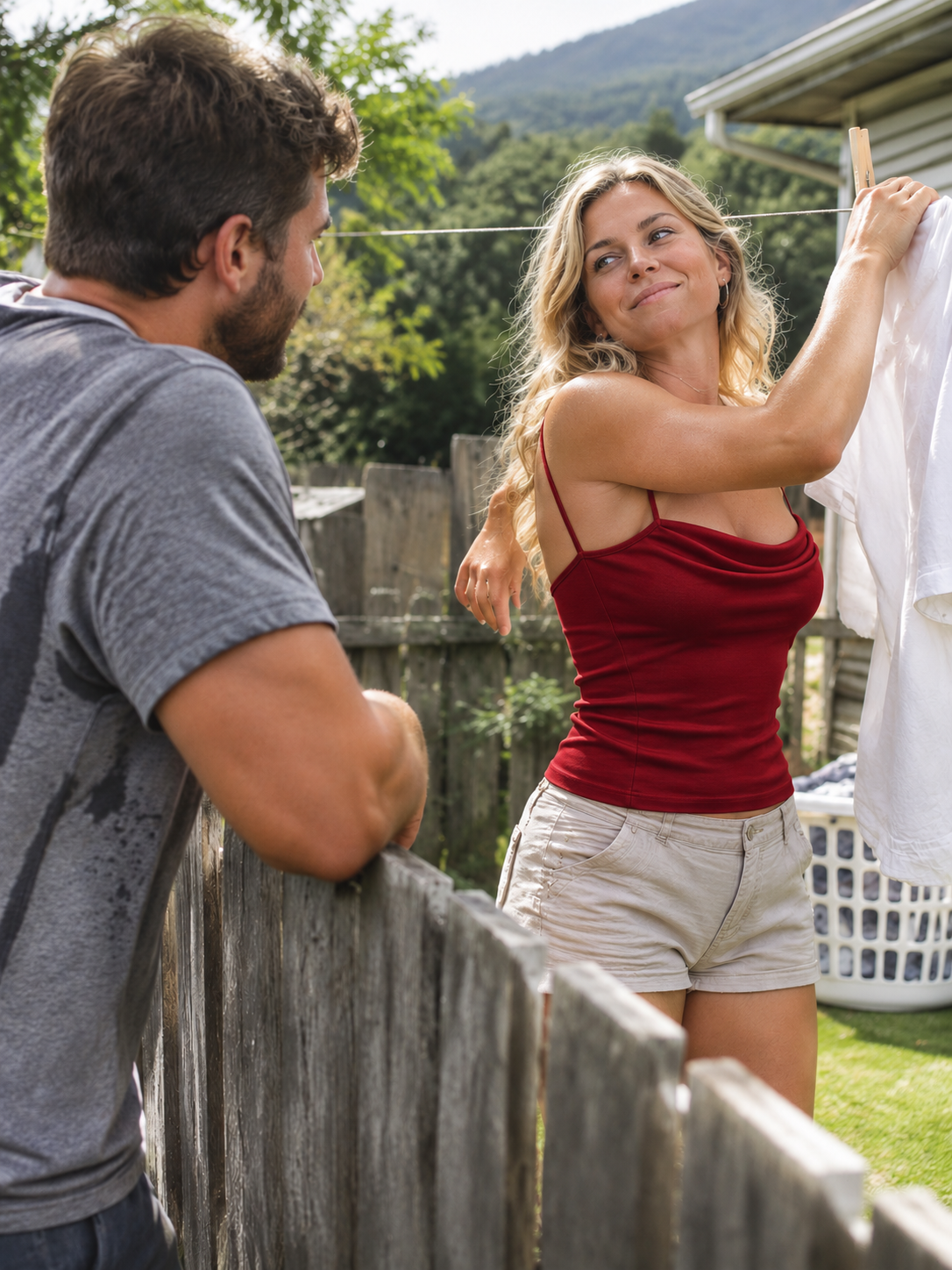
I kept joking with my 31-year-old neighbor about being two years younger, because flirting was easier when I could pretend I didn’t mean it; then she pinned a white shirt to the line, looked me straight in the eye, and told me to ask her properly when I was done joking—and the next day, I finally did…
I rested both forearms on the low wooden fence between our backyards and offered what I thought was a perfectly calibrated joke. “Thirty-one? That might be getting a little old for love.” Sherry didn’t blink. She was pinning a white button-down shirt to the clothesline, her blonde hair loose around her shoulders, and she kept one hand on the fabric as she smiled.
“I know things younger women don’t,” she said. Before I could ask what that meant, she picked up her laundry basket. “Ask me properly when you’re done joking.” Then she went inside, leaving me beside the fence with a comeback I suddenly had no desire to use.
I was twenty-nine; Sherry was thirty-one. Our rental houses shared a property line, and those two years had become easy ammunition. I teased her about being older; she said my frontal lobe was still under warranty. It was a safe rhythm: I could flirt, she could swat it away, and neither had to admit what we wanted.
That afternoon, she had refused to play along. She had looked straight through the joke and called out the part I kept hidden: I liked her, but I liked having an exit even more. If she didn’t feel the same, I could always claim I had only been kidding. I pushed away from the fence and went inside, knowing the next move was mine.
The next morning, work kept my hands busy. I was a mechanic at Blue Ridge Diesel, where the bays opened at seven and the air smelled of exhaust, grease, and stale coffee. A farmer brought in a three-quarter-ton pickup with a rough idle, convinced the injectors were failing and expecting a bill in the thousands.
I hooked up the scanner, listened to the engine, checked the data, and ran a line test. The problem was a cracked fuel-return line pulling in air and a clogged secondary filter. A fifty-dollar line and a new filter would have him back on the road by noon. That was where I made sense: finding the real problem and not charging somebody for work they didn’t need.
I had steady hours, a good reputation, and savings growing toward a down payment on my own mobile service truck. I wanted to take repairs out to farms and job sites for people who couldn’t afford to lose half a day bringing a vehicle into town. It was a practical plan, and I watched my spending.
Still, my mind kept wandering two miles down the road to Ridgeway Country Store, which Sherry managed for her aunt Teresa. It served the cabins and farms around Mason Gap, selling feed, hardware, honey, and things people couldn’t get at a chain store. I pictured Sherry on the loading dock, sorting out deliveries.
Later, she told me about that morning. A driver claimed he had delivered six cases of motor oil, not four. Sherry snapped that he needed to check his count, then saw on the manifest that she had misread it: two cases were scheduled for Thursday. She apologized. Teresa had heard the exchange. Sherry could be sharp, but she wasn’t too proud to admit when she was wrong.
Teresa also told her that John Griffith would be stopping by. John was a regional sales representative for a large distributor, and he was Sherry’s ex. He was bringing a new pricing tier that could help the store. Sherry would consider it, but she wasn’t giving up the local shelf just because the numbers looked cleaner. She knew the suppliers by name and understood that replacing them would change what Ridgeway meant to the community.
The following afternoon, Ridgeway’s box truck pulled into our service lot for routine maintenance. Sherry climbed down in jeans and a green Ridgeway polo, her blonde hair pulled back, carrying two paper cups of coffee. She set one on my workbench.
“Routine service,” she said. “And before you say anything, the coffee is because your shop is freezing. It does not constitute a pardon for yesterday’s joke.”
It was black, exactly how I drank it. I took the keys and did the scheduled work: filters, fluids, belts. Nothing dramatic turned up, and I didn’t go hunting for a problem just to keep her there. She stayed near the office, answering messages and glancing over now and then.
When I finished, I signed the work order and handed her the keys. There was my opening. I could have joked about her driving or said she owed me for the coffee, slipping back into the rhythm that let me avoid saying anything plainly.
Instead, I looked at her and said, “Friday. Seven o’clock. Dinner. Just you and me.”
Her eyes widened a fraction. She didn’t blush or look away; she held my gaze. “Yes,” she said, with a smile. Then she added, “But I have a condition. Don’t ask me out and don’t pick me up if you’re going to spend the whole night pretending this is still a joke. If we’re doing this, we’re doing it on purpose.”
“I wouldn’t have asked if I wasn’t doing it on purpose,” I said. She nodded once. “Good. I’ll see you Friday, Jeffrey.” Then she turned and walked back to the truck, leaving me beside my workbench with my coffee going cold and the feeling that the easy banter between us had finally given way to something real.
Friday evening, I arrived at Ridgeway ten minutes early. I didn’t honk or go inside to hurry her. Through the front windows, I watched her finish the drawer count, check something with the teenager on the evening shift, and walk the aisles once before locking up. She was still the manager until the moment she wasn’t.
At seven, she came out in a dark sweater with her keys in one hand. “You’re early,” she said when she saw me by my truck.
“Ten minutes.”
“I can count, Jeffrey.” A hint of a smile came and went. Then she stopped in front of me. “I want a real answer before I get in your truck. Are you taking me out because I dared you, or because you wanted to before I ever said anything?”
There was no room for a clever answer. “I wanted to. The dare just made me stop being lazy about saying it.” She watched me for another second, and her shoulders eased. “Good. Now I can enjoy dinner.”
I took her to a quiet local grill a few towns over, away from the busy diner where everyone would have stopped by our table. At first, we talked like two people trying to learn a new language. We were so used to sparring that speaking plainly felt unfamiliar, but the conversation warmed as dinner went on.
She told me why the Ridgeway proposal bothered her. The distributor’s numbers made sense, but losing the local honey, jams, and produce from farms up the ridge would turn the store into just another convenience stop. I told her I understood why she remembered every supplier’s name. Most managers saw margins; she saw the people who depended on that shelf. She went quiet, then thanked me without dressing it up as a joke.
She asked about my service-truck plan. I told her I had a down-payment target and was watching listings for used utility bodies. I liked Blue Ridge Diesel, but wanted a piece of work that was mine without borrowing more than I needed. “You don’t talk about it like a dream,” she said. “It isn’t one. Dreams don’t come with spreadsheets.” She smiled. “I like that you have a plan.”
After we paid, she pointed toward a paved path behind the restaurant, along a quiet creek. She didn’t have to be at the store until six the next morning, so we walked for forty minutes, talking about the town, work, and nothing in particular. Our shoulders brushed when the path narrowed, and neither of us moved away.
When I dropped her off, I walked her to the steps but didn’t try to kiss her. I didn’t want to rush what we had finally started saying out loud. She rested her hand lightly on my forearm. “Ask me again, Jeffrey,” she said, then turned and went inside. I stood there for a few seconds, still aware of where her fingers had touched my sleeve, before I crossed the yard to my own house. Part 2…..
IF FACEBOOK BROUGHT YOU HERE, HERE’S THE CONTINUATION YOU’VE BEEN WAITING FOR. ENJOY! 👇 Two weeks passed. We hadn’t put a label on anything, but our lives had begun to make room for each other. We drank coffee on her porch on Sunday mornings, and sometimes I stopped at Ridgeway with a sandwich when I knew she was working a double.
One Tuesday afternoon, I went into the store for a bag of oil dry and saw Sherry near the back office with John Griffith. He had a crisp button-down shirt and a stack of revised numbers. I didn’t interrupt; I had no claim on her time, so I picked up the bag while their voices carried over the coolers.
“The numbers don’t lie,” John said. “The bulk agreement drops your overhead about fifteen percent. You’d have a little breathing room.” Sherry answered that she’d lose shelf space for half the local suppliers. John said she always did like making younger men work for her approval.
My hand stopped on the bag. Sherry replied too quickly, “You always took too long to decide what you were actually offering, John.” The store went quiet for half a beat. He didn’t raise his voice. “That sounded personal.”
“It was. I’m sorry. You came here to talk business. Leave the revised numbers, and Teresa and I will go through them.” There was no scene and no attempt to rekindle anything. What bothered me was the thought that if I kept hiding behind jokes, I could become another man she had to interpret instead of someone she could trust to say what he meant.
I carried the oil dry to the front. Sherry came over, a little tight around the mouth, and set the bag beside the register. I put a twenty on the counter. “I’ll see you tonight,” I said. Her shoulders loosened. “Yeah. Eight.”
That evening, we sat on the back steps of her house. The air smelled of damp earth and pine, and she traced the grain of the wooden step with her thumb. “I was too sharp with John. I made it personal because I was irritated. He didn’t deserve that.”
“You fixed it,” I said. “After I said it,” she replied. “That’s the part I have to get better at.” Then she looked at me. “The age joke never bothered me. I’m thirty-one, not ninety-one. What bothered me was that you could say something that sounded like flirting and still have a way to pretend it wasn’t.”
“That’s fair,” I said. I admitted that sometimes I used a joke as an escape route. If it went badly, I could act like I never meant anything; if I said it straight, I had to live with the answer. “What do you want, then?” she asked.
“I want to keep seeing you. I want this to be something we’re doing on purpose. And I want Saturday, three o’clock, the whole afternoon.” Her expression softened, but she didn’t make the answer easier for me. “Saturday at three,” she said. “I’ll be ready.”
At work the next day, my manager told me Richardson Anderson Logging had moved three rigs into the weekend schedule. The work wasn’t unsafe, but they wanted it turned around quickly, and the fleet rate came with double overtime on Saturday afternoon. A full shift would have put a real dent in what I still needed for the service truck. I checked the coverage list; two other mechanics were qualified.
“I’ll take Sunday,” I said. “I’m done at two on Saturday.” My manager asked if I was sure. “Yeah. I’ve got plans.” He shrugged and penciled another name into the slot. I didn’t tell Sherry what I had turned down. Keeping a date wasn’t a favor I wanted credit for.
John gave her his own reasonable excuse to stay late. He wanted to sit down after closing Saturday and finish the supplier numbers while they were both available. Sherry told him to leave the revision; she and Teresa would look at it Monday. When he said it was a big change, she answered, “It’ll still be a big change Monday. Saturday is mine.” Then she added, “I have a date.”
Part 3 At three on Saturday, I knocked on her front door. I had showered and changed at the shop, but a stubborn smudge of black grease remained near my wrist. Sherry opened the door in a dark green sundress and flat sandals, her hair down. As we walked toward my truck, she noticed the mark.
“The Anderson trucks rolled through town this morning,” she said. “You worked before this until two. You could have stayed for the fleet hours.”
“I could have. I said I’d be here.” She touched my wrist beside the grease and looked up at me. “I believe you.” Then she made one thing clear: she didn’t want me turning down every extra shift because we were dating. I told her I wouldn’t. The truck mattered to me, but so did this, and I got to decide which hours I sold and which ones I kept. She accepted that without making me defend it.
The afternoon was easy. We drove without anywhere important to be, stopped when something looked worth stopping for, and ate an early dinner without checking the time. A few days later, I was under a chassis at the shop when Sherry’s boots appeared beside the creeper. She had come without the Ridgeway truck or coffee.
“Sunday morning, six-thirty,” she said. “I’m driving.” I stared at her. I had planned to sleep until at least seven, and she knew it. She grimaced, then changed it to eight and promised to bring coffee. “You bring yourself,” she said. That I could do.
On Sunday, she waited in her pickup with coffee in the cup holders and a paper bag of hot biscuits from the store on the console. We drove up onto the Blue Ridge Parkway, where morning mist still clung to the gaps between the mountains. At a quiet overlook, we leaned against the hood and ate while the ridges stretched out below us.
“I don’t want to be the older woman teaching you a lesson,” she said, looking over the valley. “I know that’s the joke. I just don’t want it to become the way we think about us.” I asked what she wanted it to be. “Two people who know why they’re here.”
“I’m not looking for a lesson,” I told her. “I’m looking for you.” She didn’t answer right away. She stepped closer. I touched her cheek and paused; she leaned into my hand and closed the last inch between us. I kissed her slowly, and her hands settled against the front of my jacket. When we pulled apart, she kept her forehead near mine and smiled. The attraction was no longer a question. The rest of life, as we were about to find out, would still need some figuring out.
Final A month later, a Friday threw everything it had at us. At the shop, a fleet truck that was supposed to be a simple brake job turned into seized calipers and rusted lines, putting me three hours behind. At Ridgeway, a massive freight delivery arrived four hours late, right in the middle of the evening rush. We were supposed to have dinner at six.
At , I was covered in rust dust, staring at a broken bolt, knowing I couldn’t leave for at least two hours. The old version of me would have texted, “Stuck at work. Let’s catch up another time.” I almost took that easy exit, not because I wanted out, but because another time asked nothing of me.
Instead, I called her. She answered on the third ring, sounding exhausted. “Ridgeway, this is Sherry.” I told her the Ford was still in pieces and I needed another hour and a half. There was a silence long enough for me to imagine her looking at the clock over the register. I started to say we could do it another night, then stopped.
“Okay, good,” she said. “Our freight truck finally showed up. I’ve still got three pallets on the dock. I was about to call you.” I smiled at the broken bolt in my hand. “I’m not cancelling. Can we move it? Eight-thirty, my house. I’ll be there.” She told me to eat something if I got stuck past eight-thirty. I said I’d be there again.
I arrived close to nine. I walked around the side through the small gate in the wooden fence between our yards. Sherry was in the backyard, taking the last laundry off the line before the dew settled. A white shirt moved in the weak security light, and I remembered that first afternoon almost exactly. This time, I used the gate.
She dropped a few clothespins into the basket and looked at me. “You look like the Ford one.” She stepped in and rested her forehead against my chest, and I wrapped my arms around her. We stood there for a minute, both tired, without trying to fix the day.
Then I told her I didn’t want to keep calling these dates we fit in if the rest of the week behaved. I wanted her to be my girlfriend. I wanted us to make room for this on purpose, not treat it as whatever time was left over. She lifted her head and said yes. She wanted to be my girlfriend, too, and she wanted one rule for both of us: if work wrecked a plan, we wouldn’t disappear. We would pick another time.
“Deal,” I said. “Also, I want you.” She laughed once, mostly from relief, then kissed me. A towel slipped from the top of her basket. We both bent to grab it, bumped hands, and started laughing. Nothing about the day had been romantic. That was exactly why the moment mattered. We had both been busy, both late, both tired, and neither of us had mistaken inconvenience for rejection.
By autumn, most of our lives looked the way they had before. I was still at Blue Ridge Diesel, still putting money aside for the service truck, and finally checking used listings seriously instead of just staring at them during lunch. Sherry still ran Ridgeway. The local shelf had become steady enough that Teresa started taking one morning off each week without calling twice to make sure the place was standing. John still stopped in as a vendor when his route brought him through Mason Gap.
The change was smaller and more useful. If I had to move a date, I called with another time. If Sherry had to move one, she did the same. Sometimes Friday dinner became Saturday breakfast. Once, a planned evening walk became forty minutes on her back steps because a farm truck came into my bay late and one of her employees called out sick. Nobody sulked, and nobody sent a vague message to see whether the other person cared enough to chase.
We got better at ordinary things. She learned that I went quiet for about twenty minutes after a difficult diagnostic job, not because I was angry but because part of my brain was still under the hood. I learned that if she came home carrying her shoes instead of wearing them, she had spent the day solving other people’s problems and didn’t want another decision. I offered two choices instead of asking her to make one. On my quiet nights, she sat beside me without filling the silence until I came back to the room on my own.
One Saturday morning, I carried my laundry basket through the gate between our yards. Sherry already had hers at the line. I set mine beside it and pinned my work shirts to the left while she worked through her basket on the right. When I ran short on wooden pins, she slid a handful across the top of my basket without stopping what she was doing. The gate wasn’t permanently open; the little latch had stopped feeling like a border.
Sherry shook open a white button-down shirt and glanced at me. “You know, my birthday is next month.” I looked over. “Thirty-two. I’ve been warned. I may finally be too old for romance.” I clipped one of my gray work shirts to the line. “I’m not touching that joke again.”
I looked at the white shirt in her hands and finally asked the question I had somehow never gotten around to asking. “So, what was it? That first day, you said you knew things younger women didn’t.” Her smile changed. It was less teasing now, more pleased that I had remembered.
“Nothing mystical,” she said. “I knew you were flirting, and I knew I didn’t want to spend three months pretending I hadn’t noticed just so you could keep pretending you weren’t.” That was the whole secret. I smiled. “That’s annoyingly practical.” She lifted an eyebrow. “I manage a country store.”
I stepped around my basket and put an arm around her waist. She leaned into my side, still holding the shirt. I kissed her just above the temple, then gave her one slow kiss when she turned toward me. For a minute, we stood there while the morning warmed the fence boards and a breeze lifted the clothes on the line.
Then she nudged my hip and pointed at my crooked row of work shirts. “Your side is sagging.” I fixed it while she went back to her basket, smiling to herself. Two years had never been the real distance between us. The real distance was all the things we were old enough to say and still kept hiding inside ourselves.
THE END. I’ve shared the complete story, and I truly hope it touched your heart. If this story moved you, please , like, and share the post. Thank you for reading! ❤️
✓ Lynn R. Adams
I kept joking with my 31-year-old neighbor about being two years younger, because flirting was easier when I could pretend I didn’t mean it; then she pinned a white shirt to the line, looked me straig…