I hid an injured boy from his
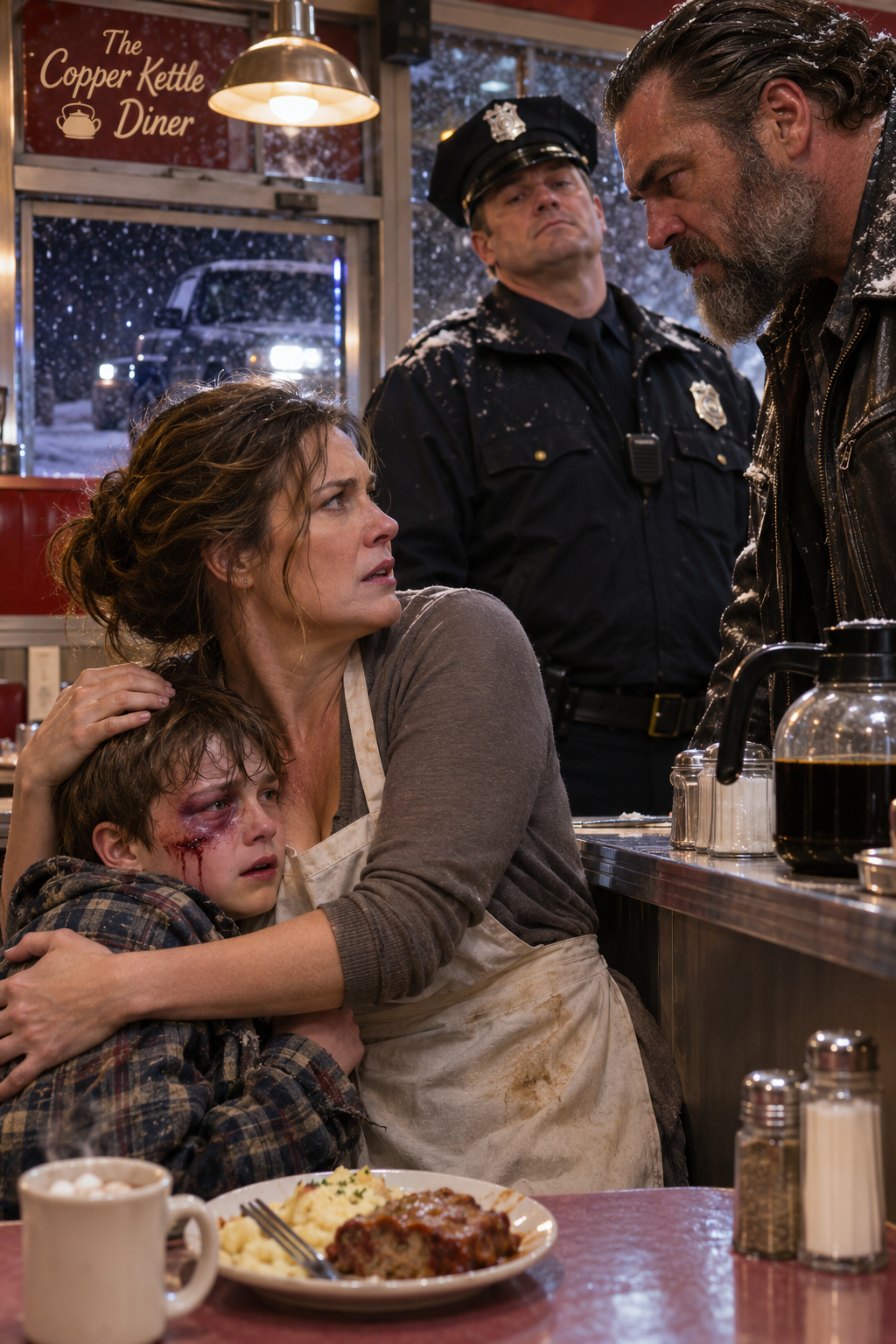
I hid an injured boy from his violent stepfather and a crooked police officer during a Massachusetts blizzard. Three weeks later, I spotted that same officer behind my car, and I had seconds to choose what mattered most….
In November 2003, I was 42 years old, working nights at the Copper Kettle Diner in Worcester, Massachusetts. My name is Abigail Foster. I had lost my husband, never had children, and inherited medical bills that seemed to grow every time I made a payment. The only things I still owned were my little drafty house on Elm Street and a battered 1992 Honda Civic.
My shift ran from 11 at night until 7 in the morning. I served truck drivers, people who couldn’t sleep, and workers heading home before sunrise. On one particular night, a blizzard had emptied the streets. Snow pressed against the diner windows, and even the coffee seemed to go cold faster than I could pour it.
At a.m., the bell over the door rang, and an eleven-year-old boy stumbled inside. He had no coat or gloves, just an oversized flannel shirt soaked with snow. His lips were blue, and he kept looking over his shoulder. Instead of coming to the counter, he folded himself into the darkest booth.
My boss, Hank Jennings, came out of the kitchen and shook his head. “We aren’t running a shelter, Abigail. He buys something or he goes.” I knew Hank worried about the police cracking down on people sleeping in businesses, but I couldn’t send that child back into the storm.
I brought him hot cocoa, meatloaf, and a heap of mashed potatoes. He raised his arms when I approached, as though he expected me to hit him. Under the fluorescent lights I saw his swollen eye, a cut along his cheek, and bruises around his neck. I set the plate down gently and told him he didn’t owe me a penny.
He ate so quickly I worried he’d choke. When he finally slowed down, I asked his name. “Leo Carmichael,” he whispered. I asked who had hurt him, and his face changed. He stared at the door and said, “Arthur’s coming. He’s going to kill me this time.”
I knew the name Arthur Penhaligon. People around the docks described him as an enforcer for a dangerous criminal syndicate, a man whose threats weren’t idle. Leo said Arthur was his stepfather. While Arthur was away, Leo had accidentally knocked over a lamp, exposing a loose floorboard beneath it.
Under the boards were stacks of white bricks and a gun. Arthur had caught Leo looking before he could put everything back. He locked the doors, but the boy escaped through a bathroom window and ran into the blizzard wearing whatever he had on. He was shaking so badly that his cocoa rattled against its saucer.
Before I could ask another question, headlights swept across the front windows. A black, rusty SUV stopped outside. Leo saw it and went rigid. I told him to get underneath the booth, then snatched away his half-eaten dinner and cup and wiped the table clean.
Arthur entered with another man, Officer Gary Mitchell of the Worcester police. That frightened me even more than seeing Arthur alone. People whispered that Mitchell did favors for the syndicate and made their problems disappear. He wore a badge, but I had no reason to believe it would protect Leo.
Arthur asked whether I had seen his stepson. I poured coffee to keep my shaking hands busy and said I hadn’t seen any child. Then he reached across the counter, clamped his hand around my wrist, and threatened to send me to my dead husband if I was lying. I could hear Leo breathing under the booth behind me.
Mitchell told Arthur to let me go. “She’s nobody,” he said, dismissing me with a glance. He suggested searching the rail yards instead. I watched them drive away through the snow before I dared to unlock my knees. I had never been so grateful to be underestimated.
I locked the diner’s front door, against Hank’s rules, and went back for Leo. He crawled out, still trembling, and explained more about what he’d found. I knew that calling the police could put him straight into Mitchell’s hands. I didn’t have a plan, only the certainty that he couldn’t go home.
When my shift ended, I tucked him beneath dirty aprons on the back seat of my Civic. We drove through nearly deserted streets to my house, where I hid him in the unfinished basement. I told no one, not even Hank. For the first time in years, I was more frightened of someone finding my home than of losing it to the bank.
Leo stayed there for three weeks. I slept during the day while he kept quiet downstairs, then made him supper before my shift. I cleaned his injuries with iodine, changed his bandages, and taught him gin rummy at the kitchen table. He started asking whether I had eaten, too, which was such a small kindness that it nearly undid me.
Some evenings he laughed at how badly I played cards. Other evenings the sound of an engine outside made him freeze. I didn’t tell him that I was afraid every time a car slowed in front of the house. We were two lonely people pretending that the basement door could keep the world away.
On December 12, I returned from buying groceries and found my front door slightly open. The lock had been picked. I dropped the bags, grabbed my heavy cast-iron skillet, and hurried toward the basement. Boxes were scattered, and old clothes lay torn across the floor. For one sickening moment, I thought Leo was gone.
Then I heard a whisper behind the water heater. He was wedged into a narrow space, gripping a rusty pipe. “The cop was here,” he told me. “I heard his radio.” Mitchell had searched my house while I was gone. If Arthur came back with him, there would be nowhere left to hide.
I went upstairs and pulled up a loose floorboard beneath my bed. Inside an old Folgers coffee can was $3,450, the money I’d saved over five years to keep the bank from taking my home. I had counted those bills so often I knew the worn edges. I put the can in Leo’s hands.
“We’re going to the Greyhound station in Boston,” I told him. “You’re buying a ticket to California, and you’re not coming back here.” He asked what would happen to me. I said I’d manage, though we both knew I had no way to promise that.
The drive to Boston felt endless. Snow crowded the roadside, and I kept checking the mirror. As we neared a highway on-ramp, red and blue lights appeared behind us. I recognized Mitchell’s cruiser. Leo slid down toward the floor as the siren started, and my hands tightened around the wheel.
Near the bus depot, we approached a busy intersection. The light turned red. Mitchell was so close that I could see his face in my mirror. If he stopped us, he would find Leo. I looked at the steel traffic-light pole ahead and made a decision I had no time to think through.
“When the car stops, run into that station,” I told Leo. I pressed the gas instead of the brake and steered toward the pole. The crash shattered the windshield, crushed the front of the Honda, and trapped my right leg beneath the dashboard. I could barely breathe from the pain.
Through the smoke, I saw Leo force open the passenger door. He looked back at me, unable to move. I told him to run, and this time he listened. He disappeared into the crowd outside the bus station just as Mitchell’s cruiser screeched to a stop behind us. I prayed the boy would keep going. Part 2…..
The next sound I heard was Mitchell’s car door slamming. He pulled me from the wreck despite my injured leg and shoved me against his cruiser, demanding to know where Leo had gone. Blood filled my mouth, but I managed two words: “He’s gone.” I couldn’t tell whether Leo had bought his ticket. All I knew was that Mitchell hadn’t caught him in front of me.
I was arrested for reckless endangerment and fleeing an officer. I avoided a long jail sentence, largely because Mitchell didn’t want questions about Arthur Penhaligon entering the record. That didn’t mean I walked away. The Copper Kettle fired me, and the hospital bills from my shattered femur swallowed everything the accident hadn’t already cost.
My leg never healed properly. I walked with a limp from then on, and on cold mornings it hurt simply to stand. A week after the hospital released me, Arthur came to my house at night. He beat me badly and set fire to my detached garage. He let me live, but his message was unmistakable: helping Leo would cost me for the rest of my life.
The years passed. I lived on small disability checks and whatever help the local church could offer. The garage remained a burned-out shell, and I couldn’t afford the repairs my house needed. I never heard from Leo. I hoped he had reached California, found people who cared for him, and built a life where nobody knew Arthur’s name.
By the winter of 2024, I was 63. Worcester had changed around me. New luxury apartment buildings stood where my neighbors’ houses once had, but my home on Elm Street was still there, with peeling paint and a sagging porch. It wasn’t beautiful, but it contained everything I had left of my husband and the life we’d planned together.
A developer named Tobias Croft wanted it. He ran Apex Holdings, and for two years he had pressured me to sell for far less than I believed the land was worth. When I refused, he went looking for another way. His company bought the old medical liens tied to my husband’s illness and my own injuries from a collection agency, then demanded $144,000, including years of added interest.
I tried to fight the foreclosure. I read legal instructions at the public library, filed motions on my own, and asked legal aid for help. I couldn’t afford the lawyers Croft had. The court proceedings went against me, and eventually the final eviction notice appeared on my front door.
It was February 18, 2024. The notice said I had twenty-four hours to leave. By 8 the next morning, sheriff’s deputies could remove me and secure the property. The gas had already been shut off, and another storm had moved in. I sat at the kitchen table under two quilts, listening to the wind whistle around the window frames.
In front of me sat one cardboard box: my husband’s wedding band, a photo album, a change of clothes, and that old Folgers coffee can. The can was empty, but I remembered its weight when I’d handed it to Leo. I wondered whether he was safe somewhere, perhaps with children of his own. “I hope you made it,” I said into the cold kitchen.
At a.m. on February 19, three sheriff’s cruisers arrived outside my house. Tobias Croft watched from a black Mercedes parked across the street, holding a coffee as though this were a show he’d paid to see. The deputy leading the eviction was Gary Mitchell Jr., the son of the officer who had chased us twenty-one years before.
He knocked and ordered me to come outside. I took my cane and picked up the box. As I opened the door, he told the other deputies to put my things on the curb and throw them away if I didn’t collect them. I looked toward Croft’s car and saw him watching. I didn’t have the strength to argue.
Final Then something vibrated beneath my feet. A low rumble rolled down Elm Street, growing louder until the windows began to tremble. The deputies turned toward the intersection. Croft lowered his car window. Around the corner came row after row of motorcycles, their engines sounding like thunder against the new apartment buildings.
There were ninety-seven Harley-Davidsons. Their riders wore leather vests bearing the Hells Angels’ winged death’s-head emblem. They filled the street, blocked Croft’s Mercedes, and parked around my little house. When the engines stopped, the silence was so sudden I could hear snow falling from the trees.
The deputies protested, but the men stood together between them and my porch. I was frightened, too. I hadn’t called anyone, and I didn’t recognize a single face beneath the helmets. Then one enormous rider stepped forward, removed his helmet, and looked up at me.
He had a pale scar across his cheek and a slight droop in his left eye. His face was older, harder, and framed by years I knew nothing about, but those eyes made me reach for the railing. My cane slipped from my hand. “You got old, Abby,” he said softly. I knew his voice before I could trust what I was seeing.
“Leo?” I whispered. He nodded. Twenty-one years after I’d told a terrified boy never to return to Massachusetts, Leo Carmichael was standing on my porch. He told me it had taken him a long time to figure out how to come back without putting either of us in danger.
Mitchell Jr. interrupted, insisting the property belonged to Apex Holdings and that he had a court order. Leo barely glanced at him. He signaled to another rider, who carried a black leather duffel bag toward Croft’s Mercedes and dropped it onto the hood. Bundles of hundred-dollar bills spilled across the windshield.
Leo said the bag held $200,000, enough to cover the disputed medical debt, the property taxes, and more. He told Croft that the claim against my home was finished and warned him never to trouble me again. Croft’s confident expression vanished. I knew cash on a car hood wasn’t how a deed changed hands, but Leo spoke as a man who had already arranged the paperwork.
Then Leo turned to the young deputy. He knew the Mitchell name. He said Gary Mitchell Sr. was in federal prison, Arthur Penhaligon was dead, and the syndicate that had hunted him had been dismantled. He warned Mitchell Jr. away from my porch. Within moments, the deputies had retreated to their cruisers and Croft was driving off.
I wanted to ask Leo a thousand questions. Had he reached California? Who had helped him? What had those twenty-one years done to him? Instead I looked at the scar on his cheek, remembering the little boy who’d flinched when I set down a plate of meatloaf.
Leo reached into his leather vest and took out a new Folgers coffee can. “I never forgot what you did,” he said. He told me he’d survived by becoming harder than he’d ever wanted to be, and that remembering my kindness had kept him from losing the last decent part of himself. Then he put the can in my hands.
Inside were legal documents, not money. Leo showed me the deed to my own home, paid in full and held through a trust in my name. Beneath it was the deed to the apartment complex next door. I stared at the pages while he explained that I’d have income and a place to live, and that I’d never have to worry about a heating bill again.
For so long I had thought my decision that snowy morning had ruined my life. Now the boy I’d saved was standing in front of me, no longer a boy at all. He had come back not because I had asked him to, but because he remembered. I put the papers down and reached for him.
Leo caught me as my bad leg gave way. I held onto his leather jacket, and he rested his face against my white hair. Behind him, ninety-six riders bowed their heads. I couldn’t give back the years we’d lost or make his childhood less cruel, but I could finally tell him what I hadn’t known how to say at that bus station: I was glad he’d lived.
THE END. I’ve shared the complete story, and I truly hope it touched your heart. If this story moved you, please , like, and share the post. Thank you for reading! ❤️
✓ Lynn R. Adams
I hid an injured boy from his violent stepfather and a crooked police officer during a Massachusetts blizzard. Three weeks later, I spotted that same officer behind my car, and I had seconds to choose…