I had spent eleven months sleeping beneath a Nashville overpass when a stranger’s motorcycle
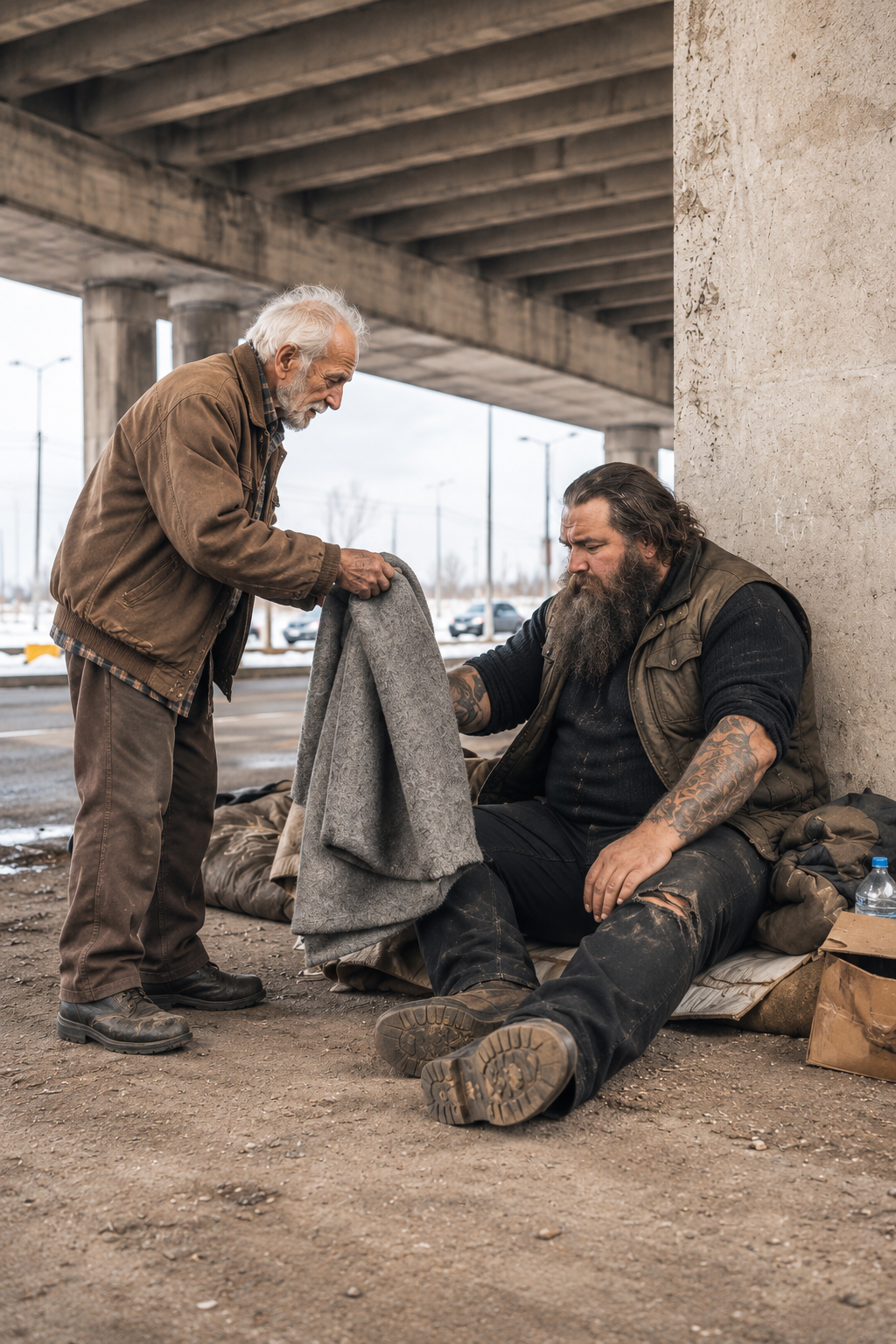
IF FACEBOOK BROUGHT YOU HERE, HERE’S THE CONTINUATION YOU’VE BEEN WAITING FOR. ENJOY! 👇 Morning brought gray light but not much warmth. Cole woke around six-fifteen, folded my blanket with the precision of a man who’d spent years making military bunks, and handed it back. He thanked me, then went to look at his motorcycle in the daylight.
He found a crack in the fuel line near a fitting. I told him there was an auto-parts store on Gallatin Avenue that opened at seven-thirty, and he looked surprised I knew the area so well. “I walk a lot,” I said, which was explanation enough.
Cole managed a call to Randy Walsh. I watched his expression change as he listened, then heard him ask, “How many?” When he hung up, he said Randy was coming with a few others, though he didn’t look entirely sure how many “a few” meant.
Randy arrived around nine-fifteen in a pickup with tools, accompanied by a younger rider named Derek. He greeted Cole with a quick embrace and then came straight to me. He introduced himself as the Memphis chapter’s road captain and shook my hand as though we were meeting at a job site instead of under a bridge.
“Cole told me about the blanket,” he said. I shrugged and told him a man had been cold. Randy answered that giving away the one warm thing I had wasn’t quite the same as handing over a spare.
While Derek and Randy examined the motorcycle, I sat by my pillar drinking water. Watching them work reminded me of soldiers maintaining equipment together, each man knowing his part. After a while, Randy crouched beside me and asked about my situation without making me feel like a problem to be solved.
I told him I’d been without stable housing for closer to three years and beneath this bridge for eleven months. I was on waiting lists for VA mental health care and housing assistance. I’d been diagnosed with a mild traumatic brain injury and PTSD, although neither had felt particularly mild when I was trying to keep a job.
Before things fell apart, I’d worked in logistics and supply-chain management. Randy asked whether I’d consider that kind of work again, and I told him I would if I could manage the noise and pressure. He mentioned a veteran named Garrett Finch who ran a construction apprenticeship program in Nashville.
Cole came over wiping grease from his hands and admitted he’d told Randy about me during the night. He said he hoped I didn’t mind. I asked what kind of help they were offering, expecting conditions I wasn’t ready to meet.
“Lunch first,” Randy said. “Then we’ll talk.” I hadn’t eaten since the previous night’s sandwich, so I agreed, and Derek stayed with the bike while we drove to a diner on Gallatin Avenue called Maze.
The place had worn booths, strong coffee, and a woman behind the counter who knew Randy. I ordered eggs, toast, and hash browns and tried not to eat too quickly. Randy told me the riders had worked with a Nashville shelter called Hope’s Door for two years and that Garrett’s program had helped twenty-three veterans into construction work over the past eighteen months.
There was a six-month housing stipend for people accepted into the program. Better still, Randy said, my logistics background could translate to scheduling, purchasing, inventory, and project coordination. I asked if he’d already called Garrett, and he admitted he had.
“I decided to come,” Randy told me. “Helping is a conversation.” It was the first offer I’d heard in a long time that left room for me to say no.
Randy handed me his phone, and Garrett answered. He asked about my work history, military service, current housing, and whether I could meet him Thursday afternoon. I answered truthfully, even when telling the truth made me uncomfortable, and we arranged an appointment at his office on Charlotte Avenue.
I wrote the address on the back of a diner receipt and tucked it into the plastic bag with my discharge papers. That made the meeting feel real in a way a promise alone wouldn’t have. By the time we finished breakfast, Derek had replaced the damaged fuel line and Cole’s motorcycle was running again.
Before he left, Cole offered to take me to Thursday’s meeting. I said I could ride the bus, and he said he knew that but was offering anyway. I accepted, and he handed me his phone number with a note telling me to call if I needed anything before then.
I walked back toward the bridge with a full stomach and an appointment I hadn’t expected. The concrete and the river were exactly where I’d left them, but I found myself thinking about Thursday instead of the next cold night. That was a change I didn’t know how to measure yet.
Randy, meanwhile, kept making calls. He spoke to chapter leaders in Memphis, Knoxville, Nashville, and riding groups across Tennessee, Kentucky, and northern Alabama. Some of those calls concerned my job opportunity, and others concerned something Cole hadn’t told me was being planned.
On Thursday, Cole arrived to drive me to Garrett’s office. I packed my duffel because it held everything I couldn’t afford to lose, then sat across from Garrett for a ninety-minute interview. He asked detailed questions about the supply systems I’d managed and listened carefully when I explained that loud environments and unpredictable demands could make concentrating difficult.
Garrett said his office needed a coordinator to schedule subcontractors, track materials, and keep projects organized. It was real work, not a favor disguised as a job, and he believed my experience fit it. The program could place me in a shared veterans’ house on Hermitage Avenue while I got established.
I asked when I could start. “Monday,” he said, “if you want.” For a moment I stared at the schedules on his whiteboard, trying to picture myself sitting at a desk again, then told him I did.
Part 3 Cole was waiting outside and read the answer on my face before I spoke. We rode back to the overpass for my sleeping bag, lantern, duffel, Bible, and discharge papers. I stood beside the pillar for a moment, looking at the patch of concrete where I’d survived eleven months, then shouldered the bag and left.
The house on Hermitage Avenue had a broad porch and a kitchen that smelled like dinner. June Carroll, a retired Army nurse, showed me my room, handed me the house rules, and told me supper was at six. When I said I’d already eaten that day, she answered, “That’s not what I asked.”
At the table I met Marcus Odum, Shane Kelly, and Dwight Barrow, three other veterans working their way through the program. June served pot roast, cornbread, and green beans, and the conversation moved easily between practical things and jokes. I found myself speaking more than I had in months.
Later, as Cole prepared to leave for Memphis, he told me why he’d contacted Randy. “You had almost nothing, and you gave me your blanket,” he said. “I wanted people to know what kind of man was living under that bridge.” I stood on the porch after he rode away, listening to the sounds of an occupied house behind me.
Friday was spent getting ready for work. Marcus helped me find clothes at the Salvation Army, and Garrett called about the software used in the office. Sleeping in a proper bed felt strange after eleven months on concrete, but I slept.
On Saturday morning, Shane knocked on my door and said there was something I needed to see. Downstairs, Dwight turned his phone toward me. A post from the motorcycle chapters announced a Sunday evening ride to the Jefferson Street overpass in honor of a veteran who had given away his only blanket.
Messages were coming in from Memphis, Knoxville, Chattanooga, Louisville, Birmingham, and Atlanta. Riders were promising to attend, and the latest estimate was already above eight hundred. I sat down at the kitchen table and asked June what I was supposed to do with that many people.
“You let them come,” she said. She spoke with the calm certainty of someone who knew the difference between an emergency and a moment that only felt overwhelming. So I agreed to be there.
Sunday was cold again, with temperatures falling toward thirty-four degrees by evening. Cole arrived from Memphis in the morning, Garrett came at noon, and Randy spent part of the afternoon coordinating with Nashville police about traffic. June borrowed a van from Hope’s Door and filled it with food and hot coffee.
By five o’clock, I could hear engines approaching the river. I stood on the gravel shoulder near the bridge, wearing a warm canvas jacket Marcus had lent me, and watched the road. At , the first motorcycles came around the bend, headlights stretching behind them farther than I could see.
They arrived in an orderly stream for eighteen minutes. Some parked along the shoulder and access road; others were directed to the open ground near the overpass. By the time the engines went quiet, there were 920 motorcycles gathered around the place I’d called home for eleven months.
Riders from different chapters climbed off their bikes and walked toward the food. Some were young, others old enough to be my father, and there were women and men in leather, denim, and ordinary work jackets. They hadn’t come to watch a spectacle; they had come to stand beside somebody they thought mattered.
Phil Stanton, the Nashville road captain, briefly told the crowd why they were there. He didn’t make a long speech or ask me to stand on a stage. He said they were honoring a man who had given what he had, then invited everyone to eat.
I moved among the riders shaking hands and accepting quiet nods. Roy Delaney, a sixty-seven-year-old Army veteran from Knoxville, told me he’d attended many gatherings but few that mattered as much to him as this one. Donna Sharp from Birmingham gave me her card and said a veterans’ housing advocacy group might need someone with my logistics experience once I was settled.
Cole eventually found me near the river. We stood together looking at the city lights reflected in the Cumberland, and he asked whether I was all right. I considered the question instead of giving the automatic answer I’d used for years.
“Yeah,” I said. “I think I am.” Then I asked why he’d stayed under the bridge that first night instead of finding another way home as soon as his phone worked.
He was quiet for a while. Finally he told me he’d known what it felt like to stop asking for help because he’d decided he didn’t deserve any. Watching me hand over my blanket had reminded him that people could choose differently, even when they had very little.
I looked toward the parked motorcycles and the people passing coffee from hand to hand. They had given up time, fuel, and a cold Sunday evening to show me I hadn’t been forgotten. I thanked Cole once, and he nodded, as if the words were enough.
Final On Monday morning, I took the bus from Hermitage Avenue to Garrett Finch’s office on Charlotte Avenue. I arrived fifteen minutes early, found a desk with a project schedule and two pens waiting for me, and understood the work almost immediately. It was logistics, the kind of work I’d done most of my adult life.
Over the following months, I kept the job and learned to accept help without assuming it came with a hidden price. I began regular VA mental health appointments when my place on the waiting list finally opened in January. In February, I called my sister Linda in Clarksville, and we arranged a difficult but worthwhile dinner in March.
I started running again that spring and eventually moved into a one-bedroom apartment on Fatherland Street in East Nashville, after finishing the housing portion of the program ahead of schedule. Cole came to visit every six weeks or so, and we kept returning to Maze for coffee and breakfast. Donna’s veterans’ housing advocacy work became another place where I could use what I knew.
Ten months after the night beneath the bridge, I went to Linda’s garage with Marcus and opened the box I’d left there four years earlier. At the bottom, beneath photographs and books, was my Purple Heart. I held it for a while, then put it in my jacket pocket and carried the box home.
The following November, Randy organized another ride, this time to Hope’s Door, where I was volunteering twice a week helping veterans navigate services. Three hundred forty riders came despite sleet and rain, bringing sleeping bags, clothing, food, and donations. The shelter director later called it the largest single-day donation in its twelve-year history.
I stood outside with a clipboard, organizing where everything needed to go, when Cole arrived dripping wet from the ride. I called him an idiot for traveling through that weather, and he agreed without argument. Then he asked where I needed him, and I sent him to help sort donations at the loading bay.
I watched him go, remembering a stranded motorcycle and a cold man on a guardrail. I’d given him one blanket because he needed it, and he had helped me find a way back to work, family, and other people. The overpass still stood above the river, but I no longer slept beneath it, and I was finally in a position to help someone else leave a place like that behind.
THE END. I’ve shared the complete story, and I truly hope it touched your heart. If this story moved you, please , like, and share the post. Thank you for reading! ❤️
✓ Lynn R. Adams
IF FACEBOOK BROUGHT YOU HERE, HERE’S THE CONTINUATION YOU’VE BEEN WAITING FOR. ENJOY! 👇 Morning brought gray light but not much warmth. Cole woke around six-fifteen, folded my blanket with the precis…