I had served an 81-year-old Korean War veteran breakfast
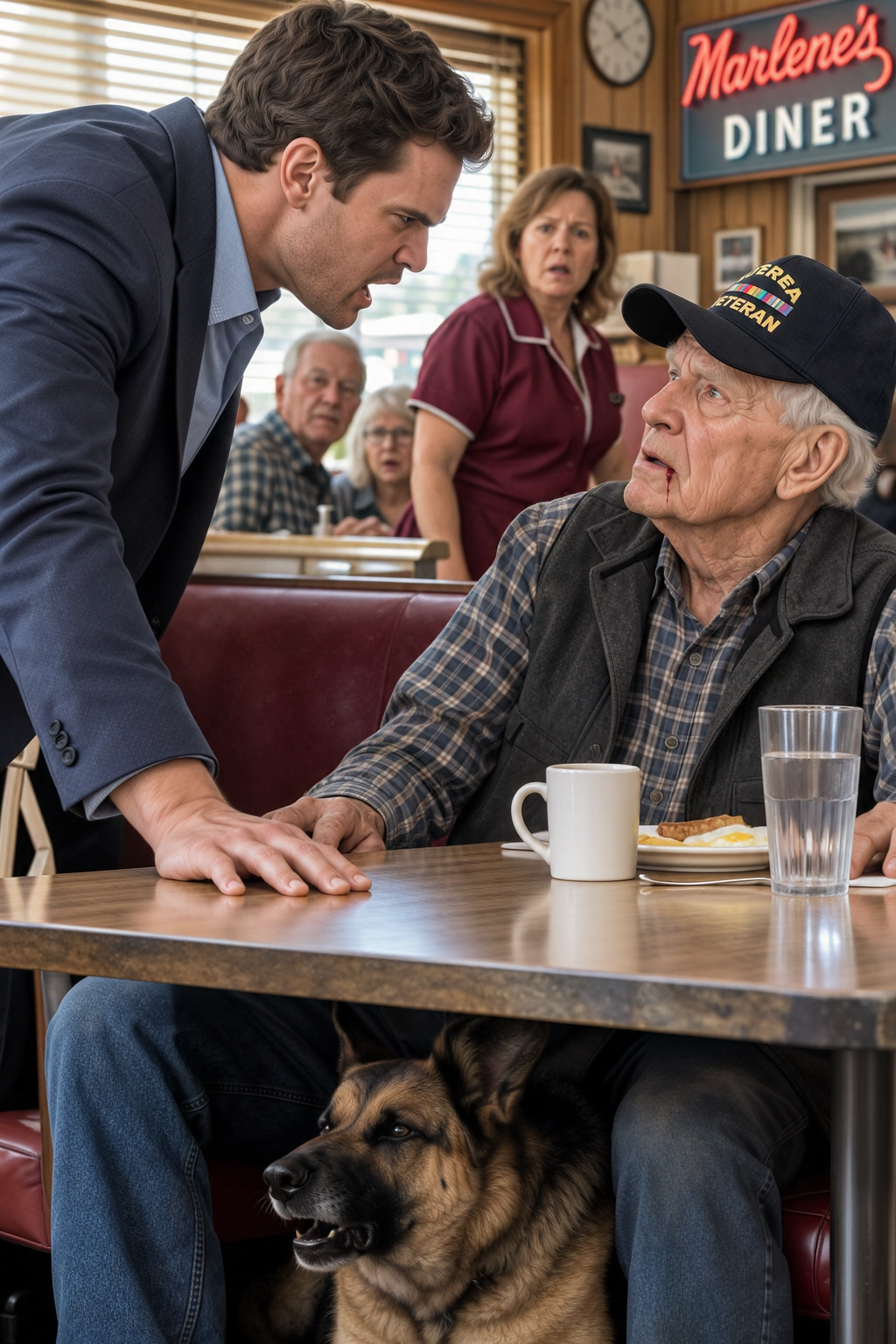
I had served an 81-year-old Korean War veteran breakfast in the same corner booth for almost 30 years, and I thought I knew every kind of trouble that could walk into our little diner, until a stranger demanded his table, struck him in front of everyone, and heard something coming from the highway that made him stop smiling…
My name is Doris, and I’ve worked at Marlene’s Diner outside Barstow since I was nineteen. By fifty-eight, I could tell which customers needed another cup of coffee just from the way they held their mugs, and I knew that the corner booth by the window belonged to Earl Dwiller in every way that mattered, even though his name wasn’t on it.
Earl came through our door at most mornings, wearing a faded VFW cap, with his gray German Shepherd, Chief, walking close to his bad knees. He’d ease into the booth, and Chief would settle at his boots while I brought two eggs over easy, wheat toast, coffee, and a bowl of water without asking what either of them wanted.
For years, Earl’s wife, Ruth, had sat across from him. When she became too sick to come, he kept her place empty, and after she died three years ago, nobody in our diner had the heart to put a stranger there. Earl still folded the newspaper the same way and waited until his coffee was half gone before letting me refill it.
He wasn’t unfriendly, just quiet. He’d nod to the truckers, slip Chief a bit of toast when he thought I wasn’t watching, and ask about my day as if he had all the time in the world. After nearly thirty years of serving him, I knew the difference between a man who didn’t care and a man who had already carried more than enough.
Some of the regulars knew he had served in Korea and still carried shrapnel in his hip. We also remembered small things he’d done closer to home: towing a stranded family in from the highway one cold night, or talking privately with a boy who’d tried to take twenty dollars from our register. That same boy came back to apologize and spent the next two years bussing tables.
Earl never told those stories himself. When someone asked about the VFW cap, he’d usually say he’d done his time, then turn back to the sports page. I think the quiet was part of why people felt safe around him, though that morning I learned how quickly a roomful of people can forget what safety requires.
The black SUV came into the gravel lot while I was carrying fresh coffee toward Earl’s table. A man in an expensive tailored jacket climbed out with his phone against his ear, talking so loudly about a real estate closing and what the nearby properties would be worth that I could hear him through the glass.
He looked about thirty-five, with polished shoes that seemed to hate our dusty floor. I learned his name was Brett Kesler, but he didn’t offer it when he came inside. He stood near the entrance studying the booths, then fixed his eyes on Earl’s corner seat and the window overlooking his SUV.
“I need that table,” he said, snapping his fingers toward me. “I’ve got people coming in twenty minutes.” I offered him a roomy table in the middle, where I could push a second one alongside it if his party needed space.
Brett didn’t even glance at what I was showing him. “I don’t want the middle. I want the corner.” Then he walked straight over to Earl, who was halfway through his breakfast, and told him to take his dog to the counter and finish there.
Earl put down his coffee cup carefully. “Give me twenty minutes, son,” he said. “I’ll be done, and it’s yours.” There wasn’t a sharp edge in his voice, just a reasonable request from an old man trying to eat his eggs in peace.
But Brett leaned across the table and told him he was buying half the block, possibly even the ground beneath our diner. He said Earl would move when he said to move. My stomach tightened, because I didn’t know whether the man was bluffing about the property, and I couldn’t imagine what would happen to the place if he wasn’t.
I stepped closer and repeated that another booth was available. Earl kept his eyes on Brett, his hand resting lightly at his side. Beneath the table, Chief lifted his head and began to growl, and Earl reached down to settle him before the dog could rise.
“We’re not looking for trouble,” Earl said. “The dog’s old, and so am I. But I’m not leaving this booth in the middle of breakfast.” Brett straightened, and for one hopeful second I thought he’d finally understood how foolish this argument was.
Then he slapped Earl across the face. The noise cut through the clatter of dishes so sharply that I stopped walking. Earl’s cap shifted, his head turned, and when he faced us again there was a small split at the corner of his mouth.
Chief sprang up snarling, but Earl caught his collar and said, “Down.” He had to say it twice, the second time more firmly, before the dog settled against his boots. Earl didn’t swing back or even stand; he just straightened his cap and laid both hands on the table.
There must have been twenty people in the diner. A trucker froze with his fork in the air, a woman by the window covered her mouth, and a young man near the register rose halfway before sitting again. I wish I could say one of us stepped between Brett and Earl right then, but nobody did.
Brett looked around as though our silence proved he was right. “Anybody else have a problem with where I sit?” he asked. He pulled a chair up to the end of Earl’s booth, sat so close he crowded the old man, and went back to looking at his phone.
I hurried over with ice wrapped in a clean dish towel. “Earl, I’m calling the sheriff,” I told him, placing it in his hand. He pressed it gently to his cheek and asked me not to, while his other hand stayed on Chief’s collar.
“It’s all right, Doris,” he said. I told him it wasn’t, because it wasn’t, and his expression softened in a way I couldn’t bear. He patted my hand once, then looked out at the desert beyond the window as though he was trying to make room inside himself for what had happened.
I stood beside him feeling ashamed that I’d been holding a coffee pot while someone hurt my friend. Earl didn’t ask me to forgive the man, and I didn’t. I went back toward the counter, trying to decide whether to call for help despite his wishes, while Brett scrolled on his phone with the smug ease of someone who’d never expected to be challenged.
That’s when the water glasses began to tremble on their shelves. At first I thought a big truck had pulled off Route 9, but the noise kept growing, engine after engine, until I could feel it through the soles of my shoes. Earl looked toward the window; Brett finally raised his head from his phone.
A dozen motorcycles turned into our gravel lot, their riders wearing weathered denim and leather vests with matching winged patches. The first man to dismount was broad-shouldered, with a gray-streaked beard, and he paused to look at Brett’s SUV parked across two spaces. Then he walked toward our entrance with eleven other riders behind him.
The bell rang as they came inside, and I recognized the man in front: Travis Dutwiller, Earl’s grown son, the road captain of that group. He’d come to surprise his father for his birthday breakfast, and he had no idea what he was walking into. His eyes found Earl’s cheek, the towel of ice, and Chief pressed close beneath the booth.
Travis crossed the floor and crouched beside his father, suddenly careful in a way that made the whole room feel smaller. “Pop,” he said quietly, studying Earl’s face, “who put his hands on you?” Part 2…..
Every head in the diner turned toward Brett. He was still in the chair he’d dragged over, but the color had drained from his face, and his phone was motionless in his hand. I watched him understand, too late, that the man he’d treated like an inconvenience was somebody’s father.
“It’s a misunderstanding,” Brett said, stumbling over the words. “We had a disagreement about seating. That’s all.” Travis stood, turned toward him, and took a single step; Brett pushed his chair backward so fast it toppled against the floor.
He scrambled upright with both palms raised, but Travis didn’t strike him. Instead, he asked in a controlled voice whether Brett had hit his eighty-one-year-old father and then sat down at his table as if nothing had happened. The eleven riders remained quiet, and I could hear Chief breathing beneath Earl’s seat.
Brett offered money. “Whatever he wants,” he said. “I didn’t know who he was.” Travis looked at him for a long moment, as though those words had told him everything he needed to know about the kind of man standing in front of him.
“That’s the problem,” Travis said. “You didn’t know who he was.” Then he began telling Brett what Earl had never been willing to tell most of us: at nineteen, near the Chosin Reservoir in Korea, Earl had carried two wounded men toward safety over eleven miles of bitter snow while fighting raged around them.
The shrapnel from that war was still in his hip. Travis spoke of Ruth, of Earl’s brother and all the friends he had buried, and of the years Earl had spent coming to our little diner without bothering anybody. I could feel the room listening differently now, not because Earl suddenly mattered more, but because we’d let a stranger convince us he mattered less.
Travis said that when he’d been fifteen, he’d come home with a split lip after finally hitting a boy who had tormented him at school. He’d expected his father to be proud that he fought back. Earl had sat him down and told him any fool could throw a punch; the difficult thing was knowing when not to.
“I didn’t understand him then,” Travis said, his voice growing rough. “I’ve spent years trying to understand him. And here he is, still teaching me.” His hands shook as he reached for the front of Brett’s jacket, and in one angry movement he pulled the younger man up onto his toes.
Brett made a frightened sound. I felt the urge to look away, the same urge that had kept me standing still when Earl was struck, but I made myself watch. Travis’s friends stayed where they were, and his father, from the booth behind him, said just one word.
“Travis.” It wasn’t loud, but his son stopped. Earl set the ice on the table and rose slowly, one hand braced against the booth and the other resting briefly on Chief’s back for balance.
He walked to Travis, put his worn hand on that thick forearm, and said, “Let him down, son.” Travis held on for another moment, his jaw tight, then opened his fingers and let Brett stand flat on the floor again. Earl stepped between them before either man could speak.
He was shorter and slower than both of them. He also looked steadier than anyone else in that room. Brett couldn’t meet his eyes, and Travis stood behind his father breathing hard, as though listening was taking every ounce of strength he had.
Final Earl asked Brett if he knew what had gone through his mind when he was hit. He said he’d remembered a nineteen-year-old boy named Danny who was dying in Korea and had grabbed his collar with a final request: whatever happened, Earl must not turn mean, because that was how cruelty won. Earl had carried those words home and tried to live by them for the rest of his life.
“I’ve kept that promise through worse than this,” Earl said. “I’m not going to break it today.” He didn’t pretend Brett’s behavior had been harmless, and he didn’t tell Travis that his anger was wrong. He simply refused to let either man’s anger decide what happened next.
Earl told Brett to remember the sick feeling he’d had when twelve bigger men walked through the door and he realized nobody was on his side. “That’s what you gave everybody here,” he said. “You made us feel small because you thought you could.” I watched Brett stare at the floor, his hands hanging uselessly by his sides.
“The difference is, I’m not going to keep you feeling that way,” Earl told him. “I’m going to let you walk out.” Travis’s fists were still clenched, but his shoulders finally dropped. He looked at his father in a way that made me think the lesson from his fifteenth year had at last found a place to settle.
Earl said Brett needed to apologize to me, not to him. He reminded Brett that I’d worked that floor since I was a girl and deserved better than having a man snap his fingers at me like I was a dog. Then he told Brett to get into his SUV and leave Marlene’s alone, whether he wanted to buy the place, tear it down, or simply have another cup of coffee.
Brett nodded quickly. He turned toward me and said, “I’m sorry, ma’am. I had no right.” I gave him one short nod, but I didn’t say it was okay, because I wasn’t prepared to tell him something untrue just to make leaving easier.
Travis stepped aside, and the other riders moved enough to leave a clear path to the door. Brett walked past them with his head lowered and drove away down Route 9. He never returned to our diner, and no one had to lift another hand to make that happen.
For a few seconds after he left, I couldn’t seem to move. Then I put the coffee pot down and started clapping. The trucker joined me, and before long the room was on its feet while Earl sat there looking embarrassed by all the attention.
He waved for us to stop and eased himself back into the booth. Chief rested his gray head in Earl’s lap, and Earl scratched behind his ears until the dog’s breathing slowed. Travis approached the opposite seat, Ruth’s seat, and hesitated; Earl glanced at him and gave a small nod.
“You should’ve let me hit him, Pop,” Travis said when he sat down, though his voice had lost its edge. “No,” Earl answered. “One day you’ll be glad I didn’t.” He put his scarred hand across his son’s and reminded him that he’d ridden all that way to buy his father breakfast.
That finally got Travis laughing. He called for eggs for his father and food for every one of his friends, all on him. The riders came by the booth to wish Earl a happy birthday and shake his hand, gently, and a couple bent down so Chief could sniff their knuckles.
We pushed three tables together and kept coffee coming all morning. I refused to charge Earl for his breakfast, and the trucker bought pie for the group before leaving. He also told Earl he was sorry he hadn’t stood up sooner, and Earl encouraged him not to carry the shame forever, only to remember it the next time someone needed help.
The story traveled through Barstow quickly, and within a week Marlene’s was busier than it had been in years. We learned Brett had been trying to buy up the businesses along that stretch, pressing owners to sell cheaply, and Marlene’s had been the last holdout. After that morning his planned deal fell apart, and whatever he’d hoped to do with the diner was abandoned.
Our cracked booths stayed cracked, our menu barely changed, and my coffee pot was still almost never full for long. The difference was that now a few of those riders appeared most mornings, stopping off the highway to spend time with Earl. They called him Pop, even the ones who weren’t related to him, and remembered to fill Chief’s water bowl.
Whenever Travis could come, he’d sit across from his father in Ruth’s old seat. They didn’t always say much. Some mornings I’d see Earl push the newspaper toward his son and Travis read a headline aloud while Chief slept beside them, and that seemed to be enough.
Earl lived four more years. Chief died first, old and tired, and Earl buried him behind his house; for a little while afterward he came to the diner without the familiar sound of paws following him. The riders made sure there was usually somebody to share his table, though nobody tried to pretend Chief or Ruth could be replaced.
When Earl died peacefully in his own bed, his funeral procession stretched two miles along Route 9, motorcycles rumbling ahead while townspeople stood by the road. We closed Marlene’s for the only day in thirty years and afterward I hung Earl’s faded VFW cap on a hook beside the corner booth.
We kept that seat for the people who had loved him, and never offered it to a stranger. Sometimes a traveler would ask about the old cap, and I’d tell them about an ordinary breakfast, a cruel stranger, a son who wanted to fight, and a father who showed all of us something harder than fighting.
I still think about the sound of that slap and how nobody moved, including me. But I think more often about Earl’s hand on Travis’s arm and the way his son let go. That’s the memory I want to keep: an old man who could have answered cruelty with cruelty, and chose instead to keep a promise made long ago in the snow.
THE END. I’ve shared the complete story, and I truly hope it touched your heart. If this story moved you, please , like, and share the post. Thank you for reading! ❤️
✓ Lynn R. Adams
I had served an 81-year-old Korean War veteran breakfast in the same corner booth for almost 30 years, and I thought I knew every kind of trouble that could walk into our little diner, until a strange…