I drove six hours to surprise my seventy-eight-year-old mother on her birthday,
Part 2: My brother reaches for a gun as his perfect scheme unravels
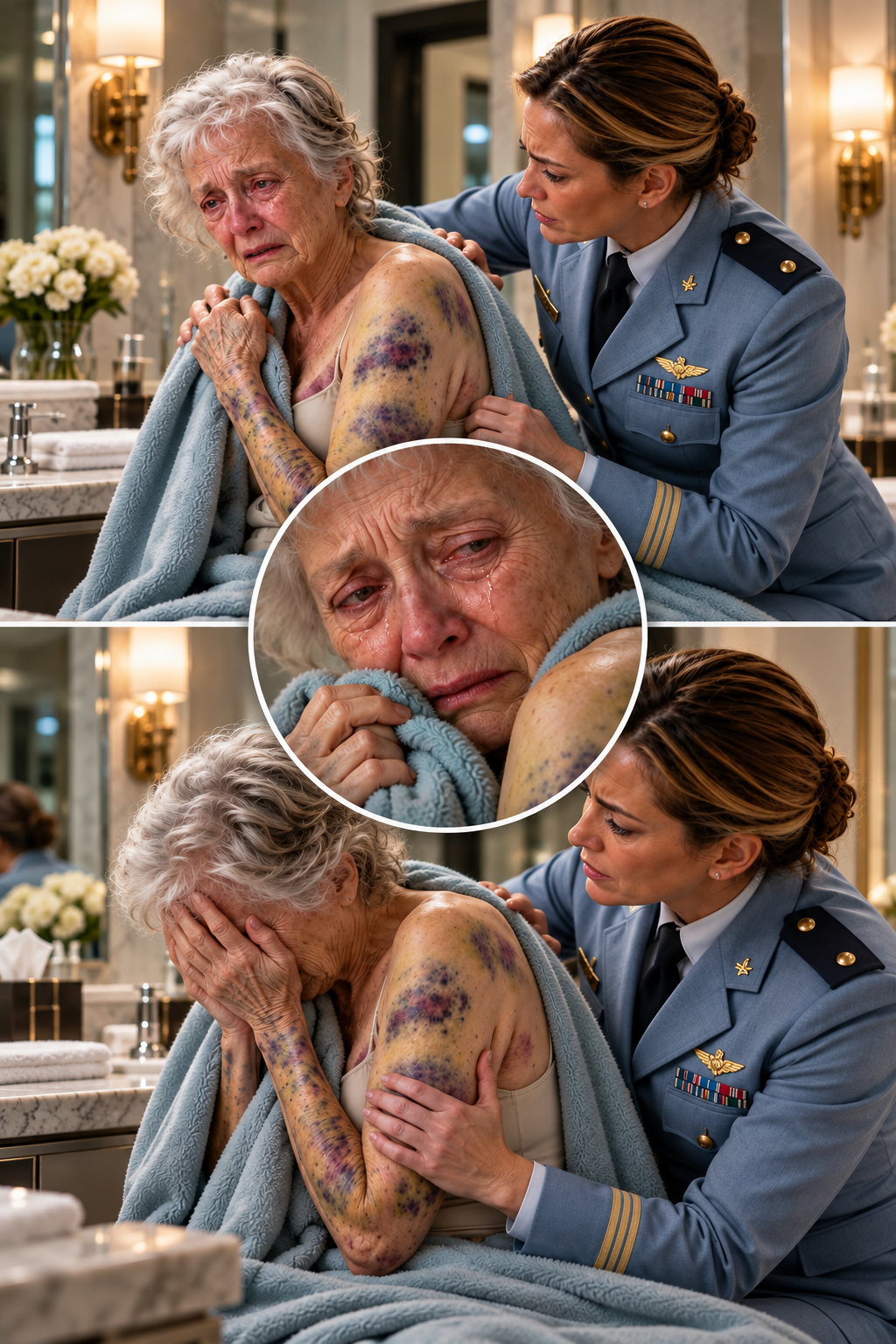
Waiting for law enforcement while pretending nothing had changed was almost unbearable, because Julian watched every movement Mom made and Chloe kept appearing in doorways with increasingly transparent excuses to interrupt us. I helped Mom into comfortable clothes, returned her coat to the closet, and tried to keep my expression neutral while every bruise I had seen seemed burned into my memory. Downstairs, Julian offered me whiskey and began complaining that our mother had become increasingly suspicious, inventing accusations about money whenever she could not remember where something belonged. Chloe suggested I should stay at a hotel rather than disturb their carefully established caregiving routine, describing the house as though it were a medical facility rather than the home my parents had owned for decades. I declined politely, explaining that I intended to spend the weekend with Mom, and noticed Julian exchange a warning glance with his wife.
The conversation deteriorated when Julian casually mentioned that ownership of the property had been transferred into a family trust for tax purposes, something he had never mentioned during our previous discussions about Mom’s finances. I asked who served as trustee, whether independent counsel had represented our mother, and when the documents had been executed, watching his confidence weaken with every question. He accused me of arriving after months away and immediately treating him like a criminal, while Chloe insisted that estate planning was too complicated for someone unfamiliar with the details of daily caregiving. I reminded them that my work involved investigating financial misconduct and that I had no intention of accepting vague explanations about substantial property transfers without documentation. Mom stood near the hallway listening, and when Julian demanded that she confirm everything had been voluntary, she whispered that he had forced her to sign.
My brother’s expression changed so dramatically that I suddenly understood the frightened silence Mom had maintained throughout the evening, because the affectionate son he performed for outsiders disappeared behind naked anger. He advanced toward her, grabbed her upper arm, and told her to stop inventing stories, while Chloe moved toward the front door carrying a handbag she had not possessed minutes earlier. I stepped between Julian and Mom, ordered him to release her, and warned that nobody would touch her again while I was present. He shoved me against the wall and accused me of trying to steal the inheritance he deserved after sacrificing years to care for an ungrateful old woman. Then his eyes moved toward the master bedroom, and I remembered the handgun our father had once insisted Julian keep secured inside a locked dresser.
Julian ran for the bedroom, but I caught his arm near the doorway and struggled to keep him away from the dresser while shouting for Mom to move downstairs. The confrontation lasted only seconds before heavy pounding shook the front door and Sheriff Marcus Hale announced his arrival with deputies who had been dispatched to protect my mother. Julian reached the drawer just as officers entered the hallway, and Marcus ordered him away from the furniture while another deputy moved Mom to safety. Chloe screamed that I had attacked her husband, but her attempt to leave the house ended when officers discovered suspicious bundles of cash and Mom’s jewelry among belongings she was carrying, prompting further investigation under the applicable legal procedures. My mother stood beside the staircase, trembling yet determined, and contradicted Chloe’s claim that she had voluntarily given away the valuables.
By midnight, the residence had become an active crime scene, with officers securing rooms, documenting visible evidence, and arranging emergency medical attention for Mom. Julian and Chloe were taken into custody as investigators began sorting through allegations involving assault, restraint, financial exploitation, and possible forgery. I sat beside my mother in an ambulance and held her hand while she apologized repeatedly for causing trouble, each apology making me understand how thoroughly her abusers had conditioned her to believe she was responsible for their behavior. I told her she had done nothing wrong, but she stared through the windshield and asked whether Julian would punish her when I eventually returned to work. I promised she would not be left alone with him again, unaware that the people who had manipulated my brother were already preparing a far more dangerous response.
Part 3: Hidden surveillance exposes a business built on elderly suffering
Doctors found evidence of injuries at different stages of healing, including fractured ribs that had begun repairing without appropriate medical evaluation, and they treated dehydration and nutritional deficiencies that made Mom even more vulnerable. A cognitive assessment identified understandable difficulties associated with stress, exhaustion, and age, but nothing established the sweeping incapacity Julian and Chloe had claimed whenever they wanted to control her finances. Mom answered questions about her property, medications, family history, and personal wishes with enough clarity to make the contrast between her actual condition and my brother’s description painfully obvious. She explained that Julian had gradually limited her telephone access, screened visitors, and repeatedly told her that my career made me unwilling to handle the inconvenience of an aging parent. The story sounded familiar because he had used the same lie in reverse, telling me Mom was too confused or exhausted to accept calls.
Early the following morning, Marcus reported that investigators had discovered multiple cameras inside the house, including devices positioned in Mom’s bedroom, kitchen, and study. Julian and Chloe had apparently installed the equipment to monitor her activities, but the recovered recordings provided investigators with a disturbing record of intimidation, physical restraint, withheld meals, and pressure to sign financial documents. One video showed Chloe discussing a proposed transfer with someone connected to Haven Senior Services, a company that marketed luxurious residential care to wealthy elderly clients and promised specialized treatment for people experiencing cognitive decline. Rather than focusing on Mom’s health, the conversation concerned obtaining a finding of incapacity, establishing guardianship, and transferring authority over her remaining assets. My stomach tightened when I learned that paperwork for Mom’s admission to Haven Oaks had already been prepared.
Financial investigators traced large withdrawals and property transactions that suggested nearly three million dollars had been diverted through questionable sales, consulting arrangements, investment transfers, and businesses whose ownership structures required closer examination. More than nine hundred thousand dollars appeared connected to entities affiliated with Haven Senior Services, and records recovered from Julian’s office included the names of elderly people unrelated to our family. Some folders contained guardianship documents, others listed property valuations and expected estate distributions, and several appeared to classify potential clients according to how frequently relatives visited them. The pattern suggested Mom had not been selected merely because Julian was greedy; she had become part of a larger operation that treated isolated older adults as profitable opportunities. Marcus requested assistance from investigators with greater resources, recognizing that the evidence extended beyond a single county.
While we reviewed what had been recovered, Mom told me something she had concealed for years because she believed the information would permanently destroy our family. Before his death sixteen years earlier, my father Samuel had discovered Julian stealing money from the family construction business, and although Julian eventually repaid some of it, Dad no longer trusted his financial judgment. Chloe had been employed in the accounting department at the time and helped conceal irregular transactions, which made her involvement in the present scheme seem less like an accidental development. Dad had begun investigating suspicious property repairs associated with elderly homeowners and had discussed his concerns with a trusted friend named Thomas Vale. Then Samuel died suddenly, and Thomas disappeared shortly after the funeral.
That afternoon, an unfamiliar man delivered an envelope to the hospital containing a brass key, a photograph of Dad standing beside Thomas, and a handwritten warning urging me to ask what Samuel had uncovered before he died. The photograph showed my father smiling outside the old construction office, unaware that the work he was doing might place his life in danger. Mom recognized the handwriting as Thomas’s and told me he had warned her shortly before vanishing that Samuel had identified a network involving fraudulent guardianships, fabricated repair expenses, and private care companies. She had never known whether to believe him because grief and Julian’s explanations had left her doubting her own recollection of events. As I turned the brass key in my fingers, I began to suspect that the abuse inside our family home was merely the newest chapter of a crime that had survived my father’s death.
Part 4: The judge I trusted becomes the greatest threat to us
The following morning, I received a call from an unidentified number, and a man’s voice warned me that my father had made the mistake of believing powerful institutions could be defeated with paperwork. He mentioned Haven by name, instructed me to stop asking questions, and disconnected before I could respond. Marcus documented the threat and advised me to remain with Mom while investigators pursued the broader conspiracy, but Julian soon requested a recorded conversation with me, claiming that he knew who had been behind Samuel’s death. I hated the thought of sitting across from my brother after discovering what he had done, yet the possibility of learning something useful persuaded me to meet with him under controlled conditions. Julian appeared exhausted, his expensive clothes replaced by jail clothing, but fear rather than remorse seemed to dominate his expression.
He admitted that he had stolen from Mom and participated in the abuse, then insisted that Chloe had introduced him to people whose influence extended beyond any local financial arrangement. When I showed him the photograph of Thomas and asked whether he recognized the brass key, Julian stared at it with visible alarm and warned me not to bring it anywhere associated with Dad’s old business. He described Haven Senior Services as a public-facing organization controlled indirectly through trusts, attorneys, and consulting companies, then said the person behind those arrangements held a position that made ordinary scrutiny almost impossible. I demanded a name, expecting a financier or corporate executive. Julian whispered, “Richard Thorne.”
For several seconds, I refused to believe him because Judge Thorne had been among the first people I trusted after discovering Mom’s injuries, and his prompt assistance seemed inconsistent with involvement in the very scheme we were investigating. Julian argued that the judge had helped because doing so allowed him to learn what evidence we possessed and maintain the appearance of independence. I reminded my brother that desperate defendants frequently accused influential people in hopes of gaining leverage, and I had no intention of accepting his claim without independent proof. Before he could respond, Marcus entered with news that stripped away every trace of my confidence. Mom had disappeared from the hospital.
A staff member had been found unconscious in a supply room, and security footage showed someone dressed in medical clothing pushing an elderly woman through a service corridor toward a restricted exit. Investigators identified a vehicle connected to the escape, while footage from another camera showed a man whose appearance resembled Richard Thorne entering the hospital during the relevant period. The evidence was incomplete, but Marcus considered the situation urgent enough to coordinate a search involving multiple agencies. My mother’s empty bed, the disconnected medical monitor, and the folded blanket she had been using made the room feel terrifyingly similar to the bathroom where she had begged me not to remove her coat. I realized that exposing Julian’s crimes had not ended the danger because someone with far more to lose had decided Mom might know enough to threaten him.
Investigators traced the suspected vehicle toward an abandoned industrial district containing Dad’s former construction office, a location Julian had warned me about only hours earlier. Marcus explained that officers were moving to secure the building, and I insisted on remaining nearby despite being reminded that my professional title gave me no authority to join an active rescue operation. The construction office had been built above remnants of an old bank, including a sealed underground vault that Dad’s company had once renovated. When officers entered, they discovered signs of recent activity and an open passage leading beneath the building. Inside the underground chamber, Richard Thorne stood holding my frightened mother near an open safe-deposit compartment.
Part 5: A forgotten bank vault uncovers my father’s dangerous final discovery
Thorne looked almost absurdly ordinary beneath the harsh emergency lights, wearing a dark suit and courtroom tie while officers attempted to negotiate my mother’s release. His presence inside the abandoned vault established that he had far more knowledge of Dad’s hidden investigation than his public reputation suggested, although I still struggled to understand how a respected judge could become involved in abducting an elderly woman. He demanded the brass key I had received from the mysterious messenger, but when I looked toward the metal compartment beside him, I saw that the box corresponding to the key had already been opened. Whatever he expected to find was missing, and Mom seemed to recognize something important when she noticed the empty space. She whispered that Samuel must have moved the original records before his death.
Thorne reacted angrily, accusing my father of destroying reputations by refusing to understand what he described as the efficient transfer of unused family wealth. He argued that affluent elderly people often possessed assets their descendants needed more urgently and that modern guardianship arrangements could prevent resources from being wasted. My mother answered that taking someone’s property through fear, deception, and manufactured incapacity was theft regardless of how respectable the paperwork appeared. Thorne insisted he had never personally restrained her or struck her, presenting Julian’s conduct as an unfortunate example of excessive force by someone who lacked professional discipline. His distinction only revealed how thoroughly he had separated his own decisions from the suffering they enabled.
The standoff ended when officers secured an opportunity to intervene and removed Mom from immediate danger while Thorne was injured and taken into custody. During the operation, an older silver-haired man emerged from a concealed access area and identified himself as Thomas Vale, the same family friend everyone believed had disappeared after my father’s funeral. Mom recognized his voice before she recognized his face, and the sight of him standing alive beneath the old building left her torn between relief and anger. Thomas cooperated with investigators and explained that Samuel had discovered irregular property transactions while reviewing invoices connected to a series of renovation projects involving older homeowners. The financial records led him toward guardianship arrangements, private care facilities, and judicial approvals that seemed designed to conceal the movement of valuable assets.
According to Thomas, my father had planned to provide the evidence to federal authorities, but his investigation became known to people connected with Haven before he could complete the process. Samuel died suddenly in his study, officially from a heart attack, while Thomas later obtained information suggesting an unidentified sedative might have been present in his system. The records available to Thomas were incomplete and required independent verification, but they raised serious questions about whether Dad’s death had been accidental. Thomas admitted that he had fled after an attempt to report his suspicions ended with threats and a suspicious vehicle collision. He had spent years collecting information from a distance, using different identities and avoiding contact with Mom because he believed the network would target anyone connected to him.
I asked why he had returned now, and Thomas explained that the brass key was intended to draw attention toward the vault while he worked to identify who still sought Samuel’s original evidence. He had not anticipated Thorne taking Mom from the hospital, and his plan had placed her in danger instead of protecting her. I told him that disappearing for sixteen years while allowing my mother to believe he was dead had not been an act of kindness, regardless of what evidence he managed to preserve. Thomas accepted the criticism without defending himself, which made me angrier because remorse could not restore the years of fear and uncertainty his silence had created. Before investigators separated us, he told me that Dad had prepared another hiding place, one Thorne would never imagine searching because it stood inside the institution that had protected him.
Part 6: My brother confesses the horrifying truth about our father’s death
By sunrise, Mom was back under medical care, Thorne remained in custody, and I began hoping that the central mystery had finally been exposed. Then Marcus showed me a handwritten statement Julian had prepared after learning that the judge could no longer protect the people involved in the Haven operation. The statement began with an acknowledgment that nothing he revealed would make him innocent, followed by a description of events that changed every memory I possessed of the night our father died. Julian wrote that Samuel had threatened serious consequences after discovering theft and suspicious company transactions, and Chloe convinced him that Dad intended to disinherit him completely. Thorne promised that certain documents could be recovered without violence if Samuel remained asleep during the search.
Julian admitted putting a sedative into our father’s evening whiskey, believing the medication would prevent him from waking while Chloe and others searched for financial records. According to his statement, Samuel became seriously ill before they completed the search, and Chloe contacted Thorne rather than allowing Julian to call emergency services immediately. By the time medical help arrived, Dad had stopped breathing, and the subsequent investigation treated the death as a natural cardiac event. Julian insisted he had never intended to kill him, but he acknowledged that his actions had created the danger and that his failure to seek immediate assistance could not be excused. I read the confession twice, remembering my brother standing beside Dad’s coffin with his arm around Mom, telling everyone that our father had died peacefully.
The knowledge struck Mom with a force that seemed almost physical because she had spent sixteen years grieving Samuel while trusting the son who helped conceal the circumstances of his death. She asked whether Julian had ever loved his father, whether Chloe had manipulated him from the beginning, and whether knowing the truth earlier might have prevented the years of abuse she later endured. I could answer none of those questions, and for the first time in my career I hated how easily legal language could describe acts that shattered ordinary human understanding. Intent, causation, conspiracy, and culpability mattered enormously in court, but those concepts offered little comfort to a widow discovering that her husband’s death had been surrounded by deliberate deception. Mom finally said she wanted Julian held accountable, even if doing so meant never again seeing him outside prison.
Chloe offered to cooperate after investigators connected Haven’s operations to additional financial offenses and identified evidence suggesting her role had begun before Samuel’s death. She described the selection of wealthy older clients with limited family contact, the creation of questionable incapacity reports, and transfers of property through related entities disguised as ordinary business transactions. She admitted that substantial amounts stolen from Mom had moved through a charitable organization called Meridian Relief Foundation, which appeared independent but was allegedly controlled by people connected to Thorne. Then Chloe claimed Thomas had once participated in transferring funds associated with the same network, suggesting his history was more complicated than the heroic whistleblower story he had initially presented. Investigators began reviewing his activities with the same skepticism they applied to everyone else’s.
When I confronted Thomas, he admitted arriving at Samuel’s office during the final emergency and choosing to remove evidence rather than remaining to assist my dying father. He said Samuel had instructed him to protect the records, but he also acknowledged that he could not know whether immediate medical intervention might have changed the outcome. I told him that preserving documents did not automatically justify abandoning a person in danger, and he answered that he had spent sixteen years living with precisely that question. Whatever his motives, the decision had consequences he could never undo. Then Thomas revealed that Samuel’s original archive had been concealed behind a memorial plaque inside Courtroom One of the county courthouse, a room later assigned to Richard Thorne.
Part 7: Evidence hidden beneath a courthouse wall destroys the criminal empire
Federal investigators searched the courthouse under appropriate legal authority, entering Courtroom One after the public areas had closed and documenting every step as they examined the memorial plaque Thomas described. The plaque honored courthouse employees who had died during a historic flood, and Dad’s construction company had installed it while repairing damage years before the modern Haven operation became publicly visible. Behind the panel, investigators found a sealed compartment containing metal boxes packed with financial records, recordings, correspondence, and documents linking old property transactions to people who later became central figures in Haven Senior Services. One envelope carried my name in Samuel’s handwriting, and although investigators initially preserved its position for evidence documentation, they later allowed me to read it. Seeing the familiar lettering made my hands shake more than any courtroom confrontation ever had.
Dad wrote that he hoped I would never need the letter, because its discovery would probably mean he had failed to explain something important while he was alive. He described how corruption became dangerous when ordinary people stopped questioning respectable titles and began assuming that polished documents must represent legitimate decisions. He warned me that anger could be useful in exposing injustice but could also become another form of captivity if I allowed revenge to replace judgment. Samuel asked me to protect Mom, hold Julian accountable if his dishonesty continued, and remember that loving a family member did not require concealing wrongdoing. The final sentence said that courage meant choosing what was right while still being afraid, and I sat alone with the page afterward because it felt as though my father had reached through sixteen years of silence to speak directly to the person I had become.
The archive contained records relating to numerous elderly people whose properties had been transferred through questionable guardianship or care arrangements, along with documents investigators could compare against corporate and judicial records. Samuel had also established a restitution-oriented trust using legitimate family holdings, appointing independent administrators and providing instructions for its possible use if the exploitation network were ever formally exposed. The money had grown during the years the records remained hidden, creating a potential resource for victims rather than merely enlarging our family’s inheritance. I was listed as a possible successor trustee under defined conditions, although I immediately understood that accepting such a role would require careful conflict-of-interest review given my government position and personal involvement in the investigation. My father had not simply gathered proof of wrongdoing; he had tried to preserve a means of repairing some of the damage.
Before investigators completed their examination, a fire alarm activated and smoke began moving through part of the courthouse, prompting an immediate evacuation and emergency response. Authorities later treated the event as suspected evidence destruction after discovering signs of tampering near the affected area. During the emergency, Chloe was identified near a restricted entrance after an apparent breach of her custodial arrangements, and officers stopped her before the situation caused more serious harm. Investigators examined materials recovered nearby and determined that someone had attempted to interfere with access to the concealed compartment. The incident exposed additional weaknesses in the security arrangements surrounding Thorne’s network and led to scrutiny of personnel who had facilitated unauthorized movement.
Julian, cooperating under supervision, provided further details about private courthouse routes and meetings he had attended with individuals linked to Thorne. He also claimed Chloe had administered additional medication to Samuel after the initial sedative, an allegation investigators evaluated against forensic records, testimony, and other available evidence. Chloe eventually acknowledged further involvement in the events surrounding Dad’s death, strengthening the case that his collapse had not been an unexplained natural tragedy. Hearing that confession did not make me feel victorious, because the truth simply replaced sixteen years of uncertainty with knowledge that people he trusted had contributed to his death. Yet the records preserved inside the courthouse made it impossible for the surviving conspirators to continue controlling the story.
Part 8: My mother’s courtroom testimony transforms suffering into powerful evidence
The investigation expanded across several jurisdictions, leading to charges involving financial fraud, conspiracy, obstruction, unlawful restraint, exploitation of vulnerable adults, and other offenses supported by the conduct of individual defendants. Authorities reviewed Haven facilities carefully rather than shutting everything down immediately, because vulnerable residents still required medication, housing, meals, and continuity of care. Independent professionals examined questionable guardianship orders, assessed residents’ actual decision-making abilities, and helped families challenge arrangements that had been imposed through misleading information. Some properties were recovered, some assets remained tied up in litigation, and other losses could never be fully reversed because victims had died or money had moved beyond practical recovery. Still, the machinery that had operated behind elegant brochures and respected official signatures could no longer function without scrutiny.
Julian entered a guilty plea resolving serious allegations connected to our father’s death, Mom’s abuse, financial exploitation, and obstruction, and his cooperation helped investigators trace additional transactions. He admitted that resentment had made him vulnerable to Chloe’s promises because he already believed Dad favored me and that inheritance should compensate him for years of perceived neglect. Chloe contested aspects of the case longer, but additional evidence eventually established her substantial responsibility for the family crimes and the broader network. Thomas also faced scrutiny over his financial activities and prolonged silence, although prosecutors separated ethical failures from offenses they could establish beyond the applicable legal standard. I learned to accept that not every terrible decision would receive the criminal punishment I personally thought it deserved.
Thorne chose to stand trial, and the courtroom that once displayed his authority became the setting where his actions were examined by a jury rather than accepted because of his title. Without his robe, he appeared older and less imposing, but he retained the practiced composure of someone accustomed to watching others defend themselves while he remained above the dispute. Julian testified about his own theft, participation in the abuse, and connections to Haven, acknowledging repeatedly that he had lied and committed serious crimes. When defense counsel argued that his cooperation made him unreliable, Julian answered that jurors should not trust him because he claimed to have changed, but should examine the records that independently supported his account. It was the first time I had heard my brother distinguish remorse from evidence.
Mom testified later, wearing a simple blue blouse with sleeves that left her wrists visible, and the sight of her walking toward the witness stand without anyone directing her steps nearly overwhelmed me. She described being restrained, denied access to food, pressured into signing documents, isolated from her daughter, and threatened with placement in a facility where she feared nobody would ever hear her complaints. The prosecutor placed her old gray coat on the evidence table and asked why she had worn it in such a warm house. Mom explained that it concealed the injuries and prevented questions that might provoke further punishment if Julian or Chloe discovered she had spoken. When asked why she finally removed it, she looked toward me and said that her daughter had come home, closed the bathroom door, and given her enough privacy to tell the truth.
The defense attempted to characterize ordinary lapses in memory as evidence that Mom’s testimony could not be trusted, but she acknowledged forgetting appointments occasionally while explaining that fear and isolation had made concentration much harder. She distinguished what she remembered directly from what others later told her, refusing to exaggerate simply because she wanted Thorne punished. When counsel suggested the judge had never personally tied a restraint around her wrists, Mom answered that powerful people did not need to perform every act themselves when they created systems that rewarded others for carrying out their decisions. Her words left the courtroom silent for several seconds, not because they were dramatic but because they described the central pattern supported by the documentary evidence. The jury eventually convicted Thorne on the principal charges established at trial, and the sentence reflected the seriousness of the documented conspiracy and exploitation.
Outside the courthouse, reporters gathered around families carrying photographs of elderly relatives whose lives had been affected by questionable guardianship orders and financial transfers. Mom stepped toward the microphones without asking anyone to speak for her, her shoulders straight despite the fatigue of testifying. She said that becoming old had not taken away her right to make decisions, own property, refuse mistreatment, or be heard when she said something was wrong. She did not discuss revenge, demand sympathy, or ask the public to remember her as a victim forever. Instead, she asked people to pay attention when older adults seemed frightened of the very relatives or professionals who claimed to be protecting them.
Part 9: A final family secret changes everything I believed about fatherhood
The years after Thorne’s conviction unfolded more quietly than the investigation itself, and Mom’s recovery consisted mostly of small choices that would have seemed insignificant to someone who had never been deprived of them. She chose what to eat, which doctors to visit, when to travel, and whether to answer letters from Julian, who remained incarcerated after accepting responsibility for his crimes. Some nights she still checked door locks repeatedly, and for a long time she could not tolerate anyone standing behind her while she changed clothes. I learned to offer assistance without taking over, because rescuing someone from control could become another form of control if I stopped listening to what that person wanted. Mom gradually rebuilt a life defined by her preferences instead of the fears Julian and Chloe had planted.
Recovered assets, settlements, and the trust Samuel established supported an independent organization offering financial review, emergency housing, medical advocacy, and legal assistance to older adults facing exploitation. Mom chose to donate the recovered lake cabin as a retreat for survivors and families, insisting that the curtains remain bright yellow because she had spent enough time inside rooms where every window was closed. I accepted a leadership role only after an independent board established safeguards preventing me from directing benefits toward our family or using the organization as a personal monument. Thomas participated in limited ways, providing historical information and helping administrators understand the original records, but neither Mom nor I pretended that his contributions erased the choices he made sixteen years earlier. He had preserved evidence, yet he had also disappeared when the people who trusted him most desperately needed answers.
Two years after the convictions, Mom and Thomas began speaking more frequently, sometimes disagreeing sharply about Samuel and sometimes sharing memories I had never heard before. Their conversations were not a romantic reunion or an easy reconciliation, because too much grief and mistrust stood between them. Yet Mom eventually invited Thomas to accompany her on a short trip, explaining with dry humor that someone who had disappeared for sixteen years could make himself useful by carrying luggage through several airports. She returned with photographs of coastal towns, crowded markets, and restaurants where she ordered whatever she wanted without worrying that somebody would criticize her spending. Seeing her laugh beside the ocean felt more meaningful than any amount of money returned through the legal process.
On the third anniversary of the night I discovered her bruises, Mom handed me a sealed envelope Samuel had asked her to preserve outside his legal records. Inside was a letter explaining that Thomas had been more than Dad’s closest friend and that Samuel had known a complicated truth about my birth throughout my childhood. Mom told me she had loved Thomas before he entered military service, believed he had abandoned her, and discovered she was pregnant shortly before Samuel asked her to marry him. Samuel had learned the truth but chosen to raise me as his daughter without treating biology as a debt anyone owed him. Thomas had known he was my biological father, yet remained distant because Samuel wanted to occupy the role of father without competition.
I read the letter repeatedly, struggling to reconcile the man who raised me with the man who gave me life and then spent years hiding in the shadows of our family. Samuel had taught me to ride a bicycle, attended every school performance he could, helped me apply to law school, and encouraged me to become someone who valued evidence over convenience. Thomas had given me biological life and preserved information that ultimately helped expose a criminal network, but he had also chosen silence when honesty might have changed our relationships. Neither truth canceled the other, and for the first time I understood that family history could be complicated without requiring me to choose a single person to call good or evil. The revelation changed my understanding of the past without changing who had been my father every day of childhood.
Thomas stood on the porch when I finally walked outside, looking older and more frightened than I had ever seen him. I told him I knew the truth, and he answered that he had never wanted to take Samuel’s place. I said he could not have taken it, because fatherhood was something Samuel had demonstrated through years of love rather than something secured by a biological fact. Then I told Thomas he should have found a way to tell me eventually, should have returned when Mom was in danger, and should have sought help when Samuel was dying. He agreed with each accusation without trying to erase the damage through explanations.
When I stepped forward and embraced him, the gesture did not mean every question had been answered or every injury forgiven. It meant I was willing to acknowledge that this imperfect, frightened man belonged to my history without allowing his mistakes to control my future. Mom joined us a few moments later, resting one hand against Thomas’s shoulder while the lake reflected the last light of evening. Samuel remained the father whose values shaped my life, Thomas remained responsible for choices he could never undo, and Mom remained the person whose courage had forced all of us to confront the truth. I finally understood that justice did not require inventing innocence where none existed, but it also did not require spending the rest of our lives imprisoned by everyone who had failed us.
Part 10: The old gray coat becomes proof that freedom outlives fear
Years later, Mom was eighty-six, living independently with support she had chosen herself, and still traveling whenever her health and energy allowed it. The marks around her wrists had faded, but she never pretended the experience had vanished from memory, particularly when she heard about another older person being isolated by relatives who claimed nobody else understood their needs. Julian remained incarcerated and continued writing letters, some of which Mom answered and others she left unopened until she felt ready. Their relationship never returned to what it had been, because understanding that a son could feel remorse did not require pretending he had not stolen money, restricted her freedom, or helped destroy the family that raised him. Mom sometimes told me that loving someone and allowing that person back into your home were entirely different decisions.
Thomas lived several states away but called before visiting, never again appearing unexpectedly and expecting others to adjust their lives around the secrets he carried. He and Mom maintained a relationship built more on conversation than nostalgia, occasionally traveling together and sometimes spending months apart without turning the distance into a punishment. I honored Samuel by preserving his letters, supporting the independent restitution work he had imagined, and teaching younger investigators why professional status should never substitute for careful examination of evidence. Eventually I left government service to focus on training professionals who handled elder exploitation cases, helping them recognize how financial control, questionable medical assessments, family intimidation, and apparently legitimate documents could conceal coercion. I did not tell trainees that every guardianship was corrupt or every caregiver suspicious, because responsible protection required distinguishing genuine need from exploitation rather than treating all difficult family situations as identical.
Every training session began with a photograph of my mother’s gray coat, hanging neatly from a bathroom hook beside the tiled wall where she finally showed me her injuries. The photograph was deliberately ordinary, with no graphic details or dramatic staging, because the lesson was not that abuse always announced itself through shocking images. Sometimes the most important evidence began with a person wearing clothing inappropriate for the weather, refusing help that should have been welcome, or becoming visibly frightened when a particular relative entered the room. I explained that these observations were reasons to ask careful questions and create safe opportunities for disclosure, not automatic proof of criminal wrongdoing. Most importantly, I reminded investigators that a frightened person’s safety should never depend on producing a perfect story during the first conversation.
On the anniversary of the lake retreat’s opening, Mom visited one of my training sessions and agreed to answer questions from social workers, attorneys, financial specialists, and medical professionals. A young social worker asked whether preserving the coat as an exhibit made Mom feel permanently identified with what happened to her, and she smiled before explaining that evidence and identity were different things. The coat recorded a moment when she had been afraid to reveal injuries, but it did not define the years she spent traveling, laughing, making decisions, and helping other people reclaim their independence. She told the audience she wanted professionals to stop treating older adults as problems to be managed and begin recognizing them as people whose preferences mattered even when those preferences complicated somebody else’s schedule. The room remained silent after she finished, and I realized that her words carried an authority no official title could manufacture.
That evening we returned to the restored lake property, where volunteers had prepared dinner and the windows stood open to a warm breeze. Mom sat on the porch wearing a light blue sweater, watching the water while Thomas quietly arranged chairs for guests who were arriving late. I remembered the afternoon I first entered her house, the heavy winter coat, Chloe’s expensive bracelet, Julian’s leather folder, and the terrible belief that I might have discovered the abuse too late. I remembered Judge Thorne’s reassuring voice, the underground vault, Dad’s letter, and the moment I learned Thomas was my biological father. Above all, I remembered Mom gripping my wrist in the bathroom and begging me not to let Julian discover that I had seen the truth.
I sat beside her and asked whether she ever wished that birthday weekend had unfolded differently, without the revelations, courtroom testimony, and years of painful consequences. Mom considered the question for a long time, then said she wished nobody had hurt her and that Samuel had lived long enough to see what our family might have become without greed and secrecy. But she did not wish I had left without noticing, because silence would have allowed Julian, Chloe, and Thorne to continue making decisions for her until there was nothing left of the life she wanted. She looked toward the open doors of the retreat and smiled at the sound of guests laughing inside. “They took years from me, Elena,” she said softly, “but they didn’t get the rest.”
I took her hand and watched the sun disappear over the water, understanding that everything we had endured had changed my definition of justice more profoundly than any courtroom victory. Julian’s punishment mattered, Chloe’s accountability mattered, Thorne’s conviction mattered, and the recovery of stolen property mattered, but none of those outcomes would have meant enough if Mom had remained frightened, silenced, and controlled. Her freedom lived in ordinary things now, in choosing a sweater instead of a coat, deciding when to answer a letter, booking a flight, refusing a visitor, or opening a curtain without permission. The gray coat remained in the foundation archive, preserved as a reminder of the truth that changed our lives, but Mom never wore it again. And whenever someone asked what I learned from the night I discovered my mother’s hidden bruises, I gave the answer she had taught me: when a person is afraid to reveal their pain, the first duty is not to demand an explanation for their silence, but to help create a place where they are finally safe enough to speak.
✓ Lynn R. Adams
Part 2: My brother reaches for a gun as his perfect scheme unravels Waiting for law enforcement while pretending nothing had changed was almost unbearable, because Julian watched every movement Mom m…