I Came Home to Find the HOA Blasting My Rock Ridge—Then the Survey Crew Uncovered What They Were Really Building
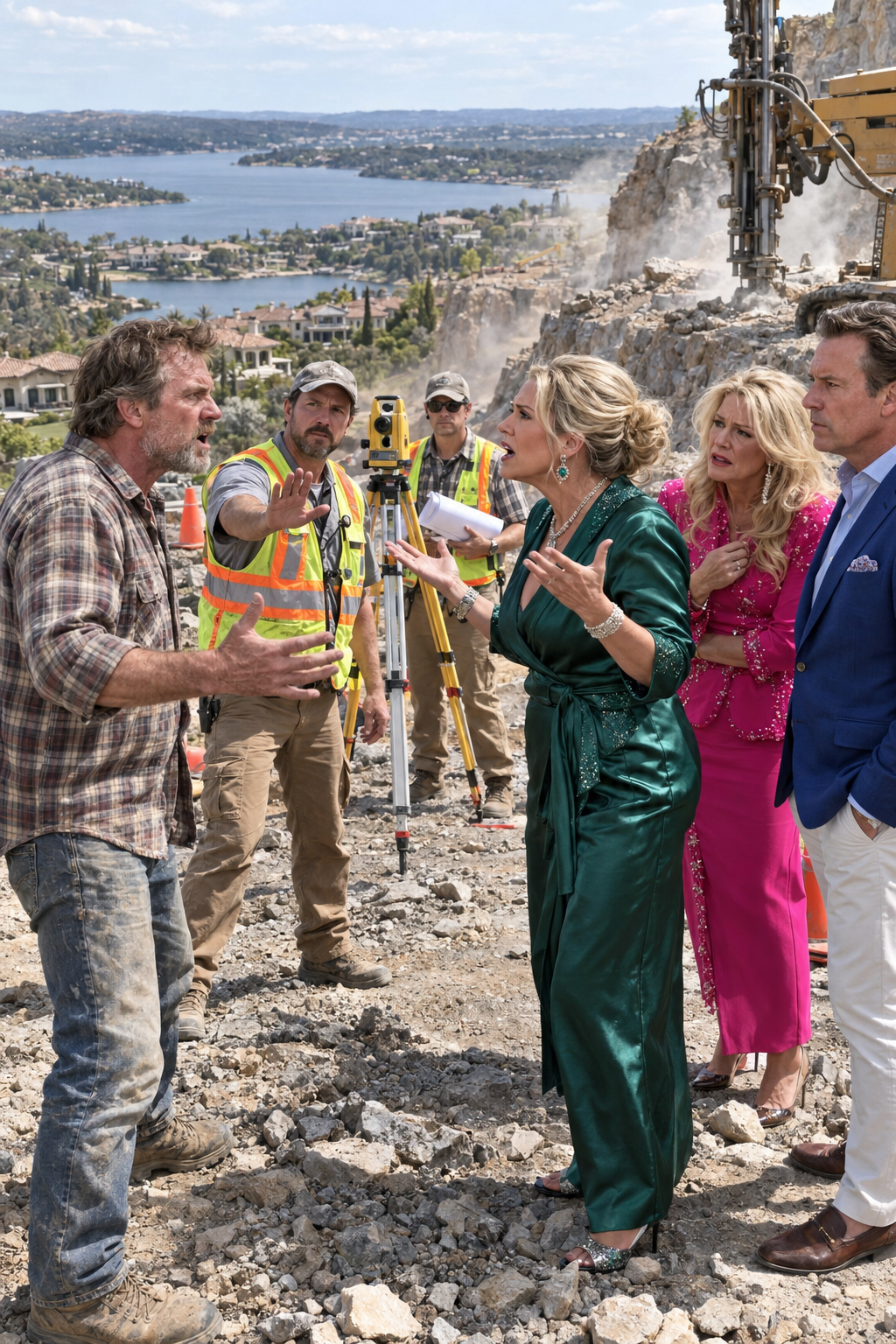
I Came Home to Find the HOA Blasting My Rock Ridge—Then the Survey Crew Uncovered What They Were Really Building
The first explosion hit before I had even turned off my truck.
My coffee jumped out of the cup holder, a flock of ravens burst from the pines above my house, and a slab of gray granite the size of a refrigerator broke loose from the ridge my father had spent forty years protecting.
Then I saw the drilling rig.
It was sitting on my land.
Not near my land.
Not beside the property line.
Three hundred feet past the old split-rail fence, halfway up the granite spine we called Copper Ridge, six men in orange safety vests were standing beside a compressor while another man waved a red flag.
Beyond them, an excavator scraped broken rock toward the edge of the slope.
And fifty yards downhill, watching the destruction from beside a white Mercedes SUV, stood Pamela Voss.
President of the Silver Creek Estates Homeowners Association.
She lifted one hand when she saw me.
Not to apologize.
To tell me to stop.
I parked my Ford beside the gate, stepped out, and heard another warning horn.
Three short blasts.
I knew what that meant.
I had spent twelve years working as a geotechnical engineer before starting my own consulting firm.
Three short blasts meant the shot was loaded.
“Hold the blast!” I shouted.
The foreman turned.
Pamela shouted something back.
The foreman looked from her to me.
I walked straight toward them.
“Hold the blast.”
Pamela marched downhill in cream-colored boots that probably cost more than my first pickup.
“You cannot enter an active construction zone.”
For half a second, I genuinely wondered if I had misheard her.
Behind Pamela stood Copper Ridge.
My granite.
My property.
And she was telling me I could not enter it.
“Who authorized explosives?”
Pamela folded her arms.
“The board.”
“The board owns twelve acres around the clubhouse.”
“We have authority over common-interest property affecting Silver Creek.”
“This isn’t common-interest property.”
“It affects Silver Creek.”
“That wasn’t my question.”
Her jaw tightened.
Behind her, the compressor shut down.
That was the first intelligent decision anybody had made that afternoon.
Pamela lowered her voice.
“You’ve been away almost three weeks, Morgan. There have been developments.”
I looked past her.
Orange paint marked a line across the exposed stone.
There were seven drilled holes that I could see.
Probably more behind the excavator.
Fresh rock dust covered the ground.
Someone had already taken off part of the ridge.
I didn’t raise my voice.
I didn’t scream.
I didn’t threaten anyone.
I pulled out my phone.
I started recording.
“State your name.”
Pamela’s expression changed.
“State your name.”
“You know who I am.”
“For the record.”
She glanced toward the workers.
“Turn that off.”
Then I pointed the camera toward the foreman.
“Sir, are those blast holes currently loaded?”
He hesitated.
Pamela said, “Do not answer her.”
That told me almost everything I needed to know.
The foreman removed his hard hat.
“Ma’am, who are you?”
“Morgan Hale. Owner of this parcel.”
His face went still.
Not guilty.
He looked at Pamela.
Then back at me.
Pamela stepped between us.
“The HOA has a legal easement.”
“For what?”
“Necessary ridge modification.”
I actually smiled.
There is no such thing as a magical easement for necessary ridge modification.
Especially not on my deed.
Especially not on Copper Ridge.
Especially not for explosives.
“You have a copy?”
“Our attorney does.”
“Good. Show it to me.”
“You’ll receive proper documentation.”
“You’ll receive it.”
I turned to the foreman.
“What company?”
“Front Range Rock and Excavation.”
“Who hired you?”
He looked toward Pamela again.
That time, she didn’t interrupt fast enough.
“Silver Creek Estates HOA.”
“For what scope of work?”
Pamela snapped, “Dale.”
So now I had his name.
Dale rubbed the back of his neck.
“View-line clearing and grade preparation.”
My eyes went to the ridge.
“Grade preparation for what?”
Nobody answered.
A cold feeling moved through me.
Because you don’t drill a granite ridge for landscaping.
You don’t bring a tracked excavator, blast mats, and forty-foot compressor hoses because somebody wants a better sunset.
And the broken rock wasn’t being scattered.
It was being pushed into a narrow bench.
A bench wide enough for a road.
I lifted my phone and slowly filmed the slope.
They had drilled into my ridge.
They had marked my trees.
They had cut my fence.
They had blasted my stone.
They had pushed the rubble into a roadbed.
They had done all of it while I was gone.
And they had expected me to come home late enough that there would be nothing left to stop.
Pamela saw me looking.
For the first time, something uncertain crossed her face.
I pointed toward the blasting crew.
“Nobody detonates another charge.”
She laughed.
Actually laughed.
“You don’t command contractors hired by Silver Creek.”
Dale spoke before I could.
“If ownership is disputed, we’re shutting down until it’s resolved.”
Pamela turned on him so fast that gravel sprayed beneath her boots.
“There is no dispute.”
Dale gestured toward me.
“She says she owns it.”
“I have already provided your office with authorization.”
“You provided an easement letter.”
“From the HOA attorney.”
“That isn’t the same thing as proof of ownership.”
Pamela’s face hardened.
“You were hired to perform a job.”
“And my license is attached to that job.”
That was the first mini-payoff of the afternoon.
One sentence.
Pamela Voss had spent two years running Silver Creek like a private kingdom.
But explosives contractors lived in a world where permits, insurance, coordinates, and liability mattered.
Dale wasn’t going to risk his blasting license because an HOA president was annoyed about her view.
He ordered his crew away from the loaded area and called his office.
Pamela turned to me.
“You’re making an enormous mistake.”
“You’re going to be liable for every hour of delay.”
“Send me the invoice.”
“You think this is funny?”
I zoomed the camera toward the exposed granite.
“That ridge is older than your HOA.”
Pamela’s mouth tightened.
“That ridge blocks the western view from forty-three homes.”
There it was.
Not the whole truth.
But something close enough to smell it.
Silver Creek Estates had been built twelve years earlier on what used to be the McAllister ranch.
Big houses.
Big windows.
Big mortgages.
The developer had marketed every property around mountain views and “unspoiled western sunsets.”
Then the second phase went up.
Some owners discovered that the western sunset was mostly Copper Ridge.
I had received complaints before.
A petition.
Once, Pamela even sent me a “vegetation compliance notice” demanding I remove fourteen ponderosa pines from my own property because they interfered with HOA sightlines.
I mailed it back with a copy of the county parcel map.
She sent another.
I ignored it.
Nothing happened.
I looked at the raw scar across the ridge.
“This is about windows?”
“It’s about community property values.”
“This isn’t community property.”
“The ridge affects us.”
“So does the weather.”
“So does the moon. You planning to fine that too?”
Dale coughed into his hand.
Pamela heard him.
That made her angrier.
She stepped closer.
“We tried working with you.”
“You offered me thirty thousand dollars for sixty-eight acres.”
“We offered fair consideration.”
“You offered less than the value of the timber.”
“The ridge has no development value.”
“Then why are you blasting it?”
She didn’t answer.
That silence stayed with me.
The county sheriff’s deputy arrived thirty-five minutes later.
Deputy Mark Alvarez had grown up six miles away.
He knew my father.
He knew Copper Ridge.
More importantly, he knew the difference between a boundary disagreement and somebody detonating explosives on private property.
He listened to Pamela first.
That was fine with me.
People who lie usually become more useful when you give them uninterrupted time.
Pamela produced a folder from her Mercedes.
Inside was an HOA resolution, a letter signed by attorney Bradley Knox, two pages of engineering language, and a photocopy of what she claimed was an access easement.
Alvarez studied it.
Then handed it to me.
The easement described “maintenance access across the eastern service corridor.”
I looked up.
“This is for the water line.”
Pamela said, “It grants access.”
“It grants access to maintain a buried water line along the eastern boundary.”
“We are improving the corridor.”
I turned the page around.
“Copper Ridge is on the northwest corner.”
She stared at me.
“It doesn’t mention blasting.”
No response.
“It doesn’t mention excavation.”
“It doesn’t mention views.”
Pamela’s cheeks flushed.
Alvarez took the paper back.
“Ms. Voss, until ownership and scope are verified, nobody works up there.”
“You can’t shut down an HOA project based on her interpretation.”
“I’m not interpreting anything.”
He pointed toward a red metal property sign my father had bolted to a cedar post twenty years earlier.
PRIVATE PROPERTY — HALE FAMILY RANCH.
Pamela followed his finger.
Alvarez said, “I’m preventing this from becoming worse.”
“It already has become worse.”
Her voice changed.
Less controlled.
She pointed at me.
“She abandoned this parcel.”
I almost laughed.
“I was in Denver for eighteen days.”
“The property is neglected.”
“It’s forest.”
“There are dead trees.”
“It creates a wildfire hazard.”
“So that’s why you blasted granite?”
Dale turned away.
Even Alvarez’s expression changed.
Pamela realized what she had said.
She recovered quickly.
“Everything was approved.”
“By whom?” I asked.
“The appropriate parties.”
“You’ll get them through counsel.”
There it was again.
Not an answer.
Pamela got into her Mercedes and slammed the door hard enough to shake the mirror.
Before she left, she rolled down the window.
“You should call your attorney.”
“I already did.”
That was a lie.
But I called her twelve seconds later.
Her name was Jenna Pierce.
We had known each other since college.
She handled land-use disputes for half the ranching families in our part of Colorado and had once described HOA litigation as “kindergarten with liens.”
I sent her the video.
She called me before Pamela reached the subdivision gate.
“Do not touch anything.”
“I wasn’t planning to.”
“Do not move their equipment.”
“Do not block the county road.”
“And Morgan?”
“Get a survey crew up there before sunrise.”
That surprised me.
“Our corners were surveyed six years ago.”
“Doesn’t matter.”
“Because if they’re dumb enough to blast before confirming the boundary, I want independent coordinates before somebody discovers those monuments have mysteriously moved.”
That sentence changed the entire direction of my night.
I called Northstar Surveying at p.m.
At , owner Ethan Cole returned my call.
At , after I emailed him photos, he stopped sounding tired.
“Those orange stakes,” he said. “Who set them?”
“The contractor, I assume.”
“Don’t assume.”
I zoomed into one of my pictures.
The stakes weren’t ordinary construction stakes.
They had pink survey ribbon.
One had writing on it.
Property line.
My stomach tightened.
“Can you come tomorrow?”
“What time does the blast crew start?”
“We’ll be there at six.”
I barely slept.
At the next morning, I walked up Copper Ridge with a flashlight.
The blast site looked uglier in darkness.
Freshly fractured granite was pale against the older weathered rock.
Powdered stone coated the pine needles.
A section of my fence lay under an excavator track.
I photographed everything.
Hole locations.
Equipment serial numbers.
Paint marks.
Drainage channels.
Blast mat positions.
Tire tracks.
One thing bothered me more every minute.
They had cut a shelf nearly twelve feet wide into the ridge.
If the only objective was to lower the view obstruction, the geometry made no sense.
They were creating a traverse across the slope.
Or the beginning of one.
At a.m., headlights appeared below.
Two Northstar trucks climbed the gravel drive.
Ethan Cole stepped out of the first with a thermos in one hand and a case of equipment in the other.
He was about fifty, gray beard, quiet voice.
His crew included a younger surveyor named Lucas Reed and a field technician named Sarah Bell.
I showed them my recorded deed.
Ethan studied the legal description.
Then the county GIS printout.
Then the ridge.
“You have old monuments?”
“Two iron pins, one brass cap.”
“Original?”
“The brass cap is.”
We climbed to the northwestern corner.
My father had shown me that marker when I was nine.
A round brass disk set into stone beneath an old juniper.
I had cleared pine needles from it every spring.
Except the brass disk wasn’t there.
Ethan looked at me.
“You sure?”
I moved the flashlight.
There was the juniper.
There was the flat stone.
There was the little notch where Dad had once dropped his pocketknife.
But the brass monument was gone.
In its place stood new rebar with a plastic yellow cap.
My mouth went dry.
Sarah crouched beside it.
“This is recent.”
“How recent?”
She touched the cap.
“Hard to say. But not old.”
Ethan photographed it without moving anything.
“What was stamped on the original cap?”
“County survey number. I have a picture.”
I pulled out my phone.
It took me three minutes to find the photograph.
Dad had been kneeling beside the marker on his sixty-eighth birthday, holding a steel coffee mug, smiling like he had personally invented mountains.
The brass cap was visible beside his boot.
Ethan enlarged it.
His eyebrows lifted.
“That’s not a private survey monument.”
“What is it?”
“Control monument.”
“For what?”
He looked toward the ridge.
“Let’s establish coordinates before I answer.”
At , Front Range Rock arrived.
At , Pamela’s Mercedes came through my gate.
She had two board members with her and a man in a navy suit.
Bradley Knox.
HOA attorney.
Apparently everybody had decided sunrise was a wonderful time for litigation.
Pamela saw Northstar’s equipment and marched uphill.
“What are they doing?”
“Surveying.”
“You didn’t notify us.”
“It’s my property.”
“That remains contested.”
Ethan looked up from the total station.
“No, it doesn’t.”
Everyone went quiet.
He didn’t say it dramatically.
He didn’t even raise his voice.
He just looked at the screen, checked something with Lucas, and said it again.
“It doesn’t.”
Knox stepped forward.
“Who are you?”
“Ethan Cole, Northstar Surveying.”
“Licensed?”
Ethan pointed toward his truck.
His company name and professional license number were printed on the door.
Knox adjusted his jacket.
“What conclusion are you claiming to have reached?”
“I haven’t completed a boundary survey.”
“Then I suggest you avoid legal conclusions.”
“I didn’t make one.”
“You just said ownership isn’t contested.”
Ethan looked toward the new yellow-capped rebar.
“Because the coordinates you people provided your contractor are not even close to the recorded boundary.”
Pamela’s face changed.
Knox’s did not.
That told me he was better at this.
Ethan looked at me.
“Current excavation is between eighty-six and a hundred twelve feet inside the Hale parcel.”
Dale, the blasting foreman, swore quietly.
Pamela said, “Impossible.”
Ethan shrugged.
“Coordinates don’t care.”
“You’re using her documents.”
“I’m using county control.”
“That line was adjusted years ago.”
Ethan turned.
“Adjusted by what recorded instrument?”
Pamela looked at Knox.
Knox answered.
“There are multiple easements and boundary agreements affecting the parcels.”
“Give me the reception number.”
Knox paused.
Ethan waited.
“So I can pull it,” he said.
“I don’t have it memorized.”
“Then I’ll proceed from the recorded plat.”
Dale stepped toward the drilling rig.
“Crew’s done.”
Pamela whirled around.
“Until this gets cleared up, we’re demobilizing.”
“You were already cleared.”
“Apparently not.”
“I paid a mobilization deposit.”
“And we’ll account for it.”
“You have a contract.”
“We also have insurance.”
Dale pointed toward the exposed bench.
“My insurer sees this footage, they’ll ask why I kept drilling after a licensed surveyor told me we’re a hundred feet over the line.”
Pamela looked as though he had slapped her.
She tried one more time.
“Dale, listen to me.”
His crew began disconnecting hoses.
That should have felt like victory.
Because Ethan was still staring at his screen.
“What?” I asked.
He glanced toward Pamela.
Then toward the missing brass monument.
“Nothing yet.”
I knew that tone.
It was the tone engineers used when something was absolutely not nothing yet.
Ethan moved farther uphill.
Lucas followed with the prism pole.
They shot three more points.
Sarah started checking county survey records on her tablet.
Pamela and Knox stood beside her SUV whispering.
At , Ethan called me over.
“Your father ever mention a second monument on the ridge?”
“Not that I remember.”
“He keep old files?”
“My grandfather’s.”
“Find them.”
“What are you seeing?”
He looked down the slope.
The newly cut bench curved around the granite face, then aimed toward a saddle between two hills.
Beyond that saddle lay Silver Creek’s western boundary.
And beyond Silver Creek were 220 acres of empty scrubland.
Land that had been for sale for years because it had no practical road access.
Everybody did.
The parcel was boxed in by forest land to the north, a creek canyon to the west, Silver Creek Estates to the east, and my ridge to the south.
No utilities.
No development.
I looked at the bench again.
Then I understood why it felt wrong.
He followed my eyes.
“The ridge isn’t the destination.”
“They’re cutting through it.”
“That would be my guess.”
“To the Westfield parcel.”
He didn’t answer.
He didn’t need to.
The first explosion had been about a view.
That was what Pamela wanted me to believe.
The road said otherwise.
I walked toward her.
She saw me coming and stopped speaking to Knox.
“What’s on the other side of this ridge?”
She crossed her arms.
“What’s on the other side?”
“You know perfectly well.”
“The Westfield property.”
Knox stepped forward.
“Morgan, I would strongly advise—”
“Did Silver Creek buy it?”
Pamela looked at me.
One second.
Jenna once told me that silence becomes evidence long before it becomes admissible evidence.
Pamela said, “You’re speculating.”
“Who owns Westfield?”
“It’s irrelevant.”
“Then answering should be easy.”
Knox said, “This conversation is over.”
“That means I finally asked the right question.”
Pamela got into her Mercedes.
The board members followed.
Knox stayed behind long enough to hand me a folded document.
“Notice of potential damages arising from interference with contracted improvements.”
I glanced at it.
“You typed this before you came.”
“Of course.”
“So you expected the contractor might stop.”
His eyes met mine.
Just for a moment.
Then he walked away.
By noon, the equipment was gone.
The ridge was silent again.
But the silence didn’t feel peaceful.
It felt staged.
I spent the afternoon in my father’s workshop.
Dad had died four years earlier.
Heart attack.
He left me the sixty-eight acres, the house, the barn, and enough tools to rebuild civilization after an apocalypse.
He also left paperwork.
Boxes and boxes of paperwork.
Most people threw away old property tax records.
Dad kept them.
Most people discarded obsolete plats.
Dad labeled them by year.
Most people did not save county planning letters from 1983.
Dad saved the envelope.
At , I found a folder labeled RIDGE.
Inside were three surveys.
Aerial photographs.
Correspondence with the county.
And a handwritten note from my father.
Never agree to western access. Makes back tract buildable.
I sat on the concrete floor.
Read it again.
Back tract.
Dad had known.
Maybe not about Pamela.
Maybe not about Silver Creek.
But he had understood exactly what the ridge meant.
I called Jenna.
She came over that evening with takeout Thai food, two legal pads, and the expression she wore when she smelled blood in a filing cabinet.
I showed her Dad’s note.
She read it twice.
“That’s all?”
“No. But I’m deciding how excited I’m legally allowed to become.”
I handed her the old correspondence.
In 1998, a developer had approached my father about purchasing a thirty-foot access strip over Copper Ridge.
Dad refused.
In 2006, another developer asked.
Dad refused.
In 2014, when Silver Creek Phase Two was approved, county planning staff referenced the landlocked western tract and specifically stated:
No vehicular connection across Hale parcel is authorized or contemplated.
Jenna tapped the sentence.
“This is excellent.”
“Because if they now claim they thought they had access, this document makes that argument uncomfortable.”
“Pamela wasn’t president in 2014.”
“The HOA existed.”
She kept reading.
Then she stopped.
“There’s an attachment missing.”
“How do you know?”
“Page three references Exhibit C.”
We searched the folder.
No Exhibit C.
Jenna called county records the next morning.
At 10:11, they emailed it.
Exhibit C was a map.
And across Copper Ridge, in thick red dashed lines, was the exact route the blasting crew had started cutting.
Not similar.
The same curve.
The same saddle crossing.
The same twelve-foot bench.
The route ended at the Westfield parcel.
Someone had taken an old rejected access proposal and put it back into motion.
I sent the map to Ethan.
He called less than five minutes later.
“Where did you get this?”
“County archive.”
“This matches their stakes.”
“Within a couple feet.”
“Can you document that?”
“I already am.”
“Ethan, who set those stakes?”
“I found a company mark on one.”
My grip tightened around the phone.
“Summit Land Design.”
I knew the name.
Everybody in our county did.
They handled subdivisions.
Large ones.
I searched them online.
Their website loaded.
Recent projects.
Commercial.
Residential.
Mountain communities.
Then I saw a rendering.
WESTFIELD RIDGE.
COMING SOON.
Luxury mountain living.
Twenty-two estate lots.
Private gated access.
Panoramic views.
I stared at the screen.
The page disappeared thirty seconds later.
Not metaphorically.
I refreshed.
I tried the menu.
I called Jenna.
“Please tell me you took screenshots.”
“I downloaded the page.”
“That’s why we’re friends.”
There was no mention of Silver Creek on the rendering.
No mention of Pamela.
No route map.
But the project name was enough.
Twenty-two lots.
Even at conservative mountain prices, each finished lot could be worth hundreds of thousands.
With houses?
Without access?
The Westfield parcel was expensive scrub.
With a road through Copper Ridge?
It became a luxury development.
Pamela hadn’t been destroying my ridge because homeowners wanted sunsets.
That was cover.
The real value was on the other side.
By Friday, things moved quickly.
Jenna sent preservation letters to the HOA, Front Range Rock, Summit Land Design, Knox’s firm, and the county planning department.
Front Range immediately responded.
That interested us.
Their attorney included the contract Pamela had signed.
Scope of work:
“Selective ridge reduction, access bench formation, and preliminary corridor preparation.”
Not view clearing.
Access bench formation.
Preliminary corridor preparation.
And the contract value was $186,400.
Paid from the HOA capital reserve.
Jenna leaned back in her chair.
“Homeowners know about this?”
“I doubt it.”
“Find out.”
Silver Creek had a private Facebook group.
I wasn’t a member.
But my neighbor across the county road, Linda Shaw, cleaned three houses inside the development and knew everyone.
By dinner, screenshots started arriving.
Nobody had voted on a $186,400 road.
Nobody even knew there was a road.
Residents believed the HOA had authorized a $42,000 “wildfire visibility and slope safety project.”
Pamela had mentioned it at a board meeting.
Wildfire mitigation.
Slope safety.
Improved emergency sightlines.
Nothing about blasting private land.
Nothing about Westfield.
Nothing about twenty-two lots.
Saturday morning, eleven Silver Creek homeowners appeared at my gate.
I almost didn’t open it.
Then an older man stepped out of the group holding a binder.
His name was Henry Walsh.
Retired CPA.
Lived on Aspen Crest Drive.
“I think our board lied to us.”
I looked at the binder.
“What’s that?”
“Three years of HOA budgets.”
Jenna, who happened to be standing behind me, whispered, “I like him already.”
Henry entered.
The others followed.
We gathered in my barn around an old workbench.
Henry opened the binder.
“Capital reserve balance last December was nine hundred fourteen thousand dollars.”
He turned a page.
“Current estimate should be roughly eight hundred eighty.”
Another page.
“Instead, as of last month, it’s six hundred forty-one.”
Jenna looked up.
“Two hundred thirty-nine thousand missing?”
“Not missing.”
Henry’s mouth tightened.
“Reclassified.”
He showed us the entries.
Slope stabilization.
Engineering services.
Emergency mitigation assessment.
Consulting.
A series of smaller payments.
Different names.
Same project codes.
I recognized one company.
Summit Land Design.
They had received $31,500 from the HOA.
“So Silver Creek paid the surveyors who staked my property.”
Henry nodded.
“One of several things we apparently paid for.”
Another resident, a woman named Diane Mercer, spoke.
“Pamela told us this was about improving evacuation access during fires.”
“Did she show you a map?”
“Did anyone vote?”
Henry looked at Jenna.
“Can she spend this without approval?”
“That depends on your governing documents.”
He smiled without humor.
“I brought those too.”
For the next two hours, my barn became an audit room.
Meeting minutes.
Every ten minutes, another piece clicked into place.
Pamela had been building something.
Not publicly.
Not cleanly.
But carefully.
She had spread costs across categories.
Used safety language.
Kept individual invoices below thresholds that required full membership approval.
The money trail didn’t prove why.
Then Diane found the first real connection.
Her son was a real estate agent.
He searched state corporation records.
Westfield Ridge Development LLC had been formed eight months earlier.
Registered agent: a Denver law firm.
Manager: Front Range Community Ventures LLC.
That company’s registered mailing address?
A post office box.
Henry recognized it.
He flipped through the HOA documents.
“Give me a second.”
He found an insurance certificate.
Same post office box.
Silver Creek Estates used it for administrative mail.
The barn went silent.
Diane whispered, “You have got to be kidding me.”
Jenna held up one finger.
“Same address is not proof of common ownership.”
Henry nodded.
“Then what is?”
“Formation documents. Banking records. Contracts. Emails. Signatures.”
I looked around the table.
“No accusations yet.”
Diane stared at me.
“They blasted your mountain.”
“My ridge.”
“And I want them stopped permanently, not angry temporarily.”
That mattered.
Anger feels productive.
Usually it isn’t.
Documentation is productive.
Deadlines are productive.
Insurance notices are productive.
Survey data is productive.
Quiet people with folders are terrifying.
By Monday, Front Range Rock’s insurer had opened a claim.
By Tuesday, the county issued a stop-work notice covering all excavation along Copper Ridge.
By Wednesday, the HOA’s own insurance carrier requested project documentation.
By Thursday, Pamela sent residents an email calling me an “anti-community obstructionist attempting to exploit a technical boundary disagreement.”
That email was twenty-three paragraphs long.
It contained no survey.
No easement number.
No explanation for Westfield Ridge.
By Friday morning, Ethan called.
“We found the brass monument.”
I stood up so fast my chair hit the wall.
“Your ridge.”
“But it was missing.”
“It was moved.”
“Thirty-seven feet.”
I didn’t understand.
“Buried under the blast spoil.”
I drove up immediately.
Ethan met me beside a shallow excavation Sarah had opened by hand.
Inside the dirt lay a chunk of stone.
Embedded in it was the old brass disk.
The same one from Dad’s photograph.
The stone had been broken from its original setting.
Someone had moved the entire monument.
Ethan didn’t touch it.
“It’s evidence now.”
“Can you tell when?”
“Not precisely.”
“Why move it only thirty-seven feet?”
“Because that shifts the apparent line.”
“Enough to put their road where?”
“Exactly where they staked it.”
I stared toward Silver Creek.
“That can’t be an accident.”
“Whoever did this knew surveying.”
“Or hired someone who did.”
That was the moment the story changed again.
Until then, I could still imagine Pamela as reckless.
The kind of HOA president who convinced herself that private land was negotiable if the community wanted it badly enough.
But moving a monument was different.
That required planning.
Someone had studied the legal description.
Someone had understood the geometry.
Someone had known which monument mattered.
And someone had believed nobody would compare it to older control data.
Ethan showed me another detail.
The new yellow-capped rebar didn’t identify Northstar.
It carried a small stamped number.
“Can you trace it?”
“Possibly.”
“Is it Summit?”
He looked uneasy.
“County contractor code.”
I stared at him.
“What does that mean?”
“It means this style of cap is normally used by surveyors working under county infrastructure contracts.”
“Normally?”
“Normally.”
I called Jenna from the ridge.
She was silent for several seconds.
Then she said, “Do not put that online.”
“I wasn’t planning to.”
“Do not mention county involvement to residents.”
“And Morgan?”
“We may not be dealing with an HOA dispute anymore.”
Pamela called me that afternoon.
First time she had contacted me directly since the blast.
I almost let it go to voicemail.
Then I answered.
Her voice sounded different.
Controlled.
Too controlled.
“I’d like to resolve this.”
“Through Jenna.”
“We don’t need attorneys for every conversation.”
“We need them for this one.”
“You’re escalating unnecessarily.”
“You detonated explosives on my property.”
“I did not detonate anything.”
Interesting wording.
“The HOA hired the contractor.”
“The board authorized mitigation.”
“Then why does the contract say access corridor?”
“You’ve been given documents you don’t understand.”
“I’m an engineer.”
“Not a real estate developer.”
“No. Developers usually buy land before building roads across it.”
Her breathing changed.
Then she said something unexpected.
“You should sell.”
I looked out my kitchen window toward the ridge.
“Silver Creek.”
“For thirty thousand?”
“A serious offer.”
“How serious?”
“Seven hundred fifty thousand.”
I almost thought I had misheard.
Seven hundred fifty thousand dollars for sixty-eight acres was not absurd.
It was far above Pamela’s previous offer.
Still potentially below strategic value.
But the number didn’t matter.
The timing did.
“It’s a reasonable solution.”
“The conflict.”
“There wasn’t a conflict before you hired a blasting contractor.”
“Morgan, this doesn’t have to become ugly.”
I laughed once.
“You blew up my land.”
“I’m trying to prevent unnecessary litigation.”
“Then send the offer to Jenna.”
“You could walk away from all of this.”
“All of what?”
“I’ll have Bradley contact your attorney.”
She hung up.
I stood in my kitchen holding the phone.
Walk away from all of this.
Not sell the land.
Not settle the dispute.
Walk away from all of this.
That phrase bothered me.
So did the number.
Why offer $750,000 now?
Because the road mattered more.
Maybe much more.
I called Diane’s son.
“What are twenty-two buildable luxury lots worth?”
“Mountain view. Gated. Near Silver Creek.”
“Raw lots?”
“Maybe two-fifty to four hundred each if fully entitled. More for premium.”
Twenty-two at three hundred thousand.
$6.6 million.
Before houses.
The ridge was worth far more as access than as land.
Pamela knew it.
Somebody else knew it too.
The HOA called an emergency meeting Sunday evening.
I wasn’t invited.
So were 146 other homeowners.
At , Henry texted me.
She says you demanded $3 million.
She says ridge work was county approved.
Ask for permit number.
She won’t give one.
People yelling.
Bradley Knox arrived.
Then nothing for twelve minutes.
At , my phone rang.
I answered.
“What happened?”
“You’re going to enjoy this.”
“I doubt that.”
“Knox just resigned as HOA counsel.”
I sat down.
“During the meeting?”
“Walked right out.”
“Someone asked him whether his firm reviewed the Westfield development transaction.”
My pulse quickened.
“What did he say?”
“He asked where they heard about Westfield. Then Pamela tried to adjourn. Diane stood up and asked whether HOA funds had been used for Westfield access.”
“Pamela said it was confidential.”
I closed my eyes.
“Knox whispered something to her. She yelled at him.”
“No idea. But five minutes later he announced his firm was withdrawing effective immediately.”
That was a mini-payoff I hadn’t expected.
Lawyers do not normally abandon paying clients in crowded clubhouses for theatrical effect.
Something had crossed a line.
The next morning, Jenna received a letter from Knox’s firm.
It was short.
They no longer represented Silver Creek Estates HOA.
All future communications should go to the board.
Jenna read it twice.
“Interesting.”
“What does it mean?”
“It means either they discovered a conflict, they weren’t being told everything, they aren’t being paid, or they suddenly became allergic to Pamela.”
“We’ll find out.”
Not from Knox.
The blasting foreman asked to meet me at a diner twelve miles outside town.
He arrived in work boots and a canvas jacket.
No company truck.
He ordered coffee.
Didn’t touch it.
“I shouldn’t be here.”
“Then why are you?”
“Because I’ve been doing this twenty-six years and I’ve never had somebody pull that kind of stunt.”
“What stunt?”
He slid a folded site plan across the table.
“Pamela gave this to us.”
I opened it.
Copper Ridge.
Drill points.
Cut elevations.
Property lines.
Except the line was wrong.
Just enough.
“Who prepared it?”
“Look in the corner.”
The title block had been cropped.
But not completely.
Three letters remained.
“What’s CPC?”
“I thought you’d know.”
Dale leaned closer.
“She told us the HOA had purchased the corridor.”
“First meeting was about two months ago.”
“Who attended?”
“Pamela. Some guy from planning. Surveyor. Another man.”
“What guy from planning?”
My hands went still.
“Don’t know.”
“Describe him.”
“Fifties. Tall. Gray hair. Red glasses.”
I knew exactly one county planning official with red glasses.
Gregory Ames.
Deputy planning director.
Dale continued.
“He said boundary corrections were already in process.”
“Those words?”
“Close enough.”
“Did he sign anything?”
“Was he at the blast site?”
“Before you came back.”
“Why didn’t you tell the sheriff?”
Dale looked embarrassed.
“I thought he was the county inspector.”
“Did Pamela introduce him that way?”
That mattered.
“Did he say he was?”
That mattered too.
Pamela was careful.
People around her made assumptions.
She rarely corrected useful ones.
I showed the plan to Jenna.
She stared at CPC.
Then typed something.
She searched corporate registrations.
Nothing obvious.
Then county vendor records.
Three minutes later she stopped.
“Found it.”
“Canyon Planning Consultants.”
“Who owns it?”
“I hate guessing.”
“Gregory Ames’s wife.”
I felt cold.
“Deputy planning director Gregory Ames?”
“Is that legal?”
“Depends what they do and what disclosures exist.”
“Have they worked for Silver Creek?”
“Give me a minute.”
She searched invoices Henry had provided.
CPC Consulting.
Six months earlier.
Description:
Wildfire access feasibility review.
Jenna turned the laptop toward me.
“Your wildfire project just grew a road.”
The county placed Gregory Ames on administrative leave two days later.
Nobody told us why.
The county issued a bland statement about “an internal review relating to potential outside consulting conflicts.”
Pamela stopped answering residents.
The remaining HOA board members hired independent counsel.
And for the first time since the explosion, Silver Creek went quiet.
Then the letters started.
To homeowners.
Anonymous envelopes.
Photocopies of old plats.
Fragments of contracts.
One contained a handwritten message:
ASK WHO PROFITS FROM WESTFIELD.
CHECK PHASE THREE OPTION AGREEMENT.
Henry brought both to Jenna.
“Phase Three?”
She looked at him.
“You have a Phase Three?”
Silver Creek had two phases.
Everyone knew that.
Phase One: original forty-eight homes.
Phase Two: another ninety-six.
No Phase Three.
Unless Westfield was Phase Three.
Diane’s son found an old planning application.
Withdrawn eleven years earlier.
Silver Creek Phase Three.
Twenty-four proposed lots.
Same western tract.
Rejected because it lacked legal access.
There it was.
The ridge had blocked the project eleven years earlier.
My father’s refusal had killed it.
Someone was trying to resurrect it.
The developer listed on the old paperwork was Heritage Mountain Communities.
That company dissolved eight years ago.
But one director’s name survived in the filings.
Robert Voss.
Pamela’s husband.
That was the first real twist.
Not inference.
A direct connection.
Pamela hadn’t stumbled into Westfield as an overzealous HOA president.
Her family had been tied to the failed development before she ever became president.
Robert Voss had spent years trying to open the tract.
My father had stopped him simply by refusing access.
Now Dad was dead.
I was frequently out of town.
And Pamela controlled an HOA with nearly a million dollars in reserves.
I sat in Jenna’s office looking at the old filing.
“She used the HOA to finish her husband’s development.”
“I know what it looks like.”
“Her husband was a director.”
“Eleven years ago.”
“She’s paying surveyors.”
“Using HOA funds.”
“Blasting the exact route.”
“Toward his old project.”
“So say it.”
She leaned back.
“I will say it when I have a document showing a current financial interest.”
I hated lawyers sometimes.
Which is why I needed one.
That document appeared forty-eight hours later.
Not because of us.
Because Pamela made a mistake.
Silver Creek’s new attorney demanded financial disclosures from every board member.
Pamela resigned.
Immediately.
No explanation.
She sent an email saying harassment had made it impossible for her to serve.
Then she listed her house for sale.
Price: $1.9 million.
That looked like retreat.
The following morning, Ethan called.
“I need you on the ridge.”
“What happened?”
“We found another monument.”
I drove up.
Ethan, Lucas, and Sarah stood near the southern end of the blast bench.
A small square hole had been exposed where the excavator scraped the slope.
Inside was a steel post embedded in old concrete.
Stamped numbers ran down one side.
Ethan handed me an old survey copy.
“See this?”
A monument was shown exactly there.
“What does it mean?”
“This isn’t your western boundary.”
“It’s an interior control point.”
“For what?”
He spread an older plat across the hood of his truck.
Not six years old.
Not twenty.
Nineteen sixty-three.
The Hale parcel had once been part of a much larger ranch.
My grandfather bought the eastern portion decades later.
Ethan traced a faded line.
“Your deed description references this control point indirectly.”
“So somebody who relocated the northwest monument would need to account for this one.”
“Did they?”
I looked at him.
“So the fake line doesn’t close.”
A survey boundary must work as a whole.
Move one point, and the geometry has consequences.
Whoever shifted the brass monument had made the northern line appear favorable.
But they either didn’t know about the older interior monument or assumed it had been destroyed.
The blasting crew had accidentally uncovered the very marker that proved the newer line impossible.
The operation meant to erase part of my ridge had exposed the evidence that stopped it.
Ethan smiled for the first time.
“Granite has a sense of humor.”
We documented everything.
The county surveyor came that afternoon.
So did an investigator from the sheriff’s office.
This time, Pamela didn’t appear.
Neither did Gregory Ames.
The yellow-capped rebar was removed under evidence procedures.
The brass monument was recovered.
Coordinates were recorded.
And when Ethan finished the preliminary boundary report, there was no ambiguity.
The blast area was mine.
The route was mine.
The access corridor was mine.
No recorded easement authorized a road.
No boundary agreement transferred it.
No HOA declaration included it.
No county approval changed it.
Silver Creek had paid more than $200,000 toward a project it did not legally control.
Front Range Rock’s insurer accepted responsibility for physical damage subject to final valuation.
The HOA insurer appointed separate counsel.
Residents filed a petition for full financial inspection.
For three days, I thought the worst part might finally be behind us.
Then Pamela’s house sold.
The buyer was an LLC.
I recognized the mailing address.
Front Range Community Ventures.
The same entity connected to Westfield.
Pamela hadn’t escaped the project.
She had sold her house to it.
Jenna stared at the transfer record.
“That makes no economic sense.”
“Unless it’s paying her.”
“Can we trace ownership now?”
“Working on it.”
Twenty-four hours later, she called me.
I drove to her office.
She had three monitors open.
Corporate records.
A title report.
An archived lender filing.
“I found Robert.”
“Pamela’s husband?”
“Current connection?”
She rotated the screen.
Front Range Community Ventures LLC.
An amendment from eighteen months earlier listed a new managing member.
RHV Holdings.
Robert Henry Voss.
I leaned back.
There it was.
The current financial interest Jenna had refused to assume.
Pamela’s husband controlled the entity behind the landlocked development.
Pamela controlled the HOA money.
The HOA paid for the road.
The road crossed my land.
My father’s refusal had blocked their project.
Pamela had tried to solve that problem with explosives.
Jenna said quietly, “Now I’ll say it.”
I looked at her.
She tapped the screen.
“This wasn’t about the view.”
The next Silver Creek meeting lasted four hours.
Pamela didn’t attend.
Robert didn’t attend.
Gregory Ames didn’t attend.
For the first time.
The clubhouse was packed.
People stood against the walls.
Others watched through video conference.
Henry had been appointed interim board treasurer.
Diane sat beside him.
The new attorney gave a careful statement.
An independent forensic review had begun.
Certain expenditures appeared unauthorized.
Certain disclosures may have been incomplete.
Insurance carriers had been notified.
No further work involving Copper Ridge would occur.
Then residents began asking questions.
They were angry.
Not because I had blocked their view.
Because they had been used.
An older woman stood.
“We were told this was wildfire safety.”
A man behind her called out.
“We paid for somebody else’s development.”
Another asked whether Pamela had received money.
The attorney refused to speculate.
Henry presented numbers.
$239,000 in questionable or related expenditures.
Maybe more.
Someone swore.
Someone else shouted about assessments.
I stayed quiet until they asked me to speak.
Then I walked to the front.
I didn’t give them a speech.
I showed photographs.
The ridge before.
The ridge after.
The broken fence.
The blast holes.
The shifted monument.
The newly uncovered 1963 control marker.
Then I said:
“I’m not asking Silver Creek residents to choose between your HOA and me.”
The room settled.
“I’m asking you to look at the documents.”
I held up the rejected 2014 planning map.
“This road was proposed before.”
Another document.
“It was rejected.”
Dad’s letter.
“My father refused access.”
Front Range’s contract.
“Your HOA later hired a blasting contractor for access bench formation.”
Summit invoice.
“Your HOA paid for surveying.”
The corporate record.
“And the western development is controlled by an entity connected to the family of your former board president.”
The kind of silence that doesn’t need drama.
People already understood.
I placed the papers down.
“I don’t know yet who knew what. I’m not going to accuse every board member, contractor, or county employee of being part of something just because their name appears in a file.”
That was true.
And important.
“But somebody moved a survey monument.”
A murmur spread through the room.
“Somebody staked a false property line.”
Louder now.
“Somebody authorized explosives.”
A man in the second row shook his head.
“Somebody spent your money.”
That one landed hardest.
“And if Ethan Cole’s crew had not checked the original control data before the next blast, part of Copper Ridge would probably be gone.”
Nobody interrupted.
I finished with one sentence.
“You deserve to know why.”
I stepped away.
That should have been the ending.
Not the ending of everything.
But maybe the end of the first fight.
The road stopped.
The blasting stopped.
Pamela was gone.
Ames was under investigation.
The HOA was auditing itself.
The survey proved my boundary.
I should have been able to repair the fence, stabilize the cut, and start figuring out how to restore a ridge that had survived ice, lightning, wildfire, and four generations of my family before finally being wounded by a homeowner association.
Instead, at 11:47 that night, Ethan called.
I almost didn’t answer.
Something in his voice brought me fully awake.
“What happened?”
“Are you home?”
“I need you to lock your doors.”
I was out of bed immediately.
“What did you find?”
“I’ve been finishing the boundary report.”
“I went back through the original chain because of the moved monument.”
My kitchen suddenly felt very large and very dark.
“What original chain?”
“Your father’s deed. Your grandfather’s deed. The 1963 survey. The older conveyances.”
“There’s a document in the county system that wasn’t in the normal index.”
“What document?”
“A quitclaim deed.”
My hand tightened around the phone.
“From who?”
Then Ethan said:
“From your father.”
I stopped breathing for a second.
“My father is dead.”
“Front Range Community Ventures.”
The room went cold.
“That company didn’t exist when Dad was alive.”
I looked at the date on the clock.
“The deed is dated fourteen months ago.”
For several seconds, neither of us spoke.
My father had been dead four years.
“Is it forged?”
“I’m not qualified to make that determination.”
“But it claims Dad signed it?”
“What does it transfer?”
“The ridge corridor.”
My knees nearly gave out.
Exactly the corridor.
Exactly the strip Pamela had blasted.
Exactly the road Robert Voss needed.
That meant they had not merely shifted a monument and hoped nobody noticed.
Somebody had built a paper trail.
A fake one.
A deed bearing the name of a dead man.
“How was it recorded?”
“That’s why I called.”
I walked to the window.
Outside, Copper Ridge was a black outline against the stars.
“The deed was rejected the first time.”
“Signature issue.”
My pulse hammered.
“And the second time?”
“Accepted.”
“Who accepted it?”
“County recorder’s office.”
“That doesn’t mean the recorder knew it was fake.”
“Who notarized Dad’s signature?”
Ethan didn’t answer immediately.
“I sent you the image.”
My phone vibrated.
Attachment.
I opened it.
QUITCLAIM DEED.
Thomas Hale.
Front Range Community Ventures LLC.
The description was narrow.
Thirty feet.
Running across Copper Ridge.
A road corridor.
At the bottom was Dad’s signature.
It wasn’t even good.
My father’s real signature leaned forward.
This one leaned back.
But beside it was a notary seal.
I zoomed in.
Read the name.
Then read it again because my brain refused to accept it.
Gregory Ames.
Deputy Director.
County Planning Department.
I whispered, “Oh my God.”
Ethan said, “Morgan, keep reading.”
“There’s more?”
“Last page.”
I scrolled.
Attached to the deed was a certification stating the corridor had been verified through a boundary adjustment review.
A county file number appeared underneath.
I copied it.
Then opened the county records portal.
The file loaded.
Not publicly indexed.
Internal land adjustment.
Three approvals.
Gregory Ames.
A county engineer I didn’t recognize.
And one more signature.
I stared at the name.
My stomach dropped.
It wasn’t Pamela.
It wasn’t Robert Voss.
It wasn’t Knox.
It was someone I knew.
Someone who had sat in my barn.
Someone who had looked me in the eye while we spread budgets across my father’s workbench.
Someone who had been feeding us HOA records from the beginning.
Henry Walsh.
Interim treasurer.
Retired CPA.
The man who had supposedly helped expose Pamela.
His signature was on the boundary certification.
Dated six months before the blasting began.
I heard gravel outside.
Not in my driveway.
Near the ridge road.
Headlights moved through the trees.
One vehicle.
Then a second.
Ethan heard me stop speaking.
I turned off the kitchen light.
The first headlights disappeared behind the barn.
The second stopped at my locked gate.
“I’m here.”
“Call Alvarez.”
I was already dialing.
Then my security camera alerted.
Motion detected.
RIDGE NORTH.
I opened the live feed.
For a moment, all I saw was darkness and dust.
Then a man walked into frame carrying a flashlight.
Another followed with a shovel.
A third figure opened the back of an SUV.
They weren’t heading toward the house.
They were heading toward the newly uncovered 1963 survey monument.
The one piece of physical evidence that proved where the real boundary had always been.
My phone buzzed again.
A message from an unknown number.
Five words.
YOU SHOULD HAVE TAKEN THE OFFER.
I looked back at the camera.
One of the men raised a sledgehammer.
And when the flashlight caught his face, I finally understood why Pamela had disappeared so easily.
She had never been the person at the center of this.
She had only been the person loud enough to make sure I never looked behind her.
✓ Lynn R. Adams
I Came Home to Find the HOA Blasting My Rock Ridge—Then the Survey Crew Uncovered What They Were Really Building The first explosion hit before I had even turned off my truck. My coffee jumped out o…