I came back to my 41 acres…
I came back to my 41 acres and found a $9 million hotel standing on an old landfill I owned. The HOA president called me a trespasser, but one detail on her survey changed everything….
I had spent twenty years cleaning up places where other people had buried their mistakes. So when every environmental sensor on my land stopped transmitting at the same time, I knew better than to blame a bad internet connection. I was finishing a remediation job three states away, but two days after that alert I was driving my old Ford pickup into Cedar Ridge County, wondering what had happened while I was gone.
My name is Elias Norwood. I was forty-six then, and I owned forty-one acres that had once been a landfill. The site stopped accepting waste in the late 1990s and was sealed beneath a protective clay-and-soil cap in 2001. It wasn’t pretty land, and I never pretended it was. But it was mine, the taxes were paid, and six steel gas vents and three monitoring wells kept watch over what was still decomposing underground.
Eighteen months earlier, I had left behind a chain-link fence, a grassy hillside, and warning signs. Now a curved stone gateway stood at the entrance, with young pine trees planted on either side. Beyond it rose a six-story hotel with glass walls, wide balconies, an underground garage, and a pale stone circular driveway. A huge banner advertised the Silver Pines Grand, a $9 million luxury retreat opening that month.
I parked on the shoulder and checked the parcel boundaries on my tablet. My stomach tightened. This wasn’t a building sitting a few feet over the line. Most of that enormous foundation occupied the old landfill cell, precisely where the closure plan had never allowed heavy construction. I stared at the map twice, as though the second look might change it.
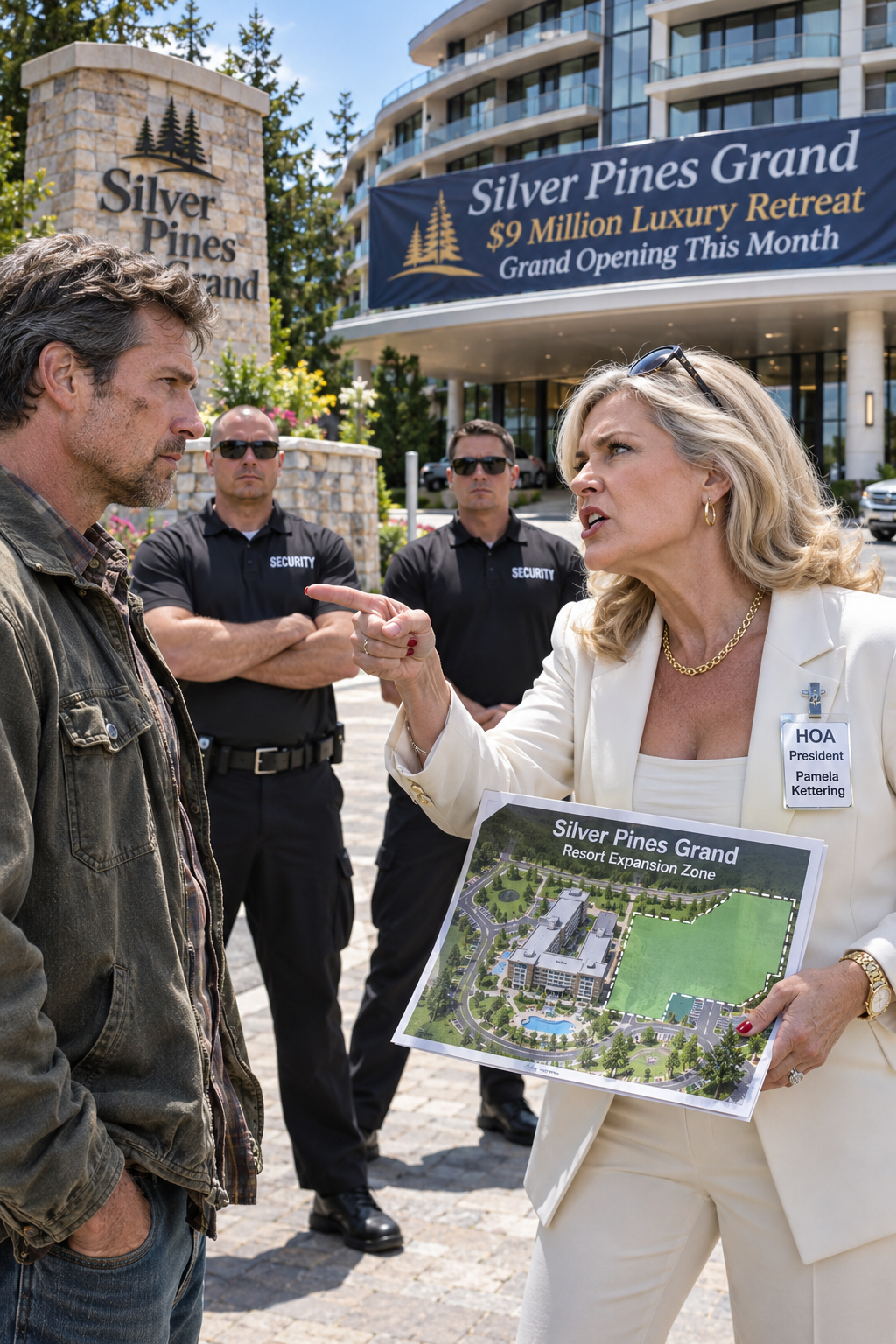
Two security guards stopped me at the construction gate and asked for an invitation. I said I owned the property. One laughed and told me it belonged to the Silver Pines Estates homeowners association. Ten minutes later, a white luxury SUV arrived and Pamela Kettering stepped out, silver-blonde hair immaculate, a tailored white blazer over her clothes, and an HOA president badge clipped to her lapel.
Pamela was fifty-three and spoke as though the argument had ended before I arrived. She said the land had sat abandoned for years and the HOA had absorbed it into a community improvement plan. I told her an abandoned landfill was not abandoned property. She unrolled a glossy development map that colored part of my parcel the same green as the hotel grounds, then warned that I was trespassing on commercial property and the guards could call the sheriff.
I could have raised my voice. Instead, I photographed the hotel, the banner, the gate, and the map in Pamela’s hands. I thanked her and walked back toward my truck. Behind me, I heard her say something to a guard and laugh. She seemed certain I was just an inconvenient man with an old pickup and a story nobody needed to believe.
Then I noticed the parking-garage ramp near the east side of the building. I remembered a twelve-foot steel pipe standing there, vent number three. I pulled the environmental control plan from a folder in my cab and put my finger on the exact spot. That vent was supposed to carry landfill gas into open air. It was now buried beneath a smooth concrete ramp. I looked at Pamela’s map again. None of the six vents appeared on it.
A closed landfill isn’t necessarily quiet beneath the surface. Decomposing waste can produce methane, which can ignite under the wrong conditions, and this site had also accepted drywall debris capable of generating hydrogen sulfide. Those vents weren’t decorative pipes. They were part of the safety system. Looking at the hotel, I couldn’t stop thinking about the people who would soon be inside it.
The next morning I was at the county recorder’s office when the doors opened. Walter Sims, the clerk, found my certified deed, the old closure order, the official parcel records, and the record of my yearly tax payments. They said the same thing: I was the sole owner of all forty-one acres. A land-use restriction recorded in 2001 prohibited lodging or residential construction over the waste cell without state environmental approval. There was no such approval in the file.
Walter also gave me the hotel’s building-permit application. It had been submitted by Silver Pines Hospitality LLC, with Pamela listed publicly as a managing member. Attached was a survey shifting 8.3 acres of my property into the hotel’s building site. The county’s online map had even been updated to reflect that drawing. But a line changed on a digital map isn’t a deed, and no recorded transaction transferred my land to anyone.
That afternoon, I mailed formal objections and certified copies of the records to the permitting office, the construction lender, the title insurer, and Pamela’s hospitality company. I wanted every person financing or approving that project to know there was a real owner and a real landfill restriction. I expected somebody to investigate. Pamela chose to make a public example of me instead.
She called an emergency HOA meeting and filled the clubhouse with seventy-four homeowners. On the screen behind her, she showed pictures of my rusty fence and neglected-looking grass. She called the property a worthless garbage pit, promised the hotel would bring hundreds of jobs and increase home values, and said the association stood to receive about $600,000 annually in shared revenue. Then she accused me of trying to extort the project.
Pamela proposed a resolution declaring my landfill parcel neglected common property. When she asked for a vote, I rose from the back of the room, carried my certified deed to the front table, and explained that a neighborhood association couldn’t vote itself ownership of somebody else’s land. A few people laughed softly at the comparison I made to a book club claiming a public library. Pamela wasn’t amused.
She ordered security to escort me out. Before I left, I asked why a developer would need a new survey to take land the HOA supposedly already owned. The room went quiet. Pamela called my question slander and threatened a $2 million lawsuit if I interfered again. I walked out with the deed under my arm, thinking about how quickly an elected neighborhood president had turned private property into a show of hands.
Later, I examined the survey more closely and saw the surveyor’s name: Leonard Gaskill. I checked his licensing history. He had retired and surrendered his license four years before the date stamped on that document. I drove back to Walter’s office and asked for the archived, legitimate boundary survey. When I laid the two drawings together, almost everything matched: bearings, monuments, notes. One line was different. Someone had moved that line through my property, pulling 8.3 acres toward the hotel, and used a retired man’s seal to make it look official. The question was no longer whether Pamela was mistaken about my boundary. It was who had deliberately changed it—and what else they had changed. Part 2…..
I called Dr. Hadley Brooks, an independent environmental geologist I’d worked with on two earlier jobs. Hadley was forty-two, careful with evidence, and not interested in anybody’s performance at an HOA meeting. We spread the old gas-control drawings across the tailgate of my pickup. She walked me through what could happen when methane and hydrogen sulfide no longer had safe pathways out of a capped landfill.
We went through historical satellite images frame by frame. First vent two disappeared beneath a graded slope. Then vent three vanished under the parking ramp. By the time the hotel took shape, four of the six vents were buried or built over, and two of the three monitoring wells had been paved beneath landscaping. At the accessible edges of my property, we found dead monitoring heads with cleanly cut wires and soil near the foundation that looked dug up and carelessly backfilled.
The monitoring reports I’d received during those eighteen months had always declared the site normal. Hadley compared three of them and pointed to the readings for well number two. That well had stopped transmitting over a year earlier, yet its monthly readings kept appearing, identical down to the last digit except for the date. Whoever had covered the monitoring system had apparently been submitting old numbers as fresh measurements.
We filed an urgent inspection request with the state environmental agency and the county. Pamela’s response was a reassuring report from a consultant hired by the hotel, claiming the building wasn’t on a hazardous portion of the landfill. Her lawyer sent me a warning about damaging the hotel’s reputation. I didn’t answer. Hadley and I obtained the permit drawings instead and spent two nights matching every page against the original environmental plan.
Near two in the morning, Hadley stopped on the basement drawings. All the gas-vent symbols were gone, not relocated, simply erased. At the position of vent four, the largest vent, the plans now showed a sealed mechanical service corridor, with electrical equipment and air-handling machinery. The very place where gas had been meant to escape into open sky was beneath a room where an accumulation could become dangerous.
I began looking into the finances as well. Pamela wasn’t just an HOA president supporting a neighborhood amenity. She had a direct ownership stake through Silver Pines Hospitality LLC. The $9 million hotel depended on a $6.9 million construction loan and private investors, and a public lender notice referred to an arrangement involving an HOA-connected entity. I couldn’t tell exactly what had been promised, but I could see that the homeowners might be exposed to risks they hadn’t agreed to.
At the next open board meeting, I asked for the association’s hotel-related financial records. Pamela announced I wasn’t a member and therefore had no right to demand them. The homeowners started asking their own questions. Why had dues risen for two consecutive years while their maintenance reserve dwindled? Why was their association defending a commercial building outside its legal boundaries?
Russell Kemper, a retired accountant who lived in the community, led a group that invoked the record-inspection rights in the HOA bylaws. They found about $850,000 moved from the reserve fund into a structure supporting the hotel, without the large-expenditure membership vote their bylaws required. Pamela called it a temporary investment that would pay everyone back. When I asked if she had disclosed her personal stake before transferring the money, her face tightened.
“That hotel is worth $9 million,” she said into the microphone. “Your landfill is worth nothing.” I asked why, if it was so worthless, she needed my land underneath it. Pamela banned me from further meetings and her attorney threatened to blame me for investor losses. But the board was beginning to ask questions she couldn’t push out of the room.
Board member Diane Whitlock asked who had authorized the reserve transfer. Pamela claimed all the directors had signed the resolution. Diane said she’d never seen it, and two other members agreed. Three days later an unmarked envelope appeared in my mailbox. Inside was a copy of a resolution bearing their signatures, including those of members whose travel records later placed them hundreds of miles away on the alleged meeting date.
That evening a text arrived from an unknown number: “You are looking at the money. You should be looking at what she buried under the lobby.” I forwarded it to Hadley and county investigators. The sender wouldn’t answer a follow-up. I understood the danger of chasing anonymous leads on private property, so I hired real estate attorney Graham Holloway and decided we’d let lawful records and verified science do the work.
Part 3 I had no intention of sneaking into a hotel or opening a sealed basement myself. Hadley designed a sampling plan limited to monitoring points on my property and places where we had proper access along the public right-of-way. Every sample was labeled, sealed, logged through a documented chain of custody, and sent to an accredited lab. Eight days later, the results showed abnormal methane buildup in soil gas close to the new foundation.
Hadley told me the findings didn’t prove the building needed demolition. They did, however, justify an urgent official inspection and caution around enclosed spaces near its foundation. I took the report to Grant Bellows, the fifty-seven-year-old head of the county’s building safety division. Grant read every page and said the county needed its own verified inspection before it could prohibit occupancy. He wouldn’t base such an order solely on our outside results.
Pamela heard about the testing and invited local reporters into the hotel’s grand lobby. She accused me of sabotaging an honest investment to make a profit for myself, then pointed to the air filtration system as if an expensive filter could answer a question about gas entering through the foundation. Watching the news that evening, I saw how carefully she’d changed the subject.
Grant, meanwhile, discovered that the environmental report in the permit file omitted the recorded land-use restriction. That put the permit itself under review. Graham sent preservation demands to the developer, the contractor, and the consultant, instructing them to retain construction records and drawing revisions. Afterward, a box truck was seen taking file boxes away from the hotel service entrance. It wouldn’t erase the electronic drawing histories preserved by subcontractors.
A supplemental laboratory report detected hydrogen sulfide as well as methane along a utility trench leading toward the hotel’s mechanical corridor. Hadley called me from the lab parking lot, her voice unusually heavy. “The building may be trapping gas that was supposed to escape safely,” she said. Then Graham called: Pamela had moved the grand opening up by forty-eight hours, to Friday evening.
The anonymous texter finally agreed to meet us at a coffee shop near the courthouse. Her name was Shannon Morrow, thirty-eight, and she had worked for two years as the hotel’s document control manager. She brought copies of records she’d lawfully maintained on the job. She was nervous, but her account was precise, and every important statement had a dated document beside it.
Before the mechanical corridor was poured, general contractor Dustin Varner, forty-nine, had sent three written warnings about damaging the gas-control system and disturbing the closed landfill. He’d requested a pause for further testing. Pamela had rejected each request because delays would interfere with the bank’s construction draws and the opening date promised to investors. Shannon’s email chains and revision logs showed the vent symbols disappearing from the drawings and the landfill history disappearing from materials prepared for approval and investors.
Then Shannon set a digital recorder on the table. She had attended the recorded meeting herself and had made the recording lawfully under the state’s one-party consent rule. I heard Dustin warn that sealing vents could cause gas to accumulate. Pamela’s voice followed: “I don’t care what that landfill used to be. I need the hotel open before the bank reviews our numbers.” I sat very still. There was no way to mistake what she’d chosen to prioritize.
Shannon explained that the $6.9 million loan had milestone conditions. A construction stoppage before opening could trigger the kind of review that would expose the survey, the false monitoring reports, and the reserve money. Graham arranged for Shannon’s original files, metadata intact, to go directly to investigators. Dustin later came forward too, acknowledged that work continued after his objections, and agreed to have his own decisions examined.
Shannon saved one document for last: an internal memo Pamela had signed three weeks before opening, instructing staff not to mention the former landfill or its gas-control system in publicity or guest information. I had gone to that first meeting at the gate thinking Pamela might not know what lay beneath the hotel. The memo made clear that she had been warned and had decided guests didn’t need to know.
Part 4 By Thursday, trucks were unloading flowers, banquet tables, ice sculptures, and lighting at the hotel. Pamela had invited about 280 adult guests—investors, local businesspeople, county figures, reporters, and neighborhood residents. Yet the hotel still hadn’t met every condition for a certificate of occupancy. It seemed she expected an important crowd and a public celebration to carry the project past whatever approvals remained.
Hadley, Graham, and I had already turned over our evidence to the county, state environmental officials, and the fire marshal. Grant told us his team was verifying the information, but he wouldn’t announce an inspection date. Giving notice, he said, could let someone alter a scene before investigators arrived. I agreed and spent the next day wishing the hours would move faster.
Friday morning Pamela held a press conference under the lobby chandelier. In front of cameras, she claimed I had demanded $3 million to withdraw my objections. From the public sidewalk I asked her to produce one message, letter, or recording showing that demand. She had none. Instead, she mocked my old landfill, and some investors laughed. I said my land had an owner, her survey had been altered, and the basement had a problem her money couldn’t solve.
Pamela told security to remove me. I returned to the public roadside without an argument. I wasn’t going to give her a video of me fighting with a guard when the inspectors needed to focus on a building that could put people in danger. Unknown to Pamela, Grant had received final laboratory verification and Shannon’s records, and was coordinating an emergency inspection with the fire marshal and state environmental team.
In the late afternoon, luxury cars arrived beneath the new stone gateway. Staff had laid out a red carpet, and a countdown clock ticked toward the ribbon cutting. Pamela, in a white evening gown, raised a champagne glass as cameras focused on her. Then county vehicles turned into the drive. Grant stepped out with environmental inspectors, a building safety team, and two firefighters. He showed Pamela his credentials and written authority and told her nobody would enter the hotel until the hazard assessment was finished.
Pamela pointed across the drive toward me, insisting I’d caused the intrusion. Grant barely glanced my way. He explained that ownership belonged in court, but the urgent question was whether the building was safe. Then an inspector’s detector sounded near the mechanical corridor. It was on Friday evening, and nearly three hundred invited guests were standing outside, wondering why the doors hadn’t opened.
Under controlled conditions, inspectors in protective gear entered the lower mechanical spaces with calibrated instruments. They logged each location and reading. In a sealed utility vault, methane registered about 6.8 percent by volume, within a flammable range when mixed with air. Another room registered roughly 28 parts per million of hydrogen sulfide, a serious exposure concern. Electrical equipment nearby made the findings especially alarming.
Grant ordered everyone still working inside to evacuate. Firefighters secured the entrances and arranged for nonessential electrical systems to be shut down safely. Pamela waved her consultant’s report at Grant, but the report hadn’t tested the critical enclosed locations and no longer accurately described the altered site. Dustin, present at investigators’ request, confirmed that he had warned the project team about burying the vents before the corridor was built.
“Your air conditioning system cannot fix gas entering through a compromised foundation,” Grant told Pamela. He issued an emergency unsafe-structure order and a red notice was posted on the glass doors: “Unsafe structure. Occupancy prohibited.” No guests could enter, no hotel operations could begin, and no certificate of occupancy would be issued. The permit, obtained on an incomplete record, was also under formal review.
Pamela called her attorney, her project director, and the bank representative. The numbers on the instruments didn’t change. The lender suspended further construction disbursements. As guests quietly returned to their cars, she accused me of destroying her life’s work. I told her I hadn’t put gas under the building. I’d warned her about the ground she’d chosen to build on.
Shannon handed over the last of her documents in person. A state investigator played a short excerpt from the meeting she’d recorded, and Pamela’s own voice echoed through the suddenly quiet lobby: “I need the hotel open before the bank reviews our numbers.” The investigation was no longer only about unsafe air below the floor. It was also about who had authorized the land, construction, and financing paperwork that made the hotel possible.
Final In the following weeks, investigators looked separately at land ownership, environmental compliance, and money. A court-appointed independent surveyor reviewed my deed and walked the original monuments. The hotel occupied 8.3 acres of my land. Leonard Gaskill, by then in his seventies, swore that he’d never seen the survey bearing his seal. Investigators treated the signature as a suspected forgery.
State environmental investigators found that construction had breached the landfill’s protective cap, buried four of six vents, and damaged the monitoring system, creating pathways for gas to collect inside the building. A structural review raised serious concerns about the foundation poured over disturbed and improperly refilled waste. The developer was ordered to prepare an environmental mitigation and restoration plan. The hotel project was suspended indefinitely.
The bank stopped further payments and reviewed its loan rights. Investors demanded an independent audit, and the title insurer investigated whether concealment and suspected fraud affected coverage. Back at Silver Pines Estates, homeowners learned the $850,000 reserve transfer was tied up in a project that could not legally open. Pamela promised the money would return, but Russell Kemper asked why the community’s savings had been used to support her private investment at all.
Under the HOA bylaws, the homeowners called a recall vote. Sixty-six of seventy-four owners voted to remove Pamela as president. Diane Whitlock became the new leader, and the board hired an independent auditor, ended its association with the hotel, and pursued recovery of the misused funds. The people who once trusted Pamela to look after their neighborhood were now trying to find out how much of its financial security she’d put at risk.
My civil case sought confirmation of my title, relief for the continuing trespass, and restoration of the landfill’s safety systems. Investigators then established that the questionable HOA resolution, with signatures from directors who hadn’t attended the supposed meeting, had been submitted to the bank as part of the financing package. The false boundary survey and the false resolution weren’t separate accidents; together they had helped support the same hotel scheme.
County prosecutor Celeste Pickett, forty-five, determined that the evidence supported criminal fraud and records-falsification charges against those responsible. Pamela faced those charges, while claims for damages and repayment moved through the courts. Assets tied to disputed transactions were preserved by court order to protect possible recovery. I wanted the people who’d been misled to have their chance at justice, but I was especially concerned about the land and what was still happening beneath it.
Three months later, the technical and civil proceedings reached a decisive point. Experts agreed that better filters or extra ventilation wouldn’t make that hotel lawful and safe. The foundation lay across a restricted waste cell and had disrupted the protection system designed to control it. After notice, technical review, and the necessary court proceedings, the developer was ordered to remove the encroaching structure and restore the site.
Demolition and rebuilding the gas-control system were estimated at another $2.4 million, on top of the $9 million sunk into a hotel that could never open. The court confirmed my ownership of all forty-one acres. I didn’t suddenly inherit a luxury resort, and I had never wanted one. My demand was that the illegal building come off my land and that the old landfill be made safe again.
Early the following spring, I stood outside a safety fence as the demolition crews worked under an approved plan. A crane had lowered the Silver Pines Grand sign onto the gravel. Pamela arrived with her attorney to attend a court-required property-record proceeding and watched the crews for a long time. Finally, she said I’d destroyed $9 million just to prove I owned a dump.
“No, Pamela,” I said. “You spent $9 million proving you thought you could ignore what was already under your feet.” She looked at the half-dismantled building, then went back to her car without replying.
Over the next few months, the crew removed the remaining structure. Hadley oversaw repairs to the protective cap, reconstruction of all six gas vents, and replacement of the three monitoring wells. Every component was tested before returning to service. My readings finally came from real sensors again, not copied entries on reports somebody wanted me to believe.
I rebuilt the fence along my original boundary and put up a plain sign: “Private property. Closed landfill. Environmental monitoring area.” One evening I stood on the hillside and watched the grass move in the wind. No grand opening, no red carpet, no fancy speeches—just six vents doing their quiet work, three wells telling the truth, and the same recorded deed I’d held from the beginning. Pamela had tried to bury the truth under a $9 million hotel. Concrete couldn’t keep it there.
THE END. I’ve shared the complete story, and I truly hope it touched your heart. If this story moved you, please , like, and share the post. Thank you for reading! ❤️
✓ Lynn R. Adams
I came back to my 41 acres and found a $9 million hotel standing on an old landfill I owned. The HOA president called me a trespasser, but one detail on her survey changed everything…. I had spent tw…