I Bought an Abandoned Stone Quarry Beside an HOA—Then Their Storm Drains Turned My Property Into a Crime Scene
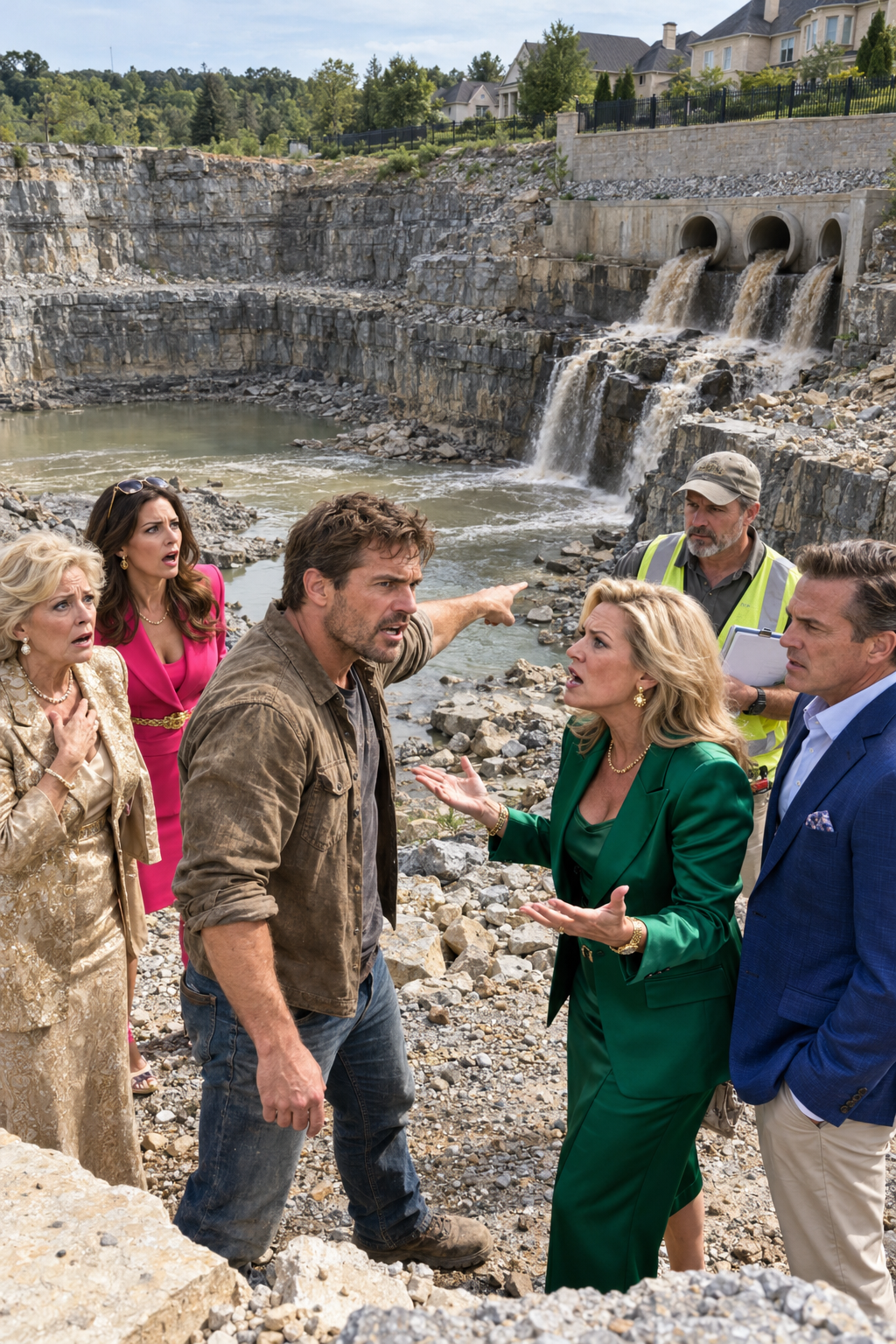
I Bought an Abandoned Stone Quarry Beside an HOA—Then Their Storm Drains Turned My Property Into a Crime Scene
The first thing the HOA president told me was that I didn’t really own the quarry.
The second thing she told me was that if I interfered with the six concrete storm drains dumping thousands of gallons of brown water onto my property, she would sue me into bankruptcy.
The third thing she didn’t tell me.
That was the part that nearly got forty-seven families killed.
I had owned Blackstone Quarry for exactly eleven days when I discovered the first pipe.
It was a Tuesday morning in late March, the kind of Ohio morning when winter hadn’t fully left but spring was already making threats.
The sky hung low and gray.
Cold rain tapped against the hood of my Ford F-250.
Water ran in thin silver lines down the limestone walls.
I stood near the northeast rim of the quarry wearing muddy boots, a canvas jacket, and the expression my ex-wife used to call my “courtroom face.”
No emotion.
No wasted motion.
Just observation.
The quarry sat on sixty-three acres outside Columbus, wedged between an old county road and a subdivision called Stonebridge Estates.
Stonebridge had 112 houses.
Perfect lawns.
Decorative streetlamps.
A private clubhouse.
A swimming pool.
Three tennis courts.
And, apparently, a very creative interpretation of property boundaries.
I’d bought the quarry at a county tax sale for $418,000.
Everybody thought I was crazy.
The place had been abandoned since 1987.
Rusting conveyors leaned against the cliff like dinosaur bones. Weeds grew through the floor of the old crusher building. Two flooded pits reflected the sky twenty-five feet below ground level.
But I wasn’t interested in reopening a quarry.
I was interested in the land.
My name is Ethan Mercer.
I’m forty-two.
For fifteen years, I designed stormwater systems, retention basins, grading plans, and industrial drainage projects.
Then I started my own civil engineering company.
Three years later, a national infrastructure firm bought me out.
I wasn’t rich enough to buy islands.
I was rich enough to stop taking orders from people who thought urgency was a personality.
Blackstone Quarry was supposed to become my next project.
Thirty acres of native habitat.
A restored lake.
A small equipment yard on the west side.
Maybe twelve high-end homes on the ridge someday, if zoning allowed it.
Mostly, I wanted space.
Quiet space.
Space nobody could schedule meetings on.
Instead, eleven days after closing, I found a forty-eight-inch concrete pipe sticking through the embankment on my eastern boundary.
It looked old.
That was the first thing I noticed.
The second was that it was flowing hard enough to send water forty feet down the slope.
The third was the smell.
Not sewage.
Not exactly.
Fertilizer.
Everything you’d expect washing off 112 suburban lots and two miles of private streets.
I climbed the bank.
Then I found another pipe.
Then another.
By noon, I had found six.
All six entered my property from Stonebridge Estates.
None appeared on my title survey.
None appeared on the county GIS easement layer.
And none appeared in the drainage documents included with the quarry sale.
I didn’t panic.
Engineers don’t get paid for panicking.
We get paid for finding out which assumption is about to fail.
So I went home.
I pulled my closing documents.
Then I opened the county recorder’s website.
No drainage easement.
No stormwater easement.
No right-of-way.
No utility agreement.
At that afternoon, I emailed the Stonebridge Estates Homeowners Association.
The message was three paragraphs.
Professional.
I identified myself as the new owner of Blackstone Quarry.
I included parcel numbers.
I explained that multiple stormwater outlets appeared to discharge onto my property.
I asked for copies of any easements, permits, maintenance agreements, engineering plans, or recorded rights authorizing those discharges.
I expected a response from an attorney.
Or a property manager.
Maybe an engineer.
Instead, at the next morning, a white Mercedes SUV came through my quarry gate.
The woman driving didn’t call.
She didn’t knock.
She drove around the chain I had temporarily removed for a survey crew and parked directly beside my truck.
She stepped out wearing cream-colored boots that cost more than my first car payment.
She was probably fifty-five.
Silver-blonde hair.
Camel coat.
Gold bracelet.
Not dressed for an abandoned quarry.
She looked around like she was inspecting something she had ordered.
“You’re Mercer?”
“Ethan Mercer.”
She didn’t offer her hand.
“I’m Patricia Caldwell. President of Stonebridge Estates.”
“I saw your email.”
“Great. Do you have the drainage documents?”
Her eyes narrowed.
“You bought the quarry?”
“All of it?”
I glanced toward sixty-three acres of limestone, scrub trees, water, mud, and abandoned machinery.
“That’s generally how deeds work.”
She didn’t smile.
“We’ve been using this property for drainage for twenty-three years.”
“That’s why I’m asking for the easement.”
“There isn’t an easement.”
That surprised me.
Not enough to show it.
She folded her arms.
“Our developer designed Stonebridge to discharge into the quarry. It’s always been that way.”
“Who gave them permission?”
“The old quarry owner.”
“Recorded where?”
“It didn’t need to be recorded.”
“It does if you expect it to bind a future owner.”
Her expression changed then.
Like I was the employee who had just complicated an easy morning.
“Mr. Mercer, you clearly don’t understand the situation.”
I looked at her.
“I design drainage systems.”
That gave her half a second of trouble.
Then she recovered.
“Well, then you understand why those pipes cannot be obstructed.”
“I haven’t obstructed anything.”
“You’re thinking about it.”
I let the silence hang.
“I’m thinking about finding out why someone built six stormwater outlets onto land they didn’t own.”
She stepped closer.
“You cannot disrupt Stonebridge drainage.”
“Show me the legal authority and I won’t.”
“You don’t really own the drainage basin.”
I looked behind me.
At my quarry.
Then back at her.
“My deed says otherwise.”
“The quarry has functioned as Stonebridge’s stormwater facility since before half our residents moved in.”
“That’s not ownership.”
“It’s established use.”
She smiled.
It wasn’t friendly.
“Good. Then we understand each other.”
“We don’t.”
Her smile disappeared.
“I’m not agreeing you have rights. I’m telling you I’ll investigate whether you do.”
That was the moment Patricia Caldwell decided she didn’t like me.
Not because I yelled.
Not because I threatened her.
Because she couldn’t make me react.
People like Patricia don’t fear anger.
Anger can be dismissed.
Anger can be photographed.
Anger can be quoted selectively at a board meeting.
Calm questions are harder.
Especially questions with parcel numbers attached.
I said nothing when she told me Stonebridge had “used” my land for twenty-three years.
I said nothing when she warned me not to contact county officials.
I said nothing when she claimed the HOA’s attorney had already “confirmed” its rights.
I said nothing when she threatened an emergency injunction if I touched the pipes.
I said nothing when she got back into her Mercedes and told me I had “one chance to be a good neighbor.”
I just watched her leave.
Then I called a surveyor.
His name was David Chen.
David had worked with me on highway projects years earlier.
He had the personality of a man who considered parentheses exciting.
Which made him exactly who I wanted when property rights were involved.
He showed up Thursday with two field technicians and a robotic total station.
By Friday afternoon, he called me.
“You’re going to enjoy this.”
“I’m not sure enjoy is the word.”
“Five of the six outlets are entirely inside your parcel once they cross the fence line.”
“And the sixth?”
“Straddles it.”
“Any easement markers?”
“Recorded plat?”
“Anything unusual?”
“One thing.”
I leaned back in my office chair.
“The northeast property line is weird.”
“How weird?”
“Stonebridge’s fence isn’t on the line.”
“Whose side?”
“Depends where you are. Seven feet in some places. Eighteen in others.”
I stared at the wall.
“So their fence encroaches.”
“Approximately eight hundred feet.”
That wasn’t devastating.
But it was useful.
I asked David to finish the certified survey.
Then I hired an environmental consultant.
Not because I expected toxic waste.
Because once you discover unauthorized stormwater entering industrial property, you document everything before anybody gets creative.
Her name was Dr. Laura Bennett.
She collected water samples during the next rain.
High chloride.
Elevated petroleum hydrocarbons.
Lawn chemicals.
Nothing apocalyptic.
But enough to prove the water wasn’t naturally draining from my land.
It was suburban runoff.
We installed three cameras.
Two flow meters.
And a rain gauge.
Over the next ten days, I learned something interesting.
During moderate rainfall, Stonebridge was sending roughly 1.8 million gallons of runoff into the quarry.
During heavy rain, the number could exceed four million.
That was a lot.
Far too much for six neighborhood outfalls unless something else was happening.
So I pulled historic engineering records.
Stonebridge Estates was built in three phases between 2001 and 2007.
The original developer was Wexler Communities.
Their approved drainage plan showed two detention ponds.
Not six quarry outlets.
I read that page twice.
Then a third time.
Stonebridge had been legally approved with on-site stormwater detention.
The ponds were supposed to hold runoff and release it slowly into a natural creek south of the subdivision.
But satellite imagery showed something strange.
One pond still existed.
The second had disappeared.
In its place stood nine houses.
All built around 2014.
I zoomed in.
Then I sat back.
There are moments in engineering when the facts stop looking like unrelated mistakes and begin arranging themselves into a sentence.
This was one of them.
The original drainage design required two detention ponds.
One pond had been filled.
Nine houses had been built where it used to be.
And now six unauthorized pipes sent stormwater into my quarry.
That didn’t prove wrongdoing.
But it made Patricia’s twenty-three-year story impossible.
At least four of those outlets couldn’t have existed twenty-three years ago because aerial photos from 2012 showed no trenches there.
Someone had installed them later.
I called the county stormwater office.
A man named Greg Holloway answered.
I gave him the parcel numbers.
There was a long pause.
“Blackstone Quarry?”
Another pause.
“Who are you?”
“The owner.”
“You bought it?”
“Three weeks ago.”
He exhaled.
That was an interesting okay.
“Is there something I should know?”
Another pause.
“I’d need to look at the files.”
“May take some time.”
“How much?”
“A few days.”
He called forty-two minutes later.
“I think you need to come in.”
The county administration building smelled like copier toner and burnt coffee.
Greg was fifty-something, heavyset, thinning hair, blue dress shirt with sleeves rolled to the elbows.
He closed his office door.
On his desk were three folders.
“I found records.”
“Some of them are strange.”
He pushed one folder toward me.
The first document was dated August 2014.
Stonebridge Estates HOA.
Emergency stormwater modification.
Temporary diversion due to detention pond failure.
That word mattered.
The HOA had apparently requested permission to reroute runoff while Pond B was repaired.
The county approved a temporary sixty-day bypass.
And the temporary discharge location?
Blackstone Quarry.
There was a handwritten note attached.
OWNER CONSENT REQUIRED BEFORE INSTALLATION.
No consent form followed it.
I flipped through the folder.
“Where’s the property owner approval?”
Greg shook his head.
“We don’t have one.”
“Then how was the permit activated?”
“It may not have been.”
I looked up.
“You’re saying the HOA installed this without final approval?”
“I’m saying I can’t find the final approval.”
“And the pipes stayed for twelve years.”
He didn’t answer.
I opened the second folder.
A compliance inspection.
The inspector had noted the temporary bypass remained in place.
The HOA claimed Pond B repairs were “pending financing.”
Another note.
A letter from Stonebridge’s attorney stating the HOA and quarry owner had “reached a permanent drainage understanding.”
Again, no agreement attached.
The quarry owner at the time was Blackstone Materials LLC.
A company that had dissolved in 1996.
Eighteen years before the temporary permit.
I stared at the letter.
“Blackstone Materials didn’t own the quarry in 2018.”
Greg rubbed his forehead.
“I noticed.”
The owner in 2018 was a holding company called Merritt Industrial Land Trust.
I knew because I had bought the property from the trust’s successor.
“So Stonebridge’s attorney identified the wrong owner.”
“Did anyone verify it?”
“I don’t know.”
“What about the detention pond?”
Greg opened the third folder.
There it was.
A zoning amendment approved in 2013.
Nine homes had been allowed on part of the original detention site after Stonebridge submitted a revised stormwater analysis.
I scanned the engineering company name.
Redwood Civil Design.
I knew Redwood.
Or at least I knew what happened to it.
The firm lost its license in 2019 after one of its principals falsified compaction reports on a commercial retaining wall.
I kept reading.
Their revised analysis claimed Pond B was no longer necessary because “equivalent off-site storage capacity” existed immediately west of Stonebridge.
Immediately west.
But there was no easement.
No purchase.
No agreement.
No recorded right.
Just the assumption that fifty feet of empty rock belonged to nobody important.
“How did this get approved?”
Greg looked uncomfortable.
“The planning commission relied on the engineer certification.”
“That the quarry could be used.”
“Without verifying ownership.”
“I wasn’t here then.”
“I’m not blaming you.”
I closed the folder.
“Who was HOA president in 2013?”
He looked at me.
“I think you already know.”
Patricia Caldwell.
I drove home without calling her.
That mattered.
If Patricia had arranged the modification, there was no reason to show my cards yet.
Instead, I hired an attorney.
Rebecca Sloan.
Former county prosecutor.
Now a land-use lawyer with an office overlooking downtown Columbus.
Rebecca read the documents in silence.
Then she put down her pen.
“You didn’t buy a quarry.”
“That’s what the deed says.”
“You bought a pressure point.”
“How much pressure?”
“If these records are accurate, Stonebridge eliminated required stormwater infrastructure, redirected runoff onto private property without a recorded easement, then represented that it had permission.”
“Can they claim prescriptive easement?”
“Possibly.”
“Successful?”
“That depends.”
“Whether the use was open, adverse, continuous, and for the statutory period. But there are complications.”
“Temporary permit.”
“Exactly. Their use may have originated as permissive or conditional. That can destroy the adversity argument, especially if they repeatedly described it as temporary.”
“What happens if I revoke access?”
She stared at me.
“You don’t.”
“I don’t block stormwater without understanding downstream consequences.”
She leaned back.
“I’m serious, Ethan. Whatever Patricia Caldwell deserves, those homeowners didn’t design their subdivision. If you cap those pipes before an alternative exists, houses could flood.”
“I’m not capping anything.”
That answer seemed to satisfy her.
“For now, we document. Then we send a demand for records.”
She drafted a letter.
Not dramatic.
Four pages.
It requested every engineering report, drainage plan, board vote, maintenance agreement, easement, permit, invoice, contractor record, insurance communication, and correspondence concerning the quarry.
Stonebridge received it Friday morning.
Friday afternoon, Patricia called me.
“Withdraw your attorney’s letter.”
“You are creating unnecessary conflict.”
“I asked you for documents first.”
“I told you our position.”
“Your position isn’t a document.”
“You’re trying to extort this community.”
That was an interesting jump.
“You bought distressed land knowing Stonebridge depends on it.”
“I learned about your drainage after closing.”
“I don’t believe you.”
“That’s okay.”
“You’re planning to demand money.”
“I haven’t demanded anything.”
“You will.”
“Maybe your lawyer should call mine.”
“I don’t need permission to speak to my neighbor.”
“Then speak.”
She went quiet.
When she answered, the polish was gone.
“You have no idea what you’re interfering with.”
There it was.
Not a confession.
Not even close.
But different from her usual script.
“What am I interfering with?”
“The stability of this community.”
“That sounds expensive.”
“You think this is funny?”
“You think because you bought sixty acres of rocks, you can hold 112 families hostage?”
“Then stop.”
“I haven’t done anything.”
“You’re digging.”
Another silence.
Then she said something that stayed with me.
“Some things were solved a long time ago for good reasons.”
She hung up.
The next morning, I found three orange survey stakes missing.
Sunday, someone cut one of my camera cables.
Monday, a drainage monitoring station had been driven over.
Not accidentally.
Its steel post was bent flat.
Tire tracks came from the Stonebridge side.
I called the sheriff.
A deputy named Mason Reed took the report.
I showed him footage from a second camera Patricia’s people apparently hadn’t noticed.
At Sunday morning, a dark pickup crossed through the fence gap.
A man got out.
Baseball cap.
Work jacket.
He destroyed the monitoring station with a sledgehammer.
The truck belonged to Stonebridge Estates.
I knew because the HOA logo was visible on the driver’s door.
Deputy Reed paused the footage.
“That’s one word for it.”
“Recognize him?”
The deputy sent a still image to another officer.
Five minutes later, his phone buzzed.
He read the message.
“Name’s Carl Dennis.”
“Who is he?”
“Maintenance supervisor for Stonebridge.”
I looked toward the fence.
“That seems inconvenient.”
Reed almost smiled.
Carl was charged with criminal damaging.
Patricia’s response arrived by certified letter the next day.
Stonebridge denied responsibility.
Carl had supposedly acted “outside the scope of his employment.”
Then the letter accused me of harassing the HOA by placing cameras “near residential property.”
The nearest house was 430 feet away.
Rebecca laughed when she read it.
“How is that good?”
“They’re nervous.”
Three days later, the HOA held an emergency meeting.
I only knew because one of the residents contacted me.
Her name was Emily Foster.
Thirty-eight.
Lived on Hawthorne Court near the filled detention pond.
She called from a blocked number.
“Are you Ethan Mercer?”
“I live in Stonebridge.”
“Patricia says you’re threatening to flood us.”
I closed my laptop.
“She says you’re going to block the storm drains unless the HOA pays you two million dollars.”
“That’s false.”
“She said your attorney demanded compensation.”
“My attorney requested records.”
“Because the HOA has storm drains emptying onto my land.”
“We’ve always had those.”
“Some were installed after 2014.”
Another silence.
“Patricia said the quarry belongs to the county.”
“It doesn’t.”
“She said the county gave us permanent drainage rights.”
“They didn’t.”
“How do you know?”
“I own the quarry.”
Emily breathed out slowly.
“My basement flooded in 2015.”
That caught me.
“How badly?”
“Four feet.”
“After Pond B was filled?”
“I don’t know what Pond B is.”
I explained.
Her voice changed.
“There was a pond where Hawthorne Court is?”
“My house is on Hawthorne Court.”
She was quiet for so long I checked the phone.
Finally she said, “Nobody told us.”
That was my first reminder that an HOA board and an HOA neighborhood are not the same thing.
It’s easy to imagine 112 matching mailboxes as one organism.
They weren’t.
They were teachers.
Retired couples.
Young families.
People who had bought houses after inspections and title searches.
Most of them didn’t know anything about detention calculations or temporary drainage permits.
They trusted someone else to know.
That trust was turning out to be expensive.
Emily emailed me photos from the 2015 flood.
Then another resident contacted Rebecca.
Then another.
Within a week, we learned at least fourteen houses had experienced unusual basement flooding since the second detention pond was removed.
The HOA had blamed “historic rainfall.”
Insurance had paid some claims.
Homeowners paid deductibles.
Nobody told them the subdivision’s original drainage system had been fundamentally altered.
That changed my strategy.
I could have gone to war.
Filed suit.
Demanded damages.
Sought an injunction.
Instead, Rebecca proposed something more dangerous to Patricia.
Transparency.
We sent Stonebridge another letter.
This one offered temporary continued drainage access while an independent engineering study evaluated a permanent solution.
No immediate fee.
No blockage.
One condition.
The engineering report had to be shared with every homeowner.
Patricia rejected it within two hours.
That told me more than acceptance would have.
A board protecting residents would have wanted the study.
Patricia wanted darkness.
So I started wondering what else was in it.
The answer came during the first major storm of April.
Three inches of rain fell overnight.
At a.m., one of my flow sensors triggered an alert.
Not because flow was high.
Because the sensor itself moved.
I drove out before sunrise.
Rain hammered the windshield.
Lightning flashed over the quarry walls.
When I reached the northeast corner, I stopped.
A section of the limestone slope had collapsed.
Not catastrophic.
Maybe seventy feet wide.
But enough to expose a pipe I hadn’t known existed.
It was buried beneath the six visible outfalls.
Black corrugated HDPE.
Probably sixty inches.
Water roared from it like a river.
I stood in the rain with my flashlight and felt every instinct I had start shouting at once.
That pipe was not on any plan.
Not the county files.
Not the subdivision drawings.
Not my survey.
Not the temporary permit.
And it was carrying far more water than Stonebridge alone could generate.
I called Laura.
Then David.
Then Rebecca.
Then Greg Holloway from the county.
By eight o’clock, five vehicles were lined along the quarry access road.
Greg stared down at the exposed pipe.
“I’ve never seen this.”
“Neither have I.”
Laura looked at the flow.
“That’s not just subdivision runoff.”
David crouched near the pipe collar.
“Installation looks newer than the quarry.”
“Hard to say. Fifteen years? Twenty?”
Greg was already on his phone.
He called county utilities.
Then roads.
Then stormwater.
Nobody had a record.
At , Patricia arrived.
Two HOA board members came with her.
So did a man in a navy suit who introduced himself as Martin Ellis, Stonebridge’s attorney.
Patricia pointed toward the exposed pipe.
“You caused that collapse.”
I looked at the rain pouring off her umbrella.
“I caused three inches of rainfall?”
“You’ve been excavating.”
“No excavation happened here.”
Martin stepped between us.
“My client is demanding that all activity cease immediately.”
Greg turned around.
“This is county stormwater business now.”
Martin recognized him.
His face tightened.
Patricia didn’t.
“This is private property.”
“Yes,” I said.
She glared at me.
I almost admired the contradiction.
Three weeks earlier, she’d argued that I didn’t really own the quarry.
Now that county inspectors were standing in it, she suddenly believed in private property passionately.
Greg pointed to the sixty-inch pipe.
“Mrs. Caldwell, do you know what that is?”
Her eyes moved toward it.
For less than a second.
But it was enough.
She recognized it.
“I’m not an engineer.”
“That wasn’t my question.”
Martin spoke quickly.
“My client will not speculate.”
Patricia looked at him.
He gave her the smallest shake of his head.
That was the moment I knew Martin knew something too.
Greg asked everyone to step back while county crews traced the line.
By afternoon, they had an answer.
The sixty-inch pipe ran east beneath Stonebridge.
Then north.
Then farther east under a county road.
It wasn’t carrying runoff from 112 homes.
It was carrying runoff from Stonebridge plus a shopping center, part of an elementary school property, and nearly ninety acres of commercial development.
Somewhere upstream, multiple systems had been tied together.
And all of them eventually emptied into Blackstone Quarry.
My property had quietly become a regional stormwater basin.
Without a recorded easement.
Without a maintenance agreement.
Without compensation.
Without me knowing.
The county issued an emergency inspection order.
That evening, Rebecca called.
“I have bad news.”
“Only bad?”
“Potentially very bad.”
“If the county has been relying on your quarry for regional drainage, this becomes politically complicated.”
“Meaning people who ignored paperwork twelve years ago may now have careers attached to that paperwork.”
“That doesn’t change the deed.”
“But it changes how aggressively they’ll protect themselves.”
I walked to my kitchen window.
Rain still fell outside.
“What should I do?”
“Exactly what you’ve been doing.”
“Document.”
“Everything.”
The next day, Patricia changed tactics.
The email went to every Stonebridge homeowner.
EMERGENCY COMMUNITY NOTICE.
The HOA claimed an “outside investor” had purchased Blackstone Quarry and was attempting to “terminate long-established stormwater protections.”
It warned residents of potential flooding.
It asked homeowners to contact county officials.
It implied I intended commercial blasting operations.
It suggested property values were threatened.
That part, ironically, might have been true.
But not because of me.
Within hours, angry residents started calling.
One man left a voicemail threatening to park his truck across my entrance.
A woman accused me of trying to drown children.
Someone spray-painted GREED on my gate.
I installed more cameras.
I still didn’t respond publicly.
Patricia wanted a villain.
Villains defend themselves emotionally.
I had something better.
Rebecca scheduled a public information meeting at a hotel conference room near Stonebridge.
We mailed invitations directly to every homeowner using county property records.
No speeches.
No accusations.
Just copies of plans available on tables.
Original 2001 drainage design.
2014 temporary permit.
Missing owner consent.
2013 zoning amendment.
Photos showing Pond B filled.
Certified survey.
We expected thirty people.
Eighty-seven came.
Patricia arrived twenty minutes early.
She walked through the room, saw the documents, and turned white.
“You cannot distribute internal HOA materials.”
Rebecca looked up from the registration table.
“These are public county records.”
Patricia’s jaw tightened.
“You are misleading these residents.”
“Then correct us.”
We offered her the microphone.
She declined.
That told the room more than anything I could have said.
At seven, I stood in front of the crowd.
No projector.
No dramatic presentation.
Just a microphone.
“My name is Ethan Mercer. I own Blackstone Quarry.”
Someone shouted, “For now.”
A few people laughed.
Then continued.
“I’m not here to ask you for money.”
The room quieted.
“I’m not here to block your drainage.”
“I’m not planning blasting operations.”
Several people glanced at Patricia.
“I am here because stormwater from Stonebridge and other properties is entering Blackstone Quarry through infrastructure that does not appear in my title documents, and I want to know why.”
Patricia stood.
“That is a gross oversimplification.”
“Come explain it.”
She stayed standing.
But didn’t move toward the microphone.
“This community has established rights,” she said.
A man in the second row said it.
Patricia turned.
He was probably seventy.
Retired-looking.
Gray beard.
Stonebridge polo shirt.
“Show us the agreement, Patricia.”
Another voice.
Then another.
“Where is it?”
Martin Ellis stood near the wall.
“Property law is more complicated than a single document.”
“Then explain the complicated version,” Emily Foster said.
A few people applauded.
Patricia’s face hardened.
“This meeting is not authorized by the HOA.”
Emily laughed.
“We’re homeowners, not employees.”
That got louder applause.
I stepped away from the microphone.
This wasn’t my fight anymore.
It was theirs.
For forty minutes, residents asked questions.
Why had Pond B been removed?
Who approved the nine houses?
Why had flooding increased afterward?
Why had the HOA never disclosed the temporary quarry diversion?
Why was a maintenance employee destroying monitoring equipment?
Patricia answered almost none of them directly.
She blamed old boards.
Former developers.
County inspectors.
Outdated documents.
Climate change.
Extraordinary rainfall.
Anybody except the woman who had been president for seventeen of the previous twenty-three years.
Then a man near the back raised his hand.
His name was Robert Lane.
Former Stonebridge treasurer.
He had served on the board from 2012 to 2016.
Patricia’s entire posture changed when she saw him.
Rebecca noticed too.
Robert stood slowly.
“I think people should know why Pond B was filled.”
The room went silent.
Patricia said, “Robert, I strongly advise—”
“You advised me twelve years ago.”
He looked at the residents.
“Stonebridge was broke.”
Murmurs moved across the room.
Robert continued.
“Not technically insolvent. But close.”
Patricia walked toward him.
“Do not mischaracterize confidential financial discussions.”
Robert ignored her.
“The HOA had a major retaining wall repair. Pool repairs. Delinquent dues. The detention pond needed dredging and reconstruction.”
“How much?” someone asked.
“About $1.1 million at the time.”
A woman gasped.
Robert nodded toward the documents.
“Then Wexler Communities offered another option.”
Patricia said sharply, “That is enough.”
Robert turned to her.
He looked back at us.
“Wexler owned the undeveloped land near Pond B. If the HOA agreed to support rezoning, Wexler would fill part of the pond, build nine homes, and contribute $460,000 to Stonebridge.”
The room exploded.
Voices everywhere.
Patricia reached the microphone.
“That is a reckless distortion—”
Robert raised his voice.
“You told us the quarry could replace the pond.”
Absolute silence.
Patricia froze.
Robert kept going.
“You said Blackstone’s old pit had millions of gallons of storage capacity. You said the county was comfortable with it. You said nobody used the land.”
I watched Patricia.
She didn’t deny it.
Not immediately.
That mattered.
Martin Ellis moved fast.
“Mr. Lane, I recommend you stop speaking until you’ve reviewed your confidentiality obligations.”
Robert laughed once.
“Confidentiality?”
He reached into a leather folder.
“I kept the minutes.”
Patricia’s face changed.
It was subtle.
But everyone near her saw it.
Robert pulled out photocopies.
“Because the official minutes were edited.”
That was twist number one.
The original board minutes from May 2013 described the entire plan.
Wexler’s payment.
Pond B’s removal.
Temporary use of the quarry.
And one sentence Patricia apparently wished had vanished forever.
PRESIDENT CALDWELL STATED THAT FORMAL QUARRY OWNER CONSENT CAN BE ADDRESSED AFTER INSTALLATION IF REQUIRED.
After installation.
Not before.
The official version of the minutes, filed with the HOA management company, omitted that sentence.
It also omitted discussion of the $460,000 payment.
Robert had saved drafts because he had objected to the project.
The room became chaos.
I didn’t celebrate.
I didn’t smile.
Because something still bothered me.
The hidden sixty-inch pipe.
Robert’s documents explained the HOA drainage.
They did not explain the shopping center.
They did not explain the school.
They did not explain ninety acres of commercial runoff.
And they definitely did not explain why the pipe was buried deep enough that nobody was supposed to find it.
The county traced it over the next week.
What they discovered turned the neighborhood scandal into something bigger.
In 2016, two years after Stonebridge began using the quarry, the county approved a road widening project near the subdivision.
That project required new storm drains.
A contractor connected them to an existing trunk line.
The trunk line was labeled on plans as STB-4.
Destination:
REGIONAL DETENTION FACILITY.
There was only one problem.
No regional detention facility existed.
STB-4 was the hidden pipe leading to my quarry.
Somewhere between the planning office, engineering consultant, road contractor, and county inspection process, Blackstone Quarry had changed from abandoned private land into an imaginary public drainage facility.
On paper, anyway.
But even that didn’t explain who created the fiction.
Greg Holloway looked ten years older when he came to my office with the county engineer.
The engineer was a woman named Samantha Price.
Mid-fifties.
Steel-gray hair.
She put a rolled drawing on my conference table.
“We found the source plan.”
“Who drew it?”
“Redwood Civil.”
The same firm that revised Stonebridge’s drainage.
She unrolled the sheet.
A blue shaded area covered most of my quarry.
BLACKSTONE REGIONAL STORMWATER RESERVE.
I stared at it.
“That has never been the property’s legal designation.”
“Who approved this drawing?”
“That’s the problem.”
She pointed to the approval block.
There were three signatures.
Redwood Civil.
A county engineering reviewer.
And a representative labeled PROPERTY AUTHORIZATION.
The name beneath it was handwritten.
Michael Mercer.
I stopped breathing for a second.
Rebecca leaned forward.
Samantha looked at me.
“Do you know a Michael Mercer?”
He had died eight years earlier.
But that wasn’t the problem.
The problem was that my father had never owned Blackstone Quarry.
Not one acre.
Not one share.
Rebecca asked carefully, “Did your father have any connection to the property?”
“What did he do?”
“He was a union electrician.”
Samantha slid the plan closer.
The signature looked like his.
Close enough that I recognized the looping M.
Close enough to make my stomach tighten.
I shook my head.
“He didn’t sign this.”
“You’re sure?”
“My father had Parkinson’s by 2016.”
Nobody spoke.
“His handwriting was barely legible.”
I touched the signature.
“This isn’t his.”
Rebecca looked at the document date.
June 3, 2016.
I remembered that summer.
Hospital visits.
Medication schedules.
My father struggling to sign his own birthday card.
There was no chance he had written this clean signature.
More importantly, even if he had, he had no authority over the quarry.
“Why my father’s name?”
That question followed me home.
Out of all the people in Ohio, why choose Michael Mercer?
I hadn’t owned the quarry then.
I hadn’t even considered buying it.
My engineering company had been working mostly in Cincinnati and Dayton.
No connection.
At least none I knew.
That night, I opened boxes from my father’s house that had been sitting in my basement for eight years.
Tax records.
Old union cards.
Photographs.
My mother’s funeral paperwork.
Three hours later, I found an envelope.
BLACKSTONE.
One word written in my father’s shaky handwriting.
Inside was a letter dated September 2016.
Addressed to an attorney.
I read the first line twice.
Then I sat down on the basement floor.
“I believe my name has been used on county documents related to Blackstone Quarry without my permission.”
My father knew.
He had discovered the forged signature.
The letter said a county employee had contacted him to confirm “property authorization” for drainage improvements.
Dad told them he owned no quarry.
The employee seemed confused.
Dad asked for copies.
He received one plan sheet.
He intended to contact an attorney.
Then the letter stopped.
There was no second page.
My father suffered a major stroke three weeks later.
He spent the last two years of his life in assisted care.
I had never seen the letter.
I called Rebecca at 11:40 p.m.
She answered on the second ring.
“You okay?”
I photographed the letter and sent it.
She called back ten minutes later.
“Do not give the original to anyone.”
“Put it somewhere secure.”
“I said I know.”
I rarely snapped.
She heard it.
Her voice softened.
“Your father tried to report this.”
“And somebody had selected his name before you had any ownership interest.”
“So this isn’t about you buying the quarry.”
That was when the story changed again.
Until then, I had believed I stumbled into someone else’s fraud.
Now my family’s name had been inside it for a decade.
The next morning, the county prosecutor’s office requested copies.
Rebecca refused to surrender the original without a receipt and evidence protocol.
By afternoon, state environmental officials were involved.
Then the Ohio auditor’s special investigations unit.
Patricia stopped sending emails.
Stonebridge’s attorney requested “cooperative resolution.”
That phrase usually means someone has finally calculated the cost of not cooperating.
The HOA offered to negotiate a permanent drainage easement.
Their first proposal was $75,000.
Rebecca read it aloud.
Not because the number was insulting.
Because four million gallons of stormwater had just reminded me that their problem was not negotiable until we knew whether the quarry was safe.
I declined.
Instead, I allowed temporary discharge under a written emergency license.
Thirty days.
No permanent rights created.
No admission of easement.
Stonebridge agreed.
They didn’t have much choice.
Then I paid for my own geotechnical investigation.
That was the decision that uncovered the thing nobody had expected.
Blackstone Quarry had always been described as an open-pit operation.
Historic photos showed benches cut into limestone.
County records showed surface extraction.
Nothing unusual.
But one of my consultants, a geologist named Owen Brooks, found references in a 1948 mining journal to “room extraction beneath the eastern bench.”
Underground rooms.
I frowned when he told me.
“How extensive?”
“No map in the journal.”
“County mine records?”
“Checking.”
Two days later, Owen showed up with an old tube of drawings purchased from the estate of a retired mining engineer.
He unrolled them across the hood of his Jeep.
Yellow paper.
BLACKSTONE LIMESTONE COMPANY.
The quarry had underground galleries.
But substantial.
Miners had followed a limestone seam east beneath the hillside.
Owen traced the tunnels with his finger.
Then stopped.
I saw it too.
The tunnels continued beneath the property line.
Toward Stonebridge.
“These old coordinates are rough.”
“Best estimate.”
“Eight hundred feet.”
My chest tightened.
“That puts them under Hawthorne Court.”
“Where Pond B used to be.”
We hired a subsurface survey company immediately.
Ground-penetrating radar wasn’t ideal at those depths, so we combined electrical resistivity testing, boreholes, and downhole cameras.
Three days later, the first camera entered a void forty-two feet below ground.
Limestone ceiling.
Old timber remnants.
Lots of water.
The underground galleries were partially flooded.
Owen looked at the live monitor.
“That’s not groundwater.”
“How do you know?”
“Look at the sediment movement.”
The water was flowing.
Not sitting.
We inserted a dye tracer into one of Stonebridge’s storm drains.
Seven hours later, fluorescent green appeared inside the underground quarry tunnel.
I stared at the monitor.
The stormwater wasn’t just spilling into the open pit.
Some of it had been intentionally routed underground.
I called Samantha Price.
Then the state.
Then Rebecca.
By that evening, officials closed the northeastern section of my quarry to everyone except investigators.
The next morning, two state vehicles entered Stonebridge.
Patricia called an emergency board meeting.
Residents packed the clubhouse.
This time, I attended.
Not as an invited guest.
As the man whose property was apparently holding up part of their neighborhood.
Patricia sat at the center table.
She looked tired.
For the first time since I met her, she looked her age.
Maybe older.
Martin Ellis sat beside her.
Rebecca sat beside me in the back row.
Patricia opened the meeting.
“We have been informed of a geological concern involving historic quarry activity.”
Emily Foster raised her hand.
Patricia ignored her.
“The HOA is cooperating fully with appropriate agencies.”
Emily stood.
“Is my house over a mine?”
The room went still.
Patricia gripped her papers.
“We do not have enough information—”
“Is my house over a mine?”
“We are waiting for technical confirmation.”
I looked at Rebecca.
She gave me a tiny nod.
Heads turned.
“The preliminary surveys suggest historic quarry workings extend beneath part of Hawthorne Court.”
Patricia slammed her palm against the table.
“You are not authorized to announce incomplete findings.”
“I’m authorized to talk about my engineering study.”
“You are causing panic.”
I looked around the room.
“I’m telling people what we know.”
A father near the aisle asked, “Are the tunnels stable?”
“We don’t know yet.”
“Could houses collapse?”
“We don’t know.”
“Is stormwater entering them?”
That was the sentence Patricia wanted to stop.
The room erupted.
People stood.
Some started calling family members.
One woman began crying quietly.
A man shouted at the board.
Patricia raised her voice.
“Everyone needs to remain calm.”
Emily turned on her.
“You knew about the quarry drainage.”
“I knew about surface drainage.”
“Did you know about the tunnels?”
It came too quickly.
Rebecca leaned toward me.
“She knew the question was coming.”
Because I noticed something else.
Martin Ellis wasn’t looking at Patricia.
He was looking at the exit.
Like he wanted out.
After the meeting, I approached him.
He stopped.
Patricia continued walking.
I lowered my voice.
“What do you know about the underground galleries?”
“You answered quickly.”
“I represent the HOA. I don’t conduct geological surveys.”
“You represented Wexler Communities too.”
That stopped him.
Rebecca had found the records that morning.
Martin had worked at another firm in 2013.
Wexler was his client.
His jaw tightened.
“That was over a decade ago.”
“You helped with the rezoning.”
“I handled limited transactional matters.”
“Did you know the quarry extended beneath Stonebridge?”
“Did you know the detention pond sat over historic mine workings?”
“Did you know the quarry owner never signed the drainage authorization?”
Three noes.
Identical tone.
He walked away.
Rebecca watched him leave.
“He’s lying about at least one.”
“Give me a week.”
She needed three days.
Wexler Communities had dissolved in 2021.
But its archived corporate filings led to a records warehouse in Indiana.
Rebecca obtained documents through a state investigative subpoena.
One box contained project correspondence.
Most was boring.
Site plans.
Landscaping changes.
Contractor disputes.
Then she found an email dated April 18, 2013.
From Redwood Civil.
Patricia Caldwell.
Martin Ellis.
BLACKSTONE SUBSURFACE ISSUE.
The email was short.
“Based on historic mining references, abandoned room-and-pillar workings may extend beneath the proposed Pond B redevelopment area. Recommend subsurface verification before residential construction and confirmation that stormwater infiltration will not affect pillar stability.”
Rebecca read it aloud in my office.
Nobody spoke.
There it was.
The warning.
Twelve years earlier.
Before the nine houses.
Before the drainage pipes.
Before the forged signature.
They had been told.
Not that the houses would collapse.
Not that disaster was certain.
But that underground workings might exist.
And that stormwater could affect them.
The recommendation was simple.
Investigate.
Someone apparently chose not to.
The next document was an email from Wexler’s development director.
“Additional subsurface study may jeopardize schedule and financing. Explore whether historic mapping is sufficiently uncertain to proceed under standard geotechnical assumptions.”
Martin replied the same day.
“Agree. Avoid creating a record of a condition not yet verified.”
Rebecca stopped reading.
“That,” she said, “is going to hurt him.”
I stared at the sentence.
Avoid creating a record.
Except the record existed anyway.
The question was whether Patricia had participated beyond receiving the warning.
Then we found her reply.
Three words.
“Please handle quietly.”
That was it.
No dramatic confession.
No evil speech.
No admission she knew homes were unsafe.
Just three words.
But sometimes three words are enough.
State investigators escalated.
The county issued evacuation recommendations for nine homes on Hawthorne Court until geotechnical testing could determine stability.
Emily Foster packed her children into her sister’s SUV while television crews filmed from the subdivision entrance.
She looked at me before leaving.
“Did she know?”
I knew who she meant.
“She knew there was a warning.”
“That’s not what I asked.”
I looked toward the clubhouse.
“I don’t know exactly what she knew.”
Emily nodded.
Then she said something I still remember.
“I paid $612,000 for a house nobody bothered to check was sitting over a hole.”
She got into the SUV.
That night, heavy rain returned.
Of course it did.
The forecast called for four inches over thirty-six hours.
The county deployed pumps.
Engineers monitored settlement points.
Emergency crews staged nearby.
The buried storm line could not simply be shut off because water would back up into streets and houses.
But letting millions of gallons continue into potentially unstable underground workings wasn’t acceptable either.
We created a temporary bypass using pumps and above-ground pipes toward a county retention basin a mile south.
It looked insane.
Generators.
Flexible pipe.
Traffic barricades.
Floodlights.
Crews working through rain.
But it reduced flow into the quarry by almost seventy percent.
At a.m., I stood under a pop-up shelter watching instruments.
Owen stared at a laptop.
One settlement sensor had moved.
Two millimeters.
Then stopped.
Not enough to panic.
Enough to stay awake.
Patricia appeared just after three.
No umbrella.
No camel coat.
Rain jacket.
Hair pulled back.
For the first time, she looked like a regular person.
She stopped beside me.
“Are the houses going to collapse?”
“I don’t know.”
“Don’t give me the engineer answer.”
“That is the answer.”
She stared through the rain toward the lights on Hawthorne Court.
“I never thought this would happen.”
I said nothing.
She rubbed both hands over her face.
“Wexler told us the tunnels were probably nowhere near the subdivision.”
“Then why didn’t you test?”
“Because the HOA needed the money.”
There it was.
Not everything.
But something.
“We had forty percent delinquency after the recession,” she said. “The pool filtration system failed. The retaining wall was moving. People were screaming about assessments.”
“So you filled the pond.”
“Wexler said the quarry could handle the water.”
“Wexler didn’t own the quarry.”
“We were told arrangements would be made.”
“With whom?”
She looked at me.
“I don’t know.”
“My father?”
Her face went still.
That answer was stronger than words.
“You know his name.”
“You recognized it.”
“I’ve seen documents recently.”
“Before recently.”
Rain hammered the canopy.
I stepped closer.
“Why Michael Mercer?”
She backed away.
“I don’t know what you’re talking about.”
“My father’s signature was forged on the 2016 authorization.”
“I had nothing to do with that.”
“I don’t know.”
“Patricia.”
She looked terrified now.
Not courtroom terrified.
Not lawsuit terrified.
Something else.
“Stop asking that question.”
That was the first time she had ever asked me to stop instead of ordering me.
“Because you already own the quarry.”
“What does that mean?”
She shook her head.
“You don’t understand what you bought.”
“I’m getting tired of people saying that.”
She looked toward the pit.
“You think this started with Stonebridge.”
“Didn’t it?”
Lightning flashed beyond the ridge.
For one second, the entire quarry turned white.
Patricia whispered something I almost couldn’t hear.
“The subdivision came later.”
Then a county truck pulled up.
Two engineers climbed out.
Patricia stepped away immediately.
“Patricia.”
She kept walking.
“What came first?”
She didn’t answer.
By sunrise, the rain weakened.
The settlement readings stabilized.
No collapse.
No flooded houses.
For the residents, that was the first real victory in weeks.
For me, it was just another question.
What came first?
The obvious answer was the quarry.
It had existed for nearly a century.
But that wasn’t what she meant.
Two days later, the state investigators executed search warrants on Redwood Civil’s archived records and the former Wexler office.
Patricia resigned as HOA president that afternoon.
Her resignation letter cited health and family reasons.
Nobody believed it.
Robert Lane became interim board president.
His first action was to approve full cooperation with the engineering study.
His second was to provide Rebecca access to seventeen years of stored HOA records.
Most were digital.
Some were paper.
Eight cardboard boxes were sitting inside a locked storage room behind the clubhouse kitchen.
I spent Saturday with Rebecca and two paralegals scanning anything related to drainage.
At p.m., I opened a folder labeled QUARRY.
Inside were invoices from 2014.
Excavation contractor.
Pipe supplier.
Then one strange payment.
M. MERCER CONSULTING.
I stared at it.
My father had never owned a consulting business.
Rebecca checked the address.
It was a post office box.
Closed years earlier.
She searched incorporation records.
No company.
“Fake vendor,” she said.
“Payment method?”
We found the canceled check.
Endorsement on the back.
M. MERCER CONSULTING.
Deposited into an account at Franklin Community Bank.
Investigators could subpoena the account records.
But banks don’t keep everything forever.
We didn’t know whether the trail still existed.
Then a paralegal named Jasmine found another document.
A handwritten note clipped to an invoice.
MIKE WILL COVER PROPERTY SIGN-OFF.
No last name.
No explanation.
“Mike?” Rebecca said.
I looked at my father’s name on the false authorization.
But something still didn’t fit.
Why use the name of a real person?
Why my father?
Why not invent someone entirely?
Unless someone needed a signature that could survive basic verification.
An address.
A Social Security trace.
A living human being.
Someone whose identity could be borrowed.
I went back to my father’s boxes.
This time, I wasn’t looking for Blackstone.
I was looking for 2013 through 2016.
Bank records.
Medical forms.
At Sunday morning, I found a business card.
Redwood Civil Design.
The name on it was Daniel Rourke.
Senior Project Manager.
On the back, in my father’s handwriting:
Dan — Stonebridge job.
Call re panel.
My father had worked at Stonebridge.
Not as an owner.
Not as a consultant.
As an electrician.
I searched old emails.
My father wasn’t much of an email user, but I still had access to an archived family account.
One message appeared.
August 2013.
Subject: long week.
“Doing temp power on that fancy subdivision by the old quarry. Contractor is a circus. Might get overtime if they start the new houses.”
I stared at the screen.
That was the connection.
My father had been physically present at Stonebridge during construction.
Redwood knew him.
Wexler’s contractors knew him.
Someone had access to his employment records.
His signature.
Maybe copies of identification from site safety documents.
Rebecca came over the next morning.
We laid everything across my dining table.
“What if they chose him because he worked there?” I asked.
“Possible.”
“He was getting sick around then. Tremors. Memory issues.”
“They thought he wouldn’t notice.”
“Or wouldn’t fight.”
Rebecca didn’t answer.
Then she picked up Dad’s unsent letter.
“Your father did notice.”
“He contacted the county.”
“And three weeks later he had a stroke.”
I looked at her.
“I’m not suggesting anything.”
“You were about to.”
“I’m saying timing makes records important.”
“My father had high blood pressure. Parkinson’s. He was sixty-nine.”
“His stroke was medical.”
Neither of us said anything for a moment.
Then my phone rang.
Owen Brooks.
His voice was different.
“Ethan, where are you?”
“You need to come to the quarry.”
“What happened?”
“We found another chamber.”
My stomach tightened.
“Under Hawthorne?”
“Under your south bench.”
“That’s away from Stonebridge.”
“What’s the problem?”
“The chamber has a steel door.”
I thought I misheard him.
“A steel door.”
Blackstone’s old underground workings were supposed to be mine rooms.
Raw limestone.
Timber supports.
Maybe abandoned equipment.
“Could it be a blast shelter?”
“You sound like you don’t believe that.”
“There’s electrical conduit.”
I grabbed my keys.
When I reached the quarry, two state environmental investigators were already there.
So was Deputy Mason Reed.
Owen led us toward the south bench.
A narrow opening had been exposed where erosion peeled away soil.
We entered wearing helmets and respirators.
Twenty feet inside, the old mine passage widened.
The limestone walls showed pick marks.
Rusty rail fragments remained in the floor.
Then our flashlights hit steel.
A rectangular door had been installed inside a poured concrete frame.
Not 1950s construction.
Much newer.
Maybe twenty years old.
There was no handle on our side.
A conduit ran above it.
So did a ventilation pipe.
Deputy Reed looked at me.
“You know about this?”
One of the investigators photographed everything.
Owen pointed toward the floor.
“There’s more.”
A modern PVC drain line disappeared beneath the door.
Water trickled through it.
But steady.
Laura collected a sample.
We didn’t force entry.
The state requested a warrant because the chamber might contain regulated material or evidence related to the illegal drainage network.
While we waited, David Chen called.
He had been digitizing the 1951 mine map.
“I found something odd.”
“Join the club.”
“No, listen. The underground workings on your old map don’t stop where we thought.”
“I thought we mapped them.”
“We mapped the production rooms. There’s another notation farther east. Different symbol.”
“What symbol?”
“Experimental heading.”
“About eleven hundred feet.”
“Under Stonebridge?”
“Past Stonebridge.”
I stopped walking.
“If the old coordinate conversion is right.”
“To where?”
“The elementary school.”
That was bad enough.
Then he continued.
“And Ethan?”
“The modern storm trunk follows almost exactly the same alignment.”
My skin went cold.
“You’re saying the sixty-inch pipe was laid along an old mine heading.”
“It looks that way.”
“That can’t be coincidence.”
“I don’t think it is.”
The warrant arrived Monday morning.
By then, everyone involved understood we were no longer dealing with sloppy HOA paperwork.
State investigators cut the steel lock.
Deputy Reed pulled the door open.
Stale air rolled out.
Our lights moved across the room.
It was approximately twenty feet wide and forty feet deep.
Concrete floor.
Metal shelving.
An old industrial pump.
Electrical panel.
Several lengths of pipe.
Nothing dramatic.
Then Owen pointed to the far wall.
Mounted to plywood.
Stonebridge Estates.
County roads.
Commercial parcels.
School property.
Blackstone Quarry.
Blue lines connected all of them.
Stormwater.
But underneath the blue drainage lines were red lines.
Old mine tunnels.
The map showed both systems together.
Someone had known exactly where the underground galleries were.
Long before we rediscovered them.
At the bottom was a title block.
BLACKSTONE SUBSURFACE WATER MANAGEMENT MASTER PLAN.
Revision date:
Four years before Pond B was filled.
Five years before the temporary HOA diversion.
Seven years before my father’s forged signature.
Patricia had been right.
Stonebridge wasn’t the beginning.
I stepped closer.
There were initials beside the title.
Three sets.
Daniel Rourke.
Patricia Caldwell?
I didn’t know.
Then Owen shined his flashlight lower.
A metal filing cabinet sat beneath the map.
Investigators opened it.
The top drawer contained pump manuals.
The second contained environmental reports.
The third contained property records.
The investigator pulled out a folder.
Then froze.
He turned it around.
The label was handwritten.
Not Michael.
Just Mercer.
Inside were photocopies of my father’s driver’s license.
Union employment forms.
His signature card.
Medical leave paperwork.
And a photograph.
My father standing at Stonebridge in 2013 beside a temporary electrical panel.
Someone had circled his face in red ink.
My mouth went dry.
Rebecca stepped beside me.
I didn’t answer.
The investigator removed another paper.
A typed memo.
The first line read:
“Mercer identity selected due to site access, declining health status, and lack of property relationship likely to trigger future scrutiny.”
For several seconds, nobody moved.
My father hadn’t been mistaken for the quarry owner.
He had been chosen.
Deliberately.
His illness had made him useful.
My hands tightened.
But I kept my voice level.
“Keep reading.”
The investigator scanned lower.
Then his expression changed.
He looked at me.
“There’s a second Mercer listed.”
Every person in the room went silent.
I stepped forward.
“What name?”
He hesitated.
Then handed me the page.
Below my father’s information was another section.
SECONDARY CONTINGENCY IDENTITY.
Ethan Mercer.
My date of birth.
My old engineering company.
An address I had lived at fifteen years earlier.
And beside it, a handwritten note dated 2010.
Three years before I knew Stonebridge existed.
Sixteen years before I bought Blackstone Quarry.
I read the note once.
Then again.
My chest felt hollow.
Rebecca took the page from my hand.
Her face drained of color.
Because the note didn’t say I was a backup signature.
It said something far worse.
“Do not approach E. Mercer unless acquisition of quarry parcel becomes necessary.”
Underneath that was another sentence.
“Family connection may provide eventual ownership pathway.”
I stared at the stone wall.
At the red tunnel lines.
At the blue storm drains.
At a plan dated sixteen years before I bought the property.
Somebody hadn’t forged my father’s identity because I happened to purchase Blackstone Quarry later.
Somebody had been watching both of us before I ever knew the quarry mattered.
Owen suddenly called from across the chamber.
He was standing in front of the large map.
His flashlight illuminated the lowest corner.
There was another boundary drawn beneath Stonebridge.
A thick red polygon.
Much larger than the known underground workings.
It covered the quarry.
Hawthorne Court.
The clubhouse.
Seventeen more homes.
Part of the elementary school.
And nearly forty acres that had never appeared on any mining record we had found.
Beside the polygon was a handwritten notation.
PHASE II — FLOOD STORAGE / VOID CAPACITY UNVERIFIED.
DO NOT DISCLOSE TO COUNTY UNTIL TITLE CONSOLIDATION COMPLETE.
Deputy Reed stared at the map.
“What does ‘title consolidation’ mean?”
I didn’t answer.
Because Rebecca had opened another folder.
Inside was a draft purchase agreement.
Blackstone Quarry.
Dated November 2010.
Buyer name redacted.
Seller name redacted.
But attached to the back was a typed acquisition strategy.
The last paragraph made every noise in the chamber disappear.
“If direct acquisition fails, maintain quarry in distressed condition until tax exposure or environmental liability forces transfer. Preferred successor should possess engineering credentials sufficient to assume corrective responsibility.”
I read it twice.
Then I looked at Rebecca.
“Preferred successor?”
She didn’t answer.
She didn’t need to.
My phone vibrated.
Unknown number.
I almost ignored it.
Then it vibrated again.
A text message.
No greeting.
Just a photograph.
It showed me at the county tax auction six weeks earlier.
Standing in the back of the room.
Holding bidder number 47.
The photo had been taken from behind me.
Someone had been there.
A second message arrived.
This one contained only nine words.
YOU WERE NEVER SUPPOSED TO FIND THE SOUTH CHAMBER.
Then the lights inside the underground room went out.
✓ Lynn R. Adams
I Bought an Abandoned Stone Quarry Beside an HOA—Then Their Storm Drains Turned My Property Into a Crime Scene The first thing the HOA president told me was that I didn’t really own the quarry. The …