I Bought an Abandoned Railway Depot — Then HOA Learned Their Only Supply Route Ran Through My Land
I spent $62,000 on an abandoned Ohio railway depot because I wanted a quiet place to open my own welding shop. Three days after I put a lock on the gate, the HOA president told me to remove it and threatened to have my property flattened. Then I paid a surveyor $1,800 to settle one question, and he pointed at the only road serving 84 homes…
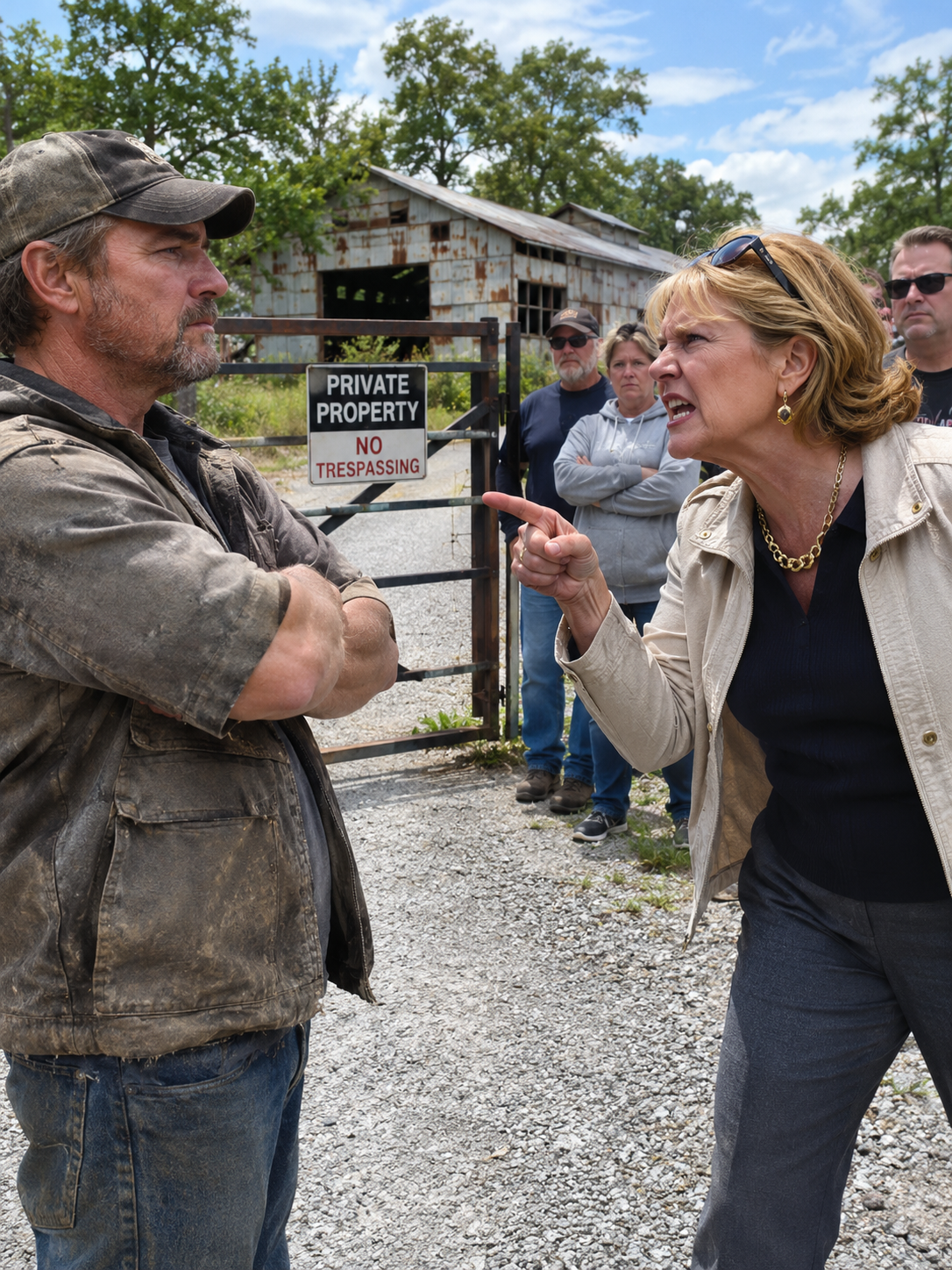
“Get this gate open. Now.” The woman standing outside my new steel gate looked like she’d never been told no in her life. I had barely finished welding the hinges when she informed me that every delivery truck serving Ridgeline Estates used the road through my property and that I had twenty minutes before she called the sheriff.
“It’s my property, ma’am,” I said, keeping my hand on the gatepost. She looked at the old depot behind me and shook her head. “You paid sixty-two thousand dollars for weeds and a falling-down railway building. You’re a squatter with a receipt.” Then she promised she’d have the place flattened by Monday.
My name is Brett Rawlings. I was fifty-two, divorced, and trying to put together a life that didn’t involve driving across Ohio to weld pipe in one industrial plant after another. I’d done that work for twenty-six years, and while it paid the bills, my knees had started reminding me of every ladder I’d climbed.
After the divorce, what I had left wasn’t much, but it was mine. I wanted a small shop where I could fix farm trailers, build gates, and take local fabrication jobs without sleeping in another motel beside a refinery. I wasn’t looking for a fight with eighty-four households. I was looking for enough room to work and a place to park my truck.
The county tax auction listing had sounded like a challenge written by somebody trying to scare away buyers. It offered 4.2 acres on the south edge of Ridgeline, Ohio, with a railway depot decommissioned in 1991, structures in disrepair, and a warning about creosote-treated ties. The bidding started at $40,000. I won at $62,000, a number I could cover with my savings if I did most of the repairs myself.
The first time I walked the land, old creosote caught in my throat before I reached the building. The corrugated roof had peeled loose in places, and whenever the wind picked up, the metal groaned loud enough to make me stop and look up. Rust covered the abandoned rail in flakes, and the ballast gravel rolled under my boots. It was ugly, but I could see a workshop where somebody else saw junk.
I spent that first weekend cutting brush, sorting scrap, and welding a square-tube gate at the entrance to the depot. I hung a simple private-property sign and locked up when I left. I hadn’t blocked Depot Road itself; vehicles were still moving between the county highway and the subdivision on the hill. I only wanted strangers to stop wandering into the work area while I cleaned it up.
Three days later, a letter arrived from Ridgeline Estates Homeowners Association. It told me to remove temporary fencing, stop parking commercial vehicles on the premises, and maintain the appearance expected of the surrounding residential community. It was signed by Diane Prescott, the board president, and written as though my little piece of industrial land belonged to her subdivision.
I read it twice at the depot, leaning against the tailgate of my truck. Ridgeline Estates wasn’t on my deed or my tax bill. It was eighty-four closely spaced houses built in 2003 on the hill north of me, with neat lawns and matching mailboxes. I couldn’t understand why its board thought it had the authority to tell me where to park a welding truck.
Then I paid more attention to the pavement. Depot Road came off the county highway, crossed the old rail property, and climbed toward the houses. There was no other entrance I could see. Steep ground crowded three sides of the development, and a creek made the fourth awkward; garbage trucks, school buses, propane deliveries, and every family car all used that same stretch.
I began to understand why Diane had been so interested in my gate, though I still didn’t understand why she was angry with me. She was fifty-eight and had lived in lot three since the subdivision was new. Neighbors told me she ran meetings strictly and kept track of things as small as garage-door colors. I figured she’d decided an old welder moving in below the hill would make her neighborhood look bad.
The following Tuesday, a county code officer named Dale came out carrying a clipboard. Someone had reported a blighted property posing health and safety concerns to the nearby homes. Dale wasn’t rude; he walked the lot, photographed a few spots, and wrote me up for vegetation over twelve inches in the southeast corner and uncovered scrap near the depot entrance.
The fine was $350. “For grass and a pile of metal?” I asked. Dale gave me the tired shrug of a man who’d had that conversation a thousand times and said I had thirty days to fix the violations. I paid, mowed the corner, and put a tarp over the scrap, because I wasn’t going to give anybody an easy reason to shut down the shop before it opened.
That evening I sat on the old loading dock, rubbing a sore spot on my hand where the shovel handle had caught it. I’d worked around enough farmers’ fence disputes and refinery rights-of-way to know that somebody saying a road was theirs didn’t make it so. Diane said she spoke for the neighborhood; the HOA letter sounded like an order. But I had a deed, and I wanted to know where its lines actually ran.
I called a surveyor named Duff Patterson. His price was $1,800, more money out of my start-up fund, but he came with GPS equipment and a plan to measure the entire parcel. I told him I wasn’t trying to make trouble with the people uphill. “Good,” he said. “Let’s find out what the ground and the records say before anybody decides what to argue about.”
Duff worked for two days in an orange vest, setting flags and taking measurements while I hauled out rusted scrap. Every so often he stopped, checked the equipment, and looked from the highway toward the hill. I tried not to hover, but each time I heard a delivery truck rumble over Depot Road, I found myself wondering how close the pavement came to my boundary.
At the end of the second day, he spread his survey across the depot’s loading dock. His thermos sat beside one corner of the paper, holding it down against the breeze. He showed me the eastern property line and the old railroad boundaries, patiently explaining marks I didn’t recognize. Then he ran his finger along the shaded strip that followed Depot Road.
“What about that part?” I asked. Duff looked up to make sure I was following him. “From the highway turnoff to the bottom of the hill, that pavement sits inside your parcel,” he said. I studied the map, thinking I’d misunderstood, and asked him to show me again.
He traced it a second time, slower. “All of it, Brett. Every inch on this stretch.” I looked toward the hill, where a school bus had just come down the road, and thought about the children, the groceries, the emergency vehicles, and all those families who had used it for years without a second thought.
“There are eighty-four homes up there,” I said. “I know,” Duff answered, resting his finger on the survey. “But according to these boundaries, they’re all driving across your land.” I had bought an old depot to get away from other people’s problems, and suddenly the only road to an entire neighborhood was sitting inside the four acres I’d just paid for. Part 2…..
IF FACEBOOK BROUGHT YOU HERE, HERE’S THE CONTINUATION YOU’VE BEEN WAITING FOR. ENJOY! 👇 My first thought wasn’t how much that road might be worth. It was whether I could ever get a welding business going with eighty-four families needing to cross my land every day. Duff warned me that ownership of the ground and the right to use it were different questions, and that I needed to check the deed history before drawing conclusions about an easement.
Before I could do much checking, Diane called an emergency HOA meeting. I wasn’t invited, but a neighbor later told me she’d proposed asking the county to take my land through eminent domain so the neighborhood could keep its access. The resolution passed twelve to three, with a retired electrician named Earl Pemberton among the three voting against her.
A copy arrived in my mailbox with a handwritten note from Diane on stationery decorated with little roses. “This is bigger than you,” it said. I pinned that note beside Duff’s survey inside the depot, where the work light flickered over both pieces of paper. I couldn’t argue with the part about eighty-four families, but I didn’t think that gave anyone permission to threaten my property.
Within two weeks, Diane circulated a petition asking the county to declare Depot Road public because residents had used it for so long. Sixty-one households signed. When I heard that number, I pictured sixty-one kitchen tables where somebody had been told I was about to strand them, even though I had never said I’d close their road.
Then, on a Saturday night, someone dumped three truckloads of crushed gravel against the gate to my work area. It was four feet high in places, enough to keep my pickup out, and whoever did it left no useful trail for me to follow. I spent Sunday moving it with a shovel and wheelbarrow, taking breaks when my knees began to throb, because I still needed to get inside and work on the building.
On Monday I went to the county records office. A clerk named Patty found the old railroad parcel’s deed history and mentioned that I was the third person who’d asked about it that month. She wouldn’t tell me who the others were, but she pushed the file across the counter and said I ought to read it carefully. I found an empty spot and started at the oldest documents.
The previous owner was Harlan Stokes, who’d held the property since 1968. He ran the depot until the rail line closed in 1991, then lived in a trailer behind it; he went into a nursing home in 2019 and died in 2022 at eighty-nine. With no will or heirs recorded, the county eventually took the parcel for unpaid taxes and auctioned it. That was how it ended up in my hands.
More important was the history of the road. When Ridgeline Estates went up in 2003, Harlan had allowed people to use the crossing by a casual, verbal arrangement, the sort of understanding neighbors make with a handshake. There was no recorded permanent access agreement in the file. The road had been used daily, but I was learning that years of traffic and a legally enforceable right were not automatically the same thing.
Duff had mentioned that Ohio prescriptive-easement claims generally turn on twenty-one years of qualifying use, including whether the use was adverse rather than permitted. Harlan’s permission looked important, but I didn’t trust myself to make a legal conclusion from a folder at the records counter. I sat in my truck outside, listening to children at the school down the street, and called a land-use lawyer.
Nora Caldwell worked alone in an office two towns over, with stacked files and a printer that sounded permanently annoyed. She looked through my deed, the survey, Diane’s resolution, the petition, and the rose-covered note without interrupting. After she finished, she said, “First, don’t block the road. These people need to get home, and we need to establish what rights they actually have.”
Her next instruction was to document everything and leave the arguments to her. She drafted a letter to the HOA stating that the road lay on my private parcel, that no valid easement had yet been found, and that I would record any further harassment. “We are not declaring war on the neighbors,” she told me. “We’re asking the board to stop acting like it owns land it doesn’t.”
The response came from the county, not the HOA. Commissioner Gordon Wells, a friend of Diane’s husband, wrote that the county was evaluating eminent domain to protect residential access. I knew the term meant government could acquire private land for a public purpose with compensation, but seeing it on official letterhead made my stomach tighten. I took the letter straight to Nora.
She said a proposal wasn’t a completed taking and that the county would have to follow a formal process if it pursued one. She was skeptical of its prospects, especially if there were possible alternatives, but she didn’t promise me a guaranteed outcome. She’d also obtained the subdivision’s original planning file, and she pushed one page across the desk. “This is what I really wanted you to see.”
In 2003, Lakeshore Development had signed and notarized a guarantee to secure and record a permanent vehicular-access easement before the development’s final plat approval. There it was in the county’s own file, a promise made before eighty-four homes were sold. Nora had searched the recorded documents and found no corresponding easement. The company had taken in more than fourteen million dollars in lot sales while an estimated $180,000 access purchase never happened.
Part 3 “Who owned Lakeshore?” I asked. Nora was still waiting on incorporation records; the company had dissolved in 2008. For now she told me to keep the work site safe and let her investigate. I’d spent years welding pipes nobody noticed unless they broke, and I was starting to recognize the same kind of neglected connection in a neighborhood that otherwise looked perfectly finished.
Diane didn’t let the subject stay in the records office. She posted a long message on the neighborhood’s Nextdoor page calling me an outside speculator and saying the depot was contaminating groundwater with creosote. She tagged local officials and the news, and by the time I read it, neighbors were arguing in the comments as though I’d arrived carrying a plan to ruin their homes.
I called Nora from my truck with a gas-station sandwich still in my hand. She asked about environmental testing, and I told her the testing done around my purchase had shown levels within the applicable limits. “Keep that report,” she said. “And don’t fight with her online. We’re still missing one piece of the development history.”
On a Thursday evening, Nora phoned while I was under my truck fixing a brake line. I slid out onto the gravel when she read the company filing aloud. Lakeshore Development’s managing partner and registered agent had been Gerald Prescott, and its listed address was 14 Ridgeline Court, lot three. Diane’s husband had been the man who promised the county permanent access and never obtained it.
I sat against my truck tire with brake fluid on my shirt. Nora said Diane had taken over the HOA in 2009, the year after Lakeshore dissolved, and she’d been fighting to control the road question ever since. We couldn’t know everything Diane had been thinking, but Gerald’s signature gave her pressure on me a different meaning. The homeowners hadn’t created this problem; the man who developed their subdivision had left it for someone else.
“They could go after him, couldn’t they?” I asked. Nora said homeowners might have civil claims depending on the documents, timing, and harm they could prove, and the exposure could be substantial. I stared at the hill beyond the depot and told her I didn’t want to punish people who’d bought houses in good faith. “Then we give them information and a way forward,” she said.
Over the next two weeks we worked out a plan that didn’t involve chains across the road or arguments at its entrance. Nora prepared a petition asking the county to clarify the road’s status, supported by the survey, title records, and Harlan’s history of permitting use. She also drafted a notice for all eighty-four households explaining the access problem, my promise not to block passage, and my willingness to negotiate a permanent easement at a fair appraised price.
The third part of the plan was simpler: put the 2003 guarantee where county officials couldn’t overlook it. Nora believed the county should examine why a developer had promised legal access without ever recording the necessary rights. She didn’t need me to accuse Gerald in public. His signature and the gap in the land records spoke plainly enough.
Earl Pemberton came by on a Saturday carrying a six-pack and the exhausted expression of a man who’d attended too many HOA meetings. He was sixty-eight, a retired electrician from lot fifty-one, and Diane had once fined him $1,200 for painting his garage door eggshell instead of ivory. “My wife’s an interior decorator,” he told me, sitting on an overturned crate. “She could barely tell the difference.”
Earl said he’d been talking to residents one at a time, asking whether they knew their homes lacked a recorded access easement. Some wouldn’t believe it, and some were furious, but he told me their anger was beginning to turn toward the board. He also offered to help with electrical work at the depot, which was a generous offer from a man who barely knew me.
A reporter named Connie Archer at the weekly Ridgeline Gazette left a card in my mailbox after seeing the county filing. Nora suggested waiting until the facts were organized before talking to the press. I used the time to install four weatherproof cameras around the depot, with a hard drive and cables I ran through steel conduit, because somebody had already demonstrated how easily a quiet Saturday night could become a mess.
The cameras cost $480, money I’d rather have spent on a welder, but I needed a record if anyone returned. Earl helped pull the wiring and took great pleasure in telling me the system looked harder to damage than the HOA’s reputation. I laughed for the first time in days. It felt good to have one neighbor sitting on a crate instead of shouting through a gate.
Nora said an independent appraiser might value the property far above my tax-auction price, potentially in the $400,000 to $600,000 range because of the road access, although any taking would still require a proper valuation and process. I tried not to dwell on the numbers. All I’d wanted was a roof that stopped leaking and a place where I could earn an ordinary living.
Our letters went into all eighty-four mailboxes on a Monday. By Wednesday, Earl called after another emergency board meeting and said Diane had proposed spending HOA reserve money to sue me for a prescriptive easement. The fund held about $128,000 collected from residents over years, and the litigation proposal had passed nine to five. Three homeowners had stood up to ask why an access agreement had never been recorded.
Part 4 Earl had asked the question I wished someone had asked in 2003. “Diane, Lakeshore Development was Gerald’s company. Did he know about the missing easement when he sold our houses?” According to Earl, she dismissed Gerald as irrelevant and ordered him to sit down. He said he finally did, after asking again loudly enough for the room to hear.
Three mornings later, I arrived to find the depot without electricity. My camera footage from two in the morning showed a white pickup with muddy plates backing toward the main electrical panel and pulling the meter box loose. Sparks flashed, the service cable dragged across the gravel, and then the recording went dark. I couldn’t identify the driver, and I wasn’t going to claim I knew who’d done it.
A deputy photographed the damage and took my report. The power company estimated repairs at $2,200 and a two-week wait, so I spent four days repairing the system, arranging the needed meter work, and protecting the replacement with a welded steel cage. I added battery backup for the cameras. My shoulders hurt more than they had after moving the gravel, and none of the work brought me any closer to opening the shop.
While I was fixing the panel, Nora learned that Gerald had paid $46,000 cash for twelve acres southeast of the subdivision. She thought he was looking for another way to the highway that would make my parcel unnecessary. For one uneasy morning, I wondered whether I had misunderstood the whole dispute and whether we’d all spent weeks fighting over a road he could simply replace.
But the parcel included about 6.8 acres of federally designated wetlands. Nora explained that building through them could require a Clean Water Act Section 404 permit and other approvals, with no guarantee of permission. A week later I drove past and saw a survey crew packing its equipment while an engineer spoke on the phone. I couldn’t know what the engineer was saying, but there wasn’t a new road being built.
The county eventually issued a written determination concerning Depot Road. Its review described the road as private, with no public-road acceptance and no valid permanent easement shown in the county records. The same paperwork brought a formal inquiry into whether Lakeshore Development had fulfilled its 2003 access guarantee. I held the letter on the loading dock for a long time before putting it in Nora’s folder.
Diane hired her own attorney and sent a threatening letter accusing me of interfering with neighborhood property values. Nora saw no reason to withdraw our filings and prepared to defend the facts if a suit came. No lawsuit followed. Instead, Gerald Prescott drove his Lincoln Navigator down the road one afternoon, parked at the gate, and walked toward me across the gravel.
He was sixty-three, wearing a polo shirt and the kind of tan that told me he spent a lot more time on golf courses than in welding shops. “Let’s talk like men,” he said. He offered $250,000 cash for all 4.2 acres, provided I signed permanent access rights, withdrew the county filings, and left. That was four times my purchase price, and for a moment I thought about the roof, my knees, and how simple walking away would be.
“You came here to weld gates for farmers,” he told me. “This isn’t your fight.” I looked past him toward the hill where families were coming home with grocery bags and school backpacks. “It became my fight when your company left those people without the access it promised,” I said. “They deserve to know what happened.”
His face tightened. “You’re going to regret this. I built this town.” Then he got back in the Navigator and drove off. I didn’t chase him or shout after him; I went inside, checked the security footage, and called Nora to tell her about the offer. It was the most money anyone had ever proposed paying me for something I’d owned, and I had turned it down because the conditions weren’t right.
Three days later, Connie Archer’s article ran on the front page of the Gazette. It laid out the developer’s guarantee, the missing easement, the dissolved company, and the county inquiry using public records. By evening it had spread through local Facebook groups, and within the week thirty homeowners had signed a letter demanding Diane’s resignation. She answered by email that she’d served the community faithfully for fifteen years and would not step aside.
The county commissioners scheduled a public hearing about Depot Road and residential access. Earl told me the meeting would be packed, and he was right. Every chair in the room was taken; people crowded along the walls, Connie sat with her notebook, and a couple of news cameras pointed toward the podium. Commissioner Gordon Wells opened the hearing by asking everybody to keep it civil.
Diane spoke first, dressed in a navy blazer and pearl earrings. She called me an outside speculator who’d purchased land to squeeze money from homeowners, and she asked the county to take control of the road. She sounded so certain that I almost wished I hadn’t agreed to speak. But each time she described the problem, she skipped the part about who had promised those families a legal way into the subdivision.
Part 5 When my turn came, I wore jeans, work boots, and a flannel shirt with a little burn mark on one cuff. I had three documents in a manila folder: my deed, Duff’s certified survey, and the 2003 guarantee filed by Lakeshore Development. My hands were steadier than I expected as I laid them in order on the podium. I wasn’t there to win a shouting match.
“This deed says I own the land under the road,” I told the commissioners, “and this survey confirms where that land is.” I lifted the third paper. “This is a promise the developer signed before the homes were sold, saying permanent legal access would be obtained and recorded. The county records show that never happened.”
I took a breath and looked toward the rows of homeowners. “You bought your houses believing this was settled. You weren’t the ones who skipped that agreement.” I named Lakeshore’s managing partner, Gerald Prescott, and said he was the husband of the HOA president who’d just called me a speculator. Gerald was sitting in the third row, and I watched faces turn toward him one by one.
He stood, opened his mouth without speaking, then made his way past the other chairs and out the door. Diane reached for the microphone and protested that her husband had built the neighborhood and that the hearing was a witch hunt. Wells asked her to sit down. I stood there with the old guarantee in my hand, wishing someone had asked the right questions twenty years earlier so none of us would be in that room.
Diane’s attorney rose to say he had not been given material facts and was withdrawing his representation, subject to the formal steps required. The room went quiet in a way I’d never experienced at a public meeting. I didn’t feel like celebrating. Those people still needed the road the next morning, and documents by themselves couldn’t carry a school bus up the hill.
So I made one more statement. I told the commissioners and the homeowners I had no intention of closing Depot Road and would negotiate a permanent appurtenant easement at a price established by independent appraisal. The land would remain mine, but the access rights could be recorded so they’d continue with the homes through future sales. From the back of the room, Earl said, “That’s more than Gerald ever offered us.”
Some people applauded, not everybody, and not all at once. I could see a few residents still looking worried, which made sense; they were hearing that the place they’d invested their savings in had a missing piece of paperwork. When the meeting ended, I didn’t look for a camera. I found Earl near the door and asked him to help keep the discussion focused on getting those families secure access.
Two weeks later, Ridgeline Estates held a special election. Residents voted fifty-eight to nine to remove Diane as president, and Earl was chosen to lead the new board. He called me soon after, not to apologize for every nasty remark that had come down the hill, but to set up a meeting with people who were finally ready to solve the problem.
We met at Nora’s office with Earl and Gwen Fielding, a CPA from lot twenty-two who had become the board’s treasurer. Gwen was checking the HOA books and watching every dollar, and I respected that; the families were already paying for years of oversight. For eleven days we went back and forth over appraisals, payment terms, and language protecting both my business and the subdivision’s access.
We agreed on $285,000 for a permanent appurtenant easement along Depot Road, payable over five years from the HOA’s general fund. The agreement was recorded with the county clerk, so the right to travel that road would belong to the benefited properties, not depend on another owner’s handshake. I signed in Nora’s office with a cheap pen that skipped halfway through. “I’ll buy better pens when I get better clients,” she said, and Earl laughed into his coffee.
I didn’t become the owner of eighty-four people’s lives. I still owned a rough old depot, and they finally had documented access to the homes they’d already paid for. The money would come in over time rather than as a pile of cash on my desk, but for once I could plan repairs without wondering whether the whole business would fall apart before I opened it.
There were consequences beyond the road agreement. The state attorney general’s office opened a civil investigation into Lakeshore’s failure to fulfill the original access guarantee, and homeowners could consider claims with their own lawyers. The potential exposure was estimated at more than $1.2 million, but I never treated that figure as a court judgment or presumed to know how every claim would end.
Gerald hired a defense attorney. He and Diane put their house in lot three on the market for $690,000 and left the neighborhood within ninety days. I didn’t go up the hill to watch them move; by then I had more useful things to do, and I knew a sale sign didn’t erase what had happened to the residents.
Final I put the easement proceeds toward making the depot into the shop I’d pictured when I bid at the county auction. We replaced the screaming roof with standing-seam steel, rewired the building properly, and poured a clean concrete pad for the welding bay. I hung a sign out front that said Rawlings Welding and Fabrication. After so many months of lawyers and land records, seeing my own shop name above the entrance meant more than I expected.
I hired two helpers, a young man just out of trade school and a retired pipefitter who missed working with steel. Some of our first customers lived in Ridgeline Estates. We made gates, fences, a steel railing for the community playground, and a mailbox post for Earl so sturdy he joked that it would outlast all of us. The same people who’d once been told I was dangerous were bringing me jobs and staying for coffee.
One Saturday I cleared a corner of the depot, set up two welding stations, and opened a free community workshop. Earl taught basic electrical work alongside me; the Rotary Club donated tools, and a local supplier sold us scrap steel at cost. Four people came the first week. By the third month we had a waiting list, and every new face reminded me how different the road uphill felt now.
I was standing in the doorway one Saturday morning when a sixteen-year-old girl laid her first clean bead on a practice plate. Her helmet tipped up, and she grinned at the work she’d done. Behind me, traffic rolled along Depot Road toward the houses, just as it had for years, except now the families had the permanent access the developer should have secured from the start.
I remembered Diane’s little note still pinned inside the depot: “This is bigger than you.” She’d been right about that much. I’d come to Ridgeline hoping to make a living on four neglected acres, and somehow the most important thing I helped build wasn’t a gate or a railing. It was a written agreement that let my neighbors come home, and a workshop where some of them were learning to make things of their own.
THE END. I’ve shared the complete story, and I truly hope it touched your heart. If this story moved you, please , like, and share the post. Thank you for reading! ❤️
✓ Lynn R. Adams
I spent $62,000 on an abandoned Ohio railway depot because I wanted a quiet place to open my own welding shop. Three days after I put a lock on the gate, the HOA president told me to remove it and thr…