I answered a 911 call from….
I answered a 911 call from my late mother’s empty house and recognized my pregnant stepsister’s voice. Then I heard my husband behind her. Days later, my father demanded the one thing my mother had left me….
At in the morning, a call came into my 911 dispatch queue in Tulsa, Oklahoma. I was halfway through an overnight shift when the address appeared on my screen, and for the first time in more than ten years on that job, I had to remind myself how to breathe. The call was coming from my mother’s house.
My name is Hannah Corwin. I was 37, and I’d spent most of my adult life being the voice other people needed in a crisis. I’d helped a husband keep his wife breathing during a heart attack and talked a frightened little girl through hiding in a closet. My hands knew the keyboard, my mouth knew the questions, and even on the worst calls, I could keep my voice steady.
Mom had been dead for six years. Her small brick house in Tulsa’s Brookside neighborhood, with its yellow front door and the roses she planted when I was born, was mine. She had left it to me outright, and I took care of it even though my husband, Wyatt, and I rented a place across town. Nobody lived in her house. At least, that was what I believed.
Wyatt had a key because he was supposed to mow the lawn on Saturdays. I didn’t think twice about trusting him with it. He knew the house mattered to me in a way I couldn’t explain to anyone who hadn’t known my mother, Ellen. She’d taught third grade for 30 years, saved every handmade card her students gave her, and kept a chipped blue coffee mug that read “World’s Okayest Teacher.” I still couldn’t bring myself to throw it away.
“911, what’s the address of your emergency?” I asked, following procedure even though the address was already in front of me. A young woman said she was 24 weeks pregnant, bleeding, and frightened. She was struggling to finish a sentence when she turned away from the phone and called, “Wyatt, get my shoes!”
I knew that voice. It was Brynn, my 29-year-old stepsister, who had once borrowed my nail polish and begged me to read her one more bedtime story. And Wyatt was my husband. Then I heard him in the background, close enough that I knew he wasn’t visiting to check a lawn mower.
I asked the medical questions. I confirmed the location. I guided Brynn as carefully as I would any caller and sent an ambulance. When the paramedics reached the yellow door, Wyatt said, “Babe, they’re here. I’ve got you.” I stayed on the line until help arrived, then removed my headset and asked my supervisor for a moment outside.
I stood in the parking lot under the dark Tulsa sky without crying. About twenty minutes later, I checked the EMS update. Brynn and her baby were stable; the scare involved dehydration and some spotting. I was relieved that they were safe. I also knew I would never forget the sound of my husband’s voice in my mother’s hallway.
At seven that morning, I drove straight to Brookside in my dispatch polo. Wyatt’s white pickup was in the driveway, parked over the flowerbed where Mom’s tulips used to grow. He stood barefoot on her front porch in sweatpants, drinking coffee from that chipped blue mug. When he saw me get out of the car, he stopped with it halfway to his mouth.
I climbed the steps and held out my hand. He gave me the mug as though it could explain everything. “Hannah, let me explain,” he said. I told him he didn’t need to. “I took the call.” I watched the meaning reach him and drain the color from his face.
Beyond the screen door, Brynn stood in the hallway wearing one of Wyatt’s T-shirts. A hospital bracelet circled her wrist. I remembered her as a six-year-old with pigtails and a stuffed rabbit, arriving in my life when Dad married her mother, Darla. I was fourteen then. For years I’d tried to be the big sister she needed, even when the adults made that difficult.
“How long?” I asked. Wyatt stared down at the porch boards. “Since last fall. It just happened.” I looked at him standing where he’d claimed he spent his Saturdays mowing. “It happened every Saturday you came here,” I said. I didn’t raise my voice, but I saw Brynn turn away behind the screen.
Then I asked who else knew. Wyatt hesitated before saying my father had known since April. Darla had told him, and he’d advised them to wait until after the baby came because, according to him, I would eventually come around. Dad had sat across from me at Easter, handed me a bowl of potatoes, and asked how work was going. All that time he had known.
I set Mom’s mug carefully on the porch railing because my hands were beginning to shake. I told Wyatt and Brynn to get out of my mother’s house that day. Wyatt gave a nervous little laugh and mentioned that Brynn had just been in the hospital. Then he began, “Your dad said—” I cut him off. “Dad doesn’t own this house. I do.”
Back at the rented place, I packed Wyatt’s clothes into trash bags and stacked them in the garage. Then I sat at our kitchen table with a pen. Dispatchers make lists when everything is going wrong; it’s how we decide what must happen first. I wrote “Call a lawyer” at the top and “Mom’s house” at the bottom.
They didn’t leave Mom’s place that evening. They finally took some bags to Dad’s house the next morning. On Thursday, Dad called and said we needed to have Sunday dinner together in Broken Arrow. He made it sound like an ordinary family conversation. Then he added, “We need to talk about your mother’s house.”
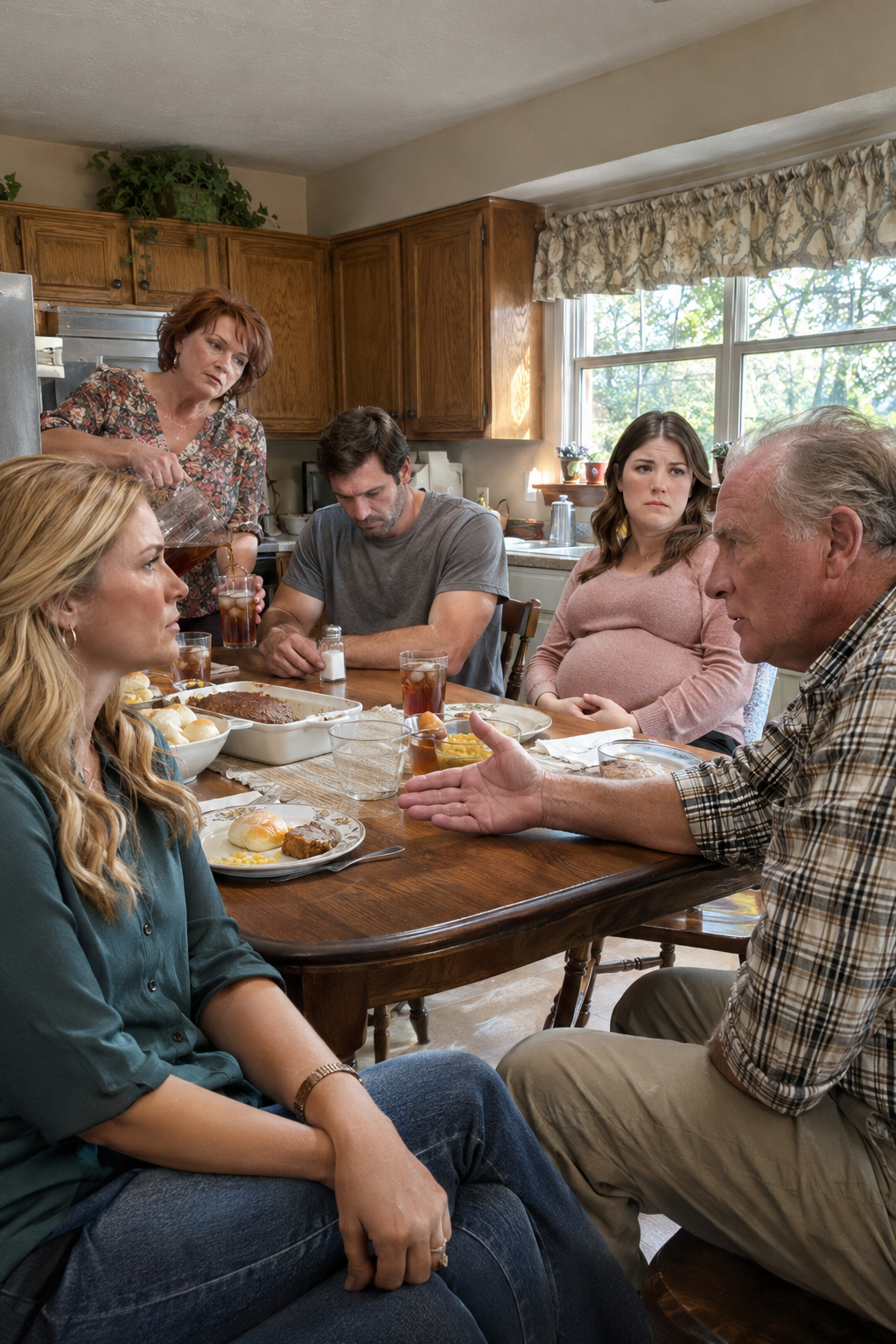
On Sunday, Darla poured sweet tea while Brynn sat with both hands resting on her stomach. Wyatt wouldn’t look up from the salt shaker. My father, Gary, waited until everyone was seated before explaining the plan he’d apparently made without me. Wyatt and I would divorce. He would marry Brynn before the baby arrived, and they would raise their daughter with a yard and a good school district.
There was one problem with Dad’s plan: they wanted to do all of it in my mother’s house. Dad said I could sign the deed over or rent it to them cheaply, whichever was easier. I reminded him that Wyatt and I had only been renting our own house and that Mom’s home had never belonged to Wyatt. He waved that away. I worked nights, had no children, and supposedly didn’t need the space.
“Family takes care of family, Hannah,” he told me. Darla nodded. When I said Brynn was my husband’s girlfriend, not someone entitled to my inheritance, Darla snapped that Brynn was my sister. “She’s your daughter,” I replied. “That’s different.” My father leaned forward, no longer trying to sound reasonable. “Your mother would be ashamed of you.”
The room went quiet. My father had known about the affair for months, yet he was using my dead mother’s memory to take the house she’d fought to keep. I looked around the table at the four people waiting for my answer and realized this was not simply a request for somewhere to live. Dad had already decided that Mom’s house belonged to them. Now he expected me to hand it over. Part 2…..
I thought about the last month of my mother’s life. Cancer had taken so much from her, but she could still speak clearly. Dad visited her once and stayed nine minutes. After he left, Mom squeezed my hand and made me promise never to let him or Darla have her house. Back then, I thought pain medication might have made her unusually frightened. I promised anyway.
At Dad’s table, I did not tell him about that promise. I said, “Let me think about it.” He smiled and called me his girl, as though he’d won. That night I went to Mom’s house to wash the sheets and air out the rooms. Brynn had taped a ballet-pink paint sample to the wall of my old bedroom. A sealed crib box sat in the corner. She was already decorating the place for my husband’s child.
I sat at Mom’s old upright piano, where she’d taught me to play “Heart and Soul.” I opened the bench, looking for music beneath her hymnals and old school programs. Instead I found a long white envelope with her familiar round handwriting: “For Hannah. Open this the day your father asks you for the house.”
Inside was a two-page letter she’d written near the end of her life. She told me Dad’s affair with Darla had begun when I was thirteen. On Wednesday afternoons, when Mom was at parent-teacher conferences and I was at piano lessons, he’d brought Darla into that very house. Our neighbor Mrs. Odum saw them through the front window and finally told Mom the truth.
When Mom asked for a divorce, Dad fought harder for the house than he fought for custody of me. Darla wanted it, and he tried for a year to give it to her. Mom won. She kept the little brick house so that one day it would be mine. At the bottom of her letter, she wrote, “Your father doesn’t change, sweetheart. He just finds new people to help him.” She warned me not to surrender the home to someone he had no right to put there.
I read the letter three times. The next morning I called Gloria Bonali, a lawyer with an office above a bakery on Cherry Street. She reviewed the deed and Mom’s will and explained that the home, inherited by me before my marriage, was my separate property. Wyatt and Dad were not owners. She also explained the importance of documenting notice and handling the belongings Wyatt had been storing in the garage without disposing of them carelessly.
I filed for divorce that Wednesday. Gloria arranged for Wyatt to be served after an upcoming school event, and I kept my plans private. Dad had told me about a memorial garden being dedicated at Grant Elementary, where Mom had taught third grade for three decades. Parents and teachers had paid for a bench, roses, and a plaque. Darla had helped arrange for Dad to speak.
Then Dad told me what he meant to announce there. In front of Mom’s colleagues and former students, he planned to say her house would welcome Brynn, Wyatt, and their baby. “It’s what Ellen would’ve wanted,” he insisted. My throat tightened. He had barely visited Mom while she was dying, yet now he planned to speak for her in the garden built to honor her.
“Who asked you to give that speech?” I said. He told me Darla had worked things out with the principal. I told him I’d attend and bring a key. He thanked me twice. He didn’t ask what kind of key.
Over the next two weeks, Darla came through Mom’s rooms with curtain measurements and paint chips, criticizing the lace panels Mom had sewn. Brynn posted a photograph of the yellow front door with a pink bow and called it “our forever home.” Old friends of Mom’s responded with puzzled question marks. Wyatt texted to ask me not to change the garage code because he had more boxes to bring.
One Tuesday, Brynn came alone while I was tending the rosebushes. She said she hadn’t planned any of this. I pointed out that she’d gotten pregnant while secretly staying in Mom’s house and then started choosing paint for my childhood bedroom. She answered that I’d always had everything: the house and a mother who wanted me. Her words hurt more than I expected, partly because I’d spent years trying to make her feel loved.
I told her I’d had a mother, and so had she. The difference was what ours had taught us about other people’s things. She left without another word. That night, I wrote one more note beneath my original list: I was not agreeing to anything. I was making time to protect what Mom had left me.
The week before the dedication, I crossed the street to visit Mrs. Odum. She was now in her late seventies, walked with a cane, and still remembered everything about our block. When I showed her Mom’s letter, she closed her eyes at the mention of Wednesday afternoons. “I was the one who told her,” she said. She had never regretted it. Then I explained what Dad, Darla, Wyatt, and Brynn were trying to do.
Mrs. Odum listened without interrupting. Finally she told me she served on the dedication committee and that Dad wasn’t the only person who would speak. I left knowing Mom’s version of the past would not have to stand alone. Three days before the event, Darla let herself into the house with a key I hadn’t authorized. She saw flattened moving boxes and assumed I was making room for Brynn.
She proudly showed me a fresh key with a pink rattle charm, copied from Wyatt’s key for Brynn’s use after the ceremony. I asked where she’d had it made, then slipped it into my pocket. Darla left pleased with herself. She hadn’t noticed that I never handed it back.
Two weeks earlier, I’d sent Wyatt and Brynn written notice by certified mail and text about the items they’d put in Mom’s garage. Anything remaining by the dedication would be transferred to safe storage, with information on where to collect it. Wyatt had replied, “LOL relax, your dad says it’s handled.” I saved the message and followed Gloria’s advice on documenting the move.
The evening before the dedication, movers packed the crib box, changing table, baby clothes, fishing gear, and other belongings into a truck. They took everything to a climate-controlled unit on 41st Street; I covered the first month. At six the next morning, a locksmith named Ray changed every exterior lock and handed me three new keys. The old cylinders and Darla’s shiny pink key went into a bag.
I put on the black dress I’d worn to Mom’s funeral and drove to Grant Elementary. I carried her letter in my purse. Dad thought I was coming to give away a house. I was coming to honor the person who had saved it for me.
Part 3 The memorial garden stood in the school courtyard, with a cedar bench, rosebushes, and a brass plaque honoring Ellen Corwin, who “taught us to read the world.” A second line credited Gary and Darla Corwin for the gift. Mrs. Odum later told me Darla had paid for the plaque on the condition that their names appeared on it. About eighty adults attended: former students, parents, and teachers who had known Mom for years.
Dad wore a navy blazer and carried three typed pages. Darla stood next to him in a floral dress. Wyatt and Brynn sat together in the second row, her pregnancy visible beneath a pink sundress. When Dad saw me, he whispered that it would be a wonderful day for the family. I sat beside Mrs. Odum, who patted my hand without speaking.
The principal, Mr. Delgado, talked about Mom’s reading corner, her silly Friday hats, and the children she’d helped learn to read. He described one boy who’d struggled terribly and finished third grade ready for chapter books. I could see teachers wiping their eyes. Then Mr. Delgado introduced Gary as Ellen’s husband, though they’d been divorced for twenty-three years.
Dad spoke warmly about what a wonderful woman Mom had been. He sounded convincing until he folded his speech and announced that her house on 37th would “stay in the family.” Brynn and her fiancé Wyatt, he said, were expecting a daughter in January and would move into Ellen’s home that month. He called the baby Ellen’s first grandchild.
Darla started clapping. A few confused people followed. Most of Mom’s friends turned toward me, because they’d attended my wedding and knew Wyatt was not Brynn’s fiancé. Dad knew they knew. He was counting on my silence, exactly as he’d counted on it at Sunday dinner.
I stood and walked to the microphone. I told the gathering that Wyatt was still my husband, that I had filed for divorce, and that he was the father of Brynn’s baby. Behind me, Dad hissed that I shouldn’t do this there. “You chose here, Dad,” I said. “You chose Mom’s garden.”
Then I took out Mom’s white envelope. I explained that she’d written me a letter six years earlier, instructing me to open it when Dad asked for her house. I read aloud the passage about Wednesday afternoons, when he brought Darla into her home, and the passage about how he’d fought for the house during the divorce instead of fighting for me.
I finished with Mom’s warning that he didn’t change; he only found new people to help him. Darla called the letter a lie and said Mom had been ill and confused. Mrs. Odum rose with the help of her cane and spoke clearly enough for the back row to hear. She’d watched Darla come up Mom’s steps on those Wednesdays. She was the neighbor who told Ellen.
The courtyard fell still. Dad looked stunned. Brynn whispered that they had nowhere else to go. I reached into my purse for a plain key with a paper tag and walked over to Wyatt. For one moment he looked relieved, until I told him what it opened.
“Unit 14. The storage place on 41st Street,” I said. “Everything you put in Mom’s garage is there. The first month is paid.” I told them Ray had changed the locks at six that morning. Then I faced Dad and said Mom had fought him for that house once. I wouldn’t make her fight him for it again.
I put the microphone down and returned to my seat. Mr. Delgado quietly brought the gathering back to its purpose, saying the family had spoken enough. He invited me to plant the final rosebush. I hadn’t known anything about that plan. Mrs. Odum squeezed my hand and whispered, “It is now.”
I knelt in my funeral dress and set the little bush into the prepared hole. Dirt stuck to my knees. When I stood, Mom’s old colleagues were applauding. Dad, Darla, Wyatt, and Brynn were already heading toward the parking lot. Nobody followed them.
Part 4 On Monday morning, Wyatt was served with divorce papers at Dad’s kitchen table while eating Darla’s pancakes. Gloria handled the legal process. Mom’s house remained mine, and when the lease on the rental Wyatt and I had shared ran out, I moved permanently into the little brick house with the yellow door. Our divorce became final the following spring.
Wyatt kept his truck, his portion of a small checking account, and all the things I’d moved into storage. By December he was responsible for the storage payments himself. The dedication hadn’t left him without his belongings. It had left him without the house he had expected me to provide.
He confronted me once in November after I finished an overnight shift. I found him leaning against his pickup outside the dispatch center, asking why I’d embarrassed him in front of the school. He was worried about what people were saying at work. I reminded him that I’d answered Brynn’s emergency call, sent help, and stayed calm for both of them when they needed me most.
Then I reminded him that my father had tried to give him my mother’s house in front of everyone who loved her. Wyatt looked at the ground. Darla had told him he couldn’t stay past Christmas; he didn’t know where they’d put the crib. Part of me wanted to solve the problem, the way I’d always tried to solve problems for the people I loved.
But I knew the difference between a crisis and a consequence. “This isn’t an emergency, Wyatt,” I said. “It’s a consequence.” I went home, locked my own front door, and slept until noon for the first time in a year.
Brynn left Wyatt the week before Christmas, after it became clear that the house she’d imagined wasn’t coming with him. Mrs. Odum heard about it through her nephew, who worked at the same feed store as Wyatt. Brynn moved back into her old room at Dad and Darla’s. Her daughter was born in January. Wyatt later rented a one-bedroom apartment in Sand Springs, paid the court-ordered child support, and saw the baby on Saturdays.
The school committee replaced the garden plaque after the dedication. The new inscription remembered Ellen Corwin, who taught people to read the world, and said the rosebush had been planted by her daughter, Hannah. Darla was asked to leave the fundraising board. Dad faced criticism at church and eventually stepped down as a deacon. Neither of them ever apologized to me.
Dad came to Mom’s house one time the following February. He stood on the porch while I spoke through the screen door. He said Mom had poisoned me against him from the grave. I told him she’d simply written down what he’d done. He stood there quietly before asking if, as my father, he could at least come inside.
I thought of his nine-minute visit to Mom’s deathbed. I thought of the months he had known my husband was betraying me and had said nothing. I told him no. Mom had asked me not to let him have the house, and I wasn’t going to start by inviting him through its door. I closed it gently and turned my new key.
Final A year later, I still work nights as a 911 dispatcher. I still keep my hands moving and my voice steady when someone on the other end of the line is frightened. But now, when I get off work in the morning, I come home to the place Mom saved for me. My childhood bedroom is a guest room again, its walls painted the soft yellow she loved instead of Brynn’s ballet pink.
Mrs. Odum comes over for coffee on Wednesday afternoons, of all days. We sit on the porch and she tells me stories about Mom that I never knew. Recently I sat at the old upright piano and played “Heart and Soul” all the way through. Then I slipped Mom’s letter back under her hymnals in the piano bench, exactly where she’d left it.
Her chipped blue mug rests on the windowsill above the kitchen sink. I washed it twice after Wyatt used it, but I kept it because it was hers. “World’s Okayest Teacher,” it says. Mom wasn’t an okay teacher. She was the best one I ever had. She taught me that keeping a promise can be an act of love long after the person who asked for it is gone, and that a home belongs with the people who respect it, not the ones who demand it most loudly.
THE END. I’ve shared the complete story, and I truly hope it touched your heart. If this story moved you, please , like, and share the post. Thank you for reading! ❤️
✓ Lynn R. Adams
I answered a 911 call from my late mother’s empty house and recognized my pregnant stepsister’s voice. Then I heard my husband behind her. Days later, my father demanded the one thing my mother had le…