Homeless With Her Daughter, She Inherited Grandma’s Ruined Farm—Then Her Uncle Offered $31,000 Before She Opened the Cellar
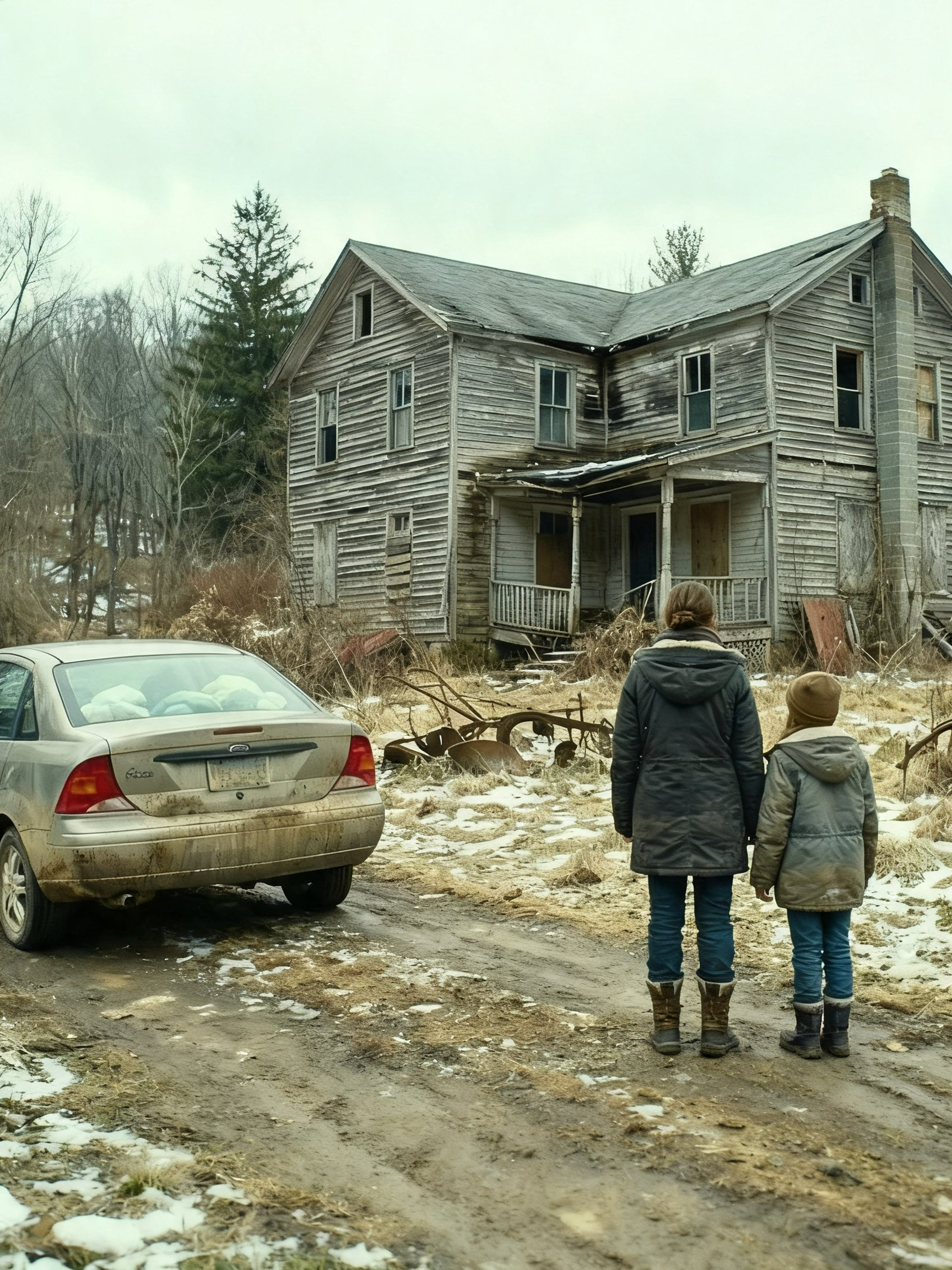
Homeless With Her Daughter, She Inherited Grandma’s Ruined Farm—Then Her Uncle Offered $31,000 Before She Opened the Cellar
Rachel Hart had been sleeping in her dead husband’s minivan with her nine-year-old daughter for four nights when her younger brother carried her suitcases onto his porch and told her she was embarrassing his neighbors.
“You’ve had almost a week,” Kevin said, although it had been four days. “Melissa doesn’t want Lily getting comfortable here.”
Rachel looked past him through the open doorway of the Ohio split-level where their mother was drinking coffee at the kitchen island and pretending not to hear.
Her daughter stood beside the minivan in a pink winter coat that had become too small around the wrists.
Kevin lowered his voice.
“You need to understand something. We have a life. We can’t destroy it because yours fell apart.”
That was the sentence Rachel remembered.
Not the cold.
Not Melissa locking the door before Rachel had finished loading the second suitcase.
Not her mother turning her face toward the refrigerator when Lily whispered, “Grandma, can we stay until Monday?”
Just that sentence.
We have a life.
As if Rachel and Lily did not.
Rachel did not scream.
She did not remind Kevin that twelve years earlier she had emptied most of her savings to cover the deposit on his first apartment after he lost his job.
She did not remind her mother who had driven her to chemotherapy appointments for seven months.
She did not tell Melissa that the bedroom Lily had slept in for those four nights contained furniture Rachel herself had bought Kevin when he was twenty-six and broke.
She simply zipped Lily’s backpack, checked that the girl’s inhaler was in the front pocket, and said, “Come on, sweetheart.”
That silence frightened Kevin more than yelling would have.
“You’re not going to make this into some family drama, are you?”
Rachel stopped beside the van.
For one moment Kevin saw something in his sister’s face that he had not seen since they were children on their grandmother’s farm.
The kind their grandmother Evelyn used to have before a summer thunderstorm.
“No,” Rachel said.
Then she drove away.
Forty-three minutes later, while Lily slept curled against a pillow in the passenger seat, Rachel’s phone rang.
The caller was from Ashland County.
“Mrs. Rachel Hart?”
“This is Natalie Cho with Sloane and Mercer Probate Services. I’m calling regarding the estate of Evelyn Hart.”
Rachel’s fingers tightened around the steering wheel.
Grandma Evelyn had died eleven days earlier at eighty-eight.
Rachel had known.
Everyone had known.
What nobody had told Rachel was that Evelyn’s funeral had been held two days ago.
Kevin had known.
Her mother had known.
Her uncle Dean had known.
Even Melissa had apparently known, because when Rachel later checked Facebook she found a photograph of Melissa wearing black outside St. Matthew’s Lutheran Church beneath the caption FAMILY IS EVERYTHING.
Rachel stared at the photograph for perhaps ten seconds.
Then she closed the app.
Natalie continued carefully.
“Your grandmother left a specific devise to you.”
Rachel almost laughed.
Evelyn had lived her final years in an assisted-living facility outside Mansfield. Her farmhouse had been empty since the county declared the electrical system unsafe six years earlier.
The Hart farm was the family joke.
A collapsing white farmhouse.
A red barn missing half its roof.
Fields swallowed by thistle.
A stone well no one trusted.
The kind of property relatives fought not to inherit.
“What did she leave me?” Rachel asked.
“The farmhouse and attached acreage.”
Rachel looked at sleeping Lily.
“How much acreage?”
There was a pause.
“The recorded estate description says one hundred and sixteen point eight acres.”
Rachel nearly missed her exit.
That evening she and Lily parked behind a twenty-four-hour truck stop because Rachel had learned that well-lit truck stops were safer than deserted parking lots.
She bought Lily hot chocolate.
She bought herself nothing.
At the next morning, before Rachel had received a copy of the will, before she had spoken to a title company, before she had even driven to the property, Uncle Dean called.
Rachel answered.
Dean Hart did not say he was sorry about Evelyn.
He did not say he was sorry Rachel had missed the funeral.
He did not ask where Rachel and Lily were sleeping.
He said, “I heard the old lady stuck you with the farm.”
Rachel watched semitrucks crawl through gray dawn beyond the windshield.
“So you heard.”
“That place is a liability.”
“Taxes. Demolition. Environmental cleanup. The septic’s probably shot. House is condemned. Barn could kill somebody. You don’t need that headache.”
Rachel said nothing.
Dean mistook silence for uncertainty.
“I can help.”
“I’ll give you thirty-one thousand for the whole thing.”
Rachel turned slowly toward Lily.
The girl was coloring a horse on the back of a restaurant children’s menu.
Rachel felt an odd pressure behind her ribs.
Not excitement.
The Hart family had spent twenty years saying the farm was worthless.
When Evelyn moved into assisted living, Dean had called the property “a hundred acres of weeds and raccoons.”
At Thanksgiving he had joked that someone would have to pay him to take it.
At Christmas he had suggested donating the land to the county so at least the family could claim a tax deduction.
Now he was offering thirty-one thousand dollars before Rachel possessed a key.
“I thought it was worthless,” she said.
“Land’s land.”
“Why thirty-one?”
“Why exactly thirty-one thousand?”
Dean laughed too quickly.
“Because I’m trying to help you.”
Rachel looked down at the center console.
Inside it, wrapped in an old blue handkerchief, was a small brass key.
She had carried it for seventeen years.
Grandma Evelyn had given it to her when Rachel was twenty-one, after Rachel spent an entire summer living at the farmhouse to care for Evelyn following hip surgery.
Evelyn had pressed the key into her palm one evening while fireflies blinked above the cornfield.
“If anyone ever comes offering money before you understand what you own,” Evelyn had told her, “you don’t argue.”
“What do I do?”
“You listen.”
“And then?”
“You find what the key opens.”
Rachel had assumed the remark was just one of Grandma’s strange sayings.
Now, listening to Dean breathe on the phone, she was no longer certain.
“I’ll think about it,” Rachel said.
“You shouldn’t think too long. County could condemn the structure completely. Once that happens, you’ll owe demolition. I can have papers ready today.”
“You already have papers?”
Only half a second.
But Rachel heard it.
“I know a realtor.”
“Of course.”
“Rachel, don’t get stubborn. You’ve never understood property.”
There it was.
The old family blade.
Rachel had heard variations of it her entire life.
Rachel was too emotional.
Rachel was too soft.
Rachel was good with sick people, not business.
Rachel was dependable, which in the Hart family meant she would do unpaid work while smarter people signed documents.
When Grandpa Walter had his stroke, Rachel changed his sheets.
Dean managed the bank account.
When Evelyn needed groceries, Rachel drove sixty miles after work.
Dean collected rent from the two agricultural fields.
When the farmhouse roof leaked, Rachel climbed a ladder with roofing tar.
Dean explained that repairs made no financial sense.
When Rachel’s father died, she organized medication, casseroles, church arrangements, and insurance paperwork while Kevin discussed which tools he wanted from the garage.
People thanked Rachel for being kind.
They rewarded others for being clever.
She had accepted that system for so long that everyone mistook acceptance for blindness.
“I said I’ll think about it,” Rachel told Dean.
He exhaled.
“Fine. But don’t go wandering through that house. It’s unsafe.”
Rachel looked at the brass key.
“Thanks for the warning.”
Three hours later she turned onto Hart Road with Lily beside her.
The lane had narrowed beneath arching maple trees, branches bare against a March sky. At the far end stood the farmhouse.
It looked smaller than Rachel remembered.
White paint had peeled away in sheets.
Two shutters hung crooked.
A section of porch railing had collapsed.
The barn behind the house leaned toward the east field like an exhausted old man.
Yet Rachel felt something she had not felt in months.
Recognition.
She had grown up spending summers there.
She knew which floorboard outside the upstairs bedroom squeaked.
She knew where Grandpa had carved Evelyn’s initials into the walnut tree in 1958.
She knew the creek behind the soybean field froze first in winter.
She knew Grandma kept peach preserves in the cellar and emergency cash inside an empty flour tin.
Lily stared through the windshield.
“We own this?”
Rachel almost corrected her.
Then she decided not to.
“It looks haunted.”
“That too.”
For the first time since they had started sleeping in the van, Lily laughed.
Rachel parked near the porch.
A black SUV was already there.
Dean stepped out before Rachel reached the stairs.
Beside him stood Rachel’s mother, Patricia, and a woman Rachel recognized vaguely as Paige Holloway, a local real estate broker who had handled several farm sales in the county.
Dean wore polished boots.
Paige held a leather folder.
Patricia looked annoyed.
Not concerned.
“You drove all the way here without calling?” Dean asked.
Rachel glanced at the folder.
“I inherited it.”
“You can’t stay in the house.”
“I didn’t say I was staying.”
Patricia folded her arms.
“Your uncle is trying to rescue you from a financial disaster.”
Rachel looked at her mother.
“Did you know Grandma’s funeral was Tuesday?”
Patricia’s expression hardened.
“This isn’t the time.”
“Kevin knew.”
“Melissa attended.”
Patricia glanced toward Lily and lowered her voice.
“You were dealing with enough.”
Rachel nearly admired the sentence.
Exclusion disguised as mercy.
“You thought telling me my grandmother was being buried would be too stressful?”
Dean stepped between them.
“Forget that. We’re here about the property.”
Paige opened the folder.
“I prepared a straightforward cash purchase agreement.”
Rachel looked at her.
“You prepared it before I arrived?”
“Dean said you were likely selling.”
Dean gave Paige a warning look.
Rachel saw it.
She saw Patricia see it.
She saw Paige realize she had said something she should not have.
Rachel walked toward the porch.
Dean blocked her.
“The county posted the house.”
A faded notice was stapled beside the door.
UNSAFE FOR OCCUPANCY.
Rachel read it.
“Does it say I can’t enter?”
“It says unsafe.”
“That wasn’t my question.”
Dean’s mouth tightened.
“You think because Evelyn gave you a worthless farmhouse you suddenly understand real estate law?”
Rachel reached into her purse and removed the brass key.
“I think because Evelyn gave me a key seventeen years ago, I should find out what it opens.”
Dean’s face changed.
It was not dramatic.
No shouted confession.
Just color disappearing around his mouth.
Rachel saw it.
So did Paige.
“What key?” Patricia asked.
Rachel watched Dean rather than answering.
He recovered quickly.
“Probably an old kitchen key.”
Rachel stepped past him.
The front lock had been replaced years ago, but Natalie from probate had arranged for a temporary estate key in a lockbox.
Inside, the house smelled like dust, wet wood, and time.
Lily stayed close.
Sunlight entered through dirty windows, revealing old wallpaper patterned with faded yellow flowers.
Most furniture had been removed.
The living room was empty except for Evelyn’s wooden rocking chair.
Rachel touched its back.
Her throat tightened.
She allowed herself exactly one breath.
Then she kept moving.
Dean followed.
“You shouldn’t have Lily in here.”
Rachel gave her daughter the van keys.
“Stay on the porch where I can see you.”
Lily nodded.
Patricia took a step toward her.
“I’ll sit with her.”
Rachel’s voice remained gentle.
Her mother stopped.
That single word landed harder than accusation.
Rachel walked through the kitchen.
The cellar door was beside the pantry.
Its old iron latch had been secured with a brass padlock.
Dean moved quickly.
“Nothing down there but mold.”
Rachel inserted Evelyn’s key.
Dean whispered, “Damn it.”
Rachel heard him.
So did everybody else.
She lifted the door.
Cold air rose from below.
The cellar stairs creaked but held.
Paige stayed upstairs.
Patricia refused to descend.
Dean followed Rachel despite having just warned her not to enter.
That told Rachel more than anything else.
At the bottom stood shelves of empty Mason jars, an old furnace, rusted gardening tools, and stacks of wooden crates.
Rachel swept her phone flashlight across the far wall.
Then she noticed Evelyn’s canning table.
One leg rested on a square of newer concrete.
Rachel knelt.
At the edge of the patch was a small metal ring.
She pulled.
A narrow floor hatch lifted.
Dean grabbed her wrist.
Rachel looked down at his hand.
Then up at him.
He released her immediately.
“You could hurt yourself,” he said.
Rachel almost smiled.
“You seem worried.”
Beneath the hatch sat a galvanized steel document box.
The brass key fit its lock too.
Inside were forty years of records.
Tax statements.
Lease agreements.
Survey maps.
Canceled checks.
A small digital voice recorder sealed inside a plastic bag.
And on top, an envelope in Evelyn’s handwriting.
FOR RACHEL. NOT DEAN. NOT PATRICIA. NOT ANYONE WHO TELLS YOU TO SIGN QUICKLY.
Dean lunged.
Rachel closed the box.
“That could contain private family documents.”
“Evelyn wasn’t mentally competent near the end.”
Rachel looked at him.
“You were the one who told the probate court she was competent when she signed your power-of-attorney renewal three years ago.”
Dean froze.
Rachel had remembered something.
So had Patricia.
“Rachel,” her mother said from the stairs, “don’t start accusing people.”
“I haven’t accused anyone.”
Rachel picked up the box.
“That seems to be making everybody nervous.”
Dean followed her upstairs.
Outside, Paige had already returned to her SUV.
Rachel sat on the porch and opened Evelyn’s envelope.
The first page contained only six handwritten lines.
Rachel, if Dean offers you money before you have read the county records, he knows.
If Patricia tells you to keep peace in the family, she knows enough.
If someone says the farm is worthless, ask why they need your signature.
Do not sell for ninety days.
Do not sign anything prepared by Dean’s lawyer, Martin Bell.
Call Henry Sloane.
Beneath those lines was a telephone number.
Rachel raised her eyes.
Dean had read the name upside down.
His face tightened.
“Henry’s retired.”
Rachel folded the page.
“Then I’ll wake him up.”
Dean laughed.
It was forced.
“You think this is some treasure hunt? Your grandmother became paranoid.”
Paige started her engine.
Rachel stood.
“If that’s true, you have nothing to worry about.”
Dean stared at the steel box.
“Thirty-five thousand.”
Patricia turned.
“I’ll make it thirty-five.”
Rachel looked at him.
He had increased his offer by four thousand dollars within thirty minutes of calling the farm a liability.
“Rachel, you are living in a vehicle.”
There it was.
The weapon he had been saving.
“You have a child. You have no job right now. Your credit is wrecked. Forty thousand cash could get you an apartment, a used car that actually runs, some breathing room. What good is pride going to do when the van breaks down?”
Rachel looked toward Lily.
Her daughter was pretending not to listen.
Rachel hated Dean for making the argument effective.
Because forty thousand dollars was not imaginary relief.
It was a security deposit.
School clothes.
For a woman with three hundred eighty-six dollars in checking, forty thousand was not merely money.
It was oxygen.
Dean knew it.
That was why his smile returned.
He thought reality had finally entered the conversation.
Rachel placed Evelyn’s letter back into the steel box.
“You’re right about one thing.”
Dean relaxed.
“You need money.”
“We can close tomorrow.”
Rachel lifted the box.
“But Grandma told me not to sell for ninety days.”
Dean’s expression vanished.
“She’s dead.”
Rachel walked past him.
“And somehow she still seems better prepared than the rest of us.”
Henry Sloane answered on the second ring.
He was seventy-six, living in Naples, Florida, and apparently not retired enough to have forgotten Evelyn Hart.
When Rachel said her name, he went silent.
“Where are you?”
“In my van.”
“Where is the box?”
“Beside me.”
“Is Dean with you?”
“Good. Is the recorder still sealed?”
Rachel looked down.
“Do not play it.”
“Because I want a witness present when the seal is broken.”
Rachel gripped the phone.
“Mr. Sloane, what did my grandmother leave me?”
Henry exhaled.
“More than a farmhouse.”
“How much more?”
“That depends on whether your uncle has done what Evelyn believed he would do after her death.”
Rachel felt a chill unrelated to the weather.
“What did she believe he would do?”
“Try to buy you out before you learned how the land was structured.”
“Because Dean does not need your farmhouse.”
Henry paused.
“He needs your signature.”
That night Rachel and Lily slept in a roadside motel paid for by a credit card Rachel had promised herself not to use.
Lily fell asleep watching cartoons.
Rachel spread Evelyn’s papers across the tiny round table.
She did not understand all of them.
But she understood enough.
The original Hart farm had once covered nearly four hundred acres.
After Grandpa Walter’s stroke, parcels had gradually been leased, subdivided, or transferred.
Dean had handled most of the transactions.
Rachel had never questioned him because he talked like somebody who understood things.
Agricultural exemptions.
Capital gains.
He used complicated words the way some men used locked doors.
But Evelyn’s ledgers were simple.
In 2008, Dean had negotiated a ninety-nine-year access easement across the western edge of the farm for a utility corridor.
In 2014, he leased eighty acres to a commercial seed company.
In 2018, he arranged an option allowing an energy developer to survey land north of the creek.
None of that seemed extraordinary.
Then Rachel found the survey map.
A thick red line ran directly through the 116.8 acres Evelyn had left her.
Attached was a letter from MidState Grid Partners dated fourteen months earlier.
PROPOSED REGIONAL SUBSTATION AND TRANSMISSION ACCESS.
The company had identified the Hart property as the preferred connection point for a major solar and battery-storage development planned across three neighboring farms.
The letter referenced projected compensation.
Rachel read the figure twice.
$2,850,000 for the access corridor, subject to final engineering.
That was not the largest number.
Another agreement, unsigned, valued a permanent substation site and twenty-year operating easement at between $4.1 million and $5.6 million depending on final footprint.
Rachel sat very still.
The farmhouse was not the asset.
The weeds were not the asset.
The collapsing barn was not the asset.
The ugly strip of land beside the county road—the one Dean had mocked for decades—was the only practical route linking the proposed power project to the regional transmission line.
And Evelyn owned it.
Now Rachel did.
But something else troubled her.
Several documents listed Hart Agricultural Holdings LLC as the party negotiating with MidState.
The company address was Dean’s office.
Rachel searched the LLC on her phone.
Dean was manager.
Patricia was listed as an early member.
So was Kevin.
Rachel stared at her brother’s name.
Then she understood why Kevin had thrown her out.
Maybe not all of it.
But enough.
At the next morning, Kevin called.
She answered.
“Where are you?”
“Mom said you’re getting weird about the farm.”
Rachel looked at Lily eating cereal from a paper cup.
“Weird how?”
“Like you think Grandma hid something.”
Rachel said nothing.
Kevin filled the silence.
“Dean’s offering you decent money. Take it.”
“Did Dean tell you what he plans to do with the land?”
Kevin hesitated.
“You’re a member of Hart Agricultural Holdings.”
Long silence.
“Who told you that?”
Rachel closed her eyes.
Not denial.
Who told you.
That was enough.
“How much were you supposed to get?” she asked.
“This isn’t what you think.”
“What do I think?”
“Dean had a development plan. Everybody was going to benefit.”
“Everybody?”
“Lily and I are family.”
“You’re twisting this.”
Kevin became angry.
“You’re sleeping in a car because you made bad choices, Rachel. Don’t suddenly act like everyone owes you something.”
She absorbed the sentence.
For years Kevin had called when his marriage was in trouble.
When he needed money.
When their mother was sick.
When his daughter needed to be picked up.
Rachel had always answered.
Now she needed four more nights under his roof, and he had evicted her because his share of some future land deal depended on her being desperate enough to sell.
She did not cry.
That came later, but not then.
Then she asked, “Did you know about Grandma’s funeral?”
Kevin did not answer.
Rachel ended the call.
At noon Henry Sloane joined a video meeting with Rachel and Natalie Cho.
A local notary witnessed Rachel breaking the plastic seal around Evelyn’s recorder.
The first file contained Evelyn’s voice.
But unmistakable.
“My name is Evelyn Marie Hart. It is April sixth, 2025. Henry Sloane and Natalie Cho are present.”
Another voice confirmed the statement.
Evelyn continued.
“If Rachel is hearing this, Dean has probably called her irresponsible by now.”
Natalie covered a smile.
Rachel did not.
Her grandmother’s voice brought the farmhouse kitchen back so vividly that Rachel could almost smell cinnamon and coffee.
Evelyn continued.
“I owe Rachel an apology.”
Rachel stopped breathing.
“I let kindness become her assignment in this family. Every time someone needed something, we called Rachel because Rachel came. Every time money had to be discussed, we called Dean because Dean sounded important. That was my mistake.”
Rachel lowered her head.
Across the motel room Lily was drawing at the desk.
“I watched that girl give away eleven years in pieces,” Evelyn said. “A month for Walter after the stroke. A winter with me after my hip. Nights at the hospital with Patricia. Money for Kevin. Groceries for me. Roof repairs. Property-tax runs. She never asked to be paid because we taught her that good women do not keep score.”
Rachel pressed one hand against her mouth.
“But the people receiving her sacrifices kept score very carefully.”
The recording changed.
Evelyn described discovering that Dean had used a broad power of attorney to negotiate development agreements involving Hart property without fully disclosing them to her.
Nothing had yet been stolen, legally speaking.
That mattered.
Dean had been careful.
He had formed Hart Agricultural Holdings and negotiated conditional options contingent on acquiring Evelyn’s remaining 116.8 acres.
MidState had never signed a final contract because Dean did not own the critical frontage.
Evelyn did.
Dean apparently believed he would inherit or purchase it.
Then Evelyn changed her estate.
“I am leaving that parcel to Rachel,” she said on the recording. “Not because it may become valuable. Because she is the only one who cared for this place when everyone believed it had no value.”
Rachel closed her eyes.
That sentence cut deeper than the millions.
Not because it may become valuable.
Because she came when it was worthless.
Evelyn had seen it.
She had seen everything.
Then came the legal warning.
“I have also created a conditional forfeiture structure for certain family distributions. Henry will explain. If Dean, Patricia, Kevin, or any entity they control attempts to coerce Rachel into selling her inherited land during the first ninety days, their contingent interests in my remaining investment trust are revoked and transferred to the Evelyn Hart Rural Women’s Housing Fund.”
Rachel looked up sharply.
Henry Sloane appeared almost apologetic.
“How much is in that trust?” Rachel asked.
“Currently?”
“Approximately one point seven million dollars.”
Natalie leaned forward.
Evelyn’s recording continued.
“Dean will call it manipulation. Perhaps it is. I learned from watching him.”
For the first time, Rachel laughed.
It came out half broken.
Evelyn continued.
“Rachel, they may offer thirty-one thousand dollars first.”
Rachel’s laugh disappeared.
The room seemed to shrink.
“How did she know the exact number?” Rachel whispered.
Henry said, “Keep listening.”
“Thirty-one thousand is not random,” Evelyn said. “That is approximately the amount Dean believes you still owe from Mark’s medical debt, based on information Patricia gave him.”
Rachel stood so quickly her chair tipped backward.
Her husband.
Pancreatic cancer had killed him eighteen months earlier at forty-two.
Insurance had paid most costs.
But not all.
Rachel had sold their house trying to settle bills and preserve what remained for Lily.
The last collection total she had mentioned privately to her mother had been just under thirty thousand.
Patricia had told Dean.
Dean had chosen thirty-one thousand because he believed Rachel’s desperation had a price.
Enough to erase debt.
Not enough to share value.
Enough to make her grateful.
Evelyn’s voice softened.
“They will not offer what the farm is worth. They will offer what they think your fear is worth.”
Rachel stared at the recorder.
There it was.
The entire family system reduced to one sentence.
They had studied her crisis.
Then priced it.
Over the next ten days, Dean became generous.
He increased the offer to fifty thousand.
Then seventy-five.
Patricia called daily.
At first she appealed to peace.
Then family.
Then guilt.
“You’re destroying Kevin’s future.”
“Dean put years into these negotiations.”
“Grandma didn’t understand modern business.”
“Do you really need millions?”
Rachel nearly laughed at that one.
Do you really need millions?
The same people who had decided she did not need a bedroom for one more week were suddenly guardians against greed.
Kevin arrived at the motel one afternoon.
He stood outside Rachel’s door holding a grocery bag and wearing the expression of a man who believed props could repair morality.
“I brought stuff for Lily.”
Rachel did not open the door fully.
“You can leave it.”
His eyes tightened.
“Can we talk?”
“Dean says you’re trying to void Grandma’s trust.”
“I didn’t create the trust.”
“You know what I mean.”
“No. I don’t.”
Kevin stepped closer.
“Look, I handled things badly.”
“You threw your niece out.”
“Melissa was uncomfortable.”
“Lily is nine.”
“I said I handled it badly.”
Rachel waited.
Kevin seemed irritated that apology had not unlocked anything.
“We can fix this.”
“Dean will give you one hundred twenty thousand.”
Rachel almost admired the escalation.
Four days earlier, thirty-one thousand had been generous.
Now one hundred twenty thousand was family compromise.
“What do you get?” she asked.
Kevin looked away.
Rachel repeated the question.
“What do you get if I sell?”
He rubbed both hands over his face.
“Maybe two hundred.”
“Two hundred thousand?”
“Eventually.”
“I don’t know.”
“You know.”
“Three-fifty.”
Rachel nodded.
Kevin said nothing.
“How much?”
“I don’t know the full structure.”
“But more.”
Rachel looked past him at the parking lot.
A family had just arrived in a station wagon.
A father unloaded suitcases while two children argued about who got which bed.
Ordinary life.
How luxurious ordinary life suddenly looked.
Kevin’s voice softened.
“Rachel, you can’t fight everyone.”
She looked at him.
That was the family’s oldest lesson.
Not that they were right.
That they were numerous.
Dean had money.
Patricia had emotional authority.
Kevin had proximity.
Martin Bell had a law office.
Paige knew real estate.
Their cousins repeated whatever version they were given.
Aunts posted vague comments online about “greed after death.”
Old church friends called Rachel asking why she was “holding up Grandma’s wishes.”
Within a week the story had spread through the family.
Homeless Rachel had discovered valuable land and become unreasonable.
No one mentioned thirty-one thousand.
No one mentioned the funeral.
No one mentioned the conditional trust.
No one mentioned Dean’s development company.
The system protected itself by editing sequence.
Make the victim look greedy first.
Then explain nothing.
Rachel learned something during those days.
Silence could be mistaken for weakness only until it became evidence collection.
She saved every voicemail.
She screenshotted every text.
She forwarded every offer to Henry.
She recorded dates.
She requested county filings.
She ordered certified copies of deeds.
She spoke with MidState’s general counsel directly.
And she discovered that Dean had done something worse than expected.
Three months before Evelyn died, Hart Agricultural Holdings had presented MidState with a draft memorandum stating that Dean expected to acquire “full beneficial control” of the critical Hart frontage by the second quarter of 2026.
MidState had relied on that representation enough to spend nearly four hundred thousand dollars on preliminary engineering.
Dean had effectively promised land he did not own.
That explained the desperation.
Without Rachel’s signature, his agreement collapsed.
Without the agreement, investors in Hart Agricultural Holdings could sue him.
Some investors were relatives.
Others were not.
One was County Commissioner Ray Donnelly’s brother-in-law.
Another was Paige Holloway’s real estate partnership.
The system was larger than family.
At the end of the second week, Martin Bell sent Rachel a letter.
FORMAL NOTICE OF EQUITABLE FAMILY CLAIM.
The letter argued that Evelyn’s transfer to Rachel resulted from undue influence because Rachel had once acted as caregiver.
Rachel read it twice.
Then called Henry.
“Can they take the farm?”
“Anyone can file a claim.”
“That wasn’t my question.”
Henry chuckled softly.
“You sound like Evelyn.”
“Can they win?”
“Not based on what I know.”
“What don’t I know?”
“There’s one more document in the cellar box.”
Rachel returned to the farmhouse the following morning with Natalie and a licensed structural inspector.
Dean’s black SUV was waiting at the gate.
So was a sheriff’s cruiser.
For one frightening moment Rachel thought Dean had obtained an order barring entry.
Then the deputy stepped out and approached her.
“Mrs. Hart?”
“Your uncle says there’s a family dispute concerning ownership.”
Rachel handed him the probate certificate.
The deputy read it.
Then glanced at Dean.
“She’s the titled devisee pending probate.”
Dean raised his voice.
“There’s an active legal challenge.”
“That doesn’t make you owner.”
Martin Bell emerged from Dean’s SUV.
Rachel had met him twice at family funerals.
He smiled as though they were negotiating seating arrangements.
“Rachel, nobody wants trouble.”
“That’s becoming difficult to believe.”
Martin lowered his voice.
“We can resolve this today. Dean is prepared to offer two hundred fifty thousand.”
Rachel looked at Natalie.
Natalie said nothing.
Martin mistook that for consideration.
“Cash. Fast closing. You and your daughter could be settled permanently.”
“Permanently?”
“You know what I mean.”
Rachel studied his face.
“Is that your final offer?”
Dean stepped forward.
“Three hundred.”
Martin turned sharply.
Rachel nearly smiled.
They were negotiating against themselves now.
“Three hundred thousand,” Dean repeated. “You walk away. Everyone walks away.”
Rachel took out her phone.
“Could you say that again?”
Dean stopped.
“So I’m clear.”
Martin intervened.
“No recordings.”
Rachel put the phone away.
“I’m not signing.”
Dean exploded.
“You ungrateful little—”
The deputy shifted his stance.
Dean lowered his voice.
“You have no idea what Grandma built. I managed that property for twenty years.”
Rachel nodded.
“You know?”
“I found the management ledgers.”
Dean’s face hardened.
Rachel continued.
“And the reimbursement records.”
Martin looked at Dean.
That reaction interested Rachel.
“What reimbursement records?” Martin asked.
Dean said nothing.
Rachel had found them the previous night.
Evelyn kept everything.
Including photocopies of checks.
Over seventeen years, Dean had reimbursed himself more than $286,000 for farm “management expenses.”
Some were legitimate.
Many were strange.
Thirty-eight thousand for consulting.
Twenty-one thousand for road maintenance on a road the county maintained.
Fifteen thousand for an equipment shed that did not exist.
Several payments to Bell Property Advisory, an entity registered to Martin’s wife.
Rachel looked at the lawyer.
“Your wife does agricultural consulting?”
Martin’s face went blank.
Dean whispered, “Rachel.”
Now she smiled.
Very slightly.
“You told me I never understood property.”
She walked past them.
“Maybe that helped.”
Inside the cellar, beneath the remaining files, Natalie found a sealed legal envelope.
Henry joined by video.
The inspector stood witness.
Rachel opened it.
Inside was a copy of a recorded deed executed four years earlier.
It conveyed not merely the 116.8 acres to a revocable trust for Evelyn’s lifetime.
It also reconsolidated three smaller strips of land totaling twenty-three acres that Dean had claimed were under separate family control.
One strip contained the only legal heavy-equipment entrance to the proposed substation site.
Another contained the creek crossing.
The third held an old burial ground.
Rachel frowned.
“A cemetery?”
Henry nodded.
“Five graves. Evelyn’s parents, grandparents, and an infant sister.”
“Why does that matter?”
“Because Dean’s preliminary development map routes construction vehicles across it.”
Natalie stared.
“You can’t just relocate a private family cemetery.”
“No,” Henry said. “Not without a process Dean never began.”
Rachel closed her eyes.
The deal was even less complete than Dean had represented.
Then Natalie unfolded a second document.
A conservation covenant.
Evelyn had granted permanent protection over seventeen acres surrounding the cemetery, creek, and original orchard.
No industrial development.
No road widening.
No substation equipment.
The covenant had been filed properly.
Dean either had not found it or believed he could persuade Rachel to amend associated access arrangements after purchasing the farm.
Grandma had not simply left Rachel valuable land.
She had built a legal maze around the pieces of the farm she considered sacred.
And she had left Rachel the one thing Dean needed to escape it.
Rachel sat on an old crate and laughed until tears finally came.
Just enough.
Natalie crouched beside her.
“You okay?”
Rachel wiped her face.
“For eighteen months I thought I failed my daughter because I couldn’t keep our house.”
Natalie waited.
Rachel looked around the cellar.
“My grandmother was protecting one for us before I even knew we needed it.”
She did not sell to MidState.
That surprised everyone.
Especially Dean.
After two months of negotiation, MidState offered Rachel $4.8 million for a redesigned access easement and substation option that avoided the cemetery and conservation area.
She declined the first version.
Then the second.
On the third, Rachel added conditions.
The original orchard would be restored.
The creek buffer would remain untouched.
A new access road would run along the northern boundary.
MidState would fund removal of contaminated farm debris left from decades of improper dumping.
The company would also contribute $600,000 to a rural emergency-housing program administered independently through Evelyn’s charitable fund.
Their attorney asked whether that condition was negotiable.
Rachel said no.
They accepted.
Her own compensation, structured over time, would make Rachel and Lily financially secure.
But the part that mattered most to Rachel was the house.
Everyone told her to demolish it.
She refused.
An engineer determined that the foundation was sound.
The roof could be rebuilt.
The wiring replaced.
The porch repaired.
The yellow-flower wallpaper could not be saved, but Rachel preserved one square behind glass.
Six months after she had slept in a minivan, Rachel watched Lily choose paint for her upstairs bedroom.
“Blue,” Lily said.
“You said green yesterday.”
“I changed my mind.”
“You get that from your father.”
Lily grinned.
Outside, contractors rebuilt the barn.
Rachel planned to turn part of it into transitional housing for single mothers in Ashland County.
Not charity in the humiliating sense.
No speeches about poor choices.
No gratitude requirements.
A locked room.
A real bed.
Thirty days without someone asking when you were leaving.
Enough time to breathe.
Evelyn would have understood.
The legal fight with Dean took longer.
Once Henry filed evidence concerning coercion during the ninety-day period, the probate court enforced Evelyn’s forfeiture clause after extensive hearings.
Dean challenged it.
Patricia challenged it.
Kevin initially joined them.
Then discovery began.
Bank records appeared.
Management reimbursements appeared.
Emails appeared.
Martin Bell withdrew as counsel when questions emerged about payments involving his wife’s company.
Paige Holloway produced messages under subpoena showing Dean had instructed her to prepare the $31,000 purchase agreement before Evelyn had even been buried.
That detail made the judge stop writing.
“Before the funeral?” she asked.
Paige looked down.
“Yes, Your Honor.”
The trust distributions to Dean, Patricia, and Kevin were revoked.
The money transferred to Evelyn’s housing fund.
Dean also reached a civil settlement over improper reimbursements and surrendered most of his remaining claim to family assets.
MidState terminated all agreements with Hart Agricultural Holdings.
Several investors sued Dean.
County Commissioner Donnelly publicly claimed he had known nothing about his brother-in-law’s investment.
No one in the family believed him.
Patricia did not speak to Rachel for seven months.
Then one Sunday she appeared at the restored farmhouse.
Rachel was planting lavender near the porch.
Lily was feeding chickens behind the barn.
Patricia stood beside her sedan wearing the same camel coat she had worn the day Dean tried to buy the property.
“I suppose you’re happy,” she said.
Rachel continued packing soil around a plant.
“I’m busy.”
“You took everything.”
Rachel looked up.
“Your uncle lost his business.”
“Dean lost contracts built on land he didn’t own.”
“Kevin lost his inheritance.”
“Kevin tried to help pressure me into selling mine.”
Patricia’s mouth trembled.
“You’ve become hard.”
Rachel considered that.
Maybe she had.
Or maybe boundaries felt like cruelty to people who benefited from their absence.
“I let you sleep in my house after Mark died,” Patricia said.
“For six weeks.”
“I helped you.”
“And this is how you repay family?”
Rachel removed her gardening gloves.
“When Mark was dying, I asked you to stay with Lily for one weekend so I could sleep at the hospital.”
Patricia looked away.
“You remember what you told me?”
“That was years ago.”
“Eighteen months.”
Patricia said nothing.
“You told me Kevin needed you because Melissa was overwhelmed planning their kitchen remodel.”
“I still figured it out.”
Her mother’s eyes filled.
Rachel did not enjoy it.
That surprised her.
For months she had imagined justice feeling like heat.
Instead it felt cool.
Almost sad.
“I don’t hate you, Mom.”
Patricia’s face crumpled slightly.
“That’s worse.”
“No. It’s just finished.”
Patricia looked at the farmhouse.
“You really think Evelyn wanted this?”
Rachel followed her gaze.
New white siding.
Restored windows.
Straight porch.
Children’s bicycles beside the steps.
Beyond the orchard, construction crews were beginning the distant access road that would pay for housing, education, retirement, and a future Rachel had stopped imagining after Mark died.
“Yes,” Rachel said.
Patricia left without going inside.
Kevin came two weeks later.
He did not bring groceries.
He did not bring excuses.
He stood on the porch and said, “I was afraid.”
Rachel waited.
“That’s not an excuse.”
“I thought if Dean’s deal collapsed, I’d lose money I’d already planned my life around.”
Rachel leaned against the porch post.
“How much?”
“Two hundred thousand.”
“You threw Lily out over money you didn’t even have.”
Kevin closed his eyes.
That answer mattered.
Not because it repaired anything.
Because it was true.
“I’m sorry,” he said.
Rachel studied him for a long time.
“I believe you.”
His shoulders dropped.
“But you don’t forgive me.”
“I didn’t say that.”
He looked up.
“I forgive you.”
Hope appeared.
Then Rachel added, “That doesn’t mean we go back.”
Hope changed into understanding.
Perhaps for the first time, Kevin realized forgiveness was not a reset button.
“You can visit Lily,” Rachel said. “If she wants.”
“We’ll see.”
That was how rebuilding began.
Not with dramatic embraces.
Not with family dinners where everyone pretended nothing had happened.
Under rules.
Kevin came alone.
Then with his daughter.
Never with Melissa at first.
He helped repair fence posts.
He stopped talking about money.
Months later he apologized to Lily directly.
She listened and said, “You made Mom sleep in the car.”
Kevin swallowed.
“That was mean.”
Then Lily returned to brushing her pony.
Children could reduce moral complexity with terrifying efficiency.
Dean never apologized.
People like Dean rarely did.
He reinvented himself instead.
He told some relatives Evelyn had manipulated everyone.
He told others Rachel had exploited an old woman.
He claimed MidState had conspired against him.
He claimed Henry Sloane had designed an unethical estate.
He claimed Rachel had always secretly wanted the farm.
Each version made him innocent.
None explained the thirty-one thousand dollars.
That number followed him.
Rachel made sure of it.
A year after Evelyn’s death, the restored barn opened as Hart Haven.
It had six small furnished apartments.
A shared laundry room.
A playroom.
A legal-aid office twice a week.
A bulletin board for jobs.
No religious requirement.
No forced counseling.
No photographs of residents for fundraising.
No requirement that women describe their trauma to prove they deserved a key.
At the opening, Natalie Cho attended.
Henry Sloane flew up from Florida.
He was older than Rachel expected and walked with a cane.
When he reached the porch, Rachel hugged him.
“You knew all along?”
“Most of it.”
“Why didn’t Grandma just tell me?”
Henry looked toward the orchard.
“Because Evelyn believed knowledge changes behavior.”
Rachel frowned.
“She wanted Dean to show what he would do?”
“She wanted everyone to.”
Rachel thought about that.
The funeral.
Kevin’s porch.
Patricia’s silence.
Dean’s offer.
Paige’s contract.
Martin’s letter.
Grandma had not created their choices.
She had simply arranged circumstances in which those choices became visible.
“Cruel,” Rachel said.
Henry nodded.
“Some truth is.”
He reached into his coat and handed her one final envelope.
“What’s this?”
“Evelyn instructed me to deliver it after the house was habitable again.”
Rachel opened it that evening after everyone left.
Lily had fallen asleep upstairs.
Rain moved softly across the new roof.
Rachel sat in Evelyn’s rocking chair.
The letter was short.
If you are reading this inside the farmhouse, you stayed.
I hope staying was your choice.
That matters.
I spent too much of my life confusing endurance with duty.
Do not make that mistake.
Land is useful because it gives people somewhere to stand.
Money is useful because it gives people choices.
Family is useful only when love survives the word no.
The farm was never your reward for caring for me.
You did not earn it by suffering.
It is yours because I wanted you to have something no one could make you apologize for needing.
One more thing.
Dean will say I ruined the family.
Ask him who taught the family to put a price on you.
Love, Grandma
Rachel read the letter twice.
Then a third time.
Outside, the repaired porch shone under the security light.
A woman named Tessa and her five-year-old son were sleeping in Apartment Two of the barn that night.
Three weeks earlier, Tessa had been living in a grocery-store parking lot.
She now had a job interview Monday morning.
Apartment Four held a nurse named Maria whose boyfriend had emptied their joint account.
Apartment Five would be occupied next week by a woman with two daughters leaving a motel after an eviction.
The farm’s value had turned out to be enormous.
But not because an energy company needed an access corridor.
Not because land prices rose.
Not because Dean had underestimated Evelyn.
The real value was that one woman who had spent decades being treated as useful but unimportant had finally been given leverage—and had chosen not to use that leverage merely to become rich.
She used it to build the thing she had needed when her own family locked the door.
A place to stand.
Two months later, Dean came to Hart Haven.
Rachel saw his truck through the kitchen window.
He had lost weight.
His expensive boots were gone.
He wore jeans and an old work jacket.
For a moment she wondered whether he had finally come to apologize.
He had not.
“I need five minutes,” he said.
“You have two.”
His jaw tightened.
Some instincts survived bankruptcy.
“My attorneys think there may still be a way to reopen the trust ruling.”
“Then talk to your attorneys.”
“I don’t want to spend another fifty thousand fighting.”
“Then don’t.”
“You could sign a release.”
Rachel almost laughed.
“A release from what?”
“Certain claims. The reimbursement issue. The management questions. We settle everything permanently.”
“What do you want?”
Dean looked past her into the restored house.
“I want this over.”
“I’m asking you to be reasonable.”
There it was again.
The family word.
Reasonable.
Meaning cheap enough.
Quiet enough.
Forgiving enough.
Forgetful enough.
Rachel stepped onto the porch and closed the door behind her so Lily would not hear.
“What are you offering?”
Dean seemed surprised.
Then relieved.
“Twenty thousand.”
Rachel stared at him.
He misunderstood.
“Twenty-five.”
She almost admired destiny’s sense of humor.
Dean Hart was standing on the same porch where he had once offered a homeless widow thirty-one thousand dollars for land worth millions.
Now he wanted peace.
And apparently peace had a price too.
Rachel folded her arms.
“Do you know what I hated most?”
Dean looked wary.
“The money?”
“The lawsuit?”
“Then what?”
Rachel looked toward the field where new orchard trees had been planted in clean rows.
“When I was twenty-six, Grandpa fell in the bathroom. Grandma couldn’t lift him. I drove here at two in the morning.”
Dean shifted.
“When Mom had cancer, I used all my vacation days driving her to Columbus.”
“When Kevin lost his job, I paid his rent.”
“When Grandma’s roof leaked, I spent three weekends up there with Mark.”
Dean looked at the porch floor.
“All those years, you people called me dependable.”
He said nothing.
“I thought it meant you respected me.”
Her voice remained calm.
“It meant you had identified the person least likely to send an invoice.”
Dean’s eyes lifted.
For once, there was no clever answer.
Rachel continued.
“You didn’t betray me because you hated me. That would almost have been easier. You betrayed me because none of you believed I would ever stop helping long enough to protect myself.”
Dean swallowed.
“I made mistakes.”
“You calculated my husband’s medical debt.”
He flinched.
“Your mother told me—”
“You calculated it.”
Rachel stepped closer.
“You looked at what cancer cost my family, added a little extra, and decided that was enough to buy me out before I learned what Grandma left.”
Dean’s face reddened.
“I was trying to get the project done.”
“We all would have made money.”
“Thirty-one thousand.”
“It was negotiable.”
Rachel smiled faintly.
“That might be the saddest thing you’ve ever said.”
Dean looked toward his truck.
“I can’t change what happened.”
“So what do you want?”
Rachel thought of Evelyn’s final letter.
Of Kevin on the porch.
Of Patricia standing by the lavender.
Of Lily asleep in a real bedroom.
Of six apartment keys hanging on a board in the restored barn office.
“I don’t want anything from you.”
Dean gave a bitter laugh.
“Everybody wants something.”
Rachel opened the front door.
“Maybe that’s why Grandma beat you.”
Dean stopped.
Rachel could have gone inside.
Instead she looked at him once more.
Her voice was almost gentle.
The way frightened people sometimes sound when asking for permission.
Except Rachel was no longer frightened.
And it was not permission she was asking for.
“Uncle Dean, if that farm was really worth only thirty-one thousand dollars, why did all of you need me homeless before you asked me to sell it?”
✓ Lynn R. Adams
Homeless With Her Daughter, She Inherited Grandma’s Ruined Farm—Then Her Uncle Offered $31,000 Before She Opened the Cellar Rachel Hart had been sleeping in her dead husband’s minivan with her nine-y…