Homeless Sister and Little Brother Buy an Abandoned Stone Mill for $72—Then Discover a Hidden Secret
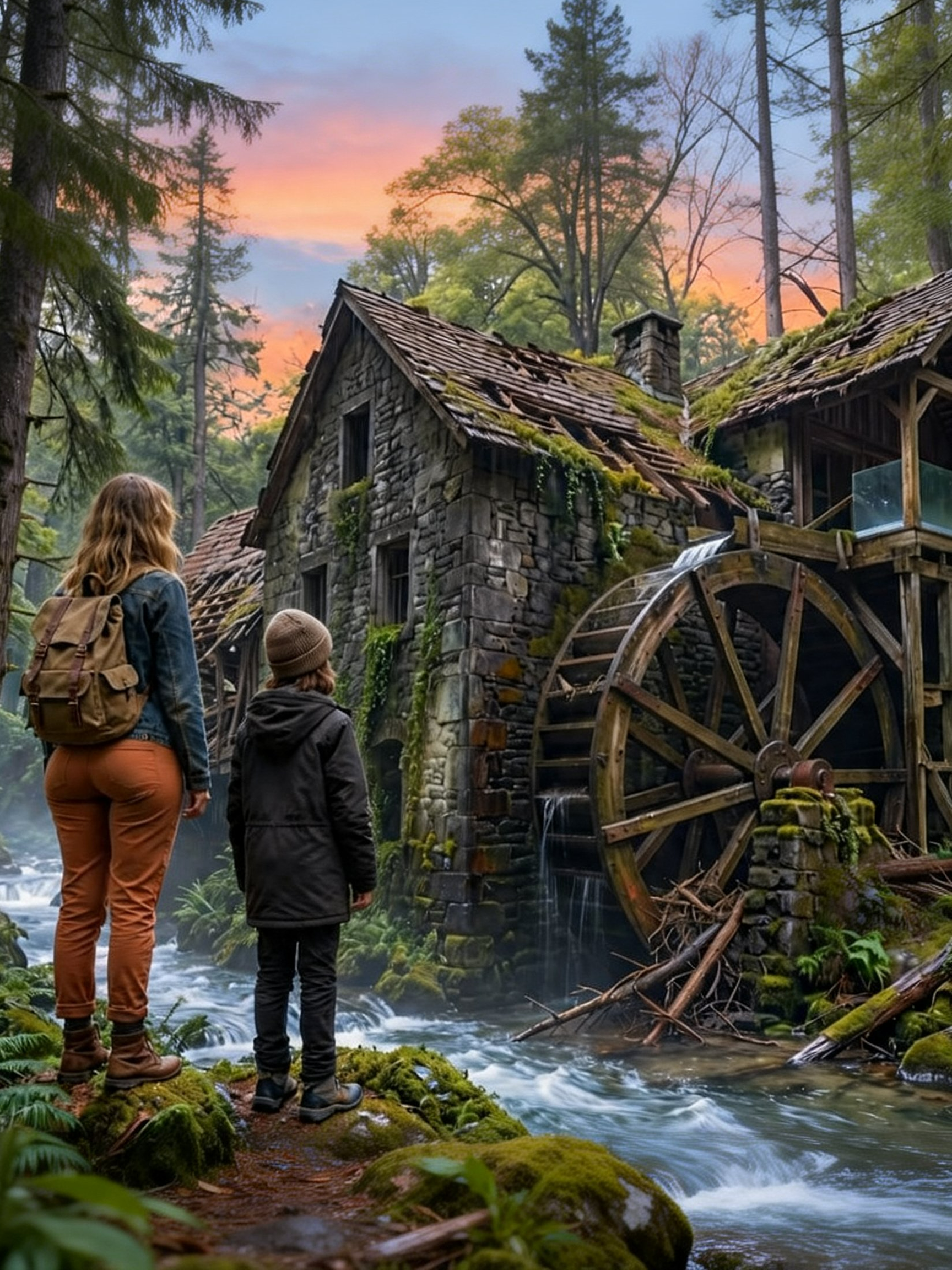
My 10-year-old brother and I were sleeping in a rusty van when a $4 notebook led me to an abandoned stone mill with just $72 in back taxes. I thought the place might be a second chance for us, but when I opened a filing cabinet upstairs, I found a map with my own name on it—and a warning I had never answered…
The night I counted the seventeen floodlights behind the Walmart in Boone, North Carolina, I had $341 left in the bank. My brother Finn was asleep in the back of our old white Ford van with a half-finished drawing of a chickadee on his chest. He was ten, and I’d been looking after him for fourteen months, ever since our mother asked me to take him while she tried to get back on her feet.
I was supposed to be the stable one. I’d spent six years doing mapping work for an environmental nonprofit called Watershed Trust, until its founder, Keane Brenneman, came under federal investigation and the organization collapsed. By October 2026, the job was gone, the rent was impossible, and four of the six firms I’d applied to had already rejected me.
Finn had learned to sleep through the engine cooling and the rattle of shopping carts. He kept his colored pencils in a small tin and drew birds whenever he couldn’t find words for what he felt. I worried about the cold, about whether he could settle into a school, and about what would happen if the van finally refused to start.
A woman tapped on my window around four in the morning. She was in her sixties, wearing a denim barn coat over a tomato-red turtleneck, and she held two coffees. Her name was Sable Yoon, and she said she’d noticed us parked there for three nights.
“I’ve got an apartment over my garage,” she told me. “Working toilet, decent mattress, heater. You and that little one can stay through winter.” I tried to say I didn’t accept charity, but she shook her head. “People take help, honey. That’s all this is.”
Sable was a retired social worker and a widow. She wanted Finn somewhere warm, with the chance to attend school in a real building. We followed her to a tired yellow house off Bryerson Flats Road, and when Finn saw the lit window above her garage, he laid his hand on my wrist for four seconds. He rarely spoke; that was how he told me something mattered.
We settled into a life small enough to manage. I helped Sable with a neighborhood history project, showing Finn and local children how to draw maps of the creek and the surrounding hills. She fed us twice a week and let us use her address. Finn started handing other children pencils without waiting to be asked, and I noticed every time.
On the days we didn’t have paid work, I sent out applications and watched every dollar. Sable never asked how many rejections came in, but sometimes she left an extra helping of supper covered on her stove. Finn started drawing the old dogwoods beyond her porch; he could tell their branches apart before he learned the neighbors’ last names.
Then Sable took us to an estate sale. On a back-room table I found a worn leather field notebook marked $4, filled with creek measurements, sketches, and the sort of geological observations I’d spent my career making. Inside the cover was a name: N. Pell.
One entry stopped me. It described an old, buried streambed near Hollow Creek, with gravel that suggested water had once run somewhere the current maps showed dry land. The notes were so exact I could practically see the woman walking the ridge, checking one measurement against another.
The man collecting money said the notebook had belonged to his aunt, Noor Pell, who’d kept records for decades. There were dozens more in the basement. I paid him four dollars, carried the notebook home in my mother’s old tan canvas backpack, and waited until Finn fell asleep before opening my laptop.
I knew Hollow Creek. I’d led the GIS mapping team on a Watershed Trust project there in 2022. When I entered Noor’s coordinates into the mapping software, the marker landed inside a strange blank space in the county’s property records: thirty-eight acres with no clear road access.
The terrain image showed a rectangular stone building, a small annex, and a circle against one wall. It took me a moment to understand what I was looking at. A waterwheel. The county’s delinquent tax listing showed $72 owed on the parcel, and a tax-certificate sale was approaching.
Seventy-two dollars was also our grocery and propane money for the week. I stared at that figure long after the laptop screen dimmed. I wasn’t imagining a mansion or a miracle; I was wondering whether an unwanted patch of woods might hold something useful that everyone else had missed.
At the county office, a clerk named Prasanna explained that the mill had been condemned since 2009 and nobody had bid on the tax certificate. Buying it wouldn’t make me the owner right away. I’d still need to wait through the legal process or secure a deed from Noor’s heir.
I paid the $72 anyway. Prasanna gave me the certificate and the public-record contact information for Noor’s son, Edison. When I called, he said he wanted nothing to do with the mill but was willing to sign a quitclaim deed. He asked only that if I found anything important belonging to his mother, I take it to her friend, an attorney named Delphine Oats in Boone.
I kept the certificate under the leather notebook for the rest of that week. It was a thin piece of paper, not a key, and it offered no guarantee that the condemned building was safe or worth saving. Still, after losing my job and nearly everything that went with it, having one small choice I could act on felt important.
Two days later I packed water, flashlights, a first-aid kit, and Finn’s warmest clothes. Sable watched us leave and said that if we weren’t back by dark, she’d come looking. We drove until the road became ruts, then walked the last stretch through hemlocks and wet leaves.
The mill stood below us beside a rushing creek, two stories of gray stone stitched with moss. Part of the annex roof had fallen in. A fourteen-foot wooden wheel still turned slowly where a narrow flume fed it water, and Finn slipped his hand into mine as we stared down the slope.
Inside, the old grinding machinery lay under dust, but the stairs were surprisingly solid. Upstairs wasn’t an abandoned storeroom at all. It was a workroom with a drafting table, a little stove, hanging tools, and four tall filing cabinets, every drawer carefully labeled in blue tape.
I opened one cabinet and followed the dated folders backward with my fingertips until I saw “WT-2022-04 Trust.” That was my old project’s number. I took the folder out, expecting perhaps an old county report, and unfolded a copied terrain map I recognized instantly: my color choices, my north arrow, my name in the corner. M. Teagan, GIS Lead.
Clipped behind it was an email from Noor Pell to my old work address, dated August 14, 2022. “I know your team flagged this tile as needs ground truth,” it said, “and I’m asking who approved the override.” My fingers went cold. I knew who had approved it. I had—and the ridge on that map rose directly above the neighborhood where Sable had just given us shelter. Part 2…..
IF FACEBOOK BROUGHT YOU HERE, HERE’S THE CONTINUATION YOU’VE BEEN WAITING FOR. ENJOY! 👇 Finn took the folder from my trembling hands and set it on the drafting table. Then he rested both palms against my forearms, pressing gently as if he could hold me in place. He’d always been better at noticing when I was frightened than I was at admitting it.
My junior analyst Theo Marlin had marked that particular terrain tile “needs ground truth.” Four years earlier I’d overridden the flag because we were out of time and money, and because the older aerial survey looked adequate. I’d put the limitation in an appendix and signed the release sheet; then I’d gone on to the next deadline.
Noor’s email had reached the address printed on the map, but I couldn’t remember reading it. I remembered setting up a filter to divert messages from ProtonMail after somebody impersonated a government agency with a phishing email. Noor had used that service. Her warning had probably gone straight into a folder I never checked.
The copied map showed the ridge above Bryerson Flats, where Sable and eleven other families could be in danger if buried water channels reactivated during a serious flood. I didn’t yet know what the county planned to build, or whether anyone had caught the flaw. That uncertainty frightened me more than the ruined roof over our heads.
I buckled the folder into my backpack and took Finn home. Sable had cornbread waiting, and I couldn’t bring myself to tell her what was in the bag. For one evening, I wanted to sit beside my brother in a warm kitchen and pretend the problem was only an old mill that needed repairs.
At the next morning, I opened the backup of my Watershed Trust emails on an external drive. I had saved it in March while trying to rebuild my portfolio. A search for Pell turned up Noor’s message and a little reminder I’d once written to myself about the Hollow Creek ground-truth question, then apparently forgotten.
There was no way around it now. I read Noor’s email twice and then aloud in a whisper. She hadn’t accused me of anything; she’d asked the one question a responsible mapmaker should have answered before anyone relied on that map.
A search of county announcements showed a public meeting about the Blackwater flood mitigation plan scheduled for November 15 at the Bryerson Flats Volunteer Fire Department. Dr. Imani Osay, a hydraulic engineer, would explain how the county proposed to redirect water in Hollow Creek. The meeting was only days away.
When I walked across Sable’s driveway that morning, she was on her porch with a crossword and a mug of coffee. She took one look at me and said, “You haven’t slept.” I told her about the notebook, the mill, the cabinets, and finally the map with my initials on it.
“I think I made a mistake,” I said, staring at my boots. “And it may have something to do with the flood plan they’re showing everybody next week.” Sable put down her cup. She didn’t ask me to make it sound better.
She knew Delphine Oats, the attorney Edison had mentioned. Delphine had handled Sable’s will and had been Noor’s close friend, so Sable insisted I go see her that morning. She kept Finn at the house while I drove to Boone, where I climbed a narrow staircase to a little office above the shops.
Delphine sat behind a worn walnut desk, black hair pinned in a low bun and a gray cardigan over her blouse. “Edison called me,” she said before I’d finished introducing myself. “He told me a woman bought the mill’s tax certificate and actually bothered to find him. I’ve been expecting you.”
I put Noor’s folder on her desk. Delphine rested her hand on it for a moment before opening it, and the look on her face made me understand that these weren’t just papers to her. She said Noor had spent months waiting for a reply from the GIS lead at Watershed Trust.
“I never saw it,” I admitted. “My email filter caught it.” Delphine nodded slowly. Noor had eventually sent a certified letter as well, but it had reached our office during a period when mail was being mishandled. That letter, too, had gone unanswered.
“She thought somebody on your team knew there was a problem,” Delphine said. “She was hoping they’d let her show them.” Then she stood and crossed to a filing cabinet with a brass label bearing Noor’s name. “What you found at the mill isn’t everything she left.”
Delphine opened the drawer. It was packed with ground surveys, correspondence, and hand-drawn maps, and she pulled out a yellow legal pad for my notes. I sat down across from her and began to read.
Part 3 For six hours I worked through Noor’s records while Delphine quietly brought coffee and answered questions. Noor had measured the Hollow Creek watershed for more than a decade, walking it in every season and recording details most people would never have noticed. She had identified three buried stream channels that could carry water again in a large storm.
Her husband, Benjamin, had died of a heart attack in 2007 while clearing mud from their flooded basement. The county’s older model had said that sort of flooding shouldn’t have happened. Instead of giving up, Noor enrolled in a hydrology program at Appalachian State at fifty-two and dedicated the years afterward to checking the ground against the official maps.
The papers showed that she’d warned different county officials about the north shoulder channel six times. Some officials had retired or moved away; others had dismissed her work because she was a citizen volunteer. In 2022 she tried Watershed Trust, where my team had already flagged the very spot she was concerned about.
Her last unfinished technical memo described what might happen if an engineered channel increased the water flowing into the upper watershed. In a major storm, hidden flow could push east toward the lots on Bryerson Flats Road. Delphine had checked the property records: eleven houses, including Sable’s, lay in the possible path.
I asked whether Dr. Osay’s design really depended on my old data. Delphine wouldn’t let me turn an educated guess into a fact. “Find the county’s preliminary presentation,” she said. “Check the source listed on the map. Then we’ll know what they’re using.”
Outside, under a parking-lot lamp, I waited for the county’s long PDF to load on my unreliable flip phone. On slide four, I saw the same rounded compass arrow and blue-gray terrain shading I had put together in 2022. My initials appeared in the corner, just as they had in the mill.
I drove to a mountain overlook rather than head home. I remembered the meeting where I’d approved Theo’s override: stale coffee, grocery-store donuts, a supervisor asking when the deliverable would be done. I’d told myself the 2014 data was good enough and recorded the warning in a methodology appendix few people would ever read.
Being exhausted explained why I’d done it. It didn’t change what I had signed. And now somebody else was using that signature to make decisions about the street where my brother finally felt safe.
For the next few days, Finn and I walked the ridge with a handheld GPS, a probe, and copies of Noor’s notes. Under the trees we found layers of rounded gravel where ordinary hillside soil should have been, along with a damp seep near the spot she’d marked. Finn held the tape, kept our pencils dry, and watched me record each point.
Farther along I found a newer survey marker from a firm working for Dr. Osay. It was roughly sixty-one meters from the channel Noor had located. That alone couldn’t prove how a revised flood model would behave, but it showed exactly why an on-the-ground recheck mattered.
I photographed the marker and uploaded our findings to Delphine’s secure folder using the public library’s Wi-Fi. Sheila, the librarian, started setting out a juice box for Finn whenever she saw him coming. He would sit with his sketch pad while I compared coordinates, and he never once asked how much of our grocery money I’d spent getting there.
Then a recruiter named Lennox emailed me about a GIS lead job with Dr. Osay’s firm. The annual salary was $94,000, plus benefits and a $6,000 signing bonus. The position involved the very watershed plan I was afraid to challenge.
I sat motionless at the library computer. That kind of money meant an apartment instead of a garage room, reliable transportation, winter coats that actually fit, and savings for the first time in months. It meant I could tell our mother that Finn wasn’t sleeping in a van anymore and that I might finally have a future she didn’t need to worry about.
The message said the hiring manager wanted someone familiar with the Hollow Creek data. I was more familiar with it than anyone, including the corner I’d approved without checking. I printed the email, folded it into my notebook, and went home without telling anyone about the offer.
That night I kept imagining that maybe Dr. Osay had accounted for the buried channel another way. Maybe I was exaggerating the risk. Maybe another engineer would catch it without my having to say a word. I recognized the excuses because they’d sounded so reasonable four years earlier.
The next morning Finn slid a drawing onto the table while I made coffee. He’d drawn Sable on the roof of her yellow house, with neighborhood children around her and floodwater touching the gutters. “Why’d you draw this, buddy?” I asked. He looked down at his crayons and said, “The water. I dreamed it.”
He knew nothing about the job offer or the eleven houses. I sat beside him until my coffee went cold. Then I went outside and called Delphine to tell her I would speak at the meeting.
Part 4 Before anyone else heard what I planned to say, I called Theo Marlin, the analyst who’d first raised the warning. We hadn’t talked much since Watershed Trust fell apart. His wife Elena was expecting a baby, and he’d found work with another firm; I knew a public challenge to the flood project could complicate his life.
“I’m going to tell the room I approved that override,” I said. “I’m not putting your name on the mistake.” He fell silent, and I heard him take a shaky breath. Then he admitted he’d seen the new plan and recognized the same problem, but fear for his job and his growing family had kept him from speaking clearly.
“You flagged it when you were supposed to,” I told him. “I was the lead. I signed past your warning.” He offered to stand up beside me, but I asked him to let me explain my own decision. I wanted people to hear why somebody who had approved the map was now asking the county to check it again.
Theo cried quietly before we hung up. I asked him to keep flagging problems in writing, loudly enough that no one could quietly sign around them again. He promised, and I believed him.
After that I went down to Sable’s kitchen, where she was making biscuits. I rolled dough beside her for twenty minutes before telling her everything: the wrong map, Noor’s records, the proposed channel, the risk to her home, and the job that could pay me $94,000 a year. She listened without interrupting or turning off the oven.
“My husband died in 2018,” she said when I finished. “Floodwater got into our basement, and nobody told us it was coming.” She brushed flour off her hands and looked directly at me. “I’d rather have had fifteen more years with him than any paycheck in this county.”
I tried to tell her I was afraid to stand in front of everyone and say I’d made the error. She caught both my hands in hers. “You’re going to tell them what you know. I’ll be in the second row, in my red turtleneck, and I’ll listen.”
We finished the biscuits together, even though I’d stopped being able to measure anything properly. When Finn came in, Sable took one look at our flour-covered clothes and said he was in charge of making sure I ate supper. He nodded gravely, as if she’d given him a very important job.
Delphine helped me assemble the documents for public comment, but I wrote the statement myself. The meeting allowed three minutes per speaker. I practiced at the garage table while the kerosene heater clicked, cut nineteen seconds, and tried again until the words fit without my having to rush.
One evening I returned alone to the mill. I stood in Noor’s upstairs workroom beside the four filing cabinets and told her aloud that I was sorry I hadn’t read her email. I promised I was reading it now, and that I would keep reading warnings like hers for the rest of my working life.
On the morning of November 15, Finn climbed beside me on the mattress and rested his chestnut-colored head against my shoulder. “You’ll be okay,” he said softly. He paused, then added, “Sable said.” I laughed into his hair and held him a little longer.
I put on my dark blue denim jacket and terracotta-colored pants, packed the tan canvas backpack, and went to the library to print four copies of my remarks on cream-colored paper. Sheila pushed a chocolate kiss across the counter without asking why I needed so many copies. I put it in my pocket for later.
By that evening, the fire station parking lot was full. I parked three blocks away and walked in past the open bay door, breathing the familiar smell of diesel and old coffee. I signed up as the first citizen speaker before I could change my mind.
Forty-seven people were in the room. Sable arrived wearing exactly the red turtleneck she’d promised; Delphine sat quietly in the back. Dr. Imani Osay stood at the lectern in a navy blazer, her glasses hanging from a cord, checking the projector like someone determined to get every detail right.
She began explaining the Blackwater plan. It would widen the Route 221 culvert, rebuild an eastern wing wall, and route some upper-stream water through an engineered channel to reduce damage farther downstream. She described the limits of the model carefully, never pretending a forecast was a guarantee.
On slide four, there was my map. The compass arrow, the color scheme, and the tiny initials were all unmistakable. I gripped the cream-colored pages in my lap and waited for the comment period, knowing exactly what I needed to say and still wishing I didn’t have to say it.
When the county planner called “Mara Teagan,” I stood up. My legs felt unsteady, but I got to the microphone, spread the papers under my palms, and looked toward the neighbors I’d come to know by name.
Part 5 “My name is Mara Teagan,” I began. “In 2022 I was the GIS lead at Watershed Trust. The map on slide four is mine, and the underlying terrain data was released with my approval.” I heard a chair scrape in the back, then the room went still.
I explained that Theo had flagged the north shoulder for a ground survey and that I had approved an override instead. Noor Pell, a volunteer hydrologist, had emailed about the same problem on August 14, 2022. I hadn’t read her warning because of a bad email filter, and her later certified letter had been lost at our office.
“Those details explain how the warning failed to reach me,” I said. “They don’t excuse the decision I made before she sent it.” I looked at the people seated along the wall. “The person who signed that override was me.”
I pointed to the area just above Bryerson Flats, where the older terrain data hadn’t captured a buried stream channel. Noor’s field surveys and the observations Finn and I had just made suggested that redirection in a large flood could bring water onto eleven residential lots. I wasn’t claiming to know every result of a future storm; I was asking them not to approve a design without checking the missing ground.
“Dr. Osay has designed for the information she was given,” I said. “I am telling you that part of that information is incomplete. Please re-survey the north shoulder with current elevation data and ground verification before you finalize the plan.”
I had rehearsed that sentence more than any other. I told them Delphine had copies of Noor’s surveys, my GPS observations, and photographs of the seep and gravel beds. Then I apologized for approving work I should have stopped long enough to investigate.
The last line caught in my throat. “I was tired and behind schedule when I signed. That’s an explanation, not a reason to ask eleven families to carry the risk.” I thanked the room and walked back toward my chair without knowing whether I’d done any good.
For a few seconds nobody moved. Then Sable stood in the second row and began clapping. Dottie Averett stood, and then Frank Halverson, and then more of the neighbors, until nearly everyone was on their feet. I couldn’t look at Sable because tears were already gathering in my eyes.
Dr. Osay didn’t join the applause. She was studying the screen, and I could see her working through what I’d said. When the county planner invited her to respond, she went back to the lectern and thanked me for bringing the records forward.
She announced that her firm would request a pause in final approval until the north shoulder was completely re-surveyed. Her company would pay for that fieldwork rather than pass the cost to local households. She also asked whether we might talk privately the following week, because she believed there was more work we needed to do together.
The rest of the meeting became what it should have been: neighbors asking practical questions about culverts, drainage, and the roads their children used to get to school. Marcella Benton, who’d lived nearby since 1974, thanked the engineer and then asked about the construction schedule. Frank wanted to know whether his daughters’ school bus route would change. The planner said it wouldn’t.
Sable moved into the chair beside me and held my hand. We listened as people discussed their own streets, which was all they’d wanted in the first place. I couldn’t make my old signature disappear, but at least it was no longer hidden inside an appendix.
After nine, as the crowd dispersed, Dr. Osay approached me in the parking lot. She asked me to call her Imani, shook my hand, and mentioned the recruiter who’d sent me that $94,000 offer. I admitted I’d received it but hadn’t responded.
Imani said she’d noticed the ground-truth override in the methodology appendix months earlier. When she learned what had happened to Watershed Trust, she’d asked Lennox to contact me. She wanted someone who knew the baseline from the inside, but she had also wanted to see whether I would speak plainly about its weakness.
“If you’d taken the job and quietly tried to steer me around the problem, I wouldn’t have approved the design,” she said. She admitted she had been testing a difficult judgment, not simply recruiting a familiar name. I was relieved that she had suspected a problem, though part of me wished she had contacted me directly before the public meeting.
She said the offer still stood, with a different role in mind: a publicly named lead on the new survey, including the responsibility to explain the corrections. There would be attention from the local press and uncomfortable questions for all of us. Imani wasn’t asking for an answer that night; she gave me thirty days to decide.
Before leaving, she told me her father had been a hydrologist in Ghana. He’d taught her that you couldn’t engineer a watershed you didn’t love enough to study closely. “Noor Pell loved this one,” she said. “I think you might, too.”
I got back into the van, and Sable glanced over from the passenger seat. “Those biscuits aren’t going to heat themselves,” she said. I drove home, cried with the engine off in her gravel driveway, and then went inside, where Finn came straight across the kitchen and wrapped his arms around my waist.
Part 6 On Monday, the county announced that final approval of the Blackwater plan was paused. Reporters called, and for a couple of weeks I found myself answering questions in places I’d never expected to be: the kitchen, the library, and a small radio studio in Boone. I tried to talk about Noor’s work and the need for a better survey, not about whether strangers thought I was brave.
One listener from Nebraska mailed a knitted scarf with a note saying the GIS lady had done right. I wore it to the creek the next morning. Finn touched the soft wool and gave me a brief, approving nod.
Edison Pell followed through on his promise to sign away his interest in the mill. With Delphine handling the paperwork and recording, the property finally passed into my name. I walked out of the county office holding documents for thirty-eight acres, a condemned stone building, and a wheel that still turned over running water.
The $72 had bought a tax certificate, not a house outright. Getting the deed had required finding the heir, earning his trust, and making sure the ownership records were settled. I thought about that whenever somebody called me the woman who had bought a mill for the price of dinner.
I called Imani near the end of the thirty days. I couldn’t accept a full-time job that might pull me away from Bryerson Flats, Finn’s school, or the mill, I told her. But I could lead the re-survey as a part-time contractor, train her younger GIS staff, and keep a schedule that let me be here for my brother.
She agreed to a thirty-hour-a-week arrangement. Then she mentioned that her firm planned to launch a citizen-science water-monitoring program in the spring and needed a field station in Hollow Creek. If we could make part of the mill safe and usable, the firm could lease space there for five years and contribute toward restoration.
“I’d want the monitoring methods built from Noor’s notebooks,” I told her. “And her name on the stations.” Imani went quiet for a moment before answering, “That’s exactly right.”
At supper I told Sable and Finn what we’d agreed. Sable served pinto beans, collard greens, and cornbread, acting as though it were the most ordinary thing in the world that a woman she’d found in a parking lot now owned a mill and had work to do there. Finn ate two helpings and asked, softly, whether he could draw the maps for the field station.
“You can help us make them,” I said. He looked down into his bowl, but I saw the beginning of a smile.
Through the winter, the mill became everybody’s weekend project. We repaired the damaged annex roof, checked the chimney, cleaned the old machinery, and sorted Noor’s records by the colored folders she’d used. Delphine came with gloves and boxes, and Theo drove over on several Saturdays with tools and supplies.
Elena, Theo’s very pregnant wife, sat nearby with a novel and offered a surprising amount of useful advice. Sable brought food and held us to sensible stopping times. Finn made a careful drawing of each room before we moved anything, and he was fiercely protective of Noor’s filing system.
We arranged for a university library in Boone to preserve copies of the records. I photographed pages until my fingers cramped and wrote down where each folder had come from. It mattered to me that Noor’s work wouldn’t depend on a single neglected building surviving another winter.
The grinding stones were unsafe to operate after so many decades, so we left them alone. A seventy-year-old mill specialist named Harlan Pike came from Burke County to examine the old wheel and its bearings. He listened to the wood and iron for a long time before telling me that whoever had cared for the machine had known a great deal about mills.
“She was a hydrologist,” I told him. Harlan laid a hand on the shaft housing. “Then she was a millwright, too.” I wrote his words in my notebook because Noor deserved both names.
The mill didn’t turn into a polished tourist attraction. It still had stone walls that held the cold and a road that ended too soon. But the roof no longer let rain into the annex, the records had a safer future, and there was room at the drafting table for people who wanted to learn the water as well as Noor had.
Part 7 On December 21, Delphine came to the mill carrying a thermos of cider and a small box tied with twine. She said Noor had entrusted her with one more thing, to be given to whoever ended up caring for the mill. Inside was a blue, hand-sewn notebook with a single word on the cover: Instructions.
The first page began, “To the next person at the wheel.” Noor wrote about the sluice that needed clearing, the hornets that nested beneath the gable, the stove damper that worked best when left open for the first eight minutes, and the exact order of the green, yellow, red, and blue folders. Her practical advice was so familiar from her field notes that I could almost hear her speaking.
Then came the reason she’d left it. The north shoulder channel, she wrote, was the most important feature in the watershed. If anyone ever proposed moving water in the upper tributary, the next keeper must insist that the channel be re-surveyed before the plan was approved.
She ended with an answer to a question she’d apparently heard all her life: Why keep doing this work? “Don’t try to answer it in sentences,” she’d written. “Answer it in work. Pour the kettle. Clean the sluice. Walk the channel. Write it down. The work is the answer.”
I closed the notebook, unable to speak for a moment. Delphine looked around the workroom and said, “Put the kettle on.” So we followed Noor’s instructions and sat with mugs warming our hands while the wheel moved beyond the window.
Finn was drawing by the stove. He held up a picture of Noor as Delphine had described her: small and sturdy, with a long gray braid and reading glasses perched on her head. She stood beside the wheel with one hand against the stone. Delphine covered her mouth and whispered, “That’s her.”
In January and February, I led two junior members of Imani’s team, Priya and Wren, across the north shoulder using better GPS equipment and ground sampling tools. We walked every section we could safely reach and compared the results against Noor’s old surveys. Her measurements held up, and we found two additional seeps she hadn’t recorded.
Nobody claimed that a field notebook alone was a finished engineering model. The survey gave Imani’s firm reliable ground information to update the analysis, and her engineers tested revised alignments before submitting a new design. That distinction was important: Noor had found what others missed, but the new plan still needed full professional review.
In March, the revised Blackwater proposal went out for public comment. It moved the engineered channel roughly seventy meters south of its earlier alignment, added a bypass to carry water from the buried channel toward the main river, and included permanent monitoring above Bryerson Flats. In April, the county commission approved it five to zero.
I knew no design could promise that no house would ever flood. But the specific danger our old map had hidden was now on the record, studied, and addressed. When the county held a signing ceremony at the fire station, Imani thanked Noor by name and credited the public comments that had made the revision possible.
Sable sat beside me in her tomato-red turtleneck, just as she had in November. Afterward, under the awning, she slipped her arm through mine and told me my mother had called. The hospital in Winston-Salem had offered her a daytime position starting in June, and she hoped Finn might come live with her again later in the summer.
I wasn’t prepared for how those words felt. I’d wanted my mother steady again for so long, yet I’d built every day around keeping Finn close. Sable didn’t tell me which feeling was right; she said we ought to visit and let him see the apartment before anyone decided.
We drove down the next week. My mother’s new place overlooked a school playground, and she showed Finn where his sketchpads could go and which window would get the best morning light. He walked quietly from room to room, then sat with her at the small kitchen table for a long time.
He said he wanted to stay with me through July and move back to his mother in August. He wanted Christmases, spring breaks, and every July at the mill if we could arrange it. I looked at my mother, who had tears on her cheeks, and said that sounded like a plan worth making.
That night, back in Boone, I stood outside Sable’s garage apartment listening to the creek in the distance. I was proud of Finn for saying what he wanted, but I wasn’t ready for the quiet that would come when his sketch pads weren’t spread across my kitchen table anymore.
Final Summer came green and noisy to Hollow Creek. Fourteen volunteers joined our water-monitoring project, most of them retired neighbors who knew the roads and old creek crossings better than any map did. Dottie Averett took charge of the lower reach with a canvas vest full of pockets and a habit of correcting me before breakfast.
We taught volunteers how to record temperature, flow conditions, and water quality consistently, using methods shaped by Noor’s notebooks. The monitoring stations carried her name. Sometimes I’d find someone bending over a field sheet exactly where Noor must have stood years earlier, and I’d feel grateful that her careful work had finally found more hands.
Delphine came to the mill most weekends and eventually introduced us to Imogen Cato, a geologist from Appalachian State whom she’d begun dating. Imogen had a warm laugh and was excellent at splitting firewood. The four of us—Sable, Delphine, Imogen, and me—started having Sunday dinners that ran so long the dishes were still on the table when the porch light came on.
Theo and Elena welcomed a daughter, Lillian, in February. I became her godmother and drove over to Blowing Rock when I could, carrying books and groceries. Theo told me he’d insisted on reviewing two questionable data sets at work and had put both warnings in writing; both projects had been corrected. He’d kept the promise he’d made at the payphone.
In April, Keane Brenneman pleaded guilty to seventeen counts of federal grant fraud and received a five-year prison sentence. I didn’t attend the hearing. I wrote one brief note about it in my field book, shut the cover, and went outside to clear the sluice.
Finn turned eleven on July Fourth. Sable baked a chocolate cake, but there were only six candles in the kitchen drawer. “That’s enough fire,” Finn declared, and for once he sounded like a boy who assumed everybody would listen. Isaiah, the Halverson girls, and June came for cake, and later we watched fireworks from Sable’s driveway.
June held Finn’s hand when the loudest fireworks went off. He didn’t pull away. I watched them from the porch steps, remembering the pencil rolling beside him in the van the night Sable first knocked on our window.
In August I drove him to Winston-Salem. We unpacked his sketchpads together and chose a spot for the drawing of the mill. My mother hugged me for the first time in two years and whispered that she was sorry for how much she’d asked of me. I didn’t rush to make the apology disappear; I let her say it, and then I hugged her back.
The next morning Finn walked me to the van. He stood on the curb with his hands in his pockets, looking much older than the child I’d carried up Sable’s garage stairs. He still didn’t like saying goodbye.
After I rolled up the window, he placed his palm against the glass for exactly four seconds. I held my hand against his through it. Then he stepped back, and I drove toward Boone, stopping once on the way because I needed to cry where he couldn’t see me.
I went straight to the mill when I got home. The hemlocks were thick with summer green, ferns covered the bank, and the waterwheel moved at its slow, steady pace. I climbed to the workroom and opened Noor’s blue notebook on the drafting table.
“The work is the answer,” I read again. Then I opened the stove damper, set the kettle on, and took out my own field notebook. I recorded the afternoon water temperature and the clear forecast, and I wrote the date at the top of a fresh page for our second monitoring season.
The building was still old. My brother was living with our mother. I still had work to do on the creek, and the people of Bryerson Flats still had to watch the weather like everybody else in the mountains. Nothing about our lives had become perfect or effortless.
But I wasn’t sleeping in a van, and Finn was where he wanted to be. Noor’s records were being used, Sable had her neighbors watching out for her, and my name now stood beside work I’d checked rather than an error I’d hidden from. I carried my mug outside, listened to the running water, and said it softly to the empty hollow: “I’m home.”
THE END. I’ve shared the complete story, and I truly hope it touched your heart. If this story moved you, please , like, and share the post. Thank you for reading! ❤️
✓ Lynn R. Adams
My 10-year-old brother and I were sleeping in a rusty van when a $4 notebook led me to an abandoned stone mill with just $72 in back taxes. I thought the place might be a second chance for us, but whe…