Homeless at Sixty-Eight, She Bought a Condemned House for Six Dollars—Then a Hidden Deed Turned Her Family’s Betrayal Into Justice
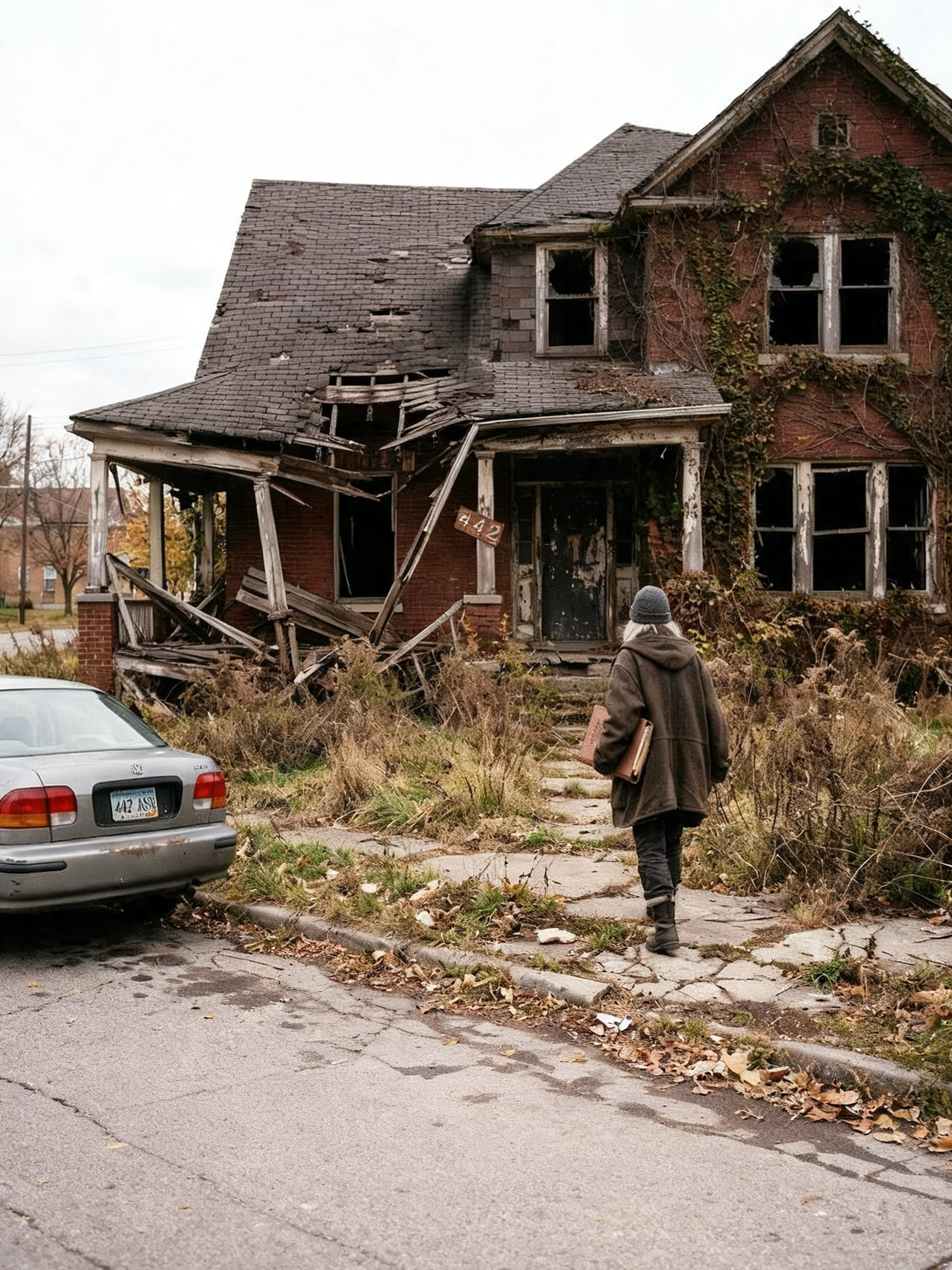
Homeless at Sixty-Eight, She Bought a Condemned House for Six Dollars—Then a Hidden Deed Turned Her Family’s Betrayal Into Justice
“You have until sunset.”
That was what Evelyn Harper’s daughter-in-law said as she dropped two black trash bags onto the front porch.
Not suitcases.
Trash bags.
One held Evelyn’s clothes.
The other held what remained of sixty-eight years of life after her son had decided she no longer fit inside his.
Behind Tessa Harper, the front door of the four-bedroom house stood open. Warm yellow light spilled across the brick porch. Evelyn could smell rosemary chicken roasting in the kitchen.
Her chicken recipe.
Her grandmother’s recipe.
Inside that house were the dining set Evelyn had bought Michael and Tessa when they married, the refrigerator she had helped pay for, the college diploma she had spent twelve years paying off, and the son she had once worked two jobs to raise.
Michael stood in the hallway with both hands in his pockets.
He would not look at her.
Evelyn looked at the trash bags.
Then at Tessa.
Then at her son.
“How many days?” she asked.
Tessa blinked.
“How many days have I been here?”
Michael rubbed his forehead.
“Mom, don’t do this.”
“I asked how many.”
“Six,” Tessa said. “Technically.”
Six days earlier, Michael had wrapped both arms around Evelyn outside the title company and told her she would never have to worry again.
He had persuaded her to sell the little Cape Cod house she and her late husband, Raymond, had owned for thirty-seven years.
The roof needed replacing.
The furnace was old.
Property taxes were rising.
Michael said the market was strong and that keeping the place was “financially irresponsible.”
He had used those exact words.
Financially irresponsible.
Evelyn had almost laughed at that.
For forty-two years, she had been the person who remembered which bills were due, which insurance premiums had increased, which grocery store doubled coupons on Wednesdays, and how to stretch fifty-seven dollars until payday.
But Michael had a business degree.
Michael wore expensive watches.
Michael said things like asset allocation and liquidity strategy.
So, after six months of pressure, Evelyn signed.
The house sold for $214,000.
There was no mortgage.
After fees, taxes, and expenses, almost all of it should have gone to Evelyn.
Michael convinced her to place the proceeds temporarily into an account he managed because, he said, moving the money would help her qualify for senior housing without “unnecessary tax complications.”
Evelyn did not understand every document.
But she understood her son.
Or thought she did.
He told her she could stay with them until they found her a small apartment nearby.
Six days later, her belongings were in garbage bags.
Tessa folded her arms.
“The neighbors are already asking if you moved in permanently.”
Evelyn said nothing.
“And Michael and I need our space.”
Still nothing.
Tessa’s voice sharpened.
“You sit in the kitchen every morning.”
Evelyn looked toward the kitchen.
“I drink coffee.”
“You reorganized the spice drawer.”
“The paprika was beside the cinnamon.”
“That’s exactly what I mean.”
Michael sighed.
“Mom, please.”
Evelyn turned to him.
He finally looked at her.
For one second, she saw the little boy who used to crawl into her bed during thunderstorms.
Then it was gone.
“There’s a motel on Route Nine,” he said. “I’ll cover two nights.”
“Just until you figure something out.”
Evelyn studied his face.
“You said you were finding me an apartment.”
“I’m trying.”
“And the money from my house?”
Michael’s jaw tightened.
“It’s invested.”
Tessa stepped between them.
“This is exactly why living together doesn’t work. You interrogate him like he’s stealing from you.”
Evelyn’s eyes moved slowly to Tessa.
The strange thing was, she did not look angry.
She did not cry.
She did not raise her voice.
That seemed to make Tessa more uncomfortable than screaming would have.
Evelyn bent down and picked up both trash bags.
One tore near the bottom.
A gray sweater sleeve slipped through.
Tessa glanced at the street, embarrassed.
“There are people watching.”
Evelyn followed her gaze.
Across the road, a woman watering begonias had stopped pretending not to stare.
Evelyn tucked the sweater back inside.
Then she asked Michael one final question.
“Did you keep your father’s blue toolbox?”
Michael frowned.
“The old rusted thing?”
“I think Tessa had the garage cleaned out.”
Tessa shrugged.
“It was junk.”
For the first time, something changed in Evelyn’s expression.
Something colder.
Raymond had carried that toolbox to work for thirty-four years.
He had repaired school roofs, church steps, broken porch rails, storm doors, picnic tables, cabinets, and once an entire nursery floor because Michael’s baby crib had rocked on uneven boards.
After Raymond died, Evelyn had kept the toolbox exactly where he left it.
A hammer with a cracked walnut handle.
Two planes.
A folding ruler.
A box of mismatched screws.
Nothing valuable.
Unless a life counted.
“I see,” Evelyn said.
She walked down the porch steps.
Michael followed her halfway.
She stopped.
“If you’re going to make this dramatic—”
Evelyn turned around.
That single word shut him up.
“I am going to make it easy.”
She walked away carrying two trash bags.
Michael did not follow.
By midnight, Evelyn Harper was sleeping in the passenger seat of her fourteen-year-old Buick behind a twenty-four-hour grocery store.
She had $143 in checking.
A nearly full gas tank.
Three quarters in the cup holder.
A wedding photograph.
And no key to any door on earth.
She did not cry.
Not that night.
Not the next morning when the security guard tapped on the Buick’s window and asked her to move.
Not when she washed her face in the restroom of a gas station.
Not when she discovered Michael had stopped answering his phone.
Not when she called the bank and learned she could not access the account holding the proceeds from her house without Michael’s authorization.
Something inside Evelyn had gone quieter than grief.
And anyone who had known her husband Raymond would have recognized the danger in that silence.
Raymond used to say Evelyn became most frightening when she stopped explaining herself.
On the third day, she went to the Ashwood Public Library because it was warm, free, and nobody asked why an elderly woman sat at the same computer for five hours.
She searched apartments.
Then senior housing.
Then emergency shelters.
Then legal aid.
There was a six-month waiting list for one subsidized apartment building and a fourteen-month waiting list for another.
The cheapest motel wanted eighty-nine dollars per night.
A woman at a church shelter told Evelyn there was one women’s bed available, but she would have to be inside by six every evening and leave by seven each morning.
Evelyn thanked her.
Then she kept searching.
Around two in the afternoon, a small appeared on the county website.
ASHWOOD COUNTY LAND REUTILIZATION CORPORATION.
STRUCTURES AVAILABLE FOR REHABILITATION.
The first house had burned.
The second had collapsed.
The third appeared to have been abandoned during the Eisenhower administration.
Evelyn clicked through seventeen properties.
Then she saw Number 214 Hawthorne Street.
Two stories.
Built in 1911.
No active utilities.
Tax delinquency resolved through county forfeiture.
Transfer price: $1.
Recording and administrative fee: $5.
Total due at conveyance: $6.
Evelyn leaned closer to the screen.
The house was not ugly.
Ugly suggested something still trying.
This place had surrendered.
Three windows were boarded.
The porch sagged.
Vines covered half the eastern wall.
The back addition leaned slightly away from the main structure as if preparing to leave.
A faded demolition notice was stapled beside the front door.
Yet the roofline was surprisingly straight.
The brick foundation looked solid.
And through the weeds Evelyn could see the edge of an old stone retaining wall.
Raymond had taught her enough to notice things like that.
Cosmetics lied.
Foundations rarely did.
She wrote the address on the back of a grocery receipt.
By four o’clock, she was standing in front of 214 Hawthorne Street.
It sat at the end of a dead street in an old neighborhood overlooking the remains of Ashwood’s steel district.
Once, thousands of men had worked down there.
Now warehouses, storage lots, weeds, and rusting rail lines stretched toward the Ohio River.
The street had six houses left.
Three were occupied.
Two were boarded.
And Number 214 looked as if the entire city had agreed to forget it.
Evelyn stepped through knee-high grass.
The porch complained under her weight.
She peered through a broken window.
Inside she saw plaster dust, an overturned chair, water stains, and a fireplace with an intact oak mantel.
Not veneer.
Real quarter-sawn oak.
She smiled for the first time in three days.
“Ray,” she whispered, “you would have loved this mess.”
A voice came from behind her.
“You thinking of buying it?”
Evelyn turned.
A man in an orange county vest stood beside a pickup truck.
He was perhaps fifty, with a clipboard tucked under one arm.
“I might be.”
He stared at her.
Then at the house.
Then back at her.
“You understand it’s condemned?”
“No plumbing.”
“All right.”
“Electrical service has been disconnected since 2014.”
“All right.”
“There was a partial ceiling collapse upstairs.”
“All right.”
He laughed once.
Not cruelly.
“Ma’am, this thing needs fifty grand before it needs curtains.”
Evelyn looked at the house again.
“You a contractor?”
“Developer?”
“Investor?”
“What are you?”
Evelyn looked at him.
“Homeless.”
The man stopped smiling.
The next morning, Evelyn walked into the county land bank office with six one-dollar bills.
The clerk stared at them on the counter.
“You know you’re responsible for rehabilitation compliance?”
“And demolition if you fail?”
“And there’s no guarantee the structure can be saved?”
The woman behind the desk glanced toward a coworker.
The coworker tried to hide a smile.
Evelyn noticed.
She noticed everything.
She signed the papers.
At 10:42 a.m., for six dollars, Evelyn Harper became the owner of the worst house on Hawthorne Street.
That afternoon, she bought a broom for $3.99.
By sundown, she had removed eleven bags of trash.
At dusk, while pulling a rotten board away from the fireplace, Evelyn found the first thing that changed everything.
It was a brass key.
Taped behind a loose brick.
She stared at it for a long time.
Then she removed two more bricks.
Behind them was a narrow steel compartment blackened by decades of soot.
The brass key opened it.
Inside was a flat metal document box.
Evelyn carried it to the kitchen floor and sat cross-legged in the dust.
There were no lights.
Only the beam from her flashlight.
The hinges resisted.
She pulled harder.
The box opened.
On top lay a photograph.
Evelyn froze.
She knew the woman in the picture.
Not immediately.
Thirty years changes a face inside memory.
But the eyes were the same.
Miriam Vale.
Evelyn had cared for Miriam during the last fourteen months of the woman’s life.
Back then, Evelyn was thirty-nine.
Michael was eleven.
Raymond had been laid off from a roofing company during a brutal winter, and Evelyn had taken every home-care shift she could get.
Miriam was seventy-eight, widowed, sharp-tongued, lonely, and almost completely bedridden.
Most aides hated working for her.
Evelyn did not.
Miriam cursed at doctors, distrusted bankers, hated canned soup, and demanded her tea hot enough to “frighten Satan.”
But she had loved birds.
And poetry.
And the Pittsburgh Pirates.
Evelyn had cooked for her, washed her hair, changed dressings, argued with insurance companies, and sat beside her during thunderstorms because Miriam had been afraid of lightning since childhood.
After Miriam died, Evelyn never heard from the family again.
She had not known Miriam ever lived on Hawthorne Street.
Beneath the photograph was an envelope.
Across the front, written in faded blue ink, were four words.
EVELYN HARPER, IF POSSIBLE.
Evelyn stopped breathing.
For several seconds, she did not move.
Then she opened it.
The letter inside was handwritten.
If this reaches you, then either Providence has a sense of humor or Ashwood County has finally become careless enough to lose what it spent years trying to steal.
You once told me a house is not made valuable by who owns it but by who is safe inside it.
I remembered that.
Listen carefully.
The tax map is wrong.
It has been wrong since 1973.
The east boundary of this property was never legally divided, no matter what the county card says.
Do not sign a correction deed.
Do not sign an easement.
Do not sign anything from Bellcrest Development, Vance Holdings, the City of Ashwood, or anyone claiming they only need to “clean up the title.”
If they are still asking, then they still do not own it.
The abstract is underneath this letter.
The survey pins are stone, not iron.
One is beneath the old pear tree.
One is at the rail embankment.
The third stands near the river road.
If Ruth Calder is alive, take everything to her.
If she is not, take it to someone who knows the difference between a tax map and a deed.
Most people do not.
That has made certain men very rich.
One last thing.
The land was never meant to make one person wealthy.
Read the 1948 covenant.
Then decide what kind of woman you still want to be.
Miriam Vale
Evelyn read the letter twice.
Then a third time.
Underneath it lay an old property abstract bound with red ribbon.
Several certified deeds.
Copies of court filings.
A handwritten ledger.
And a thick envelope labeled:
HAWTHORNE WORKERS’ HOMES — PRIVATE CORRESPONDENCE.
Evelyn did not understand all of it.
But she understood enough to know the house she had bought for six dollars was not simply a house.
And she understood something else.
Somebody had spent a great deal of effort making sure people believed it was.
The next morning, Evelyn did not call Michael.
She did not call Tessa.
She did not call the county.
She did not call the local newspaper.
She drove to a copy shop and duplicated every page.
Then she rented the smallest safe-deposit box available at a credit union across town.
After that, she went to the courthouse.
Ruth Calder had died nine years earlier.
But her name remained on the brass directory outside Calder, Quinn & Burke.
Evelyn climbed three flights of stairs because the elevator was broken.
A receptionist told her nobody could see her without an appointment.
Evelyn placed Miriam’s letter on the desk.
“Please show this to whichever lawyer here knows old property law.”
The receptionist looked annoyed.
Then she saw Ruth Calder’s name.
Twenty minutes later, Evelyn was sitting across from Noah Quinn, a thin, silver-haired attorney with sleeves rolled to his elbows.
He read Miriam’s letter without speaking.
Then he examined the first deed.
Then the second.
His expression changed.
Walked to the door.
“Mrs. Harper,” he said, “where did you get these?”
“In my fireplace.”
He stared at her.
She stared back.
He almost smiled.
“Of course you did.”
“What do they mean?”
Noah lowered himself into his chair.
“They mean we don’t contact anyone yet.”
“Because if these documents are authentic, several people in Ashwood have spent the last fifty years relying on everybody else being too lazy, too poor, too frightened, or too dead to read them.”
Evelyn folded her hands.
“How much land?”
Noah looked at the survey again.
“Potentially?”
“Seventeen point eight acres.”
Evelyn said nothing.
Noah looked toward the window.
“Possibly more, depending on how the river-road reservation was interpreted after the rail company dissolved.”
“What is on it now?”
Noah gave her a long look.
“A substantial portion of the eastern industrial redevelopment corridor.”
Evelyn still did not react.
Noah leaned forward.
“Mrs. Harper, Vance Holdings announced a sixty-two-million-dollar distribution complex there last month.”
“I don’t read the business section.”
“I’m starting to think that may have been healthy.”
Evelyn touched Miriam’s letter.
“What is the 1948 covenant?”
Noah opened another document.
“This is where it gets complicated.”
“I have nowhere to be.”
For the first time, Noah laughed.
Then he told her.
In 1948, Miriam’s father, Samuel Vale, owned dozens of worker cottages near Ashwood Steel.
He had grown up in one of them.
After a furnace explosion killed eleven workers, including his brother, Samuel placed seventeen acres into a covenant designed to protect housing for mill families, widows, and injured workers.
The property could be sold.
It could be inherited.
It could even be redeveloped.
But if its use changed substantially from residential or community purposes, a percentage of the increased value had to be placed into a housing trust benefiting displaced working-class residents.
For decades, nobody cared because the neighborhood declined.
Then the steel mill closed.
The city redrew maps.
Parcels changed hands.
A clerical error reduced the Hawthorne house on county tax records to a narrow residential lot.
But the underlying deed description had never been amended.
According to the documents inside Miriam’s box, several developers had tried to persuade her to sign a boundary correction.
She refused.
After her death, the city apparently assumed the problem had disappeared.
It had not.
The property taxes had been assessed only against the small residential footprint.
The remaining land migrated on tax maps into adjacent parcels.
But, Noah explained, maps did not automatically defeat recorded deed descriptions.
Especially when supporting survey records existed.
Especially when a chain of correspondence showed prior developers knew there was a title defect.
And especially when someone now owned the parcel from which the disputed land had originally been carved.
“You are saying,” Evelyn said, “the city sold me a problem.”
Noah looked at her.
“For six dollars.”
“And the people building that warehouse think they own the problem.”
Noah paused.
Evelyn nodded once.
That was all.
Noah watched her.
“Most people would be shaking.”
“I have been homeless for four nights, Mr. Quinn.”
She folded Miriam’s letter carefully.
“My son took nearly two hundred thousand dollars from me.”
Noah’s eyebrows rose.
“My daughter-in-law put my clothes in garbage bags.”
He said nothing.
“I slept behind a grocery store.”
Still nothing.
“And yesterday a county clerk laughed because I bought a condemned house with six dollars.”
She slid the letter back into its envelope.
“So you will forgive me if seventeen acres no longer feels like the most frightening thing happening in my life.”
That afternoon, Evelyn went back to Hawthorne Street and began pulling nails from the porch.
She told nobody.
That became her pattern.
Every morning, she worked on the house.
Every afternoon, she worked with Noah.
Every evening, she returned to the house and slept on an old camping cot inside what had once been the dining room.
The first week, she patched two broken windows with salvaged glass.
The second week, she removed moldy drywall.
The third week, she found Raymond’s old toolbox at a resale warehouse.
Tessa had not thrown it in the garbage after all.
She had donated it.
A volunteer recognized the name HARPER written in black marker under the lid after Evelyn described it.
When the man carried the toolbox from the back room, Evelyn pressed both hands over her mouth.
She did not cry.
But she sat down.
That was the closest she came.
Inside the box, beneath the planes and screwdrivers, was Raymond’s folding ruler.
On one side he had scratched a sentence with a nail.
MEASURE TWICE. WALK AWAY ONCE.
Evelyn laughed so suddenly the volunteer stared at her.
“Something funny?”
“My husband,” she said.
She took the toolbox home.
The word felt strange.
But by then Number 214 Hawthorne Street had electricity in three rooms, running cold water, one functioning toilet, and a front door that locked.
That was more than she had possessed a month earlier.
People began noticing her.
The retired electrician next door, Walter Briggs, offered to inspect the wiring.
A woman named Denise brought soup.
Two teenage boys from a church youth program helped clear brush.
Evelyn paid anyone who worked for her whenever she could.
When she could not, she refused the help unless it was freely offered.
“I’m not a charity project,” she told Walter.
“No,” he said. “You’re a seventy-year-old woman standing on a ladder.”
“I’m sixty-eight.”
“That makes it worse.”
She came down.
The pear tree Miriam mentioned stood behind the kitchen.
Most of it was dead.
Evelyn dug near the roots one Saturday morning.
Two feet down, the shovel struck stone.
Not concrete.
A rectangular survey marker.
Exactly where Miriam said it would be.
Evelyn sat in the dirt beside it.
Then she called Noah.
The legal survey began quietly.
The trouble began three days later.
A white SUV rolled up Hawthorne Street.
Two men stepped out.
One wore a navy jacket with the VANCE HOLDINGS logo.
The other carried a leather folder.
Evelyn was scraping paint from a window frame.
“Mrs. Harper?”
She kept scraping.
“Mrs. Harper?”
“I heard you.”
The taller man smiled.
“My name is Grant Vance.”
Evelyn looked at him.
She knew the name from Miriam’s letter.
“You’re difficult to reach.”
“I don’t have a phone anymore.”
That was partly true.
Michael had canceled the family plan.
Grant climbed one step onto the porch.
“We’re developing property behind you.”
“I’ve noticed trucks.”
“We’re making a significant investment in the community.”
Evelyn scraped another strip of paint.
“We need to formalize an old access easement.”
“What easement?”
“Nothing that affects your use of the residence.”
He opened his folder.
“There was apparently a minor mapping inconsistency decades ago.”
Evelyn stopped scraping.
A minor mapping inconsistency.
Miriam’s exact warning floated through her mind.
Do not sign anything from anyone claiming they only need to clean up the title.
Grant continued.
“We’d pay you five thousand dollars for your inconvenience.”
Evelyn wiped dust from her gloves.
“Five thousand.”
“For what?”
“A signature.”
“What does the signature say?”
“Our attorneys can explain everything.”
“You cannot?”
His smile weakened.
“Of course I can. It simply confirms the current boundary.”
“What boundary?”
“The boundary everyone has relied on for decades.”
“Is it the legal boundary?”
The second man looked at Grant.
Grant’s smile disappeared.
“Mrs. Harper, you bought this property for six dollars.”
“I remember.”
“It was scheduled for demolition.”
“I remember that too.”
“We are offering you almost a thousand times what you paid.”
Evelyn studied him.
Grant blinked.
“I’m sorry?”
“You haven’t read the agreement.”
“You said it confirms a boundary.”
“That’s right.”
“Then I should probably know where the boundary is before I confirm it.”
For the first time, Grant looked directly past her toward the yard.
Toward the pear tree.
His expression changed only slightly.
But Evelyn saw it.
Not everything.
But enough.
“Mrs. Harper, these issues can become expensive.”
“I have six dollars in the house.”
“This isn’t a joke.”
Grant closed the folder.
“We’ll contact you through counsel.”
“Please do.”
“Do you have counsel?”
Evelyn smiled.
It was a small smile.
Grant Vance left without offering five thousand dollars again.
Two days later, Ashwood Code Enforcement posted three violations on Evelyn’s door.
One for exterior debris.
One for an unsafe rear structure.
One for failure to obtain a permit for interior electrical work.
Walter had not yet touched the electrical system.
Evelyn photographed the notices.
Noah appealed them.
The following week, the city questioned whether the land bank transfer had complied with rehabilitation requirements.
The week after that, a utility contractor said Evelyn needed to grant temporary access across her rear property for line maintenance.
She refused.
Then the water department claimed an old lateral line might run through the disputed section.
Then a survey crew entered her yard without permission.
Evelyn photographed them too.
She did not yell.
That frightened them more.
At night, she kept a legal pad on the kitchen table.
License plates.
Conversations.
She wrote everything down.
For most of Evelyn Harper’s life, people had mistaken quietness for surrender.
Her father had done it.
Her brothers had done it.
Supervisors had done it.
Michael had done it.
She had left nursing school at twenty-one because she was pregnant.
She had planned to return.
Then Raymond broke his wrist.
Then Michael needed surgery for an ear condition.
Then her mother developed Parkinson’s.
Then Raymond’s father had a stroke.
Then tuition went up.
Then there were braces.
Then a mortgage.
Then layoffs.
Then college.
Then a wedding.
There had always been one more emergency standing between Evelyn and the life she imagined.
She did not resent caring for people.
That was never the wound.
The wound was that everyone eventually decided her sacrifices had cost nothing because she had given them willingly.
She was the one who worked Christmas Eve.
She was the one who took the smaller bedroom.
She was the one who drove two hours every weekend to wash her mother-in-law’s sheets.
She was the one who cashed out part of a retirement account so Michael would not graduate with crushing debt.
She was the one who paid the deductible when Tessa’s first pregnancy became complicated.
She was the one who bought groceries and pretended she had “too many coupons” so her son would not feel embarrassed.
She was the one who arrived.
She was the one who stayed.
She was the one who said, “It’s all right.”
She was the one everybody believed would always say it.
And because Evelyn had spent a lifetime absorbing inconvenience without complaint, nobody had noticed that she was also the person who kept records.
By December, Noah’s surveyor located the second stone marker.
In January, they found the third.
The preliminary conclusion was devastating for Vance Holdings.
The old Hawthorne deed description was internally consistent.
The historic survey was consistent.
The stone monuments matched.
The county GIS map did not.
Fourteen point six acres of the proposed Vance distribution project overlapped land traceable to the Hawthorne parcel.
An additional three-plus acres involved ambiguous river-road rights.
The project’s financing depended on clean title.
They no longer had it.
Noah advised Evelyn to file a quiet-title action.
She agreed.
The complaint was served on a Monday.
Michael arrived Tuesday morning.
Evelyn saw his Lexus from the upstairs window.
He stepped out wearing a charcoal overcoat.
Tessa was not with him.
He looked around the house as if seeing it for the first time.
By then, nobody would have recognized the ruin Evelyn purchased six months earlier.
The porch had been rebuilt.
The brick cleaned.
The windows repaired.
The sagging rear addition removed and replaced with a small sunroom built mostly from salvaged lumber.
Evelyn had painted the front door dark green.
She had restored the oak mantel.
The dead lawn had been seeded.
Even the old pear tree had been pruned back to living wood.
Michael stood on the sidewalk for several seconds.
Evelyn opened the door before he knocked.
“Hello, Michael.”
He stared at her.
“You look…”
He stopped.
Evelyn wore jeans, work boots, and an old canvas jacket.
There was white paint in her silver hair.
“Different.”
“I own a ladder now.”
“Can I come in?”
Evelyn considered the question.
Then stepped aside.
Michael entered.
His eyes moved across the living room.
The floors had been sanded.
The old fireplace was functional.
Raymond’s blue toolbox sat beside a workbench near the dining room.
Michael saw it.
His face changed.
“I thought that was gone.”
“How did you—”
“Someone else valued it.”
He looked away.
They sat at the kitchen table.
For several minutes, Michael talked about traffic.
Then interest rates.
Then Tessa’s new consulting work.
Evelyn waited.
Finally he said, “I heard you filed something against Vance.”
“They’re one of my clients.”
There it was.
Evelyn leaned back.
“What kind of client?”
Michael hesitated.
“My firm handles financial strategy.”
“For their Ashwood project?”
“Did they invest my money?”
His eyes snapped toward her.
Evelyn knew.
Not suspected.
Michael exhaled.
“Mom, this is complicated.”
“No. The documents may be complicated. The question is simple.”
She folded her hands.
“Did you place money from the sale of my home into anything connected to Vance Holdings?”
Michael stared at the table.
“They had a private placement opportunity.”
“How much?”
“It’s not like that.”
“How much?”
“About one-fifty.”
One hundred and fifty thousand dollars.
Evelyn felt something move inside her chest.
Not surprise.
Some griefs arrived after the funeral.
“Whose name is on the investment?”
Michael said nothing.
“Mine and Tessa’s.”
The kitchen went silent.
Outside, a truck moved along the river road.
Michael leaned forward.
“I was going to make you money.”
“You put my money in your name.”
“It was cleaner.”
“Mom, you don’t understand sophisticated investments.”
Evelyn almost smiled.
There it was.
The sentence she had heard in different forms her entire life.
You don’t understand.
You’re just tired.
You’re emotional.
You’re old-fashioned.
Let the men handle it.
Let the professionals handle it.
Let your son handle it.
Michael stood too.
“Mom, listen. Vance is willing to resolve everything.”
“They’ll pay you.”
“How much?”
He hesitated.
“Two hundred fifty thousand.”
“For the land?”
“For the title issue.”
Evelyn looked toward the window.
“That seems low.”
“You paid six dollars!”
Michael shouted it.
The words hit the kitchen walls.
His face flushed.
“There. Okay? Somebody needed to say it. You paid six dollars for a condemned dump. Now you have a chance to walk away with a quarter million and instead you’re acting like you discovered Manhattan.”
Evelyn turned back.
“You sound frightened.”
“I’m trying to protect you.”
“No. You are trying to protect an investment made with money you took from me.”
“I did not take it.”
“Can I withdraw it?”
“Not currently.”
“Is it in my name?”
“Did I authorize you to transfer ownership?”
“You signed account authority.”
“I signed documents you described as temporary management.”
“That’s still authorization.”
“Then you have nothing to worry about.”
Michael stared at her.
Evelyn opened the front door.
His face hardened.
“You have no idea who you’re fighting.”
“No,” Evelyn said.
“I think I finally do.”
By March, the fight became public.
A local newspaper reported that a sixty-eight-year-old woman who purchased a condemned house through the county land bank was challenging title to part of a major industrial redevelopment.
The story spread.
At first, people treated it as charming.
Then strange.
Then serious.
Vance Holdings released a statement describing Evelyn’s claim as “historically interesting but legally unfounded.”
The city attorney said the county tax maps had been relied upon for decades.
Noah responded with deed books.
Survey monuments.
Archived planning correspondence.
And Miriam Vale’s private ledger.
That ledger changed everything.
Miriam had written down names.
Developers.
City officials.
Property numbers.
Older residents who had been pressured into signing boundary corrections they did not understand.
Widows offered a few hundred dollars for easements later used to assemble large commercial tracts.
Families told their homes would be condemned unless they cooperated.
One woman, Beatrice Collins, had written Miriam a letter in 1981 saying a developer’s representative told her she could lose her pension if she refused to sign.
Another, Harold Greene, described being offered $600 for land later incorporated into a shopping plaza.
Miriam had saved copies.
Not enough to prove every allegation.
But enough to establish a pattern worth investigating.
Then Noah discovered something even more damaging.
A 1976 internal memorandum from Bellcrest Development—predecessor to part of Vance Holdings—explicitly discussed the defective Hawthorne title.
One sentence changed the entire case.
Owner refuses corrective conveyance; recommend waiting for succession event.
Waiting for succession event.
Waiting for Miriam to die.
Evelyn read that sentence in Noah’s office.
Then again.
“They knew.”
“Yes,” Noah said.
“All these years.”
“And they waited.”
Evelyn looked at Miriam’s photograph.
A difficult old woman whom everyone had called paranoid.
She had not been paranoid.
She had been surrounded.
Just as Evelyn was now.
The state attorney general’s office became interested.
Then the county prosecutor.
Then two families whose parents had lost property decades earlier contacted Noah.
Then eleven.
The story stopped being about a six-dollar house.
It became a question Ashwood had avoided for half a century.
Who had benefited when old working-class neighborhoods disappeared?
Who had signed?
Who had not?
Who had been pressured?
Who had been ignored because they were poor, elderly, widowed, sick, or inconvenient?
And who had kept the records?
Evelyn did not enjoy publicity.
She refused television interviews for months.
When she finally agreed to one, the reporter tried to create a sentimental moment.
“How did you find the strength to fight back after your own family left you homeless?”
Evelyn looked at the camera.
“I didn’t find strength.”
The reporter waited.
“I found paperwork.”
The clip went viral.
Michael stopped calling.
Tessa began.
At first, her messages were angry.
Then polite.
Then apologetic.
Then desperate.
Michael’s investment in Vance’s development vehicle had been frozen.
His employer placed him on leave after questions arose about the transfer of Evelyn’s funds.
Tessa wanted to “sit down as a family.”
Evelyn did not respond.
In April, someone shattered the restored front window.
Nothing was stolen.
A brick lay on the living-room floor.
Around it was a printed copy of the lawsuit.
Walter wanted Evelyn to stay with him and his wife.
She refused.
Noah wanted private security.
She refused that too.
But she installed cameras.
And she moved Miriam’s original papers to the credit union.
Then she repaired the window herself.
At dawn the next morning, Walter found her setting new glass into the frame.
“You should be angry,” he said.
“You never look angry.”
“That’s because I have work to do.”
In May, the court issued a temporary order preventing Vance Holdings from encumbering or developing the disputed acreage until title could be resolved.
Construction stopped.
Financing stalled.
The distribution project was suddenly worth far less on paper.
Grant Vance returned to Hawthorne Street.
This time he did not bring a junior attorney.
He brought the company’s general counsel.
They sat on Evelyn’s restored porch.
Grant looked ten years older.
“We’re prepared to make a serious offer.”
Evelyn poured iced tea.
“How serious?”
“Three point two million.”
Walter, who was pretending to work on a gutter nearby, nearly dropped his drill.
Evelyn took a sip.
“For what?”
“Full settlement. Title release. Confidentiality. All claims extinguished.”
“Does it include the housing covenant?”
The lawyer answered.
“We believe that covenant is unenforceable.”
“That was not my question.”
Grant leaned forward.
“Mrs. Harper, three point two million dollars is generational wealth.”
Evelyn looked toward the old steel district.
“For whose generation?”
Grant frowned.
“Excuse me?”
“Miriam’s father wrote that covenant because eleven men died in a furnace explosion and their families nearly lost their homes.”
“That was seventy-eight years ago.”
“Those circumstances no longer exist.”
Evelyn turned back to him.
“Old people losing homes still exists.”
Grant’s jaw tightened.
“You cannot fix every injustice in Ashwood.”
She set down her glass.
“But I can stop signing one.”
Grant rose.
“You are gambling with an extraordinary amount of money.”
Evelyn smiled.
“No, Mr. Vance. I slept in my car six months ago.”
She looked around the porch she had rebuilt with Raymond’s tools.
“You are the one with something left to lose.”
The settlement increased.
Four million.
Then a structured package worth nearly seven million, including compensation, land purchase, and legal fees.
Evelyn refused each one.
People began calling her foolish.
Some called her greedy for refusing money, which amused Noah.
“How can they call me greedy for not taking it?” Evelyn asked.
“They’re creative.”
The final mediation occurred in July.
Fourteen people sat around a polished conference table.
Vance attorneys.
City representatives.
County lawyers.
Insurance counsel.
A housing nonprofit attorney.
And, unexpectedly, Michael.
He had been subpoenaed for records connected to the investment structure.
He looked terrible.
His suit hung loosely on him.
He had gray at his temples Evelyn did not remember seeing.
During a break, he approached her in the hallway.
Evelyn kept reading a vending-machine label.
“Mom, please.”
She turned.
Michael swallowed.
“Tessa left.”
Evelyn said nothing.
“She says this destroyed everything.”
Michael looked confused.
“This revealed everything.”
He looked away.
“I know what I did was wrong.”
“Which part?”
His face tightened.
“You always do that.”
“Make people feel small without raising your voice.”
Evelyn stared at him.
“No, Michael. I spent sixty-eight years making myself smaller so other people could feel comfortable.”
She took a step closer.
“I am simply not doing it anymore.”
His eyes filled.
For one horrible second, Evelyn wanted to reach for him.
Motherhood did not disappear because a child became cruel.
That was perhaps the cruelest part.
Some piece of her would always remember his warm toddler hand in hers.
His first loose tooth.
His first baseball glove.
The fever that reached 104 when he was seven.
The way he slept in the hospital with his fingers wrapped around Evelyn’s thumb.
Love did not vanish when trust did.
Sometimes love remained like a house after a fire.
Unsafe to enter.
Michael whispered, “I thought I could fix it before you knew.”
Evelyn nodded.
“I believe you.”
He seemed surprised.
“That doesn’t help.”
“What happens to me?”
“That depends on what you did.”
“You’re my mother.”
His voice cracked.
“Doesn’t that matter?”
Evelyn looked at him for a long moment.
“It mattered when you put my clothes in garbage bags.”
Michael flinched.
Then the mediator called everyone back inside.
The final agreement was not reached that day.
It came six weeks later.
And it was unlike anything Vance Holdings had expected.
The disputed land would be divided.
A portion necessary for the industrial development would be sold at independently appraised commercial value.
Another section would remain under Evelyn’s ownership.
Vance Holdings and its insurers would contribute millions to a court-supervised housing fund in exchange for resolution of historical title claims.
The city agreed to provide matching grants and vacant lots.
Several families with documented historic claims received compensation.
The county implemented new review procedures for elderly property owners asked to sign corrective deeds.
The attorney general’s investigation continued separately.
Nothing in the settlement protected anyone from criminal prosecution for unrelated financial wrongdoing.
Most importantly to Evelyn, the 1948 housing covenant did not disappear.
It evolved.
Through a negotiated charitable trust, its purpose would continue.
Especially for older residents with nowhere else to go.
When reporters asked Evelyn why she had not simply taken millions and moved to Florida, she answered:
“Because Miriam did not hide those papers for me to buy a swimming pool.”
Construction began the following spring.
Not on a warehouse.
On cottages.
Twelve small homes first.
Then eighteen.
Single-story.
Wide doorways.
Small porches.
Affordable rents.
Emergency call systems.
A common garden.
Preference was given to older adults displaced through eviction, family breakdown, foreclosure, or financial abuse.
Evelyn insisted none of the buildings be named after her.
The board ignored her.
One lane became Harper Court.
The community itself was called Vale Haven.
House Number 214 remained exactly where it was.
Evelyn refused every offer to move.
A year after she had carried two garbage bags out of her son’s house, she stood across Hawthorne Street and looked at her home.
Fresh brick.
Green shutters.
White porch columns.
Flower boxes.
A straight roof.
The pear tree blooming again.
Nobody who had seen the property a year earlier would have recognized it.
A photographer arrived for the dedication.
Walter wore a suit and complained about it.
Noah gave a speech.
Denise cried openly enough for everyone.
The first resident to receive a cottage key was a seventy-four-year-old woman named Gloria Bell whose daughter had emptied her bank account and moved out of state.
The second was a retired machinist named Earl Benson who had spent eight months sleeping in his pickup.
The third was a widow who had lived in the same motel room for two years.
Evelyn handed each of them a key.
Not paperwork.
Not a promise.
She understood the difference now.
Three weeks after the dedication, Michael’s case was resolved.
He pleaded guilty to a reduced financial offense connected to unauthorized use of Evelyn’s funds and agreed to restitution.
His professional license was gone.
His marriage was gone.
The investment was gone.
He avoided prison under the final agreement but received probation, mandatory financial-abuse counseling, community service, and a court order barring him from managing another relative’s finances.
Some people told Evelyn he deserved worse.
Some told her she should forgive him.
Evelyn found both opinions strange.
Punishment belonged to the court.
Forgiveness belonged to her.
Neither belonged to strangers.
She did recover most of the money from her former house through restitution, insurance, and settlement proceeds connected to Michael’s employer.
She placed nearly all of it into the Vale Haven trust.
Noah protested.
“You need retirement money.”
“I have some.”
“You have a house that eats lumber.”
“I like lumber.”
“You could travel.”
“I hate airports.”
“You could at least buy a new car.”
Evelyn looked through his office window toward her battered Buick.
“What’s wrong with mine?”
“The passenger door is a different color.”
“That makes it distinctive.”
Noah gave up.
That autumn, one final box arrived at Evelyn’s house.
It came from storage belonging to the late Ruth Calder’s law firm.
Inside were old files scheduled for destruction.
A clerk had noticed Miriam Vale’s name.
At the bottom was a sealed letter.
Dated 1991.
Addressed to Ruth.
Inside, Miriam had written:
I do not know whether Evelyn will ever see the Hawthorne house.
She probably will not.
But if the property somehow survives long enough to reach somebody decent, I hope the papers survive with it.
Evelyn once spent Christmas Eve with me after her employer told her she would not be paid overtime because the shift was “voluntary.”
She stayed anyway because I was frightened and alone.
Her son was eleven.
She should have been home.
I asked her why she stayed.
She said, “Because being abandoned hurts worse on holidays.”
Some people misunderstand kindness.
They see it as permission.
I have lived long enough to know better.
Kindness is only weakness when the kind person believes she has no choices.
Evelyn has choices.
She simply gives most of them away.
I hope someday she keeps one.
Evelyn sat at her kitchen table until sunset.
This time she did cry.
Not because Miriam had left her land.
Not because the settlement had made her financially secure.
Not because the house was beautiful.
She cried because someone from thirty-five years earlier had seen her clearly.
Before Michael’s betrayal.
Before homelessness.
Before trash bags.
Before lawyers.
Before developers.
Someone had known the difference between what Evelyn surrendered and what the world had a right to take.
She folded the letter.
Placed it beside Raymond’s photograph.
Then went outside.
Winter arrived early that year.
By December, every cottage at Vale Haven was occupied.
Christmas lights appeared along the porches.
Someone put a plastic reindeer near the community garden.
Walter complained the extension cord violated three separate principles of electrical decency.
Children visited grandparents.
Church groups brought pies.
Earl Benson built birdhouses.
Gloria Bell planted bulbs for spring.
For the first time in decades, Hawthorne Street looked less like a place dying and more like a place deciding not to.
On Christmas Eve, there was a knock on Evelyn’s door.
She was alone.
A pot of stew simmered on the stove.
An old Bing Crosby record played quietly.
She wiped her hands and opened the door.
Michael stood on the porch.
No expensive coat.
No polished shoes.
He wore jeans and a brown jacket.
Snow rested on his shoulders.
For several seconds neither spoke.
Evelyn noticed he carried no gift.
She was glad.
A gift would have made things easier than they were.
“I won’t stay,” he said.
Evelyn waited.
“I just wanted to say Merry Christmas.”
“Merry Christmas.”
Michael nodded.
Then he looked past her through the doorway.
Raymond’s blue toolbox was visible beside the workbench.
Michael swallowed.
“I remember Dad teaching me how to use that plane.”
“I hated it.”
“You complained for three hours.”
“I was twelve.”
“You complained professionally.”
A tiny smile appeared on his face.
It disappeared almost immediately.
He looked toward Vale Haven.
Warm windows glowed along the new lane.
“You built all that.”
“Many people did.”
“You know what I mean.”
Evelyn said nothing.
Michael stared at his boots.
“I keep thinking about that day.”
“What day?”
“The porch.”
“I keep thinking that if I had just walked down the steps…”
He stopped.
Evelyn waited.
“If I had carried one of those bags.”
The words almost broke him.
Evelyn looked at the snow falling behind her son.
There had been a time when one apology would have restored everything.
That time had passed.
Some bridges did not need to be burned.
They simply became roads you no longer trusted with your weight.
Michael wiped his face quickly.
“I’m not asking you to forgive me.”
“That is good.”
“I’m trying to become somebody who could ask someday.”
Evelyn studied him.
That answer, at least, sounded new.
From down the street came laughter.
A door opened at Vale Haven.
Gloria Bell called, “Evelyn! We need your pie knife!”
Evelyn turned.
“Top drawer!”
“You have three top drawers!”
“The one nearest the stove!”
Michael smiled despite himself.
Evelyn looked at him again.
“I should go.”
He stepped backward.
He stopped.
For one second, hope appeared on his face.
Evelyn did not promise reconciliation.
She did not tell him everything was all right.
Everything was not all right.
Some wounds deserved honest names.
But she remembered Miriam.
She remembered Christmas Eve.
She remembered what it meant to be outside while other people were warm.
And Evelyn Harper had learned one thing from losing nearly everything.
Boundaries and cruelty were not the same thing.
You could protect yourself without becoming the person who hurt you.
She opened the door a little wider.
Her voice remained soft.
Almost ordinary.
Almost weak.
But Michael understood exactly how much history stood behind the question.
“Are you cold?”
✓ Lynn R. Adams
Homeless at Sixty-Eight, She Bought a Condemned House for Six Dollars—Then a Hidden Deed Turned Her Family’s Betrayal Into Justice “You have until sunset.” That was what Evelyn Harper’s daughter-in-…