Homeless at 23, She Bought a $10 Stagecoach Inn—Then a Root Cellar Ledger Exposed the Family Who Stole Her Life
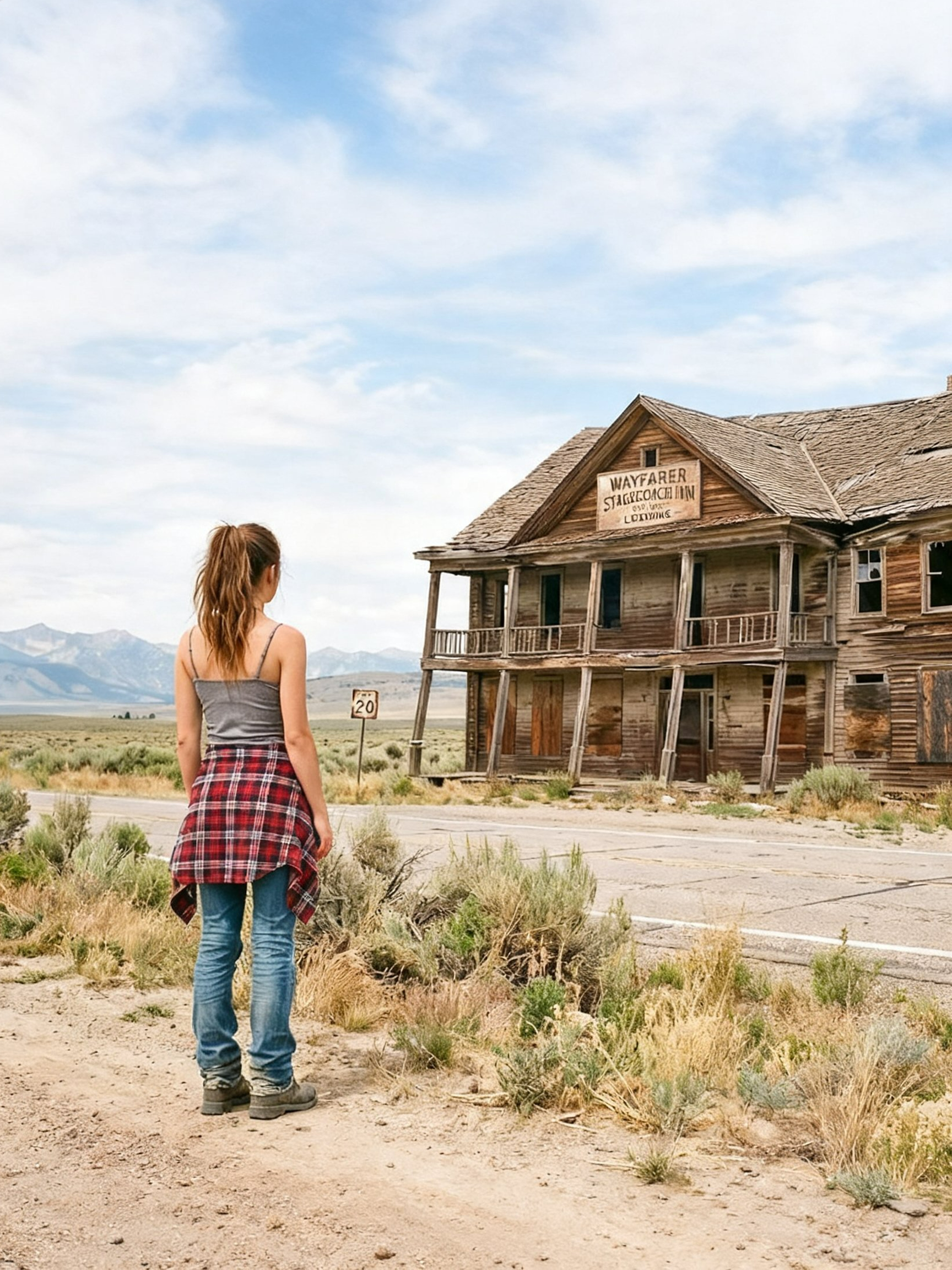
Homeless at 23, She Bought a $10 Stagecoach Inn—Then a Root Cellar Ledger Exposed the Family Who Stole Her Life
Three days after burying the grandmother she had cared for since high school, Lily Harper came home to find her clothes stuffed into black contractor bags on the porch.
Her uncle stood behind the screen door holding the deadbolt open with one hand.
“Don’t make this embarrassing,” he said. “You were living here because Mom needed help. Mom’s gone.”
Lily looked at the six garbage bags.
Then at Uncle Russell.
Then at the brass number 418 screwed crookedly beside the door she had painted herself two summers earlier.
She didn’t cry.
That seemed to bother him.
Russell Harper had prepared for tears.
He had prepared for pleading.
He had prepared for Lily to say she had nowhere to go.
What he had not prepared for was his twenty-three-year-old niece quietly bending down, picking up the smallest bag, and asking, “Where’s Grandma’s blue recipe box?”
Russell blinked.
Behind him, his wife Denise appeared in a cream sweater, gold bracelets clicking at her wrist.
“The blue recipe box,” Lily repeated. “From the kitchen cabinet above the refrigerator.”
Denise gave a sharp little laugh.
“We’re cleaning out junk, Lily. You don’t get to inventory the house.”
“I didn’t ask for the house.”
“You’re certainly not getting it.”
Lily finally looked at her.
“I asked about a recipe box.”
Something changed in Denise’s face.
Only for a second.
But Lily saw it.
That was the first thing she remembered later.
Not the garbage bags.
Not the humiliation.
Not even Russell’s hand on the door.
It was Denise’s eyes.
They moved left.
Toward the dining room.
“The box is gone,” Russell said.
Lily nodded.
“All right.”
That bothered him even more.
He stepped onto the porch.
“Your cousin Caleb is listing the place next week. We have contractors coming. Denise and I don’t need you hanging around acting like you have some claim here.”
Lily lifted another bag.
For nearly six years, she had organized her life around the woman whose house they were now telling her to leave.
She had skipped a semester when Eleanor Harper broke her hip.
She had taken night shifts at Patterson’s Grocery so she could drive Eleanor to cardiology appointments during the day.
She had learned how to flush a PICC line when infection put Eleanor in the hospital.
She had memorized medication schedules.
She had slept on the floor beside Eleanor’s bed during the last two weeks because the hospice mattress made a sound every time her grandmother stopped breathing for more than five seconds.
She had missed job interviews.
She had spent savings.
She had sold her car.
She had stayed.
She had stayed when Russell visited twice a month.
She had stayed when Denise sent flowers instead of showing up.
She had stayed when Caleb posted vacation pictures from Scottsdale while Eleanor asked whether he remembered the peach tree behind the barn.
She had stayed when everyone else decided love could be outsourced.
And now the people who had stayed away were standing in the doorway of the house she had kept warm through three Kentucky winters, telling her not to embarrass herself.
Lily tied the mouth of one torn trash bag into a knot.
“I’ll be out in twenty minutes.”
Russell’s expression tightened.
“You should understand something before you start telling people some sob story. Mom’s will was clear.”
“I haven’t seen the will.”
“You’re not entitled to see it.”
That was wrong.
Lily knew it immediately.
She did not say so.
Russell mistook silence for ignorance.
That became his second mistake.
“She left the property to her surviving children,” he continued. “That means me. Since Aunt Ruth died, practically everything is mine. Caleb will eventually get it through me. That’s how family property works.”
Lily lifted the final bag.
Denise folded her arms.
“You’re really going to do this?”
Lily looked at her.
“Act like some saint.”
For the first time, Lily smiled.
Not warmly.
Just enough to make Denise stop speaking.
“I’m taking my underwear off your porch, Denise. I don’t think sainthood is involved.”
Then Lily carried the bags to the rusted 2004 Chevy TrailBlazer she had borrowed from her coworker, Marcy.
Twenty-seven minutes later, she was homeless.
She had $412 in checking.
Eighty-three dollars in cash.
A cracked phone.
Two pairs of work shoes.
Her grandmother’s old winter coat.
And one thought she could not get rid of.
Denise had lied about the blue recipe box.
Lily slept that night in the TrailBlazer behind Patterson’s Grocery with the seat tilted back and the doors locked.
The following morning, she worked seven hours stocking canned vegetables.
She told no one what had happened.
At lunch, Marcy sat beside her on an upside-down milk crate behind the loading dock and watched Lily eat half a peanut butter sandwich.
“You didn’t go home last night.”
It was not a question.
Lily folded the sandwich wrapper.
Marcy was fifty-eight, broad-shouldered, loud, divorced twice, and almost impossible to lie to.
“I hate that man.”
“That makes two of us.”
“You can stay with me.”
“I’ve got the spare room.”
“My dachshund pees when he gets excited, but other than that the accommodations are respectable.”
Lily almost laughed.
“I’ll think about it.”
Marcy stared at her.
“That means no.”
“It means I need one day to figure something out.”
“What are you figuring out with four hundred dollars?”
Lily looked past the loading dock toward the courthouse dome visible above the roofs downtown.
“That depends.”
“Whether everybody else thinks something is worthless.”
At that afternoon, during her break, Lily walked six blocks to the Hawthorne County Administration Building.
She had been there before with her grandmother.
Mostly for tax bills.
Once for a deed copy.
Eleanor Harper believed in keeping paper.
“People become very imaginative,” she used to say, “when records disappear.”
Lily entered the property office and asked to see the county’s nuisance-property disposition list.
The clerk behind the counter, a narrow man with rimless glasses named Mr. Bell, looked at her over his monitor.
“You buying real estate?”
“I’m looking.”
“With cash?”
“Very little cash.”
That made him grin.
He turned the monitor.
“There are three properties in the rehabilitation program. Minimum transfer fee is ten dollars, but don’t let the number fool you. You assume responsibility for stabilizing the structure. They’re not gifts.”
Lily scanned the list.
A burned duplex.
A collapsing service station.
And a structure on Old Mill Road listed as:
1849 WILLOW BEND STAGECOACH INN.
She stopped.
The name was familiar.
Not because she had ever been there.
Because her grandmother had once mentioned it.
Years earlier.
Lily had been fourteen, sitting at Eleanor’s kitchen table while rain hit the windows.
Eleanor had been sorting photographs into envelopes.
One showed a long white building with a porch and six square columns.
“What’s that?” Lily had asked.
“Something your great-grandfather should never have sold.”
Then Eleanor slid the photograph into an envelope and refused to say more.
Lily leaned closer to the county screen.
“Why is this ten dollars?”
Mr. Bell sighed.
“Because the roof leaks, the electrical service is disconnected, the rear foundation needs work, and nobody has successfully owned it for more than five years without trying to give it back.”
“How much land?”
“Three point eight acres.”
“County cleared the delinquent taxes last year after condemnation proceedings. Transfer comes with preservation conditions because the original section is historic.”
“Any demolition order?”
“Not active.”
“Old well. Condition unknown.”
Lily stared at the photograph attached to the file.
The building looked exhausted.
Two stories.
Weathered clapboards.
Sagging porch.
A chimney leaning just enough to worry anyone with common sense.
Windows boarded.
Weeds waist high.
It was the kind of property sensible people drove past and thanked God they did not own.
Lily asked, “Can I see the parcel map?”
Mr. Bell printed it.
The property sat fifteen miles outside town near the edge of a new development corridor.
To the east was pasture.
To the west, a wooded ridge.
And directly north, across what had once been a creek crossing, sat approximately six hundred acres owned by Harper Land & Development LLC.
Lily’s finger stopped on the name.
Her uncle’s company.
Mr. Bell noticed.
“You know them?”
Lily folded the map.
“How long does the transfer take?”
“If you qualify for the rehab program, same day.”
Two hours later, Lily Harper bought the Willow Bend Stagecoach Inn for ten dollars.
She paid with a ten-dollar bill from her wallet.
Mr. Bell stamped three documents.
The county preservation officer handed her a packet thick enough to stop a door.
And at p.m., homeless Lily became the legal owner of a condemned stagecoach inn that had no electricity, questionable water, six broken windows, one dead raccoon under the porch, and a root cellar she did not yet know existed.
Marcy stared at the deed that evening.
“You bought a haunted building.”
“For ten dollars.”
“That does not make it less haunted.”
“It makes the ghosts affordable.”
Marcy lowered the deed.
“This is your plan?”
“It’s shelter.”
“It doesn’t have heat.”
“I have a sleeping bag.”
“It doesn’t have power.”
“I have lanterns.”
“It probably has murder.”
“That’s not listed in the county inspection.”
Marcy sighed.
Then she drove Lily out there.
The Willow Bend Stagecoach Inn sat at the end of a gravel lane under enormous sycamore trees.
Even ruined, it had presence.
The original front portion was brick hidden beneath later white siding.
The porch ran nearly the full length of the building.
Six upstairs windows looked down toward Old Mill Road like tired eyes.
A rusted iron sign hung from chains near the drive.
WILLOW BEND.
No other words remained.
Lily stood in the yard with the deed in one hand and her grandmother’s coat zipped to her chin.
She felt something she had not felt on Russell’s porch.
Not safety.
But ownership.
A strange, small island of it.
Marcy shone a flashlight at the roof.
“If this falls on you, I’m suing your estate.”
“My estate is thirty-seven dollars and half a sandwich.”
“I’ll take the sandwich.”
Inside, the inn smelled like wet wood, mouse droppings, plaster, and a century of closed rooms.
Their footsteps echoed across a wide center hall.
There was an old dining room to the left.
A parlor to the right.
The kitchen had been remodeled sometime around 1973 and then abandoned around 1998.
Upstairs, they found eight guest rooms.
One had a cast-iron bed frame.
Another had a claw-foot tub filled with fallen ceiling plaster.
At the rear of the first floor, Lily noticed a narrow door partly hidden behind warped shelving.
It opened onto stone steps.
Marcy immediately said, “No.”
Lily aimed her flashlight down.
Cold air rose from below.
“Root cellar.”
“Basement full of pioneer ghosts.”
“Root cellar.”
“We are using different words because you enjoy danger.”
Lily descended.
The walls were fieldstone.
The ceiling low.
Wooden shelves lined both sides, their boards black with age.
Mason jars lay shattered across the floor.
Near the back wall stood an old iron coal bin.
Nothing unusual.
Nothing valuable.
Nothing that explained why Eleanor Harper had remembered the building fifty years later.
Lily almost turned around.
Then her flashlight crossed a patch of mortar behind the coal bin.
Every stone wall around it was gray.
That rectangle was pale.
She stepped closer.
“What?” Marcy whispered.
Lily crouched.
The mortar line formed an almost perfect vertical seam.
Someone had filled in an opening.
Marcy saw it.
“Oh, absolutely not.”
Lily touched the stone.
Behind them, floorboards creaked upstairs.
Both women froze.
Another creak.
Then silence.
Marcy’s face changed.
They climbed the stairs quickly.
The inn was empty.
At least it appeared empty.
But the front door, which Lily was sure she had pulled shut, stood open three inches.
Cold evening air moved through the hall.
On the porch, gravel cracked under tires.
A black Ford F-150 disappeared around the bend.
Lily saw only the tailgate.
Marcy grabbed her arm.
“Someone was in here.”
Lily stared down the road.
“What do you mean no?”
“Someone wanted us to know they had been in here.”
That night Lily did not sleep at Willow Bend.
She slept at Marcy’s.
At the next morning, she bought two battery trail cameras from a farm supply store with money she could barely afford to spend.
At , she returned to the inn.
She photographed every door.
Every window.
Every footprint.
Then she mounted one camera facing the driveway and another in the center hallway behind a loose piece of molding.
Only after that did she begin moving the coal bin.
It took forty minutes.
Behind it was the patched section of wall.
Lily did not smash it.
That would have been satisfying.
It also would have destroyed evidence if evidence existed.
Instead, she removed loose mortar with a screwdriver.
Stone by stone.
By noon, there was an opening eighteen inches wide.
She shone a flashlight through.
Something reflected back.
Lily enlarged the opening.
Beyond the wall was a space no wider than a closet.
Inside sat an iron document box.
Green-black with rust.
Its lid bore a faded manufacturer’s plate from Cincinnati.
Lily pulled it out.
There was no lock.
Inside, wrapped in waxed cloth, were four leather-bound ledgers.
A stack of letters.
A brass key.
Several folded survey maps.
And a blue wooden recipe box.
Lily stopped breathing.
She knew the chipped corner.
She knew the white flower painted badly on the lid.
She had seen it above her grandmother’s refrigerator almost every day for sixteen years.
For several seconds Lily did not touch it.
Then she sat on the cellar floor.
Her hands remained steady.
That scared her more than shaking would have.
She opened the box.
There were no recipes.
The first envelope said:
The handwriting belonged to Eleanor Harper.
Lily had seen it on birthday cards.
Grocery lists.
Medication charts.
Notes tucked into lunch bags.
She opened the letter.
If you are reading this, then Russell either lied to you, rushed the probate, or both.
Do not confront him.
Do not confront Denise.
Do not tell Caleb anything.
Do not take these papers to an attorney chosen by anyone in the Harper family.
Photograph everything before removing anything.
The inn is not the inheritance.
What the inn controls is.
And if they have already started construction north of Old Mill Road, time matters.
There was another line below it, underlined twice.
The dead cannot testify, sweetheart.
Records can.
Lily read it again.
Then a third time.
Her phone rang upstairs.
She let it ring.
She pulled out the first ledger.
The cover was stamped 1948–1963.
Inside were handwritten entries concerning water usage, road maintenance, easements, rents, timber sales, and something called the Willow Bend Holding Trust.
The second ledger covered 1964–1988.
The third, 1989–2007.
The fourth was almost empty.
Only twelve pages had been used.
The final entry was dated four months earlier.
Written by Eleanor.
Russell asked again about the north acreage.
He believes the 1996 transfer extinguished Willow Bend rights.
It did not.
M.P. says original instrument controls.
If Russell files development financing without disclosing the spring covenant, lender will have a problem.
Lily read the line twice.
Then she unfolded the survey maps.
One showed the inn parcel.
One showed her uncle’s six hundred acres.
And through the center of both, in blue pencil, ran a line marked:
WILLOW SPRING WATERCOURSE AND ACCESS COVENANT — 1871.
Her phone rang again.
This time she climbed upstairs.
She answered.
His voice was too casual.
“Where are you?”
Lily looked at the cracked plaster around her.
Russell said, “Denise heard you bought that old dump on Old Mill Road.”
Lily said nothing.
“I’m here.”
“Why would you do something that stupid?”
“It was ten dollars.”
“That place is condemned.”
“It’s not safe.”
“I’ll be careful.”
Then Russell’s tone changed slightly.
“You need to give it back.”
There it was.
Too certain.
Lily walked to the front window.
Across the road, fifty yards beyond the ditch, a white SUV sat under bare trees.
She could not see the driver.
“Because I’m trying to help you.”
“You threw my clothes onto a porch four days ago.”
“Don’t be dramatic.”
“Willow Bend is worthless.”
“Then why do you care?”
A short silence.
But not empty.
Lily could almost hear him calculating.
“Because Caleb’s project is nearby,” he finally said. “We don’t need some unstable structure attracting trespassers.”
“Caleb’s project?”
“Mixed-use development.”
“None of your business.”
“All right.”
Another pause.
“You sound strange,” Russell said.
“How should I sound?”
Lily looked down at Eleanor’s letter.
“I’ve been busy.”
Russell exhaled.
“Look, I’ll give you five thousand for the property.”
Lily did not answer immediately.
Yesterday he had thrown her out with everything she owned stuffed into trash bags.
Today he was offering five thousand dollars for a ten-dollar ruin.
The inn was not the inheritance.
What the inn controls is.
Lily asked, “Why five?”
“Because I’m family.”
That almost made her laugh.
Instead she said, “I’ll think about it.”
“Don’t take too long.”
After the call, Lily photographed every page in the box.
Then she drove forty miles to Lexington.
Not Hawthorne.
Not anyone who played golf with Russell.
Not anyone whose children attended school with Caleb.
She walked into the office of Merritt, Cole & Vaughn carrying copies only.
The originals stayed locked inside a safety deposit box she rented that morning at a bank where no Harper had an account.
The attorney who met her was seventy-one years old, wore a brown suit, and listened without interrupting.
His name was Gabriel Merritt.
Lily placed Eleanor’s letter, the covenant map, and three deed copies on his desk.
He read for nearly twenty minutes.
Finally, he removed his glasses.
“Who told you the inn was worthless?”
“My uncle.”
“Why good?”
“Because that means he may not know what you found.”
Lily leaned forward.
“What did I find?”
Merritt touched the 1871 covenant.
“Possibly the most expensive ten-dollar property in Kentucky.”
Lily’s face did not change.
Merritt looked at her carefully.
“That doesn’t excite you?”
“It worries me.”
“Better instinct.”
He pushed the map toward her.
“Willow Bend was not simply an inn. It was a stage stop built around the only reliable spring between two ridges. In 1871, the Harper family acquired the surrounding land, but the inn remained separate.”
“So the family created a permanent covenant. Any parcel north of the creek using Willow Spring water, the carriage road, or later infrastructure built along that route owed annual compensation to the inn property.”
Lily frowned.
“Annual rent?”
“Essentially.”
“How much?”
“Originally pennies per acre.”
“That doesn’t sound expensive.”
“It isn’t.”
Merritt tapped a paragraph.
Lily read it.
In the event of commercial subdivision, industrial use, resort operation, or transfer to an entity not majority owned by descendants of Samuel Harper, consent of the Willow Bend titleholder shall be required for use of spring, road, drainage channel, and subsurface conduit corridor.
Lily looked up.
“My uncle owns the north acreage.”
“Through an LLC.”
“Does that count?”
“Depends on ownership.”
“It’s him and Caleb.”
“Then possibly not. But we need records.”
“What happens if he develops without consent?”
Merritt leaned back.
“That depends on what he has built.”
Lily thought of Eleanor’s note.
“And if construction has already started?”
“Then your uncle may have a spectacular problem.”
Within forty-eight hours, Merritt’s title investigator found it.
Harper Land & Development no longer belonged primarily to Russell Harper.
Two years earlier, he had sold sixty-two percent of the company to Blackridge Capital Partners to finance Caleb’s development project.
The project had a name.
Cedar Glen Resort & Village.
Three hundred luxury homes.
An eighteen-hole golf course.
Retail space.
Artificial lakes.
Equestrian facilities.
Projected value after completion:
Forty-eight million dollars.
And every approved utility plan depended on three things crossing or originating from Willow Bend rights.
The historic spring system.
The original access corridor.
And a drainage easement passing beneath the inn’s three-point-eight acres before emptying into the creek.
Lily stared at the financing documents Merritt had printed.
“Does Russell know?”
Merritt folded his hands.
“That you own the controlling parcel?”
“He knows I own the inn.”
“That isn’t what I asked.”
Lily understood.
“Does he know the inn still has these rights?”
“Your grandmother believed he thought they were extinguished in 1996.”
“Were they?”
“Because the 1996 deed attempted to extinguish them without the signature of the Willow Bend titleholder.”
“Who owned Willow Bend in 1996?”
Merritt looked at her.
“Your mother.”
Lily did not move.
Her mother, Caroline Harper, had died when Lily was seven.
Russell had always told Lily that Caroline left nothing.
No savings.
No property.
No life insurance.
Nothing but unpaid medical bills and a storage unit full of clothes.
Lily remembered Russell saying it at the funeral reception.
Your mom lived hard, sweetheart. There’s nothing to fight over.
Lily’s voice became very quiet.
“My mother owned Willow Bend?”
“For eleven months.”
“We’re still tracing that.”
“And after she died?”
“That is where this becomes interesting.”
Merritt turned a page.
“Her estate should have passed the property interest to you.”
“Should have?”
“You were seven. Your legal guardian managed the estate.”
Lily already knew the answer.
“What happened?”
“The inn disappeared from the probate inventory.”
That was the first moment Lily’s fingers tightened.
Just enough to crease the paper.
Merritt noticed.
“He didn’t sell it?”
“He didn’t transfer it?”
“No recorded transfer that I can find.”
“Then how did the county end up with it?”
“Tax delinquency.”
“Who was getting the tax bills?”
Merritt slid another document across the desk.
“Your guardian.”
For sixteen years, Lily had believed her mother left her nothing.
For sixteen years, Russell had watched the tax bills arrive for property Lily legally owned.
For sixteen years, he had let the debt grow until the county seized it.
Then, when Lily unknowingly bought her own lost inheritance back for ten dollars, he offered her five thousand to surrender it.
Lily stared at the photocopy.
Merritt said, “I want you to understand something.”
She looked up.
“This is no longer a family argument.”
“No confrontation. No threats. No social media posts. No dramatic meeting where you tell him what you found.”
“I wasn’t planning one.”
“What are we planning?”
Merritt almost smiled.
Lily returned to Hawthorne County and acted poor.
That part was easy.
She still stocked shelves.
Still borrowed Marcy’s TrailBlazer.
Still wore her grandmother’s old coat.
Still carried lunch in a grocery sack.
At Willow Bend, she replaced broken locks and covered the worst section of roof with tarps.
Russell drove past twice.
Caleb drove past once.
Denise sent a text.
Russell says you’re being stubborn. If you want a fresh start, take the $5,000 and stop making problems.
Lily replied:
I’m thinking about it.
That sentence bought her five days.
Five very useful days.
During those five days, Merritt subpoenaed nothing.
Filed nothing.
Threatened no one.
Instead, they gathered public records.
Planning commission minutes.
Utility applications.
Loan documents.
Environmental reports.
Survey revisions.
Construction contracts.
And one particularly important document signed by Russell eight months earlier.
CERTIFICATION OF UNENCUMBERED WATER AND ACCESS RIGHTS.
He had certified to Blackridge Capital, a regional bank, and the county planning commission that Harper Land & Development possessed undisputed control of all necessary water and access rights for Cedar Glen.
It did not.
Worse, Eleanor’s ledger showed Russell had asked about the covenant before signing the certification.
Meaning he may not merely have been wrong.
He may have known.
Lily read that page in Merritt’s office.
“My grandmother knew what he was doing.”
“She suspected.”
“Why didn’t she stop him?”
Merritt looked at Eleanor’s letter.
“Maybe she was trying.”
The blue recipe box contained fourteen letters.
Most were mundane.
One was not.
It had been written nine days before Eleanor died.
Russell will tell you I favored you because you took care of me.
That is not why.
I protected what should have been yours because nobody protected Caroline.
I made a mistake after your mother died.
I believed Russell when he said he would manage things until you were older.
By the time I understood what he had done, I was already sick and he had already built relationships with the bank, the county office, and the people who should have been asking questions.
Willow Bend was your mother’s.
Not Russell’s.
But if I simply told you that, Russell would move faster than you could.
So I waited for the county to take it.
Then I made sure the minimum transfer remained ten dollars.
Lily lowered the letter.
For the first time since Eleanor’s funeral, tears reached her eyes.
She did not sob.
She did not collapse.
She sat alone in the old stagecoach dining room with sunlight coming through plywood gaps and pressed two fingers against her lips.
Her grandmother had watched the county seize Lily’s inheritance.
On purpose.
Not to destroy it.
To wash away the tax complications and place it where Russell would not think to look until someone bought it.
Someone Eleanor trusted to remember an old photograph.
Someone Eleanor knew had very little money.
Someone who might see ten dollars and ask why.
Lily looked around the ruined inn.
“You sneaky old woman,” she whispered.
Then she laughed once through the tears.
The sound echoed through the empty room.
That afternoon, Russell arrived.
Not called.
He stepped from a black Range Rover in polished boots and a navy coat.
Caleb got out of the passenger side.
At twenty-nine, Caleb had Russell’s narrow eyes and Denise’s habit of smiling before saying something cruel.
Lily was repairing a porch board.
Russell looked at the hammer in her hand.
“You really intend to live here?”
Caleb laughed.
Lily drove the nail flush.
Caleb walked toward the porch.
“You know we’re building next door.”
“Then you know this building is a liability.”
“To property values.”
Lily stood.
Russell said, “We came to settle this.”
“Settle what?”
“I’ll give you fifteen thousand.”
Caleb looked annoyed.
Clearly he had not wanted Russell to go that high.
Lily wiped sawdust from her jeans.
“For the inn?”
“For everything.”
“What’s everything?”
“The property. Structures. Appurtenant rights. Whatever junk comes with it.”
Not just the inn.
Appurtenant rights.
Lily kept her face blank.
Caleb pulled an envelope from his coat.
“We already had the paperwork drawn.”
Lily took it.
She read the first page.
Quitclaim deed.
Broad waiver.
Release of all known and unknown claims.
Assignment of water, access, easement, mineral, drainage, and development rights.
Maybe not everything.
But they knew enough.
Lily folded the paper.
“I’d like someone to look at this.”
Caleb’s smile disappeared.
“You need a lawyer for fifteen grand?”
Russell raised one hand.
“Lily, don’t waste money you don’t have. This is straightforward.”
“My grandmother always told me to read papers.”
Russell’s jaw shifted.
“Your grandmother was confused near the end.”
Lily looked at him.
He realized too late what he had said.
“She had moments.”
“The hospice nurse didn’t think so.”
“I’m not arguing with you about this.”
That quiet okay.
Russell stepped closer.
“You have until Friday.”
“Before what?”
“Our offer expires.”
Lily glanced at Caleb.
“And then?”
Caleb answered.
“Then you’ll wish you took it.”
Russell turned toward him.
A warning look.
Lily saw that too.
She nodded.
They left believing they had frightened her.
By Thursday afternoon, Cedar Glen’s lender had received a notice from Gabriel Merritt.
Not a lawsuit.
A title impairment notice.
It contained three pages.
The 1871 covenant.
The unbroken chain of title.
And Russell’s signed certification of unencumbered rights.
At Friday morning, heavy equipment stopped moving at Cedar Glen.
At 10:03, the bank froze the next construction draw.
At 10:47, Blackridge Capital called an emergency meeting.
At 11:20, Caleb called Lily eleven times.
She did not answer.
At 11:43, Russell arrived at Willow Bend so fast gravel sprayed across the yard.
Lily was inside stripping wallpaper.
He came through the front door without knocking.
“You filed a claim.”
Lily kept scraping.
Russell’s face was red.
“Did you hear me?”
“You knew.”
Lily peeled away a long strip of faded wallpaper.
“Knew what?”
“Don’t play games.”
She turned.
“You told me the inn was worthless.”
Russell stared at her.
“You had no idea those rights existed.”
“Who told you?”
Lily set down the scraper.
“You’re standing inside my house.”
For the first time, Russell seemed to notice where he was.
Not the ruined plaster.
Not the old floor.
The legal boundary.
He lowered his voice.
“This can still be handled privately.”
“What can?”
“You’re twenty-three, Lily. You don’t understand what you’re interfering with.”
“Explain it.”
“Cedar Glen isn’t some little family deal. There are investors. Contractors. Families depending on jobs.”
Lily almost admired the speed with which he found morality when money was in danger.
“My grandmother depended on me,” she said.
“That has nothing to do with this.”
“My mother depended on you too.”
Russell stopped.
Lily watched his eyes.
He looked toward the hallway.
Then toward the rear of the building.
“Where did you find it?”
Lily’s pulse changed.
She kept her voice calm.
“Find what?”
Russell did not answer.
That was enough.
He knew something had been hidden at Willow Bend.
Maybe not the box.
Maybe not the ledgers.
But something.
He backed toward the door.
“You need to be careful with old documents.”
“People misunderstand things.”
“Did Mom misunderstand owning this place?”
Russell’s face went still.
Lily had not planned to reveal that.
But now it was out.
Russell stared at her for nearly five seconds.
Then he smiled.
It was the coldest expression Lily had ever seen on a relative.
“So that’s where we are.”
“Where are we?”
“You found Caroline’s paperwork.”
Lily said nothing.
He continued.
“Your mother was sick, unstable, and buried in debt.”
“She owned Willow Bend.”
“Temporarily.”
“She died owning it.”
“That does not mean you understand what happened afterward.”
“You were guardian of her estate.”
“And of you.”
Something in the room shifted.
Russell seemed to realize Lily was no longer asking questions because she needed answers.
She was watching what he did with the questions.
He straightened his coat.
“Fifteen thousand is withdrawn.”
“I assumed.”
“And if you interfere with Cedar Glen, the investors will bury you in litigation until you’re forty.”
Lily picked up the wallpaper scraper.
“Then I should get back to work.”
He stood there another moment.
That night, one of Lily’s trail cameras captured Caleb entering Willow Bend at a.m.
He wore gloves.
He carried a pry bar.
He went straight to the root cellar.
The document box was already gone.
Lily had removed it days earlier.
The camera recorded Caleb tearing apart shelves, kicking loose stones, pulling the coal bin forward, and making three phone calls.
At , he left.
At , Lily called Merritt.
At , she sent the footage to cloud storage.
At , Merritt called the county sheriff.
Caleb was not arrested immediately.
That disappointed Marcy.
“It’s breaking and entering.”
“It’s evidence,” Lily said.
“It can be both.”
“The sheriff wants more.”
Marcy slammed a coffee mug onto the counter.
“I hate patient people.”
“So does Russell.”
By Monday, the conflict was no longer private.
Construction workers had been sent home.
Subcontractors demanded payment assurances.
A local business reporter discovered the title dispute.
Then someone leaked that Cedar Glen’s controlling access covenant was owned by a twenty-three-year-old grocery worker who bought the parcel for ten dollars.
The story went everywhere locally.
The comments were predictable.
Gold digger.
Opportunist.
Smart girl.
Caleb posted a statement calling the dispute “a misunderstanding involving archaic historical documents.”
Russell told a radio host the family hoped to resolve matters “compassionately.”
Lily said nothing.
That silence drove them insane.
Three days later, Denise came to Patterson’s Grocery.
Lily was stocking pasta sauce.
Denise appeared at the end of aisle seven wearing sunglasses indoors.
“You’re enjoying this.”
Lily placed another jar on the shelf.
“Don’t lie.”
“You’ve humiliated Russell.”
Lily turned.
“Did he tell you I bought Willow Bend by accident?”
Denise’s mouth tightened.
“I don’t know what you mean.”
“The blue recipe box.”
All the color left Denise’s face.
There it was again.
That tiny reaction.
The one Lily had remembered from the porch.
Denise whispered, “You found it.”
Lily did not answer.
Denise grabbed the edge of the shopping cart beside her.
“Listen to me. Eleanor was angry. She wrote things when she was angry.”
“What things?”
“Things that weren’t true.”
“Which things?”
Denise caught herself.
Lily waited.
Customers pushed carts past them.
A child cried near the cereal aisle.
The fluorescent lights hummed.
Denise lowered her voice.
“Russell made mistakes.”
“That sounds expensive.”
“He raised you.”
“No. Grandma raised me.”
“He paid bills.”
“Grandma’s bills?”
“Family bills.”
“With money from where?”
Denise stepped closer.
“You think you’re smarter than everyone because some old deed fell into your lap?”
“You think that ruin makes you powerful?”
“Then what do you think?”
Lily slid one final jar onto the shelf.
“I think you came to my workplace because you’re scared.”
Denise’s eyes hardened.
“You have no idea what this could cost.”
“I’m starting to.”
Denise left without buying anything.
That afternoon, Merritt found the second major piece.
The Willow Bend covenant was valuable.
But Eleanor’s ledgers pointed to something larger.
For decades, income collected from north-side water and road users had been placed into the Willow Bend Holding Trust.
In 1998, one year after Caroline’s death, almost $640,000 disappeared from that trust.
The account was closed.
The money was transferred through two entities.
One eventually became the seed capital for Harper Land & Development.
Russell’s company.
Lily read the records in Merritt’s office.
“So he took the trust.”
“Allegedly.”
“Don’t lawyer me.”
Merritt sighed.
“The documents strongly suggest he diverted trust assets.”
“How much would that be now?”
“If invested properly?”
“Several million.”
Lily leaned back.
She felt no rush of greed.
No fantasy of cars.
No mansion.
No revenge vacation.
She pictured Eleanor counting quarters at the kitchen table.
She pictured Caroline’s hospital bills.
She pictured herself at seventeen handing Russell her grocery wages because he said Grandma’s furnace repair had “hit everyone hard.”
The money had always existed.
Just not for them.
Merritt watched her.
She looked up.
“I don’t want a settlement that lets him call this a paperwork mistake.”
“I want the trust accounted for.”
“I want every dollar traced.”
“And if the money bought Cedar Glen land?”
Merritt paused.
“Then this becomes much bigger.”
The following month was a slow demolition of everything Russell had assumed no one would ever inspect.
Bank records.
Probate files.
Trust statements.
Company formations.
Loan applications.
Tax records.
Emails obtained after litigation began.
The system around Russell had not been one villain.
It had been a network of people who benefited from not looking too closely.
A former probate attorney who accepted incomplete inventories.
A banker who processed trust transfers into Russell’s company.
A county assessor who repeatedly mailed Willow Bend tax notices to Russell even after Lily turned eighteen.
A surveyor who redrew Cedar Glen’s development map without showing the 1871 covenant.
A consultant who wrote “water rights confirmed” despite never obtaining a title opinion from the Willow Bend parcel.
None of them twirled a mustache.
None confessed.
They used softer language.
Clerical assumption.
Legacy record discrepancy.
Family understanding.
Administrative continuity.
Always mistake.
Never theft.
Never fraud.
Never a child’s inheritance quietly converted into seed capital.
Then came mediation.
Russell arrived with three attorneys.
Caleb arrived with two.
Blackridge Capital sent counsel.
The bank sent counsel.
The county sent counsel.
Lily arrived with Merritt and a yellow legal pad.
Russell looked older.
Caleb looked furious.
The mediator, a retired judge named Helen Dawes, spent four hours moving between rooms.
The first offer was $600,000.
Lily declined.
The second was $1.4 million plus the inn.
The third was $2.8 million, the inn, and a confidentiality agreement.
Lily read the offer.
Then asked one question.
“Does this restore the trust?”
Merritt relayed it.
The answer came back.
Lily declined.
At six that evening, Russell asked for a face-to-face meeting.
Merritt advised against it.
Lily agreed anyway.
They sat across from each other in a conference room.
No family photographs.
No childhood.
Just glass walls and legal pads.
Russell folded his hands.
“You’ve made your point.”
Lily said nothing.
“You proved you’re not stupid.”
Still nothing.
“You proved Mom hid things from me.”
Lily’s eyes lifted.
Russell immediately realized the wording was wrong.
He corrected himself.
“Documents. She hid documents.”
Lily asked, “Why did Mom own Willow Bend?”
He looked toward his lawyers.
No one spoke.
“She bought it.”
“With what money?”
“I don’t remember.”
“You were executor.”
“Guardian.”
“Both, for part of the estate.”
“I handled dozens of things.”
“My mother was your sister.”
His jaw tightened.
“You have this fantasy that Caroline was some innocent victim. She wasn’t. She had problems.”
“What problems?”
“She trusted people she shouldn’t.”
Lily held his gaze.
“Like you?”
Caleb shoved his chair backward.
“That’s enough.”
Lily didn’t look at him.
Russell raised one hand.
Then said quietly, “Your mother wanted to stop the family development plans.”
There it was.
Not a confession.
“She thought the spring and road should stay local.”
“She didn’t want subdivisions.”
“Why did that matter?”
“Because she was sentimental.”
Lily looked at the lawyers.
Then back at Russell.
“What happened to the trust money?”
His expression changed.
But enough.
“I don’t know what you’re talking about.”
Lily nodded once.
Then closed her legal pad.
Russell leaned forward.
“Take the money.”
“You have never had money in your life.”
“Three million dollars changes everything for you.”
“It changed everything for you too.”
The room went silent.
Lily stood.
Russell said, “Think carefully.”
She gathered her papers.
He tried once more.
“You could walk out of here rich.”
Lily looked at him.
“I walked into this poor.”
“That’s exactly my point.”
“No,” she said. “It’s mine.”
Then she left.
Two weeks later, the bank demanded full disclosure of Cedar Glen’s title defects.
Three weeks later, Blackridge Capital accused Russell of misrepresentation.
Four weeks later, the construction lender declared a default.
Caleb blamed Lily publicly.
The comments online turned uglier.
She ignored them.
At Willow Bend, she kept working.
Marcy helped scrub the upstairs walls.
Volunteers from the county historical society helped stabilize the porch.
A retired carpenter named Sam Whitaker replaced two rotted beams for almost nothing after hearing the story.
“You know why I’m helping?” he asked.
“Because you hate crooked floors?”
“My mother cleaned houses for people who treated her like furniture.”
He hammered a bracket into place.
“People like that count on quiet people staying quiet.”
Lily looked at him.
“I’ve been pretty quiet.”
Sam smiled.
Then the forensic accounting report arrived.
The original $640,000 trust transfer had not simply funded Harper Land & Development.
It had purchased 311 acres.
Those acres later became the core of Cedar Glen.
Over two decades, Russell leveraged them repeatedly.
Refinanced.
Sold portions.
Borrowed against appreciation.
Bought adjacent tracts.
The company’s current assets tied to that original transaction exceeded $19 million.
Merritt put the report on the old dining room table at Willow Bend.
Lily read the number.
Then the methodology.
Then the appendices.
Finally, she said, “What happens now?”
Merritt answered carefully.
“We amend the complaint.”
“For nineteen million?”
“For restoration of traceable trust assets, profits, interest, and equitable remedies.”
“We ask the court to give back what grew from what was taken.”
Lily looked toward the window.
Across Old Mill Road, Cedar Glen’s unfinished entrance monument stood wrapped in plastic.
For months, Russell had believed the worst possible outcome was paying Lily for an easement.
He had been wrong.
The easement was the match.
The trust was the fuel.
The hearing took place in June.
The courtroom was full.
Reporters occupied the rear benches.
Russell sat beside counsel.
Caleb behind him.
Denise wore pearl earrings and stared straight ahead.
Lily sat with Merritt.
When the judge entered, everyone stood.
The hearing lasted five hours.
No movie speeches.
No sudden confession.
Just records.
That was Eleanor’s revenge.
A canceled trust check.
A probate inventory.
A county notice.
A company deposit slip.
A covenant.
An email from Russell to Caleb:
Need Willow parcel resolved before Blackridge asks old-title questions.
An older email from Caleb:
Thought county already took it.
Yes. But transfer rights may survive. Do not discuss with investors until counsel confirms.
Then another, three days later:
Proceed as planned.
That email destroyed the “honest mistake” defense.
At p.m., the judge entered a preliminary order freezing transfers of the Cedar Glen core acreage pending trial.
The lender immediately moved to protect its position.
Blackridge Capital suspended Russell from management.
Caleb was removed from the project.
Outside the courthouse, microphones surrounded Lily.
One reporter shouted, “How does it feel to take nineteen million dollars from your family?”
Lily stopped.
She turned.
“It isn’t theirs yet.”
Then she walked down the courthouse steps.
That eight-second clip spread farther than anything else.
Three months later, Russell settled.
Not because he became sorry.
Because his insurers denied part of his defense.
Because Blackridge sued him separately.
Because the bank referred documents to regulators.
Because Caleb’s lawyers advised him to obtain independent counsel.
Because Denise filed for separation.
Because systems built on silence become fragile when everyone begins protecting themselves at once.
The settlement restored the Willow Bend Holding Trust.
Russell surrendered his ownership interest in the Cedar Glen core acreage.
Several parcels were sold under court supervision.
Lily did not personally receive nineteen million dollars.
That surprised people.
She could have pushed for more individual damages.
Instead, the trust was rebuilt under independent management.
Its purpose, based on the original documents and a new court-approved structure, was restored.
Preserve Willow Spring.
Protect the historic inn.
Maintain public access to a section of the old stage road.
And fund emergency housing assistance for young adults aging out of foster care or facing sudden family displacement in Hawthorne County.
Marcy cried when Lily told her.
Lily didn’t.
“What?” Marcy demanded. “You can’t even give me one tear?”
Lily smiled.
“I’m tired.”
“You turned your evil uncle’s land scheme into a homeless youth fund.”
“He helped.”
“He did not help.”
“He provided the assets.”
Marcy laughed so hard she had to sit down.
Lily kept Willow Bend.
Not as a mansion.
Not as some revenge palace.
She restored six upstairs rooms.
The old dining room became a community room.
The kitchen was rebuilt.
The porch straightened.
The original brick was exposed beneath the siding.
One guest room remained intentionally simple.
A lock on the door.
A note inside the desk drawer.
If someone made you feel disposable, that says something about them.
Stay tonight.
Make your plan tomorrow.
One year after Russell threw Lily’s belongings onto the porch, Willow Bend reopened.
No champagne tower.
No wealthy donors posing beneath banners.
Just neighbors.
Historical volunteers.
Mr. Bell from the county property office.
And eleven young people who had used emergency grants from the restored trust during its first three months.
Lily stood beneath the original iron sign outside.
Someone had repainted the words.
WILLOW BEND STAGECOACH INN — 1849.
Marcy nudged her.
“You know what’s funny?”
“Russell could’ve let you keep Grandma’s spare bedroom.”
Lily looked toward the road.
“Would’ve been cheaper.”
“A lot cheaper.”
They both laughed.
For the first time, the laughter did not hurt.
Russell eventually pleaded to a reduced financial charge connected to false lender certifications.
He avoided prison but paid restitution and lost the company he had spent decades building.
Caleb moved to Florida.
Denise sold the house at 418 and left Hawthorne County.
Lily never went back.
She did ask Merritt to recover one thing before the sale.
Eleanor’s kitchen table.
It now stood in Willow Bend’s dining room.
Scratches and all.
On a cold November morning, nearly eighteen months after Lily bought the inn, she sat at that table reviewing invoices.
Rain tapped the windows.
The building smelled of coffee and old wood.
A nineteen-year-old named Brooke was sleeping upstairs after arriving the previous night with two duffel bags and nowhere safe to go.
Lily was halfway through an insurance form when someone knocked.
A man stood on the porch.
Late sixties.
Gray beard.
Canvas jacket.
He held a long cardboard document tube.
“You Lily Harper?”
“Name’s Thomas Vail.”
She waited.
“I worked survey crews in this county thirty years ago.”
Lily’s pen stopped.
“What can I do for you?”
He glanced toward Old Mill Road.
“Probably nothing.”
“Then why are you here?”
Thomas looked uncomfortable.
“Because Eleanor Harper told me if Russell ever lost control of Cedar Glen, I should bring you this.”
Lily opened the door wider.
“My grandmother spoke to you?”
“The last time was six weeks before she died.”
Thomas placed the document tube on the table.
Lily did not open it yet.
“Why wait eighteen months?”
“Because she gave me a condition.”
“What condition?”
“She said not to come until the trust was restored and the north land was out of Russell’s hands.”
Lily felt the old sensation return.
The one from the root cellar.
A room changing temperature even though the air had not moved.
“What’s in the tube?”
“I don’t know.”
“You didn’t look?”
“Eleanor paid me not to.”
“That sounds like Grandma.”
Thomas gave a nervous smile.
Then he turned to leave.
Lily stopped him.
“Mr. Vail.”
He looked back.
“Did my grandmother tell you why?”
His smile disappeared.
Lily waited.
Thomas looked toward the ceiling, as though deciding whether breaking a promise to a dead woman carried consequences.
Finally he said, “She told me Willow Bend was never the valuable part.”
Lily’s pulse slowed.
“She said the same thing in her letter.”
Thomas shook his head.
“No. I mean the land either.”
Lily stood in the dining room staring at the cardboard tube.
Outside, his truck disappeared through the rain.
Marcy arrived twenty minutes later carrying two coffees and found Lily still standing beside the table.
“What happened?”
Lily pointed.
Marcy saw the tube.
“You don’t even know what it is.”
“I know that look.”
“What look?”
“The root-cellar look.”
Lily pulled off the plastic cap.
Inside were three rolled sheets.
One was a survey map dated 1978.
One was an engineering cross-section.
And one was a photocopy of a federal land record stamped:
CONFIDENTIAL — MINERAL AND SUBSURFACE RESERVATION REVIEW.
Marcy leaned over Lily’s shoulder.
“What am I looking at?”
“I don’t know.”
Lily spread the survey flat.
Willow Bend sat in the center.
Cedar Glen to the north.
The stage road.
The spring.
All familiar.
Then she saw a set of dotted lines beginning under the ridge west of the inn and running beneath nearly nine hundred acres.
Beside them, someone had written:
HARBOR VEIN — DO NOT INCLUDE IN FAMILY TRANSFER.
Marcy whispered, “Vein?”
Lily opened the engineering sheet.
Core samples.
Depth measurements.
Concentrations.
She did not understand most of the abbreviations.
But she understood the dates.
And she understood one handwritten name at the bottom.
Caroline Harper.
Her mother.
The final paper was not a deed.
It was a letter.
Not from Eleanor.
From Caroline.
Dated six months before her death.
If Russell learns why I bought Willow Bend, he will try to control Lily through me.
The spring rights are useful, but they are not the reason.
The geological report confirms Granddad was right.
Do not let Russell sell the west ridge.
Do not let him lease it.
Do not let him know the federal file number.
If anything happens to me, the original sample records are where Samuel hid the coach payroll during the war.
Lily stopped.
Marcy read the sentence again.
“Coach payroll?”
Lily looked toward the rear hallway.
Toward the root-cellar door.
They had dismantled the false wall eighteen months ago.
They had found Eleanor’s box.
They had restored the shelves.
They had repaired the stones.
They had assumed that was the hiding place.
Lily read her mother’s final line.
There are two cellars at Willow Bend.
Marcy slowly set down her coffee.
Lily was already moving.
They descended the stone stairs.
The restored root cellar smelled of earth and cedar shelving.
Lily switched on the lights.
One cellar.
Stone walls.
The patched cavity where Eleanor’s box had been hidden.
She unfolded the 1978 survey.
A tiny square was drawn beneath the original kitchen.
Not the rear cellar.
The front half of the inn.
Marcy whispered, “There’s nothing under the kitchen.”
Lily looked at the floor above them.
Then at the map.
Then at the brass key from Eleanor’s document box, which she had kept for eighteen months without ever finding a lock it fit.
The key suddenly felt much heavier in her pocket.
They went upstairs.
Moved the kitchen worktable.
Rolled back the new rug.
The restored floorboards looked ordinary except for one thing Lily had never noticed.
Four boards near the original hearth were shorter than the rest.
Ran her hand along the seam.
Found iron.
A recessed ring blackened by age.
Marcy said, “Lily.”
Lily pulled.
The boards did not move.
Then she saw a small brass keyhole inside the ring plate.
Her hand went into her pocket.
The old key slid in perfectly.
A metal latch released beneath the floor.
Marcy backed away.
Lily lifted the hidden hatch.
Cold air rose from darkness.
Stone steps disappeared beneath the kitchen.
Not toward the first root cellar.
The opposite direction.
Toward the west ridge.
Lily shone her flashlight down.
At the bottom stood a steel door.
Far newer than the inn.
Someone had painted three letters across it decades ago.
And beneath them, scratched by hand into the paint, was her mother’s name.
Marcy stared at Lily.
“Call Merritt.”
“Before we open that.”
Neither woman moved.
Then Lily noticed something wedged beneath the steel door.
A white envelope.
Not yellowed.
Her stomach tightened.
She walked down three steps and reached for it.
Marcy whispered, “That wasn’t there for forty years.”
The envelope had one word written across the front.
The ink was fresh.
Inside was a single photograph.
It showed Lily standing on the Willow Bend porch three days earlier.
Taken from the tree line.
On the back, someone had written:
ELEANOR KEPT YOU ALIVE BY LETTING RUSSELL THINK THIS WAS ABOUT MONEY.
Lily read it twice.
Then she turned the photograph over again.
There was one more sentence at the bottom.
YOUR MOTHER OPENED THE SECOND CELLAR ONCE.
SHE DIED NINE DAYS LATER.
Marcy’s face went pale.
“Lily, upstairs. Now.”
Lily stared at the steel door.
At her mother’s name scratched into the paint.
At the fresh envelope placed inside a hidden cellar nobody was supposed to know existed.
For eighteen months, she had believed Russell Harper was the end of the story.
A greedy uncle.
A stolen trust.
A family betrayal corrected by records, patience, and law.
Now she understood something far worse.
Russell had been afraid of Willow Bend too.
Maybe that was why he had tried so hard to own it.
Maybe that was why Eleanor had let the county take it.
Maybe the nineteen million dollars had never been the secret.
Maybe it had only been the distraction.
Lily pulled out her phone.
Before calling Merritt, she photographed the envelope where she had found it.
Photographed the door.
Photographed the writing.
Document first.
Then she stopped.
There was a sound on the other side of the steel door.
One dull scrape.
Then another.
Marcy whispered, “Please tell me that’s plumbing.”
Willow Bend had no pipes beneath that part of the kitchen.
Lily took one step backward.
The brass key was still in her hand.
And for the first time since Russell had dumped her life into garbage bags on a porch, Lily Harper felt something close to fear.
Not because she had nowhere to go.
Not because her family had betrayed her.
Not because millions of dollars had been stolen.
But because someone had entered a hidden cellar in her house recently enough to leave fresh ink.
Someone who knew her mother.
Someone who knew Eleanor.
Someone who had been watching Lily.
She looked at Marcy, then at the locked steel door, and asked the quietest question she could think of.
“Would it be safer if they believed we never found this?”
✓ Lynn R. Adams
Homeless at 23, She Bought a $10 Stagecoach Inn—Then a Root Cellar Ledger Exposed the Family Who Stole Her Life Three days after burying the grandmother she had cared for since high school, Lily Harp…