HOA Tore Up My Road and Ordered Me to Rebuild It — Then the State Billed Them $3M
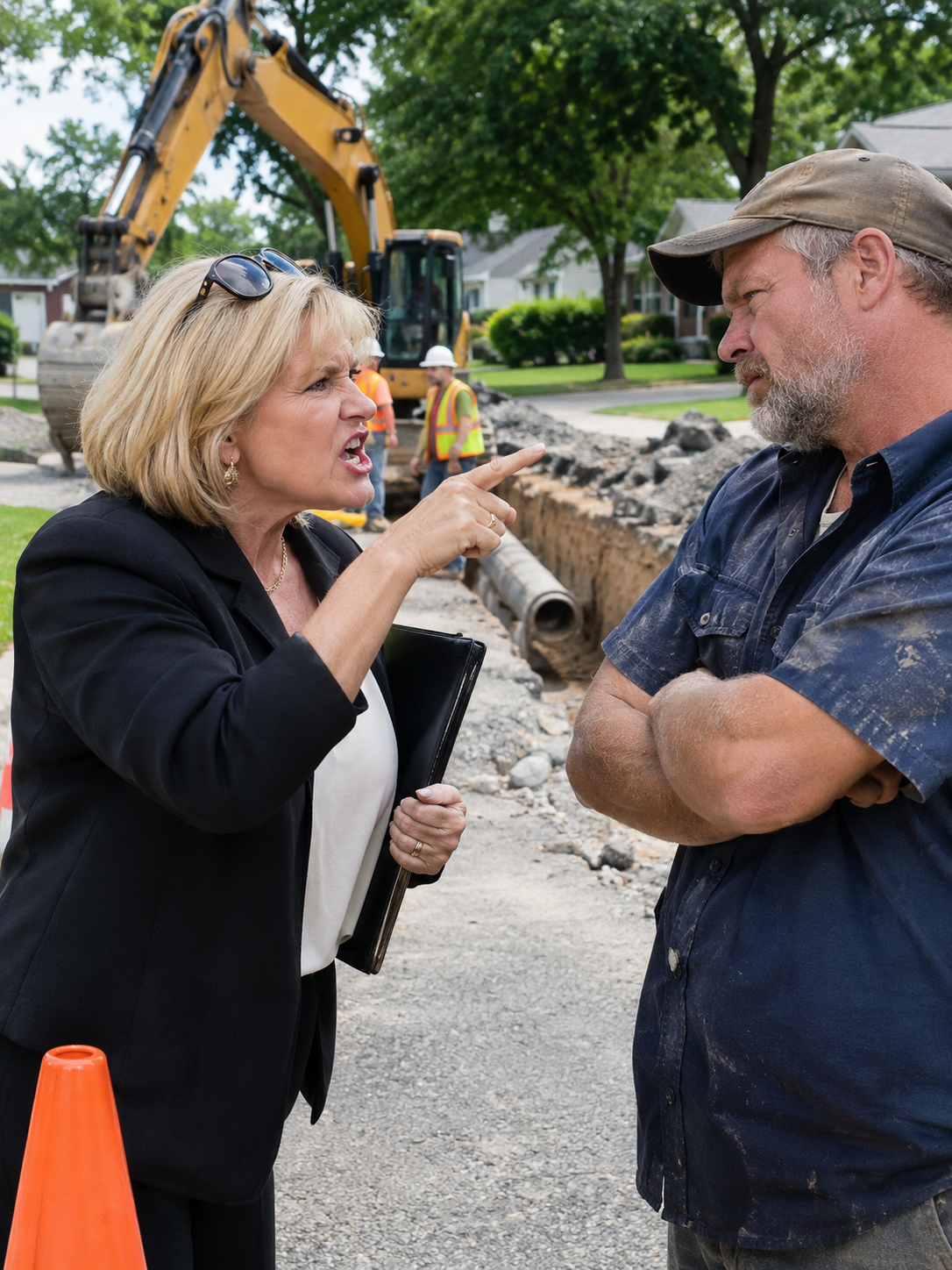
The president of our HOA said she would tear out the road to my house and make me pay to rebuild it, even after I showed her the state drainage easement underneath. I thought her $500 weekly fines and threats against my home were as bad as it could get, until my wife came home from the hospital and found our street missing…
The first letter came on a Tuesday, folded into an envelope with the Crestwood Meadows logo on it. I opened it at our kitchen table between a parts invoice and the toast I’d made for my wife, Noreen, after her night shift. According to our HOA president, Glenda Caldwell, the asphalt on Pinecrest Lane was deteriorating, and I had 60 days to fix it at my own expense.
The estimate at the bottom was $35,000. I read it twice, because I was 52 years old, a self-employed plumber, and I knew exactly how many early mornings and holiday service calls it took to earn that kind of money. Spending it on a road we did not own or maintain would change what Noreen and I could afford for a long time.
Noreen and I had lived in our house since 2016. It wasn’t fancy, just a quiet place at the end of a 400-foot cul-de-sac in a 90-home subdivision in central Missouri, with a garage that fit my work van. Noreen worked 12-hour nights in the county hospital ICU; most mornings, all she wanted was to kick off her clogs, eat something warm, and sleep.
For six years, Pinecrest Lane had been ordinary. Then Glenda, who’d been HOA president four years running because almost nobody wanted to challenge her, began treating that little road as if it were a stain on the neighborhood. She had already made a reputation out of mailbox shades, trash-can hours, and violation letters that arrived certified.
I called the county road office instead of arguing with her. The clerk explained that a state-owned storm-drain line ran under Pinecrest Lane, and the road sat on a state drainage easement. Surface maintenance was the HOA’s responsibility, funded through dues, not a bill to one homeowner.
I forwarded the county documentation to Glenda and asked if we could discuss it. She didn’t answer. Two weeks later, another envelope arrived, announcing $500 weekly fines for failing to obey her road-repair order.
Noreen held the paper in one hand and her morning coffee in the other. “Five hundred dollars every week? For a road the HOA maintains?” I nodded, and she set her cup down carefully before asking what I planned to do.
“I want to know exactly what’s under it,” I told her. She watched me clear a space on the table for the letters, then went upstairs to get some sleep. Neither of us imagined that our kitchen table would stay covered in road paperwork for months.
The orange barricades appeared on a Wednesday. I came around the corner in my van at a.m. and found the entrance to Pinecrest blocked by sand-filled barriers and a laminated HOA sign. To get home, I had to ease over wet grass beside a fire hydrant; one barricade left an orange scrape on my white side mirror.
The same week, all three households on the lane received a warning about “access privileges.” Trash pickup, mail delivery, even emergency vehicle routing were mentioned. Hank Dawson, our 68-year-old neighbor and a retired electrician, called that evening, furious because his wife depended on a wheelchair-accessible van.
“Just pay her, Travis,” Hank said. “That van can’t jump a curb.” I told him Glenda couldn’t simply cancel emergency access, but I understood what he meant: his wife had to get home safely, and a fight over paperwork wouldn’t help her up the driveway.
At the county office the next morning, a clerk turned her screen toward me and traced the easement down the middle of Pinecrest Lane. The state had the right to reach and maintain its drain, she said, and the HOA couldn’t obstruct that access. I filed a formal complaint, even after she warned me that the process might take six to twelve months.
Three weeks after the barricades appeared, an emergency board-meeting notice went up at the neighborhood mailboxes. Our rules required 14 days’ written notice for a financial vote, but this sheet gave only 48 hours. By the time I got to the clubhouse, the meeting had started early and Glenda had already pushed through a $36,000 special assessment.
Only the three Pinecrest households would pay it: $12,000 each. I stood in the doorway, work dust on my boots, looking at the figure circled on a whiteboard. “You voted before we got here,” I said.
“You had sixty days,” Glenda replied, barely looking up from her clipboard. She called it fair because only three families used the road; I asked how three families could be held responsible for a shared road over state infrastructure. She told me she’d made her decision.
That night, sitting in my parked van, I called the Missouri transportation department’s infrastructure hotline. I asked what happened if somebody demolished a road over a state drainage easement without a permit. The woman explained that unauthorized work could leave the responsible party paying for road restoration, drainage repairs, inspections, and penalties; for a major trunk line, the costs could reach seven figures.
I asked whether warning the board in writing would matter. “Keep everything,” she said. I saved the call recording with the date, along with my copies of the notices, maps, and fines.
On Friday, I sent Glenda a certified letter, return receipt requested. It laid out the state easement and warned that demolition or reconstruction required state authorization. I didn’t threaten her, and I didn’t ask for a favor; I asked her to verify the permits before anyone touched the ground.
Three days later, Noreen called at in the morning, just after her hospital shift. Her car was parked two hundred feet from home, and I could hear how hard she was trying to keep her voice steady. “Travis,” she said, “the road is gone.”
I drove home and found four hundred feet of asphalt scraped away. The cul-de-sac had become raw clay, loose gravel, broken stone, and deep excavator tracks. Noreen was sitting on our porch steps with her clogs beside her, looking at a route she could no longer drive after a twelve-hour shift.
She told me the trucks had arrived around seven and finished by three, with no inspector or permit sign in sight. I walked toward the middle of the torn-up lane, watching where I put my boots. About three feet below the former road surface, a gray concrete storm-drain pipe lay exposed, roughly two feet across, with a fresh diagonal crack at one joint.
I stood over that pipe with my phone in my hand. I had been trying to stop a fight over cracked asphalt; now there was a crack in the state’s drain itself, and I didn’t yet know how many people depended on it. Part 2…..
IF FACEBOOK BROUGHT YOU HERE, HERE’S THE CONTINUATION YOU’VE BEEN WAITING FOR. ENJOY! 👇 I started taking pictures before anyone could claim I was exaggerating. I photographed the broken edge of the asphalt, the excavator tracks, the exposed pipe and its cracked joint, and the HOA barricade still guarding the entrance as though it had any authority left. A flatbed trailer was parked on the shoulder, so I photographed its license plate too.
My first concern wasn’t how to win an argument with Glenda. It was how Hank’s wife would get down that lane in her van, and how Noreen would get home safely when her next night shift ended in the dark. I walked back slowly, trying to remember every spot where a tire might sink into the soft ground.
I didn’t go to Glenda’s house or post my photographs online. That night she posted one of her own on the HOA’s Facebook page, a view of the stripped road from her SUV with the words “New beginnings for Crestwood.” There was even a glass of white wine partly visible in the frame; I saved a screenshot before the post could disappear.
At eight the next morning, I called the state transportation department’s district infrastructure office. I gave the easement reference, the location, and a plain description of the exposed, damaged storm-drain pipe. They said an inspector would come within 48 hours; when I mentioned the possibility of heavy rain, the woman promised somebody the following day.
Inspector Darren Cole arrived that afternoon in a state truck and a well-worn reflective vest. He stood at the edge of the excavation without speaking for a while, then walked the entire 400 feet, measuring the disturbed roadway and photographing the pipe. I watched from the porch until he came to knock on my door.
“Are you the one who reported this?” he asked. When I said yes, he explained that the 24-inch trunk line connected through the drainage system toward Route 14 and served a much larger area than our three houses. He counted about 380 homes and 15 businesses in the connected drainage area, including two other subdivisions and a commercial strip.
Darren warned that the damaged joint could cause serious trouble during heavy rain, especially for low-lying properties downstream. He wasn’t trying to frighten me; he spoke the way Noreen did when she described a problem at work that couldn’t be ignored. That made it worse, somehow.
After his truck left, I drove to the county recorder’s office and requested the original subdivision plat. I’d seen the state easement before, but this time I wanted to know who actually controlled the land around it. The clerk found the 1998 plat, and I leaned toward the screen to make sure I was reading it right.
Pinecrest Lane was shown as a county-maintained right-of-way, outside the original HOA common-area boundary. Our three houses and the 400-foot lane sat beyond the line where Glenda’s association authority ended. I asked for later changes, and the clerk pulled up a 2019 amendment.
It was a resolution dated March 14, signed by Glenda herself, purporting to bring Pinecrest into HOA common area for “maintenance efficiency.” It had a notary stamp, but there were no homeowner voting records or meeting minutes attached to what I was shown. I paid for certified copies because I wasn’t going to decide by myself whether that paper was valid.
Hank came by the next evening carrying two beers. He laid one on my kitchen table, saw the plat maps and certified-mail receipts, and said, “I owe you an apology.” I told him he had been worried about his wife, but he shook his head and read the 2019 resolution twice.
“That’s all she’s got?” he asked. “Her own signature?” I said it was what the county file showed, and that we needed to see what the HOA records showed as well. Hank pulled up a chair and asked what he could do.
Section 9.4 of our HOA rules gave us an answer. If 30 percent of the homeowners signed a written petition, the board had to open its financial records for an independent audit. With 90 homes, we needed 27 signatures; Hank said we ought to get more than that.
For four evenings, he took one side of the subdivision and I took the other. We told neighbors about the damaged drain, the $12,000 assessments, and the unresolved question of who authorized the work. Some listened through closed screen doors, some were already angry, and a few wouldn’t sign anything connected with a dispute involving Glenda.
By the end, we had 43 signatures. I put the petition beside the photograph of the cracked concrete joint. The drain still needed state crews, but now at least the people paying HOA dues could find out what had happened to their money.
Part 3 The next person at my door didn’t live in Crestwood Meadows at all. Colleen Bradshaw, a 44-year-old accountant from Ridgewood Glen, had six inches of water in her basement after a heavy rain two weeks after the demolition. Her insurance adjuster had pointed to an upstream drainage problem, and Hank knew her husband through a fishing trip.
Colleen brought her laptop and her insurance paperwork. She looked at the photographs of the exposed pipe, then at the petition on our table. “I want to see the books,” she said, and for the first time I felt that somebody besides me knew how to follow this mess all the way through.
Two weeks later, Ellen Shaw, one of Glenda’s own board members, delivered the records. She looked exhausted and didn’t stay to explain anything. Colleen spread the ledgers and bank statements across our kitchen table while Noreen took her toast to the counter and let us work.
Colleen spent three days checking entries against the bank records. She found a $28,000 payment from the HOA reserve fund to the excavation crew, listed as emergency road maintenance. There was a check with Glenda’s signature, but no board approval, competitive bid, or permit paperwork in the records provided to us.
The fund had gone from $150,000 to $122,000 that quarter. That money came from all 90 households and was supposed to be there for real common-area repairs and emergencies. Noreen looked at the figures and asked the question I’d been trying not to say aloud: “She used everybody’s savings to tear up the road, then billed us to rebuild it?”
We had a financial report now, but the petition had made Glenda angry. One Monday, she learned who had signed it; by Tuesday, letters from a Clayton law firm were arriving at all 43 homes. They warned that spreading unverified claims about the board’s finances might expose the signers to defamation and other legal claims.
Hank called before breakfast, his voice tighter than I’d ever heard it. “It’s from a law firm, Travis.” I told him a lawyer’s letter wasn’t a court ruling, but six homeowners soon called asking to take their names off the petition, and I couldn’t blame them for being scared.
Then I got a letter addressed only to me. The board said it intended to place an $85,000 lien on my house for the estimated cost of rebuilding Pinecrest Lane, and it threatened foreclosure if the matter wasn’t resolved within 60 days. I stood in the kitchen holding that paper, thinking about all the years I’d worked to put a roof over Noreen’s head.
A week later, my mortgage lender wrote to say it had received a property-condition inquiry from an unnamed party. The bank wanted an updated valuation and confirmation about possible liens, and warned of a $400 monthly escrow increase if I couldn’t supply the documentation within 30 days. I suspected Glenda had stirred it up, but I had no evidence of who contacted the lender.
Noreen read both letters without speaking. Then she moved my work invoices aside and made room for them with the others. She had patients and night shifts to worry about; the least I could do was make sure she didn’t also have to wonder whether I’d ignore a threat to our house.
That weekend, I wrote to the entire board, not just Glenda. I enclosed the original plat, the 2019 resolution, the drainage easement, my warning letter and signed delivery receipt, and Colleen’s summary of the $28,000 payment. I told Ellen Shaw, Bert Kinney, and Phil Greer that I was sending it because they might not have seen all the facts before the demolition.
Ellen called the next evening. “Travis, I didn’t vote for anybody to dig up that road,” she said. “Glenda told us the county approved it.” An hour later Bert called, angry that reserve money had been spent without the board knowing and that residents were being threatened over the result.
I thanked both of them and kept notes of what they’d said. The board members still had their own responsibilities to sort out, and the state still had a broken line to repair. But for the first time I could see that Glenda’s version of events wasn’t the only one reaching the other board members.
Part 4 I ran into Glenda in the subdivision parking lot the next day. She looked at my work van and said, “You think you’re smart? You fix toilets. You don’t scare me.” I unlocked the driver’s door, put my folder on the seat, and drove to my next job without answering.
That Thursday, the state mailed a formal notice of violation to the HOA’s registered address: Glenda’s house at 14 Stonebridge Court. I later learned it was 13 pages long. Since official association mail went to her home, the rest of the board had no idea what had arrived.
Darren Cole called me to confirm a few details about the day the excavators came. Before hanging up, he mentioned that the state had sent its findings to the association. “Make sure your board sees that,” he said, and I knew from his tone this wasn’t another routine road-maintenance notice.
I told Ellen and Bert what he’d said, but neither had seen it. I wasn’t authorized to open Glenda’s mail or take anything from her house, and I wasn’t about to give her another reason to accuse me of something. I asked the state office how to get a copy of its findings and kept the rest of my records ready.
On a Tuesday night, Noreen shook me awake just before midnight. “There’s a truck backing down the lane,” she whispered. I could hear its warning beeps through the bedroom window, steady and close, and I pulled on my boots without bothering to find a clean shirt.
A dump truck stood beside the excavated road with its bed raised. Its rear lights and amber warning lamp lit up a stream of crushed stone pouring into the trench, directly over the stretch where Darren had photographed the damaged pipe. There was one driver and no inspection crew that I could see.
I held my phone steady and recorded for two minutes and forty seconds. The video showed the truck, its license plate, the gravel falling over the pipe location, and the time on my phone. When the driver left, the damaged section was buried beneath loose stone, without the pipe having been repaired.
I didn’t know who had ordered that load. I knew only that somebody had covered part of a damaged state drain while the state was investigating it, and that a recording mattered more than a midnight argument with the driver. I saved a second copy before going back inside.
At seven the next morning, I called the DOT district office. I explained exactly what I’d seen and offered the video. The woman taking the report told me not to disturb the site and gave me an address for the footage and screenshots.
By Friday, two state vehicles were back on Pinecrest Lane. Crews cleared gravel from about 30 feet of the trench and uncovered the cracked joint again. The damage was still there, now underneath stone that hadn’t been there during Darren’s first inspection.
The state recorded the additional work as unauthorized alteration of a site under investigation. I didn’t know how its enforcement staff would assign responsibility or calculate penalties, but the list of problems was growing: demolition without the necessary authorization, damage to the drainage line, and now gravel dumped over it after the state had begun documenting the site.
Around the same time, Colleen finished reviewing the rest of the records. Along with the $28,000 excavation payment, she found $8,000 in legal fees paid from the reserves, bringing the unauthorized spending she’d identified to $36,000. The firm that sent the threatening letters was no longer representing Glenda; according to the information Colleen collected, the attorney had seen the plat documents, questioned the association’s legal position, and been dismissed.
Colleen set down a twelve-page report with bank entries and supporting documents. “That’s thirty-six thousand dollars of everybody’s money,” she said. Noreen, fresh from work, stood at the counter with a piece of toast and asked whether the annual meeting was still on for the next week.
It was nine days away. Most years, Glenda could count on a few dozen empty folding chairs and an easy vote on the budget. This time Hank was talking to neighbors, Colleen had contacted a county newspaper reporter, and I finally had enough documentation to explain why that road had become everybody’s problem.
Part 5 The Crestwood Meadows annual meeting was set for seven on a Tuesday night in our plain cinder-block clubhouse. The coffee tasted burned, as it always did, and the fluorescent lights buzzed over the folding chairs. But instead of the usual fifteen or twenty people, sixty-three showed up, including residents from the neighboring subdivision and people from the business strip affected by the drainage trouble.
Noreen had traded shifts so she could sit beside me. Colleen was a few rows back, and Hank stood near the aisle, ready to ask for the road to be discussed. In the rear corner, Dana Tillis from the county newspaper opened a notebook and began taking notes.
Glenda called the meeting to order at and started reading about landscaping, the pool, and parking-lot paint. There was no mention of Pinecrest Lane. Hank stood and asked for it to be added to the agenda, and when Glenda objected, more than forty people raised their hands in favor of discussing it.
She put the agenda down with a sharp little movement. I went to the front carrying my manila folder, the same one that had started with a few HOA letters and a county map. For a moment I could hear Noreen shifting in her chair, and it helped to remember I wasn’t there to put on a show.
I held up the certified letter I’d mailed before the excavation. I showed the signed receipt establishing that Glenda had received my warning about the state easement three days before the machines arrived. Then I set out the original 1998 plat, with Pinecrest outside the HOA common area, and the 2019 annexation resolution bearing her signature but no attached homeowner vote.
I was careful about what I said. I couldn’t declare a recorded amendment invalid just because I hadn’t found the supporting records; that was for the appropriate people to examine. But no one in that room could say they hadn’t been shown the discrepancy or the warning about the state drain.
Next came Colleen’s financial summary. The reserve account had paid $28,000 for the excavators and another $8,000 for legal fees, with no corresponding board authorization in the records we’d received. Ellen Shaw sat at the front table staring at the paperwork; Bert Kinney took off his glasses, and Phil Greer, who almost never spoke in meetings, leaned forward to read.
Then I brought out the state’s notice of violation, a copy I’d obtained through the district office. It had been sent to the HOA’s registered mailing address weeks earlier, but Ellen and Bert said they hadn’t seen it. I looked toward Glenda and asked why the board had been kept from a notice about a damaged drain underneath one of our roads.
Ellen turned toward her. “There was a state notice, and nobody told us?” Glenda adjusted the pages in front of her without answering. I wasn’t going to guess at what she was thinking; I turned back to the official figures so every person in the room could see the same information.
The estimated full restoration bill was $3 million. It included the road surface, the cracked trunk-line joint, engineering and inspections across the connected drainage system, emergency drainage provisions, and state administrative penalties for the unauthorized work and later site alteration. I read the amount once and let the silence settle.
Then people began talking at the same time. One neighbor asked who authorized the excavation; another asked about the special assessment; somebody from the next subdivision wanted to know when the drains would be safe again. These were fair questions, and I didn’t have the authority or the technical knowledge to answer all of them.
Glenda gripped the front edge of the folding table, looking straight at me. I thought of the paint on my van, Hank’s wife navigating that miserable lane, and Noreen coming home exhausted to find the street gone. “I would have helped patch a few surface cracks for free,” I told her. “I’m a plumber. You could have asked.”
She picked up her purse and walked out past the other board members and the neighbors who had once been reluctant even to sign a petition. Nobody followed her down the hallway. Dana kept writing as the room turned from arguing about my road to asking what it would take to repair an entire drainage system.
Part 6 Three days later, Dana’s story appeared on the front page of the county section. It described the unauthorized demolition and the state’s estimated $3 million restoration demand. Noreen left the newspaper beside my coffee, and I noticed she’d cleared a small patch of our kitchen table at last.
The board called a special meeting, this time following the 14-day notice requirement. Sixty-one homeowners came, and the vote to remove Glenda Caldwell from the presidency was unanimous. Ellen became acting president and began gathering the association correspondence that had been routed through Glenda’s address.
There were nine envelopes from the state that the remaining board hadn’t dealt with. Ellen didn’t pretend opening them would fix the pipe or wipe away the HOA’s obligations. She hired a municipal infrastructure attorney from Jefferson City, somebody who could work directly with the agency engineers and the association on a real repair plan.
The following three months were mostly paperwork, calls, and crews assessing damage. The state insisted that the trunk line be repaired, the road rebuilt to its specifications, and the connected drainage system inspected. What the attorney was able to negotiate was how the association would pay for it, not whether the work would be done.
The final agreement kept the $3 million obligation and spread payments over ten years in quarterly installments. We were still a subdivision of 90 ordinary households, and the figure didn’t become less alarming just because someone put a schedule beside it. The board had to work out budgets that could carry that obligation long after Glenda was gone.
The association also filed a civil suit against Glenda personally, seeking recovery for the $36,000 in unauthorized spending and additional damages. The case settled five months later; according to the settlement details shared with homeowners, part was covered through her homeowner’s insurance and the balance came from her savings. I didn’t take pleasure in watching somebody lose savings, but those funds hadn’t belonged to her to spend alone.
Glenda sold her house on Stonebridge Court and moved out of the county. I heard the new owners took down the brass Caldwell placard from beside the front door and planted a hydrangea in its place. I remembered the way people used to walk past her immaculate lawn without stopping, and I hoped those new owners would find the neighborhood a little easier to live in.
Our initial household assessment came to $8,000 each, payable over five years, or roughly $133 a month. It was a serious expense, and it was only one part of a much bigger financial burden the HOA now had to manage. But it wasn’t $85,000 charged to me alone for a disaster I had tried to prevent.
Hank came over with his first installment check already written. He told me he’d kept it in his wallet waiting for the board to make the plan official. For once, he wasn’t asking me to pay anything just to make the trouble go away; he was doing his share alongside everybody else.
When contractors finally began the proper reconstruction, I checked their work the way any plumber would check a repair that mattered: with interest, not interference. They prepared the subgrade, compacted the base, repaired the drainage line, and installed access panels about every 60 feet before laying new asphalt. It was a different kind of sound from the excavators that had scraped the old road away.
By October, Pinecrest Lane was paved again. The cul-de-sac was smooth enough for Hank’s wife’s wheelchair van to enter her driveway without a jolt. Noreen rolled down the car window when she got home and said the fresh asphalt was the sweetest thing she’d smelled in months.
Final At the next annual meeting, we adopted a bylaw everyone started calling the Pinecrest Rule. Any board expenditure over $5,000 would require a majority vote of all homeowners, not just the people sitting at the front table, with no emergency shortcut around that requirement. Colleen helped write it; the vote was 58 in favor and none against.
I didn’t run for HOA president. Instead, once every quarter, I set up a folding table in that same clubhouse and offered a free Saturday workshop on how to read association rules, request records, find plat maps, and check for easements. The first time, twelve people came; the second time, twenty-five. By the fourth, folks were driving in from neighboring counties, and Hank was in charge of the notoriously bad coffee.
None of it brought back the evenings Noreen spent worrying about our mortgage, or erased the cost that families across Crestwood now carried. But people who used to avoid making eye contact at the mailboxes were asking questions at meetings and looking over the records themselves. That mattered more to me than being the man who had stood up to Glenda.
The night the road was finished, Noreen and I sat on our porch while the new streetlight shone on the dark asphalt. Hank walked over with two cold beers and carefully settled into a chair, favoring his bad knee. After a while he asked, “You ever think of running for president?”
“No, thanks,” I said. “I’ve seen what happens to presidents around here.” Noreen laughed, a real unguarded laugh I hadn’t heard in months, and I listened to it carry down a road that finally led home again.
THE END. I’ve shared the complete story, and I truly hope it touched your heart. If this story moved you, please , like, and share the post. Thank you for reading! ❤️
✓ Lynn R. Adams
The president of our HOA said she would tear out the road to my house and make me pay to rebuild it, even after I showed her the state drainage easement underneath. I thought her $500 weekly fines and…