HOA Tore Up My Private Road—Then $3.4 Million in Bills Landed on Every Board Member’s Desk
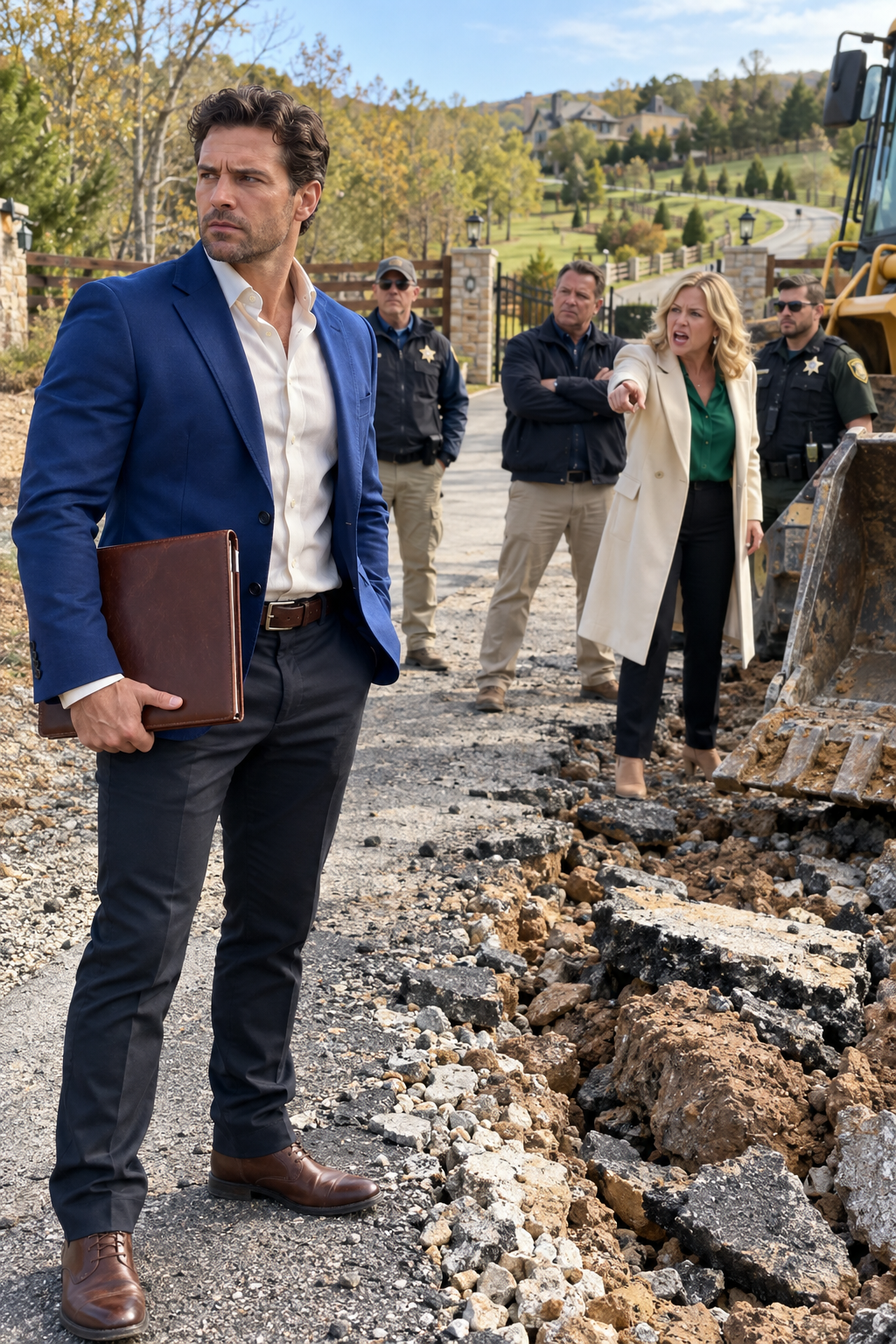
HOA Tore Up My Private Road—Then $3.4 Million in Bills Landed on Every Board Member’s Desk
The first thing I saw when I turned onto Mercer Lane was my asphalt piled in black chunks like somebody had dug up a grave.
The second thing I saw was the president of Silver Ridge Estates standing beside an excavator, smiling while a contractor ripped another twenty feet out of the private road my family had owned for fifty-eight years.
Then she looked straight at me and said, “You should be thanking us.”
I didn’t shout.
I didn’t charge toward the excavator.
I didn’t threaten anybody.
I parked my Ford on the shoulder, turned off the engine, opened the camera on my phone, and started recording.
That decision would eventually cost their HOA board $3.4 million.
But on that Tuesday morning in Colorado, they still thought I was the one about to lose everything.
My name is Ethan Mercer.
I’m forty-three years old, and I own 460 acres of foothill property outside a fast-growing Colorado town called Pine Hollow.
My grandfather bought the original parcel in 1968, back when the nearest subdivision was twenty miles away and people still stopped their trucks in the middle of County Road 17 to talk through open windows.
Mercer Lane was built by my grandfather.
Not the county.
Not a developer.
Not an HOA.
He paid for the grading.
He paid for the drainage.
He paid for the original gravel base.
My father paved most of it in the 1990s.
I replaced two culverts and reinforced the creek crossing after the flood of 2013.
The road ran 1.8 miles from County Road 17, across my property, through a narrow stand of cottonwoods, and up toward the ranch house, equipment barns, and three smaller parcels I leased to local families.
Silver Ridge Estates had been built along my eastern boundary twelve years earlier.
Three hundred and twelve expensive homes.
Stone entrances.
Decorative lamps.
A clubhouse.
A swimming pool.
A tennis complex nobody seemed to use except during HOA fundraisers.
When the development went in, the original developer negotiated one limited easement across the first 640 feet of Mercer Lane.
The language was painfully specific.
Emergency access only.
No routine resident traffic.
No commercial construction traffic.
No utilities.
No widening.
No alteration without written permission from the Mercer property owner.
I knew the language because I had read it at least fifty times.
Apparently, HOA president Linda Carver had not.
Or she had, and she thought it didn’t matter.
Linda was fifty-six, perfectly styled even at seven-thirty in the morning, wearing a cream jacket, dark sunglasses, and boots that had probably never touched mud until that day.
Next to her stood HOA vice president Randall Pierce, a retired insurance executive who spoke to everyone as though they were filing a claim he intended to deny.
There were six construction workers around them.
One excavator.
Two dump trucks.
A compact loader.
And about eighty yards of my road already destroyed.
I got out of my truck.
Linda waved toward the machinery.
“Ethan,” she called. “Finally.”
I held my phone at chest level.
“Who authorized this?”
Her smile barely moved.
“The board.”
“I asked who authorized work on my property.”
“The association has access rights.”
“For emergency vehicles.”
Randall stepped forward.
“We’ve reviewed the documents.”
“Then you know this road is privately owned.”
“You’ve been obstructing necessary infrastructure improvements for years.”
That was my first clue.
Infrastructure improvements.
Not emergency access.
I looked past them.
Workers had painted bright orange lines along the shoulder.
Utility markings.
Those weren’t markings for road resurfacing.
They were planning to put something underground.
I zoomed my camera in.
“What are you installing?”
Linda crossed her arms.
“A safer transportation corridor.”
“That wasn’t my question.”
Randall gave a short laugh.
“You always do this, Ethan. You turn everything into some legal technicality.”
Legal technicality.
My ownership of the land was apparently a technicality.
The deed was a technicality.
The easement restrictions were a technicality.
The fact that they were destroying a road worth hundreds of thousands of dollars was a technicality.
But I wasn’t angry yet.
Anger is expensive when other people are making mistakes for free.
I walked to the nearest contractor.
His reflective vest said RAVEN ROCK CIVIL.
“What’s your name?”
He hesitated.
“Mike, did your company receive written authorization from the property owner?”
Linda interrupted.
“Do not harass our contractor.”
I kept looking at Mike.
He glanced toward Linda.
Then Randall.
Then back at me.
“We were told the HOA controlled the easement.”
“Did anybody show you the easement?”
He didn’t answer.
That was answer enough.
I pulled my truck keys from my pocket.
“Everybody needs to stop work until ownership is verified.”
Linda actually laughed.
I looked at the excavator operator.
“Sir, I’m the property owner. I am informing you that I have not consented to this work.”
The bucket stopped in midair.
Linda’s smile vanished.
“Keep going.”
The operator looked at his supervisor.
His supervisor looked at me.
I said nothing.
That was when Linda walked closer.
“You don’t get to hold an entire community hostage because your grandfather built a farm road sixty years ago.”
“Ranch road.”
“Whatever.”
“It matters.”
“No, Ethan. What matters is that three hundred families live beside a road that you insist on treating like your personal kingdom.”
I almost smiled at that.
“It is my personal road.”
Her jaw tightened.
Behind her, the excavator remained frozen.
She lowered her voice.
“This community has outgrown the original arrangement.”
“That doesn’t change the deed.”
“We have lawyers.”
“You really want to spend two years fighting us?”
I looked at the torn asphalt.
Then the damaged drainage channel.
Then the freshly exposed base rock.
Then the orange utility paint disappearing around the bend toward Silver Ridge.
“No,” I said. “I don’t think this is going to take two years.”
She interpreted that as surrender.
That was her first mistake.
The second was assuming the only document I had was the deed.
Because my grandfather had taught my father something my father later taught me.
Never rely on one copy of anything involving land.
I had the deed.
I had the original subdivision agreement.
I had the recorded easement.
I had the engineering drawings from 1968.
I had photographs from every road improvement since 1994.
I had invoices for the culverts.
I had a survey completed eighteen months earlier.
And buried in a fireproof cabinet in my office, I had something Linda Carver didn’t know existed.
A signed 2009 agreement between my father and Silver Ridge’s original developer explicitly prohibiting the exact project her board had started that morning.
I called the sheriff’s non-emergency number.
Then I called my attorney.
Then I called a civil engineer.
Then I called my insurance company.
I did not call Linda names.
I did not block the excavator with my truck.
I did not threaten the workers.
Because I had learned something during twenty years of managing commercial construction projects.
When somebody else is creating evidence, don’t interrupt them unnecessarily.
Preserve it.
The sheriff’s deputy arrived twenty-six minutes later.
Deputy Aaron Bell was about thirty, calm, broad-shouldered, and immediately irritated that everybody wanted him to decide a property dispute on the side of a road.
Linda approached him first.
She handed him a folder.
“We have a legal easement.”
Bell looked through it.
Randall started talking about public safety.
Linda mentioned wildfire evacuation.
Finally Bell turned toward me.
“Mr. Mercer?”
I handed him one document.
The recorded easement.
Not twenty pages.
Not a binder.
One document.
He read the first page.
Then the second.
Then he looked toward the excavator.
“This says emergency access.”
He glanced at Linda.
She pointed at another paragraph.
“That section gives us ingress and egress.”
“During an emergency condition,” Bell said.
“Our counsel has a different interpretation.”
Bell gave her the look police officers reserve for people trying to turn them into unpaid judges.
“I’m not interpreting property law.”
“Then they can continue.”
Linda blinked.
Bell continued.
“The owner has informed the contractor that he does not consent. There is an active ownership dispute. Until you resolve it through the appropriate civil process, continuing excavation could create additional problems.”
Randall stepped forward.
“Are you ordering us off the property?”
“I am strongly advising everyone to stop altering property whose ownership is disputed.”
Linda looked at the workers.
Then at me.
Then she did something I still couldn’t believe.
She told them to continue.
Mike from Raven Rock didn’t move.
Linda raised her voice.
“You have a contract.”
Mike shook his head.
“We also have insurance.”
That was the first mini-payoff of the morning.
The excavator shut down.
Five minutes later, Raven Rock’s project manager was on the phone with corporate headquarters.
Ten minutes after that, every machine was parked.
Thirty minutes later, their attorney had told them not to touch another inch of Mercer Lane.
Linda stood beside the silent excavator while her project collapsed around her.
She still wasn’t scared.
She thought the damage was cosmetic.
She thought I would demand repaving.
She thought the HOA would write a check and move on.
What she didn’t know was that the excavator had already torn through far more than asphalt.
What she didn’t know was that the road carried infrastructure.
What she didn’t know was that one of those culverts protected a regulated seasonal drainage.
What she didn’t know was that the retaining structure beneath the western shoulder had been engineered as part of a slope-stabilization system.
What she didn’t know was that the utility markings extending toward Silver Ridge told me the real reason they wanted my road.
And what she definitely didn’t know was that my security cameras had recorded their crews arriving before dawn.
I spent the rest of that day doing almost nothing Linda could see.
That was deliberate.
I photographed every damaged section.
I used survey stakes to establish reference points.
My engineer, Rachel Monroe, arrived at 11:40 a.m. and walked the site with a tablet.
She crouched beside an exposed drainage pipe and went silent.
“What?” I asked.
“They cut your underdrain.”
I looked down.
A black perforated pipe had been crushed beneath a track.
“That bad?”
“That depends on whether the hillside moves.”
That got my attention.
The western edge of Mercer Lane crossed a slope above Dry Creek.
When my father widened the road in 1998, engineers installed subsurface drainage behind a retaining system to relieve groundwater pressure.
Without it, water could build behind the slope during spring runoff.
Worst case?
Road failure.
Potentially part of the hillside with it.
Rachel kept walking.
Twenty yards later she found another crushed outlet.
Then a third.
She photographed everything.
At p.m., my ranch manager called from the upper property.
Our main water line had lost pressure.
At , we found why.
The excavation crew had cracked a buried four-inch line supplying two rental cottages, the equipment barn, and livestock troughs.
By , I had temporary water tanks being delivered.
By , Raven Rock had formally notified the HOA that its work was suspended pending title verification.
At , Linda sent me an email.
Not an apology.
She accused me of interfering with a “lawfully approved community safety improvement.”
She demanded immediate access for contractors.
She warned that I could be held responsible for delay costs.
I forwarded the email to my attorney, Melissa Grant.
Her reply came four minutes later.
“Do not answer.”
The next morning, Silver Ridge residents woke up to a message from the HOA.
I know because three of them forwarded it to me.
The board claimed an “adjacent landowner” had unexpectedly blocked safety improvements intended to improve wildfire evacuation.
They did not use my name.
They didn’t need to.
Everybody knew.
By lunch, two residents had emailed me personally.
One accused me of putting children at risk.
Another asked whether I would “reconsider my selfish position.”
I answered neither.
At p.m., a man named Tom Whitaker drove to the ranch.
Tom lived in Silver Ridge.
Retired firefighter.
Seventy-one.
He parked outside my gate and held up both hands when I approached.
“I’m not here to fight.”
“Good start.”
He gave a tired smile.
“Can I ask you something?”
“Is this actually about wildfire access?”
His expression changed.
“How sure are you?”
I showed him the orange utility markings.
Then I showed him a copy of the easement.
Tom read it twice.
“They told us you were trying to close the emergency lane.”
“I’ve never closed emergency access.”
“They said you put chains across it.”
“I have a gate. Fire services have the code. Sheriff’s office has the code. County dispatch has the code.”
Tom looked toward the ripped pavement.
“So why are they digging?”
“That’s what I’m figuring out.”
He folded the document carefully and handed it back.
Then he said something that gave me my next lead.
“They approved a fiber and sewer expansion last month.”
I looked at him.
“Nobody showed us the full route.”
That evening, Melissa and I attended an emergency HOA meeting.
I wasn’t a Silver Ridge homeowner, so normally I had no right to participate.
But by then the board’s attorney had decided it was smarter to invite me than have residents hear only rumors.
The clubhouse was packed.
Linda sat at the front behind a long table with six other board members.
Randall was beside her.
Their attorney, a gray-haired man named Steven Coles, looked like he had already developed a headache.
I sat in the second row.
Linda opened with prepared remarks about public safety.
Then she talked about “connectivity.”
Then “community resilience.”
Then “future infrastructure needs.”
Future infrastructure.
There it was again.
When residents were allowed to ask questions, Tom stood.
“Is the Mercer project related to the sewer and fiber extension?”
Linda looked at Steven.
Steven looked at Randall.
Randall adjusted his microphone.
“The projects may share certain efficiencies.”
People started murmuring.
Tom didn’t sit.
“What does that mean?”
“It means,” I said from my chair, “they planned to trench my private road for utilities.”
Every head turned.
Linda stared at me.
Steven whispered something to her.
I continued.
“I have not granted a utility easement.”
Randall leaned toward his microphone.
“We believe existing rights permit necessary improvements.”
“Then show the document.”
Not dramatically.
Just enough so people could see me.
“I’m not asking anyone here to take my word for it. The easement is recorded with the county. Pull it yourselves.”
A woman near the aisle spoke.
“Were we told this road belonged to the HOA?”
Linda answered before I could.
“The association has substantial legal rights over that corridor.”
“That wasn’t her question,” Tom said.
The room shifted.
It was subtle.
But I felt it.
For two days, Linda had controlled the story.
Now residents were asking specific questions.
Specific questions are dangerous to people who rely on vague answers.
Another homeowner raised his hand.
“How much have we already paid the contractor?”
Randall said, “That’s a contractual matter.”
“How much?”
Linda’s voice sharpened.
“We are not conducting an audit in the middle of a legal dispute.”
That sentence did more damage to her than anything I could have said.
After the meeting, Melissa and I were walking through the parking lot when Steven Coles caught up with us.
“Mr. Mercer.”
“I’d like to arrange a temporary access agreement to stabilize the road.”
“You can contact my attorney.”
He glanced at Melissa.
“I’m aware.”
She smiled.
Steven lowered his voice.
“Off the record, I was not consulted before excavation began.”
Melissa’s expression changed slightly.
“Then who gave the contractor legal clearance?”
Steven looked back toward the clubhouse.
“I suggest you request the board’s project authorization documents.”
Then he walked away.
That was clue number two.
We sent preservation letters the next morning.
To the HOA.
To every board member.
To Raven Rock Civil.
To the property management company.
To the project engineer.
Nobody was to delete emails, text messages, plans, bids, invoices, recordings, meeting notes, or electronic files connected to Mercer Lane.
By Friday, Rachel had completed her preliminary engineering report.
The visible road damage alone was estimated at $486,000.
Then came drainage.
Then slope stabilization.
Then the water system.
Then environmental remediation.
Then engineering.
Then temporary access.
Then loss of use.
The number was climbing fast.
But we still weren’t anywhere near $3.4 million.
On Monday morning, Raven Rock’s insurer contacted us.
They wanted an inspection.
That afternoon, their regional director arrived with two engineers and a lawyer.
For the first time, I saw their project plans.
Linda had given Raven Rock a drawing labeled SILVER RIDGE EASTERN CONNECTOR.
The proposed construction ran straight down Mercer Lane.
Widen road from sixteen feet to twenty-eight.
Add drainage.
Install sewer force main.
Install fiber conduit.
Install electrical duct bank.
Build a new entrance connecting the subdivision to County Road 17.
It was not an emergency road improvement.
It was a second subdivision entrance.
And that entrance would increase the value of 74 undeveloped lots owned by a company associated with Silver Ridge’s original expansion plan.
I stared at the drawing.
Melissa noticed the same thing.
“Who owns those lots?”
The Raven Rock lawyer said he didn’t know.
Or at least I knew where to look.
County property records answered the question in nine minutes.
The 74 lots were owned by Red Canyon Residential Holdings LLC.
Its registered agent was a Denver law firm.
That alone meant nothing.
So Melissa kept digging.
Two corporate filings later, she found the managing member.
Pierce Development Partners.
Randall Pierce’s son, Brandon, was its president.
There was our first real twist.
The vice president of the HOA had been pushing a road project that would create a direct access corridor benefiting land controlled by his son’s development company.
That didn’t automatically make it illegal.
But it made every vague answer at the clubhouse suddenly make sense.
It also explained the urgency.
Red Canyon had a financing deadline.
Without secondary access and utility capacity, the next construction phase couldn’t proceed.
My road wasn’t about safety.
It was about unlocking millions of dollars in development value.
Melissa leaned back from her laptop.
I looked at her.
“Well what?”
“Now they’re going to wish this was only about asphalt.”
We didn’t release the information publicly.
Instead, we requested records.
Board minutes.
Conflict disclosures.
Insurance policies.
The HOA’s lawyer fought some requests.
The management company provided others.
Raven Rock supplied its signed agreement.
That agreement was extraordinary.
The HOA had certified that it possessed all necessary property rights for the work.
It had agreed to indemnify Raven Rock for title-related claims.
And the contract value was $1.18 million.
That meant Linda and Randall had not merely discussed a hypothetical project.
They had committed association funds.
A lot of them.
Without owning the land.
Three days later, things got worse for them.
The Colorado Department of Transportation wasn’t involved.
The county road department wasn’t involved.
The fire district hadn’t requested the widening.
And when I called Pine Hollow Fire Protection District Chief Marcus Hale, he sounded confused.
“Who told you we wanted Mercer Lane widened?”
“We didn’t.”
“Did you approve any project there?”
“Did you request a second permanent subdivision entrance?”
I sent Melissa a summary of the call.
She subpoenaed records later.
The fire district emails were even better.
Six months earlier, Linda had asked whether additional access “could improve emergency redundancy.”
The district had responded that existing emergency access was adequate provided the gate remained accessible.
Linda had then quoted only the first half of the exchange in HOA materials.
By the following week, Silver Ridge residents were no longer angry at me.
They were angry at their board.
The board responded the way boards under pressure often respond.
They hired a public-relations consultant.
Suddenly residents received polished emails about “misinformation.”
About “complex legal interpretation.”
About “community unity.”
About “avoiding rushes to judgment.”
Linda still never said why the association had signed a $1.18 million construction contract on land it did not own.
Then came the rain.
Three days of it.
Not a catastrophic storm.
Just steady spring rain.
Enough to fill the damaged drainage system.
At a.m. on Thursday, my phone rang.
“Get down to the lower road.”
I dressed and drove out in darkness.
Water was running over the pavement near the torn section.
Mud streaked the western slope.
One section of shoulder had dropped nearly ten inches.
Rachel arrived fifteen minutes later.
She got out, took one look, and said, “Close it.”
The road became unsafe for heavy vehicles.
That meant my cattle feed deliveries had to use a rough northern ranch track.
It meant one tenant with a horse trailer couldn’t reach her normal route.
It meant temporary stabilization had to happen immediately.
And because the HOA’s excavation had crushed the underdrain system directly upslope, their liability picture changed again.
By noon, engineers had installed monitoring points.
By evening, we had temporary barriers.
I paid for all of it.
Every invoice went into a folder.
Friday brought another surprise.
A county environmental inspector visited after someone reported sediment entering Dry Creek.
I assumed Linda had called them to cause trouble for me.
Maybe she had.
If so, it backfired spectacularly.
The inspector traced the sediment to exposed soil created by the HOA excavation.
Then he asked for the project’s erosion-control permit.
There wasn’t one.
He asked for disturbance-area calculations.
Nobody had them.
He asked whether the contractor had installed sediment barriers before excavation.
They hadn’t.
I watched him write notes for forty minutes.
Two days later, Raven Rock received a notice.
The HOA received another.
The fines weren’t enormous at first.
The remediation costs were.
Linda called me personally that Sunday evening.
It was the first time we had spoken since the road was torn up.
“I think this has gone far enough.”
I was standing in my kitchen making coffee.
“We need a practical resolution.”
“Talk to Melissa.”
“I’m talking to you.”
“You shouldn’t be.”
She exhaled.
“Ethan, whatever you think of me, three hundred homeowners are going to pay for this.”
“That’s a conversation you should have had before you hired an excavator.”
“We relied on legal advice.”
“From whom?”
“This doesn’t need to become personal.”
“It became personal when your contractor dug through my water line.”
“You know what I mean.”
She wanted me to separate her decisions from her consequences.
I wasn’t interested.
She tried again.
“If we restore the road to its previous condition, will you settle?”
“What else do you want?”
“The road restored correctly.”
“The drainage system rebuilt.”
“The retaining system inspected and repaired.”
“The water line replaced.”
“Environmental remediation.”
Her voice tightened.
“Engineering fees.”
“Reasonable ones.”
“Temporary access costs.”
She paused.
“Attorney fees.”
“That’s negotiable.”
“Loss-of-use damages.”
“That’s absurd.”
“Survey costs.”
“Monitoring costs.”
Then I said quietly, “And I want the HOA to permanently acknowledge it has no right to widen, trench, develop, pave, alter, or convert Mercer Lane beyond the recorded emergency easement.”
That was the one she didn’t answer.
Not because it was expensive.
Because it killed the project.
Without my road, Red Canyon’s expansion was in trouble.
Linda finally said, “We can’t agree to language that restricts future boards.”
“The deed already does.”
“You’re being unreasonable.”
“No. I’m reading.”
She hung up.
The next HOA meeting drew nearly two hundred people.
This time the chairs weren’t enough.
Residents stood along the walls.
Some waited outside the doors.
Linda opened the meeting, but she barely made it through the first paragraph.
A homeowner named Cynthia Brooks interrupted.
“Did Randall’s son benefit from this road?”
The room exploded.
Randall’s face went white.
Linda struck the table with a small wooden gavel.
Cynthia remained standing.
“Answer the question.”
Randall reached for his microphone.
“My adult son operates an independent company.”
“That wasn’t the question.”
A man in the back shouted, “Did you disclose it?”
Another voice: “Did you vote?”
Another: “How much of our money did you spend?”
Another: “Why weren’t we told?”
Randall finally said, “I did not personally own the property.”
That was the worst answer he could have given.
Because nobody had asked whether he owned it.
They had asked whether his son benefited.
Tom Whitaker stood near the front.
“Randall, did you vote to approve the construction contract?”
Randall stared at him.
“I participated in board deliberations.”
“Did you vote?”
The room erupted again.
Linda tried to restore order.
Nobody listened.
Then Melissa stood beside me.
She wasn’t representing the homeowners.
She was representing me.
But she had brought something.
A copy of the 2009 agreement.
She waited until the noise settled.
Then she addressed the HOA’s attorney.
“Mr. Coles, would you like a copy of the document your clients apparently failed to provide you?”
Steven’s face hardened.
“What document?”
She handed it over.
He read the first page.
Then the signature page.
Then he closed his eyes for about two seconds.
That tiny reaction told me everything.
Linda leaned over.
“What is it?”
Steven didn’t answer immediately.
Randall reached for the pages.
Steven pulled them slightly away.
That was interesting too.
Finally he said, “We need to enter executive session.”
Homeowners started yelling.
Linda struck the gavel again.
Melissa sat down.
I leaned toward her.
“You enjoyed that.”
“A little.”
The 2009 agreement was devastating because it eliminated their claim that easement language was ambiguous.
Silver Ridge’s developer had explicitly acknowledged that Mercer Lane remained private and could not be converted into a subdivision entrance or utility corridor without written consent from the Mercer family.
The HOA had inherited the agreement.
It had been recorded.
There was no reasonable way to pretend it didn’t exist.
And two weeks later, discovery gave us the document that turned a bad civil dispute into a board-level disaster.
Randall had sent it to Linda eight months before excavation.
Subject line: Mercer Access Strategy.
The email itself was short.
He wrote that Ethan Mercer was “unlikely to voluntarily cooperate.”
He suggested moving forward based on the HOA’s “broad easement position” and allowing Mercer to “challenge after mobilization if he wants.”
After mobilization.
Meaning after the equipment arrived.
After the road was opened.
After money was spent.
After physical facts existed that could pressure me into accepting the project.
Linda replied fourteen minutes later.
“Once it’s underway, stopping it becomes harder for everyone.”
That sentence probably cost more than the excavator.
The insurer saw it.
The HOA’s new litigation counsel saw it.
The residents eventually saw it.
And suddenly nobody wanted to argue that the destruction had been an innocent misunderstanding.
The HOA’s insurance carrier issued a reservation-of-rights letter.
Translation?
Coverage was not guaranteed.
If board members knowingly acted outside their authority, parts of the claim might not be covered.
That was when the numbers became terrifying.
The final engineering assessment came in at $1.06 million for full road, drainage, slope, and water-system restoration.
Environmental stabilization and remediation: $312,000.
Temporary access construction and operational disruption: $284,000.
Engineering, surveying, geotechnical monitoring, and expert costs: $376,000.
Legal fees and anticipated litigation expenses were climbing.
Raven Rock asserted delay and demobilization claims under its contract.
The HOA’s own unpaid contractor exposure exceeded $600,000.
Then there were insurance deductibles.
Consultants.
Emergency repairs.
County penalties.
And claims from two tenants whose access had been disrupted.
By the time mediation began, the combined exposure was estimated at just over $3.4 million.
Not a dramatic made-up number.
Not a threat.
A spreadsheet.
Forty-seven pages.
Every item supported.
Every invoice attached.
Every engineering estimate sourced.
Every damaged structure photographed.
Every board authorization documented.
Linda walked into mediation wearing navy blue instead of cream.
Randall looked ten years older.
Their lawyers did most of the talking.
My demand was simple.
Restore my property.
Pay the documented losses.
Release Mercer Lane from every claim beyond the original emergency easement.
Record the agreement publicly.
No future utility corridor.
No permanent subdivision entrance.
No widening.
No routine traffic.
And the HOA had to pay for an independent engineer to inspect the repairs for five years.
Their lawyer called the terms severe.
Melissa called them cheaper than trial.
We sat for eleven hours.
At one point they offered $900,000 plus repairs.
Then $1.4 million.
Then $1.9 million and partial easement language.
Linda finally spoke directly.
“You’re trying to punish us.”
I looked across the table.
“You’ve rejected every compromise.”
“I’ve rejected every version where you keep the thing you tore up my road to get.”
Her eyes narrowed.
“You don’t understand how much development is happening around you.”
“I understand exactly.”
“You can’t freeze this area in 1968.”
“I’m not trying to.”
“Then why fight progress?”
“Because progress isn’t a synonym for taking somebody else’s land.”
Nobody said anything for a moment.
I continued.
“You wanted a second entrance. Ask.”
“No. You told me it was necessary.”
“We offered compensation.”
“You offered eighty thousand dollars for permanent road and utility rights across land that would unlock tens of millions in development.”
Randall looked down.
I leaned back.
“You thought I didn’t understand what my signature was worth.”
That was really what had started everything.
Six months before the excavation, Randall had approached me privately.
He said the subdivision wanted to “improve” emergency access.
He offered $80,000 for what he described as a minor easement adjustment.
I asked for the plans.
He said they were preliminary.
I asked whether utilities were involved.
He said nothing had been decided.
I declined.
Two months later, they voted to proceed anyway.
Now everybody at the table knew why.
Mediation ended after midnight.
No settlement.
Three weeks later, Silver Ridge homeowners held a recall vote.
Linda Carver was removed.
Randall Pierce was removed.
Two other board members resigned before ballots were counted.
Tom Whitaker became interim board president, though he only agreed to serve long enough to stabilize the association and organize new elections.
The new board hired independent counsel.
Then something remarkable happened.
They stopped pretending.
Tom called me.
“We need to fix what they did.”
That was the first productive sentence I had heard from anyone representing Silver Ridge in two months.
Negotiations restarted.
This time, there was no argument over whether I owned the road.
No argument over whether utilities were allowed.
No argument over whether the 2009 agreement existed.
We argued about money.
Money can be solved.
Reality is harder.
The final settlement package was complicated because multiple insurers, contractors, and responsible parties were involved.
Raven Rock’s carrier paid a significant portion tied to physical damage.
The HOA’s property and liability coverage handled other portions.
The association’s special reserve took a hit.
Claims were pursued against former board members under applicable policies.
Randall’s conflict-of-interest conduct became part of separate legal proceedings involving the association.
Red Canyon Residential Holdings abandoned the Mercer Lane route entirely.
And most importantly, a new covenant was recorded with the county.
Mercer Lane remained private.
Emergency access remained protected.
No utilities.
No widening.
No secondary subdivision entrance.
No construction traffic.
No board reinterpretation.
No clever language.
No “future infrastructure needs.”
For the first time in months, the document fit on four pages.
Repairs started in August.
I chose the engineering firm.
The HOA paid.
The contractor removed damaged material down to the compromised base.
They rebuilt drainage.
Replaced the water line.
Repaired the slope system.
Installed new underdrains.
Reconstructed the shoulder.
Repaved the damaged section.
Revegetated disturbed ground beside Dry Creek.
Every stage was inspected.
Every test result went into my files.
When the final asphalt was rolled smooth, I stood near the cottonwoods where I had first seen the excavator.
Tom stood beside me.
He looked down the black ribbon of pavement.
“Looks better than before.”
“It should.”
He laughed.
“Don’t send me that bill.”
“I already did.”
His face froze.
Then he realized I was joking.
That was probably the first time either of us laughed about Mercer Lane.
Silver Ridge changed after that.
Not magically.
HOAs don’t become friendly neighborhood picnics because four people lose an election.
People still argued about fences.
Trash cans.
Landscaping.
Holiday decorations.
But homeowners started attending meetings.
Budgets got posted earlier.
Large contracts required more review.
Conflict disclosures were tightened.
Board minutes became detailed.
Residents asked questions before approving expensive projects.
Tom once told me the disaster had taught the neighborhood something.
I told him the neighborhood had paid $3.4 million in tuition.
He didn’t laugh at that one.
Linda sold her house nine months later.
I never spoke to her again.
Randall stayed longer.
His son’s development company eventually constructed a different entrance almost two miles south after purchasing the necessary land at market price.
Funny how legal access becomes possible when you actually pay the people who own it.
The original seventy-four lots were delayed more than a year.
I heard the carrying costs were brutal.
I lost no sleep over it.
By the next spring, wildflowers had started growing again along the repaired shoulder.
The drainage worked.
The slope stayed stable.
The rental cottages had permanent water.
Feed trucks came and went without trouble.
And every emergency agency that had previously used Mercer Lane still had exactly the access it always had.
Nothing had been lost except the shortcut the old board thought it could take without permission.
For almost a year, I believed that was the end.
Then, on a Friday afternoon in May, a FedEx envelope arrived at my ranch office.
No return name I recognized.
Inside was a thumb drive.
One folded sheet of paper.
And a survey map.
The note contained one sentence.
“You stopped Mercer Lane, but you need to see what Randall was actually trying to reach.”
I stared at it for several seconds.
Then I unfolded the map.
It wasn’t a subdivision map.
It covered my ranch.
Silver Ridge.
Red Canyon’s seventy-four lots.
And nearly three thousand acres north of Dry Creek.
Across the center, somebody had drawn a thick red line.
It followed Mercer Lane for the first half mile.
Then crossed beneath my western pasture.
Then continued toward a rectangular parcel owned by a company I had never heard of.
Blackstone Peak Energy Storage LLC.
I sat down.
There were handwritten numbers beside the parcel.
Pipeline diameter.
Pressure ratings.
Depth specifications.
Proposed pumping capacity.
At the bottom of the map was a date.
Eight months before Linda’s excavator arrived.
My phone rang.
Unknown number.
Normally, I would let it go to voicemail.
That afternoon, I answered.
Nobody spoke for two seconds.
Then a man said, “Mr. Mercer?”
“My name is David Shaw. I used to work for Pierce Development.”
I looked at the map again.
“What is this?”
His next words made the $3.4 million HOA disaster suddenly feel very small.
“The road was never the real project.”
I gripped the phone.
“What was?”
He took a breath.
“The land underneath it.”
Then I heard a car door slam on his end.
David’s voice dropped.
“I sent you everything I could. Don’t contact the HOA. Don’t contact Pierce. And whatever you do, don’t approve anyone to drill on the western pasture.”
The line went dead.
I tried calling back.
The number was disconnected.
I carried the survey map to the window.
Outside, Mercer Lane curved peacefully through the cottonwoods, freshly paved and completely quiet.
For nearly a year, I had thought they tore up my road because they wanted a subdivision entrance.
Now I was looking at a proposed underground corridor running directly beneath it.
And in the upper-right corner of the map, almost hidden beneath a fold, was a county filing number.
I typed it into the public records database.
One document appeared.
I opened it.
The first page showed an application for subsurface testing.
The second page listed several neighboring parcels.
The third page contained a signature purporting to authorize access across my ranch.
My signature.
Except I had never signed it.
And according to the filing date, somebody had submitted it three weeks before Linda Carver ever told me the HOA wanted to “improve” Mercer Lane.
I stared at the forged signature until my coffee went cold.
Then headlights appeared beyond my front gate.
Two black SUVs.
Neither belonged to anyone I knew.
They turned onto Mercer Lane.
And started driving toward my house.
✓ Lynn R. Adams
HOA Tore Up My Private Road—Then $3.4 Million in Bills Landed on Every Board Member’s Desk The first thing I saw when I turned onto Mercer Lane was my asphalt piled in black chunks like somebody had …