HOA Tore Down My Private Dam at Christmas Over “Unpaid Dues”—So I Shut Down the Water Their Entire Neighborhood Secretly Depended On
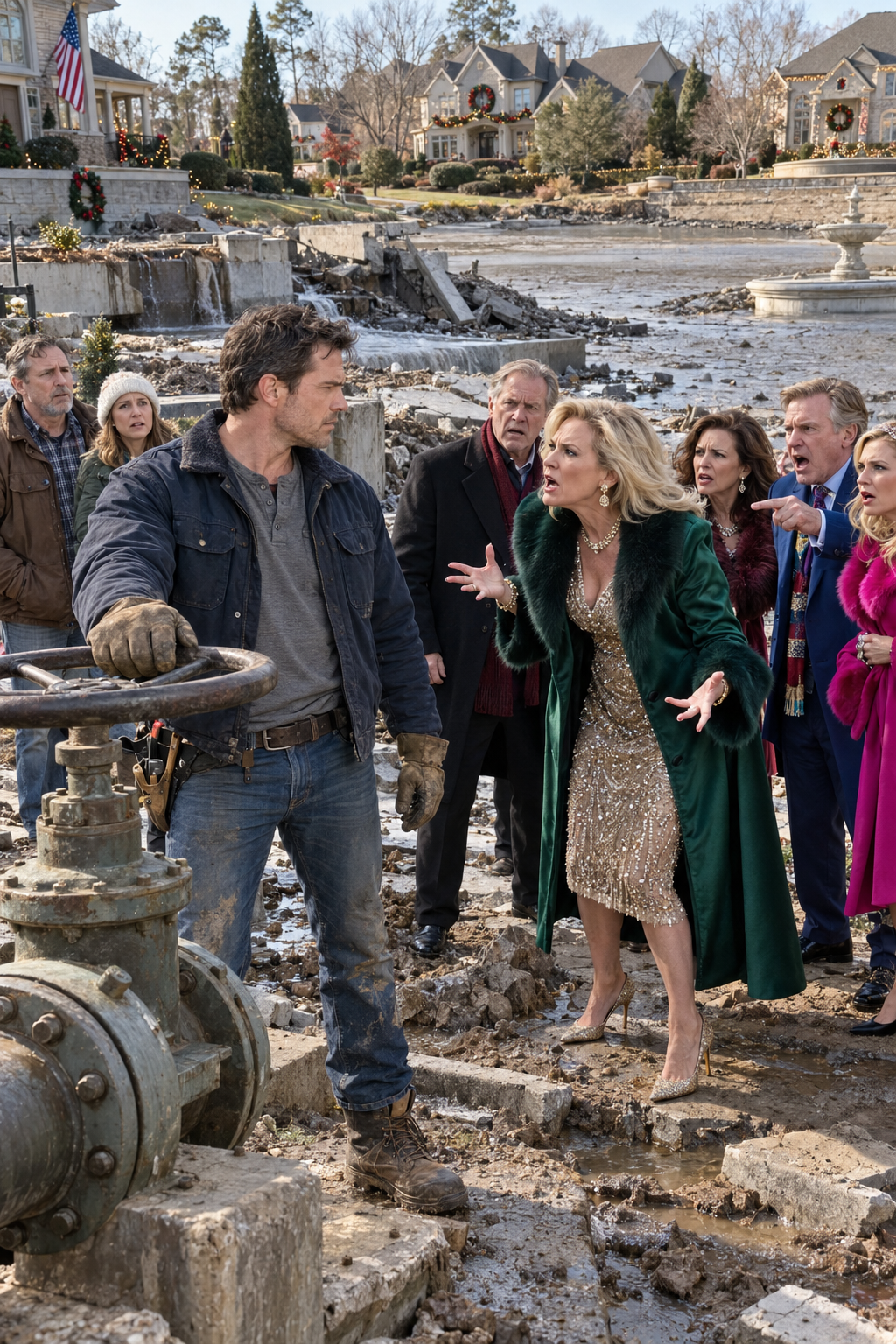
🔥HERE’S THE NEXT PART OF THE STORY, ENJOY !! The explosive twist and the final ending of this story ! ⬇️💬 Thank you ❤
Maybe me standing in front of the excavator.
Instead, I stepped aside.
“Okay?” she repeated.
“Go ahead.”
For the first time, she looked uncertain.
I turned toward my house.
Behind me, she called out.
“You’ll receive an additional invoice for demolition costs!”
I raised one hand without looking back.
“Merry Christmas, Cynthia.”
Ten minutes later, concrete began cracking.
I called my attorney from the kitchen.
His name was Mark Holloway.
He answered with Christmas music playing somewhere behind him.
“Merry Christmas.”
“Cynthia is tearing down the dam.”
“She brought excavators.”
“Tell me you’re joking.”
“Have they started?”
I looked through the window.
A section of concrete collapsed.
“They just did.”
Mark went quiet again.
Then he said something strange.
“Don’t stop them.”
“That was my thought.”
“Record everything.”
“Already am.”
“I’m calling the sheriff and county environmental office.”
Then Mark asked the important question.
“Has she figured out the water agreement?”
Another pause.
“Do not explain it to her.”
“I wasn’t planning to.”
People in Cedar Ridge called it Mercer Lake, but few residents knew the history.
When the development was approved in 1997, county planners discovered a problem.
The municipal water main stopped almost three miles away.
Connecting Cedar Ridge to the main system would have required a huge infrastructure investment.
The developer found a cheaper temporary solution.
Beneath our property sat two high-volume groundwater wells originally drilled for agricultural use.
My father agreed to let Cedar Ridge’s developer purchase bulk water from Mercer Farm.
The water was pumped to a treatment building near the eastern end of the lake, then into Cedar Ridge’s storage system.
The contract was supposed to last five years.
It lasted twenty-seven.
Because extending the municipal line kept getting more expensive, while the Mercer system worked perfectly.
Over the years, Cedar Ridge became wealthier.
Bigger homes.
A clubhouse.
A fitness center.
Three decorative fountains.
Irrigated lawns.
Nobody questioned where the water came from.
The HOA didn’t even pay me directly.
A separate utility cooperative handled billing.
But the underlying access rights still depended on an agreement attached to my property.
And there was one critical condition.
The agreement granted Cedar Ridge access to water infrastructure only while the association maintained good standing with the Mercer property owner.
Trespassing.
Intentional property destruction.
Interference with the dam.
Or unauthorized alteration of the watershed infrastructure automatically suspended the easement until the dispute was resolved.
My father had insisted on that language.
At the time, the developer probably thought it was meaningless.
Cynthia was about to discover why it wasn’t.
At , the sheriff arrived.
Deputy Ryan Cole walked down toward the lake, followed by another officer.
Cynthia intercepted him.
“Deputy, this is association business.”
Ryan looked at the excavator smashing through reinforced concrete.
“Who owns the dam?”
“The HOA has jurisdiction.”
“That wasn’t my question.”
Cynthia pointed toward my house.
“Mr. Mercer refuses to comply with legally assessed dues.”
Ryan looked at me.
“You called your attorney?”
“Already done.”
“You have the deed?”
“Kitchen table.”
Twenty minutes later, Ryan had reviewed copies of the deed, survey, easement agreement, and engineering permits.
Then he looked at Cynthia.
“Ma’am, you need to stop the work.”
Her face tightened.
“We have legal counsel.”
“Then call them.”
“Our attorney approved enforcement.”
Ryan pointed at the dam.
“Did your attorney specifically approve demolition of a privately owned water-control structure on property outside your subdivision?”
That was answer enough.
Cynthia walked away and made a phone call.
The excavators stopped.
Unfortunately for her, they had already destroyed about forty percent of the spillway.
Enough to destabilize the structure.
Water was rushing through the broken section.
The lake level had begun dropping.
At 10:12, Mark arrived.
My attorney left his family on Christmas morning and drove forty minutes because, as he later told me, “I wasn’t missing this.”
He examined the damage.
Then he looked toward Cedar Ridge.
I checked the engineering monitor connected to the pump system.
“Water level is below the emergency threshold.”
Mark nodded.
“Then follow the contract.”
I opened the utility control app.
Cynthia had no idea what I was doing.
Neither did most of the residents.
One button controlled the agricultural wells.
Another controlled the Cedar Ridge transfer system.
I selected the second.
A warning appeared.
Suspend external water transfer?
I pressed yes.
The pumps shut down.
It wasn’t revenge.
That distinction matters.
The HOA had just compromised water-control infrastructure beside an active reservoir.
The contract required external transfers to stop until engineers verified the system remained safe.
If I continued supplying water after unauthorized demolition, I could have become liable for contamination, pump damage, or pressure failures.
So at 10:16 on Christmas morning, Cedar Ridge stopped receiving water from Mercer Farm.
They didn’t notice immediately.
They had storage tanks.
For a while.
At 11:43, the first phone call came.
“You know anything about the water?”
“What about it?”
“My pressure just dropped.”
“That sounds inconvenient.”
Then he laughed.
“You shut them off?”
“I suspended the transfer after somebody demolished part of the water-control infrastructure.”
Tom started laughing harder.
“I’m coming over.”
“Bring coffee.”
At noon, I had six neighbors in my kitchen.
By twelve-thirty, there were fourteen.
None were angry with me.
They were angry with Cynthia.
Apparently she had told residents that the demolition was necessary because I had been “stealing community water.”
That didn’t survive five minutes of contact with the actual documents.
I laid the original agreement on the kitchen island.
Walter adjusted his glasses.
“This says Cedar Ridge purchases water access from your property.”
“For twenty-seven years?”
“And the HOA doesn’t own the lake?”
“The wells?”
“The treatment easement?”
Walter slowly looked toward the window.
“So what exactly do we own?”
“Some pipes.”
Nobody laughed.
At , Cynthia arrived.
She didn’t knock.
She hammered on my front door.
Mark opened it.
Her face was bright red.
Behind her stood two board members and about twenty residents.
“You shut off our water!”
Mark answered before I could.
“Mr. Mercer suspended transfer under Section Fourteen of the water-access agreement following unauthorized interference with protected infrastructure.”
Cynthia stared at him.
“Who are you?”
“His attorney.”
“I demand that the water be restored immediately.”
Mark handed her a copy of the agreement.
“Your demand has been noted.”
She ignored the paper.
“There are families in this neighborhood!”
“I’m aware.”
“Children!”
“Also aware.”
“This is Christmas!”
I stepped forward.
“That’s an interesting argument from the person who brought excavators to my property at eight in the morning.”
Her eyes locked onto mine.
“You’re punishing innocent people.”
“No, Cynthia. Your storage system still has emergency capacity. I’ve already contacted the county. Tankers are being arranged. Nobody is being denied drinking water.”
She pointed at me.
“You’re doing this because we demolished your dam.”
“I’m doing this because your demolition damaged infrastructure associated with the water system.”
“That dam has nothing to do with drinking water.”
“You sure?”
She opened her mouth.
Nothing came out.
Mark smiled slightly.
“Perhaps you should read the agreement.”
One board member, Robert Wells, finally took the document.
He read the first page.
Then the second.
By page four, his expression changed.
She ignored him.
He read further.
He held up the contract.
“Did you know about this?”
“About what?”
Robert stared at her.
“This says any intentional interference with the Mercer watershed suspends our access rights.”
“That’s old language.”
“It’s recorded with the county.”
“It can be challenged.”
“Maybe. But did you know?”
Cynthia didn’t answer.
Robert looked sick.
That was when I realized something.
Maybe not every detail.
But she knew enough.
“Cynthia,” I said, “did the HOA attorney warn you about the dam?”
Her face changed.
Tiny movement.
But Mark saw it too.
He stepped forward.
“Did counsel advise you not to proceed?”
“I don’t discuss privileged communications.”
Wrong answer.
Because Robert immediately said, “Our lawyer emailed the board last week.”
Every head turned.
Cynthia spun toward him.
“He specifically said we should not enter Mercer’s property without confirming ownership.”
“Robert, stop talking.”
He looked at the residents.
“She told us counsel had approved everything.”
Now people were shouting.
A woman near the door yelled, “You told us he owed the HOA twenty thousand dollars!”
Another called out, “You said the lake belonged to Cedar Ridge!”
Tom folded his arms.
“What else did she lie about?”
Cynthia backed toward the porch.
“This meeting is over.”
Walter said, “This isn’t a meeting.”
Then came the moment I’ll never forget.
From somewhere deeper inside Cedar Ridge, one of the decorative fountains stopped.
Another went silent.
Then another.
The neighborhood’s reserve tank had reached conservation mode.
Cynthia heard it.
So did everyone else.
For years, those fountains had run twenty-four hours a day.
Their sudden silence was louder than any argument.
By sunset, Cedar Ridge looked very different.
County emergency management had delivered potable water tanks.
Residents had plenty for drinking and basic sanitation, but irrigation systems were off.
The clubhouse pool closed.
The fountains shut down.
Outdoor spigots were disabled.
And everyone knew why.
Cynthia Vance had ordered workers to destroy infrastructure she didn’t own.
On Christmas.
Over dues I never owed.
But the story got worse.
Two days later, the HOA held an emergency meeting in the Cedar Ridge clubhouse.
I normally would never attend.
This time, I received seventy-three separate messages asking me to come.
Mark came with me.
The clubhouse ballroom was packed.
Around 190 residents filled every chair.
Others stood along the walls.
Cynthia sat behind the board table wearing a royal-blue suit, pearl necklace, and an expression suggesting she still believed this could somehow become someone else’s fault.
Robert opened the meeting.
“We have three issues tonight. Water service, damage to Mercer property, and the board president’s authorization of the demolition.”
Cynthia grabbed the microphone.
“Before we begin, I want it entered into the record that Mr. Mercer is intentionally withholding a vital public resource.”
“Can I answer that?”
The room shouted yes.
I walked to the front.
“Cedar Ridge has never had ownership rights to my wells. You have a private contractual access agreement. After the HOA damaged protected infrastructure, that agreement required suspension pending inspection.”
A man in the third row shouted, “Then inspect it!”
I nodded toward Mark.
“Engineers began yesterday.”
“How long?”
Mark answered.
“Initial assessment says four to six weeks for stabilization and regulatory approval.”
The room erupted.
Cynthia immediately seized on it.
“You see? Mr. Mercer intends to leave families without normal water service for over a month.”
I let her finish.
Then I placed a second folder on the table.
“There’s another option.”
The room quieted.
“The municipal water authority has agreed to expedite Cedar Ridge’s permanent connection to the county main.”
Robert looked hopeful.
“How fast?”
“Eight to twelve weeks.”
Groans filled the room.
“And the cost?” someone asked.
I looked at Cynthia.
“About $2.8 million.”
Cynthia slapped the table.
“Ridiculous!”
Mark remained seated.
“Less ridiculous than destroying someone else’s dam.”
Robert raised his voice.
“Quiet! Everybody quiet!”
Eventually the room settled.
That’s when a younger board member named Allison Reed stood.
“I have something.”
Cynthia’s face changed instantly.
Allison was holding printed emails.
“I searched the board archive.”
Cynthia stood.
“You didn’t have authorization.”
“I’m a board member.”
“That archive contains privileged material.”
“Not this.”
Allison walked to the projector.
A document appeared on the screen.
It was an email dated December 12.
From the HOA’s attorney.
The subject wasn’t important.
The content was.
The attorney had reviewed my deed and explicitly warned the board that the dam appeared to be located entirely on Mercer property.
He also warned that Cedar Ridge’s water agreement contained a suspension clause.
And he advised against any enforcement action until a title attorney reviewed the matter.
The room went silent.
Then Allison displayed Cynthia’s response.
It was short.
Dismissive.
She called the warning “overly cautious.”
She said delaying enforcement would make the board “look weak.”
And she concluded with a line that probably ended her HOA career.
“Once the structure is gone, Mercer will have no leverage.”
Tom was sitting near the back.
He laughed once.
A sharp, disbelieving sound.
“Oh, she knew.”
Then everyone started talking at once.
Cynthia reached for the microphone.
“This has been taken out of context.”
Robert stood.
“What context makes this better?”
“I was protecting property values.”
“You were warned!”
“I acted based on my authority as president.”
“You don’t have authority over his property!”
Cynthia pointed at me.
“He has manipulated this community for years by controlling the water!”
That actually made me angry.
Not visibly.
But enough.
I walked to the microphone.
“My family didn’t manipulate Cedar Ridge.”
The room quieted.
“When your developer couldn’t afford the municipal connection, my father helped him.”
I looked around the room.
“He gave this neighborhood twenty-seven years of reliable water access at rates below what the county charges today.”
I pointed toward the lake.
“My family maintained the wells. We maintained the spillway. We maintained the watershed. We paid the taxes. We paid the insurance.”
Then I looked at Cynthia.
“You didn’t build it.”
“You didn’t buy it.”
“You didn’t maintain it.”
“You didn’t own it.”
“And on Christmas morning, you destroyed part of it because I refused to pay fees to an organization I never joined.”
Nobody interrupted me.
I continued.
“I don’t want your homes without water. I never did.”
I tapped the agreement.
“But I will not accept a system where you can trespass on my property, destroy what my grandfather built, then demand that I keep supplying you as if nothing happened.”
I stepped back.
For several seconds, nobody spoke.
Then Walter stood.
“I move to remove Cynthia Vance as HOA president.”
Someone immediately yelled, “Second.”
Cynthia went pale.
“You can’t do that.”
Robert looked at the bylaws.
“Yes, we can.”
The vote wasn’t close.
One hundred sixty-eight supported removal.
Eleven opposed.
The rest abstained.
Cynthia Vance ceased being president of Cedar Ridge Estates at that evening.
But we weren’t finished.
The engineering report came back three weeks later.
The dam could be repaired.
Estimated cost:
Additional shoreline restoration:
Environmental remediation:
Temporary water costs for Cedar Ridge:
nearly $140,000.
Legal fees were still climbing.
The HOA’s insurance company initially refused coverage because Cynthia had authorized demolition after receiving written legal advice not to do it.
That meant Cedar Ridge faced the possibility of a massive special assessment.
Nobody wanted that.
Including me.
I could have sued the HOA for everything.
Mark believed we had an excellent case.
But most Cedar Ridge residents hadn’t done anything to me.
Some had actually tried to stop Cynthia.
So I proposed a settlement.
The HOA would pay the insured portion of the dam repair.
Cynthia would be personally named in the property-damage lawsuit.
Cedar Ridge would permanently remove every claim that my property was subject to HOA authority.
The old walking-trail easement would be renegotiated.
And the neighborhood would begin transitioning to municipal water so nobody could ever weaponize my family’s wells—or depend on them indefinitely—again.
In exchange, once engineers declared the system safe, I would restore temporary water access during the transition.
Robert stared at me when I presented the terms.
“That’s it?”
“That’s it.”
“You’re not demanding punitive damages from the residents?”
He leaned back.
“You could.”
I looked through his office window toward the houses.
“Because Cynthia made the decision. Two hundred families shouldn’t lose thousands of dollars each because one person needed to feel powerful.”
Robert extended his hand.
Cynthia did not accept her part quite so easily.
She hired her own attorney.
She claimed the HOA had authorized everything.
The former board members disagreed.
The emails disagreed.
The video from Christmas morning disagreed.
And the excavation company provided a signed authorization bearing Cynthia’s signature.
Eventually, her attorney suggested settlement.
She paid a substantial amount toward repairs.
She resigned from the board permanently.
And six months later, she sold her house.
The new owners were a young couple from Tennessee.
They brought me homemade peach pie when they moved in.
I liked them immediately.
By February, the repaired dam was curing.
By March, Mercer Lake had begun filling again.
By April, the walking trail reopened under a new agreement that made ownership boundaries painfully clear.
Signs weren’t even necessary.
Everybody knew.
That spring, Cedar Ridge voted to approve the municipal-water connection.
The project was expensive.
But this time, the residents understood exactly what they were buying.
Independence.
By the following Christmas, everything had changed.
My sister brought her family over again.
Her kids ran across the backyard toward the lake.
The dam stood exactly where my grandfather had built the original fifty-three years earlier, although the new spillway was stronger and wider.
Across the water, Cedar Ridge’s Christmas lights reflected against the surface.
And at five in the afternoon, something unexpected happened.
There was a knock at my door.
Walter, Robert, Tom, and about a dozen other neighbors were standing outside.
Walter handed me a wooden box.
Inside was a small brass plaque.
I read it and laughed.
Tom grinned.
“We thought about putting it near the dam.”
“Absolutely not.”
“Because after everything that happened, the last thing I need is the HOA installing something on my property.”
Everyone burst out laughing.
So the plaque stayed in my kitchen.
Cedar Ridge finished connecting to municipal water the following spring.
My wells returned to agricultural use.
The lake remained private.
The dam remained mine.
And nobody ever sent me another invoice for HOA dues.
Sometimes people ask whether I regret shutting off Cedar Ridge’s water access that Christmas.
The answer is no.
Because I didn’t shut it off to punish them.
I shut it off because someone had damaged a system she didn’t understand.
Cynthia believed owning the title of HOA president gave her authority.
She believed a board vote could turn private land into community property.
She believed enough warning letters could transform a lie into a legal obligation.
Most of all, she believed destroying my dam would eliminate my leverage.
She was wrong about all four.
The strangest thing was that none of this needed to happen.
If she had simply left my property alone, the water would have kept flowing.
The dam would have remained intact.
Cedar Ridge would have celebrated Christmas exactly as it had every year before.
Instead, Cynthia sent excavators onto land she didn’t own to collect dues I didn’t owe.
She tore down a dam built by my grandfather.
She ignored her own attorney.
She jeopardized the neighborhood’s water supply.
And she lost her position, her reputation, and eventually her home.
All because she wanted to prove that the HOA controlled me.
It never had.
And on that cold Christmas morning, while the excavator was smashing through concrete and Cynthia stood there smiling like she had finally won, she never bothered asking one simple question.
Where does Cedar Ridge’s water actually come from?
By the time she learned the answer, the pumps were already off.
And for the first time in twenty-seven years, the water stopped flowing.
✓ Lynn R. Adams
🔥HERE’S THE NEXT PART OF THE STORY, ENJOY !! The explosive twist and the final ending of this story ! ⬇️💬 Thank you ❤ Maybe me standing in front of the excavator. Instead, I stepped aside. “Okay?…